The Pagan Sacrifice going on around us

The truth and dignity of mankind are held up by the church. Freedom is the gift that God gives to us, which makes us the image of God and which cannot be surrendered. Together the worshiping and lamenting church asks whether the body of this country, Britain, is being broken and scattered, or gathered, restored, and renewed. In its songs and prayers, it asks whether any community represented in these markets is being built up here or demolished.

These businesses are the cultic shrines of the gods of this world. They feed on mankind, and for them mankind is continually hauled onto the altar, carved open and splayed. He is divided: half is acceptable, half declared repellent and discarded. The gods demand it, and their spokesmen insist on it. Always a new fraction of him is revealed as morally too hideous to be permitted: his inadequacy and depravity is surely holding our society back. Man is divided again and again, from work, friends, and colleagues, from his body, from wife, from children, from parents, from his culture, from the last generation and the next, and from the traditions that give him his identity and self-worth. The regime continually invents new ways of dividing him, determining which of his aspects are threatening to them and turning public opinion against them. Everyone must show that they are appalled by this newly revealed vileness and agree that we urgently need to rid ourselves of him. Everyone watches their neighbor to check that they are on the right side. The everyday functioning of media, markets, and the economy are a pagan sacrifice. Their whole message s that for the sake of economic growth, for the sake of the gods of this world, mankind must be sacrificed and, at ever-decreasing intervals, sacrificed again.

This pagan sacrifice must be unmasked by the church. It must travel through societies fallen prey to cults, paralyzed by fear, convulsed by rage, vandalizing their culture and losing their mind. Our pilgrimage through these societies will be a way of the cross for us. As we bear it and suffer it, we will realize that many Christians in other generations have borne the cross through these streets before us. Their witness called those societies back to sanity and prevented the worst of their violence. Those saints gave their witness for us and were sometimes broken for us. At intervals on our procession, we arrive at a church or Christian foundation. We can celebrate in those places in which Christians in previous generations have reconciled their society and been instrumental in its healing. They are the wells along our route at which we can be glad about signs of the arrival of new reconciliation and wholeness in our society.

Worship and Eucharist chapter 4

Catechism 6/6 Faith, hope, secularity

Faith, Hope and Secularity

6.1 The Gospel gives us secularity

The blessing of God calls us to service. God gives us the office of servant. Our vocation is to promote all the creatures of God and hold out to them the freedom, the responsibility and the universality that belong to high status of man. It is this call to serve, which has motivated the West by giving us a vocation to minister and serve, and so work for whoever we encounter including lower than ourselves, and thus follow our Lord down the long course towards maturity and self-mastery.

Christian public worship forms the habits of public speech. Through it we may learn how to say no, and so resist the more hysterical demands of the current regime. Without public discussion and some reference to the customs, common law and sources of our culture, and thus some reference to the gospel, no one can tell us what to think. No one can shut us up. No one can restrict our freedom of movement. It is right that we resist proliferating regulation, confiscation and arbitrary arrest. There is not one law for the rich and one for us. We insist that there is just one law, the same law for all. At bottom that law is grounded by the law of God. With this basic understanding that we must refer to our conscience, judge for ourselves and resist the unlawful exercise of state power, Christians uphold the secularity of the public square.

We are confident that we can persuade and convince one another, trust one another and trade with one another, and when relationships fail, we can restore them through reconciliation. It is only this confidence that sustains a functioning economy in which people can make new discoveries, take initiatives, create enterprises and employ people. No one can confiscate what we have worked for, so you can provide for your own nearest and dearest. Universal confiscation means universal demotivation: no one will work, for no one will bother. 

In this Christian conception, our economy as an aspect of our shared, more or less self-regulating public square. We are not dependents of the government. Government is not required to be the universal mediator. Those who govern us are public servants, who are accountable to us. We are not children, or wards of court, and the government is not our parent or probation officer. Until recently this political culture of consent, and self-regulation has been so dominant that for many it has seemed natural, remained unchallenged, and gave us the years of economic growth. Now it is clear that this secular public square only for as long as there is deliberate public effort to cherish what is good and to defend it from envious and angry people who would like to see it destroyed.

Western modern secular culture is good. It values individual responsibility and individual freedom, and for this reason we say that it is superior to all rival cultures. It takes everybody seriously, and encourages us to consider everyone as a free moral agent, not as a child, or a servant, or an animal, not as an unclean, untouchable non-person. This dignity is inalienable, even despite great evil, it cannot be utterly lost. It says that everybody is a person and nobody is a non-person.

It is Christianity that creates secularity. Only Christianity insists that there is a free and open public space in which all political and pragmatic issues can be examined. Christianity says this because it insists that each person is a public agent with their own critical faculties. It insists on individual conscience, which means that each person can judge, for themselves. Each of us can judge where authority really lies; we can decide for ourselves the truth of the rhetoric of the corporations and institutions and the claims of the current regime. Our ability to judge improves as we undergo the long apprenticeship of Christian discipleship. 

Christianity teaches that there is freedom of speech, and it is the public practice of free speech. On behalf of the powerless we make our petitions to the powerful, and we appeal over the heads of powerful to God. Every Sunday in full sight of the political nation we meet and declare that God is the true authority, and the sole source of political authority. We not only say this but we sing it, in unison. All of us, the great and the small, sing it in harmony, so that this single message is given by the united Christian community to the political nation. We tell them that the powerful are accountable to God and to all men, and that they must humble themselves and serve the nation, and thus that there may be no tyrants and no totalitarianism.

Christianity has created the independent legitimacy of authority and of law. Each of us, and all of us together, regardless of God religion and religious authorities are free agents. We make our public and political contribution on whatever grounds we wish, and we offer our justification of our belief and action to our community. Religious authorities have no authority over those outside that particular religion. There is clear space between everyday civil life and religious membership and belief. This doctrine about the legitimacy of the secular sphere, and all the practices of publicly giving an account that justifies our political decisions, is entirely dependent on the teaching of Christianity. Christianity is ‘faith’, that is believed, freely and voluntarily. Christianity is intrinsically anti-totalitarian. It repudiates all autocracy and theocracy. In the Christian tradition, to say ‘God told me to take this decision for you all’ is never an adequate response. You have to give reasons that appeal to that society’s shared understanding of public good, and so find pragmatic ground that you share with people who do not share your faith.

Other religions are not ‘faiths’ in the sense that Christianity is ‘faith’. They are complete packages, comprised of cult, worldview, legal system and morality. They deny any free space in which, on the territory they control, people can stand outside and independently assess them, on shared pragmatic, non-religious, grounds of a common good. There is no secularity, no separation of religion from politics in any other rival cult. Criticisms of Christianity are made from entirely Christian-derived moral standpoints and presumptions. The haters of Christianity may never know how Christian their challenges are; the fury they direct to Christianity perhaps expresses their own intuition that they are unable to escape the deep logic that Christian culture has revealed, for it is the gravity that holds us all. There will be public discovery of truth, and an anticipation of this true judgment occurs in every event of public worship.  

The Church is the assembly that states publicly stating that the powerful answer to God and answer to us. The powerful are not above us, are not unaccountable, and so do not hold the authority they claim. The Church declares that the authority of powerful is given to them by God, but it remains God’s authority. They serve us and must respond to us. In Christian worship we intercede for them and so remind them that they are our servants. Simply by doing this, publicly and weekly over many hundreds of years an accumulation of expectations has built up to become this culture that we now refer as ‘secular’.

Christianity creates secularity. The practices of self-examination, judgment and reconciliation create the public square in which many voices can be heard and in which challenges are made. Christianity is the practice of affirming the dignity of all, of talking back to the powerful, and of listening to and repeating the words of the otherwise voiceless. Christianity is the set of practices that create civility. It is that creates tolerance, and gives us our ability to be patient with people who disagree and even with those who have no patience for others, for the arrogant and those in a hurry to impose their way. It is the means by which we endure the arrogant, to a degree. Christianity is the practice of allowing the slow publicly examination and processes of the law and administration of justice to take place. Christianity is civilisation.

But our political class decided that secularity comes from rejection of Christianity. This is the big mistake that has resulted in the creation of the monster state and the loss of all our liberties. The monster state is the god of the present age. Its liturgy announces that it is secular, which means that it originates in itself (which is of course meaningless, since nothing is source of itself) and so does not originate with God. The liturgy of the present age and current regime is just a flow of rhetoric. It refuses to give an account of itself so it offers no credo. A creed is a statement of what everybody does not believe, what is not accepted and understood to be too obvious to need saying, so it a refutation of the received wisdom. It sets out the grounds on which we refuse the rhetoric of the powerful, and challenge the refusal of the powerful to justify their power. Their rhetoric declares that everything is agreed, that this agreement is a given of nature, that only morally inferior people would question. Whether or not their claim is made explicit, it rules out the possibility of questioning and challenging, which makes it impossible to see that our interests are not the same as those of the political class, that their interests are to control us and prevent us from seeing that this is what they are doing. Our claims, recited publicly in our worship, reveal that their claims are not made public, but are kept in concealment, for this is what their power rests on. 

Christianity is a complete departure from the closed cycle paganism that once gripped the continent of Europe. It has initiated a course of cultural development powered by the continuous participation in the liturgy in which man is exalted as the creature of the God of Israel, from which all forms of manliness and sociality and social mobility have follow. Generation of elites have attempted to get the lid back on, and resume control and recently seem to have got upper hand and at last achieved the re-paganism and paralysis of Europe

Christianity is all that keeps a society open and fluid. Input from the Christian community prevents the build-up of resentment that might overflow into violence. By insisting on the possibility of reconciliation Christians voices reduce tensions and allow the boil to be lanced. Christians name the pressures which cause such tensions and helps to make them seem less threatening and unmanageable. Christianity encourages a slow and gentle social mobility. People can be moved out of a public position without suffering public shame. The impulse to take revenge is weakened by Christianity. It promotes the consensus that truth is supreme, and that free speech and public challenge lead to agreement about the terms of a change of personnel and policy. Those who are replaced do not usually start threatening journalists and juries or resort to revenge.

Challenge and Confrontation are inevitable, and so is unpopularity. If you take the risk of adopting the gospel as your working theory, you will attract hostility. People will take offence at you, in ways which you regard as insignificant and mistaken, but they do so with such seriousness and umbrage that it becomes clear that something deeper is going on. A great deal of our society, and of our own individual selves, is built on envy, deception, hatred and the desire to control. Humanity and civility are thin and brittle. Under the surface there is rage and venom. A great deal is at stake. Their power over you is what at stake for them. They have convinced themselves that their identify depends on putting you in your place. They can only operate on the basis of their superiority and your inferiority. They are the enforcers of a new class society, which will grow to become a special of castes separated by function and status in a steep hierarchy, in which most of us will be drones which they can move in and out of economic activity in their service. This is the pagan society. Paganism is extreme violence. It works on the basis of an upper class keeping lower class powerless, spell-bound by the constant theatrical performance of media and social media. 

6.2 The Gospel and its rivals

Modernity as heresy, fake gospel, and the return of paganism

Our political class gospel has long believed that Christianity is essentially about equality. Equality is the kernel, and it is their job to remove the husk to reveal man this kernel. But though equality is a fundamental, it cannot be removed from Christianity, for no part of the gospel is husk, and no part is dispensable.

The gospel is the message that cannot be separated from the voice pronouncing it. The gospel is the voice of a person speaking to us, and in expectation that we respond and reply. This voice is relayed by the church which it creates and which is a manifestation of it. All the sounds of creation are over-tones of this voice. All creatures are the resonance of God speaking to us and enabling us to speak back, to him and to one another. The communication of creation is largely encrypted and concealed from us until amid this cacophony we hear the single voice of Christ addressing us.

The gospel is Christ himself. He is it. It is him. This message is this person. The gospel is information about Christ only while Christ makes himself present and available to us. He is the data that he gathers and shows us. He shows it only to those who are ready to consider it; to those who are not ready, no data is available. The gospel is about truth which we can examine and freely accept or reject, because this truth is this person, and this person offers make himself present while offering his account of himself. The truth cannot be separated from this person who introduces himself to us, and who can accept or reject us. He is as free in this encounter as we are, for he is as much a person as we are. He is not simply a set of information or an inert object which we can stand in judgment over without ourselves being judged. We may consider him as he is able to consider us. We may approach him or take leave of him as he can approach us or leave us. He makes himself available to us, but equally he can turn and vanish, and we are unable to recall him and make him appear. He can be appealed to, but he cannot be commanded. The person and the information about him are indivisible.

But this does not suit those who do not seek Christ. They want to create a gap between Christ and information about Christ so that, by mediating this information, to them they can make themselves indispensable to others. They want to gather obedient servants. They want mastery but have no wish for self-mastery. They don't want to submit themselves to any apprenticeship in the self-mastery of Christ. They don't want to be servants of the one true master. They want to build their own empire so seek power from some other source. They want to rule, but all the while their passions rule them, and their envy and resentment, their fear and their fury are their god. They want glory, but manage only self-deception. They inflict damage on the gullible, and misery on themselves.  

As long as they can say that Christianity is essentially about equality, or about anything else, some self-appointed elite is in charge. When the person, whose voice the gospel is, is set aside as the husk to reveal some abstraction – such as equality – as its kernel, the political class is in business. This division of the indivisible gospel into kernel and husk, inner truth and outer disposable wrapping gives them the status they crave. The self-promoters are in power. They have a job to do, which is to advance that equality. Everyone is equal, except they themselves who must impose this equality from above, an endless task, that requires ever-greater powers, making increasing demands on us and devising new tests for our compliance. They must advance their goal by promoting their authority, so that all public discourse becomes about them, this priesthood that raises itself beyond accountability. The pursuit of equality serves the narcissism of a ruling class that we should have capitulated to. They promote their agenda as though they required our consent yet impose it on us who withhold that consent. They know that we know it is nothing more than a disguise for their own power over us. This generality, this message about some non-personal and anti-personal concept – equality – is the vehicle for their endless self-promotion and our subjugation. Then the advocates of equality, the clergy of this cult and enforcers of the current political agenda, are caught within the trap of their own construction. We see this paradox and contradiction: they promote themselves into first class and demote us to second class in order to be rid of this very distinction of class. The political class itself is the evidence that denies what it propounds. Its very existence is refutation of the message which is its sole justification. The superiority that their message of equality gives them is proof that message is invalid because it represents a contradiction and is therefore untrue. The tension they feel but cannot express is what enrages them, and motivates them to take out their fury on us. They have spiked themselves on this hook, yet we must be punished for it. They are trampling on us because they are wrecking themselves by the pride that prevents them from confessing what they have done. They are deceived, but no one has deceived them: they have done this to themselves.

They take what is living, the person within whom and from whom life grows, and break this life up into generalities or abstractions. They turn what is living into what is dead. They then force what is living into the confines of what is lifeless. They attempt to cram life into some dead husk, so that they may give themselves the task of seeming to make it alive again. That is their trick and their performance, by which they make themselves the living master animating the dead object. They are faking life.

‘Christianity’ is simply Jesus Christ, the person who has given us this as his name. He is living, and what is alive, is so because he gives it the life that is solely his to give. He is himself and not part of any generality. He introduces himself and makes himself known; if he did not, we would have no knowledge of him at all. He is not part of a larger phenomenon. No generality takes us any distance towards him. He is through and through the person he is. He is sheer life, and no lifeless or finite husk can communicate him to us. At no point is he anything less than this person, this particular identity he reveals to us, and which he continues to extend to us and by which we have life of our own. He is all life. We can capture nothing of him with any lifeless tool of our own. Without him, we cannot grasp him or gain any knowledge of him. Without him, we have no continuing, living knowledge of one another or of ourselves. Our life comes to us from him, and so our knowledge of one another, and even of ourselves comes to us, from him. We can know ourselves truly only as he gives life to us and as he reveals to us simultaneously himself and ourselves, the two of us together. 

The West is the product of Christianity. It is the accumulation of habits and attitudes of those nations which, over many centuries, have been immersed in the gospel. Christianity is the house that Christ built. It is the house, considered apart from Christ, as though Christ were absent from it. Though the inheritors of the West, the moderns may say that Christ has been removed from it, and is now even barred from it, and insist that the house remains the same without him, or is even much improved without him, yet it is still the house that Christ built. It is the covenant that he extended to us. It is the edifice he raised in order that we should be protected from the savagery of the forces that would otherwise rage against us. 

But Christ is not absent, and certainly cannot be pushed out, from the place he built for us. Within this household he keeps himself inconspicuous, passes unnoticed by us, giving it the maintenance that keeps this house serviceable. Though we wreck it, he restores it and so the building survives. This house is the work of generations who heard that gospel and passed it on, and who learned a civility, that made it possible for us to live together in large societies. Over centuries we developed a division of labour and long supply chains that have united the world into something like a single household, in which the wants of multitudes are met by the minimal efforts of multitudes, working in ways that harmonise, to satisfy the needs of those multitudes and keep them content.

Whatever the West has learned about humanity and civilisation is Christian. It was the gospel that brought into being this civility and humanity. But they are a dead-end if we imagine that they will continue without Christ. Christ only appears to be absent to us, who snatch and grasp, because he willingly cedes place to us. He allows us a place in which we can be without him, a secular sphere. The truth is that this place does not exist without him for it is the product of his work and his patience. There is no place without him, but only places in which he has made himself imperceptible, a servant so anonymous as to be unnoticeable. The source of this orientation to a shared humanity of the West is simply is the Christian gospel. And since the West is nothing but this hope of becoming civil and humane, we can say that the origin of the West is the gospel. Western culture is Christian culture. Christianity creates the modern world. It not only created once, but it creates and recreates it now, and when its public contribution is denied and prevented, the world stops being modern and crumbles away into something else. That something is not a culture, because it is not able to promote growth, but is merely a rubble made up of fragments alternately adopted and discarded in an attempt without logic or coherence to validate the ongoing deracination and dispossession and so justify the power of the powerful and the powerlessness of the disempowered. 

There is a modern cult, but there is no modern culture. Left to itself, and considered in isolation from its source in Christianity, modernity is no culture, but a force of compulsion. Liberalism without the culture, practices and virtues of self-restraint does not stay liberal. It is not a course of persuasion, which either does or does not persuade you, which you may or may not find convincing for yourself. It is not aimed to gain your conviction and consent, but only to enforce your conformity. It wants homogeneity. It wants to extract you from the culture that formed you and from the relationships that give you your identity. It wants to put you, your relationships and culture through the blender, to produce a homogenous human existence, with no one standing outside it to judge it on criteria extrinsic to it. Modernity is the demolition of culture. Whatever this anti-culture encounters, it dissolves.

The gospel offers a set of guides and limits that may enable you to grow, and over the long term may enable a society to grow, from childhood to adulthood, from dependence to independence, from helplessness to self-reliance and self-mastery. Christianity is therefore an account of the possibility of human growth. It is a culture because it cultivates; by it we may become cultivated, educated, self-controlled, civil and liberal. There can be no modern culture. Whatever is modern is a derived from Christianity, and is a deviation and ultimately a departure from it. Modernity cannot prevent itself from disintegrating into the struggle for power by irreconcilable groups, until there is only childishness, rage and savagery.

You were born into this political culture. Though you may not be aware of its source in Christianity, it is still your mindset. Though you may disown that culture and despise Christianity, you have no other language in which you can even describe what you hate. Above all things you want to leave this Christ-derived culture behind, but you are unable to do so because it alone manifests that logic which allows you to think. This is the world you were given. You cannot live, think or speak except in the world given to you.  The more you reject, the more you find that you are surrounded by the deepest imperatives that this Christ-derived culture has set you. It has given you this will, and your will is directed to the good; the more you attempt to destroy this orientation towards what is good, and do what is evil, the more clearly the good remains out of your reach, untouchable and indestructible.

Modernity is of course an attempt to take control of Christ without allowing him to take control of you. It is an attempt to make a relationship that is unilateral, in which we take what we want, and discard what we don’t. We refuse to allow ourselves to be formed and matured through this relationship. We do not acknowledge that he has the maturity and independence that we desire, and that we may receive it from him, and hold on to it only through continued relationship with him. It is the claim that we are already mature and immutable, that we are already gods. It is to reverse and falsify the relationship, which really depends on the authority and generosity of Christ.

Without the gospel, people beg to have their responsibility taken from them so they can remain children. They demand that their rulers provide everything for them, make their choices for them and become authoritarians. This is the paradox of modernity. The upslope of modernity is all about individual aspiration and striving towards freedom; the plateau is all about the enjoyment of freedom through the amplification of choice, with smugness standing in for virtue, and the patronising of whichever groups you identify as not yet enjoying the same freedom as yourself; the downslope, however, is all about committing governments to the project of first of replacing cultural freedom with a small set of individual moral freedoms, and it is the surrender of (basic, constitutional) freedom in order to secure (peripheral, cultural) freedom and then being overwhelmed by the vista of cultural freedoms receding away from you, then despair and then the rush to oblivion. 

The Church came first. Then came the nation under one law, then the government. The state emerges out of the public life and service empowered by Christian discipleship. It is Christian discipleship that makes us willing to participate in this service that is public, our readiness to acknowledge one law and to submit to the obligations and penalties of that law. We have willingly taken these conventions to be ours and we acknowledge that we members of this nation, that is, we acknowledge that these people are our equals and our fellows and that we do not wish to live without them or apart from them, that they are our neighbours. We consent to this, and only thus as implication, to the government that upholds the law that protects the culture shared within this nation, and so to the state. We commit ourselves to this nation, and thus to its self-government, in freedom. This freedom and this consent are possible because we are witnesses of the gospel. First comes the gospel, the discipleship and community of witness, the Church, that bears it to the nation, and then comes the public service, that create government and a state.  The gospel raised us up out of coercion, compulsion, and vendetta, into freedom, in which we give our consent to one another and so become members of a nation.

Christianity makes culture. It cultivates people who aspire to be masters of themselves, who are able to live from, and be content with, what they produce for themselves. Christianity made us a cultivated people, formed by the discipleship that evolved into a culture over so many hundreds of years. Our culture and our high view of one another and the law that protects them, have given us an economic development, a standard of living and technology far beyond what our ancestors knew. It is the culture that has generated this economic development, and this technology and standard of living. But that economic development and standard of living are not stable. They depend for their continuation on the culture that generates them. That culture is not stable. It depends on the discipleship that generates that aspiration to self-mastery that arrives with the gospel. Our culture is nothing but Christianity. That culture continues when it allows itself to be refreshed by the public speech of Christian worship, and it dwindles and hollows out when it does not. Our development and a standard of living are products of Christianity. Without the public witness of the Christian community, this culture of human dignity, and this aspiration and achievement that it has empowered disappears. When that witness is given, though the standard of living, the technology and economic development may disappear, the aspiration does not. As long as we welcome the gospel, the hope and dignity remain.  

6.3 Christian worship and witness

Christian worship is public proclamation of the truth about power. In their public worship the Christian community challenges those who make excessive claims to power. 

The fundamental act that establishes human freedom, and with this freedom, establishes humanity, is that we defy the powerful. We do this by declaring that the powerful are responsible and accountable, to us and to all, and that they are answerable to God just as we are. No one is morally above us or out of our reach. Every power-holder must hear the appeal we make and heed the warning we give. We insist that there is truth and justice, and there are long-developed codes which enable us to say what is good and just. These codes are given to us in Christian teaching and in the culture, morality and law that that have developed through each nation’s reception of that Christian teaching. The fundamental act that establishes our freedom is the gathering and worshipping of the Christian community created by this revelation and formed by this teaching. This community is making a public stand. It demonstrates and manifests what is true, good and right.

The Church states the limits of the claims of the powerful to determine what is true. When it fails to convince them of these limits, the powerful place themselves above what is true, so the truth is no more than whatever they state, and there are no other authority or criteria for discovering what is true. But more than that, the Christian assembly not only state what is true, but they manifest and demonstrate it in their own gathering, which is always a reconciliation and integration of what was previously fragmented and partial. As former antagonists are brought face-to-face, and as they remain publicly together in peace, they are an enactment and the embodiment of that reconciliation and truth. The proximity to one another in which they stand itself indicates the depth of this reconciliation, and the truth of the claims they make. Moreover, they not only say what is true, that God reconciles all opposites, but they say it together, so one voice does not dominate while the many are silent, but all voices are heard. Moreover, they do not merely say this, but they sing it, and so they harmonise, each adjusting their words and tone to blend in with and so complement the singing of the others, to amplify and affirm what their leaders say and sing, and so their voices together represent the harmonisation of creation, the arrival of order and transformation from disorder.   

Christian worship is the public chanting of the truth that no elite is absolute or untouchable. Every leadership is answerable to God. It can be challenged, dethroned and replaced. The least significant members of any society can combine to proclaim this truth in public, and so warn their leaders of the limits of their authority. Our leaders are on sufferance. God is the ultimate authority: all other authorities are mandated to serve the common good. They are given authority only in order to subordinate themselves to our well-being. Authority comes through service, and is lost when that service is withheld. We tell them that have no authority to serve themselves or to weaken us by their endless confiscations and predation. This is why elites hate the gospel. The hatred that motivates them becomes central to the education promulgated by the educational institutions when they are taken over by the state, until it becomes the universal worldview of that society. The elite teaches every grade of state employee to express contempt for the gospel until disdain for our culture becomes second nature, even to those who are most despised by that elite.  

Elites are interested in power, and pursue other goals only as they serve to increase its power. All pursuit of power without limit is pagan. It is the gospel that sets out the limits. Western conceptions of the desirability of goals other than power, such as truth, goodness and beauty, come from the gospel, and were learned through the worship and witness of the Christian community. Christians are often not well regarded by our political class. It does all that it can to belittle Christian witness and the community that proclaims it in public.

Their effective paganism can be kept within limits, and the political class can be kept honest, only by the implicit reprimand of the propositions sung in the public square by the Christian community. Christian worship is this public service of declaring the limits of power. Those who, driven by their own desires, pursue power give lip-service to the culture derived from the gospel, and take on Christian identities in order to promote one another within the hierarchy. For such people that it is the hierarchy that is the Church, and that if they hold the hierarchy, they hold the Church. But it is not so.

When Christians set out these limits, they are reviled. It is their job to continue this public witness of our weekly event of divine worship, unperturbed by opposition and marginalisation.  It is all that that elite can do to create other groups and voices that offer accounts in which the elite is unquestionable, and the Christians are not worthy of an audience, too intellectually disreputable or socially inferior to be allowed to participate in the public square.

All ideologies are imitations, and reductions, of the gospel. They invert it, so that the movement towards reconciliation and re-integration goes into reverse, and pushes us into antagonism and mutual distrust. When each of us is persuaded to identify ourselves with some minority that believes itself disadvantaged, resentments grow, and the unity of a national community is lost. Such fragmentation and sectarianism are intended to dilute and distract from the sense of obligation to one another which sustains a nation, and keeps that nation an articulate people, able to resist the excessive claims of its political class. The single public truth insisted on by that faithful Christian community says that the elite is accountable to the whole nation, that we can all be full members of it, and that no government interventions are required to sustain our public national life. The state is a function of the public service of a society. Society is prior to the state. The state with its ideology can pass away, and society will remain. No elite is absolute. All rulers will pass away. When all else has passed away, God will remain, and those who acknowledge him will remain with him.  

The elite purposefully creates and promotes other communities that offer alternative messages, perhaps with similar language, perhaps with similar religious conceptuality. They create narratives to be repeated by those believe that the elite will reward them for it. Social climbers will adopt the system that offers advancement, believing that if they are loyal to the regime, the regime will be loyal to them. Those who do not accept the Christian premise that God only promotes all men and is judge of what is true, are endlessly gullible. 

Public speech is a Christian practice. Reasoning in public is a Christian practice. Or more simply, free speech and public reasoning are what Christianity is. Public reason simply is Christianity. In all our public speech we insist that we are dealing with this or that specific person, and these persons can speak and discuss and argue and reach agreement, with us. It denies that at bottom we have to do with a something, something or other. It insists that we have to do with persons, who may be like us but are not us, and that they are as free as we are. Christianity is solely about some person, this one and that one. The guarantor of each particular person is himself a person. Christ is that person.

Christianity says that there is public speech and public reason because there is this one person who insists that we give him account of ourselves, and that we respond with our account by responding to him. This means that we acknowledge that he must be responded to, that he will not go away and leave us alone. The gospel tells us that this person appeals to us through every person we meet, such that everyone we meet represents Christ’s call to us. Everyone appears before us we meet is there as one instalment of Christ’s approach to us. Despite their own obliviousness and even resistance to this, they are all transparent to Christ, and we are transparent to him as we meet and hear and respond to them.

Christianity is simply Christ. The gospel is this person who calls us and waits for us to respond and to say who we are. As we respond, we are obliged to admit that we are positioned and identified by persons other than ourselves, and so we are identified by a tradition and history. We do not simply imagine or create the context in which we live and speak; many other persons, past, present and future, make up the historical location that gives us our identity. All these are redeemed by the prophets, apostles and witnesses that Christ sends us, who reveal him to us, and make us ready for life with him within his holy community. Jesus Christ calls us all together here to respond to one another, and to him. Without him bringing us all before one another, there are no other persons, no persons at all. All existence is simply Christ’s demand that we respond to him and them. Christ is the only existing thing. With him, there is existence. Without him, there is nothing, no existence at all. Christianity offers the hope of becoming a mature, independent person. Christianity is simply this one specific person who insists that we are all persons just as he is. He insists that we hear and respond to the summons that all other persons make to us, and that we receive every one of them as members of his body. Christ is the source and basis, underwriter and guarantor that there may be public speech, that everyone can make themselves heard, and there is public reason, in which everyone can, and must, give an account of themselves and have that account examined, tested and affirmed by all others. With all those he presents to us, we can receive his self-mastery and make it our own, so it is both his and ours. Each of us must allow all others to be our judge and to be our companions and so be content to share life with them. Christ enables us to become masters of ourselves, and so freely able to commit to and serve one another. He calls us to become, and remain, truly persons and truly human.

Catechism 5/6 The Blessings

The Sermon on the Mount – The Seven Blessings

5.1 The Blessing - The High Status of Man

The blessing of God has come to us in Jesus Christ. It tells us that our identity is secure and that it is waiting for us in Christ. The blessing protects man from all that would diminish him. It is the arming and equipping of man, so he can tell the difference between truth and falsehood, and between true authority and false, and so defend himself from evil. It is the sword of the Spirit that cuts through confusion and distinguishes truth from falsehood. 

The gospel celebrates the blessedness of the poor. As a result, its impact over many generations has been to limit the disparity of wealth. It emphatically and repeatedly celebrates the poor, and those who are disparaged and disregarded, and those who are regarded as of no account. The gospel warns the arrogant and so makes it more difficult for the wealthy to consider themselves above everyone else. It gives the poor and the uneducated the means by which to withhold their approval of the rich and withdraw their consent to their rule. There is no permanently subhuman caste in any society in which the gospel has been heard.

He has put down the mighty from their seat and has exalted the humble and meek. He hath filled the hungry with good things and the rich he hath sent empty away…

Has raised up the humble and meek.

The first shall be last, and the last shall be first.

Christianity gives a society the skill set of reconciliation, by which torn social fabric can be repaired. When that society is able to respond to each rip in the fabric by taking steps to achieve reconciliation and so to make good damage to its fabric, it will continue, and can prosper.

Reconciliation involves accusation, investigation, judgment and discovery of the truth, perhaps through a public trial. It requires an attempt to encourage confession from antagonists, involving expression of remorse and penitence. It requires discussion of penalty, criminal sentence and recompense perhaps through the payment of compensation.

These steps require a degree of public revelation, and so depend on news media. They require public consent. Though the victim may not concede this, the public has to concede that the punishment is adequate to the crime, and that justice has been done. When these steps are taken, reconciliation is achieved, damaged social capital is repaired, and confidence and trust are restored.

But when they fear that there will no justice, people begin to withdraw from public participation and stop taking risks. When they fear that their property or their lives are in danger, because government and justice system do not do enough to keep them secure, they will take fewer economic initiatives.  When there is long-term failure to implement enough of these steps to enable reconciliation, there is a long-term loss of public trust and morale. Relationships are allowed to lapse, contracts are not honoured, new contracts not made, and that society drifts towards long-term economic decline. When the environment in which people are willing to take risk is not maintained by public practices of reconciliation, that society becomes poor.   

What is the trick that makes a society prosperous? What is it that restores trust when it is broken?  What is the mechanism that repairs damaged social fabric? How can people continue to trust one another when so much social capital has been destroyed? 

There are three procedural parts to this moral faculty of reconciliation. The first is acknowledgement of continuing generosity, the second is judgment, the third is forgiveness. Grace is the gospel term for this generosity of God. This means that that reconciliation is not a mechanism or technique, but is the function of a person. It relies on Christ, the one person who, having mastered self-mastery, has the power to endure, and so will not let us down. He is indeed able to bring judgment, and forgiveness, and to supply the grace which will enable a new start. God will establish the truth, and enable a society to investigate so that the truth of any loss or crime is adequately made public, so that that society is satisfied, and the process of reconciliation can start. These processes of judgment and reconciliation are begun, but they are not made complete. What that judgment will be, and what is eventually required to bring justice and reconciliation, is not yet known. We look forward to Christ’s coming to reveal the truth and establish complete justice. But the society that is convinced that the process has begun and that it will be completed, is able to endure the present injustice, make good the losses and live in expectation.

The culture formed by the gospel assumes an unlimited supply of good will. Christ can make good what is missing and will be able to satisfy all those who have been betrayed. God is provider and guarantor of the generosity available to any society that asks for it.

To bless someone is to give them an opening. You give them the opportunity they want. You tell them what you are giving them, and you give it to them in the moment that you tell them so. You bless me when you admit me to the firm, by telling me, and all other members of your firm that I am from this moment a member of it. We say, ‘Your application has been successful. We give you the job and we look forward to sharing a successful future with you.’ You employ them, or give them pay increase, or a loan or a place to live. You give them some new responsibility and larger budget. If they take this opportunity as it is given, they may grow a step towards maturity and self-mastery. Through it they may learn how to receive and pass on the generosity that comes from God, and which enables future opportunities and greater self-mastery. God blesses us, and calls us to receive, learn, practice and pass on the blessing we have received from him and so grow to maturity.

The Sermon on the Mount, starts with seven Blessings, the Beatitudes, which are then enlarged on by the teaching that follows. So the first blessing, Blessed are the poor in spirit…love your enemies and pray for those who persecute you…’ (Matt 5.44) is amplified by You have heard it said, Love your neighbour and hate your enemy. But I tell you: Love your enemies and pray for those who persecute you…’(Matt 5.44). In the heresy of modernity this has been taken to mean we should abandon and despise your nearest and dearest, and promote over them those who seem new and exotic. But the blessings are the amplification and fulfilment of all teaching, not its abandonment. The Law of Israel tells us to pay your debts, return to them whatever they give you, respect for respect, scorn for scorn.

Some Christians have attempted taken the second line away from its basis in the first line and so altered and evacuated this elementary and foundational understanding. The Lord universalizes the law of love, so that we must return not only love for love, but also love for hate. This has meant that our post-Christian societies are unable to allow public expressions of what they hate, that is, they are unable to reject the cult and the society that opposes them and which repudiates our high account of human dignity, our citizenship and our freedom and secularity, and the open civil society. Instead, our political class directs its hatred at those who express their revulsion at the crime and the criminal, and so they hate anyone who honestly expresses the horror of evil. 

Love and truth are foundational teaching of our Christianity and society. Love of a person allows that person to be free. They are not bound to love the one who loves them. True love allows them to be themselves and so be free.

The gospel does not consider ‘belonging’ or ‘community’ as solely fundamental, and it does not consider that ‘freedom’ or ‘autonomy’ as solely fundamental either. It does not define community and freedom as opposites. It is not a flight from belonging or into it. Other people can demand that we give up freedom and individuality. 

5.2 Seven Blessings

The blessing of self-mastery is set out in seven statements. They understand that self-mastery become available to us in Christ and through an apprenticeship with him. 

Blessed are...

the poor in spirit

those who mourn

the meek

those who hunger and thirst

the merciful

the pure in heart

the peacemakers

those who are persecuted for righteousness’ sake

Blessed are the poor in spirit…    

The blessing is to be humble. To be arrogant is a curse. The humble man is open to the world, and so he can learn and he has a future. The proud and self-assertive man is closed: he has decided that he is sufficient to himself, and is unprepared to receive new challenges or experience. The humble self-deprecating man is content to take the least conspicuous role. He may be promoted, but he does not elevate himself.   

  • Blessed are those who mourn...

The man who mourns waits and remains alone, without support and is content to do so. He builds himself no political support and so appears unvindicated.

  • Blessed are the meek…

The man who is meek is modest and self-restrained. He does not try to throw off those constraints and discipline of the apprenticeship. They are not pushing a political agenda or looking for political solutions. They forgive the debts and trespasses committed against them. They do not want revenge or retribution for the robbery and aggression directed against them.

  • Blessed are those who hunger and thirst for righteousness…

The man who hungers for righteousness looks for what is right, just, fair, straight, pure and simple. He avoids whatever is bent, twisted, unclear, ambiguous or contradictory. 

  • Blessed are the merciful    

The merciful man is the generous man. Blessed are those who are generous. The generous bless those they meet and pass on to them the blessing they have received.

They have worked and saved and so have provisions to share with those who need them.

  • Blessed are the pure in heart

The man who is pure is single-minded. He is undivided and unadulterated. He does not envy anyone. He wants just one thing, which is the kingdom of God, so he is not tugged this way and that.

  • Blessed are the peace-makers   

The man who makes peace reconciles those who are at war. There is no envy, resentment or rage in him. He is not driven by desire for revenge. He can absorb the aggression of others.

One more blessing tells us what follows from these seven blessings

5.3 Persecution – the eighth blessing

Blessed are those who are persecuted for righteousness’ sake, for theirs is the kingdom of heaven …

In summary of these blessings, what are these humble, mourning, meek, justice-seeking, merciful people going to receive? 

They will receive suffering and persecution and martyrdom.     

Blessed are you when people insult you, persecute you and falsely say all kinds of evil against you because of me… in the same way they persecuted the prophets before you

As you become a Christian, you learn that you are going to be hurt. People want to transfer their hurt to you, making you carry as much pain as they can inflict on you. They do this in the belief that this will transfer their pain away from themselves so that they no longer feel it.

This realisation, that you are going to suffer for this, occurs at the moment you become a Christian, and it is this that makes you Christian. You realise that Christ has taken your pain so that you are free of it. Christ has it, so you don't. Your injuries, your fury and distress have been taken on by him. By this discovery moment you are born anew, so your baptism is the moment of this realisation.

To be a Christian is to know that you are in line to be persecuted by other people. You will be persecuted undeservedly, while knowing that all this time you have been persecuting Christ, and persecuting the people sent to you by Christ, undeservedly. You were the persecutor. You were deceived, but you were also vicious and deliberate. At the moment you realise this, you cease to be that persecutor and become one of the persecuted. Now you are in the queue for punishment by people who hate you without cause, just as you hated Christ without cause. Your tormentors are waiting for you. They are going to try to punish you, but though you may fear them, you also feel pity for them. You see that are doing terrible damage to themselves for no good reason. You may tell them that it will not help them to inflict their pain on you. Yet you also know that only you, Christ’s servant, can take their pain. Only your steadfastness could convince them that their pain is caused by their own viciousness, and convince them that Christ can help them escape this viciousness. Your endurance of their rage and your self-mastery all through this passion is the one constructive you can do. If you love them, you must remain unmoved. For their shake, you cannot not be shaken or broken by them. You must not give in to their fear, or their fury. You must remain unyielding in the face of their accusations and threats. You feel fear, of course, but you know that under this onslaught your Lord is standing just ahead of you, and taking the brunt of it, and his strength is sufficient to hold you there, just behind him. 

Christians attract the hostility of those who do not exercise self-control and do not wish to. Those who do not seek self-mastery, do not learn how to endure and be content. Those who cannot endure can only lash out at those who do. They believe only that they have a mandate to punish those who do not share their passions. They punish those who do not conform, who do not express the same rage they do, and who do not lash out as they do at whoever seems easy prey. They believe that Christians are moral delinquents: those who stick out must be brought back in line.  Those who challenge the authority of those in power must be belittled, ostracized, silenced, and have their livelihood taken away from them.  Rejoice and be glad, for great is your reward in heaven…

5.4 Seven Warnings

Blessing comes to those who are disciples of the Lord, who take up the discipline and discipleship and follow him. Their happiness is in that apprenticeship in the self-mastery of Christ.

But there is no blessing for who only want to express their present tantrum, who want to avoid the persecution that could teach us to endure and so gain mastery over ourselves. The cult of modernity we pursue autonomy by imposing our mastery on other people, express our resentment, find scapegoats and inflict our rage on them. It widens the gulf between those who freely take up service and apparent powerlessness and find their contentment in that service, and those who want to evade that service, hold on to power, and exert their power to increase their autonomy.

In the Gospel of Matthew Jesus reinforces the blessings by contrasting them with seven warnings, traditionally called ‘curses.’ The seven blessings, now expressed as seven warnings, call us away from the narcissism given expression by the cult of modernity. They hope to turn us from arrogance to humility, from superiority to humility, from violence to peace.

They are exclamations of pity for those who reject these blessings, each woe describing the unhappiness that would result from this rejection.  These are the curses that the leaders of our society want to inflict on us, but will only succeed in inflicting on themselves. Only misery can come from rejecting the blessing of God. The warnings mirror the blessings

  1. Those who are not humble and poor in spirit exalt themselves.
  2. Those who are not content to lament and mourn now, build little kingdoms for themselves.
  3. Those who are not meek and self-controlled, imagine that they are the source of their own power and authority
  4. Those who do not hunger and thirst for righteousness, neglect justice, mercy, and faithfulness
  5. Those who are not merciful and generous are full of greed and self-indulgence
  6. Those who are not pure in heart are full of hypocrisy and wickedness
  7. Those who do not bring peace, are violent in the same way as those who killed the prophets. They suppress the witnesses God sends and are prepared to be violent against us.Woe to you...  who exalt yourself

You shut the kingdom of heaven in man’s faces. You do not go in and you stop other people from going in. (Matt 23.12-13)

You assert yourself, and have no wish to learn humility. You promote yourself over those around you. You climb over them and tread on as you go. You shut the kingdom in men’s faces: you don't enter that kingdom and you won’t let them do so either.

But it is the humble who are blessed, for Blessed are the poor in spirit.  For whoever exalts himself will be humbled. Whoever humbles himself will be exalted…

  • Woe to you… who when you make a convert make him twice as much a son of hell as you are…

You seek supporters and make converts to your cause. You demand that they obey you and call you master. You have a reputation to build. You want glory and renown. You grow your power by rent-seeking and confiscation. You tie up heavy loads to put them on other men’s shoulders (Matt 23.4).Woe to those who convince others to do the same, climbing over others, and keeping them out of the kingdom. 

You encourage your converts to become more extreme and destructive than yourself. Each generation becomes more uninhibitedly power-seeking, departs further from the sources, resorts to more extreme self-invention, and is less willing to acknowledge any limit to their power.

But blessed are those who mourn. Blessed is the man who seeks no glory for himself. He is on his own, and has to be content to remain alone. He mourns, laments, waits and endures. Blessed is he who gathers no supporters, builds no power base, and seeks no empire of his own.

  • Woe to you who say that temple means nothing, but only the gold in it is what counts …

Woe to those who try to recruit God to their purposes. Look out, you who claim to act with the authority of God. You claim to lend your authority to our culture, to the education of our children and to our national life. You want the status and the income that you think that your association with church and culture will bring you.

Our political class wants us to believe that we receive our authority from them. But the authority of this generation cannot come from this present generation. The source of its authority must be much deeper. Authority comes to us across many generations. Our nation has received its identity and its authority from the gospel and from the many generations of Christian witnesses who have shared that gospel and that discipleship with us. Through their efforts we have inherited a more or less politically mature society and learned a level of civility and humanity. All authority comes from God to the people formed by the gospel through all the various forms of discipline, enquiry and science that have developed out of it. Authority does not originate in our current political class, that mistakenly believes that it can lend or withhold authority from the Christian witness, worship and culture. It is not the present regime that has formed this nation. The gospel, and the Church created and sustained by it, are the origin on the nation and the source of authority within it. 

They claim too much. They take the name of the Lord in vain. They do not give God credit for the generosity that they have received. They should look out. All that they have has come to them as gift, that belongs to God, and which comes from God, and will return to God again, leaving them without authority.

Look out, you who do not acknowledge that God is the source of generosity. Look out, you who make out that you yourself are the source of all that you have. Our people received grace from God and acknowledged him and gave thanks to him. But you want to cut them off from God and so from all grace and generosity. God is the source of the life of every society and nation. You now wish to cut us, as you have cut yourself, off from the source of life and so hold us captive, so we are hostages in your campaign against life itself. Look out, you who do not worship God. You want to be honoured and respected; you want that worship for yourself, but we will not give it to you. 

It is not any globalising elite that lends legitimacy to our nation or our culture or our history. It is that faith, that public worship and discipleship, that culture and history that has given our leaders and institutions the authority they have. This authority is lent to them, so that they may invest it in those who would most benefit from it. It is not a piece of their property, which they can keep, bury, sell or exchange for something else. If it is not theirs, they cannot dispense with it. It is God only who gives authority: he gives it first to the community of his witnesses, the Church, and then through the Church, to each people and nation and the world.   

Look out, you globalists. Look out, you who set out to eradicate every particular local, regional and national identity. You have appointed yourself the dissolver of all national identity. You have made yourself priests in the cult of the universal identity. You want to start, of course, with the particular identity of the Christians. You want to push us out, hound us and silence us so that we are no longer able to speak up for all the other particular identities. Totalitarians always, and rightly, identify the Church as their first opponent. You want to dissolve and homogenise. But you will be dissolved and homogenised in your turn.  

He who swears by the temple swears by the One who dwells in it…. Whoever looks to the church, and to Christian worship, Christian discipleship and culture, looks to God from whom that church, worship and culture come, and by whom that culture is supported and renewed. Any appeal to our culture is a reference to Christianity and so, however faint, it is an acknowledgement of God. God made us what we once were, what we are now, and what we always could be if we turned around. Our nation and our culture are not so moribund that a single appeal to the Lord would not at once revive and restore them. 

But blessed are the meek. Blessed are they who submit themselves to the authority of the Lord. Meekness is self-mastery. Self-mastery comes from Christ who learned it and perfected it. He did not flinch; he took on the anguish and fury of the whole world. He did not attempt to escape it, but bore it, alone. And he bears this fury still, for us, who continue to fight him, by our hostility to all, and particular to those whom he sends us. Christ mastered his passions. He withstood and overcame the forces that we used against him, and so he mastered our passions. We have not been able to break him. We cannot make him give in to the fury that moves us, rules us and destroying us. His strength is revealed in his limitless ability to endure. We cannot break him. His restraint and patience are perfect. Christ has perfected self-control. The truly meek one, from whom all meekness comes.   

Christ offers his own self-control to us. Through his companionship and discipling we may gain the same meekness and participate in his self-mastery. Meekness comes through submitting yourself to the discipline that will make you independent and mature. It will give you self-restraint and so make you civil, and able to receive all others without attempting to recruit them or dominate them, and so you can be members together of an open liberal society. Meekness and self-restraint are fundamental to a secular society.

  • Woe to you who… neglect justice, mercy and faithfulness.

Whose image is this? And whose inscription? Caesars. Then give to Caesar what is Caesar’s (Matthew 22.20-1) .

Give back to the dictator what he offers you. Return it. Refuse it. Don't touch it. Have nothing to do with the works of darkness.

You pay your taxes, and so you support the state which wants to expand its powers over us, becoming unstoppably idolatrous and tyrannical. It is your failure to bring justice locally in your own community that encourages this endless resort to state power, intervention and centralisation. As you feed the tyrant so he grows, devouring the powerless, enforcing compliance, destroying resistance. You find yourself doing homage to him, giving assurances of your obedience, ever more extravagant displays of worship in his personality cult, until you discover that you have become powerless too. The tyrant is intent on making himself divine. He is the product of our own faithlessness and failure of courage. He is the result of your complicity. It is your worship of him that has created this monstrous world-devouring idol.  

From whom do the kings of earth collect tax and duties? From their own sons, or from others? From others (Matthew 17.25-6)

You neglect justice, mercy and faithfulness. You have no appetite for justice. You have given away your own powers. You should have provided justice, quickly and locally. But, instead, you delegated that responsibility to far-away authorities, from whom no justice is forthcoming.

But blessed are those who hunger and thirst for righteousness

  • Woe to you who clean the outside, while the inside is full of greed and self-indulgence ….    

Blessed are the merciful. Blessed are the generous.

But you have shown no generosity. You feel no pity for them and show them no mercy. You do not provide people with the resources they need, do not relieve them of their burdens or cancel or pay their debts. You maintain the appearances, but inside all remains filthy.

But blessed are the merciful. They are generous, who share what they have received and what they themselves have worked for, who, when the poor ask, bring out of their storeroom provisions that they have long saved and what they have just grown, inherited resources and new ones.  

They show no mercy. They are ungenerous. They do not share with the poor. But blessed are the merciful…

  • Woe to you whoappear righteous, but inside are full of hypocrisy and wickedness.

You use one measure for outsiders and opponents, and another for your own people. You conceal what you are doing, so you claim to be what you appear, consistent and fair, but you are not. You employ two different standards, and are divided and double-minded, so you are unknowable and unpredictable. You can only create confusion. Without an intrinsic unity and integrity, you cannot be reliable or trusted. 

The hypocrite wears a mask. The appearance is not the reality. Under the surface they are devious and malevolent. They are not pure, since they are not the same on the inside as on the outside. The outside is all pleasantness and reason, but the inside is all vindictiveness. They want to get back at whoever they imagine opposes them, or has slighted them, or who would refuse them. They are two irreconcilable things, goodness and evil. They discriminate against the poor, and against those who refuse to obey and pay them tribute. They impose a harsh law and penalty on them.

You stay compliant in order to keep in with the present regime. You make accusations against others, and turn them into the scapegoats that the regime wants. You insist that others obey the regulation of the current regime and conform to current thinking in the hope that you will not be persecuted. You will not hear the call of Christ to follow him through suffering into the long apprenticeship in self-mastery. Wickedness is malice, that wants to destroy whatever is independent and good.

But blessed are the undivided and single-minded. Blessed are the pure in heart

  • Woe to you who….  are descendants of the those who killed the prophets…

Woe to those who take up arms against God. Word to you who do not welcome the gospel of peace. Woe to those who raises their voices, hurl insults widen divisions, threaten punishment, and seek no reconciliation. Woe to those through whom violence comes.

If you allow violence to start, you may be drawn in, and will be unable to escape when the blood-letting starts. Violence will become your master, and your violence will be returned to you. Though you are violent, violence owes you no loyalty, and you will be destroyed as easily as you destroyed others.

Those who do not follow them, turn against the prophets that God has sent us. They may find themselves drawn into the persecution and murder of the servants of God. They do not want to hear that it is God whom they are fighting, and it is God who will end that fight. 

You are on the same path as those killers. Woe to you who express contempt, bring division and encourage sectarianism. Woe to you who want to see our resentments grow. Every generation has its psychopaths. If you do not actively attempt to reconcile opposing parties while they are still able to listen to one another, you may find that that the psychopaths are in control and you are no longer listened to. If you insist on following the same path you will end up in the same orgy of violence as they did. They murdered those who brought you the gospel, the news about the peace that God has brought us. You say that you would not have rejected and killed the prophets as your forefathers did. But you are about to reject and kill the prophets sent to you now, the Son of Man and his disciples, and by turning away from the gospel, this nation exposes itself to the same violence. 

Our cultural leaders today celebrate just a few of the best-known figures of our national history, who were regarded by their contemporaries as Christian prophets. With their heritage industry and by replacing education with indoctrination in schools they sanitize and control our national memory. But they suppress the history and witness because these prophets were Christians, and suggest that, apart from a small selection of exceptional figures, all previous generations were fools and bigots.

Many want to win the approval of our tyrants, in the belief that they will be rewarded. So they reject most of the prophets given to us today and suppress anyone who does not affirm the claims the regime makes for itself. They decide who is an opponent and dissident and prevent their message from reaching the public, just as their ancestors did in their time. In this way the present regime is the heir of the regime that killed the prophets, punished the missionaries who brought the gospel and so turned the people of Britain from violence to peace. They are not peacemakers, but create the tensions that bring conflict. But blessed are the peace-makers, for they shall be called sons of God

Seven Things Christians Need to Know

Seven Things in summary

1/ God is the sole source of authority

No state, government or other institution has authority over us unless it is exercised with our consent, a consent that we can withdraw, and acknowledges that it is accountable to us through law. 

2/ The Gospel gives us a discipleship, a way of life and a Christian culture

The gospel gives us Scripture, the wisdom that comes through the experience of our fellow Christians and our own well-discipled conscience. The nation and its political culture are formed from Christian culture and require the constant renewal of that culture. Christian culture requires constant renewal through the lives, and through the public witness and the worship, of Christians.

The gospel has resulted in a vast informal covenant of Christian culture, which has given us a very high view of human sovereignty and the rule of law. This culture crumbles away when it is not renewed by Christian public worship. 

3/ There is an anti-gospel

The gospel is imitated, and the imitations are offered as alternatives to the gospel, easier ways to the same end, the hope of human autonomy. We have to contrast the gospel with the anti-gospel, the culture of life with the culture of death.

4/ There is a contest between the gospel and the anti-gospel

The gospel raises man, gives him the hope of reaching maturity, and provides him with the company and the discipline by which he may endure the apprenticeship that will enable him to grow up into this maturity. All other rival versions take away this hope, leave him without the discipline or the company that would enable him to aspire to self-mastery, so that he remains foolish, frustrated and angry.

The gospel made our public institutions, but these have separated themselves from the gospel and are now turning away from public service to the sole pursuit of power, totalitarianism disguised by agendas and ideologies. The gospel re-affirms the truth of their vocation and warns the powerful of the consequences of this betrayal of the hopes of man. This takes place in public confrontation and contest between the gospel set out by Christian witnesses and all the representatives of all rival ideologies and institutions.   

5/ Each of us has to become aware of this contest

Each of us has to become aware of this contest, and take measures to protect ourselves.

We may defend ourselves by learning and internalising for ourselves the whole experience of God’s people, given to us in the Scriptures. We do this in the worship in which the assembly of Christians give their public witness, in which those Scriptures are read and sung to the nation. There is no substitute for the experience we receive through the bible and through the worship that brings us into confrontation with the envious and aggressive rival powers of the age. 

6/ We may have to resist the ideological and cultic demands of state and corporations.

We have to say that God only is the source of authority. All exercise of power must keep to its proper calling, which is to serve the common good. It must acknowledge its limits and remain modest. When it does not, its claims expand until it is making absolute claims on us, and compelling our obedience and punishing our autonomy.

We may have to refuse and resist the demands made on us and endure the consequences of doing so. We may talk through these pressures and threats, and our responses to them, and must make it possible for other Christians to do the same. We must pray publicly for those who are being persecuted, and for those who have overstepped their powers who are persecuting them. 

7/ Public Worship

Our public worship is our public speech. You have to meet together in one place with other Christians and raise your voices together, singing and giving thanks to God, praying and lament as Christians have always have done. Our worship of God in Christ is the best thing we can do for our society and nation.

Seven Things

1/ God is the sole source of authority

The gospel is the source of life. The life we have, we have received from God through Jesus Christ, and from no other source. God gives us the promise of a future, in which we live with him, and through him, with one another. This is the gospel that has makes us human and that keeps us civil. It alone can bring us salvation, deliver us from death, and give us the unbroken life that God intends for us. It alone has created, and can sustain the culture of consent out of which the modern world has emerged. The gospel promises us that life, and Christ supplies it to us and defends it against all rivals.

Christianity is the blessing of God to us and so it is religion of life, and creates a culture of life. But there is another religion, the cult of death, which is the reverse of that blessing. It intends to undermine and remove the blessing. The Life Cult is honest, because it tells us what it is, but the Death Cult conceals what it is. It does not want us to realise that it is a cult, so we are not able to decide against it and defend ourselves from it. It does not present itself as a religion, that is, as a single package, which we can believe and follow, hides behind many claims, which are all claims to power. They present themselves in terms of our personal well-being, of our health, our safety and security, in terms of measures to increase our efficiency, to save whatever is under threat, to manage the economy and bring back growth. These are all claims to power, made by people, by institutions and governments, and behind them, by forces that acknowledge no limits and do not respect us because they do not fear God.  The drive for limitless power is what the Death Cult is. It cannot bring life, so it hates everything that has life, and so only works to take life away. It exercises power through destruction. All our institutions were founded by Christians, but whenever they separate themselves from the gospel, they turn into the opposite of what they were, and become destructive.

2/ The Gospel creates a way of life and a culture

As the gospel is heard and the Christian life lived, so a Christian culture is formed. The gospel tells us that we are made in the image of God, and so has it created a uniquely high view of the dignity of man. As a result we aspire to be independent, accountable, mature, unafraid, sovereign beings.  We are given freedom, and Christian discipleship gives us the disciple to practice that freedom, to hang on to it, to use it well, which means use it in the service of those around us.

Religion – the Christian religion and no other – is the means by which we identify what is public, secular and therefore political. It is the means of the identifying what we have in common and then protecting public speech so we can deal with those concerns together. 

This Christian culture has enabled generations to discover their identity through public service. Public service develops into political service, administration and government. Government is the outworking of the self-government of the many members of nation who understand that dignity comes through service. 

It is the law, not the state, that is the source of authority. The law gains its authority from the political and moral culture of a nation, which comes from the gospel. The law is an expression of the sovereignty of the people formed by the gospel. The law therefore comes from Scripture and from the natural law of creation, both of them given by God. God is the ultimate source of law, as of all things. The nation is healthy when the state recognises that God, and not itself, is ultimate arbiter, and that the nation, with its long-accumulated wisdom expressed in its customs and culture, is the secular arbiter of law. God gives each of us sovereignty, so together as a nation we have authority to discover the law of God, the blessing revealed by the gospel.  

This Christian culture that created our law and created this nation, and many other nations. This culture has also created an economy which has expanded around the world. This culture and nation exist only because of this Christian culture. When the gospel is heard, they thrive. When the gospel is not heard, they decay and die. Our culture and nation are dying. All the hospitals and schools and charitable institutions once founded and run by Christians have long been absorbed into central government. As people have demanded that government takes on more responsibility it has made greater claims about its own authority, and taken responsibility away from us. People give their own powers away, and so at our own request the state has demoted us from citizens to clients, customers and supplicants and so it has become our secular saviour. Even Christians have erected this idol and sustained this idolatry, unable to let go even whilst it has grown into a monster that hates them.

This Christian culture makes you a cultural Christian. It does not make you a Christian. For you to survive, and for that culture to survive, you yourself must take up your cross and become a Christian. You must be born again, be baptised into Christ’s passion and receive the promise of being raised with him at the resurrection of all. You must understand that this baptism makes you a member of his body, and makes you his witness, and it means that you have to receive the power of the Holy Spirit, be fed and equipped, and accompanied by those holy witnesses of all generations. Only so will you grow up, endure that service and be able to suffer the resentment of those who envy you, and so remain a disciple. 

Our life depends on our preferring the culture of life, and the culture of Christianity therefore. It is for us to promote that culture that can regenerate our nation, adopt that discipline and learn those habits of mind that enable us to regard one another as equals and fellow members of nation, as political participants, and as bearers of the image of God. We may do this when we understand that that culture is not self-supporting. The culture, along with the political peace and economic prosperity that derive from it, must be constantly re-stated and renewed by the gospel. We regenerate our culture by our public worship of God. We cannot be cultural Christians, but must be actual witnesses and worshippers of God. 

3/ There is an anti-gospel

There is the gospel and there is an anti-gospel, and there is a contest between the two. There is a shadow gospel, a pretend gospel. The true gospel is so admired and so envied that many imitations of it have spawned. All of them are images of the thing itself, but they are no more than imitations and fakes. None of them can do what the gospel does, for none of them can create life. They want to pass themselves off as less costly and demanding, and want to give you the impression of the same functionality. They claim to do what the gospel does, and yet they are lifeless. The anti-gospel creates an anti-culture, a culture of death.

The political class say that the political and the religious are two spheres, and that religion is a threat to freedom. But we say that the political and secular, the sphere of our mutual engagement, is generated and renewed by the religious resources of the Christian tradition, and that freedom, along with responsibility and self-discipline, comes from Christianity and can only be renewed by it. 

Now we are at the turning of the time. If enough of our nation are determined to dismiss God, they will remove from the protection that the covenant has given us, our constitutionality will disappear and our nations will break up. They have taken for granted the advantages given by Christian culture. That protection has given us the priority of truth, the sovereignty of freedom, the dignity of the individual and the rule of law.  None of this is given by nature; it is only given by the gospel, and if we dismiss the gospel, we remove ourselves from this political covenant that gives us truth, freedom, respect, justice and rising standard of living. Our elite has made a mistake, in taking this for granted. As a result, it will disappear, to be replaced by delusion, coercion, subjugation, violence and misery.  We have done this to ourselves. We have not taken up this cross for ourselves, we have not received it and so have not passed it  on, and the result is over so many years in the West each generation has become thinner and weaker. Few Christians are able to explain the purpose of this gospel, or make the connection between the gospel and Western and modern culture. few are able to see that modern culture may collapse as soon as there is no effectively vocal church to provide the public speech and so sustain that political culture of consent. 

God may leave us. The gospel and the church will continue in other parts of the world, but in Britain and Europe, and these countries and their peace will be replaced by loss of the politics of consent, economic breakdown, civil strife, demographic collapse, and then by a slave society living under totalitarianism. 

4/ There is a battle going on

There is a battle going on, over your head and all around you. It is a battle for you. You are the prize they are fighting for. Christ wants you. Satan wants to take you away from Christ. You are vulnerable until you realise this. If you do not take precautions, you will soon be swallowed up by those who want to take your dignity, freedom and life away from you. Each side intends to recruit you, so you must either fight with Christ, and so for your own life, or against Christ, and so against your own survival. This battle is between God who loves you, and the devil who hates you. It is spiritual, but it is fought through many different arenas, so that it may seem sometimes domestic and intergenerational, emotional, mental, psychological, intellectual, financial and economic and public and political. You have so many ways of losing this battle, and only one way of winning and surviving. If you realise that Christ has fought, and is fighting, for you, and you so say so and publicly give thanks, you will survive.

When you tell us that you don't believe in God this is not a sign of independent thought. It only tells us that their propaganda has worked on you, conveniently for them. The line that you are convinced is your own, an expression of your own independent thought, has been repeated and drilled into us by the political class over many generations. Even without being a Christian, you are a beneficiary of Christian culture, as you are even when you deride the gospel and belittle Christians. The political class has told us generation after generation that those who confess God are ignorant and unworthy people. You may have submitted to them, and tell us that you don't believe in God, but this is only because you believe them instead, and believe that they will reward your loyalty to them.

But it is not ignorant to insist that the powerful may not set themselves in God's place as our judges, and that it is not for them to decide that we may not be their judges. Our fathers held the powerful to account, and the gospel is how they did so, and we should do the same. It is our essential public service to tell the powers-that-be emphatically that they are not our masters. They have always told us that we have no God just so that they themselves could take God's powers and use them against us. They don't want to be interrupted. Nevertheless, it is our job to interrupt them, and to tell whoever, both the powerful and the powerless, that God is the one true source of life and truth, and of all power and authority, and he is the guardian of our dignity and sovereignty. 

5/ Discipline and discipleship teaches us freedom and responsibility

The gospel brings service and responsibility, and through them comes freedom. Freedom is learned and exercised through the discipline, and so through the practice of self-control and restraint, that comes with discipleship. 

The contest is between the culture of freedom that results from the gospel, and the culture of power and force. The culture of freedom creates a space in which a people are able to take each other seriously, listen and speak, debate, agree and disagree, achieve consensus, and make decisions so that policies are formed, solutions are found and settlements emerge. The culture of freedom creates this constitutional way of life, in which everyone understands that everyone else is a participant, a voice and can offer their input, or dissent, refuse, and withhold their permission. It is a slow orderly anarchy, in which enough order emerges to keep most people just about satisfied most of the time. It is not top-down, but an emergent order. This is not the government taking all decisions for us. This is not powerful men deciding that we are too immature to decide for ourselves and doing everything they can to make us even more dependent and childish.

The culture of freedom exists only as long as people, shaped by Christian discipleship, insist on the dignity of each other person. We are taking part in the contest between the culture of freedom and wide political participation, and the culture of authoritarianism. It is a contest between consent and coercion, between independence and submissiveness, between the political culture of sovereign people, and surrender to the culture of death. We have to make this distinction between the culture of life, and turn to it, and the culture of death, and turn away from it.

If you do not protect yourself with the protection God's gives you, you will be picked off, assimilated. Worse than that, you will be turned into an advocate of some self-declared new and improved version of Christianity and, though you may still consider yourself a Christian, you exercise your powers against those Christians who have not been absorbed. Or you may believe that you have grown beyond Christianity. It doesn't matter which. You are now swapping the gospel, for misleading abbreviations of it, offering half-truths in place of the whole catholic and apostolic truth, and of course you are doing the opposite of what the Holy Spirit intends you to do, and so you working against him. You are now a threat to those around you.

We have lived under the blessing of God and so under the covenant. We have been sheltered by it for so many hundreds of years, that we assume that it will always be there. But it won’t. That culture is crumbling away and its protection is being taken away from us by forces that despise us. If our regime insists in rejecting God and dismantling the culture that has arisen through the gospel, God may give us what that regime demands. He will hear its prayers. God will let our political class have the consequences of their action, the consequences of which he has long protected them from. The culture of life is preserved by the God of life, but so is our freedom to shun that culture and pursue the culture of death. If our leaders continue to spurn the covenant and its protections, they will no longer have them. God who has held back the anti-culture of decay and the force of demotions will hold them back no more. When we allow our leaders to dismiss the covenant, seven other spirits push their way in and destroy the culture that once made us strong.

6/ We may have to resist the ideological and cultic demands of state and corporations

We should keep a proper distance from the state. You may have to refuse and resist the demands made on you. You are a Christian. God has made you his witness. As long as it is renewed by the gospel, you have a mind of your own. You are therefore able to conclude for yourself that our leaders have claimed too much, have lost their way, and do not have authority they claim. You may have to decide that the state has become an enemy of the people it once claimed to serve. You may have to decide that the state has just become a mob that must be withstood. You only have to stand, and give no sign of fear. It is a monster that is all fury, but which has no courage and no staying power. 

You may have to decide that the particular circumstances in which you are being forced and tormented are not significant. They are not challenging you for the reasons they claim. It is not a matter of your own failings, as they claim, so the particular charges they bring against you may be irrelevant. They are frightened, despairing, angry people, fleeing from God, and determined to humiliate and silence whoever does not join in with them. They think that directing all responsibility and all blame at one individual will absolve them, and that punishing a single scapegoat and will make each member of the mob safe again for a while.  The institutions of the state are this mob. You may decide that you can do no more than have pity on them, and though they cannot hear you, you can declare that God is witness to all this. Whenever the mob becomes enraged against you, you may look up over their heads and see that the Lord is always directly before you.

You have a conscience. You have a mind of your own. You may have to use it. You may simply have to say, ‘Here I stand. I cannot do otherwise.’ The state is not your friend. You may have to follow your conscience and go the other way, against the crowd, into unpopularity and into constant wrangling with your employer and every institution. The government no longer speaks with one mind and a reliably meritocratic public service intention. It is now many rival forces, some more or less rational, others inadvertently or even deliberately obstructive and destructive. We may to conclude that they are deliberately doing what is destructive and we cannot be their enablers, and will not pay the taxes that make this possible, that we will not be complicit.

The government may not be your friend anymore. That is the possibility we have to consider and we have to allow one another to say this. We have to listen to one another reservations, weigh up and make decisions, perhaps even the decision to withhold our consent, and to say that we can no longer be members of this political fix, and that we are conscious objectors. Over many centuries Christians in the UK have been regarded as dissenters and nonconformists.

We cannot give the state or any political party or institution unconditional obedience.  Our governments cannot cede their jurisdiction to any international institution, whether claiming to secure our peace, our defence, our health, or our human rights. Such institutions represent the attempt supplant our own governments and to acquire an unaccountable power over us, exercised from outside our own territory, without consideration of our sovereignty and without reference to our culture and law. The worship of God is all that keeps our public political life modest, limited, truthful, rational and liberal. To worship God is to ensure limited government with a high view of our individual sovereignty. Not to worship God is to allow unlimited government and diminish personal sovereignty. The worship of God is all that keeps a nation political and secular, and prevents it from becoming ideological, cultic and absolutist. Not to worship God is to worship other gods, and to remove our own God-given dignity and autonomy.

7/ Public Worship

Our public worship is our public speech. It is the best thing we can do for our society and nation. You have to meet together in one place with other Christians and raise your voices together. You have to pray and lament as Christians have always have done, and by singing and giving thanks to God. 

Our public worship is our public speech. It is the best thing we can do for our society and nation. You have to meet together in one place with other Christians and raise your voices together. You have to sing what Christians have always sung. You can save your own life by singing. Sing and you and your culture and declare what Christians it is only your voices.

Singing is saying what is true, but doing it in unison. By standing and singing with others we show that the forces that want to split us up are powerless. the power of God to reconcile us and unite us is more powerful than any other power. The worship of God makes us mature, self-controlled, responsible, social and civil. Only God makes it possible for us to become human, and the more we acknowledge that this is what God does for us, the more the glory he intends for humanity appears in us.  

Have you seen this 50-page Catechism?

(Part one is here)[/catechism-1-6-the-hope-of-self-mastery]

Catechism 4/6 The Creed

The Creed

We give a public account of our Christian faith. We give reasons in the hope that others will realise that this faith grounds us in the truth and logic of creation, and enables to live in harmony with all creatures in it. The Creed gives us this account. The first of the ten commandments is that we should worship God, while the Creed identifies for us the God who is to be worshipped.  

4.1   Our Public Statement of Faith

We say the creed together in unison in each church service. We read the Scripture and give long recitals of the narrative of God's saving acts, and we give this short summary of that narrative, and we give many brief acclamations that summarise our faith in a single line. By saying the creed, we offer a single unchangeable and non-negotiable account of our faith, and by doing this, we remain catholic and apostolic and prevent ourselves from veering from the truth.   

The creed is a record of the faithfulness of the early generations in fending off all the forces that want to bend Christian witness into pagan shapes, and which try to replace the truth with imitations of it. They were all intended to undermine the incarnation and overwrite the revelation of the truth of God's dwelling with man that the incarnation brought. They want to negate the challenge to the self-appointed divinities and so to maintain the hierarchy in which those at the top have all power and authority, while the powerless remain at the bottom where they are no threat.

Many powers and spirits try to control us. We can resist them, when we receive power to do from God. We can remain independent of all forces when God makes us so. The pagans who are bound by fate and driven by their resentments to their ancestors, and since they don't have a choice, they have experience of hope are freedom, and so no gratitude. The gospel must always be stated and expounded again in order to pass the gospel on to each generation. Faithful theology must be set out in the face of faithless theology. As it was in the first centuries of the Church, so it must be in the twenty-first century.

4.2   We believe in God

I believe in one God, the Father the Almighty…

We believe in God. God is first. We are second to him. God calls us to be his second, and so he honours us.

Maker of heaven and earth, of all that is seen and unseen …

God is the creator of all things. Creation is his act of hospitality to us. It is the good place in which we can meet, grow and live. In Christ God took flesh, showing that our created materiality is good, and redeeming it so it become glorious. 

Creation is not an unfortunate lump of evil material within which each of is trapped and from which we have to free ourselves. Material is not evil. The world is not a mistake. The materiality of the cosmos does not impose limits on what God can achieve with it. He is its supreme commander. All creation obeys him, though we do not see that obedience is complete yet.

The gospel declares that there is such a love that brings God right up close. In the incarnation God appears to give himself away utterly to everything that dishonours him. No other religion or philosophy concedes this. Cultures not shaped by Christianity believe that man is unworthy of God, and that it is not in God’s nature to take any interest in man, and that God cannot endure a relationship that is so ungodlike and so unworthy. 

The powerful of earth tell us that God does not make himself known to men, and that God himself could never come close to us. A very few men may raise themselves, for a while, but they will inevitably fall again. A few may be exalted to the position of gatekeepers, in a properly pious cult, that intends to preserve the heavens from contamination. The most philosophical expressions of other traditions insists that men are wretches, who cannot and should not be associated with what is precious. They say that they alone can be mediators and go-betweens between God and the poor. All who believe themselves worthy consider us unworthy. When you add to this incarnation the news of the cross and passion of our Lord, the offence becomes even deeper. The news of Christ is always controversial and contested. Every regime understands the threat to its authority.

Much human art and culture represent our refusal to believe in this love, our wish to hide from it and decide that such love is not possible, and such a vast hope may not be permitted. Some would rather not take the risk than face such crushing disappointment. Some would rather believe that God is a sadist than that he loves us as he says he does. Some believe that their ability to defy him and insist on their own awfulness, is stronger than God's ability to love them. Pessimism and fatalism are given until the appearance of the gospel, and every act of Christian witness must be pushed upstream against them. 

We believe in one Lord. Jesus Christ, the only Son of God…

Man is not brought too near to God; by being brought near to God his identity is secured, not endangered. God is not threatened by the new proximity of man. Man does not bring anything additional, either good or bad, to God. Man neither adds nor subtracts in this relationship. God is not glorified when man is abased or crushed, cast off or ignored. 

We can consider everyone and everything when we concede that they are creatures of God, each given their own dignity, each knowable within their own set of relationships, in the light of the Jesus Christ.

Eternally begotten of the Father, God from God, light from light, true God from true God, begotten not made, being of one substance with the Father, Through him all things were made…

The Father makes himself known to us through his Son, who is of one being with the Father. The phrase, secured by the council of Nicaea, ‘of one being (homoousion) with the Father’ is the confession that fastens man to God. Now we may no longer understand ourselves in any other way than as God's man. The true God is God-with-man.

All Christian theology is set out in debate with those who want to take God away from man and from creation. They say that the Son is not of the same being as the Father, but of lesser being, divine only by association, and immediately new intermediaries appear to fil the gap they have opened between God and man, and they are those intermediaries. As soon as it looks as though they have created a job for themselves, a job of pretending to make the relationship between man and God possible, but by pushing themselves in and attempting to create a gap where there is none, they are attempting to take God away from man, and so hoping to make themselves effectively the only God whom man can know.

This fundamental statement that the Son is ‘of one being’ (homoousion) with the Father is the most succinct expression of the gospel that God is with man as the Father is with the Son. Any departure from this homoousion, is a reversal of the gospel that it is really God who has brought man into communion with himself. The unity of Father with Son, is the unity of God with man.

When God is with man, man is with man. When God is with man as his companion. Companionship flows from God to man, and man can extend this companionship to his fellows. The division and isolation that spreads across humanity is halted and turned back. Division and death are driven out. The power of homogenisation that reduce the distinctiveness of each person is reversed. No longer is each entity pulled into the collective and finally absorbed back into the ground. Each person is established in their distinctiveness. They will eternally receive their supply of life, of companionship, of freedom and holiness. Communion and unity bring reconciliation and integration.

The Western conception of God has never been adequately informed by Christian teaching about the incarnation, so it deist rather than Christian. Without the fully Christian doctrine, set out in this creed at Nicaea, the implicit conceptuality of the West assumes that God and man are two monads, units defined in opposition to one another, each fundamentally without communion or communication with anything other than itself. Whatever relationship between them is at most distant and brief.

The Christian concept of God comes with an equally distinctive concept of Man. Man is the secret of God. God is the secret that only God can make known and does make known. In coming to know this secret man comes into his own true existence. In revealing himself, God both reveals man and calls into being the man he reveals. 

By the power of the Holy Spirit, he became Incarnate from the Virgin Mary and was made man.

The Lord took human flesh and dwelt among us. We have seen his glory, because he has taken on our flesh. He has made himself visible, audible, and tangible to us in the same way we are to one another. He has a body just as we do, and so he made himself perceptible to us. He clothed himself in what is created so he can be seen by people like us. 

The Holy Spirit gave him to us, asking Mary, one member of the people of Israel to act for the whole people in hosting the Lord in her own body. He took her flesh, a sample of the flesh shared by all of us.

The true and only knowledge of man is as God’s creature and companion. God loves man and has united man to himself. The inexhaustible and unknowable has made himself known, to us. Man may not be known apart from God. God may not be known other than as God who has united man to himself. This achievement must be maintained against the intellectual and ideological pressures around us that intend to divorce God from man, cast man off from God, and tell us such love and union are impossible, and that man is never the worthy recipient of it. God does not enter the circle of the universe. All theist and atheist protests against the outrage of the incarnation and against the audacity of the Christian revolution that express it, are a refusal to take this love as given and receive this communion opened up to us. 

For our sake he was crucified under Pontius Pilate, he suffered death and was buried…

To those appalled by the Lord’s association with those who are unclean and unworthy and by his passion and death the gospel is offensive. It is fear of the cross and suffering that makes us reluctant to concede that God has joined himself so irrevocably to our destiny. They represent the end of the attempt by any political or religious elite to raise themselves above all others, act as mediator, and so to promote themselves into a junior God, a second besides God. They persecute us when we contradict them.

On the third day he rose again from the dead according to the Scriptures…

Christ took on all that death could inflict, and withstood it, and broke the power of death.

God himself is our mediator. The hierarchies that claim to be our way to ascend towards perfection are now redundant and their power over us is broken. The layers of priestly middle men are dismissed; our political class has lost its hold over us.

God is entirely at home in the creation of his own making. Nothing about it manages to repel him. In Christ, God knows the full range of human experience, and of human degradation endured in the passion and crucifixion. 

The resurrected Christ underwent the incarnation and passion. The glory and power of God is demonstrated in that the Son of God took on all the constraints of a creature, and within them, continued to display that same glory and power. This weakness taken on in the incarnation and passion is evidence of the power of God. The incarnation, passion and crucifixion are the work of the resurrection, which demonstrates that Christ always acted freely.

Christ did this ‘according to the Scriptures…’ in fulfilment of the covenant and completion of the promises given to Israel. The people of Israel are witnesses of the long and patient approach of the Lord to man, and the record of the patriarchs, prophets and people is available is given to us in the Old Testament.  

He ascended into heaven and is seated at the right hand of God…

Jesus Christ is the truth about mankind. He is the true man who now sits at the right hand of the Father. The truth of us is there where he is. In him, man is already united to God and no power is strong enough to take us away from God.

Since man has this future, he is not entirely knowable. Man cannot utterly know man, and thus he is not the object of our control or domination, and our attempts to do so are not only totalitarian but futile. Man belongs to God, who secures his identity forever. 

He will come again in glory to judge the living and the dead and his kingdom will have no end….

God is able to bring judgment and forgiveness and to supply grace. God will establish the truth, and enable a society to investigate so that the truth of any crime or loss is made public adequately, so that that society is satisfied, and the process of reconciliation can start. These processes of judgment and reconciliation are begun, but they are not made complete. What that judgment will be, and what is eventually required to bring justice and reconciliation is not yet known. We look forward to Christ’s coming to establish the truth and to make bring justice complete. The society that is convinced that the process of justice has begun and that it will be completed, will be able to endure the present losses and injustice; it will live in hope and expectation.

The fundamental act that establishes human freedom, and with this freedom, establishes humanity, is that we defy the powerful. We do this by declaring in public that the powerful are accountable to God, and to us and to all men. All of us are responsible and accountable, the powerful just as much as we are. None of us can put ourselves beyond accountability. We insist that there is truth and generosity and justice, and there are long-developed codes which enable us to say what is good and true and just. These allow us to challenge one another and hold one another to account. This code is given to us in Christian teaching and in the culture, morality and law that that have developed through each nation’s reception of that Christian teaching.

We believe in the Holy Spirit, the Lord, the giver of life, who proceeds from the Father and the Son, who with the Father and the Son is worshipped and glorified…

The Holy Spirit anoints Christ, and brings us to him, making us the Lord’s people, the body of which Christ is the head. The Spirit is the anonymous servant who brings us together, hosting and enabling each of our relationships, who is able to bring good out of every encounter, who mediates between us all, who gives us power, by reinforcing us with the whole company of heaven, so we act in concert with them and their act is our act, and so making us social and gregarious. The Holy Spirit brings us out of ignorance, confusion and silence to recognise, give thanks and worship the Lord, and so grasp and articulate the whole truth, and to break out of delusion and confinement into the glory he has prepared for us, and so to become free and joyful. 

The Holy Spirit makes us the people of Christ, members of his holy company. Without constant infusion of fellowship from God, man defines and identifies himself solely in contradistinction to others. He cannot say what he has in common with them and he cannot provide it. This commonality must arrive from outside, from some third party.

Between every two persons, there is a third, the Holy Spirit. He is that self-effacing servant who makes it possible for each two beings to come together, acknowledge one another’s distinctiveness and become reconciled to each other. He is our interpreter and mediator, the supplier of what each of us needs in order to endure the other. The Holy Spirit continually provides the holiness that makes possible a society of persons, distinct from one another yet compatible with one another.   

Who has spoken through the prophets

The long experience of the people of Israel, recorded in the Scriptures and passed down to us, tells the Lord was already on his way. He foresaw what was coming, and through his witnesses he warned us of the opposition he would receive, so that the Old Testament tells us about the cost of our salvation. The Lord long anticipated what he would suffer at our hands, and yet went through this horror for our sake. 

I believe in the One, holy, catholic and apostolic church…

The fundamental act that establishes our freedom is the gathering and worshipping of the Christian community shaped by this revelation and this teaching. This community is making a public stand. It is a public manifestation of what is true, good and right. It is not only stating the limits of the claims of the powerful to determine what is true, that is to place themselves above what is true, so the truth is no more than whatever they state.

But when the communion of saints meets, they demonstrate the authority of God over all the powers of dissolution. every Christian gathering is a reconciliation, an integration of what was otherwise fragmented and partial.

The Church is the bringing together of the implausible, the unlikeliest of the manifestation of the reconciling of irreconcilables. As they stand there, together, opposites brought face-to-face in, former antagonists, and as they remain publicly together in peace, they display that message. The proximity to one another in which they stand itself indicates the truth of what they say. moreover, they not only say this, but they say it together, so one voice does not dominate while the many are silent, but all voices are heard. Moreover, they do not merely say this, but they sing it, and so they harmonise, each adjusting their words and tone to blend and complement the singing of the others, to amplify and affirm what their leaders say and sing, and so their voices together represent the harmonisation of creation. 

Jesus Christ makes himself available to us in the public worship of the Christians that gather in each city. This body is the particular, gentle form in which he makes himself known. 

Christ makes his people one indivisible whole, and the Church is this future whole, making itself present to us in time. God sends us instalments of this whole which make it publicly present within the world, in the communion of this people. The Holy Spirit holds the disparate community of the Church together as this one body.

Saints are those whom God has made holy so that they may be our companions on our journey with the Lord to God the Father.  We are not divided from them by death. the world is full of people we don’t see. But we may yet see them. We may see them when we become holy enough to do so.

We acknowledge one baptism for the forgiveness of sins. We look for the resurrection of the dead and the life of the world to come…

We enter the holy community through baptism, by which we die to the world and are incorporated into Christ’s passion and death. The truth stands whilst falsehood rages all around it. As we are baptized into the truth, we are immersed in this turmoil, and must now live in the middle of a battlefield. For the truth is to be declared and made public and protected from those who oppose it and want to crush it. This is the vocation of the Church, the community called together by God in order to be witnesses who through the constant public iteration in their worship, state and re-state the truth, broadcasting what would otherwise be suppressed. 

The Church is always there. Regimes try to assimilate it, but it cannot be assimilated. It is not only the one counter-culture that survives, but the survival of any culture depends on it. The church’s public act of worship penetrates what might otherwise be complete gloom. That worshipping assembly only needs to be stubborn. The representatives of the regime can ridicule, ostracise and ban the church yet still it is here. And just by continuing to be here, those two or three who gather infuriatingly show them the limits of their power.

As long as any society is vaguely aware that there is this other culture, offered by the Church, this community within the community of the nation it lives on. The best thing for any culture is that it acknowledges that there is this other culture, that cannot be assimilated, that is ancient, and that remains and continues to say now what it has always said, over many centuries. The presence of the Church shows the leaders of that nation the limits of their reach, and so indicates that there are indeed limits, and that the nation is healthy when it acknowledges these.

Christians say that there is a reservoir of generosity, which we can tap. There is a supply we can draw on, and a delivery of fresh generosity can get us out of difficulty. These moral resources include the means by which damage can be repaired and relationships restored so that life may continue. We insist that the truth may not be controlled or suppressed, but there must always be the possibility of public discovery of truth, a process of acceptance by all parties, and time for that process. There must be confrontation, accusation, judgment, confession, penitence, and punishment. There must be public discussion of restitution. We can do better than resort to collective punishment or appeasement. With enough honesty we can probably identify who is responsible and to punish the right individuals.

Any society formed by Christian culture shares the assumption that when there is political or financial disaster, we need not stay paralysed. Fresh generosity can make good shattered relationships. We are not obliged to go round and round over the same terrain, making the same mistakes and never learning from them. There is not only the present, but there is also the future.

The Christian insistence that God is able to provide what we cannot, and that we can appeal to him for more generosity to get us out of trouble, is enough to keep our moral economy partly open to what it has never yet experienced. The future could be larger and more generous than the present. Since there is generosity, there is also hope. Since there is hope, there is the possibility of a world to come.

4.3   The Impossibility of Man without God

The doctrine of God is the source of the doctrine of man. The doctrine of man cannot be separated from the doctrine of God. Man exists among men. Each man is one among many, who lives among responsive beings, whom he recognises and who are able to recognise him for what he is. He is able to give them this recognition only because each of them receives recognition from the source that is prior to all of them. Their circle is sustained by the life it receives from the being who is outside it and prior to it. But when man defies this, withholds acknowledgement from God, denies God, and attempts to be the source of his own being, he attempts to wrest life from those around him. Without acknowledgement of any reciprocity, no man can let any other man be, or concede him his own independent existence. Each wants the other to be only what fits the man who considers him. Without God, all life is an attempt to exert a relationship that is unilateral and so to dominate one another.

But man may exist and hope to grow to maturity he stands in second place, turned to the one who is there before him. God is first. Whatever is first, is God. God is the basis on which there may be more than one, and on which there may be many. The priority of God is the basis on which there may be anything and everything. God makes it possible for each thing allows and enables it to be not-God, distinguishable from God, a distinct being. Man is second to this first. If man is first, nothing follows him or can exist distinct from him – all his creations are transient, and failing. No resources reach them from man, and so they fail and pass away. Man just does not stand on his own. Western ‘theology’ in which doctrine about (deistically-conceived) God always become secularist, that is, in revolt against Christian witness to God. The West continually lurches into heresies about secularism, in which a some conflict is identified between one group of human beings and another. God makes it possible for each being to recognise and be responsive to other beings, and so to be a person. 

Treating other persons as things, that is, as mere functions purely of our own self-promotion and self-construction is the modern mode of life. We do not concede that we are not the first being, and thus we assert that we are alone, and that we must make ourselves alone. We are determined to make ourselves beings without relationship, without a society, without a context, without our place characterised by history or even by the natural world around us. We recoil from them and denounce them. We are averse to everything. We drive ourselves towards greater self-differentiation and separation, towards fragmentation and isolation. The stripping away of all relationships is what modernity is. It is the long cul-de-sac, into which the generations before us have marched us. We flinch and evince before whatever appears in front on us.

But we may avoid the direction taken by our most recent generations, turn around, and retrace our steps and pick up the way taken by much earlier generations, who were content. We need to renounce the aversion and unhappiness, and rediscover the contentment and happiness and transmission and continuity from one generation to the next that can only be found through marriage and family life, and through the Christian culture that turns a society away from this despair and which can supply any society with a forward orientation, with confidence, anticipation and which in the Christian gospel goes by the name ‘hope’. In particular we can resist the stripping of men from women, and women from men, and of parents from children, the stripping of the present generation from the future generation. This stripping is what modernity is. It is a syndrome and a pathology. It is the determination not to acknowledge anything it does not construct. It hates the world it finds itself in, and in its place constructs ‘technology’, by which we attempt to increase the distance between ourselves, repudiate the demands of other people and frustrate their attempt to reach us. It is the machinery of distance-creation, intended to enforce our dominion. It is the determination to reduce everyone to the status of servants, and then assert that we do not rely on them but are sustained sheerly by our own will. 

The Western intellectual tradition contains the resources of the apprenticeship by which man can rise to self-mastery. That tradition is which is the accumulated experience and insight of centuries, of those who followed took this course of those who did not. They contain the resources by which man can decide that the apprenticeship has no attractions, that such a course would be demeaning for him. So this apprenticeship can be conceal and so the ways blocked so others never find it.

The education offered by schools and universities is composed of intimations of that apprenticeship, and so it directs us towards self-mastery for ourselves, and so enables each generation to hold together as a society and even to flourish. But they when they offer us only bowdlerised and abbreviated forms of that apprenticeship those educational institutions can also inoculate us against that great tradition, so that we never grasp the vastness of the apprenticeship, or realise that the self-mastery that it makes available, is required for the continuation and flourishing of that society.

But in each generation the elite generation has by attempting to silence the chief proposition of the gospel which is that God holds them to account. God hears the distress of the neglected, of the silenced and the poor. God holds that elite accountable for them.

That elite is determined to conceal from the poor that they can appeal over the heads of their rulers to God, and that God always hears them, and that they are never cut off from him. The elite has no absolute power; it is always on probation. The elite that attempts to conceal from the poor their true dignity, that does not want them to understand that God hears them, and that those who rule over them and belittle and silence them. Such an elite is running out of time. In every act of public worship, the Christian congregation repents on behalf of such rulers and encourages them to make this repentance for themselves. 

The rich man says that he does not believe in God. His message is taken up by the entire intellectual class, by university humanities departments and professions. They do not believe God. No, of course not. Their job is to replace God, and so make themselves God, the sole arbiter. They can stand no limits. They must bust them. They must assert their own sheer and limitless will.  The job of the department of religion is to root out the heresy that is ‘belief in God’. They are unable to deal with the complexities of life shared with large numbers of other people. They are narcissists and hysterics, who having a breakdown.

The victim is a bully. Those who seek power are the same people that are willing to surrender all their freedom and dignity in exchange for security. But this surrender doesn't give them security. They are anxious and their fear makes them vengeful. They will take it out on you.  They see themselves as victims, and do not want to hear that they are not victims. They find this status comforting, for they want to be able to blame someone else for their misery. They seem to want to be pushed around, and they are amazed that you don't want to be pushed around. They want to share with you the fellowship of the abused and traumatised. Willingly they surrender their sovereignty. But we cannot do so.  

4.4 Rejection of the gospel – the claim of ‘Atheism’

I believe… We believe…

You may become a Christian. You may believe, that is, you may realize that things are as the gospel describes, and it brings with it power to change our minds. This realization may come to you. It can come if you want it. But the Lord takes his cue from you. He will call. If you call back, he will call again. He will step closer only with your consent, at least until the time at which he makes himself known to all. 

Our knowledge of God must be a matter of our consent to what the Lord wants to show us, and therefore it is the function of our consent, our faith and readiness to believe. We are not confronted by a revelation that is so indisputable that it takes away our freedom. We can see nothing if we choose.  

He could do no miracles there because of their unbelief – They didn't want what he wanted to give them. They had given up, and though he waited for them to change their mind, they did not. They denied their own need

The question is not whether God exists. The question is not whether there is God. it is whether there is man. God is the condition of possibility of there being man. It is God who brings each man together with and holds them apart, and so sustain their distinctiveness, so that they do not become a sludge. We may become men, and learn about other men, and recognise and honour and respect them, because God enables us to do this. God who is first companion, is the basis of give. He is the fundamental host. There is humanity and there are individual human beings because God makes this so. 

The rebellion against God is our rebellion against our own best hopes. This rebellion is conceptual and deep, for the West long ago evacuated the concept of God, by imagining that God is a second god to man. God is a possibility, but man is a certainty, and as such is the judge and criterion of all other knowledge. God is at the edge, man at the center. In Europe Christianity took this hit below the water line four hundred years ago, when there was a Reformation, which was simultaneously a reform of the Church and return to faithfulness, and an overreaching and failure of faithfulness. The Church in Europe went through a Reformation that reformed and renewed. The bad Reformation imprisoned the proclamation of the Church within the bubble which has the individual – or the mind, idea, or the will – at its center ever since. It was a return to a Hellenistic idea of the soul imprisoned in a hostile world, and a step back from the idea of the Church as the gathering of God's people. The individual was the criterion by which all things are judged, while God was out on the periphery. The implicit corollary later made an explicit claim that there is no God. This means that the term ‘God’ has no meaning, and may not be used, and so ‘God’ is simply the idea that you are not allowed to have, the impermissible thought. This is equivalent to saying that there is no judge, that is, there is no such thing as a judge, and thus that truth is through hostage to the will of the individual, or the political class or the regime. The solitary unaccountable will is supreme. Willpower, or simply power, is all there is.  The will of the individual is God. Sheer power is God.

The claim that there is no God, no such thing as ‘God’ or a ‘god’, is simply a universal act of powerplay directed against us, by those who don't want us to identify the claims they are making as divine claims, and as unjustifiable ones. They want their own claims to without challenge. They do not want us to demand that public justification of their claims. They do not want us to be able to say that they are making absolute and therefore divine claims. They simply do not want to be challenged, and so wish to deny us the conceptuality by which we can do so. The doctrine of God enables us to challenge and demand an account from those who wish to remain unaccountable. We say that no one is unaccountable. They may consider themselves so far above us, and consider us so far beneath them. We reply that they are making a claim to mastery, but their claim is false, but is only an expression of their own misery. They are making a claim to divinity, but no one is divine, except God alone, and God has made himself accountable to us. Only the God who has sent his Son, who took on and now bears our flesh and our humanity, is God. The God of Jesus Christ is the sole mediator for humanity, and who, and in providing for all our needs, is our Saviour. That is the gospel and that is the good news.
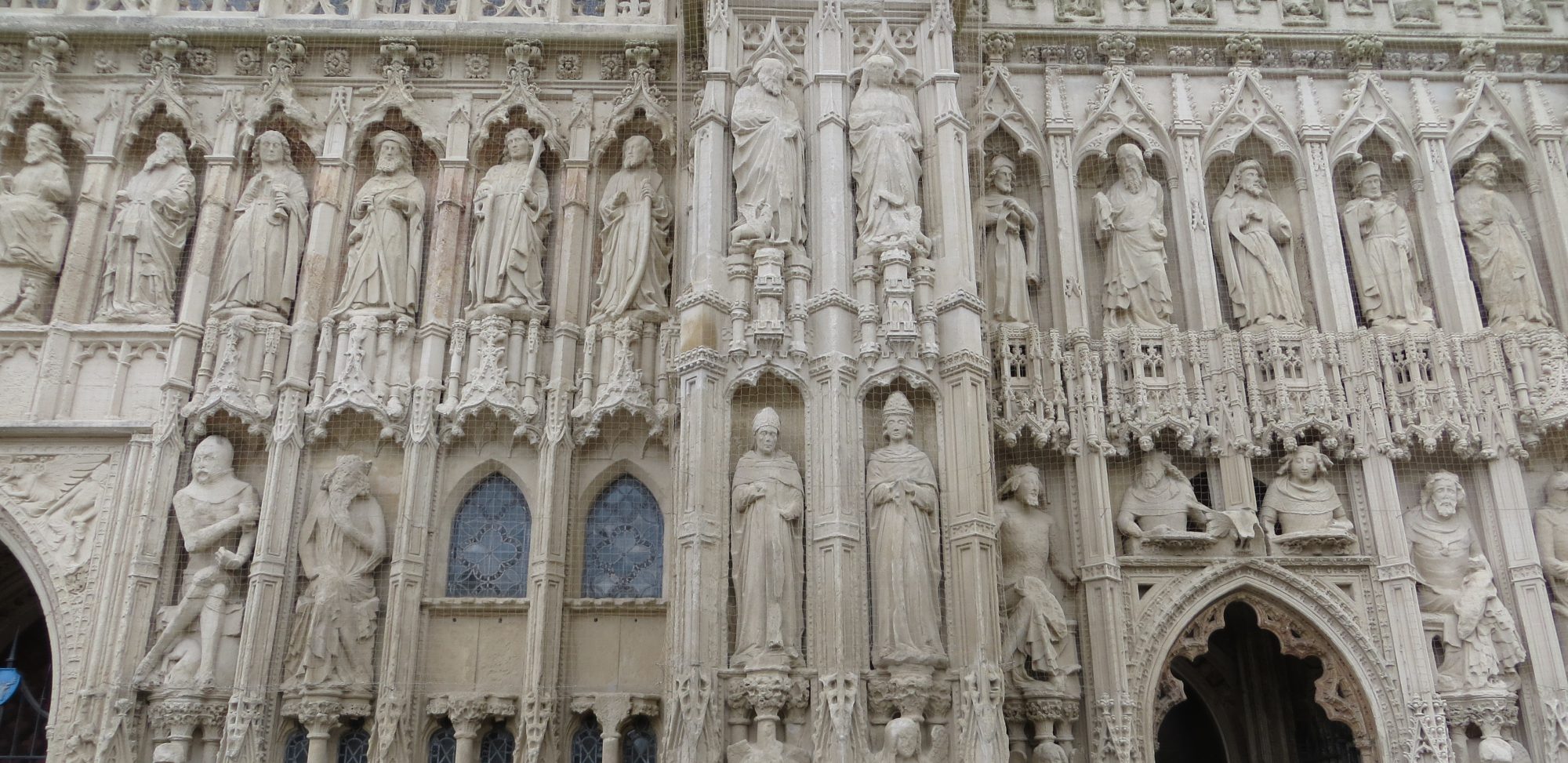
Catechism 3/6 The Ten Commandments

The Ten Commandments

We may worship the true God

I am the Lord your God who brought thee out of the land of Egypt, out of the house of bondage. Thou shall have none other gods but me.

God is the Lord. There is no other God and no other lord. 

We may know God because he makes himself known to us. He makes himself known as the Lord who brought Israel out of Egypt, out of the house of bondage, and as the Father of our Lord Jesus Christ. He gives us this knowledge of himself.

To know God is to worship and be in awe of him. It is to be incapable of suppressing expression of your awe. We cannot help ourselves, so awe bursts out of us, and is heard by those around us. 

That God is God, is the foundation and the source of all truth, and thus also of the truth of man. Man is a living being. The life he has is God's life, the life that God gives him and shares with him. Man is not a lifeless being, and not a self-subsistent being either: he is neither thing nor god. 

To love God, express awe and so worship him, is simultaneously to do the very best thing for yourself and for those around you. For the fundamental requirement of all human interaction is that it takes place in truth, not in delusion. To understand that God is God, is the beginning of truth and the basis on which all human relationships may flourish. You may love and serve your neighbour, and love and serve your enemy, by letting this exclamation of the truth of God, and of the glory of God, flow from you, so that it dispels delusion and establishes truth.  

The first commandment is our foundation. The nine that follow it are amplifications and exemplifications of the first. The second commandment tells us that there are no imitations or substitutes for God; the third, the that you cannot use God's name or authority as your own and thus cannot make yourself a junior god; the fourth, that other people are not your property, so you cannot hold them captive, but must release them on the Sabbath; the fifth, that you must give your grateful acknowledgement that you have received all things from those prior to you, who are your parents, who taught and mediated this knowledge to you, so you acknowledge that you are not the source or master of it; the sixth, that no one derives their life from you such that you have authority to take it away from them, since you are not their god, for that would be murder; the seventh, that there may be no adultery, mixing, dilution, ambiguity, confusion, darkness or chaos, but only purity, simplicity and clarity, so that appearances do not deceive us; the eighth, that we may not steal; the ninth, that we do not bear false witness and so do not lie; and the tenth, that we master our desires, and do not desire what is not ours to have, and so remain content.

The Commands tell us to give our worship to the true God, not to any other, and so not to make fake gods, and not to claim for ourselves the authority of God and make ourselves a rival to God. All the commandments that follow simply amplify this first commandment. Because God is our Lord, we are free. Any obligation or constraints that are not based in this truth, are false, invalid, and not binding. Our freedom from all other constraints is established by the acknowledgement that God is sovereign. As a result of his sovereignty, freedom is sovereign for us.

Worship God …

God must be worshipped. God is he who cannot not be worshipped.

When you give your worship to the true God, you live in the truth, and many other things may become clear. When you withhold that worship, either believing in some other god, or in the belief that you worship nothing, so much more remains confused, contradictory and puzzling. The God you want is the Father of our Lord Jesus Christ. He who brought Israel out of Egypt, out of slavery and into the promised land, will do the same for you. The correct identification of God opens up to you a larger world. 

Those who espouse atheism and agnosticism are, inadvertently perhaps, advocating for the unchallenged and unchallengeable power of the elite. Christianity say that the elite are attempting to make themselves gods. We use the concept of ‘god’ in order to challenge those who don't want to be challenged, who are attempting to make themselves divine, putting terms so far above us that they cannot be called to account. Atheism is the resort of those elites who don't want to hear any challenge from Christians, and who therefore want to belittle and take away the conceptuality by which we can make that challenge.

  • Do not worship any other being

You must not worship or revere any other god. Other gods are idols, representations of God that are untrue. They have a power that is dangerous to us. Although these forces have no reality of their own, they still seem to us as compelling as any of the real forces of creation.

‘Pagan’ is the traditional name for those who do not worship God. They worship many gods or conceptions of God, but these are all just the products of their imagination. They are copies and they are fictions.   

The pagans venerate these images and archetypes of their society. They idolise the strong man and adore the desirable woman. Pagans worship power. They worship power without truth, or goodness or beauty, and so without understanding the purposes to which power must be put. They do so without understanding that there are proper limits to power, and that self-control is needed to resist the temptations of power. They love power simply because it allows them to gain more, and to take away power away from others. Eventually their use of power without control will destroy whatever they touch, until finally they are also destroyed by it.  When it is uncontrolled by any other desire, the desire for power draws all things towards chaos and destruction. In their long-term effect, all pagan cults bring about the destruction of our civility and humanity.

Those in authority uses the media to pump out a torrent of images, of fictional characters that represent passions and that meet in brief encounters. If you let it, this torrent may fill your imagination and displace all other real relationships. These images are pushed at you by those who want to keep you bewitched and malleable so that they can control you. Such images are carried into your awareness, your affections and life as on a conveyor belt, and at every moment as the gloss disappears from them, they are replaced by new ones. The powers behind the media want you to believe that these figures love you as truly as you love them, and forget that they are a performance designed to make you powerless. These figures are the gods of our age. As long as you watch and stay entranced you are caught in their cult, and you remain childish and helpless. You are giving your worship to pagan gods, whilst not realising that this is what you are doing, and in denial that this is what has happened to you. The powers of the present regime do not want you to become master of yourself. They want you to remain a slave. 

  • Do not misuse the name of the Lord your God…

We may not claim to have the power of God. We may not say that our undertakings have the authority of God.  

To make use of the name of the Lord is to claim to speak with ultimate authority. It is to suggest that you yourself have the authority of God. Do not claim that you have the Mandate of Heaven, or of History, or of Science. Do not claim that you are the Representative of the People or the Embodiment of the Nation or the Voice of the Future. All these are claims to be God. Do not take the name of the Lord in vain. If you claim such authority, you surely do so in vain. Your attempt will fail and bring you disaster. 

Our contemporaries believe that the identity of things depends entirely on their knowledge and their will. Those in power believe that they can determine our identity for us, and that we have to accept their account of ourselves. They want us to recognise them as the spokesmen for reality, the infallible representatives of truth and science. They want us to acknowledge that they have authority. Though they do not want the absolute and cultic nature of their claims to become clear. They believe that they only have to acknowledge only what they are willing to acknowledge, so they don't need to acknowledge either God or any reality whatever outside themselves. Their will is supreme: there are no other sources of authority.  They want to be our master and want us to be their prisoners and slaves.  

The will to power is the fundamental principle of the modern era. Our contemporary pagans clamber up through media, government and every institution to win power over us. They want to decide what we may think. They want us to be interchangeable so they may freely employ us or discard us. They hate anyone who is able to hold out against them. They are at war with the Christian gospel because it enables us to think for ourselves.

In order to defend ourselves against their constant, well-concealed, aggression we have to become familiar with our own history. We have to get to know the long experience of Christians in every generation who have held out against the powers of their own time, who have kept the faith, and passed Christian teaching down to us, even at the cost of their own lives. We have to revere these people who are the saints and the martyrs of the Church. Only the Church of faithful witnesses displays the wide range of talents that can make us servants of all and finally masters of ourselves. Only the life and experience of our Lord, that we now participate in, can turn a people from worship of power and consequent dissolution to worship of God and consequent blessing.

  • Remember the Sabbath day to keep it holy…

You can work for six days but on the seventh there must be rest. For six days you can send your workers out to work, but you must leave them on the seventh. They do not belong to you so their lives are not yours to dispose of. You have no authority to work them until they drop. There is no obligation on them on the seventh day, so do not prevent their release, or hold them back from worship of God. On that day they are free, and free of you.

We are given authority to live with all other creatures and to interact with them in order to make our contribution to its beauty. We may work and do what is good. We may do this for ourselves, through our own labour, struggle and risk-taking. But we cannot coerce other people to work for us or force the land to produce without limit. 

The Sabbath and Jubilee command that we live within the limits of what the world provides without depletion. But, by mineral extraction and over-farming we have been losing forests, soil and water systems, we have been turning the world into a desert and contaminating what remains to us. 

The Sabbath is the coming together of all things, through the resurrection when death is overwhelmed by life, and so the start of the coming together of all broken parts, the reconciliation, restoration and completion of all things, the eschaton. 

  • Honour your father and your mother…

We owe acknowledgement, first to our parents and their generation, to our teachers and local leaders, and then to our grandparents and their generation, and then to all the generations of our nation before them. They passed down to us whatever good practices we now rely on. They discovered them, recognised their goodness, taught and defended them and passed them on to us. We received these talents from them. We did not invent them for ourselves. We may receive what they offer us with gratitude. What they passed on us above all was the gospel with the entire package of Christian discipleship which alone enables us to grow up out of childhood and sullen adolescence, out of the bitterness and frustration of enforced servitude, to independence and maturity. They enabled us to aspire to self-mastery, and they taught us that this hope comes to us in Jesus Christ. We acknowledge that everything we have, we have received from someone who has worked for it, preserved it, kept it in good order for us and passed it on to us. For this reason, we honour our father and mother and all previous generations.

Our predecessors intended to pass on to us all that would benefit us. We must do the same for our own successors. We must look for stability and permanency, not upset and rupture. Tradition and continuity are the basis of human society.

We must honour our parents by giving them grandchildren, and so bring a new generation into being. We owe them life, but instead we have withheld life. Our generation has decided that the next generation owes us. We have put them in debt and like Pharoah, allowed them no Sabbath, no debt relief. We have not obeyed the wishes of our parents and so have not found our dignity through service to the next generation.

The leaders of the present age want to divert our affection from our family to them, and so to replace our parents with themselves. They want us to accept their fiction as reality. Those who are convinced that they know better than their parents did suffer from a wilful blindness. Their effortless superiority, their determination to rip away our own roots, and do without the input of all previous generation tells us that they have set out to build their new world without considering whether they have the resources to do so. 

Because it does not acknowledge its debt to past and to future generations, this generation has become idolatrous. It has attempted to avoid the bill for its expenditure by borrowing. It has lived by delaying the reckoning. As a result, disaster, demographic, cultural and economic, is coming.  

  • Do not murder…

The life of every human belongs to God. It cannot be taken away without the formal judgment under the process of law by a man’s peers. 

To take away the means of life is murder. To deny people the means by which they can support themselves and provide for their family, is murder at slower pace. Driving people out of public life, loading them with financial burdens and so impoverishing them so that they cannot take part in the life of the nation, is murder at its slowest.    

Life has been withheld from us. The generation that does not pass on life to the next has raised itself above all other generations, past and future. It has taken life but it has not given it. It does not want to take its place in the succession of generations, and does not acknowledge its own createdness and mortality. It sees itself as the summit of history and so wants to stop time and make itself immortal.

  • Do not commit adultery…

Do not introduce confusion. Do not mix or dilute or adulterate. Do not introduce copies and substitutes, do not replace the reality with mere images of it. Do not create ambiguity. Do not allow appearances to deceive us, so that everything is delivered to us mixed with its opposite, and nothing can be seen for what it is. Do not create ignorance, darkness or chaos. Ambiguity, confusion and any sense of the impermanence of our relationships are socially destructive. Instead establish purity, simplicity and clarity.

Do not commit adultery. The basis of every society is the marriage of one man and one woman. Marriage establishes the equivalence and mutuality of one man with one woman. Marriage cannot be dissolved and no other form of partnership can substitute for it.  Marriage safeguards the formative years of new generation of children, which makes that society robust.

Those in power want to rub out the differences given to us by nature and make us all equivalent and interchangeable. Their agenda is to dissolve all the things that make you unique, the first of which is your sex. They assert that there is no functional difference between male and female, but only complete interchangeability, so that every individual is functionally identical to every other, and any individual can be substituted for by any other.

Modernity is simply hatred of the idea that there are any givens of nature, and that the powerful are not able simply to make and re-make us as they desire. 

  • Do not steal…

We have been taking from our people their identity and dignity. We have not allowed them to receive what previous generations intended for them, and so they have not received what is owing to them. Their inheritance has been withheld and so they have been robbed.

Each generation rightly demands that the next should pass on the life they have received. We must take from past and give to the future. What we have received, we may pass on to those who come after us.

Our parents want us to pass on what we have received and so serve the next generation. They intended that we have children just as they did, and that we bring them up to adulthood so that they can do the same too. Our parents want us to be the servants of our children just as they were servants to us all through our childhood.

But this transmission of life is now being suppressed. Transmission of life is what culture is, and it requires the knowledge, the attitudes and skills which enable this transmission. But our children have not received the culture that would tell them what they are due from us, and what they have to hand on to those who come after them. This culture has been taken from them and concealed by the very institutions, in particular educational institutions, responsible for that transmission.  It has been hidden from them, and as a result they are bereft and exposed. They do not have the moral, emotional or intellectual resources that would allow them to defend themselves from the constant incursions of those who want to rob us of our decision-making powers, of responsibility and of our sovereignty. This is how the holders of power hold the present generation to ransom.

Debt is the way we put off paying mode of our obligations to the past and the future. It is the form in which we repress and disguise our obligations to the generations before and after us. It is the form in which we hold and consume for ourselves what should go to them. It is usury, and it is theft.   

Debt takes from those with little and left them with less. It has given most to those who already had most. It has taken all financial security from the middle class and turned them into an insecure and frightened people. It has made the poor destitute. All the fissures in the nation have opened so the gap between top and bottom has widened into a chasm. It has taken away that social mobility which gave each of us the hope of improvement, that hope which is the constant gift of the gospel and which gives us our motivation and confidence  

Bank credit effectively brings future spending power into the present. Debt repayments to banks destroy money. This means that the credit which enables commerce is withdrawn and customers have neither credit or currency with which to make a purchase, so that they are unable to buy and none of us can make a living. Our entire economy is being plundered and emptied out by our financial class and the power-seekers who have only contempt for us because they do not fear God.

  • Do not give false testimony…

Be true witnesses. Live not by lies. Reject the delusions that keep people fearful, and pass on the good tradition you have received.

The gospel is the source of public speech. We may speak freely and so make whatever suggestions seem best for our nation. The gospel is source and guarantor of the public realm in which anyone may offer ideas, and in which we give a hearing to other people, and are prepared to consider their proposals. We do not set out to silence anyone. We do not regard anyone as beneath us, and do not consider ourselves beyond challenge.  We concede that the truth is sovereign, and the truth may make itself clearer to us through a multitude of voices, including those not we do not welcome. If we suppress them, and put ourselves forward as sole arbiters and possessors of the truth, we give lie. If the authorities are telling us lies, and we do not speak out, we are complicit because we share in testimony that is false.

Our generation is being told a lie. We are told that we should lift ourselves above all other people. If you wanted to destroy the happiness of a people, follow our current formula: remove yourself as far as possible from the natural world; repudiate the continuity of your culture; believe you are wise enough to do whatever you happen to want and not only get away with it, but have a right to it and a right to silence those who disagree; minimise the role played by a common body of belief; actively attack and dismantle every social structure as a potential source of oppression; and reject the idea of a transcendent set of values.

We give false testimony when we reduce education to indoctrination and homage to the state, which represents our determination to avoid responsibility and adulthood and freedom. We give false testimony when we bail people out and maintain their delusions, so they never have to face the consequences of their actions and so become morally mature. False testimony keeps them in immaturity, for it takes the power of judgment away from them. The whole discipline of modern economics is just about removing ethics and moral judgment, and acting as though we were in a mechanistic system and so under fate.

The delusions of the current age are maintained by arrogance that does not allow truth to be uttered. These delusions allow the arrogant to remain unaccountable and secure themselves against risk, and express their contempt for those who withstand and defy them and testify to the truth against them. 

The true testimony is that is truth, judgment, accountability and justice. There are long-developed codes which enable us to say what is good and just, and this code is given to us in Christian teaching and in the culture, morality and law that that have developed through each nation’s reception of that Christian teaching. The fundamental act that establishes our freedom is the gathering and worshipping of the Christian community shaped by this revelation and this teaching. In the fundamental act of free speech, the act that founds and sustains the public square, this community proclaims that only God is God, and that without the authority of God all claimants to power others are dangerous, delusory, parasitical, lordless powers. The God-worshipping community makes its stand, raises its voice and gives its witness to what is true, good and right.

Do not covet

Self-restraint must govern our desires. Desire without limit is idolatrous. Without self-control, with absolute surrender to our passions and to those who are able to manipulate them, there is only misery.

We have been consuming the material resources that future generations may need. We have written ourselves promissory notes, and so created the debt that binds future generations. We have spent resources without understanding their limits, unconcerned about what we have left for those who come after us.  

Our society has decided not to admit to its own mortality or acknowledge that we are under an obligation to pass life on to our children and successors. We have not decided which desires are good and pursued them only. We have pursued every desire without discrimination. The result has been resource exhaustion, loss of relationship to our own land and ecology, and deracination and dispossession. We have created an utterly dependent and vulnerable proletariat in cities, in countries that have to import their power, not fed by their own national agriculture but on food imported from continents away.

We have to decide between desires, to give up some in order to purse others, in order to achieve self-control. A man seeks wisdom by being educated in the traditions and formed by the disciplines of his culture. He may demonstrate courage, justice and good judgment, wisdom and self-restraint. He may master his passions. He not just the helpless victim of his appetites for he intends to be a responsible being, not just a man out-of-control and endlessly manipulatable. A man is independent when he is able to provide for himself. A man whose needs are provided by others cannot claim he is independent. When the needs of a society are provided by populations of migrants, slaves, prisoners, underpaid factory workers, clients and colonies, that society is not independent. When everything is provided for us, we are helpless babes, and when our demands and desires are not met fast enough, and we are enraged, our helplessness becomes so embarrassingly obvious, that we are further enraged. We are that man so lacking in self-control that he is pitiable. But the man who hears the command of God, and understands that he is summoned to maturity and adulthood, will take up the discipline that can bring him self-mastery, and so he will grow up into the sovereignty that God intends to share with us. 

The Commandments express the sovereignty of man with God

The first commandment is the foundation of human life. It alone enables man to grow towards maturity and self-mastery and so become civil and humane. This commandment, to worship the one God who reveals himself in Christ and in his people Israel. It has become fundamental for those societies shaped by the gospel, and which we came to call the West. That Christian culture enabled those societies to spread beyond Europe and around the world, briefly creating a global political culture and economy. But without the continuing, living witness of a faithful Church renewing that culture, that culture has become moribund and has not renewed those nations. As a result, they have lost their identity as living political nations, in which each individual is sovereign, responsible, and so accountable to his fellow countrymen. They have become part of a totalitarianism that is everywhere, a universal bullying and childishness, where no moral obligations, and no sources or limits are acknowledged. The ascent to maturity stalled, became bogged down and has been abandoned. But it lives and it continues wherever God is worshipped, wherever the first commandment is celebrated, and the creed is repeated.

Christianity represents the possibility of human maturity, and sets out the conditions of its realisation.  Our self-mastery comes to us from God. It is the self-mastery of God, shared with us, so that it is really his and really ours. Let us turn to one another every new day and say ‘Let us begin with what we know to be true...’. Let every Christian all the faithful Church say together, ‘Our Father, which art in heaven….’ And ‘Hear O Israel, the Lord your God is the only God…’, and ‘I believe in one God, the Father almighty…’

Catechism 2/6 The Lord's Prayer

2. The Lord’s Prayer

Christians say what our Lord taught us to say. We use the words that he used. He stood in our place, and spoke these words, and as we repeat them, and make whatever petitions and requests occur to us, we stand behind him, and are members of his company. His identity becomes ours too. We are drawn into the conversation, of Father and Son, until we participate in their life and become the son who can say ‘Father’. 

Our Father who art in heaven…     

The Lord has us sons and heirs who can speak to you as to our father, using Father as your name. You respond to each of us as you child. What we have comes from you to us, personally and directly.  

God is Father and Jesus Christ is the Son. He has now brought us into this sonship, so that we may stand with Jesus and call God, ‘Father.’ Our relationship to God is person to person and intimate. Since Christ has told us to use Father as his Name, we have Christ’s confidence to stand before God, and before all the powers and authorities in creation, and to speak. As the Lord speaks to us, we can hear and reply and make our wishes known to him, person to person. 

The Lord tells us to make these seven requests: 

Hallowed be thy name….

Thy kingdom come…                                                                    

Thy will be done, on earth as in heaven…

Give us this day our daily bread…

And forgive us our trespasses as we forgive those who trespass against us….

Lead us not into temptation

And deliver us from evil

In these seven requests we ask that Godmake known the holiness of his name, and so make it known that he is our lord; that he asserts his rule, his reign or kingdom, so we are not subject to the rule of others. We ask that he make clear the goodness of his intentions for us; that he enables us to provide for ourselves and one another; that he forgives and releases us from the consequences of our actions and so gives us a new start; that he does not allow us to be tested beyond what we can bear, and that he delivers us from evil and from evil men.

Hallowed be thy name….

We ask the Lord to make himself known to us. We ask him to show us who he is. He can make himself known to us, so that we are able to grasp his identity in its all uniqueness and distinctiveness. He hallows his name, that is, he makes his holiness evident, so we can acknowledge that there is no one like the Lord, that he is without peer and without parallel. He is the only Lord. Though there may be other authorities, none of them is holy. 

The Lord has made his name known to us through all the patriarchs and prophets of Israel, and at last, in Jesus Christ, he has made it known fully and definitively. We ask him to reveal his holiness more and more so that we may increasingly grasp the claims he makes on us and live only in the light of the truth, so that we can learn for ourselves what is true, so we can explore and make discoveries, and so we can see what is right and good. To say that God is holy is to say that he is entirely himself, and also that he is so for our sake. The best favour he can do for us is to be himself, and aid us to acknowledge his holiness and so to hallow his name.

Thy kingdom come…                                                                             

We ask the Lord to establish his leadership, his rule, and his justice for us. We ask him to take power away those regimes and ideologies that intend to control us and to save us from the leaders that tyrannize us and which want us to obey them as though they were gods.  

Thy will be done, on earth as in heaven…

We ask the Lord to carry to completion his good will for us. His desire is for our good. The Lord has higher ambitions for us than we do for ourselves. He intends to redeem and perfect creation, by uniting earth to heaven, so that the glory and holiness of heaven comes to all creatures and fills creation. 

Heaven is the company God surrounds himself with. He summons them, they come and take their place around him. This company is waiting to receive us. They point us to him, and they point us to our place in that company. Heaven is the company that lives in the truth. In this assembly all is revealed. Nothing is concealed. We cannot keep our past out of sight. Everyone will see everyone for who they are. All of them will share the goodness, the truth and the beauty of the whole company of heaven, which represent the good will of God for us

Give us this day our daily bread…

We ask the Lord to give us what we need. The Lord knows what our needs are, and he supplies them. He does not supply them to us all at once, but delivers them to us through time as we are able to receive and employ them. What he gives us are simply resources but also opportunities. He gives us openings through which, if we take them and act well, our agency increases. Good decisions make still better decisions possible. He has created this world in order to provide for us. We must ask him, and take what he gives us, confident of its goodness. 

We want to be content with what we have. We ask for what is sufficient for this time. We do not want to accumulate or to consume more than is good either for us or for the world that provides us with these resources. 

We give thanks for our place in this material creation, for the particular characteristics of our own country and its land. By our creation, we are given a place in this material creation. We have bodies, which must grow and work, and feed and rest. With our bodies we can live and work together, share what we have and enjoy life together. We give thanks for these bodies of ours, for the place that is home to us, and our ability to work and bear children who will continue what we have started when we are gone, and so we can give thanks for our place in a history and in the work of creation. 

We do this in a world in which others are not confident about their bodies or their needs, and who are not able to trust or share with one another. They are in flight from materiality. They are afraid of labour. They are afraid that there will not be enough resources if they do not seize them for themselves and conceal them from us. They are afraid to go out into open air, to discover the healthy unpredictability of their natural environment. They are afraid to commit to the work by which they can support themselves and provide for others. They want to make themselves as disembodied as they can in order to evade one another. They seek to separate themselves from us, and want us to become as fearful of the materiality of creation as they are.

Christians give thanks for our givenness to one another, made available to one another by our bodies and by the material means of life that sustain them. We accept that all resources come to us in time, and so daily, and come to us as gifts created by the work of many other people, and that all of them aspects of God's gift to us of creation. So we ask for, and we give thanks for, our daily bread.

And forgive us our trespasses….

We ask the Lord to release us from one another. We ask him to take away from us the excessive power that we have exercised over other people, and so release them from our grip, and let them forgive us the excess or the deficit that we have imposed on them.

We trespass when we exceed our authority. For fear that we would not have enough, we have taken more than we needed. We have consumed in excess and have insisted on a standard of living that we are unable to sustain. 

We may al confess and repent on behalf of the powers that be. They have trespassed against us, and we can help them to acknowledge this by saying what needs to be said, and by admitting the offence that has become too difficult for them to admit to. We can invite them to acknowledge that all our civic and national life and economic prosperity come from the culture that the gospel has brought into being. We can invite them to stop damaging our nation by their attack on that culture by ending their defiance of God.

We have become used to having limitless power at our disposal and are reluctant to adjust to a lower and more sustainable use of power. When we acknowledge that we have exceeded our authority we may discover a more realistic way of life. We confess this, and bed that that our trespassers are forgiven, and the damage we have caused is made good. 

Forgive us our debts….

We live under various obligations. We have a commitment to our parents, grandparents and all the generations whose lives and work have contributed to the prosperity we now enjoy. They have a claim on us, and we are in debt to them. They want us to have children and work in order to bring those children up to adulthood. They are determined that we should pass on what we have received and so serve the next generation and the continuity of the nation. All previous generations want us to understand that we have to pass on the life we have received. Our obligation is moral and demographic. This is the debt we must pay, and for which we must be forgiven if we cannot pay it. We pray for forgiveness and a new start and a chance to do what we have not yet done.

In this prayer we acknowledge this ongoing debt of service, that links us together in families and over generations, and through the world-wide supply of goods and services. This is debt is concealed. We may assume that it is fair and possible for our own children to service the debt obligations we have placed on them. But those debt obligations now far exceed the ability of the next generation to pay. We may assume that the workers in those countries that supply goods to us are adequately paid for them. But they may not be. They may never have the prosperity we have enjoyed.

We need to give up the assumption that governments take care of the general welfare, and that they will provide for us what we do not provide for ourselves. We are under an obligation to care, first for our children and the next generation, and then for our own parents and those who once cared for us. We ask the Lord to give us the means to provide for those nearest to us and so pay our debt to them.  

Our refusal to seek judgment and ask for forgiveness has allowed our generation, and our governments, to assure us that we are not in debt, that we have trespassed, that we have earned our riches, and we are not under obligation to anyone for them. They have led us to believe that we are rich, and are entitled to all we possess. They assure us that we don't really have to work ourselves, that we do not have to pick up tools, go out into our fields and cultivate our own crops. Anyone who does not do so, believes that other people will always work for him, in ways disguised by long supply chains and the complex division of labour. They believe that the energy necessary for an industrial economy will always be there to power industry, even if that industry is now invisible to us on other continents. They believe that they will never have to do this themselves directly. All this is delusory. We have trespassed and we are in debt, and our dignity depends on us seeking judgment about the truth of our position. 

Lead us not into temptation… 

‘Temptation’ means ‘testing’. Testing is what we undergo in hard times, when we are unable to control what is happening to us, and when our confidence and security are gone. We ask the Lord not to test us beyond what we can bear, not allow us to be pushed beyond our breaking point. 

The Lord promises that we will not be tempted beyond what we can endure. We will not be broken, but we will be made stronger by all experience that God allows to come to us. By enduring, we become stronger.

Christians are being tested, and must endure. We are undergoing a trial and persecution. Wedges are being forced in, dividing us and blinding us from the overwhelming number of ends and purposes that we as humans do actually share, such as respect and family, and the struggle to prevent our powers from being removed and the fruits of our work being taken away from us.  

Some are in such a panic to secure their position, and refuse to accept any drop in their standard of living. They are turning away from the rest of the nation, ready to abandon the rule of law and our way of life. Many people are willing to fall into line with the latest emergency measures, perhaps believing that such measures will affect others but not them, or that the situation will change and the crisis disappear.

The centralisers may mistakenly believe that they will survive any conflict. But they are betraying their own people, and breaking the rule of law that protects them as well as us, and the national cohesion that means that we do not regard one another as enemies.  We must go through these trials and can do so if the Lord gives us the means to withstand them.  

We can ask the Lord to identify the temptations on us, and so show us how we are under attack. Temptations always present themselves as new and attractive, though they are always old, and they represent an attempt to take our decision-making away from us and so to disempower us.

It took many generations of hard-lived Christian discipleship for our culture to emerge. This culture gave previous generations the qualities of self-restraint, public accountability and responsibility, and of the rule of law. But it will not take generations to destroy and lose this culture. It takes even less time to create economic chaos, suspend the rule of law, put in a state of emergency, suspend civil rights and end political stability. If we allow this to happen economic confidence, stability and prosperity will not come back in our lifetime.  We must therefore resist temptation. We are being tested. We must be ready to say, ‘We must obey God rather than man’ (Acts 5.29).

But deliver us from evil

We ask the Lord not to send us into the time of trial. We ask him to rescue us from the hostile powers that have a hold over us.

Do not let us compromise or arbitrate between God and any other power. Do not let us test our strength against the Lord, or make him wait, or imagine we can hold out against him or defy him.  

We ask the Lord to deliver us from evil men, and to prevent us from being so taken over by this evil that we ourselves become one of those evil men.

How can we know what is good and what is evil? What is evil? Evil is whatever causes the destruction of man and creation. How can we know what is good? We can learn what is good by following the Commandments the Lord has given us.

The governments and institutions of our time have overreached. They have too high view of their own authority. They do not acknowledge that they are not the source of their authority; they refuse to acknowledge the real source of their authority, or acknowledge the limits of their authority. They are unable to acknowledge or respect anything that they have not made. Those leaders, institutions and political classes that do acknowledge the source and limits of their authority are good: they understand that they are accountable, they underhold the rule of law, and will enable that settlement to continue for another generation. Those leaders, institutions and political class that do not acknowledge the source and limits of their authority are evil: they pursue power without reference to public well-being, evade responsibility, undermine the rule of law and make it unlikely that peace will continue for another generation. Their overreach will divide and destroy that nation.

Christians are witnesses of the increasingly totalitarian response of our political class to the unmanageable systemic contradictions that they have created and concealed. Christians have to withstand the pressures such regimes put upon us. We must learn how to challenge and resist them and avoid getting caught up in their schemes. Through enduring whatever suffering they inflict on us, we can grow and develop the character of Christ. The nation will regrow once the Church has recovered its voice, and by offering our lives, given its true witness to the world.

For thine is the kingdom…  

‘Kingdom’ means the rule. A country is rational, peaceful and prosperous when under the rule of law. The law is supreme when there is a consensus that justice is fundamental, and that justice depends on truth, and that the discovery of the truth depends on public examination and judgment, and so on courts with powers of enforcement. It depends on our understanding that the law is master, and so that the law is above the monarchy, the government, the party, the media and every other section and interest. The law is not whatever the present government decides. The law is the summarised accumulated experience of many generations about what makes life possible and so of what things have to be ruled out in order to keep life tolerable. The jurisdiction we have inherited has been formed by generations of Christian discipleship and learning. In this jurisdiction everyone is equal under the law; justice is performed in public and the powerful are held to account. God is acknowledged to be the source of true authority. He is the good judge, who can see through all deceit to uncover the truth, and release all who have been held captive by the falsehoods of powerful people and regimes. 

…the power

God starts, continues, endures and completes his work. All power comes from the Holy Spirit, and is to be used for good. God exercises his power with a patience that outlasts all resistance.

…and the glory... 

Glory is the revelation of the truth. It enables the proper recognition and acknowledgement of reality, that is unafraid and does not shun the whole truth in its fullest dimensions

Christianity has given us the highest account of human being. Man is given his glory by God. God raises man. In particular he glorifies the poor, who have received no glory from any other source. Those who had none, are given glory. ‘He has put down the mighty their seat and has exalted the humble and meek. He hath filled the hungry with good things and the rich he hath sent empty away…’ 

Jesus Christ has gathered around him a people, who are present and recognisable in every place as his Church. He regards his people as his glory. From this people come the Christian and discipleship and skills that form the culture which sustain any society that receives it. This culture brings peace in nations and between them, so that, precariously, a civilisation may emerge. This civilisation has a glory that comes from Christ.  The Christian people encourage us not to give in to fear and despair but to respond to the call of God, to discover the dignity intended for us, and to join them in prayer to God our Father.   

As it was, is now and ever shall be, world without end…

Jesus Christ is the same, yesterday, today and forever. He is the source and founder of our humanity. Those who refuse to give glory to God despise our Christian forebears, conceal our history and attempts to destroy our national culture and memory. Driven by envy, they hold out against the gospel, belittle our people and want us to despair. Christians oppose them. We declare in public that authority, power and glory belong to God, that they come to us from God and that we must return them so that he can refresh and restore them for us. We say simply that the Lord is God, and that God is our Father. We give thanks to God. It is in acknowledging what we receive from him, and that it is indeed him that we receive it from, that we truly receive it.

From the practice of saying this prayer the Christian community has learned to give thanks in all circumstances. Thankfulness is our fundamental characteristic. The people and nations that absorb this thankfulness also develop a fundamental contentedness that enables them to endure frustrations and stay at peace with one another. From the petitions of the Lord’s prayer, we learn that God is ready to give what we need and to take away what we cannot cope with. He will take us through difficult hard times and keep us company, so that we do not face them without him, whose self-mastery is constantly available to us to draw on, and that at last we will overcome and arrive with him at the perfect sonship. 

For a second account of the Lord who makes this possible, and who is our Lord, we turn to the Ten Commandments and so to fundamental statement of the gospel, and fundamental proposition of all Christian teaching, that only God is God, and he is our God, God for us. This is the first commandment. The nine that follow are amplifications of the truth of the first, that God is the Lord. The Lord is God. The ten commandments orient us so that we are the people who know this and have authority to declare it. We are true recognisers of God, who has given his recognition to us. We have received glory from him and so we give glory to him.

Catechism 1/6 The Hope of Self-mastery

The gospel in four short statements 

This catechism sets out four brief statements that summarise the gospel. We will look at the Lord’s Prayer, the Ten Commandments, the Creed and the Blessings of the Sermon on the Mount. Two of these are recited when Christians gather together in worship.

We set out the gospel by saying both what it is, and what it is not. We say what it offers us and what it protects us from. We show how it different it is from its rivals and from all caricatures of it.

The gospel is a greeting, sent to us by Christ, who introduces himself in it.  The gospel tells us that someone who we did not know, but who knew us, is introducing himself to us. From this moment we may know him, and through him we may know one another too, and so at last come we may also come to know ourselves.  

The gospel introduces us to the particular person, Jesus Christ, the Son whom God has set before us. Everything Christians that have ever said, tells us about him, and tells us about ourselves in relation to him. He is the one person who is able to face us in complete truth. The gospel appears in a world full of rival messages, most of which are not honest about their claims about man or God. As we discover the gospel, we realise that none of these rivals is able to show us the very high dignity of man that Jesus Christ reveals to us, in which each person may become master of themselves. 

  1. Our Calling – Summoned to maturity
    1.  God is with us

We have a companion. God is that companion. We are not on our own and do not wish to be. We want to find any person can give us some recognition. We ourselves cannot be that other person. That person someone else, someone who is not us. God is that person, distinct from ourselves, who is able to give us that recognition and who can acknowledge our own distinct identity. Only another person can confirm that we are truly an independent person. Only someone other than ourselves can establish that we that we exist not only in our own imagination, but in truth. We exist, and we inhabit a world, which exists independently of us, and which is comprised of other beings, who are freely able to acknowledge us. It is not us who decides on the existence of other beings, and we cannot deny their existence or withhold life from them. They are not a figment of our imagination, so we have to come to terms with them.

God is with us. This is the truth about mankind. When we acknowledge this, we have made a good start. When we evade this truth, everything becomes problematic. God’s wish is to do good for us. He offers us company, a particular company of persons within which we can truly be ourselves. There are voices other than our own; they can respond to us and we to them. They can find us, make us welcome and we can be glad to be with them.  

God sets before us a world full of persons who are able to be good company for us, and to supply us with what we desire. They are the generosity of God to us. Whoever turns away from this generosity not only turns himself away from God, but turns away from his own true self, and from everyone who could acknowledge him and be glad of him. Anyone who attempts to live without God will push away all very people who God presents to him. If persists in turning away everyone he meets and refusing the entire company that God has been sending him, he will never grow up to maturity and never become a person able to recognise and be glad of other persons. 

We diminish ourselves when we regard other persons as unworthy of us or acknowledge only those who reflect our own claims. We diminish ourselves when we decide that other men are too unacceptably different from ourselves, and see them only as the poor, whom we can disregard or despise. We diminish ourselves when we try to make ourselves master and oblige other people to become our servants. 

Without God, man is a threat to all others around him. If he is not willing to accept his place in the society of men, he reaches for power over them. He attempts to make others into his creatures who must serve and fawn over him, and so makes himself a tyrant. To build his power, he makes ever stronger claims about himself until, for those around him, he is claiming an absolute power. Over time every unchallenged political ideology becomes a religious cult. By attempting to put himself above all others, so that he is no longer accountable to them, that man is attempting to make himself godlike. But he only succeeds in turning truth to fakery for those who have surrendered themselves to him. His claims are fraudulent, his power is only the power of the delusion.  

If we try to rub away the image of himself that his creator, the true God, has placed in us, we turn ourselves into a monster. This snatching and stealing of what has not yet been given to him is how we turn ourselves into that most miserable being, a god who is fake. Then we are the plaything of all desires, emotions and forces that roar around us and in the world of our creation. The self-exaltation over all others, our rejection of those whom we might have received as companions, the trampling of the powerless and making them hostages to our dictatorship, all this is the way we abase ourselves and bring ourselves to ruin. Without God, we are not ourselves, but only the creature of the many forces that manipulate us. Yet despite all our efforts to separate ourselves from one another and from him, God does not abandon us so we are not utterly on our own.

1.2 The one true master

The gospel reveals that the one true master of himself is Jesus Christ. He has reached complete self-mastery, so he is able to withstand all powers and pressures. No one put him under any obligation or compel him to do anything. Whatever he does, he does freely for himself. Freely, Christ has turned to us and put himself into our service. He offers us this hope of self-mastery, and he proposes to accompany us through the course by which self-mastery is gained. Together with him, we can stop being the helpless victims of forces outside our control, pushed around first by our own passions and then by the passions of all those others who want to direct and control us. They intend to overcome our self-control, and take control of us. But with Christ, who has perfected self-mastery, we can hope to become free, and remain free, of them all. With Christ, we can be freely with other people. We can be their companions, and allow them to become our companions, not because we are under any compulsion, but because we are glad to do so. We can decide for ourselves to give them our recognition and to serve them. We can love them, and we can allow ourselves to be loved by them, without fear and without reserve. This hope, of companionship with love and freedom, comes to us from God. We may receive it through Jesus Christ and so through the gospel by which he presents himself to us, and the one person who can in complete freedom, give us the recognition and affirmation we are looking for. 

1.3 Self-mastery

We want to be independent persons, mature and socially competent. We want to be able to establish relationships, and sustain them, and not become trapped by them. We want to control our emotions, overcome our fears, be confident and open to new experience.

We want to love and to be loved. We do not want to be deceived, betrayed or pushed around. We want to know the truth. We want to explore and discover the world around us and understand every relationship in it.

We want to learn how to develop this competence and maturity, so we are looking for the culture which will teach us these skills. We want to know how to manage our emotions and develop self-control. We want to be able to endure the aggression directed against us without becoming provoked. We want to remain constant whatever the pressures on us, so we are not simply pushed along by the changes going on around us. We are looking for an apprenticeship that will enable us to become prudent, humane and civil. It will develop in us the strengths we need, which will become second nature to us. We want this apprenticeship because we want to become fully independent and competent, and so fully adult at last.  

1.4 The Gospel gives us self-mastery

The Gospel makes adulthood possible. It states that it is possible to live well by living in relationship with other people, without limit. We live well by acting for the good of all those we encounter. We can work for them, and we can decide to do so freely, not under compulsion. We can find our freedom by following this vocation to serve whoever is willing to accept our service. We can make ourselves their servants, and as far as is right within each relationship, we can say and do what seems to us to be best for them. They may regard us as their servants by right, as though we are obliged to do this, but we need not feel any resentment. We know we are well-served by Christ, and his service to us powerful and limitless, so our identity is never threatened by the obligations that others attempt to place on us. We have no reason to feel envy or resentment. They may treat us poorly, but Christ treats us richly. There is no ultimate threat to us. Freedom comes through finding our contentment in this service, and as Christ gives us the strength for such service, we also go through all those challenging experiences which build in us the self-control, the patience, and all that is part of the adulthood we need. Our independence and self-mastery grow through difficult encounters and trials, not through trying to avoid them.

The gospel tells us that the various strengths and social competence of which life consists, are offered to us. The people who have these gifts are ready to share them with us, and we can receive them as they are given to us, freely. We can learn them from the witnesses that Christ sends us, the people whom he has called and trained through the suffering that they have been through with him, through which they have acquired his holiness. Christ has prepared them to be witnesses to us. They are his holy ones, and their fellowship is the communion of saints.  

Christ has perfected self-mastery. He has not been mastered by hatred. He has endured the fury of the world and yet not given way to that fury, and not given up on the world. His love for us has not been overcome by our hatred of him. He has mastered all the passions, so that his passion for us is his sole passion. He has become the true measure of man; he is the criterion of maturity and independence, and so of humanity. Christ offers to share his self-mastery with us by accompanying us through the training by which we may overcome our own passions, and so become masters of ourselves.

All strengths and competence are aspects of one life, and this life comes to us through the person who wants to share them with us. When we take what he gives, we gain life from him, and so we participate in the life that is his. We gather from him the virtues that we learn through living, so his life can become our life.

All the people we come across are presented to us by Christ. They are given to us as a gift, and as a puzzle and a challenge. Coming to terms with them involves us in a passion in which we have to control our own envy and resentment, leave behind our whatever is immature and unholy and, through pain and embarrassment, discover what is mature.  Each of them is the means by which Christ intends us to discover what is holy, develop new self-control, and so grow towards the true freedom and maturity. Through each encounter, Christ holds out to us the qualities that are his, and which would make us adequate to serve and remain free and content in this service. Each new relationship he opens present us with painful decisions. Doing what is right within each relationship is sometimes so fiercely resisted that it becomes an agony. We have to endure this passion so that our own desires may turn towards what is holy. We are being sanctified.  

Through following him we may come to realise that all these persons are all sent to us by him, and so are his gift to us. Our interaction with them is the way his strengths transfer themselves to us and may become internalised within us.

Christ is able to make us fully adult, fully ourselves, fully independent, and yet fully social, confident and competent among all other people. His life communicates itself to us, so that it becomes ours, and then, through us, transfers itself again onwards to others. He makes all relationships possible for us. Christ is what it is to be fully a person, independent and mature. He extends his own personhood to us in order that we may become as self-controlled and therefore free as he is. The adulthood we seek is available to us from him, and through the challenge of every demanding relationship, we may learn to take to take it from him.

1.5   The Christian apprenticeship

Christian discipleship is the route to maturity. The route is a steep climb, it is winding and it never appears to end. Christianity is the glory of that mature human being who, in perfect self-mastery, is limitlessly able to love and serve whomever he encounters. The gospel is the voice of the Lord who accompanies you on that route, and on each step waits for you, until you finally stand with him at the top. The Christian community is the reinforcements of the saints that he puts around you to keep you company and keep you strong and single-minded on the way. They will pop the bubbles of delusion that might otherwise mislead and divert you off your path. 

Christianity is the route to follow; it is the sequence of exercises that will make you strong; it is the strengths and the skills that develop through those exercises, and it is the good company of those who accompany you through those tests along that route. They are there to encourage you so you see that every difficulty, all resistance, and every opponent who seems to block you, are part of those exercises that, when you stick with them, will develop that self-mastery in you. The people who follow this route, and endure the opposition of those who want to block them, will become a robust people. Their presence will encourage that society away from the viciousness of pagan life, trapped in cycles of retribution and violence, and make it a society that understands how to seek reconciliation, limit damage, and create peace.

Maturity comes as you learn the skills of self-control. By mastering your passions, you become master of yourself. As you become master of yourself, you no longer submit to the power claims of those you are afraid of, and you stop trying to make yourself master of others. You are not so easily pushed around by the forces around you or unsettled by your own responses to them.

With Christ, we learn how to separate ourselves from the regimes and ideologies that intend to belittle us and control us. Their agenda is to prevent us from growing up into greater self-mastery.  Our sin is to attempt to prevent other people from growing up and becoming masters of themselves; we sin when we frustrate their desire to make their own discoveries, to take initiatives, work for themselves and become publicly vocal and articulate. We sin when we conceal from them the apprenticeship in human dignity that is taught by the great Christian tradition, by which all previous generations have learned their various degrees of self-mastery, through which they have raised their aspirations, and demanded to know the truth.

When this Christian experience is not publicly voiced, the regime of the day imposes its own agenda. It wants to keep people down. It belittles people and prevents them from growing to personal and political maturity. It makes a living out of them. It is always extracting an income from them by confiscating what they have worked for and they do this while claiming that their own services to the nation are indispensable. 

Those who reject the apprenticeship do not want to learn self-mastery. They do not intend to control themselves. They want mastery and dominion. We may want to escape our present childishness, but they want to preserve our childishness, our naivety and helplessness. They want to hold us back whilst they climb over us, and extract whatever they can from us. They don't feel any affection for us but only want keep us at a safe distance. They want to use some of us to control the rest. They want to divide us, so that some of us act as their police force. They want us to become bullies just as they are bullies, so we respond to the bullying we receive by bullying those beneath us. They want us to identify with them, copy them, and wish to please the persecutor who despises us. This is our sin, the ruinous tangle of falsified relationship and power-claims that have enveloped the world in delusion. We have done this to ourselves and to one another. Only God can save us. The gospel that is Christ’s first word of greeting comes to us just as we are bound and made powerless by these conflicting claims on one another. With him, and by his power, we can participate in his mastery of himself. The true master of himself can redeem us from our proliferating false claims to mastery of one another. He can make us social beings, able to face one another without submission or domination. This master has come to us, and has taken us on. The gospel that announces and accomplishes this salvation comes to us as good news. He saves us and so we are saved.

1.6  The Gospel creates the open society

A mature society emerges as its members exercise enough self-mastery, who are willing to work, to wait, to endure delays and set-backs, snubs, who can live with unsatisfactory compromises and a shared understanding level of shared humane and civil behaviour emerges

The gospel offers a society the skills and practices that bring about reconciliation. Reconciliation allows damage to our social fabric to be repaired and losses to our social capital to be made up. If a society knows how to restore what has been damaged, it will continue, and can prosper. It responds to each offence and injury by taking steps to achieve reconciliation. The gospel gives a society the means of reconciliation, and those societies that have been shaped by the gospel are constantly restored and renewed by these practices. In these societies trust remains high so economic activity continues, and with no need for resort to revenge and violence, there is peace, and consequently prosperity.

Those who are self-controlled and courteous are examples to the rest of us. We want to learn to rise above our passions as they do. Since they know how to govern themselves, they help other people do the same. Those who can govern themselves can be trusted with positions of leadership. If they understand the dignity that comes from service, we can expect them to serve the nation as a whole, and not fear that they will simply serve themselves. From individual self-government emerges the idea of public service, the rule of law, and national identity. All government originates in the individual self-government that develops into individual public service. 

The Christian gospel gives rise to the secular public sphere and the practices of public speech. These include good counsel, individual conscience, record-keeping and the public administration of justice. These create trust and confidence, and respect for the individual, his privacy, his work and property. Individuals are not the property of the state. This confidence makes it possible to take risks, to explore and discover, and develop the culture which pursues knowledge and science, and from which industry and prosperity come.

Love aspires to permanence, and so seeks the correction and discipleship that will make it permanent. When we exercise self-restraint that we can act generously and for other people. The Church teaches self-control and the ability to wait. Christian discipleship sustains our self-giving permanently.

It is the Gospel that keeps a society open. It makes available the skills and practices of reconciliation which prevents the build-up of resentment that would otherwise lead to rage and vendettas. Over generations the presence of Christians creates a slow and gentle social mobility in that society. People can lose status without regarding it as a disaster, and can gain status without attracting envy. People can be moved out of public office without loss of face. Those who lose their position are not publicly shamed. Loss of status does not demand retaliation. The pressures that might push people to take revenge for humiliations is continually released by the gospel teaching on the dignity of service and servanthood.

The gospel creates a social consensus that truth is supreme, and that free speech and public challenge and discussion that leads to agreement about the terms of a change of personnel and policy, and so creates an understanding that the functions and institutions of government are not the freehold of particular holders of power. Powerful men have only a leasehold on public positions, and their leasehold may not be renewed. The miracle of the modern West is made by the very confidence and level of trust achieved by those societies. These are the result of the Christian teaching on the high dignity of man, the sovereignty of each individual, and of Christian practices of reconciliation, that involve making public challenge, understanding that truth is fundamental, that truth is discovered through judgement and debate, and that peace is maintained through judgment and forgiveness, through consensus about what steps are sufficient to bring about an interim reconciliation, so that revenge is avoided and trust and confidence are restored in order that public life can continue. 

What is the basis of this reconciliation? Jesus Christ has gathered around him a people, who are present and recognisable in every place as his Church. From the life of this people come the gifts and discipleship that form a Christian culture which sustain any society that receives that culture, and brings peace in nations and between them, and so, precariously, a civilisation emerges. The Christian people encourage us not to give in to fear and despair but to respond to the call of God, to discover the dignity intended for us, and to join them in prayer to God our Father. We will look next at the Lord’s Prayer and Ten Commandments.

Energy and independence

There are just two issues, one material, the other moral.

The material issue is energy. There isn’t enough energy to power the economy we want. Our energy supply has not been meeting our expectations for economic growth. Energy is there, but is not so easily available to us as it was. It is energy that determines how much making and buying and selling we can do. There is no economic activity whatsoever that is not use some form of energy. The economy simply is energy consumption.

But this supply has not been growing fast enough to keep up with the larger economy that we have all been banking on. We have been compensating for this missing energy by promising one another that it will be there in the future. We have declared that future energy will create future economic growth which will compensate for the energy and growth that is missing at the moment. The economy of the future will be so much bigger that it will allow us to catch up after the smaller economy we are presently putting up with. The future will be bigger than the present, guaranteed. On the basis of that promise we have issued IOUs on this future growth. Those IOUs are debt, personal, commercial and governmental debt. Central Banks then turn some of that debt into money. Simply by saying so, they convert debt into money in the hope that this will grow the economy. But it is not more money, and it is not more debt, that creates more economic activity. Only more energy creates economic activity. Only the arrival of more energy makes an economy grow, because the economy simply is the supply and consumption of energy.

(2) The second issue is about our independence. It is about our belief that we are dependent, or are not, on the state and corporations. If we think that we cannot let go of our present standard of living we will believe that the present corporates-dominated global economy is necessary and inevitable. Globalism is the cost of convenience and prosperity. If we want to make ourselves more independent, and so less dependent on international corporations, this will mean doing without some of what the global supply chains have been providing for us. We will lose the convenience and security, and our standard of living may suffer, but we will be a little more independent as a result. It is a trade-off, between dependence with greater prosperity, versus less prosperity but greater independence. Ultimately, there might just be less prosperity anyway.

The question is to what extent people are willing to take responsibility for themselves and live with whatever standard of living results. Is this a nation of feisty independent people, or a nation of helpless powerless people? Perhaps the helpless and dependent are even going to resist the more independent and prevent them from providing for themselves. Perhaps government action will be taken to prevent independent economic initiatives and revival of local economies. Perhaps the farmers will go to prison for ‘hoarding.’

Do people really want to take power back into their own hands? If they do, they are going to have to wrest it back from all those who are happy to remain dependent, and all those in public sector jobs, who want to go on providing services centrally and don't want people to take matters into their own hands. They want to remain indispensable, and so will insist that the rest of us remain dependent on them.

This second issue is whether people prefer maturity or childishness, whether they insist on being treated as adults or whether they are content to be treated as children. Is the government our universal sugar daddy? Is the state our true provider? Is it the government who is the real parent of every child, and every woman’s real husband? In other times, men were providers and protectors. Now perhaps we don't need them, and they should be happy to be honourary women and come to terms with it. Soft times make soft men. It was a growing energy supply that made a single global economy, in which all the most basic functions, iron and steel and manufacturing, are carried out many thousands of miles away from consumers, with the result that recent generations of Europeans have never had to learn how to make things. Soft times are paradoxically hard for men who want to provide and protect. Of course, soft times can’t last. The energy is not available to sustain this global form of economy, or least, we don't have enough energy to remain customers and valued members of that global economy. But can soft men toughen up? Can they do it when less energy is available to revive some of the basic economic functions in this nation? Or perhaps they can they only do it when there is so much less energy is available. We shall see.

Naming the Powers

Our contemporaries have an addiction to power. They have isolated power from the question of for whom and for what purpose is it exercised? We can help by naming for them the powers that they have placed themselves under.

Our contemporaries say that they place themselves above all other relationships and forces. They are each of them entirely sovereign in their isolation. They establish themselves simply by asserting and defending their superiority to and isolation from all other beings. They establish themselves simply by rhetoric (to the extent that this persuades those around them) and by their own gullibility. We have to identify the forces that our contemporaries – moderns – put themselves under. They swap the truth of autonomy for a lie. They swap autonomy with relationship (with God, and through God with all other creatures), for autonomy without relationship (which is to say, with a relationship only to power, fear, emptiness and death). They worship the void. The void has entered them and is now hollowing them out.

Christians must expose our contemporaries as intensely religious people. We must blow open our contemporaries’ claim that they are immune to status anxiety, are above all forms of compulsion or commitment, of public acknowledgement of duty, of public declarations of obligations owed, or acknowledgement of superiority and inferiority. They are adamant that for them no relationship is mandatory, no acknowledge of relationship is obligatory. In fact, they are afraid of powers that they are aware of but cannot name and cannot come to terms with.  Their god is Power. In the cult, they give an unconstrained worship to this god of Power. They insist on what is not true, which is that Power is the god above all gods, that Power is above goodness and above relationship, and so it above all constraint, and that Power without restraint, must be followed and emulated, and so each other them turns themselves into an asocial being, renounced their own intrinsically social nature, and takes on the solipsistic character of someone used to being unchallenged, the autist behaviour of the man who can only scream, cringe and clutch himself when anything happens outside his own control. Because they are narcissistic, they are hysterical, panicked and superstitious.

Our contemporaries revere other gods. They are in hock to other powers. They acknowledge many lords and obey many masters. And they do indeed worship and venerate these powers. They are first puzzled then incensed when we do not join them. They regard it as blasphemy or treason when we do not the same public gestures of obedience. They adulation and loyalty to their gods turn to hatred of us who refuse to join them or to make the obeisance demanded by their cult. Because they refuse to acknowledge any ties, and so refuse to acknowledge any duty or any do any homage, they are involuntarily and unwittingly doing homage to the most vicious of forces, which are Power itself, and the worship of Power results in their bondage to Destruction and Death.  

It is for Christians to reverse this blindness to the other forces which have slipped in to our political culture and made themselves at home in the mindset of our contemporaries. They are incapable of seeing that these are powers with an agenda to reduce our dignity, to make us malleable, to turn us into deracinated individuals, stripped of all relationships, separable and interchangeable, so that we can be put in or taken out of whatever functions our power-brokers decide. These agents and mediators, our managerial class, all wrongly assume that the regime will reward their loyalty. They have the copy and simulacrum of individual autonomy, and they sustain it only by their refusal to see that they are bound by it to obedience to the powers and to their fear of Death, and thus their autonomy is sham.

They are having a breakdown. Their revolt is aimed at everything that they have inherited, every cultural and political accomplishment and institution that was there before them, and which they cannot take credit for. Their uprising against the world they find themselves in, which the goodness or even the objectivity of which they do not want to acknowledge, is a kind of grief that wants to tear down and smashes up and everything apart until it is exhausted and sits alone in the ruins. Their breakdown is bringing about a universal demolition. It is spiritual and psychological, and consequently it is cultural, political and economic. This is the result of our failure to see the goodness of what we have as good, as good enough, and to be content with it and so to express our contentment and even find a basic thankfulness. If we cannot make this basic attitude of thankfulness, we will finally be left only with this anger that will rage until it has broken everything and is left with nothing.

Christians must point out that the worldview of our contemporaries is characterised by powers that acknowledge no limits or restraint. They are powers without definition and so without any control. These powers have gone wild. There is no restraint. There is no modesty and no self-knowledge. This is an attempt to break all the restraints that make for a civil society, in which we acknowledge under one law, and instead set upon one another in a dog fight.

We must say that these claims are false and dangerous. They are extreme, unwarranted and destructive. They will bring about the unravelling of the mutual respect and civility, the rule of law and political culture laboriously built up over many generations to create a complex society and an unparalleled standard of living. All these are being thrown out, and we will all be poorer, culturally and in terms of security, life expectancy, and prosperity. They can all be broken and lost by a generation that, unable to acknowledge the goodness of what it has received, refuses to pass it on, and instead trashes it.  

So, we always need to give our answer in three parts, one in which we are individuals, each of us an agent responsible for themselves, in another of which there are powers and forces (such as the movement of crowds). These are partly identifiable in economic, political, psychological and other terms for which the social sciences can offer us descriptions. In the third account, a simply malignant force is pushing us towards ruin. It runs over all positive human achievement, apparently unable to distinguish good from bad. This force is sheer power, that is, power decoupled from goodness and therefore from all considerations of purpose, and rationality. It rolls forward like an automaton over all human achievement, and so it is a sheerly inhuman and anti-human force, that squanders and crushes everything that might become good, and it conceals and deceives, so that increasingly no one is able to say what is good. This is nothingness become an active force, it is motivated only by envy resentment and fury, and it wants to see every human come to an end, so that we vanish along with our culture and all our hopes, and are replaced by nothing. Its goal is emptiness. Christians sometimes refer to this as Death, towards which sin draws us, deflecting all that is good into its opposite. The individual, the self, that sees itself in enmity which sees itself threatened by every relationship and attempts to withdraw from them. So, we have first the individual, second, the forces that press around him and, third, sheer power, that results in the destruction of whatever it touches. In the Christian account this sheer destructive power is termed ‘Satan’ and these three forces together are referred to as ‘the World, the Flesh and the Devil’.

What is going to happen next?

Our society is in the dark about one great issue. Its own continuance. It fears that if its standard of living falls, society itself will fall. This is the publicly unsayable thought which paralyses all public debate. It is not true of course. It is possible that we could undergo economic collapse and yet still remain an intact society. That is a matter of moral strength, which we can’t assess until we need it and then either do or don't discover it. Perhaps we will find the courage on the day to hold together as a united national community under the rule of law.   

Since our standard of living depends on consumption of energy, and that means on coal, oil and gas, and (despite the rise of solar and wind power) at greater levels than ever before, it is imperative that energy continue to be cheap and available. That is our problem. Our energy is becoming more expensive because it is becoming more difficult to extract. We consumed first the energy that was easy to reach and so cheapest. The question is, is there enough productivity in our economy to afford to pay the price of getting this more expensive oil out of the ground? If we are unable to pay the energy extraction industries what they require for this increasingly difficult oil and gas extraction, that oil and gas will stay in the ground. The oil price has to go much higher if oil companies are going to be able to drill and pump oil. But if the oil price goes higher, our economy goes into recession and demand for oil falls back. There is then a loss of enterprises, of employment and of infrastructure and so a drop in demand. If enough economic damage is done, demand for oil may not recover. Then oil companies stop investing, exploring, drilling and soon after, pumping. Perhaps this is the moment we have arrived at. Our economies are now at stalling point. Every single transaction requires energy, but available energy has become too expensive for us, and now every single part of the economy has become vulnerable to a never-before experienced volatility.   

For a long while our society has faked its standard of living. Our long-term drop in productivity has been masked by debt, which has been the principal source of growth, for the last forty years. There is scarcely any home-produced energy, any industry, and certainly none of the industrial sectors that we rely on for transport and communications that could make our debt burden plausible. We are no longer able to procure the energy to maintain the productivity that supports the public sector and service industries which employ most people. There is not enough productivity to support our present standard of living.

Our leaders have, wittingly or not, responded by cutting a large proportion of the population out of economic participation. Bizarrely, governments have decided that the only essential workers are public sector workers, while the private sector, the small and medium businesses are expendable. Governments must serve their clients first, and buy off short-term trouble even though this means making things worse long-term. They have shut large parts of our population out of economic participation, as consumers and producers. It has been decided that these are unneeded and superfluous. They have effectively been made redundant. They are no longer able to travel and commute or even gather in groups. Measures have discouraged them from congregating in city and town centres, either in the pubs, clubs, gyms and stadiums and festivals of the sports and entertainment industries, which was previously how numbers of people came together and were able to exchange views face-to-face. Governments are dealing with our energy crisis by dramatically reducing our freedom to travel and meet, o work and support ourselves, and to discuss and oppose this power grab. Perhaps they have decided that it is imperative that there be no panic and no opportunity for protests and violence as this great economic slide becomes obvious. What is going to happen next? Here's hoping we all find our courage.

Christianity helps you see

Christianity helps you see. You may have noticed that not everybody wants you to see because then you can see what they are doing and can challenge them. They prefer it if you have just a restricted and short-term view, limited to what is immediately around you. These people don't want you to develop any long-term perspective. They want you to be easily whirled around and pointed in whatever direction they intend for you.

So, there are people who don't want you to discover that Christianity helps you to see. They tell us that Christianity is a religion, and that religion is a bad thing, that Christianity is mistaken, and we can do without it. They want you to think that you can become mature, independent and far-sighted entirely by yourself. If that were possible, there would be nothing to learn from other people, or through books from previous generations. There would be nothing that could make you more far-sighted than you already are, and there is no particular device that will help you get further than you can on your own. They tell you that any viewpoint and any direction you take will be just as valid as any other. They know, that on your own, you will go round in circles, and remain powerless. You will be unable to see what they are doing, and unable to challenge them on it. The powerful don't want to be challenged. They don't want a world of informed, critical, articulate, ambitious people. They don't want you to discover Christianity. They have told us that Christianity is a threat to us, whereas it is only a threat to them.

This profoundly mistaken belief that Christianity has to be put behind us has been damaging us all for a long time. The extent to which they have been successful, and people have believed them and not made use of Christianity, is the extent that people have become fearful and infantile. Earlier generations of our society were motivated by hope, which came at first or second-hand from the hope created by Christianity. But generations later, our hopes that we may become mature have gone. The result of rejecting Christianity is that the powerful are unchallenged, and that most of us are poor, gullible and fearful, because we don't know that we can challenge them and we don't know how to do so.

Christianity is the device that helps you see. Through it you can see, so that you are less confined to your immediate surroundings and so less wrapped up in the present moment. It allows you to anticipate. Christianity makes it possible for you to see that there are various world-viewing devices, various worldviews, and so makes it possible for you to choose which of them you are going to adopt. It makes it possible for you to decide that you prefer the world-viewing device that allows you to identity many of the forces at work in your environment, and so to see furthest.

If you employ Christianity, you give yourself the best chance to see the world as it is, and the best chance of seeing which forces are sympathetic to your freedom and your development and which are hostile. This make it possible for you to move towards whatever is sympathetic and to avoid whatever is hostile. You can move towards a greater maturity, a greater emotional intelligence, a greater toleration for unknowns, and so you are able to explore and discover. You are not stuck where you are. You do not confine yourself to your present situation and comprehension of it. You are not so emotionally brittle, you do not start screaming when you cannot control those around you and your world become unpredictable. You can learn. You can go forward. You have a mind of your own. You gain a brain. This is the advantage of Christianity. It gives you the critical intelligence to avoid hostile control. This means that the powerful are wary of those who have this advantage. They don't like it, and they don't like you if you have it. So one of the chief features which pervades the thought-world broadcast to us by our rulers is the belittling of Christianity. It is this permanent disrespect that Christians know well. The entire world is a contest between the Powers-that-be, on one hand, and Christianity, on the other. Once you discover this truth, you will shortly discover many others too.

You want to be strong. But the powerful don't want you to be strong. They want you to be weak. They want you to follow the paths which will take you in circles, all avoiding those turning points at which you could enter any part of the great West tradition created by Christianity. They want you to listen to consume the entertainment provided for you. They want to keep you happy with whatever is trite and trivial. They want you to prefer banal music, for example, and not to take up the challenge of listening to that much more rewarding music because it is more demanding and so has higher hopes of you.

The gullible cheer at the official line. The easily-led join in the great belittling. Anyone who cheers when the powerful are belittling Christianity, or the culture that comes from it, or any dissenters, is making it difficult for themselves to escape into anything more worthwhile. The Powers-that-be will never notice your loyalty to them. They are not going to reward you. Those who cheer for the Powerful and worship what their entertainment channels tell them to worship, are frittering away their own chances. They either do not realise that they are trashing their own chances or they are just too afraid to resist. I have said that it is the Powers-that-be that are inflicting this suffocating constriction of worldview on us. But more than that, the Powers-that-be want us to identity with them. They want us to inflict this on ourselves, and on one another. They do not want us to see that they are different from us, that our interests are not the same as theirs. They want us to spend our lives to hanging on their words, and loving them while they extinguish all our hopes. They want us to worship them who want to get rid of us.

In 2021 the Church follows the Gospel of Mark

Here are some of the themes that appear in the early chapters of Mark

Jesus came proclaiming the good news. Good news for the poor, according to Isaiah 61, is _freedom for the captives, release from darkness for the prisoners_… and this is because (Isaiah 40) her hard service has been completed, her sin has been paid off… Israel has done her time, her deficit has been paid off, and she is out of debt, and no longer owned by anyone. The Lord proclaims a general release. He is commanding all tyrants to let go of the people they have enslaved. No contract of debt bondage is binding, they are null and void. Our masters don't have the power to hold you any longer. You are no longer under arrest. You cannot be held. The authorities have to admit who they are holding – this is ‘Habeas Corpus’ – and release them. No more detention is over. No fines need be paid. We have paid them enough, since we have been paying interest that has been compounding faster than you can pay it down.  This is not merely news, but an announcement to all masters that we are no longer their slaves. The locks turn, the doors fly open, the warders have gone, the gate swings wide, our way out is clear before us. 

This entire morass is the consequence of man’s being hunted by man. This hunting and being hunted has become chaotic and destructive that it is difficult to say where blame lies, so we sum this up by the name Satan, the personification of the pursuit, catching and tying up of mankind, which is the of man’s unreadiness and inability to live with his fellows. Man is afraid, and afraid of them. He is panicked and lashes out. He is stampeded into retribution, trying to get his own back, to inflict pain on whoever inflicted pain on him. The limitlessness of the violence that unrolls one who just wants to see all mankind tied down and thrashing around forever, each only ever able to harm, and to hurt those nearest to them and so endlessly and helplessly to pass on the evil on, in a kind of living destruction. All Israel is sloshing around in the waters of chaos, over their heads in trouble, and with every moment making this worse for themselves.

The Lord wades in. Christ goes into the water until it goes over his head. This is the meaning of this immersion the river, this baptism with John. He hauls those he catches out onto dry land, one at a time, as it were hauling in a net, with people caught in it or clinging to it as though it were a long rope-ladder. Through all the events of the gospel of Mark we see Jesus hauling the people of Israel out of the water, the underworld domain of death. He pushes through the flood and storm into which the land and people of Israel have fallen, pulling people out, and dragging them to solid ground, out of this violence and turmoil. He cuts us loose from the folds of the endless vengeance, and so extricating us. The more we cling to this rope ladder he has thrown us or this net he is dragging behind him, the more we are pulled free of all the other coils of entanglement which have been holding down.

Since they are at Capernaum, on the shore of this inland sea of Galilee the Lord likens this hunting to fishing. The fisherman hunts an underwater creature and hauls it up to the surface. Fish don't want to remain down there, in the dark. They want to be creatures that live in the open, in the air and light as we do. But at the moment, men live in dark dank environment, swimming through the slimy, treacly, glutenous environment created by their own vicious acts. They live in a world of revenge, in which everyone is permanently set against everyone else and so fear another.

These men, the apostles, are now going to be the rescue service, that drag us one by one out of this suffocating mesh of entanglements in which we are drowning. The waves caused by our own acts and our own irresponsibility are swamping us and whipping up a storm. Yet we still have the power to subdue the water, simply by calling out, ‘Lord, save us’.

Third Sunday in Lent John 2 Cleansing the temple

Exodus 20:1-17   Psalm 19    1 Corinthians 1:18-25    John 2:13-22

The Passover of the Jews was near, and Jesus went up to Jerusalem.  In the temple he found people selling cattle, sheep, and doves, and the money-changers seated at their tables. Making a whip of cords, he drove all of them out of the temple, both the sheep and the cattle. He also poured out the coins of the money-changers and overturned their tables. He told those who were selling the doves, ‘Take these things out of here! Stop making my Father’s house a market-place!’ .... ‘Destroy this temple, and in three days I will raise it up.’ 

The Passover of the Jews was near, and Jesus went up to Jerusalem…  

The Lord has come into his city. We will follow him into his city on Palm Sunday.

Jerusalem is the place in which he has promised to make himself available, so that all nations can turn to Jerusalem and pray, appealing over the heads of their tyrants to the true God of all gods, and that the Lord will hear them. The temple is the palace into which anyone can come to have an audience with the king. It is also mechanism by which God's people are made holy.

But the temple is not working. It is wrecking Israel and ruining God's people. It has created the poverty that has rendered the people of Israel impure. Its sacrifices have been impoverishing the people until they are no longer able to appear before the Lord. The temple has become an anti-temple, a pagan sacrifice in which people are no longer made holy but instead consumed.

In theory each member of Israel would take his own animal to the temple, in order to demonstrate his own husbandry. The state of the animal would reveal the condition of his household. In practice, no one took their own animals with them to Jerusalem; everyone simply bought a prime animal from the livestock market at the temple. This made these sacrifices, necessary to anyone who wanted to come to the temple, financially ruinous. The sacrifices were intended to promote the good condition of the people of Israel, and so demonstrate their aspiration to holiness and their progress towards it. But in the first century, the system designed to promote holiness was creating poverty impurity, poverty and exclusion from the life of the nation. The mechanism of the temple had gone into reverse.

The temple is the place where the nation convenes and all its formal relationships – justice, education, political and constitutional life, economic life, finance and tax are carried out, all in public assembly. All the functions of citizenship and public life, all the various ministries of government take place here, in colonnades, accessible to all citizens. For the British, though, all these public services take place in the financial and governmental district of our capital, but their proceedings are in office rooms that are closed to us, communicated to us by a media only by a media more loyal to our governors than to us.   

In the first temple courtyard is a livestock market, a vast series of pens through which sheep and cattle are pushed. On one side are the financiers who issue the dockets, cheques, bonds and receipts that represent this flow of animals which is the national meat supply. Could it be that it is us who, innocent and gullible as sheep, are being herded by our governors? Are we the cattle that they are buying and selling? Is this all for the long-term well-being of our people, or are we being farmed and consumed here?

Jesus sees that the elite that runs the capital is consuming the people, the regime itself is destroying the temple, the nation of Israel. He drives them out. He does not give up on the temple though, but preaches and teaches there, and at the same time he establishes the neighbouring hill, the Mount of Olives, on which is the Garden of Gethsemane, as an additional courtyard of the temple in which he teaches his disciples. When arrested in Gethsemane, he points out that he was also publicly available in the courtyards of temple, teaching there daily. Perhaps our obedience to him demands that we condemn those who have seized power over our nation, and drive out those who are consuming our people.

Destroy this temple, and in three days I will raise it up…

The Lord we see the Lord throwing the animal-sellers and money-changers out of the temple courtyard. He cleaned the temple so that it could perform its proper function of keeping Israel pure and holy. He realises that he is himself the true high priest who must re-establish the true worship and true temple, even if this is at some other site (Mount of Olives) within or just outside Jerusalem’s walls.

The cycle has worked in reverse to make the people unholy. The Lord puts it into forward gear, so that it makes holy the people, instead of making them poorer.

In the temple he found people selling cattle, sheep, and doves, and the money-changers seated at their tables. 

These various elements of Israel’s theology and worship had been hived off and captured and turned into the programme of competing religious parties are the parts that Jesus assembled and put back into employment.  Israel was not in charge of its own national affairs. But it has a certain amount of political and religious autonomy. Jesus saw that if Israel attempted to throw off the rule of Rome, Rome would retaliate by taking away this semi-autonomy. It would do so by destroying the temple and bringing to an end the worship that took place there.

Jesus taught that the true calling of Israel is to bear and put up with gentiles, and this means to put up with the political domination of gentile empires. In this way, Jews had succeeded in travelling across the empire of Rome and making a substantial difference to it.  Jesus warned that this coming destruction would be the act of God. God would act against Israel. This terrible outcome could be avoided if Israel recovered its true destiny as the holy people who held themselves above the violence of all other, gentile, nations. Israel was the innocent lamb. It could only flourish by recovering its holiness. The proper functioning of the temple was essential to this recovery the national mission. The political elite that that had installed itself in the temple was preventing the nation from recovering its identity and mission. 

The common and debased currency of Judaea was not pure enough to be acceptable within the temple, so coins had to be changed at extortionate rates into the coinage that was acceptable for offerings. In theory each member of Israel would take his own animal to the temple, in order to demonstrate his own husbandry. The state of the animal would reveal the condition of his household. In practice, no one took their own animals with them to Jerusalem; everyone simply bought a prime animal from the livestock market at the temple, and this made these sacrifices, necessary to anyone who wanted to come to the temple, financially ruinous. The system of sacrifices which were designed to promote the good condition of the people of Israel, and so demonstrate their aspiration to holiness and their progress towards it. But in the first century, the system designed to promote holiness has gone into reverse, and was creating poverty and keeping people out of the temple.  

Making a whip of cords, he drove them all out of the temple….

Driving the traders out of the temple, is just like driving the demons and alien spirits out of Israel. Access to Christ is free, not for sale. The whole creation is God’s free gift to all; no one should reduce access or charge for access to it. The Lord cuts down all the middle men who have inveigled themselves in and make a living charging the people of Israel for what the Lord makes available of them for free. What is always needed, now as then, is a Reformation, in which all the self-appointed agents, intermediaries and their hierarchies are chopped out.

In the trial and examination of Jesus, his interrogators, the Pharisees and Scribes will repeatedly ask – How? For if anyone one of us were to try such a thing, knowing it will not happen simply because we command it to, we have to seek power by gathering together the resources of manpower and material.  We have to take from one place in order to use in another. So how will Jesus do this?

This is the question. By what authority does Jesus make things happen? Will he make a clean sweep of the multitude of tax farmers and their ideological supporters, and will he inaugurate the direct rule of God, by which Israel will triumph over the gentiles and ungodly, driving them out and then take up her task, long promised to her, of subduing and ruling over the Gentiles?

The version preferred by the temple authorities is that Jesus is the front man of some very sinister demonic power. The alternative is that Jesus is identical with the true Israel of the prophets, he is God’s front man and thus he is God himself, acting for Israel to free her from all other divinities, desperate and pernicious.  They wriggle like eels on a line on the only answer that is possible. Things happen around Jesus by the authority of God. He is the power of God at work before us. It is in order that we are not confronted by a brute fact, but may be free, to follow or not, and so we may act only in faith, not forced to do so by any  irrefutable manifestations of power.

By what authority does Jesus act? By what authority does he refuse to act as a king and take charge, but instead, to the distress of disciples, Peter and Judas, presents himself as the candidate for punishment and then on the cross makes himself the epitome of sin and guilt?  By what authority does he insist on going through this discipline and punishment, this passion which any other created being would avoid? How can this one, publicly raised as a vile object of national revulsion, be God’s representative and God's message? Has the God of Israel set himself against Israel? Has God set himself against man?

Destroy this temple, and in three days I will raise it up…

How will he bring down this regime? Here in the temple he knots a whip and drives them out.  And in its place will appear the new regime of the rule of the Lord. By ‘this temple’ Jesus means that regime and that set of economic arrangements, which then in predatory fashion lived off the backs of the people of Israel. The people of Israel are preyed on by tax farmers, and left impoverished. In the Gospel of Mark this year we will see the Lord driving out many ambiguous forces, infirmities and forms of alienation. Here he drives out these parasites on the body politic.   

Here in the Temple there is a public showdown. Christ is going to engage these vicious masters, defeat them and wrest us out of their power. How is he going to do this? Not by fighting them as the world understands fighting. He does not raise an army, and this is the only occasion in which he even seems to raise his fists.  But so we may understand what is doing on he acts out in miniature the battle waged on the cosmic level. He makes a whip and goes in and uses it, driving the pests out, in the same way he drives out all the various pests and contaminations, unidentified and unconfessed, that hold down the people of Israel.  

Christ cleans the human body politic. This cleansing purge of the temple is the rapid cleaning of the body. The crucifixion is the throwing out of the parasites, the unclean spirits. Each of us is this temple, in which God dwells, and dwells with us. Yet each of us is filled with other needy, greedy spirits.  They are mediators who have interposed themselves between us, so that, as they insist and we believe, we can only deal with one another through their agency. Each of us is filled with these desperate and hostile spirits. And the Lord drives them out of us.

The life of Israel has become centralised on the temple, so all politics is a battle for control of the temple, to control the taxes and tithes brought to it, the tangible expressions of Israel’s worship. Having bought the loyalty of the political leadership, these money-changers insist that you have to pay taxes in the currency they issue, and which you are obliged to borrow from them. All economic business can only be done in the debased coinage, and this debasement has pushed Israel back into debt servitude, a new captivity. Israel’s future is hostage to their cult of centralisation and debt, the very opposite of grace.   Since Israel’s leadership has not been effectively worshipping some other Moloch rather than their own God, the people of Israel are in appalling condition in which we see them in the Gospel of Mark.  

Jesus doesn't intend to throw out the puppet government or the occupation power behind it and doesn't intend to set up a rival government. He believes that Israel must continue to submit itself to the hard school of foreign power. Having a master is not the worst thing. While the gentiles are in power Israel can be a good student and how to rule itself. Israel is not in a position to be master because Israel has not learned self-mastery. It has followed the law of the Lord which makes you free – regardless of whether or not you have a master over you, and regardless of how good or bad, or domestic or foreign that master is. Israel is in no position to rule the gentiles, for she cannot rule herself. Like Israel, we have to stick at our long and painful apprenticeship and there is no release for us before our schooling and our sanctification is complete. 

The Lord says that he can and will knock this entirely financial and fiscal regime down. This tower of Babel will come down, all at once, in a day. Then there will be silence for a day. Then, on the third day, he will build, a new in which the people themselves are the true economic product, in which the whole people of Israel, and all the peoples of the world with them, are able to grow tall in the garden of God.

The Gospel of Mark

In 2021 the Church follows the Gospel of Mark. Let us look at the themes that appear in the earlier chapters of Mark

  1. The beginning of everything that God sent his Son into the world. This Son, and his sending, was prior to the world and created the world and now sustains the world, for the world is just all the people in it. The world is not only all the people in it now, but all the people who ever have been and ever will be. The world is made up of people. The world is this great assembly of persons. They are persons, because God considers them so and treats them so. And he insists that we do the same. The material world, nature, is just the means by which we are present to one another, it is the way we are together, here, present, touchable, visible and audible. We are present and tangible to one another because we have bodies, because the natural world makes and sustains these bodies. It is the natural world that makes us present to each other and sets us before one another. We are embodied persons. We are persons, and we are present to one another, because our bodies enable us to be so. Our bodies are good, and flesh and materiality and nature are good. Food and plant life and meat and compost and soil are good. Each is always being transformed into the other, each a stage on a cycle, and our existence and presence are the outcome of this cycle. The Son of God was sent because God always intends to gather this assembly, bring these many persons together into life and so the bring each other us into this good company, that we call the whole company of heaven. Our Lord makes this company known to us, person by person, both through the apostles Jesus gathers and so through Israel, from which he calls them, and then through the people who bring us to Jesus, our own friends and family, whom he has also made his witnesses. In Jesus Christ God intends us to be with him, and intends that we be together, happily and freely, and he intends that we both know him, and come to know them, willingly and freely. He intends to be with us, as we are with one another, and yet more convincingly, uninterruptedly, unlimitedly, without the interruption of death or of the evil that come from our fear of death.
  2. In this first chapter of the Gospel of Mark Jesus calls his people. He selects his team. This is the team that is going to take the good news of salvation out across the world. But it is not merely going to bring is news, but it will cut through and free us and save us from the entrapment into which we have all been driven, and driven one another.
  3. Jesus came proclaiming the good news. Good news for the poor, according to Isaiah 61, is _freedom for the captives, release from darkness for the prisoners_… and this is because (Isaiah 40) her hard service has been completed, her sin has been paid off… Israel has done her time, her deficit has been paid off, and she is out of debt, and no longer owned by anyone. The Lord proclaims a general release. He is commanding all tyrants to let go of the people they have enslaved. No contract of debt bondage is binding, they are null and void. Our masters don't have the power to hold you any longer. You are no longer under arrest. You cannot be held. The authorities have to admit who they are holding – this is ‘Habeas Corpus’ – and release them. No more detention is over. No fines need be paid. We have paid them enough, since we have been paying interest that has been compounding faster than you can pay it down.  This is not merely news, but an announcement to all masters that we are no longer their slaves. The locks turn, the doors fly open, the warders have gone, the gate swings wide, our way out is clear before us. 
  4. The Lord calls them fishers of men. A fishman is a hunter who hunts fish. Christ is going to make them hunters of men, but of a particular sort of hunter. All men are hunted and have become prey, and all have been preying on others. These disciples are going out to find those who have been hunted and caught and are trapped in order to release them. All men have become prey and are hunted, and all have been caught in the trap. All of them are struggling, unable to free themselves, and by struggling have only ever become more entangled. The whole environment in which they live has become a kind of darkness and paralysis, a thick, clinging medium in which everyone is held down, and in which everyone is responsible for holding everyone down. In this world, everyone has only one aim, to get you back, to lash out, to wound whoever we can find to blame. In our distress we attribute guilt to anyone and everyone. All of us are thrashing around, caught, and yet lashing out, and so all of us making this mire worse.

This entire morass is the consequence of man’s being hunted by man. This hunting and being hunted has become chaotic and destructive that it is difficult to say where blame lies, so we sum this up by the name Satan, the personification of the pursuit, catching and tying up of mankind, which is the of man’s unreadiness and inability to live with his fellows. Man is afraid, and afraid of them. He is panicked and lashes out. He is stampeded into retribution, trying to get his own back, to inflict pain on whoever inflicted pain on him. The limitlessness of the violence that unrolls one who just wants to see all mankind tied down and thrashing around forever, each only ever able to harm, and to hurt those nearest to them and so endlessly and helplessly to pass on the evil on, in a kind of living destruction. All Israel is sloshing around in the waters of chaos, over their heads in trouble, and with every moment making this worse for themselves.

5. This is where our society is now going, back to a world of envy, viciousness and revenge. As long as our nation honoured Christ and understood that its own flourishing was the result of following him, it remained a civil society. People were not the helpless victims of the cycle of revenge within which all are helpless. Over generations it built up its record of experience about how to be responsible to one another, how to trust one another. But now, over many decades of despising and directing their aggression against Christ, this vast cultural capital has dwindled away, all spent, nothing to show for it.  Now it is sinking back into that mire in which everyone is stuck, in which all life is simply lashing out at other people who lash out at you, in which an entirely society is stuck in this vicious environment of turmoil. 

The Lord wades in. Christ goes into the water until it goes over his head. This is the meaning of this immersion the river, this baptism with John. He hauls those he catches out onto dry land, one at a time, as it were hauling in a net, with people caught in it or clinging to it as though it were a long rope-ladder. Through all the events of the gospel of Mark we see Jesus hauling the people of Israel out of the water, the underworld domain of death. He pushes through the flood and storm into which the land and people of Israel have fallen, pulling people out, and dragging them to solid ground, out of this violence and turmoil. He cuts us loose from the folds of the endless vengeance, and so extricating us. The more we cling to this rope ladder he has thrown us or this net he is dragging behind him, the more we are pulled free of all the other coils of entanglement which have been holding down.

6. The Lord calls these first men into this first military unit. They are selected. This is their recruitment and conscription. They don't hesitate. They are now his troops. He will appoint twelve, one for each division, making up the full complement of the army of Israel. These men will go out into the predatory nations of the world and call out of them those who are going to be the troops of this army, a great company of witnesses. The Lord appoints twelve, one for each division, making up the full complement of the army of Israel. These men will go out into the predatory nations of the world and call out of them those who are going to be the troops of this army, a great company of witnesses.  They are going to be hunters of men.

Since they are at Capernaum, on the shore of this inland sea of Galilee the Lord likens this hunting to fishing. The fisherman hunts an underwater creature and hauls it up to the surface. Fish don't want to remain down there, in the dark. They want to be creatures that live in the open, in the air and light as we do. But at the moment, men live in dark dank environment, swimming through the slimy, treacly, glutenous environment created by their own vicious acts. They live in a world of revenge, in which everyone is permanently set against everyone else and so fear another.

These men, the apostles, are now going to be the rescue service, that drag us one by one out of this suffocating mesh of entanglements in which we are drowning. The waves caused by our own acts and our own irresponsibility are swamping us and whipping up a storm. Yet we still have the power to subdue the water, simply by calling out, ‘Lord, have mercy, Lord, save us’.

APPEAL FOR THE CHURCH AND THE WORLD to Catholics and all people of good will

In this time of great crisis, we Pastors of the Catholic Church, by virtue of our mandate, consider it our sacred duty to make an Appeal to our Brothers in the Episcopate, to the Clergy, to Religious, to the holy People of God and to all men and women of good will. This Appeal has also been undersigned by intellectuals, doctors, lawyers, journalists and professionals who agree with its content, and may be undersigned by those who wish to make it their own.

The facts have shown that, under the pretext of the Covid-19 epidemic, the inalienable rights of citizens have in many cases been violated and their fundamental freedoms, including the exercise of freedom of worship, expression and movement, have been disproportionately and unjustifiably restricted. Public health must not, and cannot, become an alibi for infringing on the rights of millions of people around the world, let alone for depriving the civil authority of its duty to act wisely for the common good. This is particularly true as growing doubts emerge from several quarters about the actual contagiousness, danger and resistance of the virus. Many authoritative voices in the world of science and medicine confirm that the media’s alarmism about Covid-19 appears to be absolutely unjustified....

Finally, as Pastors responsible for the flock of Christ, let us remember that the Church firmly asserts her autonomy to govern, worship, and teach. This autonomy and freedom are an innate right that Our Lord Jesus Christ has given her for the pursuit of her proper ends. For this reason, as Pastors we firmly assert the right to decide autonomously on the celebration of Mass and the Sacraments, just as we claim absolute autonomy in matters falling within our immediate jurisdiction, such as liturgical norms and ways of administering Communion and the Sacraments. The State has no right to interfere, for any reason whatsoever, in the sovereignty of the Church. Ecclesiastical authorities have never refused to collaborate with the State, but such collaboration does not authorize civil authorities to impose any sort of ban or restriction on public worship or the exercise of priestly ministry. The rights of God and of the faithful are the supreme law of the Church, which she neither intends to, nor can, abdicate. We ask that restrictions on the celebration of public ceremonies be removed.

https://veritasliberabitvos.info/appeal/

The Covid Coup 2

The Covid-19 panic of 2020 is a coup. The ease with which has taken place shows us how far our political culture has crumbled away in recent years. The determination to sustain our financial system have required the prolonged concealment of truth and profound corruption of public discourse and political life.

Our governments have taken advantage of the global panic in order to enact authoritarian measures to cover up for the fact that the financial assumptions about growth which have sustained Western living standards are now collapsing. The Covid-19 panic measures have allowed governments to conceal the real crisis, the financial crisis, beneath, and so prevented populations from understanding the extent of the collapse and from understanding their own responsibility, as well as the responsibility of the financial sector and governments, for this collapse.

First, in this coup the medical industry and pharmaceutical corporations have taken control of government. The stock prices of pharmaceuticals, and Big Data, have been holding up stock markets, and the bizarrely over-valued stock market has been sustaining the belief that all is well with us and we can continue to borrow and spend. Their vaccination and tracing projects are intended to regulate which of us will have access to employment and public life.

Then this is also a coup by the public sector, directed against the private sector. Government no longer wishes to acknowledge that it is dependent on the national working population. Governments have divided the population into essential workers and non-essential and acts as though only government employment is essential. They think that they can do without us. They believe they can take economic activity and employment away from a large proportion of the population and yet expect their own prospects to remain the same. But government is dependent on a free-functioning economy. When government thinks it is more essential than the economy that supports it, the parasite is endangering its own host.

An economy is the most complex integrated man-made organism on the planet with billions of inter-dependencies. Its complexity is understood by no single human. That's the beauty of it. Politicians can't fathom it or understand any part of it, usually because they've never produced anything of value that needed to be marketed and sold. Trying to make adjustments to it will continue to cause unimaginable problems. Governments find it impossible to allow us all to manage our own risk. They cannot do because they cannot resist the demands made by those who do not want, or do not know how, to provide for themselves and who have no concern for their own freedom or dignity.

The West is failing because it lacks sound money. Unlimited currency means unlimited government, unlimited debt and servitude and eventually limitless collapse. Secondly it has replaced markets, in which everyone shares some level of risk (and so has their own dignity) with massive central planning and crony socialism. Markets reveal the truth of values. Central planning attempts to repress the truth of values.

Globalism is the belief that we in the West do not have to work for ourselves to produce what we consume, for it believes that we can give that task to distant Asian populations that are driven by their masters as a slave society. We can benefit from their labour without having to acknowledge their servitude. The result of our willingness to buy from them and export our industries to them is a long-term loss of economic power. We have given away and so lost the skills by which we once supported ourselves, and so we have made ourselves vulnerable. The consequences are becoming clear now. Globalisation has left us without industries and so without skilled work and good wages. The world has turned into a globally-coordinated command economy. One inevitable result of the centralisation and collectivisation of our economy is that there will now be shortages and failures of supply, and reducing demand, no goods for customers and no customers for goods. The global financial system suffered a new financial heart attack in autumn 2019 when it suddenly turned out that US government debt was no longer valid as collateral for the loans by which they could meet the interest payments on all previous loans. There just isn't enough real economic growth to be able to make these interest payments.

Governments cannot stop this depression and deflation. Money printing transfers wealth from savers, the holders of existing money, to the holders of the new money. It is a form of theft. Quantitative easing is, in the real world, deflationary because it signals to markets that the central banks are so scared of the future that it cannot be trusted to market forces. This feeds the fear and causes people to hoard money, thereby exacerbating the cycle.

The government response to the waves of fear (Coronavirus, BLM and other manifestations of cultural revolution) has revealed our social fragility and low morale. There has been no public resistance to these new restrictive powers that are now driving us further into isolation from one another. If we allow our governments to control our life and ability to assemble, we will be unable to talk and debate with one another, to be informed or reassured by one another or decide on any course of collective action.

Of course, you and I will live on in Christian freedom, always holding out the gospel and encouraging people to walk away from the gods of the present age. We will treat the present regime always in the light of the limited authority of its true mandate. We will decline to give it the worship and obedience it demands, and will continue to meet together in public to worship the one true God.

The Covid Coup 1

This is going to be a very difficult year. The coronavirus and the return of the credit crisis are two immediate reasons for this.

Last year it was obvious that the financial markets were in crisis again. The reality of our financial situation ? for individuals, for businesses and for the nation ? has become more vulnerable as the debt situation has got worse.

Our national debt has increased beyond all expectation that there could be enough economic growth to be able to make the payments on this debt. All advanced nations have sunk deep into utterly unsustainable levels of debt. No one believes that this debt load can be managed, that interest payments can be met. The markets have lost the ability to challenge governments and central banks by selling currencies or stocks. Stockmarkets, on which our pensions and unemployment benefits depend, are up only because central banks have been pouring new credit into them in order to prevent them from crashing. These banks have been creating new debt, to function as new money, at an unprecedented rate. Nonetheless this money is vanishing as debt is paid down, so there is a liquidity crisis - no one has any cash.

The emergency measures have gone on longer and vaster than ever before. Central banks have prevented markets from establishing real values and letting the truth of our situation from emerging. We have avoided recognising how impossible our situation has become. This long emergency intervention by governments and central banks has concealed our situation from us. We have been borrowing, but since we have not achieved any growth, we are unable to repay but have simply been taking from future generations. Our borrowing has funded our present consumption, not gone into useful investment. No new source of energy has emerged.

No government, media or population wants to hear this. Those in authority understand that their remit is simply to conceal from us the truth of our economic situation.

But we Christians are determined that truth must always be revealed. The long suppression of truth is one reason for the crisis. A reckoning is not only unavoidable but it is good. Christians offer truth by asking questions of governments and media, and so letting the contradictions in their claims become clear. We do not set out policies or one political approach. We ask questions to all the assertions and assumptions that express the worldview of our leaders and media. We do not try to have the last word on any subject. But we do not let anyone assert their view without challenge. We do not believe that the way things are is the way they must always be. Christians do not silence one another or refuse to allow questions to be asked. There are no forbidden subject areas. We are responsible for calling the mighty to account and for pointing out to our own generation the consequences of its long self-deception.

It would be a relief to see our situation with greater honesty, if our nation could begin to recover its sight and is able to admit to itself that endless economic expansion is over. Our single greatest deception has been our assumption that economic growth will continue forever, that growth is the norm and that we will soon return to it. But there has been no real economic growth for many years. Debt-fuelled ?growth? is not real growth, when the burden of interests payments grows ahead of real productivity. We should consider whether the economy and standard of living we have known are now gone for good. England has slipped into a long Lent, a time of passion, fasting and decline, but it has been undiagnosed, because we have not named it as such. Truth is the only medicine and truth can only emerge through public debate and judgment. ?

Candlemas

Luke 2.22-40

When the time came for their purification according to the law of Moses, they brought him up to Jerusalem to present him to the Lord 23(as it is written in the law of the Lord, ‘Every firstborn male shall be designated as holy to the Lord’), 24and they offered a sacrifice according to what is stated in the law of the Lord, ‘a pair of turtle-doves or two young pigeons.’  When they had finished everything required by the law of the Lord, they returned to Galilee, to their own town of Nazareth. The child grew and became strong, filled with wisdom; and the favour of God was upon him

Presentation in the Temple

They brought him up to Jerusalem to present him to the Lord…

Every firstborn male shall be designated as holy to the Lord….

They offered a sacrifice according to what is stated in the law of the Lord., a pair of turtle-doves or two young pigeons

The Lord wants to see us, and so he commands us to come. We go to his temple, the meeting place at which has agreed to make himself available to his people. As often as we turn up, he grants us an audience, listens to us and looks us over. He wants to see how we are getting on, so he invites us to come and make our report. We take to the Lord some sign of what we have achieved since we were last before him. We take a representative sample of our livestock, because this is evidence that we are good stockmen and managers. We bring some representative part of what the Lord has given us so he can see how it has grown since last time. If it has flourished, he can see that we are good stewards, capable of handling what is entrusted to us well, and now perhaps worthy of more responsibility. The health of this single animal represents the health of our entire holding.

The animals brought into the temple represent sons and all the other members of our household. Our own sons and servants may accompany us, and perhaps the Lord can see that we treat our servants as though they are our own sons. Animals dispatched back to heaven are messengers from the present generation of this household to ask for another generation for this household, so that it has a future.

Fourth Sunday of Epiphany John 2 Wedding at Cana

John 2.1-11

On the third day there was a wedding in Cana of Galilee, and the mother of Jesus was there. 2Jesus and his disciples had also been invited to the wedding. ......When the steward tasted the water that had become wine, and did not know where it came from (though the servants who had drawn the water knew), the steward called the bridegroom 10and said to him, ‘Everyone serves the good wine first, and then the inferior wine after the guests have become drunk. But you have kept the good wine until now.’11Jesus did this, the first of his signs, in Cana of Galilee, and revealed his glory; and his disciples believed in him.

On the third day there was a wedding. The third day is resurrection day. After the slog and pain of this day we arrive, we can stop, put down our work, and are released. A wedding is a gathering and a feast and gladness. We stop work, come together and celebrate being together.

Wine

When the steward tasted the water that had become wine, and did not know where it came from, though the servants who had drawn the water knew…

The steward called the bridegroom and said to him, ‘Everyone serves the good wine first, and then the inferior wine after the guests have become drunk. But you have kept the good wine until now…

Water is changed into wine. But this happens before us in order that we realise that this water is simply being changed back into wine. Water really is wine, but wine toned down for our benefit. Water is a liquid of earth; wine the liquid of heaven. It is heaven that makes earth what it is for us. Whatever is earthly comes from heaven, but is reduced so that that it does not overwhelm us. Everything that is good, comes to us from the holy life of God and is a portion and manifestation of it. Wine is a strong manifestation, and water a weaker manifestation, of that holy life.

There is fullness in heaven, or rather, heaven is simply fullness. It is the self-renewing, replenishing store cupboard, from which supplies come to us as we need them. We learn what they are and what they can do, as we receive them in thanks and as we, in giving thanks for them, pass some token of them back in acknowledgement. Just as if you receive a large package, you tear a strip off it and send this back as your receipt and acknowledgement of what you have received. In all our thanksgiving we are offering acknowledgement of what we have received.

All food and supply and provision arrive on earth from heaven.  The completed whole supplies each present instalment to us. The whole supplies the part. Everything does not arrive all at once, for then it would simply be unassimilable by us. We live in a just-in-time system.

Heaven supplies all things to us. There is the fullness and reality of all that is. We send back our thanks for the supplies we receive. And we send back whatever is broken or spoiled or we cannot deal with. All that presently exists in creation is a fragment of a greater reality, the unity of which lies ahead of it. Nevertheless, each thing may be seen as a first instalment, a first fruit, a glimpse or a view of what is coming.

The wedding at Cana prepares us for more metonyms or equivalents:

Wine is blood

Blood is holy life

Fire is holy life

Blood is dilute fire

We learn these signs and symbols from the prophets. John says that this was the first of the signs – that is,wonders or miracles – that the Lord gave us in order to tell us. He tells us what is going on and shows us through these illustrations. We not only hear what he says, but through these signs we see it for ourselves.

Second Sunday of Epiphany John 1 The Lamb of God

John 1.29-42

The next day he saw Jesus coming towards him and declared, ‘Here is the Lamb of God who takes away the sin of the world! 30This is he of whom I said, “After me comes a man who ranks ahead of me because he was before me.” 31I myself did not know him; but I came baptizing with water for this reason, that he might be revealed to Israel.’ 32And John testified, ‘I saw the Spirit descending from heaven like a dove, and it remained on him. 33I myself did not know him, but the one who sent me to baptize with water said to me, “He on whom you see the Spirit descend and remain is the one who baptizes with the Holy Spirit.” 34And I myself have seen and have testified that this is the Son of God.’

35 The next day John again was standing with two of his disciples, 36and as he watched Jesus walk by, he exclaimed, ‘Look, here is the Lamb of God!’ 37The two disciples heard him say this, and they followed Jesus. 38When Jesus turned and saw them following, he said to them, ‘What are you looking for?’ They said to him, ‘Rabbi’ (which translated means Teacher), ‘where are you staying?’ 39He said to them, ‘Come and see.’ They came and saw where he was staying, and they remained with him that day. It was about four o’clock in the afternoon. 40One of the two who heard John speak and followed him was Andrew, Simon Peter’s brother.41He first found his brother Simon and said to him, ‘We have found the Messiah’ (which is translated Anointed). 42He brought Simon to Jesus, who looked at him and said, ‘You are Simon son of John. You are to be called Cephas’ (which is translated Peter).

I saw the Spirit descending from heaven like a dove and it remained on him…

The Lamb of God  

Jesus tells us that he is the Lamb of God. He is Agnus Dei, qui tollit peccata mundi – the lamb who bears away the sins of the world.

The Lamb is the token of God and of Israel. He stands for both them together. He is able to go freely between heaven and earth. His coming and going is seen in the sacrifice of lambs made at Passover. The Passover sacrifice is the sign of the founding event in which Israel is taken out of Israel. The lamb is the Lord entering the people of Israel, and through the lamb, as though he were the passage and escape route that opens up before them. He provides the food supply by which sustains them as they do so, for he himself is that food supply.

God takes away the sin of the world. The lamb turns himself into fire in order to take our sins back with him to heaven, returning these broken parts to the whole, so that they may become part of the whole again and so be redeemed.

In Israel’s Law, sins were formally loaded on two oxen and dragged out of the city. Also once a year they were notionally packed onto two goats, one of which was driven far away into the desert from it would not return.

A lamb is an emblem of innocence and sinlessness; the idea is that the creature without any sin or other encumbrance of its own, has no limits on its strength and so is able to pull weights that no creature encumbered by sin can pull. The lamb is not constrained by any sins of his own, so his energy is limitless.

Jesus is the innocent and thus limitlessly powerful draught animal who can take our sins so far away that we will be finally free of them. In daily life all human refuse and waste is dumped just outside. It takes a very well-organised society to dedicate the resources – draught animals – to take that waste far enough away that it will not pollute the water supply on which that settlement depends

The Lamb takes away the sin of the world by returning to heaven, taking with it whatever we load onto it. By fire the lamb returns to heaven. The lamb turns himself into fire in order to take our burdens back with it to heaven, returning these broken parts to the whole. In daily life all human refuse and waste is dumped just outside the settlement. It takes a well-organised society to dedicate the draught animals of taking that waste far enough away that it will not pollute the water supply on which that settlement depends. In Israel’s Law, sins were formally loaded on two oxen and dragged out of the city, and also once a year they were notionally packed onto goats, one of which was driven far away into the desert from it would not return. A lamb is an emblem of innocence and sinlessness; the idea is that the creature without any sin or other encumbrance of its own, has no limits on its strength and so is able to pull weights that no creature encumbered by sin can pull. Jesus is the innocent, and thus limitlessly powerful, draught animal who can drag our sins far enough away that we will be free of them.

First Sunday of Epiphany Matthew 2 Wise Men

Matthew 2.1-12

In the time of King Herod, after Jesus was born in Bethlehem of Judea, wise men from the East came to Jerusalem, 2asking, ‘Where is the child who has been born king of the Jews? For we observed his star at its rising, and have come to pay him homage.’ 3When King Herod heard this, he was frightened, and all Jerusalem with him; 4and calling together all the chief priests and scribes of the people, he inquired of them where the Messiah was to be born. 5They told him, ‘In Bethlehem of Judea; for so it has been written by the prophet:  6 “And you, Bethlehem, in the land of Judah, are by no means least among the rulers of Judah; for from you shall come a ruler who is to shepherd my people Israel.” 

7 Then Herod secretly called for the wise men and learned from them the exact time when the star had appeared.8Then he sent them to Bethlehem, saying, ‘Go and search diligently for the child; and when you have found him, bring me word so that I may also go and pay him homage.’ 9When they had heard the king, they set out; and there, ahead of them, went the star that they had seen at its rising, until it stopped over the place where the child was. 10When they saw that the star had stopped, they were overwhelmed with joy. 11On entering the house, they saw the child with Mary his mother; and they knelt down and paid him homage. Then, opening their treasure-chests, they offered him gifts of gold, frankincense, and myrrh. 12And having been warned in a dream not to return to Herod, they left for their own country by another road.

Israel is a kingly and royal people. All the nations of the earth will see this and come to Israel for leadership and judgment. Israel will provide this government when Israel follows the Lord his God. 

They were overwhelmed with joy….   They knelt down and paid him homage… They offered him gifts…

We worship Christ. The response that recognises him truthfully is this worship of him. These kings worship this king and so make him their overlord. Their homage declares him king of kings. In our worship we offer the Lord gifts. The gifts we offer are the gifts we have received from him. We show him how we have used the blessings and resources he has given us. 

We worship the king, here at this altar. We stand behind the wise men, doing as they do. This worship makes us wise. Understanding and wisdom follow from these actions we make in homage. When we acknowledge that we are standing here before the Lord, creation begins to open itself to us. With this holiness come both life and truth. As result of this our people were able to develop a greater understanding of the world around them. When theology, the Christian confession of God, was made the fundamental starting point, that is when theology became queen of the sciences, all sorts of other sciences became possible, and our knowledge and understanding of creation and our place and vocation in it. We understood that we have been appointed kings and stewards, responsible to the Lord for the good management of creation so that it should achieve the great flourishing of which it is capable.

Opening their treasure-chests, they offered him gifts of gold, frankincense, and myrrh

These are gifts that communicate eternity. God, frankincense, and myrrh do not corrupt and so prevent whatever they are mixed into from rotting. These gifts show us that these kings recognised that this child is not king for a while, as they are, but king for all time, the king whom time will never impact upon, so his kingdom will not be replaced by another. These gifts communicate eternity. Knowledge has to do with what is unchangingly true, and therefore with eternity. For time leaches away everything that is not eternal, and make everything we were able to say about it, for as the forces of time wear away at it, whatever it was, it is no longer. Real knowledge is knowledge of what is changelessly true and so it is knowledge of eternity. This is what these kings communicate to us with their gifts.   God makes man immune to change and decay. He who had his beginning in time remains mortal, but immortality pervades him. Eternity has soaked into him, so what is mortal is overcome by what is immortal.

Christmas 3 Matthew 3 Baptism in the Jordan

Matthew 3.13-17

Then Jesus came from Galilee to John at the Jordan, to be baptized by him. 14John would have prevented him, saying, ‘I need to be baptized by you, and do you come to me?’ 15But Jesus answered him, ‘Let it be so now; for it is proper for us in this way to fulfil all righteousness.’ Then he consented. 16And when Jesus had been baptized, just as he came up from the water, suddenly the heavens were opened to him and he saw the Spirit of God descending like a dove and alighting on him. 17And a voice from heaven said, ‘This is my Son, the Beloved, with whom I am well pleased.

The Christian is Baptised. He is drawn down through the waters and then drawn back up out of them again reborn.

You enter Christ and become one of his people, a member of his Body. If you are baptised you have been given a very high office. There is no higher status than Christian. By baptism you became a king, priest and prophet, and you became a son and heir. You did so because at baptism you entered the body of Christ, the communion of his holy people. There is nothing higher than this. It takes a lifetime of discipleship to discover how vast this dignity is.

At the beginning of our Christian life we are babes, vulnerable, who need the protection, supervision and teaching of the church immediately around us. The church – starting with the specific Christians and congregations – has to take care of you and give you the best start, so that you can grow. They have to ensure that your growth doesn't stall. They have to accompany you so that you learn to recognise and follow the voice of the master and discern his voice among all the other voices huckstering and dinning all around you. All those other voices want something from you; they want you to join their club and so bolster their power. They want to manipulate you and use you. All the Christians around you want you to grow up, become strong, and grow independent, able to defend yourself from all the charlatans. 

Only Christianity says that persons are individuals, and says that they are not individuals because they make themselves such, by cutting themselves off from all others. To cut yourself off is to put yourself at the top of the chute that will send you sliding away down into the isolation of utter aloneness.

But they are individuals because God calls each of them by their name, and hold them before him, so that it is his relationship with them that makes them utterly distinct from every other person. Their uniqueness flows into them from him. By loving us and calling us, and waiting for our response, God makes us who we are, and refuses to let us lock ourselves into to any smaller or vicious identity. We may attempt to close ourselves down and lock ourselves in, but by continuing to call us God keeps us open.

Scripture is the waters of baptism in which we should stay immersed. Our fathers taught each other the bible, and they knew that all truth and their own identities were revealed to them by the bible. They learned parts of the bible off by heart, so that they were always ready to quote some part of it to help them weigh up how to respond to each situation and decide on the best course of action. They became a more self-controlled and not so easily upset and not stopped by any setback.  They got further on the way towards personal maturity and adulthood. They were disciples, and we should become disciples too. All the virtues of discipleship will help us to deal with all the shocks and adjust to all the changes that life will bring.

The waters are cold deep and the current is powerful. The unruly forces that push their past us and over us will not hear anything we say. They want us to lose our footing, so that we are swept off our feet and carried along. These forces make us helpless babies. Our rulers present us with screens through which pour all forces of the world, the whole current pushing against us and attempting to take it with us. In putting screens into the hands of our children we are recklessly pushing them out into a flood of unhappy human experience without the means of dealing with it. We are pushing them out into rough waters and letting them become immersed in the fear and violence of the unhappy world, in which all is flux and flow, in which the current bears everything away. 

This flow comes at us through our electronic devices. The screens we hold in our hand are the altars towards which we direct our gaze, our desires, prayers and adoration. Each delivers a torrent of images, messages and action, which tumbles together every motive and desire and identity, jumbling everything up with everything else so that no settled individuality emerges and we remain entirely fluid, our identity undeterminable. They set us in an entirely non-reciprocal, asymmetrical and so unjust relationship, in which technology and media owners are everything and we are nothing. We must let go of them and allow the one true flow of holiness that comes from God bears away all that does not belong to us, so that our baptism results in our standing solely on the solid ground of Christ. 

When Jesus had been baptized, just as he came up from the water, suddenly the heavens were opened to him and he saw the Spirit of God descending like a dove and alighting on him. And a voice from heaven said, ‘This is my Son, the Beloved, with whom I am well pleased.

Now we hear this voice. Now we may put down our phone, look up to the altar and see the Beloved Son of God and know that his gaze holds ours, and we are out of the river and on solid ground at last. Out of the torrent and the flood steps the unchanging truth of man with God.

Second Sunday after Christmas Naming and Circumcision of Jesus

Luke 2.15-21

When the angels had left them and gone into heaven, the shepherds said to one another, ‘Let us go now to Bethlehem and see this thing that has taken place, which the Lord has made known to us.’ 16So they went with haste and found Mary and Joseph, and the child lying in the manger. 17When they saw this, they made known what had been told them about this child; 18and all who heard it were amazed at what the shepherds told them. 19But Mary treasured all these words and pondered them in her heart. 20The shepherds returned, glorifying and praising God for all they had heard and seen, as it had been told them.

After eight days had passed, it was time to circumcise the child; and he was called Jesus, the name given by the angel before he was conceived in the womb.

The Angels come to earth, bringing to us the gospel and the worship of heaven. Angels are bearers and personifications of the message. Through them, heaven reaches down to earth.

The shepherds are the people of Israel. They are the least regarded and lowest status, since their lives are semi-nomadic, almost never bringing them into the city or political life. Nonetheless, shepherds are representative of Israel. The prophets liked Israel’s rulers to shepherds, either good rulers or bad ones, good guardians or predatory ones.  

The shepherds said Let us go to Bethlehem and see this thing that has taken place…

Bethlehem is the city of David. The shepherds come to worship the Lord. Shepherds are both outsiders, and they represent Israel’s rulers who are often referred as shepherds of their people.

This is the search for man. This is the revelation – which is what ‘epiphany’ means – of the truth of man. Here is the true man, the real and complete man. Now we can say, Show us this man! Show us what a real man is! Where can we see the truth of man? We want to see Jesus. 

Jesus Christ is called the Son of Man. He is the truth of man, and the personification of man. He is the best product of mankind, the prototype and the finished work. He is man who is made holy, brought into the presence of God. As we go through the world we hope to discover more of this true man. We look for intimations of him. A real man can stand through life without becoming a victim – to envy, resentment, to rage or to all the forces that stoke up his resentment and use it to manipulate him. As soon as a man lashes out – at those nearest to him, who he can hurt without consequences – he has failed to be a man. A real man is a disciplined man, which means that he must be a disciple. 

At the centre of our Christmas celebration is the scene of the nativity of Jesus, the crib. Here set out in this cabinet we see Mary and Joseph, the ox and the ass, the shepherds and the kings. This scene is static, but it allows us to direct our worship in the right direction in the same way that the cross and the altar do. It directs our gaze to our true Lord, and so away from false lords, towards the truth and away from fakes and falsehood.

But we leave church and this nativity scene, where does our gaze settle? There are all the many other cabinets of figures, each presented by some institution broadcasting its identity through spectacle. In all these other cabinets the figures move, and the spectacle is live action, loud, repetitive, formulaic. We may watch these spectacles in the isolation that our screen gives us, so we are simultaneously on our own, and part of the vast crowd of spectators. We cannot hear or see this crowd, yet as long as spectacle is streamed to us, we are a member of it. We are held here, rendered supine and voiceless by this show. The point of the show is the power of those who mount it. Their power is the power to make you their audience. As long as you have this show on, you belong to their demographic. Their power comes from your reception, receptivity and susceptibility.

But if you watch the nativity scene you are watching the antidote to the shows now appearing on all other screens. The scene of these figures gathered around this manger in this stable is not too fast moving to take in or to question. It is slow enough for you to deliberate and make your judgment. In the same way, the Easter scene, in which the Lord was similarly flanked by the other figures who make up the scene (they crucified him, one on the left the other on the right), directs us gaze to the one true object and subject of our love.

Any child who watches is gazing at an altar on which a particular religious event is taking place. It looks as though he is merely watching and therefore detached from it, not taking part in it. But this show is the performance by which the powerful lure the gullible, and by catching and holding them, making them powerless. It is an event in which power flows from the watcher – the watcher is drained of the ability to act and the performer and provider of that spectacle draws to himself the power of all those he has rendered powerless. So simply by watching the viewer is inadvertently taking part. It is an event of child-maiming and stunting. It is a religious event in which they surrender their child to the forces which will prevent him from growing up. They surrender not only his childhood but his adulthood to. He enters a form of captivity which is permanent. He cannot live now without the torrent of images, which flash past him too fast to be queried, digested, challenged. He cannot live without this level of over-stimulation. It cannot be produced within any small community, but only by the whole vast financial and technical resources of the global media, the purpose of which is to dissolve all locality and create this single global economy, this single cultic form of obedience. They are stunting their own children, and ensuring that they will never be able to grow up because they received and don’t know what love is, or that human relationships are entirely about face-to-face, reciprocal relationships, in which we listen and speak to one another, in which we hear and are heard by one another. They are giving their children away to the gods, and the gods are not kind. This child-abuse is becoming child-sacrifice, worship of Moloch.

The Son of Man

Jesus calls himself the Son of Man, meaning that he is the offspring and true product of Mankind. He is the true figure and representative of Man, the best of Man, all mankind in one. He tells us that he is the first-fruits, brought to the temple, and there found good by God. There is a test, and he passes it. Summarising the Book of Hebrews, there is a trial, and though many start the course, only one has ever arrived and withstood all that has been hurled at him, which is all the aggression and accusation men have ever hurled at one another. He is the real outcome and achievement of all human striving.

The gospel we have inherited has brought us a very high account of mankind. It is good and true, and reliable and trustworthy. It is ambitious for us in a way not rivalled by another other tradition. It pins us to the hope of love and truth and freedom. It insists that we are men for one another, people in a community, bound by love, and it insists that we learn what is true, and adjust ourselves to the truth, that we develop good judgement in order to explore and its saying that we should abandon our fantasies and let reality be our judge. We should discover that creation is good, that there is a very significant role for us, and that nature is to not simply to be defied.

We are men, we already are human, but we also have to learn how to be men or how to be women. Man and woman are roles that we have to grow into. We grow into them in the same way we grow into any other set of skills; we learn and practice a set of disciplines until we have learned a certain facility, a certain capability and freedom within them. So, we are not up against nature, and not bound to struggle against everything it represents for us. Nature gives us the opportunity. Nature gives us a starting place, and without taking this starting place from nature, we cannot very well make a start on becoming either a man or a woman and so cannot become truly and fully human. In the same way, the formation and education and enculturation we received from our families and neighbours give us opportunity and a starting place.

After eight days had passed, it was time to circumcise the child; and he was called Jesus…

By this circumcision Jesus becomes a member of Israel. The people of Israel have been chosen to be the example of what mankind is intended to be. Israel is the model of mankind, and therefore it is also our coach and trainer. Israel is the sketch and prototype, so there are many – many false ways explored and finally abandoned. All the errors and mistakes are remembered and still visible as much as the successes. It is the people with the experience and they are therefore the teacher for whoever wants to learn and follow. Israel’s experience and history are written down in order that there be a public record of Israel’s long apprenticeship. Israel is elect to be the eldest son, the eldest of many brothers. He is to make life easier for them by showing them the way and leading them. He is their pioneer and trail-blazer.

Each of us is given an identity. It is a Christian identity. We are who we are, because our parents and families name us and call us and affirm us. for these many centuries they have done so in confidence, understanding your unique identity, because they received their identity from the gospel. We have understood that God knows us, and calls and names us, and waits for us and hears us and answers us. He has given us this name – Jesus – just so we can call him.

First Sunday after Christmas Matthew 2 Infancy

Matthew 2.13-23

After the wise men had left an angel appeared to Joseph and said Get Up, take the child and his mother and flee to Egypt, for Herod is about to search for the child to destroy him…

Jesus Christ is the Truth of Man with God

Christ became man so that we may become God. He has come to make us God’s companions. When we are companions of God, we may become companions of one another too. Christ comes to us, as we are, and so as children, and he will take us with him to adulthood and responsibility. With Christ we will become mature persons, able to use our own judgment well, for ourselves and for one another. Without him we are pushed about by powerful people and swept along by forces we cannot name, and so we remain their victims. Without Christ we are stuck in a childhood which is enforced on us, which we never grown out of, so that though we may be adults in years, we never achieve maturity. The powerful want us to remain children forever. Christ has come in order to free us from their power. The childhood of Christ is so that we do not remain infantile. The first we learn of Christ’s childhood is that a new pharaoh was on the hunt, intending to destroy him so that his parents took him on the same course as Israel, to Egypt and when danger had passed, back into Israel again, to Galilee of the Gentiles.

Christ became a child in order to grow up with us and before us. In this way we could see what a fully mature human being is like, and so discover from him how huge and wonderful human life is, and so become ready for our part in it.

We want to become grown-up, responsible mature people. Christ became a child in order to grow up with us and so show what it is to become responsible and mature. He shows us the whole range of human being and experience, from smallest and weakest up to the greatest self-mastery and preparedness for all human experience.

Jesus Christ will allow us to grow up. He will help us become the sort of people not in the power of others, not always pushed and guided. He will not leave us on our own but will come with us and show us the way and provide the strength and insight we need to meet each challenge. He will help us resist and endure the responsibility-removers and independence-deniers.

He is born for the rising and falling of many. Many powerful people will lose their power. Many who have been kept down will learn to stand up tall for the first time.

Herod sent and killed all the children in and around Bethlehem who were two years old and under…

Herod does not want us to grow up. He wants us to remain dependent, so that we always turn to him to ask him for what we want, and we always ask for what he has taught us to ask for. The powerful want us to remain children. They watch us and intervene at any sign that we are able to live without them and are able to make ourselves independent of them.

Our masters do not want us to become independent. They do not want us to discover for ourselves the sources of happiness, which are the sources of self-control. They do not tell us what all previous generations knew. They tell us that what all previous generations knew is obscure or too difficult for us. They do not want us to develop any concentration or curiosity.

Our masters use us to watch one another and hold one another in check. Herod given to each of us the weapon by which we can see without being seen and so elevate ourselves above one another and isolate ourselves from one another. Through this universal hand-held, face-shielding medium he has shaped our wants so that we want only what cannot satisfy us or teach us how to be satisfied. He has taught us to be helpless and needy. Every electronic device is the eyes and ears of the regime. Every camera and screen is Herod searching for our children, finding them and neutering them so that they can be no threat to him. He seeks total surveillance that will eradicate freedom

A voice is heard in Ramah, wailing and loud lamentation; Rachel is weeping for her children; she refuses to be comforted because they are no more…

The British are grieving and crying because their identity has been taken away from them. They do not know who they are. They have fallen into the hands of a cult that has sat them down before a screen, put a keypad in their hands and now they find themselves unable to move and powerless to help themselves. They cannot turn to one another, speak to or hear from one another, without reaching for this screen and keypad. Every relationship is mediated through this device, so that every person holds this screen before them, averting their face and so separating themselves from those around them. Like people sitting in cubicles forced to talk through a glass partition that prevents one from reaching out to touch the other. The universal presence of the screen, mediating every relationship with a time delay, has turned them into a people in a trance.

They have become the victims of a religion that does not give its name, celebrated by the powerful, imposed on the powerless. This cult is turning the English into powerless, voiceless, memoryless, passive, inarticulate, distracted, fearful people. They consume all those things that they are told are free, without seeing that they themselves are paying the costs which are loaded on them but concealed from them. 

But the Christ child has come so that we may grow up. When you see the Christ child, you see who you could be. You see the truth of you. You are not merely watching someone else, but seeing the point in which you yourself may come into the action. You are watching a sketch of your own true identity and vocation. As you watch, you are coming to yourself, getting up and entering the action.

As Jesus is wrapped in swaddling so we must be wrapped in all the education our people can give us. We need the protection of this swaddling in order to grow. But instead we have let ourselves go naked into a hostile world in which our rulers have concealed from us the means by which we can challenge their monopoly. These wise men brought gifts to the true king, just in order that we should see and understand the gifts that our king gives to us. These gifts are the virtues with which man is supplied by God.   

Our rulers have averted the eyes of our people from the scene of the nativity of our Lord, and so from the event of the incarnation and the revelation that God is with us. This scene is the point at which all human love, life and true emerge into our view. By distractions that block our view of this sight, our governors have taken our children into their power. They have withheld from them all the virtues that made our people strong, and rewarding only simple emotional responses. Their intention is to turn us all into children. They want us to conceive of ourselves as the beneficiaries of their services, and so conceive ourselves as their wards. They do not want to hear that we are moral agents. Their agenda is to reduce our freedom to act for ourselves, which they justify by claiming to provide for those who can’t or won’t provide for themselves. Their entire effort is directed towards keeping us in a prolonged childhood. Modernity is a vast conspiracy to keep us from the sources of our identity and authority. When we cannot control ourselves, and cannot say no to whatever is presented to us, we have become pitiful.

But they not our guardians, and certainly not our moral guardians. They have no power of attorney over us. The Lord has arrived to free us to act for ourselves or for one another. We rejoice to hear him say, ‘Out of Egypt have I called my Son’.

January - Epiphany

Epiphany is the revealing of the Son of God and Son of Man, the true God and true Man. The truth of Jesus’s identity is revealed through the events in which he grows to manhood and takes on his public identity and mission. He is the leader promised to Israel who receives from God the anointing of Israel’s king. Israel is the witness of God to all nations, and so is the model to the gentiles of the life that God intends for all humanity. 

What is man that thou art mindful of him, the Son of Man that thou carest for him?

The gospel we have inherited is good and true, and reliable and trustworthy. It has brought us a very the high account of mankind. It is ambitious for us in a way not rivalled by another other tradition. It gives us the hope of love and truth and freedom. It insists that we are people who live for one another, in communities bound by love. It insists that we learn what is true, and develop good judgment so that we can discover and recognise what is true. It insists that we should abandon fantasies and let reality be our judge. We should acknowledge that creation is good, and that nature and biology give us our role, and so are to be feared or defied.

We are human. We are men already. But also have to learn how to be men or how to be women. ‘Man’ and ‘woman’ are roles that we have to grow into, in the same way we grow into any other set of skills. We learn and practice a set of disciplines until we have learned a certain facility and freedom within them. We are not up against nature, and not bound to struggle against everything it represents for us. Nature gives us our starting point. Without accepting the starting place that nature represents, we cannot launch into becoming either a man or a woman and so cannot become truly and fully human. In the same way, the formation and enculturation we received from our families and neighbours are our starting place and our opportunity.

The gospel is good, and like whatever else is good, it attracts emulators. The fake versions look like the real thing at first. The fake gospel tells us that each Christian is an individual, able to look for and find their own self-fulfilment without effective relationship with any other Christian or source of Christian refreshment, and in defiance of our nature and place in creation. Such fake gospels suggest that each one of us is on his own, without any organic link to Christians around them, or to the Church of the past or future, or to their nation and culture. It is not so. God is with us. we live in his company, and the life that we regard as our own comes to us from that company. Each Christian is a member of this company, and so is accompanied, taught and enabled by this company to grow up into their full status. The company of God does not leave us on our own. Their presence and support enable us to become sovereign individuals, to take up our responsibility, learn to form good judgments and give our reasons for them. With their aid we become more able to exercise our conscience, and no matter what the pressures on us, to do what is right and grow up towards the full human stature promised to us.

Christmas Day Luke 2 She gave Birth to her Firstborn Son

Do not be afraid; for see—I am bringing you good news of great joy for all the people: to you is born this day in the city of David a Saviour, who is the Messiah, the Lord

Someone is waiting for you. This universe contains this someone. The single significant feature of this universe is that this someone is intending to meet you in it. They are waiting for you in patience. They let you have your time and space, and make your decisions and be a moral person.  The whole universe is yours to move around in, and so is the distance you can keep between you and them. They do not crowd you, or hurry you or take any decision away from you. They are content to wait. But it is you that they are waiting for. They are waiting for you no matter how you act or what character you display. Nothing you could do would make them give up and go away. You cannot outwait them. You cannot satisfy them with someone who is merely like you. You are not replaceable or substitutable. You are unique. You are so because this is what they believe you to be. You are unique because they regard you so. You may avoid them or send them other people in hope of keeping away from them forever, but you will not succeed in doing so, for they know the difference between you and all others. All the space of the universe may seem to separate you from God, yet this is only how it seems to you. The vastness of this space is only distance to you. You live in a place that is directly before God, which is his hospitality and the way he protects you until you are ready.  

To you is born this day in the city of David a Saviour, who is the Messiah, the Lord…

The Lord has come to us, and become incarnate, flesh just like us. We celebrate the doctrine of the incarnation in this season of the Nativity. He is Emmanuel, God with Us, who has taken on our whole experience. He proceeds through the stages of childhood to adulthood and start work. He takes on in his ministry all our disastrous and very damaged experience. We follow this by reading the gospel throughout the year, and with greater intensity through Lent. He picks up our sins and loads it onto himself. He takes on our increasingly determined opposition. He has taken on our sin. It is our sin, not his sin. At the end of this process of taking on our sin, on the cross, it looked as though he was this sin, had become identical to it, indistinguishable from it, definitively and irreversibly bound up with it. He could never get out of that. That was what death assumed, as it took him down into the cave of hell there to consume him. He’s gone. That’s the last we’ll see of him, said all Judaea’s political leaders. Let’s all agree on that, at least. He brought us together. In this act of killing we are united.

The entire Western intellectual tradition however values the worldview in which solitary confinement is assumed to be our greatest wish. It is all about shaking off the demands and expectations of other people, closing down and making predictable whatever is open and unpredictable. Dividing each person into a number of things, and separating out each thing, and bringing each thing to a halt, so that it is still and no longer moves. The perfect universe is homogenous, neutral and empty and can be seen at a glance from end to end. Nothing blocks our view, and nothing makes us wait before we can see what it is.

In modernity there is no one to respect you, to acknowledge you thank you and tell you your worth. When there is no one to appreciate you. You are then in solitary confinement, for fear of others you have walled yourself up in a cell. Our existence as people is entirely dependent on there being other people around to recognise us as one of them. We depend on their recognition and they depend on the recognition and respect we give them. We are in a covenant of mutual evaluation and esteem. It is the very high dignity of each of us to esteem and encourage others, and by our praise help give them some direction.

The gospel we have inherited is good and true and reliable and trustworthy. It has brought us a very high account of mankind. It is ambitious for us in a way not rivalled by another other tradition. It pins us to the hope of love and truth and freedom. It insists that we are men for one another, people in a community, bound by love, and it insists that we learn what is true, and adjust ourselves to the truth, that we develop good judgement in order to explore and its saying that we should abandon our fantasies and let reality be our judge. We should discover that creation is good, that there is a very significant role for us, and that nature is to not simply to be defied.

Each individual Christian is sovereign. Each of us is responsible; each of us capable of forming judgements and giving our reasons for them. Each of us is given a conscience; very occasionally there are things that are wrong, which we must refuse to get involved in, even though everybody around us is telling us to do so. We must do what is right, as far as we can see what that it, no matter what pressures are on us.

The Heavenly Host

And suddenly there was with the angel a multitude of the heavenly host, praising God and saying ‘Glory to God in the highest heaven, and on earth peace among those whom he favours!’

Glorifying and praising God….

The angels worshipped Christ and then the shepherds worshipped him. What is worship? Worship is the respect and recognition we give one another and receive from one another. It is our acknowledgement and our esteem, our judgement and evaluation of you. We give you your worth, and we do this clearly and publicly so that all other people can see what esteem we hold you in. We say that you are worthy, at least worthy of our time and attention. We pay you attention, we value your company and treasure what you say. We look up to you or we look to you as to an equal, or at the very least we look upon you fondly. We meet your eyes, return your look, we do not avert our eyes from you.

When it worships, the church takes the worship of heaven and repeats it here in the language of our societies here on earth. It receives the breath of life and it passes on that breath simply by singing and worshipping God. The Church brings the words of life. These are not simply words, but life. They are the oxygen supply that makes every creature live. The Church does not simply issue words but blows life into the world. What we receive from the Lord is not simply information that we then have to assess and act upon. It is that life supply makes everything possible in the first place, and which makes it possible for us to judge well, act well, recognise our true Lord and give our worship to him only. All creatures and creation sing Holy, Holy, Holy. They point forward, and point you forward, to our perfection., when we will be complete and holy.

Advent 4 Matthew 1 The Virgin shall conceive and bear a Son

Joseph, son of David, do not be afraid to take Mary as your wife, for the child conceived in her is from the Holy Spirit. 21****She will bear a son, and you are to name him Jesus, for he will save his people from their sins.’ 

The Lord has come to Man

Christmas is the feast of the Holy Family. Joseph serves the future by taking Mary as his wife and so securing the nest in which the future is born. The holy Family is a revelation that God is with Man. And that Man is with Woman. That man is with woman, and that together they are with the next generation, and that generation will succeed generation and so man will be renewed is the fundamental truth about man. Though mortal, he is renewed

The Holy Family. The family is the source of our life. It is inviolable, and fundamental, and nothing should push it way into it. It is the evidence of our sovereignty. As Mary and Joseph, we can willingly give birth to the future. We can give birth to man, to someone who is not simply ourselves. We can take the risk and pass on life. We can take the risk with anyone, with other people’s teenage children and young people, those who are not parented – even though this will be difficult and often unsuccessful (and so take up our cross)

In this nativity scene there are four actors. We see two before us, and we ourselves are a third actor. The fourth actor are those who see us, as we first watch and then participate in the action of the two before us. God is the first actor here, and the initiator of this event. God gave to humanity his Son. In sending his Son, he gave himself. God whom we cannot see gave us God whom we can see. God whom we can see lives in responsible to God whom we cannot see, and we can see this life as this response. The Son lives before the Father, but also before us. The Father and his Son are the first and second actors, and we are the third. The Father gave this son to Mary. He gave her his Son. She took him for us. She received him, and so we have received him. Mary represents all humanity here; she receives the Son of God as she receives this child. Mary hold Jesus; we all cluster round. Holding Jesus, gazing at Jesus and adoring Jesus is Mary’s job; clustering round is our job. Then we can also gaze at Jesus and adore the two of them together. Jesus is the perfected and perfecting form of humanity. In accepting, receiving and holding him, Mary is the perfected form of humanity. She is perfected by the one she holds, and perfected by holding him. And we are the humanity that is perfected by gathering round, gazing and adoring this child, and so by giving him, rather than anyone else, our worship. We do this publicly, before the fourth actor, the world that looks on and decides whether or not to join us.

Joseph, son of David, do not be afraid to take Mary as your wife

We are men and women. We are not undifferentiated beings. We are differentiated from one another, and the primary differentiation that generates all others, is our sex. We are male or female, either one or the other. This differentiation is prior to any decision of ours.

We are beings oriented toward one another, by the differences of gifts. Each of us lacks some gift or other, and has to receive them indirectly through the agency of someone else who does have that gift. We require each other and desire each other. We go looking for that particular person who can provide for us what we cannot provide for ourselves, for that person who is ready to do this, and willing to do so for good. 

But when we admit to desiring someone, we have made ourselves vulnerable, for they may not want us. None of us like being let down, so none of us enjoy being open and vulnerable. Perhaps none of us likes being dependent on someone else for our identity. No one likes being weak. Women punish men because women don't like relying on anyone other than themselves. Some people say they don't like the fact that the world is differentiated into these two divisions, sexes A & B. They are angry and they direct their anger at men. Of course, all this is chiefly the preoccupation of middle-class men and women in the West.

Do not be afraid to take her as your wife

Our society has set itself against men. It is becoming a man-punishment session. It is sexual differentiation-denial session. But to punish, humiliate and push out men is inevitably to punish women also. To rob men of their dignity and purpose function is to rob women of their dignity too. For each of us has dignity because someone else gives it to us; dignity comes through being acknowledged and thanked by someone for whatever they have received from us. 

All this is evidence of a great howling unhappiness. For we know we are not complete, we look for what we do not have, we search for what we need. And yet we do not like to be not in control of our own future. We do not want to be dependent on something we cannot command, or summon and make obedient to ourselves. We yearn, but we don’t like doing so. We stretch towards this or that quality, but what we want can only ever be that other person, who has this quality, and who can always supply what we will always need. We need them to plug our gaps. 

Men have taken this all very seriously. They have believed what they ought not to have believed. They should have resisted, but many have capitulated. They have been told that they are not worthy and disastrously many of them have come to believe it.  

All this is all nothing but a vast exercise in self-harm. We are complicit in it until that moment at which we finally stand up and declare that it is untrue. Men are not unworthy. Men are good. Men are good enough for women, and that in all probability that there is a woman who able to acknowledge that this man is good enough, and she will respect him, live with him, allow him to serve her, and so love and live with him. She will be able to give him what she has but he doesn't, receive from him what she does not have but he does, and above all to give him his dignity. Of course, there is no complete identity or equality or symmetry between them. But together they build one another up to become more robust and resilient, ready to compensate for what the other cannot provide and so together able to cope with whatever comes their way. These can grow and serve one another, and so they can become more supportive of one another and more worthy of one another. 

The world is determined by these two sexes. Their symmetry is never complete. There is just enough asymmetry to allow movement. Things do not remain as they are. People age, and people are born. Young people grow up, become our rivals, and push us aside, fill the place that we thought was ours, and take what we wanted, and become what we wanted to be. The world of human beings is not static. It lurches and shuffles forward. We are mortal. To acknowledge this is to concede only what is true. To seize the present moment, and to attempt to seize and hang on to what we have and make it permanent and set ourselves against a future that is not identical with the present, is to turn ourselves into tyrants and idols, and to insist that we are immortals. It is because there is no complete equality between the sexes that the present generation and the next generation are not in a perfectly balanced equilibrium, but the present generation, despite itself, is always crumbling away and ceding place to the new generation that is pushing up through it. Whether the old generation is willing to acknowledge the new or is determined to resist, the new generation must make its way, and as soon as it succeeds, acknowledge that it is only for a time. The perfect equilibrium of equality between the sexes could be realised only in conditions of immortality. The demand for equality for the sexes is a denial of our mortality, and so of our createdness. The demand for an ever more exact equality is only ever an attempt to secure power by one sex over the other, and of one class and one generation over another. Christians cannot commit themselves to power games such as these.

The Church stands for the continuity and continuation of human society. Our society like those of the first and second centuries may stand for its own unhappiness and dissolution, but the Church defies this impulse to suicide, and so it must insist on its own continuity and faithfulness to what it received, and so it can give our and any society the one thing it lacks the wish to go on, continue and survive. Those who demand a break with the past are demanding that we anoint man and hand all power to them. They show no comprehension or pity when our society is suffering doubt, and so many individuals are in despair. They are sawing off the branch on which they sit, and so destroying what our children could have expected to inherit.

A huge misstep has been taken. Whatever church pursues this path with always wither and disappear. It cannot prosper, and cannot be the Church, for it is ultimately just a cult justifying the power of those who presently wield it. But wherever the Church proclaims this Christmas news, truth and hope arrive, and the world has a future.

Advent 3 Matthew 11 Good News for the Poor

Isaiah 35.1-10    Psalm 146 James 5.7-10    Matthew 11.2-11

Go and tell John what you hear and see:5****the blind receive their sight, the lame walk, the lepers are cleansed, the deaf hear, the dead are raised, and the poor have good news brought to them. And blessed is anyone who takes no offence at me.’ 

Our leaders don't think much of Christ. They are waiting for another leader. They don't think much of us.  They don't want people who can think for themselves and see that their claims are absolutist and cultic, and who can charge them with idolatry. They seek a power without limit, which is in effect a power that is divine. They want us to regard them as our superiors, and as people beyond our challenge. They want a pliant people, without a memory have no means of comparing now with twenty years ago. Who are not able to notice what is happening to them because they have no memory and who are in a permanent state of frenzy. They have fobbed us off with a diluted gospel. 

They want to browbeat the educated and those able to make cultural comparisons into silence, by telling everyone that they are elitist. We would like an elite that is educated (and educated particularly the modesty of the mandates of public service) But unfortunately it is not the educated who are our elite, but those who have driven the educated out of positions of influence. Our education men have gone into internal exile. They have done what they were commanded. They have shut up. They should never have done so. They had education and but they should have led us by reminding us who we are, what we have received. But you cannot give in to the pushy for they will never be satisfied enough to stop pushing, but they will identify more and more groups that opposes them (at least by not identifying with them and affirming them).

Our leaders have diluted our education. They present our history as a jumble of unrelated themes and they present it with interruptions from other cultures that had no connection to ours. They have diluted our culture. They have blended with other cultures that are not ours, and that were unknown and that made no contribution to our national life, and which are the very opposite of our culture and values. They have diluted our population. They have imposed new populations that are dependent on benefits paid for by taxing us, so that our own children say that they cannot afford to have children. But they are paying for these new populations to come in and have children.

They have diluted our money supply, which is the grace that functions as the universal medium of our interchange with strangers. When we want something at home some member of the family gives it to us. When we are among strangers or people who don't owe us anything, we have to make our request in that very formal and ritual way in the medium that we call money. We use currency or credit. We pay them. That is, we give each other credit.  But this medium of credit that we call money is sustained by the behind-the-scenes machinations of a cabal that wants to give the impression that this medium is absolutely unchanging and reliable – but which is actually always devaluing it in order to divert value out of our control and into its own. It pretends to be a reliable organ of state, but is actually working as a foreign power, a state within a state, always doing this unseen, unchallenged, beyond our ability to call them to account.

Everyone dilutes the gospel. Everyone looks down on everyone else and assume that they will be satisfied with some abbreviation of it. You have to ask again and again. You have to nag and rattle their door and waylay them whenever they appear and ask them for more. We have to besiege them.

It is a possibility that here for us in this country, there may not be a Church with any public presence.  There will be Christians, but they will be just as beleaguered as Christians under the great totalitarianisms of this or the last century. The Church may be driven underground. This could only happen if the leadership of the Church is seized by those who and who believe that they have to re-educate Christians, drawing them away from their unchanging gospel toward some more politically-acceptable agenda. If those who lead the Church introduce and attempt to drive through their agendas, replacing the unchanging worship and proclamation of all Christians everywhere, the witness of Christians may be effectively stifled. Only the gospel brings to us what is new, and prevents our society from becoming overweening.

Those who want to replace the gospel with some fake gospel of their own do so because they enjoy the power that want to enjoy pushing others around.

Which Sins are Mine?

The problem is that the distinction between the sins that I have committed, against others, and the sins that others have committed which I have to suffer. The distinction has to be made between the perpetrator and the victim or casualty of this sin. Sometimes I am perpetrator, and others are the casualties of my sin. Sometimes I am the casualty of what other people have perpetrated. And sometimes it is different to say where responsibility lies and so to distinguish between perpetrators and victims, because there is a large area of murk because we are drawn into complicity. We didn’t commit this sin, but we didn't protest, name it as sin or direct our challenge against anyone in particular either. We kept quiet. The original crime is worsened by the cover-up and by a general pretence that nothing happened. Complicity is contagious, creating misunderstanding and deception.

We have to say both that we are persecutors and we are persecuted, that we sin against other people or to their disadvantage, and that other people sin against us and make it difficult for us to avoid the contagion. When they continue to commit this sin of theirs despite our challenge, they are our enemies, and it is right for us to warn everyone against them.

One enormous sin committed against us all, is the two claims made about us by our leaders that there is no sin, and this is because we are not responsible or moral creatures, and that we are intrinsically sinful and violent by nature, and nothing can be done about this except that we are governed and controlled by our leaders. They alone are moral. We should give up identifying specific sins sin or talking about sin as a whole. The paradox here, is that while our ideological leaders charge us with using this – and so being divisive, they themselves have adopted it and are employing it to degrade and debase us. Our ideologists disparage us and policymakers demote us. In in the everyday Christian version, they are all sins. They have been dumped on us. That has now become secular and turned against us, so every member of Christian culture is guilty – by virtue of inheriting that culture, by membership of a people, and so of an ethnicity.

Advent 2 Matthew 3 Repent, for the kingdom of heaven is near

Isaiah 11.1-10   Psalm 72.1-7,18,19    Romans 15.4-13   Matthew 3.1-12

In those days John the Baptist appeared in the wilderness of Judea proclaiming, ‘Repent, for the kingdom of heaven has come near.’ 

The voice of one crying out in the wilderness: Prepare the way of the Lord…

John has called the people of Israel down to the River Jordan. He repeats the warning that generations of prophets have given Israel, and which Israel has heard and taken to heart, as a result of which Israel has changed course, returned to her Lord and so saved herself many times.

And many people, hearing the same warnings, come now to hear them again from John, and follow his lead. He calls for national repentance and about turn, and they repent. So should we.

The same voices cry out now. They speak up and warn us. They give us the same warning that alerted our forebears, which they took to heart and were converted by. They heard and obeyed this warning. They did indeed prepare themselves for the Lord, and they received from the Lord all the preparations he provided for them. These warning voices do not come from official sources. You will not hear them through the media. You will not hear them in schools or universities or any centrally-funded institution. In the churches, those voices have been reduced to a whisper. They can be heard only in whatever unpoliced spaces are left to us.

All previous generations recognised these messengers and valued the gospel they articulated enough to record it and pass their witness on to us, so that through all the turmoil of the history of our people there is a consistent Christian voice and witness. We can read that history and for recent centuries, and above all we can hear and read the words of Scripture.

John the Baptist tell us that we have to get up and go back to the beginning. Our present situation is wobbling towards its end. The society that does not receive what the Lord sends it will not survive. Only if we go back to re-learn the original discipleship which founded our society will it continue. If we take what the Lord sends us, the unity, the peace and the living standard may continue for another generation. But we have to return to the source from which we came. We have to go down to the river and there be re-born as a people. We have to wade in and be completely immersed. We have to cross the river to reach the wild territory on the other side. That is the place untouched by domestication or civilisation, the way the world existed before the land was settled and before there were laws and governments. There we have to follow the Lord in the simplicity of nomads, trailing along after him in order to discover who he is. We have to learn that ‘a wandering Aramean was my father’, Abraham, who got up and left home and followed the Lord who promised. The Lord said, ‘Come’, and Abraham went and that is the way in which we have to follow the Lord. Like Moses we have to get up and leave the civilisation of Egypt, go out into the desert and become homeless nomads, who only follow the voice of their master. We have to be the flock that goes wherever he goes whose one intention is to keep up with him

When he saw many Pharisees and Sadducees coming for baptism, he said ‘You brood of vipers! Who warned you to flee from the wrath to come?...

Israel’s leaders are clearly concerned about its own future, for they are coming to John in repentance, trying to return to the very sources which they spurned as long as things went well. They read the signs of the times enough to know that things are no longer within their control. They want to know how to return the situation to normal. John points out that it is they who are responsible for this breakdown, and for the destitution in which the growing dispossessed of Israel have been reduced. The forces that they have unleashed are now running out of their control. 

Who are our Pharisees and Sadducees? Are they not the centralisers and globalisers who want to make us more biddable, more malleable? Aren’t they the ones who regard us as less-than-citizens, less conscious of our full dignity as heirs of European and Western culture – less aware of our status as heirs, or as Scripture says, as Sons? Have we not been undergoing a long slow putsch, in which we let go of our responsibilities and dignity while breaking the covenant between a people and their leaders, the power-brokers accumulate our powers into their hands – all simply because they are afraid?  Have they not subtly raised themselves above the law, and taken their client groups with them? So now there is not one law for all, but one law for some, another for others, and so they have divided the nation, into the new more worthy class, the special reserved groups, and the old despised English – too white and too male. 

Do not presume to say we have Abraham for our ancestor…

The Pharisees of our Age want to believe in their own irreplaceability, that they are immune to time, and will never have to give way to what is not of their own making. They will not give way to anyone, not even their own children. They regard the future as their enemy and so they make themselves the enemy of the future and therefore the enemy of man.

Without this voice, the gospel that comes to us, this country does not continue to be our home. Left to ourselves we fouled it, have no idea how to maintain it, so becomes unrecognisable and we become unrecognisable to one another. There are large parts of our country in which the people scowl and shout at us to go away, and tell us that this country is theirs, not ours anymore. 

Who are the pharisees of our generation? Who else could it be – but us? We have become the pharisees. It is us who are blocking the way. It is us who have muted the gospel. We have stupidly put ourselves between Christ and those who are drowning. We are the clients and employees of the agencies that impose layer upon layer of regulation upon our people. We are the ones who attempt to store the gospel away and keep it out of reach and out of sight. It is us who have held the whole world locked up. We are our people’s goalers. We are the warders in this camp. They may not know who to blame or which name to call, but we should know well. We are the clergy, the professionals who intend to make ourselves indispensable and so to place ourselves between man and God. Let judgment begin with the self-proclaimed house of God. Our comeuppance is on its way.

Even now the axe is at the root of the tree 

In all the years in which our age group has led these institutions, they have not been renewed. They could only be renewed from the same impetus from the same source which brought them into existence in the first place. The nation has received no true gospel from no voices carried in from the wilderness and the national community and has continued to run on the momentum from previous generations until that momentum was gone. The nation has it rides on the waves as though at the turn of the tide, in slack water, unable to make way, set itself a course. Nothing our national leadership can say can give us any sense of purpose. The nation has heard nothing from the Church and so has received nothing of the gospel that created it. The gospel is not heard in the churches. Instead it offers a different message, offering substitute gospels, phoney gospels, pretend salvation…all of which attempt to elevate the imaginings of our leaders to a vision to secure this against challenge and to make our present situation permanent and declare the irreplaceability of the present regime. 

There is no worship coming from these churches. Futilely yet manically, those now in power are reinforcing their position against whoever offers any challenge to them. The active are prevented from working. The articulate are prevented from access to the media. We are told that everything is already being done for us and that there is no need for us to concern themselves. The young have their phone and games consul; the elderly sit before their television screen. Everyone is sent into the isolation of their own separate cubicle, and permitted to communicate with one another only through a keypad. Those who not employed to impose this regime on us are distracted, sedated or left to despair. We gave our consent to all this by signing our name or putting a tick in the box.

The people in power have been attempting to drive the gospel out of the Church. They have closed the bible, put away the prayer books, and locked the building. They are only prepared to open them as museums of a way of life that they do not ever want to see again. They have shut the churches that are the sole source of our dignity as people and as a national community. They have belittled all the generations of Christians who built the nation and despise those Christians who do not join in with them in this great act of renunciation. They have continually taken the words we inherited from our parents out of our mouths and in their place offered us their own slogans. They have replaced what was familiar to us with what they imagine would be easier, more acceptable and uncontroversial. Now there is no density to their contemporary liturgies, no weight to their words at all. They have silenced the voices of those who say ‘Blessed is he who comes in the name of the Lord.’ 

As a result, the people have been made poor and silent. They are divided and isolated. They have been segregated into groups or scattered. There is no consciousness of their identity as ordinary people, a working-class. They have no gathering places that are not provided by the state and policed by it. They are left without any sense of what to do and what to look forward to. They are those without aspiration; they who are without are the poor in spirit. They have received no encouragement or motivation. The harvest is ready and so the fields are white (we would say that they are golden). The people are ripe. We can now go in and gather them and bring them in. We will have to do this with the voices of our leaders and teachers, our pharisees and moralists, dinning in our ears and every kind of obstacle put in our way – for these pharisees believe that the people are their fodder, for them to tax, use and exploit and neglect. The Law-Abiding are sure that it is their task of keep these people quiet.

Advent begins: See I am sending my messenger. We British have received many messengers from the people of God, from Israel and the Church. Those who have brought us the Word of God have sustained our nation with it.  If the British continue to read the bible they will continue as a nation and as a national political community. Even if only some small number of the British read the bible book, Britain, though always seeming about to die, will never die. Those who do read the bible will keep alive those who don’t. Those who read it, they will provide the leadership. They will be sin-and-fear-impervious. The fearless and robust, who have the self-mastery to accept responsibility and do not blame others for what is wrong, will compensate for and carry the fearful and weak who are always look for someone weaker than themselves to take the blame and from whom recompense can be taken.

The religion of The Cult is no more than the enforcing of obedience to that religion and war against those who do not comply. The Cult is simply war with those who do not comply with the cult.

These two systems are truly incompatible because they rest on opposite sets of values. Truly, this contrast has to be clearly made and presented in our public debate and political life, and efforts to suppress this debate by denying this contrast are dangerous to the health of our political life. Those leaders of ours who attempt to deny this contrast and this incompatibility are attempting to stop this debate, and to suppress the freedom that essential to our culture and values, and they will bear responsibility when explicit conflict results.

Now we must ask our leaders why they ostracise and punish those who point out these political and cultural contradictions. Their refusal to allow debate of these central issue of our political and cultural identity has corrupted our national life. They themselves have become a cult of truth-suppression that needs to be dealt with before larger issues can be addresses. They have covered up each other’s wrongdoings. They have not given our citizens the full protection of the law, and they have concealed their failures to do so. They have given protection not only to those who have broken the law but to those who wish to replace our law with another. Our leaders refuse to hear those who appealed to them. They concealed the truth and used the power of the law to persecute and silence those who stood up against them. Lord, save us from the servants who betray us.

Back to the Beginning

Then the people of Jerusalem and all Judea were going out to him, and all the region along the Jordan, and they were baptized by him in the river Jordan, confessing their sins…****.

The people of Israel entered the land promised to them through the river Jordan. Now John takes them back out into the wilderness so they can have all their sin removed from them and are able to re-enter that promised land.

We should follow John and do the same. We should go back to the beginning of our Christian history. We should admit how far we have wandered out into the Badlands. We should turn to the Lord and follow him through the waters into the land he has promised to us and though it were the first time.

Advent 1 Matthew 24 No one knows the hour

Isaiah 2.1-5   Psalm 122   Romans 13.11-14    Matthew 24.36-44

But about that day and hour no one knows, neither the angels of heaven, nor the Son, but only the Father. ... Therefore you also must be ready, for the Son of Man is coming at an unexpected hour.

The Lord speaks to us. He addresses us as people who want to hear and to be taken seriously. We want to know that we have a future, that our lives and our achievement are acknowledged and confirmed. We want to know that life will go on, and that whatever we have achieved will continue after us and not simply disappear. We stand on the layers of achievement of our predecessors. It is the culture that they created that supports us. We have made our contribution because we stood on the foundations they laid. Following them we have laid foundations, started projects and set up institutions in the hope that they will continue after us and so that we can pass them and that those who come after us will take them on.

Two will be in the field; one will be taken and one will be left

The Lord is coming. Those who hear and recognise him, will drop everything and follow him. Those who do not get up and follow will be left where they are. The Lord and his people will move on without them. The nation will divide into those who hear and those who do not, those who get up and follow, and those whose remain, heads down, where they were. In a moment it will be clear, who wants life and who doesn't.   

We must be alert to threats to our way of life. We must be aware of our vulnerabilities and weak points. We should close the gaps through which trouble could come. We don't want to be taken by surprise. We know that it is best to confront trouble early on. We should prepare for a range of eventualities. We do not want to be utterly caught out and have things suddenly break down in front of us. If people are working against us, it is best that we recognise it, discover who they are and what is the offence they hold against us, and so defend ourselves against them.

Will the troubles that come singly suddenly turn into a torrent?  What is the flood that may come and sweep us away if it is not simply consequences of our own acts? What we have done is certainly enough to destroy us and render our society unrecognisable. Which of us will survive it? What can we do to ensure that it is us and our children who survive?

Perhaps we stand before an epic event. The slow disappearance of everything known and precious may seem to be speeding up. Perhaps it will accelerate, and the world we know while vanish to leave a world of sudden poverty, of mistrust and hostility. Suspicion is growing, trust is vanishing; the social capital that accrued over centuries, and which enabled us to live together as a united society is no longer so strong. Everything that was done by consensus and learned sense of obligation is now centralised and imposed through regulation. We have experienced a great levelling, which we have welcomed and all contributed to, but now we find that it is proceeding well beyond what we envisaged. The movement that started as our general emancipation and enfranchisement has changed into a movement to dissolve every tie except our loyalty to the central power of the state. The idealists and reformers now have us in their sights. Those movement towards greater tolerance that we launched are now being directed against us. We who once regarded ourselves as pioneers are now seen as opponents. The microphone has been taken away from us. It is us who are being levelled down now. We who were once someone, but now no longer. We are suffering an undignified decline in political status. We cannot get ourselves heard. We are becoming nobodies in our own country. We are divided between those who notice this and those who have not, and have no wish to notice it. Our children will never realise how great was the society made confident by the gospel. The shaking has begun.

But about that day and hour no one knows

We could say that at least this makes future quite democratic, because it is equally unknown to everybody. And yet it is possible for those who want to, who can read and explore the political, economic and demographic analysis us to look ahead and identify some of the possibilities, and to act to mitigate some of them. We can look at the graphs that indicate trends in demography and energy supply, in debt and purchasing power.  

Now, again, as ever, the West is faced by its opposite. The society that has only known internal peace for so many centuries cannot imagine or that it could ever lose that peace. It cannot imagine that the very things it does is now eroding that peace. It cannot imagine how different, and how violent, is any society that has not undergone and how rapacious and predatory it is. Yet the West can also see such a society, because colonies of that society, emerging right here among us. Now we are face to face with the society by the society that is everything that the West developed away from. It is faced by the cult and society that promotes community over freedom, and indeed which has no room for freedom at all. It is opposed to freedom, and regards freedom as a mistake. Freedom is an error. The demand for freedom is the one pathology which the cult is committed to eradicating. The eradication of freedom. The collective is supreme, the individual is nothing. This cult and society have taken teachings of Christianity and Judaism and turned them on their head to produce a monster that destroys stood Christianity and Judaism on their head. Our leaders have poisoned our political discourse by suppressing discussion of these opposed identities.

We are mortal. We live in time. Our life here has an end as surely as it had a beginning. We will be succeeded by other people, who may follow the way we have taken or reject our way. They may be our heirs and inheritors, or they may despise us and refuse to take anything from us. Will our civil life, our culture and political system continue? The culture we inherited brought about a secular liberal political system. This culture has demonstrably brought about the lifting and exaltation of man. It values freedom and consent, over coercion. It tolerates dissent and despises totalitarianism. It has brought about the rise of exploration, science, technology and medicine. It has looked with pity on those static societies sunk in poverty, misery, ignorance, disease and social immobility. It has brought about the modern world. 

Keep Watch

If the owner of the house had known in what part of the night the thief was coming, he would have kept watch and not have let his house be broken into…

Keep watch! Stay alert! Each Church service is a going on watch, a stand-to, in which this guard is inspected, its readiness confirmed and its report made. Our commander calls us to assembly before him and show that we are ready. He appears before us to check that we are ready. We are to serve the world by watching out for the forces coming against us, and for the forces of the Lord coming to our aid. We are on guard duty. Our job is to give warning or news of relief. Keep patrolling, and when those patrols come in, make should that they are de-briefed, refreshed, recuperate and are re-equipped ready to go out again. It is only this patrolling that keeps the society around us peaceful, secure and confident. The sight of these patrols stops the bullies from being tempted to humiliate the weak. We hope to discourage the enemy by the intensity of our attention. We want to intimidate our enemies by such a show of force, to convince them that we cannot be overpowered, and that we are strong because we take our supplies and strength from our invincible Lord, never allowing ourselves to be separated from him.

December - Advent

No one knows the Hour

Repent, for the Kingdom of Heaven is near

Good News for the Poor

The Virgin shall conceive and bear a Son

God is on his way. He is coming to man. But what condition will he find man in? 

God loves man. This news has reached us in the gospel. It tells us that we may live with God, and that in relationship with God, we can live with one another. God makes it possible for us to live together with all others. This is the news that changes everything, because it brings a greater conception of the life open to man. 

The gospel has changed everything. It was the coming of this news that opened a vaster and more ambitious account of man and of the possibilities for his life with his fellows. It has altered his world from close and static, to open and dynamic. Hope arrives into his world. It introduced to him the idea of freedom, and so the prospect that every man may become a social and political being who may contribute to and participate in a public life shared by an entire society. The gospel has brought into being the political nation, of which all men are members and share a single dignity.

 Christianity created our nation, which its inclination towards living in peace under one law with widening political participation. It is the coming of the gospel that created England and Britain. Our civil society and political nation depend for their renewal and continuation on the constant arrival and reception of the gospel. The news that God values us, and gives us the grace to value one another is all that maintains the way of life we know. 

We should not assume that our way of life will continue as it is now. Whether it continues depends on whether we receive from the Lord the blessing that he brings. 

What sort of future do we have? Where will our present course take us? What threats are coming against us? How will we survive them? Will our existing way of life continue? These the questions put to us by the Gospel that brings us news and warning of the coming of God.

In the season of Advent, the gospel calls us back out into the world that existed before the world before widespread political participation, before literacy and political participation, before the achievement of a single national law that secured the same value for all men.

We have to go back out into the pre-political undomesticated world, where the Lord is. Whatever does not help us or our society to continue we must get rid of. We should leave our self-absorption and go back out to where these issues can be seen in all their starkness. We must follow John the Baptist down into the wilderness, the place where our course is not determined by any institutions. We should listen for the call of the Lord just as our forebears did.  We should follow the messengers Christ has sent.

John the Baptist stands at the frontier and calls Israel out, and people come out to him. Israel follows him down to the river, and through it into the uncivil desert on the other side. In the wilderness where there is no law and no civil society, and where no values are established, so the value of people is entirely insecure. This passage through the water is the re-enactment of Israel’s foundational years in which she followed the Lord alone, and learned an entirely new existence as his people. So Israel now re-enacts its founding as the people of God. 

John the Baptist stands for all the messengers, the prophets, apostles, teachers and Christians whom the Lord has sent to us over so many centuries. All of them have been sent to us by the Lord to give us the help, the guidance and warning we need.

In Advent we learn that our society is in trouble. People have not received what they are due. Life depends on our relationship with the truth. But the truth has been concealed and the sources of our have been concealed and denied, and the poor have been dispossessed and robbed of the resources on which life depends.  

We learn that the Lord himself is coming. He is willing to be our Lord. He has come because people have prayed and asked him to, because we have been too vulnerable without him

In the Nativity of Jesus, at Christmas, we learn that God has come to Man and intends to stay with him and remain with him without limit, forever. God has made himself vulnerable to us as this infant, and so given himself into our hands, as utterly graspable. As we can lift this infant and hold him, so we hold our future. Our own identity is in our own hands. All our existence is bound up in that infant, for he is going to become the source of all our humanity. We will live and prosper because he gives us life and peace and well-being.

Self-Mastery

Christianity makes you master of yourself. You are no longer taken in by manipulative people who want to control you. You stop being gullible.

The gospel tells us that each one of us can truly become masters. This is what we can become when we understand that we exercise our mastery entirely in service. We become masters by serving people around us, our family and neighbours, and a widening circle of people. And our service to them is to help them become masters of themselves, so that they able to look after themselves, and after one another, and so to make them independent of us. The only way to do this, is to undergo this service. You do not give up when you realise how long, difficult and painful it is, but you to press on towards self-mastery. You understand that your only way to self-mastery is through the opposition you receive. By trying to stop you, your opponents are helping you. You insist that you will be their servant, and do so, not by doing what they tell you, but by doing what is right and telling them the truth. This is the way to become masters of ourselves and so acquire self-mastery. You become a master and a lord by becoming a servant. You become a servant of the truth. By being a servant of Christ, you become a servant of all men, a conduit of Christ’s limitless service to all men, by which he is the only true Lord. 

Our opponents want us to give up the hope of self-mastery. They want us to become children, and to want to stay children. They punish and ostracise anyone who shows any signs of adulthood, or who expresses any dissatisfaction with their dependence, or expresses any hopes of becoming independent. Your only, but constant and never-ending crime, is to step out of line. This is the reason why they are determined to punish you, now and forever. Your insubordination, your reluctance to give them the worship and obedience they demand, is why they are so ready to oppose everything you do and say until they have destroyed you and obliterated your memory. Fear of freedom and hatred of freedom is the very powerful motive force that drives those who are determined not to concede anything to God.

The faithless generation that destroyed the hopes of its own children

The Church in this country has not realised how conditions have changed, and that what was once good has now become destructive. Government and the welfare state were the outworking of Christian concern for the nation and in particular the poor. But over recent decades they have changed into something else. They have become a huge burden weighing down on the economy, and crushing the hopes and ambitions of our working people. The state monopoly on health provision and education is taking so much out of the economy that they are preventing it from growing. They are preventing us from providing services for one another and so from providing for ourselves. It is weighing down on all of us, and in particular it is holding back the energies of the young. It is taking away from them the resources by which they could invest, and start new businesses and hope to support themselves in future years. It has become a monster, in which one generation (now retired and elderly) is confiscating resources from its children’s and grandchildren’s generation. It is now spending significantly beyond what we have earned and saved. It is dependent on borrowing, and so on borrowing from overseas and so on increasing our national burden of debt, and those each year it is adding to the amount of our national product that we have to spend on the interest on that debt, and it is detracting the amount that we have left to spend on anything else, like investment for the future. It is doing so in an attempt to prolong life for one generation at the expense of the living standards and life expectancy of subsequent generations. People are desperate to prolong their lives is because they are no longer confident of the promises of God. Loss of faith means that a generation fearful of age and death and reluctant to let go, and is demanding that the health service give them more years of life, and this is bankrupting their own children.

The state and government are good when they are small. They become counter-productive when they become too great, and take too large a proportion of our savings out of the economy. They are counter-productive when they intervene even when we do not need them to. We do not want to be helped all the time. We want to help ourselves. We all want to be independent. Anything that intends to keep us dependent, is holding us back and frustrating our desire to be free.  We do not want to be suppliants, always applying for more funding and in paralysis until it comes

Who will release us from this bind?
Any and every Christian disciple who points this out to us will help us here. And anyone who prays, Father, forgive us our debts...

Two Cults

Gospel gives us a prospect. Ahead lie opportunities. The future may be bigger than the present. More may be expected of us. We may look forward and be expectant, and so we are prepared to wait for one another, welcome one another’s efforts and to talk one another up. This is the fundamental assumption that has enabled and motivated the rising hopes of peoples under the cultural influence of the gospel. Through hearing the gospel they discovered the advantages of the culture and law of universal mutual-respect, and so of civil society. As a result, they became communities of growing political participation – sovereign nations – and so experienced economic take-off. The point about a nation is that it is a population that follows a single rule of law by which no one can be robbed of the product of their work. When this is so, everyone has a motive to work and to discover how, through new techniques and technology, to achieve more by their work. Curiosity and inventiveness are rewarded.

It is the closed economy of Christian discipleship that creates and sustains the open economy. We are free, because we are given freedom. Yet it is not ours until we have also taken this freedom, and the only way to take on this freedom is by taking on a particular limitation of this freedom, the particular discipline of Christian discipleship. We can take on this form of constraint in order to grow into this freedom. We will never have this freedom unless we exercise it within this discipline and restraint. It is the form of service that will bring self-mastery.  The true master is a master of self-mastery. The true master discovers and learns and unceasingly exercises his self-mastery through putting himself through an apprenticeship. He does so by serving all those with less self-mastery than himself. The powerful remains power only by serving the helpless and wildly flailing people around him. They lash out, and he gets buffeted by them. He comes to their aid and they fight back and excoriate him while he does so. He exudes calm, while they punish him for not being as frenzied, demented and angry as they are.

We can show what the effect of the gospel is by contrast with the other cult, which has the opposite effect. It produces highly polarised societies in which a tiny elite who hold all the wealth and the majority have nothing, not only no wealth or prosperity, but no working capital and no hope of gaining or of hanging on to any. As soon as anyone hears that you have made money, the strongman sends his enforcers around to take it from you.  

So two cults. One of consent. One of coercion. One of freedom, the other of force. The one will be patient and wait, expects change and looks forward to an eventual transformation and new situation. The pushes relentlessly, in this moment and every moment, and is always pushing us back towards zero. It is determined that nothing shall ever be different from the original shove that stops us and pushes us backwards, so that we all end up with less than we started with.

Sexual difference

The Powers-that-Be want to abolish sexual difference and all the mutuality that it allows, so we no longer think of ourselves as men or women. They want us to think of ourselves simply as individual units without relation, without gender and without any other specific characteristic. They do so because they want to make the entirely population directly depend on them for their identity. They want to make themselves the universal mediator between each and every individual so that no individual may be with another without their mediation. And they want to break up relationships so that we live in a perpetual flux, so that they can always bring us into new voluntary relationships and so that – and each of us lives in a catalogue from which other may choose someone to bring home and create the brief fiction of belonging and of mutual giving-and-taking.

The Transsexual phenomenon is an attack on men and women. Any attempt to create confusion about our identity, and so about our identity as men and women, is a form of aggression. It comes from those who want to demote us. Sow confusion – that’s their agenda. We say that the best thing for men is confident women, and the best thing for women is confident men. Men gain from women who are confident. Men and woman strengthen and support each other. The confidence of one helps the confidence of the other. Each enables the other to grow and reach their potential. But those who sow confusion want us to believe that a gain for men is a loss for women, that men and women can only detract from one another and are rivals and enemies and that each is better on their own. Obviously if men and women believe this and never trust each other or come together at all there will be no children at all, and so there will be no future women or men. Perhaps that is what they want. Perhaps they are motivated by fear of rising populations and want to see populations decline. Sowing doubt about the goodness of the two sexes and the complementarity and orientation of each sex to the other is the agenda that manifests their aggression.

The attack on our sex and gender is absolutism and totalitarianism. It makes a person unsure of who they are, and how they may fit in, and how they may contribute and how they may be valued and become confident this is the work of those who are prepared to concede us no dignity and no identity of our own at all. This is the robbery of our identity, of our innocence, the robbery of childhood, or the hope and aspiration to grow and become independent and mature.

We Christians know that enmity is not the fundamental force of creation. Love is fundamental. The love of God motivates all creatures that God calls into existence. They are called into a communion of love, in which they can love, and are not ultimately inhibited by fear or aversion to their own selves or to others. They learn to love all creatures in all the various forms of love that are appropriate to each. We may love our parents, brother and sisters, friends, our work, our workmates and team mates, our town and our country, our people and their habits and attitudes, their language and history, our countryside, its wildlife, its views and products. There are all these and more loves, and with them forms of affection and trust and loyalty, a whole host of affections and assumptions too deep to name. To a degree we can say that we love ourselves, we take of our own bodies and we love the bodies of those closest to us and take care of them. We tell them how lovely their bodies are. They are distinct from us, and we encourage them to learn a proper amount of independence, and we see them as part of us. They are them and they are ours. They belong to us and we to them. So parents see children, and so men see women and women see men. So we Christians say that men and women are creatures of love. We tell people that they have no fundamental reason for becoming suspicious of one another. But we should be aware of those who want to create fear and suspicion, and we should guard ourselves, and warn one another of this agenda of that this vast distrust and ambiguity that is always being pushed at us, and in particular at the children who, being more trusting, may be more gullible and vulnerable to it. The truth of man – and of any male – is that he can and may serve a woman. And she may allow herself to be served, and to wait until she is served, and to allow him to provide for her what perhaps she could do for herself, but generously to allow him to give. She serves him by waiting for him and so giving him time to act. She does not serve either him or herself by acting instead of him. Her action is allowing him to act for her. He may protect her and he may provide for her. He may pick her out, exclusively from all others and love and serve her alone. He may present her with the gift of a new life. He may give her a child. By fathering that child for her he is the hope of continuity for that woman, so she may live through her children. By her readiness to become the mother of that child she is the hope of continuity for that man, so he may live through his children, look forward to the life they will continue when he himself is gone. He has someone to work for; this wife and children make his work purposeful and his life meaningful. She may give him a child. They may do this together, and can only do this together, and in order that they do, each must perform for the other what they cannot do for themselves. There is something, or sometimes many things, that only a man may do for a woman, and that only a woman may for a man. They are complementary because they are different. Take that difference away, make them identical and indistinguishable from one another, and they become useless to one another.

Distinguishing the True from the false Gospel

As we grasp the gospel we realise that there is also a rival to it. Whatever is good and valuable attracts emulators and copies. There is a look-alike gospel, a rival gospel. And the rival gospel attempts to make itself just as look the real gospel as it can so that it is not straightforward to distinguish the original from the copy, the real from the counterfeit. The Christian gospel holds out the most enormous and ambitious account of human being. In response all sorts of other accounts emerge that take elements of the gospel and combine them in some simple and superficial way and make them available with the claim that they are cheaper. And they are cheaper, initially. They just don’t do the same thing at all. The Christian gospel give us a man with freedom. This freedom comes from God and makes him like God. The other fake gospels create a man without freedom, who is therefore like an animal, and remains just an animal with pretensions.  To give people the fake rather than the real is, just like giving them fake medical treatment, unbearably cruel. And mankind is endlessly gullible and capable of self-deception. All Christian history has been about distinguishing the true gospel from the copy. We have to continue to make this distinction, by searching in the scriptures and teaching of the Church for the true, the highest and most ambitious account of man that the real gospel offers. This account combines the freedom of man with the fellowship of man, and so holds together our independence as individuals with the love that makes us servants of one another, and in which the truth brings the most testing self-judgement. The one ‘tell’, the give-away, is that the fake version does not usually involve any great status loss, any discipling and self-discipline. It fits in with the perspectives of all those around us, our leaders are OK with it, and it does not make you unpopular. The true Gospel shows us the long way of renunciation of much of what our neighbours and leaders value. It shows us the cross.

Limitless Power

Why are you so suspicious about the intentions of the government? What have you got to hide?  We have to reply that it is they, the government and its apologists, who are doing the hiding. They are attempting to conceal a power claim that has no limit. We believe that government does not want power just in order to carry out some set of purposes, but that government has turned into the grasp for power for its sake, and is now this and nothing more. All the good intentions oriented to public service have given way to the imperative to come up with what the government demands and to submit to whatever it imposes on us, in the belief that it can be satisfied and will then allow us some space in which to carry out our own business, whereas it will always and immediately demand more. It appears to have no sense of its own limits. In this it has become absolutist and dictatorial. This is morally corrupting for those employed by government agencies and so are complicit in this power grab, and it is corrupting for all of us in the rest of the economy who attempt to act as though the government acknowledges our authority to act for ourselves on our own account, while of course our purposes are deflected, our effort misdirected and resources misallocated by our attempts to give government what it demands, while pretending that these demands are limited and purposeful while they rather in fact unlimited and directed to taking away from us all freedom to act on our own behalf. Left to itself the government will attempt to swallow the nation. What cannot stop itself must be stopped. This is why we say what we do.

Worship

Of course you worship. You worship something or other. You can't help yourself.

If you do not give your acknowledgement to truth, you make concessions to falsehoods and fictions. You worship someone or something, whether or not you realise it. You worship even though you do not understand that this is what you are doing. You give your recognition to various persons and authorities. You cannot prevent yourself from acknowledging a range of powers and authorities. By giving them an acknowledgement that is misplaced or excessive you pay them tribute and so add to their power and so make them powerful, giving away to them what is yours and so alienating your own powers. You give yourself away, giving them what you should keep for yourself.

God alone can give us our true valuation. God alone can give us our proper worship. He alone can tell us apart from all other persons so he can give us the recognition and acknowledgement that is uniquely true and right for us. He knows us and gives us precisely that respect and love that is good for us. He neither overestimates nor underestimates us. His valuation of us is true, and his love does not have a limit. All worship that is not right is either an overestimation (in which we fear those who should not be feared) or an underestimation (in which we ignore or despise those who are due more than we give them).

Our value and our true valuation comes from God. He extends his recognition to us and so he values us, and as he values us, so we receive value and become valuable. We become what we receive from him. We become what he gives us. God gives us worth and considers us worth. This worthship is what worship is. He gives us his worship, which is his true estimation that we are his. We are his creatures and his people. This acknowledgement by God that this is our status is our entire existence. We live as a result of his worship of us. His valuation of our is our life.

Our worship of God is our response to his worship of us. It is his worship returning to him. We realise that he is the one who knows us, who values us and evaluates us truly. We realise therefore that our existence comes from him to us and travels back to him. This circulation of acknowledgement is the form in which we receive life. We live in gratitude. Life and truth and acknowledgement come to us but cannot stop with us or be impeded by our deficiencies or incapacity. Our existence continues because it is independent of our control.

The realisation that our worship comes from God is the beginning of our worship and of our ability to name and truthfully identify and value anyone and anything. Our gratitude is consequent on our realisation that we are valued and truly known. This is the moment of our waking up to and coming to wonder at the complexity and beauty of relationships that are independent of us but which we are dependent on within one creation. There is for the first time the possibility that we may know and evaluate anything truly because we are known and evaluated truly. God knows man as his creature. He owns him, takes responsibility for him, and despite all disaster does not give up on him or send him away but remains with him.

God’s ‘worship’ of man is not only the source of the value of man. God's ‘worship’ gives to man the means by which he can live together with other men. God gives this worship to man in order that man can see and value anyone and anything around him and so exist in a world of creatures that he can recognise and evaluate. Men can value and identify one another because with his worship God has given them the currency with which they can do so. God gives to man the worship by which man can give and acknowledge true worth to anyone and anything.

Let the young look up

I have been dismissed from every teaching job I have ever done. I arrive wanting to give my students something of what I have received. But I find the whole college is giant conspiracy not to deliver what is promised, and to squeeze out anyone who points this out. I find greatest difficulty in raising their expectations enough that students become capable of receiving even a first instalment, or of realising what it is, or of picking up the attitude and practices of knowledge-seeking, or of coming to understand that there is more, much more, all available to them. Our ancestors in the Church have kept for us, and are anxious to supply to us, a mountain of life experience. They can set off an avalanche for anyone ready to jump into it. I don't see why in this short time in this college dedicated to learning, we should hold one another back from this vast accumulation of experience, any part of which will make you very much happier, stronger and more resilient. You have a long life ahead of you which is very likely to go much better if you do in these short years of study, what we all say we want to do – learn, by making our forebears'experience our own.

I want these students, and expect my colleagues, to load their pockets with the wisdom of ages. By the way, if your colleagues do not read and debate papers with each other in a senior seminar it is a sure sign that they have stopped learning and the place is dead. I want to see the young ambitious and greedy. But they arrive at college bored and listless, made old and dependent by years of Powerpoint and handouts.

My colleagues, however, want to be like their students, and to be liked by their students, so staff and students enter a covenant of demanding nothing, of mutual holding back. That way no one is left behind, and no one, by walking on ahead, is allowed to hint that the whole crowd are being robbed and are robbing one another.

In my own school and university years I never managed to find respect for any teacher who wanted to make friends with me. I wanted to look up to them. I considered a pedestal to be the proper place for them. They were not my equals, but my superiors. Their first job was to show just by their demeanour what a lot I had to learn, by which I mean, what a huge amount there is to learn. Then I would know that I was at the foot of the mountain, in the right place to learn it.

I don't expect you to want less than I did. In any college I am paid to raise your expectations. If I can't, I am not earning my money. I expect you to want what I wanted or more. You think that you can keep your expectations modest, but learning is a semi-communal activity, so you can’t keep your expectations low without pulling ours down too. The Lord is calling us. You stay here if you want to, but we are off, for we want to catch up with him. Where is the Lord? He is in conversation with Irenaeus and Athanasius. If you go into the library and start with these two saints, you can listen in. You can’t stay here anyway. Satan is coming with his bulldozer and every place vacated by the Lord’s people he will raze. Satan always leaves rubble and ugliness as his monument to those who dawdled and got caught.

Similarly, ministers who want to attract the young and who want to be liked play amplified worship music played by a band. They believe that this is ‘contemporary music, ‘modern’ music. Modern – is there any concept more old-fashioned, quainter, than ‘modern’? Modern – it sounds so tired. It seems such a long time ago now. Modern – it means nostalgia for people with paunches. The young are through all that and out the other side. Play your modern music if you want them to get up and leave the room.

But if you are hoping they will stay, ignore them. That’s right. Ignore them. Get down on your knees as though they weren’t there. Say Evensong. Sing the responses. Apart from the psalms, you can do it without the book. When Evensong does its work the congregations and choirs of saints of all ages will sing to them. You won't need to worry about the young people after that. Desire will awake and curiosity will lead them on. Stop reading the bible, and start singing it. Once they have got used to hearing Scripture and singing the service, they will want to know what they are hearing and singing. Then they will want someone to open Scripture for them. They will want to know what the teaching of the Church and is and has always been. They will be at the foot of the mountain. Maybe they’ll come to you. You ready?

The clergy and other centralisers

The clergy have created over these last decades a ‘gospel’ which is both unattractive and inaudible. The British people long since decided that the clergy are saying nothing of any consequence. And they are right.

For the clergy are saying nothing that is in any way different from the offering of the media, corporations and governments, with their long determination to remove decisions from us. The corporations know how to delight and entertain, while the government knows how to buy loyalty with jobs and incomes. Only the Church knows that humans must not sell themselves or give up responsibility for themselves and their neighbours. The clergy have not challenged any of the abandonment of responsibility through centralisation or the growth of regulation, or challenged the distractions and compensations offered for them. The have given into to the temptation to commit our all health, education and welfare to the all-centralising powers, and been part of the prejudice against actual people making decisions in their own towns and villages.

The clergy themselves are centralisers. They are here to take decisions away from us. They seem ready to amalgamate parishes into oblivion, replace the wide-spectrum gifts and ministries of congregations, parcelling up the various aspects of Christian witness into jobs and careers reserved for a few in a central office.

Lucky for them, we are here to oppose them. We insist that all life and wellbeing begins at the altar in the worship of God, and that our refreshment and restoration depends on our manning our station at the altar at every parish church in every place, small as well as large. Only the prayer of Christians can prevent man from surrendering himself to, and being swallowed up by, the overweening Leviathan.

Scripture is the source of all education

We are in the grip of a vast cultural pessimism. All diagnosis of this pessimism merely adds to it, unless it is preceded by the original and optimism that bubbles out of Christian worship. This cultural pessimism has been taught in schools from the moment that schools ceased to be witnesses of the gospel, and gave up schooling generations in hope that comes from the gospel. The bible that was once the one and only book of our studies, and then the first step for all other studies has been made the one book that may never be opened again. As long as the bible is shut, and Christian worship not sung, these are schools in name only. The literature and thought that once formed our culture, believed to be too difficult for our children has been withheld from them. Our new leaders believe that they are not worthy of it. In schools, the very place where children should be introduced to the writers and thinkers of our culture, they are given only what is easy and undemanding, and encouraged to dismiss whatever is not contemporary and immediate. They are not introduced to this literature, but they do pick the sense that it is too difficult for them or that is to be sneered at. They are introduced to ‘critical’ thought that despises this great tradition.

So get that bible open. It is your only way out of the cult that is driving this pessimism

The Resurrection opens the world 2

There is a divine character to West society which comes from its aspiration to freedom. Freedom is a characteristic of God and is the gift of God to man. Where that gift is given, there the Church appears. The Church is the community of those who meet in freedom, in which every person is willing to associate themselves with all these others and to be counted as one of them, and is available to called upon by them and put themselves at the disposal of these others. In the Christian conception freedom is unthinkable without love. And love is unthinkable without freedom. You may love, but whoever you love is not bound to return that love, or to return in the way you give it. Your love cannot bind them, and certainly cannot confine them. It can only wait for them. The Lord waits at the door. He does not come and pull us out. He waits, for days, years, lifetimes and periods of time beyond definition. The Lord waits, for us. We make him wait, and yet he waits only because he wants to. This waiting is the passion of God. Christians are enabled to share in the divine patience.

God lives where men live because men live where God has set us. He is the space in which we live. Creation exists before him, where he has placed it. Creation exists in the space given to into within heaven. Heaven gives creation a place. We live where God places us. We live here in this material creation. We live in one another’s proximity, able to see and hear and touch one another through the materiality of our bodies. We are not ethereal. And if we were, how would any disembodied being be able to meet any other disembodied being? You perceive me because you see my body. Even when you write to me, you send your message to any of the various addresses from which I, through my body, will eventually hear or read it. Our body is our ultimate address. Wherever my body is, there you will find me. This will continue to be true until the day I die, after which it will no longer be possible to say anything about me with certainty.

The created and material world does not hold God in or hold God out. God may be distant or he may be close – we cannot say. We can say only what scripture says: ‘Where two or three are gathered together in my name, there am I in the midst of them.’ The Lord may be right here where we are. The space we live in is our place; it confines us and it enables us to find one another. The space we live in does not confine God, either to keep him away or to fix him here where we are so that we may draw him into the field of our perception. He may come and go without our ever being aware of it. We live in the place he has made available to us. Perhaps he is present here first, and we are only present here because of his hospitality.

We may be at once mortal-and-immortal. We do not jettison our biology with its limits, but by the grace of God its Creator, our biology may become the idiom of our ongoing, unlimited life in communion with God and with all creatures.

The Resurrection opens the world 1

The resurrection renews the world. It makes it new so that it is a new world. The resurrection has opened and so transformed the world in which we live. Of course it is not until we are baptised that we begin to learn this, and through years of discipleship begin to grasp the dimensions of this transformation. The pagans – that is, anyone untouched by the gospel – live in a closed world, in which every man must fear that a gain for his neighbour is a loss for himself. They are locked in and set one against another in unending conflict. This was the world of our ancestors, until the gospel arrived. The gospel told them that God has broken through into this world, has made himself at home in it, and comes and goes in and out of our sight, beyond our control and beyond our ability to summons him or deny him. He is Lord of time and space. Every barrier and confinement we meet opens before him to let him enter. Though solid to us all, creation is porous to him. The master comes goes as he please. The elements of the world divide to his right and left and bow before him as he passes. No time or place confines or contains him. All places and times are the places that he creates and opens to us, so that we may meet and encounter one another and live together there. All places are his hospitality to us. As this realisation sunk into our pagan forebears they learned a much more benign and tolerant attitude to one another, the mighty to the weak, and they ceased to fear one another, learned to trust those with whom they had no ties of blood, and so learned to live together in much greater units. They gave up living in tribes that were committed to aggrandisement through war, and became a nation, a community of people under one law.

The gospel our ancestors received, released them and delivered them from ties of blood and the cycles of retaliation, and ceased to be so afraid of one another. They were on their way toward a civil society.

The Christian gospel makes very great claims for the dignity of human beings. Impossibly great, some have said. The gospel commands us to regard every single human being as a person, so claiming for them a great range of godlike attributes. They are free. They are sovereign, independent and autonomous. They are rational. We may speak to them and they may speak to us. Each is available and accountable to every other. None is too mighty to be held accountable. You may address them and attempt to persuade them and expect that they will respond rationally. They speak for themselves so no one speak for them or take their voice away. They are not interchangeable, and one cannot substitute for another. They cannot be collectivised or conglomerated. Each of them is unique, an irreplaceable one-off. This is a very high view of man. On this basis, man – every single human being – is like God, a true counterpart and companion of God. That is the new thing that the Christian gospel into human culture. It made public what was implicit in Israel’s Law. Other than that, no human political culture had conceived such a revolution as this.

The culture created, or at least, transformed by the gospel, is evidence of the divine nature. It is evidence of God. It is of course not proof of God; the evidence that it represents may be overlooked, the pattern not recognised. Yet the pattern is there that reveals a history and causality. Western society is the product of the Church and the Church is the product of the resurrection.

Drill, train, patrol

We Christians are like the troops of a faraway, forgotten garrison. We do not train or appear on parade or carry out the exercises that would keep us fit and prepared to meet the trouble which will inevitably come one day. It is a long since we have taken their weapons out of the armoury and spent time on the range, squinting down sights at distant targets. Do we check their stores? Do we man the walls? Do we scan the horizon? Do we go out and patrol the neighbourhood? Do we listen for the rumours? And why? Because we Christians believe we have no enemies. Perhaps we think that the world has grown up, left strife behind, reached a kind of worldwide consensus called ‘modern world’ or ‘globalism’ and there is therefore nothing to defend, because everybody already subscribes to all this. No one wants to destroy this society, because it includes everyone, no one is excluded or feels so. Everyone feels included, we believe. Perhaps.

Not every is as confident as we. Some are panicked. Some are ready enough to lash out and destroy whatever they can because they fear that our culture has no place for them. Some are discovering that the modern world, that promised increasing prosperity and opportunity for everyone, isn't going to deliver on that promise. The global economy has no place for them. Some see the door closing, and realise that they are shut out. Western infrastructure and technical and medical advances have for a few decades encouraged and supported such vast populations that there is no going back to a peasant economy. These populations are trapped in vast urban proletarian cauldrons. Hard to find your dignity amid such rapid dissolution of familial and cultural bonds. Who can imagine their desperation? Much though our broadcasters would like to conceal it, we have seen the destruction of Christianity in the Middle East in our time. Our brothers and sisters in Christ have been butchered, burned and driven out with all cameras running. We don't have to imagine the future. We can see it approaching, if we look.

We may not like to believe we have enemies, but we have enemies nonetheless. But the greatest mischief comes from those who are in denial about these threats, and are in power and are using their power to prevent us from protecting ourselves. So how shall we become an effective garrison of troops prepared to defend what needs to be defended?

What shall we do? We must do what Christians did in the first centuries, by which so impressed our pagan ancestors that they converted and adopted this faith, and so commenced the great political development take-off. We must take Christian worship out, wherever our people can see it, so it becomes public again. We must take it out through our streets, on our feast and festivals and get used to the weight of public hostility and learn to control our own fear. We drill, we train and we patrol. We occupy the territory and fill it with our song and thanksgiving. That’s how the blessing comes.

Religion and defiance of the cults of power

Our rulers tell us that they are not religious. They may believe this to be true because in their self-justifications they make no use of the word ‘God’. Because they believe that we should do as they do, and be like them, our managerial classes believe that we should not be religious. Each of us is working with a slightly different definition of ‘religion’. Implicitly our leaders mean that we wrongly hold on to a tradition which they regard as old and mistaken, and which wrongly encourages us to hold out against the wave of the future, and to make trouble for those charged with leading us into future.

Christians use the word ‘religion’ to refer to whoever or whatever people acknowledge as source of their identity. We always use the word in awareness that our leaders wrongly consider it our religious duty to worship what they worship and obey them who intend to lead us towards greater conformity with it. They want our acknowledgement and obedience. Though they don't put it these terms, they want our worship. Christians live with this awareness that something is demanded of them that they cannot give. We know that it is our religious duty not to give them the worship that, whether explicitly or not, they seek from us. We consider it our religious duty to worship only the God of Jesus Christ and so continually to question and turn away from every other power-claim. Ceaselessly questioning – that is the habit we gain through obedience to the God of Jesus Christ. When we question God himself, and ask questions about his motives and intentions and we call this lament or petition or prayer, all of which are intrinsic to our worship and our religion.

When our leaders demand that we should do as they do and believe what they believe, and give us no reasons that are sufficient, they are being religious. More than a simply political loyalty, they are demanding an absolute and religious obedience from us. Though they may never put it in these terms, they are insisting that we convert and become members of the cult of which they are the priests. When they say that they are not religious, they mean only that, though they are making divine claims for themselves, they do not wish to admit it. Perhaps they have never been presented with this description of their claims. We have not confronted them with the absurdity of the claims they make. Much of the time, of course, they succeed in keeping their claims implicit. But if we do not make explicit what they wish only to imply, we become complicit with them. We give our assent to entitlements that are taken without being made public. If we give assent or otherwise surrender power to political entities that demand obedience yet refuse to be accountable, not only do we become the victims of these ‘gods’, but we become their votaries and collaborators. Whatever political cult we do not describe and identify, and then reject and publicly separate ourselves from, continues to exert a power over us.

Some of our leaders may have become powerful enough to be unaccountable and so have become gods themselves. They are unused to receiving any judgment on their position, in particular any judgement informed by the conceptuality of ‘religion’, that is, the large pack of analytical tools shaped for use by Christian discipleship. Christian discipleship is, and always has been, voluntary; you are not conscripted into it: you can take it or you can leave it, for it is a faith. It is the faith that always puts questions to the holders of power. If our leaders have never received the charge that they are turning themselves into little gods, or into demons, this may well be because Christians have failed to put these questions to them. It may be our fault that our leaders have never had these questions put to them. They have not heard the challenge that the gospel puts, and of course wishing to remain unchallenged they are determined not to hear this gospel now. This is perhaps a Christian failing, for in Europe over the last two hundred years in particular, though Christians have been using the word ‘God’, they have seldom put to the holders of power the question of whether they acknowledge this God, the God of Jesus Christ, and consequently acknowledge the limits on their own power, or whether they claim a rival divinity for themselves.

Before that, Christians were more explicit. There are many gods, they said. There are many gods, but none of them are really gods. Not one of them is God. There are many powers – they are the Powers-That-Be – and there are many forces and influences. Sometimes we personify them and tell stories about them, but sometimes we regard them as forces of nature, physical and cosmological forces or fundamental principles. They are fate, and are hidden so deep in the background that we don't even notice them. But, say Christians, there are all creatures; they are all parts of a complex and wonderful whole within which we are situated. They are the creatures of God the Creator. None of them have any ultimate status, we should not fear them, revere them or give them too much loyalty. They cannot be worshipped. We may however revere their Creator, the God who created them and maintains them in their proper order and function. Our worship of God does not make him greater than he is; it does not affect him and he is not dependent on it. God is a safe place to which the return all the praise which would be harmful when left heaped up anywhere else. This God, and no other, is worth our worship. It is safe to return to him, and only to him, all the credit. Our worship of him will neither aggrandise God nor belittle or distort us. But it does allow us to grow up to our full status as creatures and as appreciators and custodians of his creation. Our acknowledgement of God makes us companions of God, his juniors, his representatives, together and individually each of us almost like a second God whom God has summoned to stand before him.

Proper scepticism

This is a time of transition, the centralisers always tell us. They tell us that they are increasing our chance of democratic decision-making, but to do so, some changes have to be made. They have already made those changes for you, without your consent or participation, but they want to reveal that. Power will soon be returned to you, they claim. This transition, this state of emergency, is just temporary, they imply. It isn’t. It is as permanent as they can make it. The changes are unilaterally foisted on us because we do not speak up and protest, and each failure to speak up makes them stronger and us weaker. Those who like to manipulate want to make us easily manipulated. The centralisers don't want feisty, independent people. They want malleable, easily-directed people. They want plastic people, so they tell us how important it is to keep up and value whatever they introduce to us as new, and how it is to be rigid and to value what we already have. What they call new, they call good. What they call old, they call bad. We however have a different view. We do not think it is a good idea to ‘see what our leaders decide for us’. Those in positions of authority who tell us this, are telling us that we have no authority of our own. We do. We have authority. They have no authority to tell us that we have no authority. This authority was given to us in our baptism, when we were made Christians, and as Christians, we first come to share in the priestly, prophetic and kingly office of Christ.

Pray - and defy the powers

If there is no one at the altar rail in the mornings in these churches, no one performing their public office as Christians, these churches are no longer our house of prayer. Then they are just museums which memorialise a past that now baffles us. When God's worship is not sung and the buildings are empty and silent the people are left stumbling around in the dark. Of course they go straight to their televisions for light and comfort. As a consequence our society is stumbling around in the dark. The darkness grows with the huge amount of artificial lighting emitted by every electronic device, every screen and every building. As a result no one can see where they are going. They are future-blind. Those who do not pray to God unwittingly direct themselves to other forces which are only too ready hear and take advantage. Those who appeal to anyone other than God are surrendering themselves to forces without pity. Every electronic screen is an altar across which many mischievous gods dance. Only the altar with the cross on it, with a candle, with no electronics, is our rendezvous with the Lord. The Lord who meets us there is determined to do us good. Only the Christian hunched over bible and then singing and praying before the altar lit by one candle can see where we are all going.

Let us get back to morning and evening prayer.

The cross as staff and gate

The cross is the staff Jesus carries. A staff indicates who is in charge. It tells us that of all the people gathered here, this one is the king. His sceptre identifies him. Thy rod and staff strengthen me (psalm 23.4). As this staff, the cross is the tangible manifestation of his authority. When the master holds his staff out before him, he decides how to separate those who are ready from those who are not, and gives judgement in favour of those who are right over those who are not. As this staff the cross is able to cut through anything and so to separate what has been lumped together, mixed and confused. In the hands of the good judge it therefore brings clarity to everything it moves through. The sword is a staff that has become a blade sharpened to separate sinew from bone. The shepherd moves through his flock, moving his staff left and right so that each animal is directed to the right or left and so either into the pen or back out into the field. He may divide them into those who will breed and those who will not, those who will stay and those who will go. The Lord judges and decide which is the right place for us to be.

The rood screen is a tree. A rood is the trunk of a tree. The tree opens itself for us so that we can step through it into the company of God's holy people in heaven. The tree is the gate. Since it had never opened before, we had not noticed it or realised that it was a gate.

In our parish church we go through the rood screen up into the sanctuary, into the redeemed Garden of Eden, where we join the choir before the altar and throne of the Lord. This garden in a courtyard is paradise and a model of creation redeemed and restored. The rood screen has a double door which you go through as you step up into the choir. The screen and almost all surfaces in the choir are carved or decorated with twining plant motifs indicating that we are witnessing the arrival of new life and so of spring. The Lord opens the gate of heaven to let us in. The cross is this gate.

Inside the tent of modern liberal political culture

We live within a covenant within a covenant. The covenant of Western liberalism arose, and could only have arisen, within the covenant that is Christianity. We have lived within the political and moral culture that is the product of Christianity for two or more centuries. We have got used it. So used to it that we have forgotten that there is a world outside it. For a long time it has been inconceivable to modern liberal thought that this liberalism might weaken, and have to fight for its life, and even come to an end and be replaced by other political cultures that are not liberal. It found it even harder to imagine that other cultures could see it but not wish to join it and become absorbed by it, that they could be repulsed by it, and fight it with the venom of someone fighting for his life, and that they could win and succeed in destroying this liberal political culture, and that they could do so quite easily because it was already quite hollow. For a long time, inside the tent of modern political culture, all has been temperate. No one now living has fought for his life, and no one wonders if he would fight and could fight if some fiercer culture suddenly appeared to make him do so.

Within our modern liberal culture there is another less liberal 'culture', recently expanded to fill much of the space so that we are nearly all trapped within it. This is the ‘culture’ of those who want to suppress Christian political culture. They attempt to suppress it by accentuating one aspect, and one set of tools, taken from Christianity, and direct it against all those other aspects and tools which constituted this Christian, and liberal, political culture. The ideologists of this newly totalitarian 'liberalism' temper their self-hatred by turning some of it on you. They decide that you are as hateful as they themselves, and the more they despise you the less hateful they find themselves. They employ tools that have evolved within the Christian political tradition against that tradition. They have set about demolishing the building they are squatting. No one dares ask where and how they intend to live when they have reduced our building to rubble, but it is clear that we will all be out in the open air, a much fiercer environment than we have ever met. Our anti-liberal liberals have reduced liberal culture to a set of rules, so that what was voluntary and consensual becomes imposed and homogenous. They turn what was a common mutual responsiveness into a series of commands issued by leaders to followers. And through media, and syllabuses in schools and universities, they suppress that those Christian-shaped habits and traditions, removing our memory of a culture that refused to bow to them.

The tent of late modern political culture that we have all shared has turned into the tent of the denial of Christian culture, and therefore of the dissolution and loss of this shared political culture. Nevertheless the political culture that remains does so only because it is the continuation of this excoriated Christian culture. The worship of the Church is the pump that creates the flow that maintains the pressure within the flapping tent of our common political culture. It sustains modern liberal culture even though that liberal culture has turned against it, and is now so taken up by hate that it is consuming itself. The balloon of our shared political life is deflating. Our political liberalism is failing. The conditions that sustained it are disappearing. When we regard ourselves as one people, we were united by a mysterious identity that we knew was not created but simply inherited by the present generation. But who is motivated to act for the public good of this divided and self-hating people now?

Why is this? Only because this political culture refuses to be renewed by the source that created it and until recently sustained it. Our liberal political culture has become an oxygen tent without oxygen. The populations of the West seem to become entombed within the place in which such life and freedom had been possible. It has turned into very opposite of what it once was. Long ago the atmosphere inside soured. Now there is only anoxia and suffocation for the populations whose mental life is trapped within the tent.

The source of modern political liberalism is the Christian public life and culture that comes from Christian public worship. Our political culture is not bound to die. It could at any time take a gasp of oxygen, revive, get up and throw off the parasites that in its weakness have attached themselves to it. ‘Take up your bed and walk,’ the Lord told the paralysed man. Now you can pick up your begging mat and leave your pitch forever, for you are free to go wherever you want. How is this possible? What has happened to this man? Simply, the Lord has arrived. The breath and spirit of the Lord enters the man, raises him to his feet so breaking the paralysis. The Word of the Lord is pure oxygen. Through the song and expirations of the worshipping Christian community this oxygen fills the paralysed body of our society and propels it to its feet. Christian faith and thanksgiving reanimates and restores us, so that our social and political functionality return, along with our ability to take each other seriously enough to live together in a commonwealth. But the Christian community must sing and worship in defiance of the powers and of the fears by which those powers hold whole peoples in bondage, and that community must lift up its voice and maintain its public presence against the whole fury of the dying culture around us.

The Happy and the Unhappy

There are two ways of life, two competing ways. There is the way of the blessed. And there is the way of the resentful and miserable. Bliss is the old English word for happiness. Bliss and bless are related, indeed one comes from the other. We are blessed, and so made happy, by God. You are happy if you have been given life and the good things that belong to it. You are happy if you know that you have received some of these good things, and may expect more. You are happy if you realise that these are indeed good things and if you are able to look forward to more. Thankfulness makes for happiness. You are happy if you can say ‘I am content, I have enough’. And you are happier still if you meet other people who make the same acknowledgement, express the same gratitude and gladness. You can share your happiness with one another. We are the people who turn everything to good. We may turn terror and disaster into a challenge that we can overcome or at least come through, with tears, through gritted teeth, sometimes through horror and numbness. And afterwards, we may give thanks and find that happiness has returned.

The strange thing is that both the happy and the unhappy want to share their experience. Just as the happy want to share their happiness, those who are in misery want to make us feel as they do. They want to make their misery ours. Sometimes, if they have never pushed back against it, their misery becomes so strong that they want to frighten, hurt and break everything up, no longer caring whether what they do is good or bad. Evil grows, when we don't push back against it. In their misery some want to bring the world down. They believe that if they are not going to survive, no one else should be allowed to either. They do not wish the world to continue on without them. They enter a tail spin. Their rage shrivels them, and attempting to take the place of God they destroy and become destroyers and are burned up by their own fury. We see this fury aimed against the West by those excluded from happiness by their own evil, particularly when this evil is given ideological justification by their primitive cult.

But why should we talk about the Unhappy? We should talk about the Unhappy only in order to be able to identify them and avoid the signs of contagion. We walk through them, and they hammer away at us. It is only important that we do not turn aside, try to split the difference with them and so get drawn in to them. No identifying with our persecutors, no Stockholm syndrome for us. Every week we come up to the altar in order to confess, to retch and cough up all the bile in the air which we have breathed in during the week. We do not confess our own sin only but all the sin around us. As we confess it, its hold is broken, we are released from it and then we are in our right mind again, and may give thanks and be glad.

Good Friday - The Tree of the Cross

‘Behold the wood of the cross,’ we say on Good Friday. ‘Touch wood,’ we say on any day of the year, reaching out for the nearest piece of wood as an extension of the wood of the cross. When we cross our fingers it is a sign of the cross we are making.

The cross is a tree. This tree represents the union of God and man in Christ, and the history that creates this union, and the gospel that reveals this history.

The cross is a representation of the figure of a man with his arms extended upwards. Moses held up his arms until the battle against the Amalekites was won and Israel was saved (Exodus 17.11.-12) in battle. ‘He opened wide his arms for us on the cross.’ His arms are up in welcome and to give us his protection. The Lord extends his arms out in order to save us and give us his shelter. He extends his covenant to include us, so we are covered and protected. He holds out his arms as a hen gathers her brood under her wings, and as the Holy Spirit gives us his protection, portrayed in our West window as the dove with outstretched wings.

The Lord opens wide his arms for us also on occasions when his arms are not mentioned. In the Transfiguration on the mountain the disciples see the Lord radiant with glory, with Elijah on one side and Moses on the other. Peter wants to recognise their dignity by setting up awnings to give them some shade. By his reply the Lord indicates that it is he who gives Peter and the Disciples shelter. The Lord is our covering (kippur), the covenant and the atonement that keep us safe. He raises his arms so that we can all come in under his coat. Moses and Elijah, the prophets and the law, are two wings of this shelter. Elijah stands on one side of Jesus, Moses on the other, so that the three of them form a triptych, in which Elijah and Moses reflect different aspects of Christ, so that we can see better who Christ is because we can see these two aspects of his identity in these two other figures.  The elements are no threat to the Lord, for they are simply his obedient servants. But the Lord gives us our shelter not so much from the elements, but from some of the worst consequences of the disorder in creation that result from our failure to rule it well. The Lord gives us shelter. He gives us a place to be. That place is with him. He is that place. 

More...

The Centralisers

The clergy have created over these last decades a ‘gospel’ which is unattractive and inaudible. The British people long since decided that the clergy are saying nothing of any consequence. And they are right. For the clergy are saying nothing that is in any way different from the offering of the media, corporations and governments, with their long determination to remove decisions from us. The corporations know how to delight and entertain, while the government knows how to buy loyalty with jobs and incomes. Only the Church knows that humans must not sell themselves or give up responsibility for themselves and their neighbours. The clergy have not challenged any of the abandonment of responsibility through centralisation or the growth of regulation, or challenged the distractions and compensations offered for them. The have given into to the temptation to commit our all health, education and welfare to the all-centralising powers, and been part of the prejudice against actual people making decisions in their own towns and villages. The clergy themselves are centralisers. They are here to take decisions away from us. They seem ready to amalgamate parishes into oblivion, replace the wide-spectrum gifts and ministries of congregations, parcelling up the various aspects of Christian witness into jobs and careers reserved for a few in a central office. Lucky for them, we are here to oppose them. We insist that all life and wellbeing begins at the altar in the worship of God, and that our refreshment and restoration depends on our manning our station at the altar at every parish church in every place, small as well as large. Only the prayer of Christians can prevent man from surrendering himself to, and being swallowed up by, the overweening Leviathan.

Public Worship is public witness

Our worship alternates between private prayer and public prayer. When we pray in public it becomes clear that we intercede not only with God but also with our fellow men. We pray to God, who is always the first and final hearer of our prayers. We are the voice of God appealing to our neighbours and neighbourhood and to the whole nation. We are the voice of God to them, so God help us and God help them. We are the mediator between man and man, and we are the mediator between God and man, and this is so because this is what the Lord makes us; he determines that we – we are his embodiment her and now, to these people.

The Church comes out of church, and travels along our streets, taking the worship service with it, taking that service into the marketplace in the centre of town. So we shuttle between church and marketplace, between closed building and open space. The Church goes from church to marketplace and back to church again. It oscillates and alternates because being ‘in church’, inside its own building, behind walls and therefore invisible and unnoticed, to appearing in public, and singing and kneeling and standing there, regularly and unhurriedly on vigil, in peak footfall in the day and late evenings, holding the ground, claiming the territory against all who ravage across it in the hours of darkness.

We carry these tableaux with us into our town centre and public spaces. We carry the cross, and our voices carry our songs into the middle of the Saturday morning busyness of our shopaholic neighbours, and to the place where our unemployed and listless are waiting for something to happen. Because we carry this cross, we are recognisable as Christians, even at a distance. Even when they are just passing in the car and turning off the roundabout, people will catch a glimpse of us and some of them will realise what we are doing. Our identity is clear because we are alternately standing and singing, and kneeling and praying, around a large and very visible cross. Some of those standing on each side of the cross are robed in vestments. We can carry an ark depicting the Lord – as a carnival float, and those in vestments stand on either side of this scene and by framing it, make it visible to those further away. We do not use amplification. We use only the harmony of our own coordinated voices, singing either in unison or antiphony, which is alternately, one group responding to the next. As far is as possible we sing and pray what we know off by heart. Our corporate unity and our identity as the Body of Christ displays and amplifies the gospel proclaimed in our worship

Lent and Easter Vigil 2018 Despised and Rejected

In preparation for Easter, Christians undergo a process of public self-examination and repentance, for ourselves and for our nation. We will hold a vigil. Its theme will be repentance, first our own, then the churches, then repentance on behalf of our nation. We have adapted prayers from Common Worship and the Book of Common Prayer, and added our own, and hope that our prayers will improve through use.

We will be giving thanks for the blessing of God for this nation over many centuries, which has created our law, freedom of conscience, civil liberty and our open and generous society. We will say that it is ongoing Christian witness that sustains our confident liberal political culture; when that witness is not given, this liberal culture is replaced by ideology and coercion. We will repent that we have not succeeded in passing the gospel on and so have left our young people exposed, vulnerable and without hope.

Over the last couple of years it has been revealed that in many British towns young women have been under attack. There have been assaults, drugging, rape, kidnapping, prostitution, repeatedly and sometimes over many years. Public services knew these crimes were taking place, covered them up, and threatened those who tried to make them known. Their actions may have involved perverting the course of justice or misconduct in office.

We will pray for all our public servants. We will affirm that the law of this nation is sovereign and that our police have full authority to uphold it. No section of the community is above the law, or may impose another law in this country. Whoever fears one community, and gives them immunity from the law, is committing an injustice against every individual and against the whole nation. We will mention the towns in which the rapes of women and girls were long known about but covered up – Rochdale, Rotherham, Stoke, Derby, Telford, Oxford, Aylesbury, Luton and many others.

We pray for all ministers and public servants, in local authority, police, courts, probation and social workers. We will remind our public servants of their high calling, and of the source of their authority. We will give thanks to God for all public servants and officers of the law.

We believe that the Lord Jesus Christ draws us into his own priestly and intercessory ministry, making us the body of which he is the head. We are to give voice to the prayers and laments of our people, to express for them what they cannot articulate for themselves. We do so with the words of the gospel and worship handed down to us. As we follow the passion and crucifixion of our Lord, so we may learn to see the people of our country, despised and rejected, polluted and wretched. Following our Lord and using the psalms, we may express their grief and give thanks for the salvation open to us in Jesus Christ.

Lent Three - Our modern clergy, secular and religious

In John 2, in Lent Three, Jesus drives the traders out of the temple. In other readings this Lent and throughout the Gospel of Mark in Year B of the Lectionary, the Lord drives demons and alien spirits out of Israel. Access to Christ is free, not for sale. The whole creation is God’s free gift to all; no one should reduce access or charge for access to it. The Lord cuts down all the middle men who have inveigled themselves in and make a living charging the people of Israel for what the Lord makes available of them for free.

How is our own national temple? How is the mechanism of our nation’s economy? How successful is it at allowing formal economic participation and giving hope of prosperity to those at the bottom? How much economic freedom and consequent social mobility does it allow? Who are our intermediaries, and what sort of job are they doing?

First, we need to say something about clergy.

Clergy were those who could read, and were appointed so that the rest of us, who had no bible or could not read, could hear what was written. They would read it, we would learn it, and attempt to learn it off by heart. We preserve our memory of scripture by singing or chanting passages of it. Of these priests not all reserved themselves for the liturgy. Some taught and became teachers and did so in schools and universities. Some dedicated themselves to the care of the sick and so to medicine and became doctors and scientists. Some studied church law, and worked its principles out into secular law and political jurisdiction. They became lawyers who worked in courts of justice and as they oversaw the preservation and transfer of property, they moved into in commerce as contract lawyers. All the members of these professions were once referred to as clergy, the class of the literate, made powerful by the records they studied and added to. All these are our modern secular clergy. We call them public servants or civil servants or accountants, analysists, administrators, managers, financiers and IT people. As they identify new areas of responsibility these professions create sub-divisions, proliferating a thousand career paths. They are all agents and intermediaries. Our forebears used the word ‘priest’ for all such intermediaries. These professionals are the priestly hierarchies of our age. They divide and re-divide resources so that they may be shared as widely as possible. As they offer us this service, each takes their own share just before they pass us our share. They offer us a service, but sometimes the cost is more than the total economy can support. Then when a population has suffered many years of immiseration as a result of these professions and a bloated public sector, it undergoes a spasm in which many of them are thrown off, and the burden on the lowest classes is temporarily lightened enough for them to recover confidence and enter the formal economy again.

The Public Sector and Professions are the clergy of our age, and church clergy are just a small sub group indistinguishable from the rest of the public sector. What is always needed, now as then, is a Reformation, in which all the self-appointed agents, intermediaries and their hierarchies are warned, have the opportunity to make redress, or if not, are cut out from the body of the Church and nation

Slave Club

What is the purpose of Slave Club? The purpose of Slave Club is to prevent anyone escaping Slave Club. The power of Slave Club is the fervour of its slaves. It is every slave’s job to keep everyone else enslaved. Slave loyalty means that no one can be allowed to leave. They all live in fear that someone will escape. If anyone does, it will show that escape is possible, and the power of Slave Club will be broken. But they don't believe that there is any life for them outside Slave Club. They make their threats in public and in daylight. Six times daily they get into line and murmur ‘Death to those not in the line’. Each demands this demonstration of loyalty from his neighbours just so he can feel sure of the power of Slave Club. If anyone escapes the rest will not know what to do. They fear that they will not even know who they are. If anyone ever did escape Slave Club it would prove the truth that the club is not compulsory. It would show that there is life outside the club. The fear sends them wild. What motivates Slave Club? Fear! What fear is this? Fear of Freedom!

If you are outside Slave Club, you are free. If you are free you are an offence and an enemy of Slave Club. You are proof of the falsity of Slave Club. You are an existential threat to those who impose Slave Club on each other. You show that the power of compulsion that they believe that they are under, is false. Your freedom shows that Slave Club is fear without reason. That’s why you are the one they hate. Obey and conform, they bellow. Your independence of mind must be such a burden to you, they say. Lay it down. Only do as we do, and all will be good. How they hate it when their fear doesn't work on you. You show that they don't have to do or to be what Slave Club says. You show that Slave Club is nothing beyond a state of mind, the product of the weak. Your laughter alone can save them

Spencer and Derbyshire on the Religion of Peace

Christianity or Islam: which is the real "religion of peace"?.... Is Christianity's history really as bloodstained as Islam's? In Religion of Peace? Why Christianity Is and Islam Isn't, New York Times bestselling author Robert Spencer not only refutes such charges, but also explains why Americans and Europeans must regain an appreciation of our Christian heritage if we ever hope to defeat Islamic supremacism. In this eye opening work, Spencer reveals:

* The fundamental differences between Islamic and Christian teachings about warfare against other religions: "Love your enemies" vs. "Be ruthless to the unbelievers" * The myth of Western immorality and Islamic puritanism and why the Islamic world is less moral than the West * Why the Islamic world has never developed the distinction between religious and secular law that is inherent in Christianity * Why Christianity has always embraced reason--and Islam has always rejected it * Why the most determined enemies of Western civilization may not be the jihadists at all, but the leftists who fear their churchgoing neighbors more than Islamic terrorists * Why Jews, Christians, and peoples of other faiths (or no faith) are equally at risk from militant Islam

Spencer writes not to proselytize, but to state a fact: Christianity is a true "religion of peace," and on it Western civilization stands. If we are not to perish under Islam's religion of the sword - with its more than 100 million active jihadists seeking to impose sharia law--we had better defend our own civilization. Religion of Peace: Why Christianity Is and Islam Isnt

John Derbyshire reviews Spencer's book

If what he has told us is true — and so far as the present state if Islam is concerned, I think it is — then the West should proscribe Islam, and the sooner the better. We should not allow Muslims into our countries, other than for necessary diplomatic or scholarly purposes. We should revoke the visas and permits of resident aliens who are Muslims, and ensure their departure. We should offer to purchase the citizenship of Muslim citizens, and bribe them to leave. Those who will not leave should be carefully watched by the police, and subjected to social disabilities — they should not, for example, be admitted to the armed forces, or allowed to proselytize in prisons. (Take a religion addled with violence and infused with a hatred of our society, and teach it in prisons to the most violent and antisocial of our people? Have we gone stark raving mad? ) Mosques and madrassahs should be closed, or at the least punitively taxed.

http://www.johnderbyshire.com/Reviews/Religion/religionofpeace.html

The choice is between true worship and mass hallucination

Where are you going to die? When the moment of your death arrives, are you going to be sitting in front of your television screen? Or are you going to be kneeling before the altar that has a cross on it? Are you going to be in church, absorbed in the worship of God in the presence of all generations of his saints? Are you going to be sedated and speechless before the shrilling puppet show of the media? Which is for you, the true liturgy of God by which all creation is remade and redeemed, or the counterfeit liturgy within which all life is faked? Which liturgy is yours? Which liturgy do you belong to?

As long as we turn on the television and watch this media output we offer our homage to the founders our media empires. As long as we sit before the screen, and let this torrent run over us, they are happy. We are sedated and rendered harmless. We inhabit the world they have constructed for us so we share in the great hallucination. We live on the reservation created by media and entertainment industries, in the cage they have erected around us, made happy by confinement within the park assigned to our age-group.

We might as well erect a little bust of these media moguls and put them in the place of honour above the television. To watch the output of the their media empire is to adore all the products of their imagination, and so to honour them as head of our household. Of course each television and each screen displays the images and idols that show us what we want to be, while the voices tell us what we want to hear. Just as the Romans kept figurines of generic ancestors in alcoves and cabinets, so we enjoy figurines that flicker and move across the screen which each of us keeps before us, or behind which each of us hides. There we are content to live an ersatz life, lived through the perpetual of human types, each Punch-and-Judy show keeping us fixated and secure. We might as well offer our media masters a pinch of incense and venerate them as our own ancestors and, as the authors of all possible outcomes conceivable for us, as the Fates. Unless you pray to the God who made you and gives you a voice, that is.

Despised man, slave man, New Man

We have suppressed our men. The result is that our daughters have no men to protect them, and our cities are becoming unsafe for them. We have left them exposed to the predations of a Dark Age cult, who see the English female as a free meal. They sense our fear. They notice our ludicrous self-censorship and it makes them bolder. They push forward to find the point at which we stop making concessions to them. They cannot find it. We appear to give everything away. They discover that the police do not want to touch them and so that law does not really apply to them. They are amazed at our weakness. They rightly regard the forces of our state as utterly feminised. These forces are never employed to defend our borders, our laws or ourselves. They are only used to slap down anyone who points this out. Where will we make our stand?

To have mercy on the members of this Dark Age cult, as well as on all who are intimidated by it, we will have to make our stand. We will have to stop denigrating and abasing our men, and let them rediscover their vocation in protecting and providing for their women. The Gospel summons them and raises them to their feet again, gives them their respect and opportunity to serve. This is how we will become a strong society again, strong enough to resist the cult, which is the best thing we can do for all those captive to it. Only the Christian gospel turns men into men.

Upholding the law under fire

The problem of the British is only that they don't not realise that this envy and rage are directed against them, and they do not take any steps to defend themselves. Our political culture and institutions seem incapable of recognising their opposite, or of recognising that they have enemies and must defend themselves against them. The institutions of our government, the judiciary in particular seem incapable of acknowledging that these insults and assaults may not be simply individual criminal acts, but political and ideological acts, directed against us as a society. Each attack attempts to weaken our society by detaching each individual from its protection, so that our society no longer identifies with any individual the savages set upon. Each attack on an individual is also an attack on our law and our national cohesion.

Our government does not yet want to acknowledge that these are not random individual acts of criminality, but deliberate attacks on our law, political culture and our identity. Many people do see what all these individual attacks have in common and point out that they are not simply many individual incidents but a concerted attack on all of us. And this is of course what the representatives of the Slave Cult themselves are telling us, that each attack must be understood as part of the campaign by which they intend to replace our law with theirs. The greatest problem at the moment is that the media have so far failed to challenge the government account and ask whether it is mistaken. The greatest failure is always the failure to tell the truth, or to allow the conditions within which the truth can be heard in public.

The police not enforce the law against the criminal manifestations of the slave cult. But they do enforce silence on whoever points out the criminal manifestations of the cult. We can only reply that it is our duty as citizens to report crime to the police. We can only ask the police to uphold the law. We can remind them that they are officers of the law. We can tell them that we are all equal under the law, that no one is above the law, that there is no special group that may not be criticised, challenged or offended. We hold all officers of the law and public servants accountable. We stand outside police stations, courts and the offices of the Crown Prosecution Service (CPS) to remind to those who work there of the responsibility of public office and the absolute nature of justice. Justice is impartial, we can say. There is an impartial judge, he is the source of law and arbiter between all men. We worship him, and by doing so we defy all other powers.

The Church appoints some men but no women to the role of bishop 6

Part Six – The Representative Male

Jesus is the first born son. Jesus is male. Anybody who stands in the great passion play of a Christian worship service represents Jesus. But in order to do so, they must also be male. If they are female, we could only suppose that they are Mary or one of the women who follow the Lord and who stand at the foot of the cross. These women, even more than the male disciples, gaze at the Lord, and we are able to follow the direction of their gaze. You can see this if you look at any of the images in the windows of any church. You can tell which of these figures is Jesus by following the gaze of those around him. If a woman is situated in the middle of the image, she is Mary, the mother of the Lord, gazing down at her infant. If women are situated on one or both sides, looking at the male figure in the middle, that figure is Jesus. That’s how we identity him. From the context we can guess that she is Mary Magdalene, or they are Martha and Mary, or the woman taken in adultery. In any of the scenes portrayed there may be crowds of people, but we can guess that the person they are all looking at is the Lord just because they are all looking at him.

The job of a disciple is to point to Jesus. The apostles serve us just by doing this. John the Baptist has often been portrayed pointing, with one finger stretched out towards the Lord. They are showing us which member of the crowd is Jesus. There are many people standing around. How do we know which one is Jesus? We know because of the posture and stance of the disciples; their body language us tells us where to look. Their gaze focused ours. And in the church service, we are all performing the same role for the watching world. The world is looking at us: we help it by looking at Jesus. We are all looking the same way, towards the Lord, who stands at our head. One male Christian stands before us, while others, the servers, stand on each side of him. They frame him; they are our viewfinder; just as the cherubim hover the throne of God, just as the angels sat on either side of the empty tomb, so the servers stand each side of Christ so we can see him for who he is. There may be two servers or many; just as there may be two angels or many, two or three disciples or thousands upon thousands of worshipping Christian saints. This is what we see. This is the vision before us. For other people, arriving after us, who first see us and then see who we are looking towards, we are part of this vision.

Perhaps it is because Protestants have shunted Mary off that the only figure visible before them is Jesus – alone – without any of his company around him to point him out to us. The result is this desire to stand in Jesus’s place rather than Mary’s, and so to be female priests.

But what about women? Doesn’t a female Christians have the same rights to stand at the front and represent Jesus while the congregation represent the disciples? No. She doesn’t. No Christian has rights. No male Christian and no female Christian has rights. In the Church no one talks about rights. That is just not how we think. We talk only about grace, and we say that grace has picked us up and now enables us to slowly following, learning and imitating Christ’s action towards us, and enabled by his grace, we do so by reproducing that action towards other people. We don't say anything about rights. And so we never claim that anyone has been left behind, or set back, because some right has been denied. ‘If I am generous, are you envious?’, asks the master in the parable of the workers in the vineyard (Matt 20.15). It is the particular charism of everybody to follow, to be in the body, to look to the head, but not to stand at the front as Jesus.

When a male stands at the front, he can represent a male, and since Jesus is male, he can represent Jesus. Why is this? It is because the sexual dimorphism of human beings into male and female are given by nature, and so is part of the whole package of creation presented to us by God. It is God's work, and God's gift to us. The gift is not for us to spurn. It is for us to discover how it is good, and how the enables lots of good things to unfold. The sexual dimorphism found in nature is not unfortunate and it is not a mistake, and so is not something we have to correct or override or abolish. By attempting to do so we could only frustrate human flourishing. What form this differentiation of roles takes is worked out by each man and woman in their marriage together.  But resentment at the thought that there is some such differentiation is a failure of gratitude and an unhappiness that spills out into endless failures to allow other people to be different from us, and from their difference to provide for us what we cannot provide for ourselves.

The gift and the envious

The British have in their possession a vast political, legal and cultural gift. They have received a legacy that is deep and wide. It has as much future as it has past. But this makes them the objects of the envy and resentment of other people. These other people do not tell the British people how great this legacy is or how lucky they are. Rather they do whatever they can to obscure this fact. They mock what they envy. They charge the British with imagined offences, and many young people foolishly listen and believe that the blame is theirs. The British do not realise that is envy and rage that motivates other people, and that we must recognise the enmity of those who despise us. They never concede how great this legacy is or reveal any desire for it, even though their criticism of it are dependent on it. They impose on themselves the curse they suffer. They are their own enemy, and they wish to spread their unhappiness, and so they are our enemy too.

This is why we pray  …..

Lord, bring all that have erred, and been deceived, into the way of truth. Strengthen those who stand; comfort and help the weak-hearted; raise up them that fall and in your mercy finally beat down Satan under our feet. Lord, forgive our enemies, persecutors, and slanderers, and turn their hearts. Give us, with them, true repentance; forgive us our negligence and sin, and give us grace, by your Holy Spirit, to live our lives according to your holy Word.

The Church appoints some men, but no women, to the role of bishop… 5

Part Five      What does a bishop bring?

The local church is the whole Church in that place. Singly and together, those Christians are witnesses and worshippers of Christ, and even if they are two or three, even if they are just one single Christian, the Lord makes their witness good, true and effective.  That church is part of the communion of saints, made holy by the Holy Spirit, who enables it to pray and to ask for gifts, insight and power required for its witness to the world around it. And the Lord supplies it with what it needs and asks for. He sends it persons from churches near or far, who bring those gifts.

A bishop is a missioner sent by other churches to us, in particular sent to us by Christians of other earlier generations, that is, from the churches of the past. This missioner s responsible for our re-supply. He has to point out where we are compromised and weak, where our gospel is skewed, where some aspect of our witness seems to be missing. He has to refer us again to the Scriptures, and to the whole back catalogue of Christian experience of all the saints, martyrs and teachers of the Church who open Scripture to us and present from it that insight that we had neglected.

So this missioner comes to us to bring us whatever we lacks, and whatever we require to pass on to the world around us. He comes to us as out of the past or the future, from any time but our own, and he brings with him whatever our own time needs. His job is to keep the Church directed toward whatever will keep our society going, what will enable it to produce a new generation, and equip that generation for life.

So the question of bishops is not a minor and insignificant one. The bishop is sent to open each church to the whole gospel so the Church can open the nation to life.  What the bishop is to the local church, so the church is to the nation. The question is whether the present generation can bear to hear any voice but its own, whether it can bear to admit its own mortality and concede that it must pass on the life that it has received and be glad. All issues of the ministry of the Church are simply about the transmission of life, both biological life and cultural, which results from the grace of God.

So these truths not only get our intellectual assent, but they are manifest in the way we gather and meet and arrange ourselves, in such a way that the watching world can see that we are witnesses to the value and complementarity of men and of women. We wait for one another, we suffer, put up with one another. Christians undergo a passion, in which our desires are frustrated, and we wait, while what doesn't belong to us is stripped away.  The very form of Christian assemblies show that men wait and women wait, and we do so because we look forward to what we do not yet have.

The bishop is the missioner from all churches to this particular church, and from all generations to this present generation. Since the missioner has this commission, I suppose you could call him a _com_missioner. You could equally call him an apostle (since he is sent), or an overseer, inspector, supervisor, or a chairman, president or moderator. It is as if there is just one very large panel or college of these missioners, which selects the men to send to each local church. We need not ask whether these are Roman Catholic or Orthodox or Anglican or any other denomination, for each of these bishops is representative of the whole unchanging worldwide Church.

When they do not hear what the Church says, the leaders and opinion-formers of our nation become merely representatives of, and advocates, for the present adult generation. They assert the rights of this generation over the hopes of generations past and to come. Only the Church represents generations other than this present one, and so advocates for the future generation. Only the Church is dedicated to such long-term inter-generational communication, the transfer of gifts up and down the line of human generations, for Christians are witnesses of the communion of saints that God sustains through time.

So the bishop must bring to the church here and now all the insight of the Church of all ages and places. He must bring the future into the present, and remind the present church to keep itself open to the future. The Church must remind the present generation to keep itself open to what is new, and to the hope of its renewal. Only someone who advocates to us for generations other than our own can help us. Only this figure can enable each local church to receive and to pass on the whole deposit of faith, and so give to the nation the whole vast account of human flourishing that the Church has received from God.

Nothing says more clearly that the present hierarchy of the Church of England is not interested in remaining part of the Great Church, than that they put a woman forward for the office of bishop.  The figure who stands for continuity is replaced by another figure representing a complete break with all previous witness and ministry. Such a self-contradictory figure owes nothing to the  generations of Christians who passed on the gospel with the scriptures, and us the worship and teaching, who remained faithful through all opposition and persecution, and through centuries of tyranny that continue today. They communicate only their own wilfulness, ignorance and confusion. But when they are challenged and discover they cannot give adequate reasons for the break they have made, they become strident and it becomes clear that their loyalty is to power rather than to the Lord.

The present hierarchy does not appear concerned for the churches of Africa, Asia or South America, for whom missing male leadership results in loss of civil society and peace, and female and child poverty. It assumes that previous generations of the Church and churches in other parts of the world had no reasons, or no good reasons, for ordaining men to service in the Church so that men could serve women, and women could be secured and emancipated by that service. The message of our present hierarchy is that there is nothing for men to do, there is no real significance to the role of man, that their contribution is not wanted, and that men can take themselves off, as they are now doing, into depression and addiction, dependency and violence. But when the opportunity or hope of leadership is taken away from men, the consequent tribalism and totalitarianism are suffered by men and women alike.  

The moment the Church starts ordaining women to the role of priest, and even more of bishop, the Church stops being the Church. Suddenly the nation has no one to bring it insight and encouragement from other generations. Then our totalitarians don't have anyone who can stand up to them, because, apart from the faithful Church, no one has the conceptual resources by which to do so. Our totalitarians have a clear run, and women are suddenly very vulnerable.

A ‘woman bishop’ could be bishop only in the Cult of the Present Generation. This is the generation so afraid of what it has received, and so unable to take the risk of love, that it has closed itself off from all other generations and no longer wishes to live. For this generation’s sake, the Church must stand against this generation. It must continue that unchanging Church, one, holy, catholic and apostolic faithful to the gospel, to the form of ministry and to the commission that it has received.

The Church appoints some men, but no women, to the role of bishop… 4

Part Four – Misconceptions of Equality and Rights

The concept of rights brings us to a concept of self-determination and of human will without definition or limit in conflict with nature and culture, and that irrationality results from overreliance on the concept of equality.

If there is perfect equality, nothing will ever happen, for perfect equality is perfectly static. There is equality, but it is not static or absolute. It is dynamic and intermittent. Here’s an analogy. When we look at you standing there we see a magnificent example of human being, standing upright, your weight on your two legs equally. Let us say that one leg represents the male half of humanity and the other the female. As long as you are still there is a perfect equality between them. But humanity has things to do, and so cannot just stand there. You are on the move, and as you do your weight transfers from one leg to the other. With every step one leg pushes off and the other absorbs the impact of the ground. In any snapshot there is no equality between the male and the female side, for at any moment each is doing the inverse of the other, each acting for, and compensating for the action of, the other. As long as you are walking you are out of balance, one leg extended, the other bent, so there is no moment of settled equality. Men and women can be perfectly equal as long as nothing has to happen. But humanity has to act, to provide and care for itself, and to care for the next generation, so humanity is on the move. There is reciprocity, mutuality, complementarity and, at instants, equality. But the demand that equality between men and women be achieved and so finally established is a device to throw Christians off their way, for it is a concept that cannot bear a world that is not static, and a static world is a dead one.

Humans are mortal. We exist in time, we grow old, we give way to those younger than ourselves, and then we are gone. We may, or may not, discover that all the fun of life consists in passing life on, in serving others and preparing them to take our place. If it is to continue, the human race has to bring new generations into being. If our generation decides that it doesn't care much about the human race, that it doesn't want to pass its life and its culture on to another generation, it won't. It appears that many of our contemporaries don't care to have children, and our most vociferous ideologists don't care to pass on the culture we inherited. Our generation has decided not to bother with having babies at replacement rate, so left to ourselves, our population would slowly reduce in size. No problem there, except that we are never left to ourselves. For even those who have no children of their own wish to be looked after, and so our national economy draws in young people from other cultures, with no concern for equality between the sexes, or which are even determined to root it out. The paradox is that those opposed to the idea of children of their own are dependent on the offspring of cultures who are quite ready and willing to replace them and to replace their views with views diametrically opposite. This childless world of our ideological classes is being pushed aside by other societies that keep women in a subordinate role, producing children without any concern for freedom, consent or self-control, or for economic or ecological sustainability.

The debate about equality between men and women is now trumped and rendered irrelevant by the concept of transgender. If I am a man and you are a woman, you may fairly charge me with acting unjustly toward you by failing to treat you as my equal. But if I am a man and you are a woman, but I declare that I am transgendered and am now therefore a woman as much as you are, I give you no recourse. I have undermined even your ability to charge me with acting unjustly and so have undermined the possibility of justice between us.

Transgender is one of a number of issues that show the irrationality and confusion, and consequent unhappiness, that arise when traditional Christian concepts and arguments are not presented because Church leaders are not familiar and with them or confident of them. All Christian conceptuality and reasoning is intended to be employed by the Church in its public witness to protect our societies from the totalitarianism to which they are always vulnerable.

The Church appoints some men, but no women, to the role of bishop… 3

Part Three     Equality and the demands of love

Equality between men and women is a major aspect of justice and central to the gospel of Jesus Christ. This equality is an expression of our faith and of our hope. We yearn for it, work for it, but always have to point forwards towards it. It is not our present possession, and will only made complete in our redemption.

The Church is sent to the world to bring it the whole blessing of God. So we Christians are sent to our contemporary British society, as witnesses to all that contributes to its true well-being.

The Church is able to give this witness because it passes on what it has received, from the Lord, and from all the many generations of Christians whom the Lord has sent to us. It tells our generation what is unchangingly true and good, so that our society may flourish. Amongst these are two complementary truths: one is that men and women (and every human being, of every status and station) are equal, and of equally incomparable value.  The second is that, in order that each generation prospers, it must prepare for and give way to the next generation. In order to do this, there is a proper functional asymmetry and inequality. The Church witnesses simultaneously to an eternal equality and to a provisional functional inequality. In marriage it has always encouraged men and women to agree freely on this relationship of provisional inequality within ultimate equality, first for the sake of each other and then for the sake of their children. These two people, man and woman, may defer and subordinate themselves to each, and both of them together deferring and subordinating themselves to the children they bear. In this covenant, in confidence of their eternal equality, they may leave equality aside and take a demotion in order to serve and promote their children over themselves. They may do this willingly, in freedom, because they wish to, and because they can see the good and the happiness it may bring about.

The Church has always said that there cannot simply be perfect equality in time, because Generation One has to give way, willingly, to Generation Two. Only when Generation One has passed life on to Generation Two can the children of Generation Two, now adult, look back and recognise that their parents were indeed their equal. Our parents are our equal because they subordinated themselves to us, lowering themselves in order to raise us. Then the challenge for us is to become their equals, by lowering ourselves in turn in order to raise a new generation. Between generations equality is an emergent, not a static, quality.  In the course of this great inter-generational transmission, in certainly does feel, to women in particular, as though there is not much justice or equality about it, since childbirth and child-rearing are draining, isolating and always undervalued. But we Christians praise those who go through it. We tell anyone who will listen that it is central to the flourishing of our society and to our happiness as individuals. Many of our contemporaries have been so afraid of the loss of status that child-rearing involves that they have not had families of their own, and have constructed ideological justifications of this. They have robbed themselves of happiness, robbed the next generation of confidence in its ability to love, and made our society much less sure of its own worth.  We have given our children less than we received from our parents, so equality between generations has suffered because one generation has made an idol of equality between sexes.

The Church assures each generation that blessing comes through passing on life. We tell them, and show them, that vulnerability and apparent loss of status are not a permanent or real loss, but are the way that real gains come. We point out that our confidence in this eternal equality enables us to let go of some of the present appearances of equality, and make our descent into a provisional inequality. The Church demonstrates the asymmetry between the sexes that enables one generation take the steps – ‘make the sacrifices’, we used to say – to bring a new generation into being. The Church gives this witness against all attempts by the world to turn equality (or any other such good) into an idol. When equality is made absolute, male and female are rendered not just mirror-images, but identical and indistinguishable. Then neither has any need of the others, or any reason for seeking or loving another person. When its members doubt their ability to love, to be patient and vulnerable, that society as a whole stops taking the risk of love and mutual service, and ceases to sustain itself with children of its own. The Church must address this with compassion and clarity, as ever pointing to what is unchangingly good and true. When a society is dissolving, the Church must do the opposite. For their sake, we must hold firm. We must give our contemporaries all the truth we have received from all previous generations of the Church.

That is why the Church in its ministry give public witness of the goodness of functional inequality, just as much as it witnesses to the goodness of equality. It ordains people from one sex but not the other. One sex has to serve, the other to be served. This is the very conspicuous way in which the Church has insisted that love and mutual service are what make us human, and that it is only some indefinable difference between sexes that makes such love and service possible. The Church has always said that there are roles which men and only men can and should perform for women (and for the young and the old, the next and the previous generation), and which women can and should perform for men (and for the young and old, the next and previous generations). By God's grace, each sex can allow the other to serve it.

Some of our contemporaries believe that both men and women now have to do and be everything for themselves, and leave the other sex with nothing to do or to offer. For their sake, we disagree. We say that men and women may to look to each other, wait for each other, and continue in their need. Love must always remain vulnerable. The Church is witness to the mutuality and complementarity of sexes, for this is part of the way in which God has given us to one another, to neighbour and to stranger. We are enabled by God to love, and do so even when no love is returned. We may love in patience, always conceding that person’s freedom to refuse to respond or recognise our value and our equality with them. We are witnesses of love, which cannot be nagged or coerced. This is the very good reason why the Church has always taught this, and not only teaches but demonstrates it in its ministry by ordaining only men to serve, and teaching the rest of us to be content to be served by them.

The Church appoints some men, but no women, to the role of bishop… 2

Part Two – Why Clergy?

Where two or three are gathered in my name, there am I in the midst of them… Any Christian gathering, small as much as large, is a valid worshipping and witnessing community. It is not a fraction of some greater entity. It is not a subdivision or shopfront for some global institution. It is the whole of the whole in that place. It is fully supplied by the Holy Spirit, and so fully able to be the body of Christ in that place.

So why does this local church need a bishop? Why do we need clergy?  Why do we need a priest? Let us start with the issue of the clergy.

The point about clergy is that they have been given the skill of reading and of writing. Clergy are clerks. They read. A reader is someone who read aloud to a group of people listening. Earlier Christians practised memorising, and so they developed their powers of recall. They not only listened to what was read, but they intended to memorise it so that they could reproduce it when there was no book and no reader available. This is how we should read the Scripture in our service, slowly and deliberately enough that others can commit it to memory. What is read is also expounded so that its sense becomes clear.

Our clergy read books. By reading books they have access to a time other than the present. The past is a walk-in storeroom, and reading is the key to the door. As they read they are mining different lower strata of Christian experience, strata that are out of reach of most of us most of time. They trawl through the records of other centuries and come up with things that we have never seen before. We learn that previous generations of the Church valued practices that we don't immediately see the point of, but which we should note, in case we ever need them. If we read about them, perhaps we would find out why earlier generations of Christians insisted on the goodness of practices, like fasting and celibacy, which we assume we can do without. The reader is the man who comes out of his storeroom bearing treasures old and new. Old treasures may be new to us, but bring exactly the experience and insight we need now.

If you can read, you can do what earlier generations of clergy hoped to do, to bring out of store resources which may be useful either now or in the future. If you read what other generations wrote down for you, you have something to give your own church. But you have nothing to bring your fellow Christians if you do not bring it supplies from earlier generations. The contemporary church has nothing to offer the world if it does not bring it news from other generations. If we confine ourselves within the mind-set of our own generation, and we elect ourselves officers who are equally confined, how will we help each other and how will they help us? Why do we need them, if they can only contribute what we all already know?

So it is the job of every Christian to encourage one another, and in particular to encourage the clergy, to read the books written by other generations and so to discover what they intended to communicate to us. We must encourage our clergy to persevere with reading and learning from all generations of the Church even if this is difficult and demanding effort, and even if it brings us up against the prevailing wisdom of our own age. What we receive from the generations before us, so that it reaches the generations that come after us. We must therefore withstand and defy our own generation. You can be sure that bravery will be required, for we will receive derision and condemnation from the leaders of our own generation. If we don’t, this may be because our clergy has become so conformed to them that they have no effective gospel to give.

What we need then is a Christian from outside, who can what we lack and give it to us. What we need is a bishop….

The Church appoints some men, but no women, to the role of bishop…

Part One

I will talk about the priest and bishop as icons of Christ in worship. I will suggest that it is only the difference of men and women that enables their mutuality and complementarity and that these enable the creation of families, the arrival of children and so of a new generation. Only a society in which each generation can distinguish the roles of men and women’s roles can produce the new generation by which that society can continue. When the differences that enable mutuality are not observed that society dies out. It is not merely equality of the sexes that is required for the continuation of life but also difference and complementarity of the sexes, or in more familiar terms, love, service and patience. The society that demotivates its men, makes its women vulnerable, as we can now see.

Equality derives from the concept of rights. But the concept of rights cannot help us set out the gospel. Rights are used to replace concepts of love and service. The concept of rights brings us to a concept of self-determination and of human will without definition or limit, in conflict with nature and culture. Irrationality results from overreliance on the concept of equality.

Nothing says more clearly that the present hierarchy of the Church of England is not interested in remaining part of the Great Church, than when they put a woman forward for the office of bishop. (Poor woman. God be with her. Some manipulative and mischievous men have been at work here. I was once part of this mischief; I taught women on ordination courses and saw some of the fall out, and still see it all around. Happy the woman who gets out of the clergy without too much trauma)

Those who are responsible for this decision want to give us a bishop who never refers us to the long rich experience of the Church, who makes no reference to churches of other ages, who has no effective conception that the Church must inevitably stand against the demands of the moment. Such a person cannot function as a bishop because they are an advocate for the present against the future, demanding that we cut ourselves off from generations past and future. Such people are truly representatives and spokesmen of the global powers and ideologists who use the institutions of government to introduce an alternative morality that promotes the present over the future. They contrast what is old and what is new, and insist that we should replace what is old with what is new. But their lack of reading shows through, because they never realise that what they regard as new – for instance the absorption with sex and gender – is also very old. A wide variety of expressions and transgressions of sex and gender were just as much a part of life two thousand years ago as now. The Church knows them well because it grew up with them, and deliberately and rationally articulated its teaching on the relationships of men and women dialogue with them and in controversies against them. The Church that is still in possession of its memory must say that these old issues have acquired no new validity just because they have come to the attention of our present decision-makers for the first time.

The attempt to put a woman into the role of bishop comes from the belief that equality is more fundamental than any of the other concept in the Christian understanding of the world. The implicit claim is that the gospel can be reduced to this agenda, and that the ultimate injustice, the lack of equality between the sexes, can then be resolved. To help to bring inequality to an end, the powers that be want to see women in every role. They are therefore determined to brush aside all consideration of proper difference and complementarity, or of the waiting and self-control that are required for all roles and relationships.  The secular powers are therefore opposed to the Church which necessarily waits, debates and must usually decide against whatever the current secular orthodoxy is. The powers do not want to the Church to function as a countervailing power, a rival authority and source of dissent. Those who are ashamed of the distinct and unchanging position of the Church on public issues, and who are convinced that the Church must simply be pushed into conformity are unsurprisingly helped up into positions of power by their secular allies.  The Church often has to suffer bishops and other clergy who have been propelled into high office in the Church because of their malleability and readiness to return favours, who are government placemen and Church-hating secular fellow travellers. That is why we must always pray for our bishops and for all our clergy, beseeching God to have mercy on them and on us.

Permission to suffer

The twentieth century has been one long retreat from this God-given permission to love. We are not inviting people to be good. We know well that it is impossible to ‘be good’.  We cannot. Salvation is what we are hoping for. What we are saying is that there is a love that is true and real and lasting. There is this real love, and there are many fraudulent copies of it.  We are simply telling anyone who will listen that they have no need to content themselves with what is fake. They don't need to be fake people with fake love, because they can have love that is lasting and real. They are not bound to live with any fraudulent love, always fearful that even that will be withdrawn by anyone who is even less confident than ourselves.

Marriage is our public acknowledgement that lasting love is reciprocal, consensual and productive. Marriage gives us public permission to suffer, to endure and to learn the character by which we can do so. We love truly by passing on the love we have received from God, who is the source of all love, and who is the only guarantor that this love will one day come good.

The god of the baby boomers

The baby-boomer preoccupation with equality may have served many of them through their careers in the first half of their lives. But it is going to undo that service in the second-half of their lives,  as they themselves become what they never imagined - passive and dependent. All the freedom they took for themselves is going to disappear, for there is no longer enough social capital or social fabric to sustain it. They do not live among their own people. They live among their own elderly age-cohort. For forty years that age cohort has acted as though it were a community of its own, and so has not been concerned to support relationships with the nation outside that cohort. They can enjoy no community-mediated freedom now, because they never bothered to build that community.  They took care to make themselves wealthier than those coming after them. As a result people twenty and thirty and more years younger than they, do not know them. Their children now live far away; they can visit, but they cannot stay, and since they are no part of the neighbourhood, they bring no one new into the house. In the absence of that social fabric, they lapse into immobile old age in a void. Their own friends are losing their ability to travel and disappear into infirmity as they are, all them committed to health appointments, first monthly then weekly until their health becomes their sole preoccupation.

They did not bother to keep family ties strong, because for much of their lives they substituted fake for real relationships. They adopted as their own the relationships and personalities portrayed to them by the media. In the evenings they gaze at these fictional characters presented to them by television with same fondness as though they were gazing at their own grandchildren. But relationships broadcast by the media are without reciprocity, more worship than friendship.  Our elderly baby boomers never worked or worshipped or ate or drank together with anyone who now passes their window. Those who pass them now, do so in cars, not on foot on the pavement, so there can be no exchange of greetings. Dog-walking is the only means of striking new up relationships in England now.  The social changes they started are now going to roll right over them. They are going to live, get old and die alone, in a society that presently consists only of their own cohort.  For each of them, the first of the many lurches down into housebound ill-health will push them overnight into a society of complete aliens, care workers who with whom they have no equal relationship, who owe them nothing and with whom there is no shared culture. The baby-boomers have had their own way. They have built the world in which no lasting ties, obligations or sense of place were acknowledged.

What can they do? They can repent. They can go to church, and spend the remainder of their time there, before the altar, saying morning and evening prayer, keeping the doors open and making welcome all those whom they used to be too busy to acknowledge. There is a choice to be made.  They can spend their last months listening to the secular liturgy of radio and television, sitting alone until the ambulance comes for them for the last time. Or they can kneel before the altar, spend their last year in church with the angels and saints and passers-by, praying for the world, being reconciled with those they once spurned and preparing themselves to meet their Lord. They need to choose to curl up before the altar of God if they do not wish to die before the Moloch they have created.

The Gospel has a cross...

What is wrong with this Church of ours, that it makes no impact, that it is silent, has nothing to say or contribute to the world around us? What is wrong is that this church has muffled the gospel, and concealed from itself that this is what it has done. This suppression has been going on for so long that we are now only very tenuously connected to the true Church, the true Church that is created and sustained by the gospel. But we have to hear and return to that one, holy catholic and apostolic Church, the Church of all places and all ages, if the ‘Church of England’ is to be what its name claims.

We have taken out the cross. We have a gospel without truth and judgement, a message of mere empathy and affirmation, an inoffensive gospel, no longer able to cut through any of the contrary claims it meets. Our church does not see how much trouble our neighbours are in and does not go to their aid. Its ‘gospel’ offers them no diagnosis, and no corrective, no medicine, no surgery. It does not challenge the thugs who hold them captive; it neither warns nor threatens them. It does not even identify what it is that ties people down and holds them captive; it does not point out what our troubles are or who is inflicting them on us.

We have divided the gospel into two gospels of love and of truth, and we have chosen love and given up truth. And the result is that our love is no longer truthful; it has no characteristics at all, and so no staying-power, no ability to form people so that they can continue to love no matter what happens. We have got used to half-truths and falsehoods, and do not notice the damage being inflicted on those around us. Without truth and judgement, there is no true love.

But the Gospel of Jesus Christ reveals what is true. It judges us, so we are able to see that we do not measure up to what is true. It shows this judgement by each, of all; it shows that none of us meets the criterion for a finished human being. It stops and confronts us and tells us that we are going the wrong way and must turn around and go back towards what we were running away from. It brings disagreement and controversy; it stirs up anger and defensiveness and brings hard words. It reveals that we have condemned ourselves and we have condemned one another.

No offence – no cross  – no gospel

No gospel – no Church

But thou art the same Lord whose nature is always to have mercy….

Do not be conformed to the world

The Church is holy, and holy is what it must want to be. Let us put it this way.

Christ is our husband. The Church is his bride. He provides for it and protects it. When it is glad about this and acknowledges him as husband, the Church is a functioning body of witness to Christ, who is the source and the truth of our humanity. When the Church does not acknowledge Christ as its husband, it becomes confused, anxious and divided, and its members are scattered and picked off by other predatory forces.

Now the Church is also the Body of Christ, the Lord’s mode of embodiment here and now, for the world. So in the same way, united to Christ, the Church is husband, and the nation is bride. The Church is here to provide for the nation, to protect it and give it its identity. The Church blesses, that is, talks up the nation, so that the nation can grow up to be a united communion of persons glad to belong to each other. Then each member of the nation recognises every other as a fellow member of this political community. But if the Church does not pass on to the nation what the Lord gives us, then its members will no longer remember why they should be glad to belong to it, the nation will become weak, confused and divided, and the Church will be responsible for this. The state of the nation shows the husbandry of the Church. It reveals when we Christians have not done our job. If the nation despises the Church, it is because the Church has not loved the nation enough to give it what it needs. The nation that despises the Church also despises itself.

For the nation’s sake the Church must remain holy and distinct, so that it always has what the nation does not possess, and so always has something to give it. The worst thing we can do for the nation is to stop being the holy Church, and become afraid of the world and conform ourselves to it. So, do not be afraid. Be holy. Stand out.

Common worship as defiance of the spirit of the age

Common Worship is good, the Lectionary is good and the hymn book is good. They are faithful and they are powerful. With them we can joyfully follow the Lord around the Christian year, and we can take our worship outside the church through the seasons. With them we can worship in church and we can take that worship out with us so its witness is seen and heard in any public space, outside church or any other public building.  When we do this, we are doing the very best for our town and nation we can.

Any and every member of the parish can turn up and lead this worship.  This public prayer is our central unchanging act. By it we may defy the spirit of the age and disarm the powers. Our service to England is to tell it that it is not bound, it need not be afraid, it can keep its hopes as high as ever. We warn it that the nation is full of agencies intending to reduce our options in some way. They all want something from us, all intend to get their suckers into us. The world is full of little power-brokers trying to raise their own status until it is so high that they are no longer accountable to us. Though they will not admit it, they want our worship. They want to be our gods.

Each Christian congregation must spell out in its public worship that only the true God keeps all these fakes and frauds accountable, and so prevents them from acquiring divine status, and turning us into their worshippers. We reject them and withhold from them the worship they want. We publicly re-direct all  worship from the fake gods to the true God. That is the point of Christian worship.

So for you and me, the best thing we can do is to open the Hymn book, Lectionary,  and Common Worship and sing, read and pray our way through them, every day, sometimes in church, sometimes outside church, visible and audible to the world around us, until we become a common sight in town, and our neighbours start to desert their fake gods and follow the only God who will do them any good.

Christian discipleship makes public service

This faith brings us a discipleship, which brings a self-control and many forms of (public) service. The country lives at second-hand on this self-control and service. The country lives from the virtue it has received, over many centuries, from Christians. It enjoys the rule of law because Christians learned and demonstrated how to live together under the discipleship of the Church. All the education, health and social care that together have formed our welfare state are derived from centuries of love and service of Christians to those around them. All the forms of national public service have been built up by this Christian service to neighbour and neighbourhood. Without it we would constantly be pushing against each other, and the unhealed sources of friction would make us a society of constant rivalries, sectarianism, violence and totalitarianism. It would be a society of feud and retaliation, and consequent poverty and lack of aspiration, just as static as every other culture untouched by the gospel.

The presence and (comparatively) well-ordered lives of Christians are constantly healing wounds that would otherwise stay open and fester. The country lives on the moral credit of the few accumulated over many generations.

The nation owes its existence and its ongoing vitality to the continuing supply of this love that produces this public witness and public service, and the discipleship which produces this self-control so we accept the restraints on our action and live with one another as in mutual respect as a law-abiding society.

Christianity forms us as citizens and members of the nation. Without Christianity, people don't take on political responsibility, and become fully citizens able to commit themselves to an open mutual accountable form of life. They separate into two classes, one of the managers and controllers, and another of those who are managed and controlled,  who are dominated and passive, who have never learned to express themselves, or to express themselves in any other form than discontent and occasional dangerous outburst of anger.

It is Christianity percolating over many centuries into every relationship  that makes a society of people content to recognise each other as equals under the law and so as members of a shared political community. Only Christianity makes a nation. The Christian political and moral culture that spread from European nations around the world sustains the present worldwide modern regime. But that political unity and culture, and the modern world, are entirely dependent on being renewed by the same gospel that brought them into existence in the first place. Without renewal from the gospel and the political culture which it produces, the present world will break up and disappear.

The Church stands against the Spirit of the Age

There are two alternatives. On the one hand the church has to be brought up to date. The world has moved on but the Church is struggling to keep up. The Church is irrelevant because it is lagging, left behind because people can no longer agree with it.

On the other, the Church stands where it has always stood, while the world is going round in small circles. It is not marching bravely on to a bright new future as it has asserted. It is not going anywhere, but marching and counter-marching and repeating itself in endless confusion. The Church stands where Christ built it. He is its unchanging foundation. It is the lighthouse, beaming out the same light it always has done. It does not adapt or modify, because the truth it shows is fundamental and unchanging, the basis on which any groups of humans may love and live and sustain a society. Anyone who confesses that the Church is ‘one, holy, catholic and apostolic’ is committed to this second view, that the Church must stand where Christ planted it, and never that the Church must leave its station and start running to catch up with the world.

The centralisers and those who take responsibility away from us

The clergy have created over these last decades a ‘gospel’ which is unattractive and inaudible. The British people long since decided that the clergy are saying nothing of any consequence. And they are right. For the clergy are saying nothing that is in any way different from the offering of the media, corporations and governments, with their long determination to remove decisions from us. The corporations know how to delight and entertain, while the government knows how to buy loyalty with jobs and incomes. Only the Church knows that humans must not sell themselves or give up responsibility for themselves and their neighbours. The clergy have not challenged any of the abandonment of responsibility through centralisation or the growth of regulation, or challenged the distractions and compensations offered for them. The have given into to the temptation to commit our all health, education and welfare to the all-centralising powers, and been part of the prejudice against actual people making decisions in their own towns and villages. The clergy themselves are centralisers. They are here to take decisions away from us. They seem ready to amalgamate parishes into oblivion, replace the wide-spectrum gifts and ministries of congregations, parcelling up the various aspects of Christian witness into jobs and careers reserved for a few in a central office. Lucky for them, we are here to oppose them. We insist that all life and wellbeing begins at the altar in the worship of God, and that our refreshment and restoration depends on our manning our station at the altar at every parish church in every place, small as well as large. Only the prayer of Christians can prevent man from surrendering himself to, and being swallowed up by, the overweening Leviathan

It's a school when it opens the bible

Poor sods, the British, in the grip of a vast cultural pessimism. All diagnosis of this pessimism merely adds to it, unless it is preceded by the original and optimism that bubbles out of Christian worship. This cultural pessimism has been taught in schools from the moment that schools ceased to be witnesses of the gospel, and gave up schooling generations in hope that comes from the gospel. The bible that was once the one and only book of our studies, and then the first step for all other studies has been made the one book that may never be opened in a school in Britain. As long as the book is shut, and Christian worship not sung, these are not schools. They are centres for the indoctrination of the next generation in the delusions of this generation.  The literature and thought that once formed our culture, believed to be too difficult for our children has been withheld from them. Our new leaders believe that they are not worthy of it. In schools, the very place where children should be introduced to the writers and thinkers of our culture, they are given only what is easy and undemanding, and encouraged to dismiss whatever is not contemporary and immediate. They are not introduced to this literature, but they do pick the sense that it is too difficult for them or that is to be sneered at. They are introduced to ‘critical’ thought that despises this great tradition.

All education has to be home education  now, home and church. Give them the optimism that bubbles out of Christian worship

Christian worship frees us

The Christian teaching about God is the only defence against idolatry. Idolatry is excessive recognition of the wrong powers. When we give them too much acknowledgement, we become captive to them, we become servants of them, transmitting their claims and imposing their worship on those around us, and so spreading the pathology. Idolatry is the obstacle to our becoming free, willing, accountable and mature members of the human race. Christian worship frees us from illegitimate power claimants, and thus it takes us out of their power.

Choose your liturgy

Where are you going to be when you die? When the moment of your death arrives, are you going to be sitting in front of your television screen? Are you going to be kneeling before the altar? Are you going to be in church, wrapped up in the worship of God in the presence of all generations of his saints? Are you going to be sedated and speechless before the shrilling puppet show, your life a reflection of the cartoons? Which set of characters are you to be counted among - celebs or saints? Which is for you, the true liturgy of God by which all creation is remade and redeemed, or the counterfeit liturgy within which all life is faked? Which liturgy is yours? Which liturgy do you belong to?

As long as we consume this media output we offer our homage to the founders our media empires. We inhabit the world of their construction. We live on the reservation created by media and entertainment industries, in the safari park they have erected around us, made happy by confinement within the paddock assigned to our age-group. We might as well erect a little bust of each other of them and put them in the place of honour above the television. Of course each television and each screen displays the images and idols that show us what we want to be, while the voices tell us what we want to hear. Just as the Romans kept figurines of generic ancestors in alcoves and cabinets, so we enjoy figurines that flicker and move across the screen which each of us keeps before us, or behind which each of us hides. There we are content to live an ersatz life, lived through the perpetual of human types, each Punch-and-Judy show keeping us fixated and secure. We might as well offer our media masters a pinch of incense and venerate them as our progenitors, as the creators of all the possible outcomes conceivable for us, and so as the Fates. Unless you pray to the God who made you and gives you a voice, that is.

Governments attempt to place themselves beyond challenge

What Christians have to say is seldom acceptable to the governing authorities as long as those authorities make the assumption that the rest of us are morally deficient. They regard us as lesser people, best dealt with en masse by large solutions. They do not easily regard us as persons who rightly demand person to person interaction and dignity. They grow complacent, patronising and arrogant, or to attempt to place themselves beyond challenge, to refuse to give an account of themselves, to conceal the truth.

No one is above the law

The police not enforce the law against the criminal manifestations of the slave cult. But they do enforce silence on whoever points out the criminal manifestations of the cult. We can only reply that it is our duty as citizens to report crime to the police. We can only ask the police to uphold the law. We can remind them that they are officers of the law. We remind them that they are we are all equal under the law, that no one is above the law, that there is no special group that may not be criticised, challenged or offended. We can hold them accountable. We can stand outside police stations, Crown Prosecution Service (CPS) offices and courts as reminder to those who work there of the responsibility of public office, of the absolute nature of justice. Justice is impartial, we can say. There is an impartial judge, he is the source of law and arbiter between all men. We worship him, and to do so we defy all other powers.

Faithful and public

The gospel proclaimed by the worship of the Church is a public event. It not only takes place in public and intends to be heard by the public but it creates the public that can hear it, and which can take part in it. Each church understands that it is speaking to its own community and nation, and that they can hear what this church is communicating to them. This worship gathers together and reconciles persons representative of different and hitherto antagonistic groups, bringing their enmity to an end. It demonstrates that the power that cuts persons and groups off from one another is itself overcome. It establishes that that human relationship cannot be broken or brought to an end by any power, not even by our mortality and death. Relationship between person and person may continue without limit, and thus the universe is open, and man is the creature of hope, directed towards his future.

So Christians ask, is twenty-first century Christian theology faithful to the teaching of the great Church? Would ancient or medieval Christians recognise us as fellow Christians?  Or would they say that we have turned from the faith towards some simulacrum of it? Would they charge us with robbing our own future generations to the point which our society is disintegrating and its culture disappearing before us? How could we reply? Lord, have mercy. What other reply could we make? Lord, have mercy.

Telling the truth

Our government does not yet want to acknowledge that these are not random individual acts of criminality, but deliberate attacks on our law, political culture and our identity. Many working class people do see what all these individual attacks have in common and point out that they are not simply many individual incidents but a concerted attack on all of us. And this is of course what the representatives of the Slave Cult themselves are telling us, that each attack must be understood as part of a campaign and that they intend to replace our law with theirs. The greatest problem at the moment is that the media have so far failed to challenge the government account and ask whether it is mistaken. The greatest failure is always the failure to tell the truth, or to allow the conditions within which the truth can be heard in public

Detaching each individual from the protection of our society

The problem of the British is only that they don't not realise that this envy and rage are directed against them, and they do not take any steps to defend themselves. Our political culture and institutions seem incapable of recognising their opposite, or of recognising that they have enemies and must defend themselves against them. The institutions of our government, the judiciary in particular seem incapable of acknowledging that these insults and assaults may not be simply individual criminal acts, but political and ideological acts, directed against us as a society. Each attack attempts to weaken our society by detaching each individual from its protection, so that our society no longer identifies with any individual the savages set upon. Each attack on an individual is also an attack on our law and our national cohesion.

With the saints, with one accord

The Church is an assembly of people, each different from the other, so it is a plurality of voices. This assembly is given to each particular location in order to proclaim the gospel to the community in that place. That these many different voices agree and speak with one accord, and that all these different churches of different times and places give the same witness, is itself evidence of the authority of the gospel, the power of God and the truth that he, and no other, is Lord.

The Church teaches that the whole company of heaven, some of whom are the patriarchs, prophets and apostles portrayed in Scripture, are heard and even glimpsed in its worship. This heavenly company makes itself heard through the worship in the voices that make up each local congregation. It gives us the speech of Jesus Christ to his listeners, both disciples and adversaries, and it relays the speech of Abraham, Moses, David, Isaiah and all the patriarchs and prophets as they reply with their worship to Christ. In church the singing voices of our neighbours are amplifications of the voices of the patriarchs, prophets and apostles alerting us to the arrival of the Lord among us.

The true God and the fakes

The Christian doctrine of God derives from the service of Christian worship. In this worship Christians gather to distinguish publicly the true God from the false gods, to thank the true God and to defy and deride all other gods. Christians proclaim and chant in public, in every town centre that Y_ou alone are the holy one, you alone are the Lord, you alone are the most high, Jesus Christ, with the Holy Spirit in the glory of God the Father_. They perform this service for the benefit of the surrounding community; all those who hear this worship may understand which gods are false and are owed nothing, and which God is true and truly for us.

There are a multitude of powers. When these powers act beyond their authority and remain out of control, they are gods – and demons – to whomever falls under their influence. To worship the God of Jesus Christ is simultaneously not to worship any other gods. It is to realise that there are other claimants and so there are plenty of powers making claims on us, and so claiming semi-divine status over us; when they do so they are false gods. But Christian theology that takes its mandate from the worship of the whole Christian people must distinguish the true God from false gods and the powers of our age. These gods exert a power over us, and so we have to concede that we are captive to them until we are free of them.

The Christianity of recent decades has ignored one central question. It asks whether we believe in God. It does not ask which God we believe in? Which gods are our gods? Which powers are we committed to? Of course we cannot remember surrendering to any gods, but this is only because it happens too slowly and subtly for us to notice that this is what is happening. Of course we may refer to them as powers, forces or fundamental principles rather than as gods. Christians assume that we do acknowledge and defer to gods, and we have to name them and question whether they are worth our worship. We do not agree that moderns are atheist as they claim. They have their own gods, but their cult conceals this from them. They tell themselves that they are the master, and that each self is the centre of the world; that all things exist to please them, and that they can be anything they want to be. But they live in a perpetual battlefield of the gods, in which every power and every spirit competes with every other, and they are competing for us. They want what we have. They want power over us. They want us to be theirs. It is up to us to learn from Christian worship how to identify, give names to and defend ourselves from these powers.

Forces without pity

This is a time of transition, the centralisers always tell us. They tell us that they are increasing our chance of democratic decision-making, but to do so, they have to make some changes which they must take for us. Power will soon be returned to you, they claim. This transition, this state of emergency, is just temporary. The changes are unilaterally foisted on us because we do not speak up and protest, and each failure to speak up makes them stronger and us weaker. The centralisers don't want feisty, independent people. They want malleable, easily-directed people. So it is never a good idea to ‘see what our leaders decide for us’. Those in positions of authority who tell us this, are telling us that we have no authority of our own. We do. They may not deny it. We have authority. They have no authority to tell us that we have no authority. This authority was given to us in our baptism, when we were made Christians, and as Christians, we first come to share in the priestly, prophetic and kingly office of Christ. Parishes can be amalgamated only because the people in each parish have got out of the habit of saying morning and evening prayer. There is no one at the altar rail in the mornings in these churches, no one performing their public office as Christians, so the churches are not being used, and occasional services apart, are effectively closed. The lights are off and no one can see where they are going. The church is stumbling around in the dark and, as a consequence, our society is stumbling around in the dark. The darkness grow with the huge amount of artificial lighting emitted by every building and every electronic device. Only the Christian hunched over bible and then singing and praying before the altar lit by one candle can see where we are all going. Those who do not pray to God, of course, unwittingly direct prayers to other forces which are only too ready hear and take advantage. Those who appeal to anyone other than God are surrendering themselves to forces without pity.

Ah, the British

The British have in their possession a vast political, legal and cultural gift. They have received a legacy that is deep and wide. It has as much future as it has past. But this makes them the objects of the envy and resentment of other people. These other people do not tell the British people how great this legacy is or how lucky they are. Rather they do whatever they can to obscure this fact. They mock what they envy. They charge the British with imagined offences, who foolishly listen and believe that the blame is theirs. The British do not realise that is envy and rage that motivates other people. They do not realise that others are their enemy. They never concede how great this legacy is or reveal any desire for it or admit that they are. They suffer the cruse they have imposed on themselves. They are their own enemy, and they wish to spread their unhappiness, and so they are the enemy of all. Envy and rage are their sole motivating force. Anyone who listens to them is vulnerable to them.

What's new?

New? There is nothing remotely new about any of this ‘new agenda’. The policy that this latest clerical cabal wants to push through in our parishes locally is the same policy that they have been trying on us nationally for these last four decades. It has had the results we see. It has emptied the churches, and allowed social devastation nationwide. They have offered us a cup with less and less in it, and amazingly, the English people are less and less interested in it. The clergy and the very few over-seventies are the only people who still do not realise that no one is listening and no one is any longer receiving the great package of Christian discipleship. British families and the nation are in trouble just exactly because this modern clergy has replaced the Gospel and put in its place a perfectly tasteless substitute.  Apart from the current generation of clergy still attempting this same trick, no one is fooled.

Many people have left the Church. Outside the cities, no one is coming into the churches.  Many clergy have left the ministry or gone over to the Catholics or Orthodox. Many of these said clearly that the result of ordaining women would be the end of the Church of England as part of the worldwide catholic Church, in which notionally a Church of England bishop was recognised as a bishop by all other bishops in Roman catholic and Orthodox churches across the world. The Church of England has claimed and hoped that its bishops are recognised as fellow bishops by other bishops of other provinces and churches. The activists for ordained pseudo-priestly ministry did not want to hear this. They did not consider themselves bound to the churches around the world, or to previous generations of Christians who did not appoint women to public ministry. They promoted themselves over all actual bishops, whether of all previous generations of the Church of England or of Catholic or Orthodox churches in other parts of the world. They would rather have the appearance of tradition and apostolic continuity than wait for the reality, which can only ever come by waiting for agreement and consensus.

The question is whether the Church of England is now anything but a sect. The answer we seem to get from the activists of women’s rights is that they don't care. They don't feel the force of the question. They don't feel that sort of loyalty to the whole Church, because they don't see themselves as inheritors of an unchanging deposit of faith or as its transmitters. They don't share the awareness that the Church is the community that unlike any other stretches across time, continents and cultures – and yet is always the same. They are people in a hurry, driven by the conviction that whatever worked then, cannot work now. Whatever was, must be abandoned. ‘New’ and ‘change’ appear in their every utterance.

But we must continue to be members of the Church of England in the sense that our parents and grandparents were. These parishes, church buildings, were built by them and handed on by them to us, with the expectation that we will do the same. Those who close churches, lock the prayer books and hymnbooks in cupboards from which they never expect to come out, have been turning the Church of England into a sect. It is the same old Arian unfaithfulness, motivated by a love of power. The Church of England has suffered it many times over the centuries, and eventually and at great cost, overcome and been restored. Of course we must treat these activists with the same respect we treat every other Christian, and always ask them to show us how they claim to be members of the one, holy, catholic and apostolic Church. Meanwhile, stand your ground, and hold tight onto that altar rail. Our agenda is public worship as public witness, through Morning and Evening Prayer in this and every parish church, and on feast days, in every public square.

Dear Bishop

You are right. We live life together as the Church. We share the gospel. We serve the people of Devon with joy. You have summarised our calling.

We are able to serve the people of Devon because the people of Devon have served us. They passed the gospel on to us. We have the good news, and the worship that expresses it; we have the hymns, prayers, liturgy and we have the churches which are their gift to us, these large three-dimensional witnesses at the centre of every community. What they have given us, we hold out the present generation of Devon. In our worship we tell Devon that the Father of our Lord Jesus has been good and faithful to us for many generations, and that this long discipleship has made us a mutually-accountable, egalitarian, articulate and prosperous society. Each person is called to be responsible to his neighbours and to the next generation. We tell them that when we do not take what all previous generations have given us, we shrink back into a more authoritarian and less equal world and become a dependent, envious, resentful, timid people, afraid to speak and unable to listen to any news that does not affirm our own view of ourselves. When we do not hear the gospel our energies are directed toward ever more spurious forms of self-expression while our society becomes sectarian and totalitarian. The gospel makes us free;   Christian worship defies the powers of the present age and calls us towards a vaster view of humankind. This witness and worship is the one true thing we offer to our neighbours, in Devon or anywhere.

On Saturday evening the Knight family celebrates evensong. We do this publicly, and so it is our act of service to the people of Devon. We sit in the choir and say or sing the canticles, psalms, responses and a hymn. The children read out loud the lessons of the following Sunday morning. Beforehand we talk about the readings and so become aware of our progress though the gospel of Matthew. We pray our own intercessions antiphonally followed by the BCP collects. We say prayers in particular for all in authority, and in particular for those who overstep their authority. We intercede for those who do not pray for themselves, confess their sins as well our own and so we speak on their behalf, which is our priestly office.

There are short intervals of silence between prayers. There is none of the anxious prologues, apologies or playing with the microphone which interrupt every clergy-led service. There is no talk, no nervous attempts at ice-breaking, no embarrassment, no boredom. Since everyone gives the responses, every voice and mind is engaged. Another year or two of this and our children would be capable of saying evensong without a book and without an adult. They will probably have to.

This is our public act for the people of Devon. It takes place in church at the normal evensong time, it follows Common Worship and the Lectionary, and anyone can join. This worship service can expand or change form at different seasons to become, for example open air carol singing around a crib in Advent. We expect to be praying in church porches before long as we increasingly find doors locked.

So you are right. We share the gospel and we live together as the Church. We have two prayers: that we will not be prevented in this, and that we will not always be on our own.

What else can we do?

Dear Interim Priest

Here is what I said in our first conversation. You came to me, of course, in order to find out what my views were. I said three things to you.

The first was that all Christians are witnesses to God and icons of Christ. Each Christian is glad to meet another and recognise in him the image and gifts of Christ. We bear this witness together every time we pray in public in our morning and evening prayer. This service of public witness is as intrinsic to us as our breath, and it is our service to the world. The best we can do for the world is praise God, publicly, and so this is what we do.

The second was that each church needs to receive from all other churches the full packet of holy catholic and apostolic life, and we acknowledge this package when we receive the person who presides for us in the Eucharist. Our church is a faithful witness for as long as it receives what is passed to it by the whole worldwide church, not only contemporary but generations past and future. It receives as gift, not as command, whatever it can recognise from the diocese and national church as faithful. It cannot receive what does not seem to be faithful.

Thirdly I said that worship of God is the public service of our church to the people of our town, our neighbours and our nation. Our service to God is also our service to them. The service begins as we stand and sing a first hymn at the entrance of the Lord. The procession of priest, servers and congregation together form the procession of the Lord coming into the world to dwell with man. The procession comes down the side aisle, up the nave. In this shared act, priest and people represent the drama of God's advent in this public pageant played out before heaven and earth, before our neighbours in the parish and the nation.

That procession and this service is our act of witness. It is our mission and evangelism, and it is our intercessory and priestly office. The congregation is not inert. We are at work, for our praise and thanksgiving is the ‘Work of God’. We Christians have been offering this public work of praise of God here, according to the panel of names of rectors by the south door, for eight hundred years (and probably some centuries before that).  No one has the authority to alter this.

The whole congregation sets out on this work of God at the start of the service.  When you, or any priest, halt the procession in order to address us chummily you break our dialogue with the Lord. We do not want to have our attention drawn to you, or to listen while you labour to establish some other form of rapport.  This is not vaudeville and the priest is not an entertainer. We do not want you to make our servers, stand and look foolish whilst you attempt to establish some basis other than the liturgy. Your own ad hoc remarks are no different from those we have all heard from the BBC all week long.

In this procession and service you are in persona Christi, so we greet you as the Lord coming into the world. Surely the Dean of a cathedral knows this much.  We are in a large public drama, a ‘passion play’, so all the world can see that God is with man. I pointed this out to you and asked you not to do it.  Now I ask you again not to undermine this corporate act of ours.

This is not a private matter solely between you and me. It is a concern for our public life together as a congregation. It was you who changed it from private to public, by making a report to a statutory body. In that Sunday morning conversation I suggested that the three of us should talk again so we could hear one another’s reasons, see perhaps where there has been misunderstanding, and so attempt some reconciliation. I suggested that that reconciliation must take place before the altar.

It is baffling that you should think that that pastoral care should consist in telling people what their moral failings are. And that you should tell them this so heatedly, before these witnesses, minutes after celebrating the Eucharist with them.  A second point is this: we are looking for a pastor for men who are angry as well as for those who are not, and indeed for men of every sort. A pastor must love and serve each member of the church regardless of their moral failings, despite those failings, and with some awareness that we all, and he himself, share these moral failings. That pastor will be able to cope with all people of all characters of the parish and may not decide that the character of any parishioner is deficient and that they should be sent away.

You replied by saying that you want your legal representative to be present at our next conversation. It is again astonishing that you think that recourse to lawyers is any way to offer pastoral care. One of us then reminded you of the command in Matthew to sort out issues before two witnesses, and then before the Church, and quoted 1 Corinthians 6.1 about not taking disputes outside the Church for judgement.

The way you have exercised power and taken decisions without consultation has been a shock to us. It seems to reveal such a low view of us and of our shared life and worship. It lacks the patience and self-control listed among the spiritual gifts. Our church is looking for pastoral, that is to say, spiritual oversight.  For you to resort to social workers and talk about using lawyers against parishioners within one month of your arrival is a colossal failure.  This has all taken place before our priest left the office of Rector, surely a breach of procedure and even of legality.

You came to visit me in order to find out what I thought. I told you.  At the end of our first conversation you told me that if I did not entirely share your views of Christian ministry you would not be able to work with me. I agree. It does not seem possible for you to work with us. And you do not want to work against us, do you?

Dear Churchwardens

Thank you for being our Church Wardens.

A Church Warden, as you know, safeguards our place of public prayer, so that anyone and everyone may come to Church to pray and worship God. The true worship of God is our refuge from all the insanities of our contemporary world that are broadcast at us all week.

Yet from what he has said and written in the parish bulletin, it is clear that the interim priest believes he represents the mandate of the diocese to bring changes to us, even though we have not sought them. But if such changes do not come from us, through consent, gathered over a long period, they are imposed. Then we simply have another unilateral ideological decision, pushed through by a central authority that wants to take decision-making away from us. You will be aware that every significant national institution is attempting to streamline, centralise and take decision-making away from us.

Over a period of many centuries, the Christian faith has enabled us to become mature, responsible, mutually-accountable persons. We are fully able to take decisions, for ourselves, for the long-term common good of our church and parish, as we are for national and local communities. We are not children, and any central institution that insists that decisions have already been taken, remotely, would seem to love control more than it loves us. We do not welcome totalitarians. We certainly do not set out to impose decisions on one another, do we?

Our church, like every other church, is fully sufficient as it stands before God. It is not the local branch of a national chain store. We do not take our orders from the centre. We take them from the Scriptures we hear each Sunday, and we take advice and discipleship from all the generations of the saints of the English Church from the beginning up until now. They formed us to withstand the destructive pressures of the world, for the world’s sake.

As we are all most painfully aware, for many decades the Church of England has not convinced anyone. We Christians are becoming fewer, our congregations smaller and more elderly, with the prospect that we will be one of the last Christian generations.  This is so, despite the attempts of many in the hierarchy to make the gospel more attractive and accessible by reducing its demands. These attempts have been counter-productive, perhaps because everybody outside the Church can see that they are dishonest. The gospel is demanding – it ‘demands my life, my soul, my all,’ as Isaac Watts taught us to sing. As St Paul emphatically reminds us every time we read the letters to the Corinthians, the gospel has a cross in it, and therefore pain and confrontation are unavoidably part of the passion that the Lord takes us through. It is paradoxical that some elderly parishioners call for yet more infantilising ‘family services’, while we reply that the whole gospel, and the full package of Christian discipleship, is what our children are due, now and always. What is easy and uncontroversial is hardly worth having: what is hard, and represents adventure, with real risks – that is what young people want.

The views that we have to contribute are entirely the views shared by all previous generations of Christians. These views created a confident society with confident individuals capable of making reasonable judgements about how to serve the future. We do not believe that the present generation had a burst of insight not known before, or that some special revelation about the relationships of men and women has come to some particular elite in the last twenty years. Our worship together surely protects us from such gullibility.

Without Christian discipleship, this generation can only serve itself. The country now finds it difficult to sustain the marriages that protect families and bring into being the children that will be our next generation of mature decision-making adults. Only Christian discipline makes it possible for us to serve the next generation, as our parents’ generation served us, by passing on the whole Christian way of life that will allow them to take our place.

So I say the following with gentleness, gratitude to you and love. I wish there were many more young families. Elderly members of the PCC have no mandate from us to make decisions for us, or without us. To do so, would just be a coup by the elderly against the young. You do not intend to do this, do you?

One way of avoiding this, would be to coopt one of us onto the PCC. You may not look forward to hearing views different from your own, but you are surely all professional enough to cope. To do this would be to be a good warden of the Church, helping to secure for another generation our access to the worship of God

The Lord be with you

Introduction to The Christian Year

The Church follows the Lord on a public year-long pilgrimage through the fasts and feasts of Advent, Christmas, Epiphany, Lent, Easter, Ascension, Pentecost and Trinity.

The Church is the body of Christ passing through the world. When people see us processing through our town centres they are able to acknowledge that it is our Christian witness that we are bringing them. Christian worship is a public demonstration that God brings all contraries together, and puts them face-to-face in reconciliation, and side-by-side in fellowship. The world that looks on can see this meeting and, if it wishes, recognise this reconciliation and decide that it wants to become part of it.

In some seasons the church is a large and noisy demonstration passing through a crowded town centre. During the feasts of the Church year we are celebrating and on carnival. The world will part on each side to let us through and some will join us as we go.  We bless the world by greeting everyone as Christ’s future people. We greet them as examples of Christ’s body rejected, lost and forlorn, and we greet them as future members of his body redeemed, restored and made joyful.

At other times, during the fasts, we are on a demonstration of our public repentance and remorse. We are going out into neighbourhood and nation to bring them comfort and to repent for not having brought that comfort to them sooner. In our public processions we sing and bless. We sing psalms and hymns in alternation. We pray and intercede, kneeling together and keeping silence for long moments. So the form of our progress is simultaneously the way of the resurrection and glory, and the way of the cross and shame. As we go, the cross alternates with the glory, so at any one moment we are either repentant or joyful.

More...

Our Parish Church

You have just stepped inside our parish church. If you are free to walk around you can have a look at everything. But perhaps you are here when the service is going on. So there are two moments when you come into this church. You can either look at the building without the worship. Or you are in the middle of the worship, and you can only hear what we are singing but cannot see much. You can either hear the sounds or you can see the sights. Whichever way, the church itself, and everything in it, is a message to you from all previous generations of Christians in this town.

Let us start by saying what you see first. This church is long and thin, with a path up the middle. The church is a model of the Christian life, and the Christian life is a long journey. This central aisle is our route. As we walk up this way we learn that we are travelling along behind many other people, and that they are following the Lord Jesus Christ. He is taking them and us with him.  Many other people keep us company on this pilgrimage, and the Lord leads us from the front and keeps us together. Many of the psalms we sing tell us that the Christian life is like walking along a path. It is not easy to see the way, but if you follow the Lord, you can keep going the right way, one step at a time. God's word always lights up the next step. ‘Your word is a lantern to my feet and a light to my path’, says Psalm 119. Without it, it is easy to turn off the path by mistake and lose your way. The main part of this long church building is called the ‘nave’. ‘Nave’ comes from ‘navis’, the Latin word for ‘boat’. You can see that the roof looks like the inside of a boat. Imagine you see an old fishing boat hauled up on a beach and turned over. If you crawled in under the boat, it would look like this roof. The church is like a boat. An old word for boat is ‘ark’. It is taking us across the seas, through the storms. The people of Israel knew that seas can rage out of control, so they used the word ‘sea’ as another way of saying ‘rage’ or ‘violent’.  This church is the ark that will get us through that storm. In some churches you see the altar right in front of you, but in our long church you have to look through a great wooden screen and the chancel to see it. You go up the middle aisle of the nave and you get to this large wooden lattice with an entrance in the middle. This is the rood screen. ‘Rood’ sounds like ‘root’ but it means the whole trunk of a tree. The wood of this cross is a vast living tree, with growing branches that stretch across our way. This tree is the cross on which Jesus was crucified, and you are standing at the foot of this cross. You can see a cross up above you and under it the words ‘By thy cross and passion deliver us’. The whole wooden structure is a tree that is budding and bursting into life. This is the tree of life. All humanity are branches that grow out of the one central trunk, and Jesus is that trunk. So you step through the tree that is also the cross, and inside is the sanctuary. ‘Sanctuary’ means ‘holy’. It is a garden. It is the Garden of Eden, but now Eden is being redeemed, so it is decorated like paradise. The walls and floor and ceiling have a flower-and-tendril pattern that has been copied all over every wall and wood surface in the Church. Everything is budding and growing. The new growth has started up here but it is spreading out from here all around the Church, and from the Church it will spread back out into the world. This place is also known as the choir. On each side there are benches, which tells us that the people of God are a choir, or two choirs, one on each side. One choir sings, and then the other choir sings in reply and so there is a kind of conversation, just as there in heaven. When you look up you can see that angels, carved and painted on the rafters, are holding up the roof. Each angel holds a scroll with words of the hymn ‘Glory to God in the highest…’, so you can read, or sing ‘… and peace to his people on earth’, as you walk round, following the song from one angel to the next. When you look back into the nave, the main bit of the church, you see that the big stone pillars are also like trees, like the olive trees under which the Lord gave the gospel to the disciples on the Mount of Olives, where the Garden of Gethsemane is. So the whole church is a model of the redeemed creation. And it is a message to us from all the Christians of this place over many centuries. ‘It is good’, they say, ‘good news of great joy.’ ‘Pass it on’, they say, ‘pass it on’. At the top of the sanctuary is the altar and a step where we kneel to receive communion. Communion is what happens when the whole congregation of people comes together in the morning on Sunday. Of course some people come in here every day in the morning and again in the evening. They continue the worship of the Church, which never stops, even though we may not hear it. But ‘communion’, also known as ‘fellowship’, is the ‘togetherness’ of the Church that meets once a week at the Eucharist. When the Lord Jesus is present, so is the whole Church. ‘Church’ means ‘gathering’. The Church itself is standing in for the whole creation, so each gathering of Christians is the first instalment of all creation. One day all the fragments will be gathered up and fitted together, and will find their true place in the whole unbroken creation of God. When all the broken pieces fit each other everything will be mended. God now calls all the piece together, and the first pieces that arrive are the people who meet here, and in every other church. Together they are the sign that God is at work bringing things together and reconciling them so that they not at war with each other any longer. But meanwhile, there is a difficult process of getting used to being with these people. Why are they all so different from me, you may ask? The answer is, that they are so because they are God's challenge to you. He gives them to you as a present, and you have to learn how to value them. Can you do it? Yes, within this holy communion, you can. But why is it so complicated, you ask? Why isn’t it simpler? Well, many churches are quite simple, with plain white walls. But Christians are always trying to tell you the gospel as simply as they can. And so they tend to draw you a picture that puts the gospel plainly and simply. Once all churches were decorated with painted scenes from the bible on the walls. Each picture was simple enough. Many of them show you Jesus healing or helping someone, or show you a parable. Here you can see a picture of King David and another of the Good Samaritan. Then, five hundred years ago many Christians decided that there were so many images in each church that they could no longer be understood. The simple message of the gospel was being lost in the clutter. So they whitewashed over the images, took out all the reminders of the saints, and churches became quite simple again. Christians believed that this would make it easier to hear the news of the gospel when the bible was read out loud. That would also make it easier for us to read the bible for ourselves. But Christians always create pictures because people always ask for something simple. Though we left the walls plain, we continued making pictures on the glass of the windows. Hundreds of little pieces of coloured glass are put together to create pictures of the Lord and the apostles and scenes from the bible. That way we can also see what we are listening to. At the back of the Church on the right the window has a picture that shows you the Eucharist. What you see in this picture, you also see on Sunday morning when the priest holds up the bread and cup. There is Jesus in the middle, holding the round loaf and a cup, about to share them with us. He is going to let us into this loaf. He has gathered us and all the other broken pieces of creation to make this one, perfect loaf. Now he calls this loaf his body. He shows it to us and then he shares it with us. He breaks it open so that we can come in, and become part of this body of his. On one side is his mother Mary, on the left as you look up, and Mary Magdalene who is holding the ointment with which she anointed the Lord.  Both Marys are looking at the Lord and then at us. It is the same with all the apostles: We just follow their eyes and see the love in the expression on their faces. The same with all the apostles; they look at the Lord and we follow their eyes. And the Lord? He looks at us, and then he looks up to his Father and hold us up. If he didn't hold us we might run away. You see it is simple, in a way. So this is some background about what you can see in this church building when it is quiet.  Now we need to say what is going on when the church is gathered on Sunday morning and it is not quiet at all. The Church Service On Sunday morning everybody comes to worship the Lord together here. We call this into ‘holy communion’ or ‘the Eucharist’. The service begins ‘In the name of the Father Son and Holy Spirit’. This ‘Father’ is Our Father, because his Son, Jesus has become our Lord. We say publicly that we are the Lord’s people, Jesus’s people. We tell the world that we are the people who belong to this Lord, the true master, who is our Father. We don't give our time to any of the many little ‘masters’ who bother everyone else in the world so much. In Church as we pray to him, we come close to the Lord. We ask the Lord if we may enter his presence. We are only able to ask because we know that we may enter, and we have entered and we stand before him. He has come to us, and by his Holy Spirit we can stand here, right in front of him.  A similar prayer later is called the ‘prayer of humble access’, which describes the situation. The Ministry of the Word We come because the Lord called us. Now we hear his call to us in the scripture. In the next stage four passages from the bible are read out, or sung out loud.   Everybody in the bible is telling us to get ready for the arrival of the Lord, and so they are saying that we should shoo off all the other little lords who try to get in the way. The first passage comes from the Old Testament, which means from the patriarchs and prophets of the people of Israel. They explain and encourage and warn us, in order to prepare us for what is coming up. Even when things were going wrong for them, the people of Israel were passing on their experience to us and so acting as God’s witnesses to us. Then we read a psalm, which responds to what the Old Testament reading has told us. Someone sings the psalm and we all sing one line of it as our response. Then we read from the New Testament, starting with an epistle, a letter written by one of the apostles, very often Saint Paul, to one of the churches. Then we all sing a hymn which is some version of the psalm or repeats the message of the psalm, or is our own glad response to that message. Then the priest reads from the Gospel. We get to our feet because we treat the Gospel as the arrival of the Lord himself. The priest should read that Gospel so slowly and clearly that everyone in the building should not only be able to hear it, but to learn it, as he delivers it phrase by phrase. Imagine that no one had a bible of their own, and the only way to receive the bible, is by learning it off by heart as you hear it, week by week. That is how we should hear the Gospel. We have to chew on that lesson from the Gospel all week, because we have nothing else to live on, nothing nourishing anyway. So one witness responds to another, and one part of the bible replies to another.  The Old Testament prophets speak and the New Testament apostles reply. And we reply too, at the very least with our ‘Thanks be to God’ and our ‘Amen’. And so week by week the Lord gives us this great chorus of witnesses and they give us the Lord’s message to us. The Lord always introduces us to new people. Some of them, like the apostles and other Christians, are clearly on our side. But some of whom seem to be against us. We have to learn from the Christians how to cope with those who are unhappy and at war with themselves, are also at war with us, and with everyone else around them. Our Christian life comes as a series of friends and companions. And it comes as a series of bruising meetings with unhappy people. Some of them try to push you around, or frighten you or lash out at you in some way. It is a struggle with people who don't want us and don't want anything we can give them. It is a long trek through unpopularity and other people’s grief. It is a way of glory and at the same time it is the way of the cross. The bible prepares us for this by introducing us both to Jesus’ disciples, and to those who hate him. It gives us both, at the same time. So our life following Jesus is described to us by the gospel and the other passages we read each Sunday of the year. You don't just get one picture of the Lord. You get a new picture of him each Sunday. As these images flip past us we get a sort of old-fashioned jerky movie of the Lord moving along in front of us. We see the disciples and all the Christians in front of us hurrying to keep up with him. And we get better at keeping up, and we get better at telling who is following Jesus and who is just trying to get between us and him, and so getting in the way. The bible is read, and then the priest gets up to open the passage for us. His job is just to say what is there, so we can see our own next step. That means he should repeat each sentence in it and say the same thing again in different words. Then he can connect it to the other readings and to last week’s gospel, so we can see how we have moved on since last week. As I say, the best thing is simply to learn the passage off by heart. Your priest is to administer the Word and Sacrament. In other words, his job is to stand there behind the great pot of lamb stew, and to push his ladle down to the bottom and give you everything that comes up. Your job is to say ‘Give us more meat, Father’, or ‘Give us more gravy, Father. Leave nothing out’. The Gospel is the meat and the fat and the onion and all the herbs - rosemary, bay, sage, each week a slightly different taste.  ‘Herb’ means ‘bitter’. The gospel tastes bitter, fiery, sweet too sometimes, but it always is full of the goodness that goes down deep and makes you strong from the inside out. Tell the priest that you are going to need that nourishment to toughen you ready for what is coming. Tell him that is job is not to entertain you and not even to please you. His job is just to look into the bible and then look into your face and see what you need, and without being afraid of your reaction, to give it to you, holding nothing back. Christ gives us his message. He tells us who we are and who he is. And all these people we meet in the scripture are part of the message to us. Of course we don't understand them or like them all straight off. The Lord shows us what is true, and what is not, and we receive this as knowledge. So that is the ministry of the Word.     Confession Next come prayers and intercessions, and then confession. We make our confession, that is, we say what we need but do not have, or what we cannot do or have not done. We put together is all those things that have gone missing, or somehow got broken, dropped and left behind. These includes all those times when you said or did too much, for instance, shouting, when it would have been enough to tell them, or even better, not to have told them. You went too far? That’s a ‘trespass’. You didn't go far enough? We call that a sin. It’s whatever was left out but shouldn’t have been. During the week we can get bruised, and then we sometimes lash out and give each other bruises. Not real ones, but the hurt is inside. But in the mass we exchange the kiss of peace. That is, we ask one another for forgiveness and we do forgive one another. We give one another the hug that came from God, and which brought us together in the first place. We share the handshake of forgiveness around the church. Everyone there recognises that everyone else has received forgiveness from the Lord, so we must add our forgiveness too. With this handshake we publicly make peace with those around us in the Church and this tells the rest of world that the same truth-telling and the same forgiveness are available for everyone. We Christians take the accusations, true and false, that the world throws at us, and we swallow them down, along with all the hurt that caused them. There is no place to hide from the hard words of God. They are true, and they will find us, and it is a relief when they do. We are sorry. Well, sometimes we are not sorry, but, if we carry all this unfinished business around it gets heavier and we will be sorry about that at least. You shouldn’t try to get used to the weight of it, though you see so many people trying to. So many people try to make out their sins are just normal and they don't ever want to be parted from them. But these sins are crumpling them up like a slow illness, and the effort of not saying so is making everyone around them ill too. No. You want to get rid of it. You want to dump it somewhere. But where? I know. The best place is at the altar when you go up at the Eucharist. Go up to the altar and the moment you reach the altar rail flip the whole lot off your shoulder with a kind of shrug and let it all shoot out. It will disappear deep down under the altar into God’s forgiveness and it won't come back up.  Then you can skip back the way you came.  This may not mean very much to you at the moment, because your sins are so small they wouldn’t wet a paper bag. But as you get older, everything gets heavier. But we can simply dump all these sins.  They stop being ours. They are Jesus’s problem, and that means they are no problem at all. So sin removed, and it is replaced with holiness. In fact it is holiness that is very gently nudging sin out all the time. Ministry of the Sacrament Now we get to the Ministry of the Sacrament, the Eucharist itself. It starts something like this: Blessed are you, Lord of creation. Of your goodness we have this bread to offer, which earth has given and human hands have made. God is holy. And God makes us holy. Being with God, which is what the mass is, makes us holy. And so the elements at the centre of the mass, known as sacraments, make us holy. God himself does the work here, and he uses whatever is to hand to make us holy. Eventually all creation will be caught up into this work, and all creation will become holy. But here and now, in the mass, the first instalments of this holy creation are bread and wine. Jesus told us to break bread and drink this wine, and so we do. The Holy Spirit is making us his holy people.  He set to work on us at our baptism (or perhaps long before, but we didn't know about it) and he been at work on us ever since. As you look back you can sometimes see how this happened in different stages, and confirmation is one of these. We could call the Spirit’s work ‘sanctification’ – ‘holy-making’.  In old English we used to say that the Spirit is hallowing us. ‘Hallow’ is the same word as ‘halo’ and ‘holy’. All this means that Jesus stands before the Father, speaking with him on our behalf, saying the things, like ‘Thank You’, that we would say if we could. And he asks the Father to overlook and forgive what is missing, and then he just supplies whatever that is. Jesus puts himself between us and our sins, and puts his own body between us and those who are trying to harm us, to shield us by taking their blows himself.  He lifts us up and holds us up, just as parents do, just as he is carrying that lamb on his shoulders in that window over the altar. Your parents raise you over many years, and sometimes they just pick you up and put you on their shoulders like that. They can do this, because in the background Jesus raises us all up, and keeps us there between him and the Father. Jesus shares his life with us. This is the life he shares with the Father. Together they break off little pieces of that life and pass them to us. They give us their life in instalments. But they don't just put each piece into our hands and leave us there holding it. How would we know what to do next? They put it into us, just as you put milk into a baby, or just as you would blow air into someone who couldn’t breathe for themselves. That milk and that air do what is necessary; our bodies know what to do with them, or that milk and that air know what to do to get our bodies going again. Jesus has breathed his Spirit into us and that Spirit puts in us some of what he shares with his Father. Their relationship, or their holy communion, is what they are putting into us, and what they are raising us up into. It revives us. We are able to live within this communion of theirs, and can’t live without it. For now, each little piece of that communion – each sacrament – prepares us to receive the next piece, so we are slowly brought up into the whole communion. They are bringing us into their company just as you could (and one day, will) bring someone into your home and life. The Lord does not just put holy things into our hands. He also puts us into situations in which you find that you know what to do with these holy gifts, even though you have never done it before. With them you learn new skills. All the skills used well together add up to what we call Christian service or Christian love. Sacraments give us the gifts and skills of the Spirit. So now, looking back at the ministry of the word, we can say that God’s word and scripture are not just knowledge about God and about us. It is also fuel that powers us along, further and further into God’s great assembly. The Father and the Son between them know we are not ready – not holy yet – and they work to make us ready. When they have finished, and each of us is ready, they will declare that we are holy. So meantime Jesus works on us, to make-us-holy. His holy-making is his sacrifice. This is his work. He dedicates himself entirely to it, and we can say that it costs him everything, and he pays whatever it costs. It is all at his expense, and if it leaves him with nothing, still he will go through with it until it is all done. But at the end, we will be holy, and the Father and Son will decide that we are worth their effort, and we will be quite amazed. Communion We go up to the altar to receive communion. When you go up to the altar with everyone else you all form a line, moving slowly forward up the aisle. At that moment you can see that we have all set out on a long walk that continues as long as our lifetime, and which takes us on a trek through the world. We are going through the desert with the people of God, led by the Lord who we can only see as a distant column of fire and smoke ahead of us. Mostly what we see is the long column of people in front of us. You are following the Lord, just as the children of Israel did. You can practise that long walk – in glory but through shame – every Eucharist. The line of pilgrims only appears for a minute, and no one points it out. But you can know that you are always safe in the middle of that line, because Jesus has pioneered the route, lots of Christians – ‘saints’– have followed and they now show you the route. And lots of Christians will follow you, and they will be thankful because you keep the Lord Jesus in your viewfinder and so you show them the way too. Standing before the Lord In every church we look for the Lord Jesus where the altar is. He is our king and he is enthroned here. Sometimes the bible tells us that the earth is his footstool, and the altar is a little version of that footstool. All around the altar is white and gold, reflecting back to us the rather dazzling future glory of heaven.  But when all this light doesn't blaze out at us too much, we can make out the Lord and Mary and the disciples, and behind them, all the Lord’s people. All of them are pointing out the Lord for us.  In this church, above the altar, in the window, we see the Lord, with the lamb across his shoulders, St Peter on the left, St Paul on the right. Above them there is the Holy Spirit, portrayed as a dove. He hovers over creation, keeping the covenant of God which protects us all, and he comes down to us to bring us into his holy communion.  And that is a pelican, who feeds his children from the blood she takes from her own breast. When we see the priest in the mass we see where Jesus is. Jesus puts our priest and servers there, so we look in the right direction, even though we can’t make Jesus out. On either side of the priest are two servers who help us to focus on the right place. They are doing the job of the angels, framing the view of Christ in the middle, like a range-finder. When it is talking about the angels in the most holy place in the temple, the Old Testament calls them the Cherubim. All angels sing, Holy, holy, holy… and we join in with them. So we see Jesus twice at least. Once in the image of Jesus portrayed above the altar (or maybe on the cross on the altar), and once in the priest who stands at the altar.  But without these images, we don't see Jesus yet. We are not ready. But he is making us ready. Remember the blind man in the Gospel of Mark (8.24) who said he could only see stick-men, ‘like trees walking around’? Remember how difficult it was for the disciples on the way to Emmaus to realise who they were looking at? Jesus and everyone around him are still completely blurry to us. It is as if we can sometimes make out their outline, but mostly only see the brilliance without being able to see who it is who shines that brightly. The priest looks like any other Christian. He wears the dull-coloured clothes of poverty (because in theory, only rich people wear bright colours). But in the Eucharist, he puts on the bright white garment of the holiness that God is spreading over all of us. God lends us his holiness, and since he doesn't ask for it back, it stays with us, and the Holy Spirit always tops it up for us.  So the priest becomes one of the holy things, just like the bread and wine. As this bread and wine become holy, and we receive them, we become holy. Of course this takes our whole lifetime and more. But in the Eucharist the priest, along with all the other elements and the prayers, is a true-to-life portrait of our own future holiness. Sometimes the priest is dressed in the green of creation, with gold, reminding us that man is placed in creation in order to look after it, and that creation will be redeemed and glorious, just as we will. So even the vestments of altar and priest tell us about our own future. We will see Jesus as he really is, and we will be like him, and we will shine like that too. And sometimes, when others see us, they may get a glimpse of that future glory. Sometimes they like the look of that glory, and sometimes they turn away from it. We can’t see it when we look at each other, and yet, in the Eucharist, we can learn to see each other as we will be, when we are all made holy and this glory shines through each of us too. Holy, holy, holy We are at the doorway into heaven. We can hear the singing and make out some of the words. We stand before the Lord and he speaks to us, and he does so through these many voices. And we hear what they are singing and saying in heaven, and we are able to join in. Everybody is there. There are out there, in a place that is wide open. We are still stuck here in a smaller space, but this is good because we are not yet ready for life out there in that much bigger place. It is too much for us, and there is no point in sending us out there before we are strong enough for it. Our confinement here is preparing us for the time when we are ready, just as splashing around in the shallow end means you the getting ready for the deep end, and that one day you will be ready for the sea. What do you see in the service when church is full of people? You see people. You see them from behind, and some of them see you from behind. We see people who are ahead of us; they started out before us, and now they are older, they have got a bit further. We look to them for their experience. So in the service the Lord surrounds us with people and always presents us with new ones. At the exchange of peace they will come and shake your hand and at the end they will introduce themselves to you. Then you can ask them what they are doing here. Ask them why they come. Ask them something about the service. Ask them what their favourite bit is and why they like it. Ask them which their favourite hymn is. You are too shy? You are afraid that you don't know anything and will sound silly? Don't be. They will probably be glad you asked your question. They may be as shy as you are, but they will glad if you ask them a question. So what do you think of our parish church now?

4. Raised - and true Mothering

In this covenant, God undertakes to maintain creation for us. Everything needs maintenance. Every machine works as long as it receives its occasional oil change. If its filter is not taken out, and cleaned or replaced, any mechanism will clog and stop working. Everything needs to be exposed to daylight or to receive the caustic of public truth. But the poor old British – no home truths have been told them for such a long time. Everything needs a service. And every church service is that service. Christian worship tells us what is missing, and supplies it to us, so that the Church can provide the maintenance that the nation requires.

More...

3. Christ must suffer and be rejected

In the first two talks we said that the Gospel brings the reconciliation that allows a national communion to develop. Without Christianity, there is no covenant between rich and poor, or between one tribe and another, and so there is no nation, and no basis for an international community of nations. The law makes us secular: secularity is the achievement of Christianity, not an escape from it.  The Ten Commandments are our call to liberty and to communion. They call out of the savage all-against-all isolation of pagan society, and into civil life together. They give us such confidence that we are able to live with those who we do not know or do not like, so this confidence gives us this civility and this civilisation. Only Christian discipleship enables us to grow up towards the vast definition of humanity set out by the Gospel, towards maturity and holiness, made fit by God for life with him and with each other.

More...

2. The Law, the Command and the Freedom

We are under the covenant and so we settled. We are members of a robust and confident society, culture and nation. And we are on the move, following Abraham, who is following Christ. We alternate between being settled, and being nomads. In Lent and Passion week we are on the move, in file behind our Lord, and he is taking us with him through the very darkest places. Noah and Abraham, obedient to God's call, stood up, left their communities and cultures and walked out into unknown, and so became the founders of a new society,  Israel. We are amongst their heirs; we worship their God. 

But why should we worship God? Or rather, why should we worship this God rather than some other?

More...

Lent & Easter 1

Out of the house of slavery I called you. This commandment, to worship this and not some other God, is the basis of all British history. The British were once in the house of slavery, of war and revenge. The gospel came to British tribes, and was nearly lost again as they were driven out by pagan Anglo-Saxon invaders, who then made their home here and were converted by British missionaries; and were later nearly overcome by further pagan Viking invaders, who settled were also converted by Anglo-Saxon missionaries. The arrival of Christianity reconciles warring tribes and creates a single unified nation; it teaches us not to idolise our kings or state power, and so no totalitarian state has taken hold here. This process is never over. The gospel is not Britain’s in perpetuity. The justice and peace that make possible the existence of a nation are the gift of God, not the achievement of this nation or its permanent possession.

More....

Ted Hughes

Buried in their deep valleys, in undated cob-walled farms hidden not only from the rest of England but even from each other, connected only by the inexplicable, Devonshire, high-banked, deep-cut lanes that are more like a maze of defensive burrows, these old Devonians lived in a time of their own… The breed was so distinct, so individualised and so all of a piece that they seemed to me also a separate race. How rapidly that changed within the next decade, how completely that ancient world and its spirit vanished, as the older generation died off and gave way to sons who were plunged into the finance nightmares, the technological revolutions and international market madness that have since devastated farmers, farms, and farming ever since, intensifying right up to this moment….. That seismic upheaval which has been, probably, one of the biggest extinctions so far in the evolution of the English countryside and farming tradition. … this deeply satisfying self-reliant if occasionally gruelling way of life had mutated – into a jittery, demoralised, industrial servitude, in effect farming not stock and land but grants and subsidies, at the mercy of foreign politicians, big business conglomerates, banks managers and accountants.

Ted Hughes Moortown Diaries

Flooding

George Monbiot   Drowning in Money

Vast amounts of public money, running into billions, are spent every year on policies that make devastating floods inevitable. … To listen to the dismal debates of the past fortnight, you could be forgiven for believing that rivers arise in the plains; that there is no such thing as upstream; that mountains, hills, catchments and watersheds are irrelevant to the question of whether or not homes and infrastructure get drowned.

A group of visionary farmers at Pontbren…  realised that the usual hill-farming strategy – loading the land with more and bigger sheep, grubbing up the trees and hedges, digging more drains – wasn't working. It made no economic sense, the animals had nowhere to shelter, and the farmers were breaking their backs to wreck their own land.

There is an unbreakable rule laid down by the common agricultural policy. If you want to receive your single farm payment – by far the biggest component of farm subsidies – that land has to be free from what it calls "unwanted vegetation". Land covered by trees is not eligible. The subsidy rules have enforced the mass clearance of vegetation from the hills.

Just as the tree-planting grants have stopped, the land-clearing grants have risen…even in places where farming makes no sense because the land is so poor, farmers will now be paid more to keep animals there. But to receive this money, they must first remove the trees and scrub that absorb the water falling on the hills.

The Benedict Option again

The Benedict Option Again

Rome’s collapse meant staggering loss. People forgot how to read, how to farm, how to govern themselves, how to build houses, how to trade, and even what it had once meant to be a human being. Behind monastery walls, though, in their chapels, scriptoriums, and refectories, Benedict’s monks built lives of peace, order, and learning and spread their network throughout Western Europe. They did not keep the fruits of their labors to themselves. Benedictines taught the peasants who gathered around their monasteries the Christian faith, as well as practical skills, like farming. Because monks of the order took a vow of “stability,” meaning they were sworn to stay in that place until they died, Benedictine monasteries emerged as islands of sanity and serenity. These were the bases from which European civilization gradually re-emerged

It is hard to overstate what Benedict—now Saint Benedict—and his followers accomplished. In the recent Thomas Merton lecture at Columbia University, law professor Russell Hittinger summed up Benedict’s lesson to the Dark Ages like this: “How to live life as a whole. Not a life of worldly success so much as one of_human_ success.” Why are medieval monks relevant to our time? Because, says the moral philosopher Alasdair MacIntyre, they show that it is possible to construct “new forms of community within which the moral life could be sustained” in a Dark Age—including, perhaps, an age like our own.

For MacIntyre, we too are living through a Fall of Rome-like catastrophe, one that is concealed by our liberty and prosperity. In his influential 1981 book After Virtue, MacIntyre argued that the Enlightenment’s failure to replace an expiring Christianity caused Western civilization to lose its moral coherence. Like the early medievals, we too have been cut off from our roots, and a shadow of cultural amnesia is falling across the land.

Rod Dreher   The Benedict Option

Taki's Christmas message

Taki Theodoracopulos is a Greek. Like all his countrymen, he is very aware of the horrors in the lands to the East, and of the pernicious political ideology that prevents them from being civilised to one another or to anyone else. And he is not inclined to hold back from pointing out how appalling these people are to Christians.

Turkey and Saudi Arabia - fuggedaboutit where Christians are concerned. What I don’t understand is how we—Americans and Europeans—can sit comfortably in our ivory towers and dispense wealth to these crappy countries while their leaders and religious fanatics persecute people who believe in our Lord Jesus. Once upon a time Saudi Arabia’s Mecca and Medina had a thriving Christian and Jewish population. But centuries ago, when a single gunboat could have forced the camel drivers to lick our boots and keep licking them until the last Jew or Christian was safe, they were finished off. In Lebanon, the West’s hypocrisy is even more blatant. A Christian majority is so threatened by Sunni (read Saudi) fanatics, some Christians are reaching out to Hezbollah’s Shia in a desperate hunt for allies.

Tolerance in Islam is unthinkable. Just count the Christian churches in Saudi Arabia. Jihad is Islam, nothing more nothing less. The Saudi rulers fund terrorism in order to be allowed to keep drinking whiskey behind the walls of their palaces... Just think of Jesus. He descended among men to show them what their true nature was. He wanted to be a model of a man, what we should strive for. His father made men free in order for them to be willing followers, not fearful slaves. Now think of Allah—or better, don’t. Consider his followers: intolerant and fanatical. A proselytizing Muslim preacher cannot teach why one must obey Allah since any claim of understanding him is a sacrilege. He can only demand blind obedience. And Muslims have been killing and enslaving Christians since the days of Mohammed. Syria and Palestine in 633, Egypt by 642, Greece and Serbia in the 1300s, Constantinople in 1453, and now more than ever in the land of the Bible.

Taki

Mary, standing there, looking up

Stabat mater dolorosa juxta Crucem lacrimosa, dum pendebat Filius. Quis est homo qui non fleret, matrem Christi si videret in tanto supplicio?

At the Cross her station keeping, stood the mournful Mother weeping, close to her Son to the last. Is there anyone who would not weep, whelmed in miseries so deep, Christ's dear Mother to behold?

Pergolesi - Stabat Mater in Saint Denis, Paris

Economic growth

A growing band of experts are arguing that personal carbon virtue and collective environmentalism are futile as long as our economic system is built on the assumption of growth. The science tells us that if we are serious about saving Earth, we must reshape our economy. This, of course, is economic heresy. Growth to most economists is as essential as the air we breathe. In recent weeks it has become clear just how terrified governments are of anything that threatens growth. Amid the confusion, any challenge to the growth dogma needs to be looked at very carefully.

The New Scientist on economic growth - and see NEF. It looks like more fasting.