God exercises his freedom in love

Since his existence is not a given thing, God is not obliged to choose whether to say yes or no to it. For him there is only one way to exercise freedom, and that is affirmatively, positively. What is there for him to say no to? God has the freedom of saying yes. The Father’s freedom is expressed by saying yes to the Son, and the freedom of the Son is expressed in saying yes to the Father. This is the yes and yes again, that the Apostle Paul says (2 Corinthians 1.19) has come to us in Christ. Since for God nothing is given, there is nothing which he has to refuse. For God, the exercise of freedom does not take the form of a choice, but it is exercised voluntarily, in the form of love, expressed in his trinitarian life. If we apply this to human existence, freedom is not sometimes yes and sometimes no, but only ever yes. There is only one way to exercise freedom to demonstrate that you are free, and that is love. Giving your affirmation to beings other than yourself is the only way to exercise freedom. Our food therefore consists in saying that you acknowledge that this exists for you, that you desire it and intend it to become part of your very being. The relevant verse in the Second Letter to the Corinthians tell us that ‘Jesus Christ who is amongst you and is preached by you, did not become yes and no, but in him it has always been yes’ (2 Corinthians 1.19). God’s ‘yes’ and Christ’s ‘yes’ is now the freedom of affirmation.

This is the way in which God is who he is, as trinity. The Father freely consents to this Son, desires him and acknowledges him as his Son, freely. God exercises his freedom in love and affirmation when the Father begets the Son, and when he sends the Holy Spirit. This opens up a way of life for man which consists in exercising our freedom affirmatively, as love. This exercise of freedom transforms us into the likeness of God. The image of God is fulfilled in the self-government of man who, though he is able to say no, says yes, as God does. This is how we may join those great lovers of God and of man, the spiritual Fathers, who have learned how to break out of their individual will to submit themselves to the other, in the person of their spiritual father.

John Zizioulas

Revitalized classical learning in a Catholic context

Two generations later, new winds of change are blowing through Catholic higher education in America: the bracing winds of dynamic orthodoxy. Some elite Catholic schools are, sadly, lost â?? and quite likely lost for good. Yet others have made significant comebacks in recent years, thanks to generational change in theology departments, courageous presidential and board leadership, students who demand authentic Catholicism from schools that market themselves as â??Catholic,â?? and the work of alert alumni. Moreover, several smaller Catholic liberal arts colleges, in virtually every part of the country, are giving fresh life to Msgr. Ellisâ??s vision of revitalized classical learning in a Catholic context â?? and proving once again that that kind of learning is a better preparation for a professional future that the intellectual disarray that still reigns supreme on some campuses with stratospheric U.S. News & World Report ratings.

These new-wave Catholic schools consider their linkage to the Church an integral part of their lives. In doing so, they remind us that doctrine is liberating, even in institutions dedicated to critical thought.

George Weigel on how catholic colleges are becoming Catholic again

Where is our robust group of Catholic intellectuals?

There are a number of important issues at stake here. First, there is a clearly a clash between two principles: the principle of equality as defined by human rights legislation, which includes sexual orientation, and the principle of freedom of religion and conscience in a pluralistic society. In this case, the principle of equality has trumped the right of freedom of religion and conscience.

Second, what is striking is the influence that the homosexual lobby has gained through using human rights legislation to achieve their political and ideological ends. We have passed from decriminalizing homosexual behaviour to the active promotion of homosexuality as a lifestyle the equivalent of heterosexual marriage. The next stage in this process is the silencing of any opposition—particularly opposition from the Catholic Church.

The Anglican churches in England, Scotland, Wales, and Ireland, like their North American counterparts, are broadly sympathetic to the homosexual cause, as are several other Protestant denominations, thus leaving it mostly to the Catholic Church to defend traditional Christian sexual morality. The success of the homosexual campaign in silencing those who dissent from the new liberal secularist orthodoxy can be seen from the behaviour of the police in recent years. When an Anglican bishop mentioned the possibility of changing sexual orientation in a parish newsletter, he received a visit and a stern warning from the local police. The police have also threatened such Christians as an elderly couple and a Catholic radio broadcaster who objected to the homosexual lifestyle.

Even more ominously, these conflicts over faith schools and Catholic adoption agencies reveal the existence of powerful secularist lobby groups that are not only anti-Christian but especially anti-Catholic. They are found in the main political parties and among public figures and seem determined to remove the Catholic Church from public life and to undermine its institutions.

North American readers are well familiar with this syndrome of the illiberal liberal left. What is lacking in Britain is a robust group of Catholic intellectuals such as exists in the United States to answer these assaults on the Church. Instead, we have The Tablet, which, under the editorship of John Wilkins, gradually abandoned orthodox Catholicism and seems to have become little more than a vehicle for something resembling liberal Anglicanism, which, as has been demonstrated, is no answer at all.

John Loughlin Secularist Attacks on the Catholic Church in Britain

Orthodox and Protestants - churches or mere ecclesial communities?

Over at Mere Comments, S.M. Hutchens has responded to the Congregation for the Doctrine of the Faith's Questions on the Doctrine of the Church which recently reaffirmed the teaching of Dominus Iesus (2000).

In Hutchens' summary, in his Notes on Questions on the Doctrine of the Church, this

directed Catholic bishops not to use the term â??sister churchesâ?? in referring to Protestant denominations. This document, in continuity with Lumen Gentium, the Second Vatican Councilâ??s dogmatic constitution of the Church, made it clear that according to Catholic doctrine these churches lack a valid episcopate, hence the integral substance of the Eucharistic mystery, and are therefore not churches in the true sense of the term. Rather, they are â??ecclesial communitiesâ?? ambiguously related to the Church of Rome.

Touchstone (of which Hutchens is an editor) took the position that it had

no desire for Rome to surrender the integrity of its beliefs on the terms required by mainline ecumenism, for we cannot imagine it could, in that frame of mind, stand against the â??progressiveâ?? Catholics who are trying with all their might to baptize their church in the same wallow of confusion, heresy, and immorality into which their Protestant counterparts have already introduced their own.

Hutchen's piece attracted some impressive comments. Here is one from DGUS

Mr. Hutchens's post is quite correct in asserting (1) that real ecumenism--indeed, any meaningful religious dialogue whatsoever--must proceed from candor and clarity, even where that may be painful, and (2) that, by authentic RC lights, this recent statement (like "Dominus Iesus" and "Lumen Gentium" before it) is probably as generous and open as real RC doctrine will permit. As an evangelical non-Catholic, I thank the RCC for its clarity, and take no offense.

However, Mr. Hutchens's following comment is also correct in emphasizing the result that seems "intolerable": Even the extremely liberal RC parish (open to same-sex unions, tolerant of abortion, universalistic, indifferent to Christological error, etc.) is deemed a "proper church" and its dissident priest is deemed authentically Christian because they are believed to possess apostolic succession and a valid Eucharist, while the non-Catholic minister and congregation that affirm the Nicene Creed without reservation, acknowledge the authority of the Scriptures, confess the Lord Jesus as fully God and fully Man, crucified, risen, and coming again, and preach a Gospel of salvation by faith in Jesus Christ--these are mere honorary "Christians" in a non-church "ecclesial community."

So my first question in the ensuing dialogue is this: Does the RC Christian acknowledge any dissonance in this disparity? Is he comfortable that mere apostolic pedigree seems to count for so much, and that believing and preaching the apostolic message seems to count for so little?

From Stuart Koehl

Talk of Orthodox "defectiveness" begs the question of whether communion with Rome is a prerequisite for the fullness of the Church, particularly in light of the "ecclesiology of communion" adopted by the Catholic Church in Vatican II. It is the Eucharist that imparts the fullness (katholikon) of the Church, not communion with any one particular bishop. One might just as well say that Rome is defective because it is not in formal communion with Constantinople, Moscow, Antioch or Alexandria. Among the true Churches, whatever "defects" exist are mutual and derive from the unnatural separation that perdures as the result not of real differencs in faith but simply the sinfulness of men.

Transformation

In the Church of Uganda, Anglicanism has been built on three pillars: martyrs, revival, and the historic episcopate. Yet each of these refers back to the Word of God, the ground on which all is built: The faith of the martyrs was maintained by the Word of God, the East African revival brought to the people the Word of God, and the historic ordering of ministry was designed to advance the Word of God.

So let us think about how the Word of God works in the worldwide Anglican Communion. We in the Church of Uganda are convinced that Scripture must be reasserted as the central authority in our communion. The basis of our commitment to Anglicanism is that it provides a wider forum for holding each other accountable to Scripture, which is the seed of faith and the foundation of the Church in Uganda.

The Bible cannot appear to us a cadaver, merely to be dissected, analyzed, and critiqued, as has been the practice of much modern higher biblical criticism. Certainly we engage in biblical scholarship and criticism, but what is important to us is the power of the Word of God precisely as the Word of God - written to bring transformation in our lives, our families, our communities, and our culture. For us, the Bible is "living and active, sharper than a double-edged sword, it penetrates to dividing soul and spirits, joints and marrow, it judges the thoughts and attitudes of the heart" (Heb. 4:12). The transforming effect of the Bible on Ugandans has generated so much conviction and confidence that believers were martyred in the defense of the message of salvation through Jesus Christ that it brought.

Archbishop Henry Orombi What is Anglicanism?

Life without limit

The Gospel points to real life. When the bible talks about eternal life, it does not mean some other life, but simply the reality of life. The reality of life is spiritual, of the Holy Spirit. This life does not die and does not share in the deception of that life that leads to death. Real life cannot be brought to an abrupt end by death, so it will not prove false. Real life springs from the resurrection, that is, from Christ himself who transcends biological death. This does not mean that we are trying to ignore biological death or substituting some other life for it. On the contrary, the afterlife, as it is called, is the truth and continuation of this life; it is the real side of this life. So death, by which we mean this counterfeit life with which we are presently content, and which carries death within it, is the outcome of the fall. It is a poor, evil and intolerable form of life. The Christian view is that death is never good, but that it is always an outrage.

The gospel is the breaching and breaking of death. The resurrection is the promise that the confusion of false and real life will come to an end and be replaced by real life. The false life to which we are subject will be removed, to leave only the reality and truth of life. What is true and real can never be delimited, or broken off or brought to an end, nor can we run out of. Life that is real is not finite, but unlimited and eternal.

John Zizioulas

To fight side by side with the Sister Church of Rome to transform European society

Society and the people of our time are thirsting and seeking. They have values and principles, traditions and customs that were formed in the light of the Gospel and under the wise guidance of the Fathers of the Church and of other ecclesiastical personalities, but are unable to recognize Christ's presence and the power of his soteriological message. They refuse to admit the fundamental importance of Europe's Christian roots: it is the hour of the Church and the new evangelization, the hour of the mission ad intra!

Yet, without the collaboration of the European Churches and our common Christian witness, it is certain that very little will have a positive outcome and that the many isolated efforts of the various Churches and Christian denominations will unfortunately be doomed to failure.

Instead of exercising a positive influence on the convinced European Christian, our globalized epoch seems to reject the historical ecumenicity of the Christian message and to marginalize its dynamic and effectiveness. Secularization, eudaemonism, the deification of technology and atheistic science confuse our neighbour and lead him inevitably to existential desperation. His anguished cry is heard: "Lord, to whom shall we go?" (Jn 6:68).

What, then, is our responsibility as spiritual fathers? What is our approach to spiritual care for our young people? Shall we succeed at last in protecting the sacred institution of the family? The sacredness of the human person, now defenceless in the face of medical research, abortion, euthanasia? And the oneness of God's creation which surrounds us and risks being destroyed irreparably by us?

The Orthodox path passes through spirituality, ascesis, fasting, the study of the texts of the Church Fathers who were inspired by God, the sense of the sacred and first and foremost the Divine Eucharist: these are our spiritual weapons and we wish to fight side by side with the Sister Church of Rome to transform European society, which is anthropocentric, into a Christocentric society with respect for our brethren of other religions, for immigrants, the poor, refugees and the weak of this earth.

CHRYSOSTOMOS II ARCHBISHOP OF NEA JUSTINIANA AND ALL CYPRUS TO HIS HOLINESS BENEDICT XVI

Psalms

The answer to the â??worship warsâ?? is in the back of the pew in front of you. There, languishing between the storied suffering of Job and the royal wisdom of Proverbs, lies the Book of Psalms â?? one hundred and fifty of the greatest praise and worship songs ever.

How many churches squabbling over music have sung even one, first verse to last? How many have even considered it?

Christians these days are rethinking what they sing. Not all thatâ??s old is good. Not all thatâ??s new is bad. But the Psalms and biblical canticles are the measure of both. Any congregation that rallied around that point would eventually find its musical taste transformed. The best would drive out the pretty good, regardless of age. Almost miraculously, water would be displaced by wine.

Our songs shape our piety. More than most preaching, theyâ??re the things that stick with us after weâ??ve exited the pew and passed through the back door. If we wallow in schlock and schmaltz, our devotion grows schlocky and schmaltzy. Our faith becomes long on sentiment, short on substance.

It is one thing to sing a line such as â??now I am happy all the day,â?? to quote a traditional old hymn with a lie in its refrain; it is another to sing, with the author of Psalm 119, â??It is good for me that I have been afflicted, that I might learn your statutes.â?? We can (and should) outgrow ditties and bad hymns. We cannot outgrow the Psalms. Psalms mature us.

Paul Buckley Sing psalms

Theology from London - more books

Colin E. Gunton's The Barth Lectures, edited by Paul Brazier, and introduced by Stephen Holmes, is just out from T & T Clark.

Alan Spence's The Promise of Peace: A Unified Theory of Atonement appeared last year. Now he has produced Incarnation and Inspiration: John Owen and the Coherence of Christology. There are rumours of a John Owen conference in the UK next year. Another Owen fan is Kelly Kapic, whose Communion with God: The Divine and the Human in the Theology of John Owen, also started as a London PhD. Its first chapter is online at Baker Academic (PDF).

Andy Goodliff keeps a good list of theology books - here is his notice of The Rhythm of Liturgy, the latest from the increasingly impressive John Colwell, a baptist with an Anglican ecclesiology, who with Alan Spence, is one of those rare birds, a dogmatic theologian in London.

Anglicans, sing for your lives

7.3.2 The singing of the psalms and of the authorized and commended canticles provided in the Book of Common Prayer and in Common Worship has declined rapidly and in many parish churches is unknown, a hymn or song being preferred as a more accessible alternative. There is a considerable challenge to assist congregations to re-engage with these core texts which have been a central part of Christian worship since earliest times and particularly distinctive to worship within the reformed tradition and to Anglican worship since the sixteenth century.

GS 1651 Transforming Worship: Report of the Liturgical Commission

Faith and public square

Pluralism, Politics and God? - An International Symposium on Religion and Public Reason 13-15 September 2007

In his controversial Regensburg lecture of 12 September 2006, Pope Benedict XVI sought to re-frame the interaction of religious traditions on the principle that ‘not to act reasonably is contrary to the nature of God’. He also called on the universities, and on all partners in the dialogue of cultures, to rediscover this principle by engaging ‘the whole breadth of reason’ – appreciating its grandeur and repudiating reductionist approaches to reason.

This unabashedly hellenistic emphasis raises important questions about the relation between faith and reason, and about the role of religion in the exercise of public reason. Is religion necessary to sustain reason? Do different religions represent competing claims about reason and rationality as well as about revelation? Does religious diversity mean that public decision-making, even as regards moral or ethical matters or human rights, should seek to bracket the God-question? Or is that not possible without undermining the rational basis for deciding and acting?

Scholars from around the world will gather at McGill on the anniversary of the Regensburg lecture to consider such timely questions and to present papers. Debates will be held on 'Religion, Rights and the State', 'Reasonable Accommodation', 'Religion, Sex and the City', 'Beyond the Clash of Civilizations' and other topics, with distinguished panelists including Gregory Baum, David Blankenhorn, the Hon. David Brown, the Hon. Michael Ignatieff, the Hon. Jason Kenney, Margaret Somerville, Janice Stein, Katherine Young, and other well-known public intellectuals from inside and outside McGill. John Witte Jr will deliver a Beatty Memorial Lecture and Nicholas Adams a Claude Ryan Memorial Lecture. On the eve of the symposium Fr Raymond DeSouza will speak on the Regensburg theme.

There are more details at the Newman Centre

The project director is Douglas Farrow, editor of Recognizing Religion in a Secular Society: Essays in Pluralism, Religion and Public Policy, who should be well known for the incomparable Ascension and Ecclesia a rich source for PhD theses. Ex-King's, of course.

Religion, secularism, public square...

The Church as public service The Christian life in the Church is the form of life in which we can most truly be together. It is life with Christ. The proper identity of Christ is established by the Father, so Christ does not have to establish his own identity, which makes him free to be our servant, and to remain so, forever.

Christian politics rests on this understanding that we are served, by Christ. Christ is not wrestling for power with us as we wrestle with one another. Free from any concern to establish his identity, he endures and will overcome our all power play, against him and one another. The assumption that, if God wields more power or responsibility we are left with less, is entirely untrue of the Christian God. Christ intends us to become like himself, self-controlled, and so free to take our delight in one another and find service of one another its own reward. Christ shares with us the self-control by which he is always free, even whilst being our servant. With Christ fully free, and therefore fully therefore master in all his service of us, we may participate in his self-mastery and freedom. In Christ we participate in the relationships which he shares with all others, and through all these relationships we share in his freedom. Then we are free to receive and pass on the love and care, discipling and mutual correction, which is the form his grace takes.

Members of the church serve one another. The household of mutual service (leitourgia – liturgy) which the Church is, spills out beyond the Church to serve those outside it, so Christians serve whoever is ready to receive their service. The Church serves the world because not to offer guidance, correction or intervention when it seems to be required would be a lack of love. Such love comes as provision of care, protection and order, and explicit teaching about these. Long-term concern for justice, government and education, and public dialogue about them, is an outworking of the gospel, not an addition to it. Through time this outworking does become ossified into the national institutions of justice, law enforcement, education and health services. The service which the Church offers to anyone who will take it, is the extension of the self-government, that is the mutual subordination, of the Church which is the public form of Christ’s service of the world.

Christ, religion and 'other religions'

With many thanks to the Tyndale Fellowship's Ethics & Social Theology group and Jonathan Chaplin of the Kirby Laing Institute for Christian Ethics

Marriage is not a creation of the state

Marriage is first and foremost a social institution, created and sustained by civil society. Law sometimes creates institutions (the corporation is a prime modern example). But sometimes the law recognizes an institution that it does not and cannot meaningfully create. No laws, and no set of lawyers, legislators, or judges, can summon a social institution like marriage into being merely by legal fiat. Marriage and family therefore can never be reduced to a legal construct, a mere creature of the state.

As scholars in other disciplines come to shed increasing light on the importance of marriage as a key social institution, family law as a discipline is moving in the opposite direction, embracing family diversity as the moral ideal which should undergird family law. Even as American society in general begins to refocus on how marriage can better serve the needs of children, much of family law as a discipline and practice remains preoccupied with the sexual choices and rights of adults.

The basic understanding of marriage underlying much of the current same-sex marriage discourse is seriously flawed, reflecting all the worst trends in marriage and family law generally. It is adult-centric, turning on the rights of adults to make choices. It does not take institutional effects of law seriously, failing to treat with intellectual seriousness any potential consequences that changing the basic legal definition of marriage may have for the children of society. Sadly, an attack on the idea that family structure matters now forms a part of some advocatesâ?? case for same-sex marriage in both the courts and the public square.

A legal or policy reform strengthens marriage as a social institution when it: Protects the boundaries of marriage, clearly distinguishing marriedcouples from other personal relations, so that people and communities can tell who is married, and who is not. The harder it is to distinguish married couples from other kinds of unions, the harder it is for communities to reinforce norms of marital behavior and the more difficult it is for marriage to fulfill its function as a social institution.

Treats the married couple as a social, legal, and financial unit. When the law, through the tax code or other means, disaggregates the family and treats married men and women as if they were single, this does not represent â??neutrality.â?? Because marriage is in fact a real economic, emotional, social, parenting, and sexual union, the law must in justice treat married couples as a unit, rather than as unrelated individuals.

Marriage and the Law: A Statement of Principles
The fullness of the apostolic witness

Leander Harding. Unbeatable.

I am going to take it as established that the historic episcopacy is a continuation of the apostolic ministry which has evolved in the church under the guidance of the Holy Spirit and that therefore an episcopacy which has integrity and authenticity will be self-consciously seeking an ever greater conformity with the ministry of the first Apostles. One way of speaking about godliness in the episcopacy would to enumerate all the virtues that would go into a truly consecrated character. So we would speak of prayerfulness, learning, humility, the spirit of service, zeal for souls and so on. But how might a bishop find a way into these virtues? How can the motivation to grow in real godliness be sustained? I think by dwelling on the originating encounter with the crucified and risen Lord which propels the Apostles into their ministry. Essential to the ministry of the first Apostles is that they are witnesses to the resurrection and it is in the resurrection encounters that we should expect to find the distinctive shape and power of the apostolic ministry

Godly Bishops

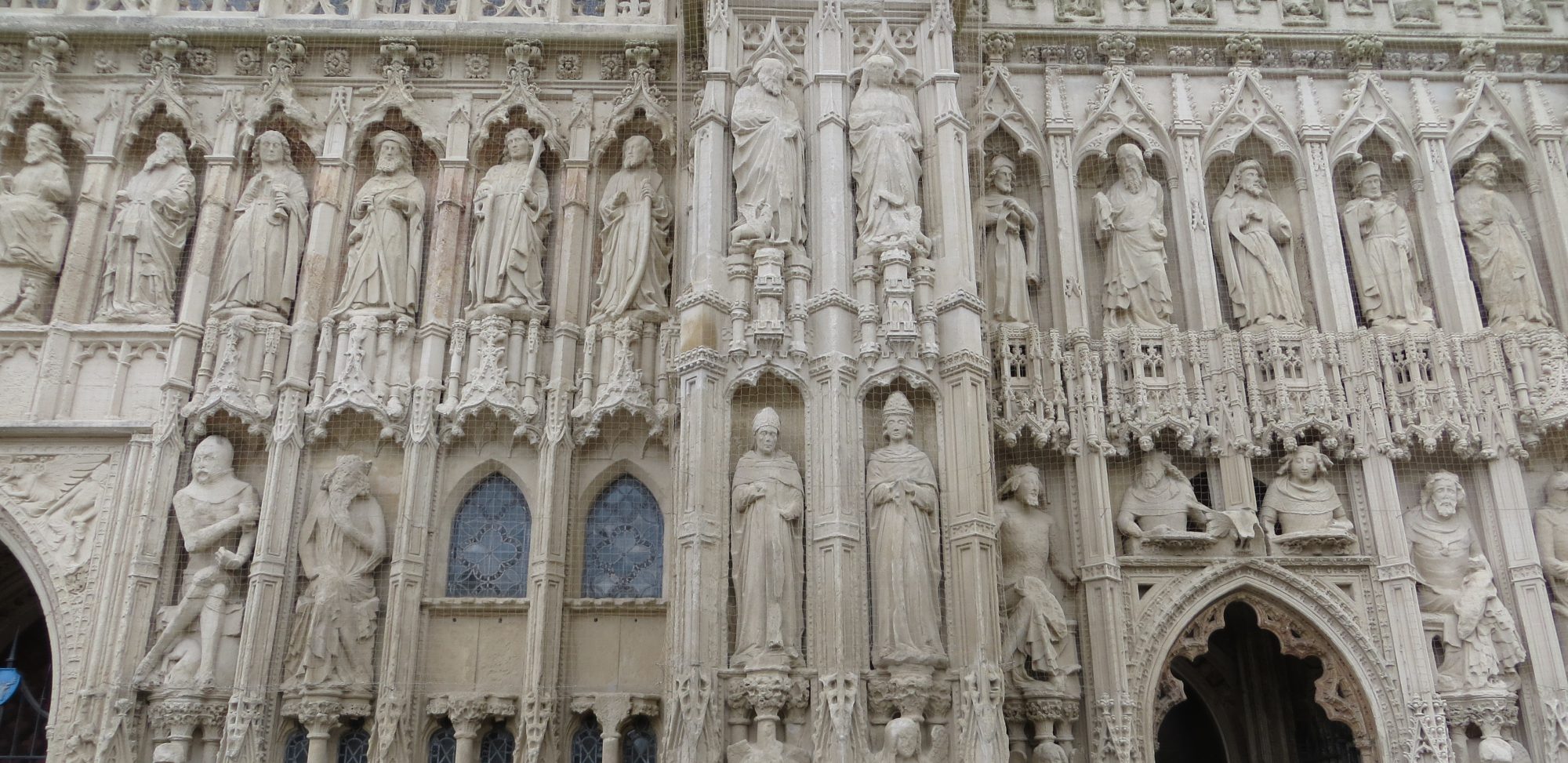
The great book about all of this is Michael Ramsey’s The Gospel and the Catholic Church. Ramsey’s argument fits perhaps best into the category of plene esse (fullness of being). Churches without bishops are certainly valid members of the body of Christ, but there is something about the fullness of the apostolic witness and unity that is lacking and toward which the churches should press with full vigor for the sake of a fuller and more adequate witness to the crucified and risen Lord. Ramsey’s book convinced the Reformed pastor and missionary in India, Lesslie Newbigin, of the significance of the catholic order of the church for the sake of Gospel mission, and made it possible for Newbigin to embrace a call to be one of the first bishops of the Church of South India. Ramsey’s book remains a classic and breaks open stale arguments by arguing for the evangelical and missionary significance of the catholic order of the church. It is a travesty that the book is out of print.

The Esse of Episcopacy

Hallo Wipf & Stock?

Bishops lead the liturgy

5.1.7 Bishops cannot exercise their responsibility for liturgical leadership effectively without support and advice. We recommend that every diocese should have a Diocesan Liturgical Committee or equivalent group, which should relate directly to the Bishop. Its task is to hold an overview of the liturgical life of the diocese, to offer advice to the Bishop and others on liturgical matters when needed, and to work closely with diocesan CME departments in providing training opportunities for clergy, Readers, and other ministers. It may be asked to help the Bishop in his oversight of Fresh Expressions of church within the diocese (cf. para. 6.5.1 below). It may also be tasked with planning special diocesan services (e.g. for diocesan conferences), but its role is more strategic than tactical. In general, it should seek out good practice, inside and outside the diocese, and help it to be followed more widely. Within the DLC, it may be helpful to have an individual who is identified as the Bishop’s Adviser for Liturgy, or as Diocesan Worship Development Officer.

Transforming Liturgy - report to the General Synod of the Church of England

We must not let our poor beleagured bishops feel that they are on their own, so they must have good advisors and teachers. But equally, something as central to the office of bishop as the liturgy cannot be delegated

Modernity and the witness of Israel and the Church

The Eschatological Economy

God’s elect people, Israel, demonstrated in the public drama of sacrifice to the watching world that Israel’s God is the one true God. But when later Christians ceased to read the Old Testament as God’s witness to the world of the Gentiles, Israel came to be understood instead as just an example of primitive society, and Israel’s sacrifice was understood as just another form of primitive violence.

The result of this was first a smug account of the superiority of the Church over Israel, then (in the eighteenth and nineteenth centuries) a story about how far we have come since we were primitive, and then (in the twentieth century) a merely secular notion of historical change and cultural relativism. The result of this belief that ancient people sacrificed animals (and we don’t), and that the particular people of Israel are forever associated with this, means that Jews became identified as non-modern. Some of the best known champions of modernity, amongst them Kant and Hegel, wondered whether the particularity of the Jewish people was an obstacle to the unity and maturity of nations.

So the issue of sacrifice is linked to that of supersessionism (‘replacement theology’), and it has significant political consequences. To look ahead for a moment – is modernity is intrinsically supersessionist? Does modernity have a prejudice against the particularity of individual peoples? Does modernity mean simply homogenisation? These were some of the questions that needed to be asked.

You can find out more about The Eschatological Economy at Amazon.com or at Amazon.co.uk or at Eerdmans