Two men

In The Eschatological Economy I compared two christologies. One is the Christian christology, in which Christ is the truth of man, and true man is in fellowship with God and with all men and creation. As Christ is the truth of man, so (Christian) christology is the truth of anthropology. I take this from Irenaeus.

But there is another ‘man’ and another, non-Christian, christology. This man is a titan. He is man without God, and without anything that is not himself. This is a christology of ascent, determined by man’s belief in his own autonomy. Man is ascending away from his fellowmen, away from bodies and earth. The great chariot of mankind roars down the track, gathering ever greater speed, zooms up the ramp, lifts off and soars into the air, leaving the earth and heading out – but then, looking around for some third party confirmation of its lift-off, the chariot hesitates, finds that it has peaked, and beginning to fall back towards earth, starts to fly apart. So it is that we find ourselves tumbling and twisting in ever smaller pieces, each making our re-entry alone. In this ‘christology’ without Christ, in which man decides to do without the confirmation of his fellows, man can have no idea whether he is in fact ascending or descending, gathering unity and permanence or breaking up and dissolving. I credit Kant with this anthropology.

So, just as there are two loves, that make two cities, so there are two men and two histories of man. One history crashes, the other is sustained by the call of God.

This is a great book

Colin Gunton in his The One, the Three and the Many (Bampton Lectures) sought to offer a theological analysis of modernity while at the same time calling Christian theology back to the heart of its faith, the Triune God. In The Eschatological Eschatology: Time and the Hospitality of God, Douglas Knight has similar goals, though here he follows the recent trend of eschatologicizing doctrine by mapping an eschatological ontology onto Gunton's Zizioulasian trinitarian ontology. This book does a lot. Knight reconceives the task of theology, the role of Scripture, christology, the Trinity, pneumatology, Israelology, ecclesiology, hermeneutics, and so many other topics. It also redefines so much basic terminology such as time, being, person, place. But I think it is most expedient to view this book as a theology from the view of sanctification, for the goal is to better understand how God transforms us into participants in his life.

Essentially Knight believes that we need an 'eschatological' rather than 'protological' ontology because humanity is in the process of becoming human. This is Irenaeus' vision of Christian transformation. He coins a 'doxological ontology', which employs the relational personhood theory, now so common to the literature (see two popular theologies that make this theory applicable Like Father, Like Son: The Trinity Imaged in Our Humanity; and Trinity In Human Community ), Knight believes that our personhood is constituted by our relationships. Likewise, our knowledge is mediated by the communities in which we participate. Thus, God transforms us by altering the formative relational structures according to his eschatological end for creation. In other words, God creates a new community - Israel/Church - and institutes new practices - temple, sacrifice, sacrament, liturgy, worship, etc. - so that humanity can become holy under his provision and grace. God teaches us to be human, and as we worship we become what we are doing.

This conceptuality allows Knight to engage in some anthropologically attuned biblical exegesis of Israel's sacrificial cult and temple. Knight is very sensitive to the political challenge marked by Israel's actions. As Israel becomes holy, the world is judged and demythologized. Israel's sacrificial cult, for instance, teaches us not to participate in human sacrifice.

On the basis of this, Knight offers a suprisingly thorough criticism of modernity. For starters, Knight dislikes modernity's static conception of 'being' (as a function of natura) and its 'immediate' epistemology. He also disdains the way it cannot account for embodiedness.

This is a great book. It makes use of much recent theology - Zizioulas, Gunton, Jenson, for example - but it does so in such a way so as to recover classical Christianity. Knight has an impressive ability to connect and assemble doctrinal themes. I hope to see him develop this portrait more. I'd be particularly interested in how his admittedly more Eastern view can cohere with Reformed theology, especially since he is a self-described 'catholic-evangelical'...

James Merrik reviews The Eschatological Eschatology: Time and the Hospitality of God.

A 'mini-dogmatics'? James really is an excellent judge of books. I am very grateful to him.

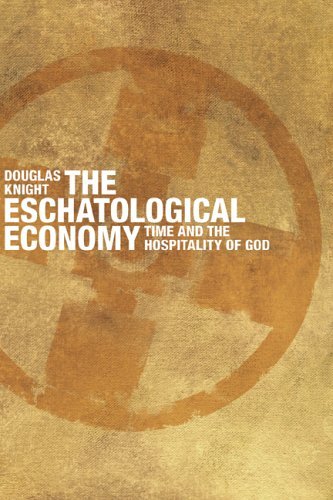
The Eschatological Economy: Time and the Hospitality of God

The purpose of this blog is to tell you about **The Eschatological Economy**. Reviews are beginning to appear.

In this ambitious book, Douglas H. Knight sets out to illustrate the way Christian theology can function not as one category of knowledge within a larger secular account of the world but as itself the site of open and rich thinking on anthropology, sociology, psychology, language, history, and politics. It is not the secular economy but Christian orientation toward eschatology that provides this openness to the new. Knight attempts to do profoundly theological work while renouncing the religious language by which theologians tacitly accept their marginalization.

This work offers much for theologians to celebrate, ponder, and engage. Knight's attempt to out-narrate anthropology and psychology challenges other theologians to take their own training more seriously and rather than cursing the darkness of modern anthropologies, to turn on the theological lights. He makes bold attempts to overcome spirit/body dualisms, so that "our theological concepts always remain in touch with the biological, chemical, and physical" (p. 203). His section on Israel's sacrifice as parody of the sacrifices of pagans was, for this reader, revelatory. His integration of Trinitarian theology with scripture studies (and the attendant argument about the nature of scriptural scholarship) deserves serious attention from scripture scholars and theologians alike.

Most significantly, Knight's flair for refusing to allow theology to be trapped in its own jargon without ever sacrificing the fullness of theological content marks out new territory in the sad old debate over the coherence and relevance of theological language in public. He argues that theology can and must be public and engaged, not by becoming less scriptural or Trinitarian, but by embracing the story of God's work with Israel and the movement of history towards its End. In academic accounts of the "human" as in politics, the job of Christian theology is not only to be faithful to itself nor only to be in service to human well-being, but to work for the well-being of all creation by being the people who know what God's work in the world means. The world is not to be abandoned, but to be brought out of its narrow and self-deceived economy, its paralyzing dualism of nature and action, and into the mutual giving that God is making humanity to be.

But it is not all praise

Given that one of the book's most interesting and well-developed themes is the modern inability to deal with the issue of unity and plurality, it is particularly disturbing that Knight's attempt to claim the physical as a site of the work of the Spirit never mentions female bodies. He discusses the work of the Spirit in reproduction in Israel, develops Adam theology, expounds at length on the nature of sonship, and provides serious theological consideration of semen and circumcision while never mentioning Sarah, Hannah, or Mary. A reader can only wonder what sort of authorial decision led to such an omission. The oversight seems a bit too glaring to have been accidental.

Kelly Johnson Modern Theology 24.1 2008

To write a review of this sort is a major undertaking. I am very grateful for this one in particular. It is wonderful and extraordinary to see how readers discover widely differing things in one book. I have found it difficult to write reviews myself because I never know how far to criticise a book for what it does not contain. One obvious criticism of this book is that there is too much in it: in reply I would just get autobiographical and start telling you about the vanishing context of theology in the UK.

Female bodies? Obviously there is one female body I am very fond of, two bodies including daughter, and I am a member of a third - that of St Mary, Stoke Newington - but I presume that there is something else here that I don't get.

Anyway, **The Eschatological Economy**. It is yours for $18.49 or £8.65.

The Eschatological Economy: Time and the Hospitality of God

Now and again, there appears in all fields of study a work that offers its readers a radical reconception of the basic subject matter in question. In the case of Douglas Knight’s The Eschatological Economy, the term ‘radical’ is especially apt because, rather than seeking something novel, Knight returns us to the roots of Christian theology, to the basic story of humanity laid out in the biblical narratives. By returning to the roots Knight’s intent is simply to lay bare the ‘main story’ of the biblical narratives. That story is, he believes, an Irenaean story about God’s nurturing and maturing of humankind, within which Augustine’s account of the fall of Adam is not the main thing but only a subplot (p. 14). The basic thesis of the book is that the divine economy is properly understood as an eschatological economy whose content is determined from the end, rather than from the beginning. It is determined, that is, not by what humanity does before God in its infancy but by what God ordains for humanity at its end. God’s purpose for humanity – the freedom and full form of the creature in relation to God – is established and made known in Christ the one true Israelite who takes up and fulfils Israel’s appointment as God’s servant. The good news, accordingly, is that God comes to humankind and in the course of this coming we are enabled to grow up in love for God and for his creatures. That process of formation is delayed though not defeated by sin and rebellion, while time is conceived as God’s gift to us allowing the process of formation to be worked through.

The reorientation involved in the conceptual shift from a protological to an eschatological economy opens up new vistas on the biblical story that Knight explores with impressive creativity and insight. Drawing especially on John Zizioulas and Robert Jenson, and in constant dialogue with the contrary assertions of modernity, Knight traces in the biblical narrative an account of human persons in constitutive relationship. Persons are fundamental, Knight contends, and are sustained only through relationship with other creatures and by the ongoing relationship of the Creator with the creation. Such relationship is not a status but a project and so ‘an account must be given of the place and work into which persons are to grow, and so of the ongoing co-labour of creation’ (p. xvi). The freedom of the creature is the work of creation. This is God’s work and ‘very subordinately it is the task into which God introduces human beings’ (p. xvi). Thus does Knight develop, in opposition to the pervasive individualist and monist ontology of modernity, a ‘participative ontology’ in which we learn and grow into fully human being. These themes will certainly be familiar to readers of recent work in theology.

Knight’s fascinating contribution to our consideration of such themes consists in his development of them through sustained and detailed attention to Israel’s story. The election of Israel, Knight explains, is the means by which God introduces human beings to the co-labour of creation and discloses what it means to develop competence in the life that God shares with us. In communion with God, Israel learns and practices the life God gives and thus becomes, through liturgy and ministry, steward of and witness to God’s purposes for his creatures. Knight offers us a thoroughly trinitarian construal of Israel’s task. Israel’s role is that of the Son. The Father speaks to the Son and the Son hears and receives his speech. By addressing Israel in this way God draws Israel into the Sonship of Christ. Israel’s being is constituted by its incorporation into the life of the Son. All that goes on in the temple is the expression and demonstration of Israel’s appointment to Sonship. There Israel exercises the offices of story-telling, intercession and sacrifice. The high priest enacts these offices for Israel and, just so, all Israel enacts them too. Jesus Christ and Israel are thus to be understood together, the former, the one, determining the identity and task of the many. As Gentiles learn the character and action of the Son, they too, through the Spirit’s enabling, become members of his body and one with him. The Holy Spirit adopts all creation as the medium through which we grow into the being of the Son, while the event of the cross is our baptism into this new medium (p. xviii).

By virtue of this trinitarian construal of the divine economy it may be seen that God is not separated from his work (p. xvii). God plays both his role and ours so that we may come to play our role for ourselves (p. 100). This is the basic plotline of Knight’s imaginative and profound retelling of the biblical story. Along the way he offers provocative and arresting accounts of the Aqedah, of law and sacrifice, of the temple, of atonement and the cross, of the Enlightenment, of modernity and of the loss of mediation, all in service of a theological account of what our human being properly consists in.

Knight’s rendition of the explanatory and saving power of the gospel will restore confidence in theology’s mandate to understand the world in the terms that scripture offers, and to address the world with the truth about the divine economy into which all the peoples of the world will one day be assembled.

Murray Rae International Journal of Systematic Theology 9.4 October 2007

Find out more about The Eschatological Economy

The Eschatological Economy: Time and the Hosplitality of God

In The Eschatological Economy, Douglas Knight avoids the defensiveness of much recent theology and presents the Christian faith as a bold challenge to modernity. He takes Kant and Hegel to task for down-playing the significance of the particular, and urges the Church to proclaim God’s eschatological promises to a world increasingly devoid of hope.

Knight begins by discussing the nature of personhood, making extensive use of John Zizioulas’ work on the subject. Then, in the second chapter, he addresses the issue of how a holy community can come into being by a growth in competence that arises out of relationship with God. In the third chapter, he examines the doctrine of the Trinity, arguing that this doctrine is vital for keeping Christians in relationship with Jews, and for pointing to the central role of worship. Chapter four then makes the case for a positive understanding of our creature-hood and for the transformative power of the Holy Spirit.

With this groundwork in place, the fifth and sixth chapters then question the view that the West was once religious but is now secular. He says, ‘It is not that the world is becoming secular, but that the world is always secular by definition.’ (p. xx) He then challenges the notion that secularization is about showing there is only one (natural) world whilst religious people claim there are two (the natural and the supernatural). Secularization assumes two worlds: those of nature and those of human action; Christianity, on the other hand sees one world, embracing the natural and supernatural, and this is all God’s creation.

What is especially striking about this book is the extent to which Knight makes his points with reference to Israel as God’s elect people. Personhood is to be understood from the relationship of the Hebrew people to one another under their gracious God. Their holiness comes from their being with this God and from his provision of sacrifices for their sin. And their self-understanding of being creatures of a God who made the heavens and the earth forbids a separation of the sacred from the secular. Christians therefore need to pay serious attention to the Old Testament if they are to faithfully proclaim the Gospel of Jesus Christ.

Knight summarises his own work by identifying three themes: that Christian theology is not only about ideas, but about life; that it is about establishing community; and that it provides a means of saying who people are in a way that is lacking in secular society (pp. xxf). If those are Knight’s goals, this book is a great success. Theology is never allowed to lose its role as a guide to action. It is also seen as a communal endeavour, rather than something left to certain scholars. And it is not afraid of the secular ‘gods’, who seem so powerful and yet lack the ability to answer even the basic question: Who am I?

This book is a challenging read. It is bursting with ideas, many of them fresh or newly stated, and assumes graduate level knowledge of theology; it is, after all, based on a PhD thesis. But the effort is rewarded. Not only does it provide an eloquent response to modernism, it also engages postmodernism, offering many new replies to the challenges they pose, which will be helpful to pastors and apologists as well as to theologians.

Justyn Terry Trinity School for Ministry, Ambridge, PA Anglican Theological Review

You can find out more about The Eschatological Economy at Amazon.com or at Amazon.co.uk or at Eerdmans

Modernity and the witness of Israel and the Church

The Eschatological Economy

God’s elect people, Israel, demonstrated in the public drama of sacrifice to the watching world that Israel’s God is the one true God. But when later Christians ceased to read the Old Testament as God’s witness to the world of the Gentiles, Israel came to be understood instead as just an example of primitive society, and Israel’s sacrifice was understood as just another form of primitive violence.

The result of this was first a smug account of the superiority of the Church over Israel, then (in the eighteenth and nineteenth centuries) a story about how far we have come since we were primitive, and then (in the twentieth century) a merely secular notion of historical change and cultural relativism. The result of this belief that ancient people sacrificed animals (and we don’t), and that the particular people of Israel are forever associated with this, means that Jews became identified as non-modern. Some of the best known champions of modernity, amongst them Kant and Hegel, wondered whether the particularity of the Jewish people was an obstacle to the unity and maturity of nations.

So the issue of sacrifice is linked to that of supersessionism (‘replacement theology’), and it has significant political consequences. To look ahead for a moment – is modernity is intrinsically supersessionist? Does modernity have a prejudice against the particularity of individual peoples? Does modernity mean simply homogenisation? These were some of the questions that needed to be asked.

You can find out more about The Eschatological Economy at Amazon.com or at Amazon.co.uk or at Eerdmans

Learning to live with the time to end all times

The Eschatological Economy: Time and the Hospitality of God

Right from the days of Jesus’ mission between the Jordan, Galilee and Jerusalem, some have been embarrassed by the eschatology articulated in his message of the approach of God’s final reign. Some have not been able to avoid asking whether there is something shamefully mistaken or wrong hereabouts. Such embarrassment has persisted to this day. For about the last 100 years such concerns have become especially strong amongst some academic circles including theologians, historians, anthropologists and others. Complementing this, we are familiar with a recurrent cluster of embarrassments in encountering death or the dying, and topics such as guilt, sin, judgement, the worth and meaning of human life, authority, tradition, and related matters, in a wide range of contexts. The anthropologist Mary Douglas, most famously in her book Purity and Danger, explored insights concerning how we (as human beings) tend to find dangerous or dirty (impure) matters which we do not know how to make sense of, in terms of our conventional and established ways of trying to sort out our experience into various kinds and schemas. For example, is blood more to do with life or death, and how can we, how should we, keep these apart, or connect them, or both?

If Knight is right, then he offers us a powerful paradigm, new yet with ancient roots, for living and working face-to-face with such matters, so as to make better sense of them and of our shared, shareable humanity, in the company of Israel, Jesus Christ and the Christian community. His account of the triune God articulates the grammar which guides this approach. Knight helps us, here and now, towards appreciating better the riches of the vision of Irenaeus of Lyons: the glory of God is a living human being: human life is the vision of the glory of God. This is a book to buy and re-read, to argue and struggle and live with.

Ian McPherson Amazon (UK) review of The Eschatological Economy: Time and the Hospitality of God

You can read the Introduction to The Eschatological Economy on this site (right side bar) and chapter 1 at Amazon

Now you can read chapters 2-6 of The Eschatological Economy at Google Book .

Humanity is one of the languages of the persons of the Trinity

The Holy Spirit is the medium of God for humankind. He makes a real and material place for us and supplies the whole resource of our creaturely life with God. The Father and the Son speak the Spirit. The Spirit is the language they speak. But the Spirit can speak and be many languages, without being less the language of the Son and Father. The Spirit extends their speech to create a new language, which the Father and the Son are content to speak. They speak humanity. Humanity is one of the modes in which they speak divinity to each other. Humanity does not give divinity something that it did not have before; it is not a reduction of, or addition to, their divinity. The Son is the first speaker and the native speaker. He speaks humanity perfectly and is at home in the flesh; and in the flesh of humanity he is perfectly at home with the Father. He is not impeded by or disguised by the flesh, for it is brought into existence by the speaking of the Son and the Father. The human entity and mode of being are spoken by that enfleshing word and utterance. This humanity the Son receives from the Father, by the Spirit.

Douglas H Knight The Eschatological Economy: Time and the Hospitality of God chapter 1.5

Sacrifice and Israel’s witness to the nations

The Eschatological Economy

It is time for another in the series of little pieces on the logic of sacrifice and atonement, which I set out in the central chapters of The Eschatological Economy.

The reason we find sacrifice, along with other accounts of salvation, hard to accept is that we tend to overlook the crowd watching the event in the temple. A sacrifice is not a deal done between just two parties, man and God, but between at least three parties. The third is the crowd of onlookers – made up the whole people of Israel. In fact there are two crowds – Israel is the first and nearest, but all the rest of the world is also there, watching Israel and her God from a distance.

But modern biblical studies does not find it easy to account for the public nature of performance. In The Eschatological Economy I wondered whether this is because we assume that writing is the only valid, because verifiable, mode of communication. Do we assume that what cannot be written down is not significant? Yet publicly enacted drama, played out before vast crowds and the world’s media in public civil occasions, is significant – think of the ceremony attached to Olympics, or public acts of flag-burning. If do not concede the meaningfulness of such large scale public ceremonies, or ‘ritual’, how will we understand what was going on in the public events of sacrifice that took place in Israel’s temple at Jerusalem?

In the theology of Israel, the nations were represented by animals: Israel was represented by the lamb. The presentation of the lamb in the temple in Jerusalem was the enactment of the promise of God that Israel would triumph over all the predatory gentile nations of the world.

Though this is not directly theological work, it does build the case that modernity is in denial about crowds and plurality, and about other more embodied forms of rationality than its own, and it helps show that sacrifice does make good sense as an account of the atonement. This will help us show that the atonement makes good sense as account of the relationship of God and us, and also that it makes for a better account of relationships between ourselves. Theology makes for a better sociology than sociology itself does.

You can find out more about The Eschatological Economy at Amazon.com or at Amazon.co.uk or at Eerdmans

Sacrifice and Israel’s holy witness

The Eschatological Economy

To understand the theological concept of sacrifice we need to learn the connections between all the various parts of the theology of the Old Testament. The election of this people, the covenant, and the whole life of this people in obedience, and disobedience to God, is the key to sacrifice. This is what I wanted to explain in The Eschatological Economy.

Christian theology must proclaim clearly that God calls and forms his people, bring them up as a parent brings up a child, and that God makes his people holy. But when the narrative of God nurturing and forming his people is lost the meaning of sacrifice was lost. When this narrative is lost, so is the point of what Israel did in the temple at Jerusalem. There God’s elect people, publicly, before the watching world showed (and of course said and sung in worship) that Israel’s holy God provides for his people, is creator of all the earth and that all the gentile nations are wrong to believe that they have to please and provide for their various divinities. The Israel's temple practices were publicly demythologising the violent cosmologies of the nations around. Israel is critic of the world of the pagans, and witness to the true God, who provides for and hears all who pray to him. Israel not only says this, but acts it out in the drama and ritual, that we call ‘sacrifice’ in the temple at Jerusalem.

You can find out more about The Eschatological Economy at Amazon.com or at Amazon.co.uk or at Eerdmans

Postbag

EE

Dear Dr Knight

I am on my second reading of â??EEâ??. As a Lutheran layman I am a reader of First Things and Touchstone. My pastor and good friend has just left our Lutheran church and communion for the Church of Rome. About the time he announced his decision to leave, I ordered â??EEâ?? on a whim and a few reviews. I have found it to be an excellent work in addressing the problems of church division and modernity. I have been quite frustrated with the very questions you address: Creation, Israel, the work of the Holy Spirit, and how I raise my children in the midst of screaming cultural conversations. Thus my second reading. I am captivated by the bookâ??s premise of a Trinitarian theology in which God is bringing his people to a fullness and freedom through his dynamic work: Father, Son and Holy Spirit. I have often struggled in this highly individualized culture with how to participate in the life of God as Body of Christ and how the time afforded me fits with that of the fullness of that Body in its history. Thank you for your diligent work. It has helped to clarify much of what was bothering me so much. I shall probably have a number of questions â?? one of which I will ask you now. Do you have an outline of â??EEâ?? that would enable me to teach an adult class in my church? I really believe that Christians of all educational levels (and economic levels) are struggling with the questions your book so helpfully addresses. I intend on developing such a series of classes that relies on scriptural readings, parables, and questions pertinent to the development of an eschatology that informs faith and inspires Christian formation. Can you help me with this? Sincerely your in Christ, CG

* * * *

Dear Christopher Many thanks for your wonderful mail.

Yes I do have an outline of The Eschatological Economy, though it needs more work. I have written a series of posts on EE for the blog and to post on Amazon. I will send you what I have, though I don't know if it will help your class.

As for scriptural material for classes on eschatology that informs faith and Christian formation, I am working on that too. I have been putting together some chapters on Christian formation which I hope will be of some use to the church. I am going to call it The Apprenticeship, and it will cover much of the same ground as The Eschatological Economy, but more accessibly.

Everything that Christians say about time, history and the purpose of the world, which is that we come to share life with God, can be lumped together as eschatology. It is a catch-all for all the issues around our looking forward in hope and faith to his coming again in great glory. This means that we have to say that the world has a plot, but it doesn't really know what it is, so there are two rival accounts of the plot â?? the worldâ??s and the Lordâ??s. There is a double history: secular history and salvation history. It is the Christian privilege to point out the difference between them. That is the line I would take with a class.

But there are many other and better people working in these areas, I commend their works to you. I have started to compile lists of books on my Amazon homepage, but it is a long job and James Merrick (there is a link from my blog) for example does it better than I do. You can find out what my suggestions are by looking through those lists. It would be a lot quicker than waiting for me to produce new material.

I don't think there is any need to leave the mainline denominations, Lutheran, Presbyterian, Episcopalian, nor to feel abandoned when someone near, dear or senior does. There are many reasons why individuals might leave this or that congregation, but whether we leave or stay, the Christian life is always going to hurt, but we should always be glad of it.

We English used to think that we were in possession of the gospel: then we decided that we had seen through the gospel. Now we really don't know what the gospel is, but are still too proud to say that it matters to us. So churches don't run classes in England, and almost no one asks for classes. Where classes are run, by charismatic churches for example, they tend not to make connections between discipleship and intellect, and don't see the intellectual side work as real work. The Christian here is a student without a teacher (or teacher without a class) - a sparrow on the rooftop. Thanks. If you want more, please ask me again.

Douglas

You can find out more about The Eschatological Economy at Amazon.com or at Amazon.co.uk or at Eerdmans

Representation and participation

EE

In The Eschatological Economy I wanted to show that one unfortunate consequence of reading the Scriptures without the doctrine of election of the people of God - first Israel, then also the Church - is that the Christian tradition has under-played the process of formation and transformation, and has little comprehension that a community is being changed, because it is being brought up by its God.

We have to learn the proper interrelations of Christian doctrine, or we will be putting together elements that don’t belong together. When too many scriptural notions are simply superimposed, rather than introduced only at the proper place in a narrative, we confuse what should be distinct accounts of the work of Christ.

The most obvious of these confusions is penal substitution, where sacrifice looks like the frankly pagan propitiation of a needy tyrant. To sum up what I have said so far: sacrifice does not belong with atonement; it is about the transformation of a people, so it belongs with sanctification.

The central Christian confession that ‘Christ died for us according to the Scriptures’ demands that we explain how one person can be for another. The concept of representation is crucial to the doctrine of the atonement. Here we must meet the important philosophical challenge of Kant to representation and atonement. Kant declared that one person cannot stand in for another.

So how is Christ for us ? How does he represent, substitute, intercede, supply what we lack and do what we cannot do for ourselves? The answer must take the form of a narrative of Christ that shows his action as public action, that takes place before the world, before his own people, before the Gentiles and in contest with them - and before God who approves his work.

I have been trying to set out these different audiences of Christ’s work, and to show that these atonement models also make sense in terms of a general purpose anthropology. For others do in fact speak up for us, stand in for us, invest in us – or at least we complain when they don’t.

If we go further and understand that we not merely are, but that we also we have a share in making one another the people we are, we could even call these models of atonement ‘social ontologies’.

A patient interest in Christian doctrine brings us to a concept of participation, which used to be called 'corporate personality'. We a concept of participation to explain what we mean by the term 'In Christ'.

You can find out more about The Eschatological Economy at Amazon.com or at Amazon.co.uk or at Eerdmans

Fan mail

EE

Dear Dr Knight:

Last night a group of us (the others are Protestant pastors and I am an Orthodox priest) here in Des Moines, Iowa, decided to read your book - The Eschatological Economy - as a group. It fits with some other things we have been reading, and they are as interested as I am in what you have to say about Metropolitan John (Zizioulas). Indeed, his Being as Communion may be our next book. I am eager to read your forthcoming work on his theology.

Are you an Anglican?

If we become perplexed at some point in our reading of your book, I may email you for a clarification!

In the peace of Christ, +Lev

* * * *

Dear Father Lev and friends

I am honoured that you have picked The Eschatological Economy for your reading group. Now I really do wish it was a better book.

I wrote it as I was looking around for a systematic theology that could help us diagnose our present church situation, and to explore what Metropolitan John Zizioulas meant by ‘eschatological ontology’, and to get clearer in my own mind how Christ died and lives for us – so three different motives.

Much theology is written in a panic about our present situation. Theologians seem to be waiting for permission from someone before they say anything too Christian – so they don't seem to be our teachers any more. I think we should give them this permission by praying for them, and writing to them to encourage them to teach us to be disciples. If they do so, the panic will subside and we can start to lay the Christian proposal before the world with a bit more patience and reason.

The life of the Church must be sourced from the whole Christian theological and historical experience, because only the whole deposit of faith makes us the distinct – holy – community of witness, able to communicate this faith and so to be of some use to the world. So The Eschatological Economy reads like a set of demands, made to any theologian who is prepared to receive them, to pass on the whole deposit of faith. I have learned how to make more demands, or pray more prayers, since I wrote it.

I am an Anglican – a ‘catholic evangelical’, I think – with various friends trying to tug me in more Catholic or Orthodox directions. My theology is Reformed and Barthian, but I have learned from TF Torrance and Robert Jenson that we can grow out of the worst of our Western problems if we go back to the Fathers. This is what I have tried to do by making Irenaeus' account of the formation of man the main narrative, and making all the Augustinian fall-and-sin issues subordinate to this. Then comes the Protestant part of my agenda, which is to set out a good account of the atonement by properly relating ideas of representation, substitution and sacrifice, and to make a decision about penal substitution, and that is what is going on in chapters 3 & 4.

Of course I would like to hear your reactions to The Eschatological Economy, but there are probably other people who would like to know what you make of it too, so I would be especially grateful if you would also copy your questions and reactions into the comment box on the book’s Amazon page, or the DK blog. Then I will not be the only one to be grateful to you.

Best wishes Douglas Knight

Sacrifice in the Old Testament 2

In The Eschatological Economy I argued that the community of Israel brings animals to the temple for their God to inspect and pronounce good (or not), and thus publicly to assess and agree on the progress of this sanctification. It is not that animals are made holy, but that the whole people is being made holy. Its animal gifts are shown as samples for the public inspection of the progress towards this promised transformation. So then it is this transformation, which makes sense of this public demonstration-and-inspection process. God is forming and teaching his people. Within this process God insists that his people report back to him at intervals with demonstrations of their progress, by bringing him samples of their husbandry.

Israel's action – sacrifice – is also a public parody and demythologisation of the nations. Israel is demonstrating to other nations that their worship is all about propitiation and killing because their gods are needy and tyrannical, and thus not gods at all.

You can find out more about The Eschatological Economy at Amazon.com or at Amazon.co.uk or at Eerdmans

In praise of Amazon

The variety of information Amazon makes available for each book title grows each month. The Amazon ‘See Inside’ function takes you to the Amazon Online Reader (their equivalent to Google Book Search).

The ‘See Inside’ function now works for The Eschatological Economy : it opens the Amazon Online Reader, which allows you to select 'Excerpt' which shows you the beginning of Chapter One.

I now realise that The Eschatological Economy starts with a very steep climb, because the opening of Chapter One is quite dense. I wish the Online Reader showed the Introduction instead, where I set out as simply as I could what this book is about, and briefly what each chapter contains.

But the ‘Search’ function of the Amazon Online Reader is a wonder.

So far I have used it on The Eschatological Economy to search on ‘death of Christ’, and ‘resurrection of Christ’ (and have realised that the ‘of’ complicates matters) and ‘atonement’. Best of all, ‘Holy Spirit’, referred to on 35 pages of The Eschatological Economy. Not bad, eh?

Then you get a list of three-line excerpts in which the search word appears, just enough context to know which references are worth pursuing. Then a click brings up the relevant page.

Though The Eschatological Economy is all about the atonement, I don't use that word all that much. Nonetheless ‘atonement’, ‘reconciliation’ and ‘salvation’ all take you to the relevant discussions in the book. Here are some search results for ‘Atonement’ as they appear in the Amazon Online reader:

6. on Page 142: "... tradition, Karl Barth decided against employing sacrifice as a model for his discussion of the work of Christ. Though the atonement could be presented in sacrificial and priestly terms, Barth believes that these are now antiquated and so presents his account ..."

8. on Page 82: "... God has broken through to sweep all sins finally away. Whether hilasterion means the event or the site of atonement, the sins of Israel were all dealt with together on that one day in the year. The atonement of the ..."

9. on Page 84: "... talk of representation and substitution is alien to Israelite sacrifice, I suggest that we should see Old Testament talk of atonement of place as a solution, not a problem. If we make a hard distinction between individuals and persons defined by ..."

10. on Page 119: "... Israel and the character of Israel's God." Comprehension and appropriation of these practices are not secondary to the rituals of atonement themselves, for the rituals are responsible for the formation of Israel's new mind. According to Milgrom, all Israel's sacrifice is ..."

28. on Page 237: "... itself. The economy of modernity, and all the human and social sciences that support it, is a massive effort of atonement that constitutes this secular so- ciety. It is led by the discipline of economics, itself an ethic masquerading as a ..."

29. on Page 244: "... will be justice, both for us and for those who have been denied justice by us. Critics of the forensic atonement ask by what right God brings us to court to try us as sinners. We exercise this right against each ..."

Modernity’ brings up 70 pages. ‘God’ brings up ten pages of results, because the word appears on 261 pages of the book, ‘man’ on 63 pages. At least we know what The Eschatological Economy is about now.

Sacrifice in the Old Testament 1

The Eschatological Economy

In The Eschatological Economy I wanted to show that when we talk about sacrifice, in the bible or in ancient pagan world, the first question we have to ask is whose sacrifice? Do we mean Israel’s, or the sacrifices of other nations? The difference between sacrifice in Israel, and sacrifice in the rest of the (pagan) world is the difference between the true God the false gods. Failure to make this distinction confuses everything said about the topic of sacrifice.

I argued that, for Israel, the decisive point about a sacrifice was not that something was killed, but that something was presented – to God and to his people. Sacrifice was a public act so the animal admitted to the temple is a public demonstration that Israel, and the individual Israelite, is admitted by God.

It was also a double act. The sacrifice is coming from God to Israel, and from Israel to God in thanks and recognition of God’s initial gift. God gave Israel gifts and he did so publicly, before the watching world - Thou hast prepared a table for me before the face of mine enemies… (Psalm 23). So sacrifice serves to sustain the relationship of the people with their God, and to show Israel and the gentile world beyond, what that relationship was.

You can find out more about The Eschatological Economy at Amazon.com or at Amazon.co.uk or at Eerdmans

Solly on 'The Eschatological Economy'

Recapitulation – God's reverse engineering of creation. Eschatology has tended to mean that which is to come. Then it meant that which is to come which has actually come in Christ, the proleptic future. Now it means the bow wave of God's work of recreation, coursing through the created order, renewing everything in line with the end. It's quite an image, and an idea, and in one sense challengeable at every point, yet we see by faith not be sight. The Church is on the crest of that bow wave, or it should be. Sometimes it isn't. The world seeks to resist that bow wave, puts up its sand banks, and storm walls. But God just does a new thing, outflanking the world. A crucified God: who'd have thought it?

Douglas Knight reminds us, once again, that we are grafted into Israel, not the other way around. We then partake of Israel's paideia. We are in the same school as them. Yes, things are different, for Christ has come, who has summed up Israel in himself, yet also, the people of Israel are still being formed. Their story is not a handy source of illustrations, much as we might refer to Shakespeare, or Dickens for illustrations; their story is our story, which is God's story, his narrative. Israel is still central to God's plans. This is the election of God, through which the world is blessed.

Pay a visit to the all-new Solly Gratia.

You can find out more about The Eschatological Economy at Amazon.com or at Amazon.co.uk or at Eerdmans

Changes that have a future - George Ille on The Eschatological Economy

The Eschatological economy makes daring and provocative claims:

`Christian thought is political. It contradicts other systems of ideas and creates a real encounter and contest of world-views...'

`Modernity is a religion... Modernity and Christianity are both forms of enlightenment, but modernity is the counterfeit version, Christianity the real one...'

`The Word of God identifies Western being as a failure of action and of relatedness, and thus as a failure of being... `

Such bold claims require a radical approach and in an important sense Douglas Knight's book is about the totality of the real: about God and God's action and about time and history.

`Modern thought [was] ever ready to take things apart but [was] unable to put them together again'.

Yet, while making bold claims about things theo-logical, the book is also about humanity, perhaps profoundly about humanity. After all, God's action and being are deeply bound to humanity and there is no knowledge of the Creator God without knowledge of his creature.

From this perspective the book is about personhood, about sanctification and transformation, that is, about paideia, which becomes, in Knight's use, a key theological term. Special attention is accorded to the `stage' of this transformation and especially to the role of Israel in this process.

`A Trinitarian and Irenaean view of Israel's anthropology puts human beings in touch with the creation of which they are members. Humankind is hosted by God and brought up by him into the practice of God's hospitality.'

The sacrifice of the Son, the event of the cross is shown to be the apex of God's labour for and with the world, through which we are integrated into the person of the Son through the Holy Spirit, becoming thus members of his body, the Church. All these things are spelled out in conversation with the contemporary (post)modern world, its claims and proposals, systems of ideas, dichotomies, utopias and above all, its idols. It is a conversation to be sure, but it is also a contest and a battle against falsehood and pretense, an affirmation of what really `is' and what `is to come', against a rhetoric of `being' and self-made existence.

In this sense, the book is also about method and sources, as it advocates reflection that listens to the Scriptures and acknowledges the richness of church doctrine and tradition. Indeed, Christianity can and must tell the difference between constructive change and mere decay since `one way of being human is very considerably better than other ways'... Knight modestly claims that there's nothing really new in his book (This reminds some of us of Zizioulas' modest stance!)...

Yet the book offers a genuine experience of the `new', just confirming, perhaps, an underlying theme in Knight's book: It is only as we respond to God in obedience and praise that we allow him to do new things; we allow Him to labor `changes' that have a future, changes that conform us to the image of His Son.

After all, the Gospel, as Knight reminds us, `is the most exhilarating thing in the marketplace'... Getting a taste of this pathos alone makes the book worth studying. A must read for all Theology students and preachers but also for philosophers, sociologists and political theorists who engage themselves in `descriptions' or `prescriptions' of the contemporary world.

George Ille's Amazon review
Solly on 'The Eschatological Economy'

God is judge. This is an idea that has undergone a metamorphosis in my mind. Too often 'God is judge' means he is like those guys in red dispensing retributive justice in our British court system. This was Luther's apprehension of God before he understood things better, but it is an apprehension that seems to creep easily back into Reformed thought on the ground - and possibly Catholic thought too. God is out to punish sins, so watch out. God is a judge, and a judge gives you what you deserve. Okay, he actually gave Jesus what you deserve, as the doctrine goes, but after that, you had better watch out, cos THEN he will give you what you deserve if you don't behave. Legalism goes hand in hand with this. Of course, it's not God's fault at all but the use humans make of the idea.

This would seem to mitigate against the idea of God as punishing judge rather than saving judge, since Christians can be all to quick to judge others, including their salvific position before God - check any Christian debate forum - and I don't think that that is what is meant. We need a word that covers action on behalf of those in trouble as well as conveying the thought of discernment. Not that God did not punish, but the glee with which people, including Christians, will cut another off for some transgression, is surely not an imitation of God's actions. No wonder Jesus said forgive seventy times seven times…Something more is intended. Remember, The Eschatological Economy is about paideia, about God training up a dysfunctional houseful of delinquents and outcasts to be a mature family carrying on their father's work. Is this also where a renewed Protestant thought touches base with Eastern Christianity and its doctrine of theosis, if one sees such a thing from a vocational angle, rather than just a 'spiritual' one?

In addition to writing the world's longest and most charitable book review, Solly blogs perceptively about Israel and Atonement. Visit Solly Gratia.

You can find out more about The Eschatological Economy at Amazon.com or at Amazon.co.uk or at Eerdmans

Why I wrote 'The Eschatological Economy' 2 – Sacrifice

The Eschatological Economy

In The Eschatological Economy I wanted to show that there are interesting reasons why modern society wants to believe that the concept of sacrifice is vicious and outmoded. Modernity is not only mistaken about this, it is concealing something about itself. Christians certainly need to rediscover a clearer and more trinitarian account, because the concept of sacrifice is central to the gospel and cannot be removed without loss. Jesus Christ is ‘the atoning sacrifice for our sins, and not only for ours only but also for the sins of the whole world’. My own professor, Colin Gunton, wanted to show that the concept of sacrifice makes sense, but he found it hard to show how. Many other theologians, like the New Testament and patristic scholar Frances Young in her ‘Sacrifice and the Death of Christ’, were saying that ancient people sacrificed, we don’t, so it difficult or even impossible for us to make sense of Christian doctrine, in terms of sacrifice at least. I was amazed to find Karl Barth saying the same thing (Church Dogmatics volume IV.1 p.275). Frances Young and Karl Barth were puzzled because they understood sacrifice as propitiation (placating a fierce judge), which seems to suggest that pain must be experienced, which is very close to saying that God demands the pain. The problem was that the concept of sacrifice had become linked in Augustinian theology to a doctrine of God that was more pagan (Stoic) than Christian.

It is part of the creed of modernity that we have left all our earlier violence and superstition behind. Just as Christianity surpassed paganism, the modern worldview believes that modernity has now surpassed Christianity. The belief that one system and one age gives way to another that is superior, is itself a ‘replacement theology’, or supersessionism. It believes that we used to be religious, but now we are not. It is up to the Christians to pop this balloon, and point out that one religion (Christianity) has been swapped for another (modernity) but it is still an open question which religion is better. Christians have to say that if a society, like ours, gives up Christianity it has not gone beyond Christianity, but simply gone back to the default position and become pagan again.

See The Eschatological Economy at Amazon.com or at Amazon.co.uk or at Eerdmans

The economy of man without God versus the economy of God for man

I have one reader. But what a reader. Solly has clambered into the lumber room of my head and has started picking things up and putting them back in their proper places. Already I am beginning to feel better. I think I see what I was trying to say. What we seem to have in this book The Eschatological Economy is a very simple contrast. On one had we have the economy of modernity (â??the way we are nowâ??) and on the other the economy of God, the eschatological economy. The eschatological economy is simply reality and the arrangements God makes by which we will enter reality, join him there and so become real ourselves at last .

Here is Solly setting out what is going on in The Eschatological Economy 5.5

â??It is the concept of God's time, of God making time for us, and the idea of debit and credit in our relationships, that stands in opposition to this â??economy of modernityâ??. This is the focus that reassembles the fractured understanding Christian theology provides at the moment: Spirit is personal and proactive, not impersonal and reflective; time represents God's longsuffering and hospitable attitude towards us not something we must suffer and finally be ejected from; we have responsibility to one another, humans are holistic and interactive, mutually giving and receiving, not prefabricated and schizophrenic automatons feigning freedom in an unfree world. The world as it is posits ends, ends we are all assumed to have accepted, but the revealed secret of the Emperor's new clothes is that there are no ends, merely the eternal recurrence of the same, for there is no change in this world, only fashion, no growth, only talent acquisition, no people, only personalities. We live in a moebius strip, acclaiming the return of that which was past as new and fresh or secretly ironic.. The important fact of the work of the Spirit in the world is not that it represents the sum of what has happened - the spirit of the age, etc - but that it represents the fact of something new happening from outside the closed system we have made of the world, constantly opening up that which we seek to close off from God, just as the Spirit's work in the resurrection of Christ stopped the foreclosure of that part of history. As the writer says in Ecclesiastes, characterising the secular world, there is nothing new under the sun. But God makes things new.â??

Visit the great Solly himself

See The Eschatological Economy at Amazon.com or at Amazon.co.uk or at Eerdmans

Why I wrote 'The Eschatological Economy' 1 – Sacrifice

Here is the first of a series of posts on why I wrote The Eschatological Economy. I will start with atonement, move on to the doctrine of election and the people of God, and to the issue of time. Later on I will talk a bit about practices, bodies and the distinctive Christian life and then talk a bit about modernity and the non-Christian way of life. Since these are all interrelated there will be some repetition, but I hope you will not mind that.

The Eschatological Economy

The Eschatological Economy started because I wanted to know why the concept of sacrifice had become so alien to us, and whether sacrifice really is as wrong or incomprehensible as many believed. My own professor, Colin Gunton, had restated the place of sacrifice in theology of the atonement. In ‘The Actuality of Atonement’ he argued that some very traditional and unfashionable atonement models, such as the Christus Victor model, the concept of sacrifice, and Anselm’s account, still made good sense. But Colin Gunton was able to make only limited sense of sacrifice. He used to quote Hebrews ‘the blood of bulls does not take away sin’ at me and insisted that we moderns no longer practice sacrifice. I tied to convince him that we moderns sacrifice too. We don't sacrifice sheep in the public square, but we do rear and butcher animals, and the way we surround this process with (industrial, commercial) ritual and keep it is as far out of the public eye as possible is equally strange and even (in a non-Christian sense) religious. It is not crazy to say we sacrifice people, or that other people are involuntarily sacrificed – expended – for us. The economic levers and gears that provide us with our standard of living may be doing so by grinding the faces of the poor, and if we deny that this could be the case, that our comfort is at the cost of their sacrifice, we may be living in denial. So I think we are mistaken if we think that sacrifice and ritual took place in the ancient world but don’t any longer – because this makes much ancient Christian teaching – most of Hebrews, for instance – difficult to understand.

See The Eschatological Economy at Amazon.com or at Amazon.co.uk or at Eerdmans