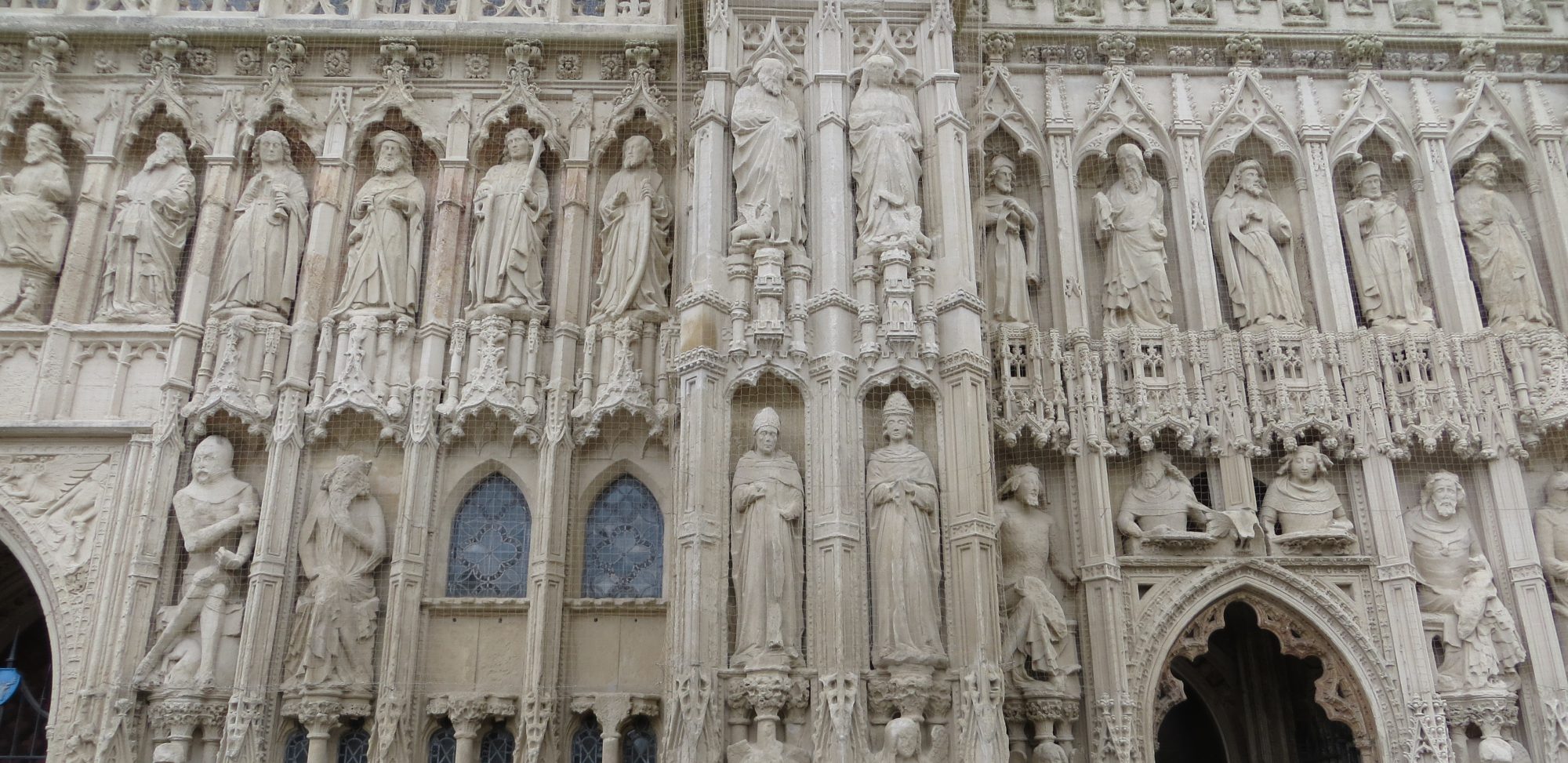
Solly at Solly Gratia is reading a really tough book at the moment. He is riffing on its opening lines, just saying what occurs to him as he goes along and thereby asking all the hard questions about the context and audience, not only of this theology book, but of theology. Who is it for, and how can they hear it? I'm hoping Solly doesn't give up - because it is for him, and not for him only but for anyone who asks.
N.T. Wright - where to begin?
Dear Bishop Tom,
I have enjoyed the Maurice lectures immensely. In your first lecture you told us about postmodernity, apocalyptic and time, and talked about the tension between the ‘now’ and the ‘not yet’, and about true and false expectation. Your second lecture, about art, suggested that good art tells us about this tension between present and future, so we understand two things about the glory of God – that it does already fill, and that it does not yet fill the earth.
Often you introduced what you had to say with the phrase ‘the New Testament narrative shows …’, or ‘the Scriptural tradition shows…’, and at other times with the phrase ‘Art shows…’. Can I ask some questions about this?
Does the bible show us…, and how does it do so? Does art show us…, and how does it do so? Isn’t there is endless wonderful disagreement and controversy about what either the bible or art shows us? How should we assess what you say they say? What criteria do you commend to us?
Isn't bible just another text, or artwork or commodity, about which everyone’s opinion is equally valid, until we, its readers, come under some control? If your view of the bible is right, isn’t that because you have found the right control? The right control enables you, and us, to read the bible as a key to some of the other subjects you have explored …. art, culture and politics. Is there any reading of the bible that is useful until it is under some control and is honest about what that control is? The particular control that you and I advocate is that given by the Christian Church and tradition. Why be reticent about saying so? If we are not up front about this, we will be concealing our control. All other discourses – art, politics and above all, the market – conceal their hermeneutics because they want to conceal what communities, and elites, they serve. If we do not say straight out that our control is the Church and its tradition, what we have to say about art, or politics, or the bible, is just another ‘discourse’, a piece of rhetoric and power-play.
We agree, I suppose, that the bible and the Church belong to each other, each being the source and control of each other (both sourced in the kindness of God)? The bible makes Christian doctrine. The bible creates the Christian community, its form of life and the account it gives of that form of life through time, that tradition of teaching that has learned from the encounters of the bible with different cultures. Christian doctrine is the accumulated experience of the Christian community at reading (1) the bible and (2) the world. This community of the Church reads the world through the bible. Any other community or hermeneutics will read the bible through the world, and so get as many readings of the bible as there are views of the world. Have I got this right?
Why don’t we say that there is no useful interpretation of modern culture or of art that is not formed by the discipline of the Christian tradition, itself controlled by the bible (both functions of the generosity of God)? Only when we are under this control does the bible give us a distinctive Christian hermeneutic and way of approaching the world – in faith, in hope and in love, for example. Aren’t you offering the distinct Christian view without saying where it comes from and how you got to it? You are giving us your answer to the sum without giving us your workings, that is, without giving us the means by which we can follow you and come to the same conclusion.
Is there any useful interpretation of modern culture or of art that we Christians can give that is not formed by the discipline of the Christian tradition (itself controlled by the bible and by God)? Of course each of us can give our own opinions, without sourcing any of them from Christian teaching, but then the question is, what is distinct about the views we offer? Only when we are offering what the Church knows, which is different from what everybody already ‘knows’, are we doing something really useful. Are we giving what we have received (in faith, hope and love), from the Church, and which the Church has received from God? Or are we offering what derives from ourselves as individuals, so is ultimately just rhetoric and power-play?
It is good thing to be a Christian – Church-formed – reader of the bible, because such a reader of the bible may be a well-formed interpreter of art or commentator on global politics. The mind formed by the long experience of the Church shaped by the bible is a good mind, and even the secular university can concede that.
It is unfair to make this charge against you of all people because, far more than most scholars, you do display your workings. You show us the politics that drive the New Testament exegesis and hermeneutics in The New Testament and the People of God, for instance, so you offer your argument in a generously-drawn context. But, because you are a bishop (discipled by, and discipling us with, the authority of the Church) you are big enough to take this question: Have you done the same in these university lectures? In your talks so far you have not said that your views are anchored in what the whole Christian community declares publicly to the world in every act of Christian worship.
So when, in your first lecture, you took us through the doctrine of hope (eschatology), why did you not tell us that you were offering us what the whole Church offers, and teaching us what the whole tradition teaches? Why did you not once say ‘the experience of the Church on this point is….’ or ‘Christian doctrine alerts us to…’? Why not quote the teachers of the Church – Irenaeus, Augustine, Gerald Manley Hopkins – so we can look them up and begin our own acquaintance with them? Don't tell us that Hopkins is a poet – tell us that he is a theologian, found edifying and approved by the Church. It is intellectually robust and generous to wear your colours on your sleeve. It dares other discourses to do the same. Christian faith is intellectually respectable and may be argued from at the outset. It does not require that we argue to it from some other, notionally wider, more acceptable because ostensibly more liberal, position. It is not the case that if you talk from within the Church, only the Church hears you. The world will hear too the moment the Church says anything distinctly its own.
Many thanks
Anglicanism
Over at Confessing Reader, Peter Brown’s article on the future of Anglicanism, in the United States in particular, starts by thinking through the institutional possibilities but quickly gets down to the theological motives and principles. Here are three of the points he makes:
1 The bond of communion is a sacramental witness to the love of God on earth.
2. The catholic community is a necessary context for authentic exegesis of Scripture
3. To survive as a unified body, Anglicanism will need to develop an authoritative tradition of Scriptural interpretation. In order to provide an effective restraint, this authoritative tradition will need an institutional voice. In short, we will need something very like the Catholic magisterium; indeed, since we have retained episcopal governance, our episcopate is the natural location for such an interpretative function.
These three points are blooming obvious, so it is only a very short time I am sure before we start to hear these points being made by bishops in the United Kingdom. After all it is exactly these three points that make a bishop a bishop.
Whose crisis?
Here is more provoked by O'Donovan’s move (see post below).
In every university in the UK administrators are making it difficult to do any academic theological work. But administrators don’t start out as administrators, but as academics, people excited by ideas. But those academics who do not care to explore the wonderful world of the Western intellectual tradition right back to its beginnings, are very likely to run out of ideas. Then they will lose interest in their subject, be attracted by anything that relieves of what they will then see as the burden of teaching, they will be drawn into preoccupation with syllabuses, examining and funding, and so be drawn into administration. Those who search that long intellectual tradition will find there all sorts of ideas about what it is to be human and what humans have to hope for. Their wonder at the tradition will communicate itself through them. They will not run out of ideas, but will be happy to pass on the excitement they find there, and so they will find satisfaction in teaching and be content to remain academics.
Debate is the real business of the university. But debate costs a lot of nervous energy and the risk of public loss of face is high. It is easy to turn to administration and settle for the satisfactions of paperwork, the more social soul might well get enough satisfaction from rounds of meetings. Demanding paper trails, and complying with the demand for paper trails, is certainly easier than debate.
Administrators are there to serve the university and thus to serve the debate. But because administrators do not attend the seminars in which debate takes place they are never subject to that debate, in the way every academic is. They are not subject to the conflict of ideas or to the testing of those ideas. Debate – the imperative of setting out your ideas before your colleagues and having to defend them – is a very severe discipline. Administrators are those academics who can no longer face that discipline. They place themselves above it. They put themselves beyond the control of the university – that is the universe represented by the various disciples – and so become a separate and superior class, above the academics of the university, who are thereby demoted to the status of the producers of mere product.
The Humanities (literature, history, philosophy, sociology….etc) are that part of the university particularly concerned with what it is to be human, and what humans can do and can hope for. In the long term the health of the humanities is dependent on their staying in touch with the thought of all previous generations on what it is to be human. But it is always tempting for the Humanities to patronise previous generations, to think that they know the long tradition without having read it, or even to believe that they have surpassed all previous generations and no longer need to learn and cultivate that tradition. This temptation always puts the Humanities on the edge of a crisis. When they reach this crisis, produced by laziness or arrogance, they are tempted to believe that the crisis is particularly bad for that discipline most clearly associated with a long history and commitment to things that happened centuries back – Christian theology. But Christianity is very clear about the importance of looking back, faithfully, because it understands that our ability to look forward, hopefully, depends upon it. Christian theology has a very strong definition of what it is to be human and so has a very distinct message. Unlike any other discipline of the humanities, as long as theology listens to the gospel and continues to look back and forward, theology does not lose its way.
It is Christianity (along with Platonism) that is behind whatever agenda other humanities still faintly remember. It is the Humanities which are in crisis, not theology, and this crisis will continue as long as they deny that Christian theology and the ancient tradition of paideia (Plato) offer definitions of human being and what human being may aspire to. Humanities administrators project their crisis onto theology, by appointing to theology teaching positions those who are so poorly acquainted with the Christian theological tradition that they do not understand Christianity as a tradition of thought about how to be human, and a course of education in being human (on the definition revealed in the gospel).
Here is my point. In the UK we have such administrators appointing to theological positions people who have never learned, or learned to love, the Christian tradition of doctrine, and whose assumption that the Christian tradition is in crisis is never challenged by serious engagement with that tradition. These administrators – academics who themselves no longer have anything to teach – appoint to theological positions people like themselves, who pass on this myth of crisis on in their teaching.
I told you this blog is all about stating the blooming obvious.
The Son before Jesus?
Over at the ever-excellent Pontifications Al Kimel is examining the Logos Asarkos, the question of the status of the Son 'before' taking flesh (sarx) in the incarnation. Al says that the idea of the ‘pre-existence’ of the Son seemed obvious until Robert Jenson put it in question. So far Al has given us excerpts from Hans Küng and Herbert McCabe, and a tell-tale one-line intervention from Jenson has appeared in the comments box.
In my view we have to rely on this concept of the pre-existent Son only if we set out our doctrine of Christ before we turn to the doctrine of the Holy Spirit. If we make the Holy Spirit central to our christology we will not have to rely solely on concepts of nature (the two natures doctrine) or a contrast between eternity and time (which is another version of the same doctrine). I have found it helpful to think this through in terms of language. Imagine that divinity (or equally love, or communion, or eternity) is the language spoken by the Father, Son and Holy Spirit. Then imagine that the Father and Son invent another language – humanity (or perhaps better imagine that they speak the same language with a new accent). Humanity is then the language is which God is perfectly God, and God (freely) creates us by speaking us into being, and makes himself known to us by addressing us, and makes us known and reachable (incarnate) to one another, and finally makes himself known and reachable to us as Jesus.
This way of thinking about the issue is strange, of course, but as long as we insist on busting theology up into such static categories as nature, rather than allowing it a more dynamic and inter-personal logic (such as language) we will be stuck with such conundrums as the logos asarkos. Let me pursue this a little further.
The Holy Spirit supplies the whole resource of our creaturely life with God. The Father and the Son speak the Spirit. The Spirit is the language they speak. But the Spirit can speak and be many languages, without being less the language of the Son and Father. The Spirit extends their speech to create a new language, which the Father and the Son are content to speak. They speak humanity. Humanity is one of the modes in which they speak divinity to each other. Humanity does not give divinity something that it did not have before: it is not a reduction of, or addition to, their divinity. The Son is the first speaker and the native speaker. He speaks humanity perfectly, and is at home in the flesh, and in the flesh of humanity, he is perfectly at home with the Father. He is not impeded by, or disguised by, the flesh, for it is brought into existence by the speaking of the Son and the Father. The human entity and mode of being is spoken by that enfleshing word and utterance. Having spoken us into being, they also speak through us: the Son replies to the Father in the flesh. They make us speakers. Then they speak to us and so make hearers of us. They speak to us with the intention that we hear and receive one another. They speak to us one another, giving us in this speech one another as words and gifts from God. We are to learn to speak to one another and receive one another from them, with thanksgiving.
This humanity the Son receives from the Father, by the Spirit. The Spirit takes what the Father gives him, and gives it to us, in it making himself present to us (incarnation) and us to him (creation). The fleshly materiality of Jesus of Nazareth derives from, and is supplied by, the consummated materiality of the Spirit. As yet we speak humanity very badly. It is a language and a life we are scarcely acquainted with, so like any foreigner, we mangle this language, not because we are native speakers of some other language, but just because we are autistic, scarcely able to speak. But our bad performance of flesh does not make flesh problematic for God. The Father and Son speak the language of flesh perfectly, this language is sustained by their use of it, and they will enable us to be at home in it to them.
Faith and Theology
I am very grateful to Ben Myers of Faith and Theology for an extraordinarily energetic and creative blog, full of competitive but informative lists, links, news and bits from Barth and Jüngel – the perfect blog really. It is only hard to see why he has made my much duller effort his ‘blog of the week’.
I think Arni over at Annall is spot on about the two of us – Ég rakst á tvö áhugaverð guðfræðiblogg um daginn, öðru er haldið úti af Douglas Knight, sem er breskur guðfræðingur. Hann kennir við háskólann í Leeds ef ég man rétt. Hitt sér Benjamin Myers um. Hann kennir við háskólann í Queensland. Báðir eru systematíkerar og hugsa upphátt um eitt og annað sem er áhugavert.
Ben and Arni have both taken advantage of my offer to send an e-copy of The Eschatological Economy to anyone who asks (see ‘Eschatological Economy’ in ‘Pages’). I just hope they are still as polite when they have read it.
Wright in London
The lucky few in London next week could pop along to the F.D. Maurice lectures. Maurice was one of the great teachers of the Victorian Anglican Church, who was punished by being sacked by the college which now hosts these lectures in Christian theology. The subject this year is The Bible in the Postmodern World, given by some New Testament bloke, apparently. Anyone heard of NT Wright?
Bretherton on hospitality
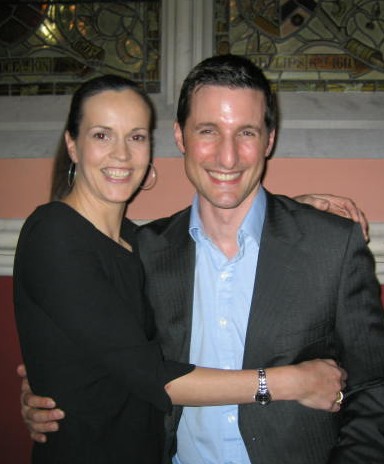
All the Glitterati were out at the reception given by the Brethertons last night to launch Luke’s new book Hospitality as Holiness – Christian Witness among Moral diversity.
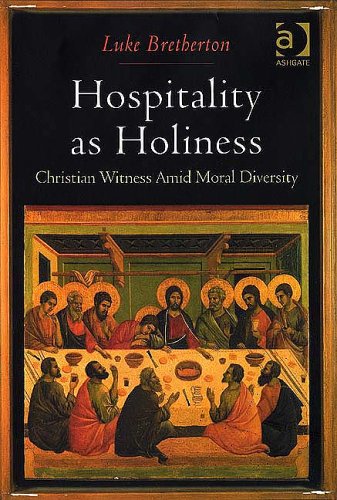
Synopsis We live amid increasing ethical plurality and fragmentation while at the same time more and more questions of moral gravity confront us. Some of these questions are new, such as those around human cloning and genetics. Other questions that were previously settled have re-emerged, such as those around the place of religion in politics. Responses to such questions are diverse, numerous and often vehemently contested. Hospitality as Holiness seeks to address the underlying question facing the church within contemporary moral debates: how should Christians relate to their neighbours when ethical disputes arise? The problems the book examines centre on what the nature and basis of Christian moral thought and action is, and in the contemporary context, whether moral disputes may be resolved with those who do not share the same framework as Christians. Bretherton establishes a model - that of hospitality - for how Christians and non-Christians can relate to each other amid moral diversity. This book will appeal to those interested in the broad question of the relationship between reason, tradition, natural law and revelation in theology, and more specifically to those engaged with questions about plurality, tolerance and ethical conflict in Christian ethics and medical ethics.
O'Donovan and Webster

Oliver O'Donovan's departure from Oxford is an omninous event. I wondered whether John Webster (on the right) was over-reacting when he decamped north, but it is now clear that he was not. If you want to see what is at issue, compare Webster with the man who was put in to replace him. Webster, an evangelical theologian and natural teacher and communicator, has done some great work interpreting Barth and Jüngel, the outstanding evangelical theologians of the twentieth century, and has now started on more constructive and creative theology, to show the relationship of Scripture, doctrine and ethics. Webster promises he is at work on a theological commentary of Ephesians, so this theologian is actually doing some interpretation of Scripture to show us what difference it makes, which is exactly what theologians should do, you might think. See his Holiness – it is a gem, and the kind of thing we all wish we could write. Compare this with the man who replaced him as Lady Margaret Professor of Divinity, whose latest offering takes up ‘the critique of theology found in the work of Heidegger’, and whose lecture courses seem hardly aware of Christian doctrine or its great exponents. One cares for the Christian theological tradition, the other does not, indeed believes that theology is crisis, and is intent on running it down.
This is one of those moments when the struggle for the Christian faith impacts on lives and careers in the comfortable West. I doubt whether Oxford’s administrators are troubled about losing these two scholars, because it is these administrators in every university in England who are making it so difficult to do any academic theological work. Administrators, and those who sit on appointments panels, are those teachers of humanities subjects who have run out of things to say and given up teaching. If they believe that theology is in crisis, they are wrong. The humanities are in crisis. Theology is the only part of the humanities that is not in crisis. Because theology has a gospel it has something to say. Theology believes in education and passing on a tradition of thought, and it so it has plenty to contribute to the university. The administrators appoint to theological positions people who have never learned, or learned to love, the Christian tradition of doctrine, and whose assumption that the Christian tradition is in crisis is never challenged by serious engagement with that tradition. There is no one more articulate about the crisis of the humanities and its origin than Oliver O'Donovan, see his Ways of Judgment, and Bonds of Imperfection and The Desire of the Nations - though Webster is not far behind. But what makes this so unusual is that O'Donovan and Webster were Canons of Christ Church, senior clergymen of the Church of England, employed by the Cathedral to teach Christian doctrine in the university. In twenty years time, when the university has finally disappeared up its own backside, the Christians will be meeting in the back of cathedrals and re-inventing the university there, just like last time.
holy
Demetrios said he received a great reception when he went back to Hagia Sophia. His old parishioners stood in a line to greet him one by one, with a kiss on the hand. - What does the congregation make of the new priest? - Well, he doesn't speak any English (Oops. Three quarters of this particular Greek congregation in London are second generation and don't speak Greek). - But the new priest is much holier than I am, says Demetrios. Of course, he is a monk who has spent many years on Athos. (Demetrios is married, with fourth child on the way, therefore not nearly so holy – obviously).
Christ and Israel
Some scholarship identifies the trinity as the concept that separates Christians from Jews. It assumes that the way to Jewish-Christian dialogue is to emphasise monotheism and play down the doctrine of the trinity. James Dunn tells us that â??Christianity is only Christianity when it is monotheistic. Only so can Christians remain true to their roots, to their heritage within the religion of Israel.â?? Francis Watson counters, â??If â??monotheismâ?? here refers to a view on which Jews and Christians agree, over against classical Christian trinitarianism, these statements would have to be reversed. Christianity is only Christianity when it is trinitarian. Only so can Christians remain true to their Jewish roots and to the Jewish scriptures within their canon. A â??Christianâ?? unitarianism is not a Christian faithfulness to Jewish roots and scripture.â?? I will argue with Watson that the trinity is the doctrine that keeps Christians in relationship with Jews.
There were many Judaisms. Some of them were inherited by Judaism, some by Christianity. It was only with regard to what it called Christianity that Judaism insisted that it was one Judaism and not many. Likewise Christianity insisted it was one only with regard to what it called Judaism. Considered apart, they make two. But apart from Israel, the Church may not confess itself one. The unity of each community is the function of the indivisible work of God. Each side played up the differences, and claimed that the other party had moved away from its origin. In actuality neither side took anything away from the other, or made it impossible for the other to make proper use of the scriptures. What in the Apologistsâ?? period became Christian theology was not a fixed quantity, but competition for the resources of scripture. Patristic and conciliar theology did not arise as part of a growing away from Jewish resources, or living from its â??ownâ?? resources, but as a continual process of the rising to expression of Israelâ??s scriptures as address to the world.
New Testament scholarship that does not allow the unity of Christ and Israel would be in continuity with the idealist or modern theology that seeks an individual. This scholarship would be looking for someone it has decided does not belong to his people, or they to him, an individual subject of narrative (Jesus), or notional individual author of narrative (Paul). It would be searching the first century for the pioneer of twentieth century man. It would be looking for the psychology of Jesus, understood as an individual, whereas it should relate this distinctly human mind, will and set of opinions, to the mind and sensus communis of the whole people of Israel. The rationale of Jesusâ?? action comes, not from a psychology, but from the mandate of Israel displayed in Scripture. If biblical exegesis cannot do this, it will be merely reproducing a modern concept of mind, a psychology of interiority, that is not publicly responsible or contestable. On this basis Jesus would be the first of many men defined without relation, the object of historical critical science who must be identified by separating him from the people he gathers around him. Such a New Testament studies would be unitarian. It would remove Jesus from Israel and refuse to take with him the manyness of the hands employed by the Word of God. This would be to impose an extrinsic criterion, and create a new time, modernity, that defines itself by contrast with the time of God for Israel. It would tend to resist the claim that Jesus is the messiah whose world-rule all Israel participates in. Instead, we must say that Jesus, with his people Israel, is the oneness and indivisibility of God in his work.
the Holy Spirit
Chris asked: Who/what is the Holy Spirit? That is the kind of question I like.
The Holy Spirit is our Lord. He is God, the real, the holy, the only God. There are many masters and authorities that have power over us (the Christian tradition calls them ‘gods’), but they all want something from us because they are needy. Only the real God does not need anything from us, and this is what we mean by saying he is holy. He does not engage with us because this is in his own interests, but he is interested in us anyway, and is determined that we should know this, which involves us becoming holy too.
There is no way to know God except as the Holy Spirit. When we say he is holy we mean amongst others things that he is ungraspable, we don’t grasp or get him or know him via any route we establish without his cooperation. He makes himself known, and he does so in the (holy) Son of the (holy) Father. He provides the breath, life and words by which we come together and praise God, and say publicly that God knows us, and wants us to know that he knows us. Simply by praising him we will move a little way out of the dim half-life we presently know and will shuffle very slightly closer to reality, in which you will be holy to me, me holy to you, and thus, as his holy people, you and I will become real to each other.
As the Holy Spirit powers our praise, which is our acknowledgment and appreciation of reality, we will grow into the life that he shares with us, so we won’t ever run out of things to say about him – or to one another. It is fine to ask ‘what’ questions about the Holy Spirit (or about anyone), but the answer can only be in terms of ‘Who’. The Holy Spirit is the source of all ‘Who-ness’, even yours and mine.
encourage that bishop
Last week’s Church of England Synod discussed the issue of how to look after those who will not accept a woman as their bishop. It didn't deal with the issue of woman bishops, but merely this lesser issue of how to look after those who, after the decision to ordain woman as bishops has been made, hold out against their (woman) bishop. The Synod was beginning to consider whether they should be offered another bishop to report to, under a measure allowing for ‘transferred episcopal oversight’? (Should they? What do you think?)
According to my source (my vicar is a member of Synod), the Synod doesn't know how to talk through the issue of women bishops directly, but the majority assumes that they are inevitable.
This is not the problem at all, however. The problem is that we do not know what a bishop is, and this is because we are so confused about authority. Being under authority is good for us, and it is a fundamental part of the good news of Jesus Christ. A bishop is quite simply our trainer and our disciplinarian, given to us by our Lord, to train, discipline, form and disciple us. He and his discipline is good news, central to the gospel and to our salvation. We are not left alone, but in Christ we are now to be shaped, moulded and loved, by the Church, the whole Church, the whole historical tradition and worldwide catholicity that is the body of Christ. This Church has authority over us for our sake, to bring us up and make Christians of us. But the Body of Christ is not a merely theoretical or amorphous authority that we choose to receive as we want, that we may choose the acceptable and discard the unacceptable parts of. It is a specific sets of authorities, and indeed one specific authority, one person, this bishop. The bishop was chosen, by Church, for you. You were chosen, by Christ, for the Church, for the world. The logic is exactly the same. We have to put up with you, and receive you gladly as the gift of Christ to us. So individually we don’t choose our bishop, our teacher, but they are imposed on us, by the Church. Of course we are under many authorities in the Church, but this one particular person, the bishop is all these authorities conveniently packaged in one person, whom you can ring and go and see. (In your church, the bishop is called the Moderator, or the Superintendant, or something similar).
The snag is that our (Church of England) bishops forget how to be under discipline. They forget how to take discipline themselves, and so they forget how to give discipline. They don't know how to lead or disciple us. No one ever tells them that they are the discipline of Christ for us – and we seldom pray for them. A Church without real leaders and disciplinarians is as confused and unhappy as children without parental discipline. They don't know where the boundaries are, and so are always pushing a bit further to se if they can find them. Each episode of childish misbehaviour is a question to their parents. Do you love me? Show me, grasp me more firmly. So with bishops, if our bishops don't push back, and reprimand us, it may be because they love us too little. Let us pray for them, and whenever you see your bishop, remind him of who he is and what he has to say to Church.
tinkering
You are wondering where this blog is going. You are not alone. The thing is that I have been tinkering with all three books, with the result that none of them has moved forward very fast. The Eschatological Economy proofs arrived last weeks, with the instruction that I had to get them back within three weeks, and do the index. After a day, and thanks to the ‘Find’ function on a PDF file, the index no longer looked such an impossible task. I have quite enjoyed showing the links between chapters to emphasise the book’s unity. I have entries for ‘agency’, ‘analogy’, ‘being’, ‘becoming’, ‘blood’… The hassle is that a number of footnotes don't work and I want to delete them, but cannot do so now without pages changing. If pages change I will have to re-do the index. I also have been trying to re-write the Introduction to the Zizioulas book, and hope that Demetrios will offer some critical comment on it when he appears tonight. Because they are fasting on Wednesdays and Fridays, these are the days I invite tall bearded Greeks round. I hope to be shot of books 1 and 2 in a month, and then can get going on the doctrine again, and try to take an interest in where we are in the church year.
being and doing
That is the thing about the blooming obvious. You have to keep saying it over and over again. So…
Being and doing are one and the same thing. The work of each creature is the being of all other creatures. Their work is not only the well-being of all other creatures, but their very being. But there is more at issue even than this. It is not only the being but the freedom of other creatures that is our purpose. The freedom of all creatures is the task of all other creatures, and it is sustained only by live relationship with all other creatures. This nexus of relationship which sustains the freedom of each, is itself sustained by the ongoing relationship of Creator with the creation that he has made and now maintains. Our Creator intends not that we merely are, but that we live, that we become animate and vocal, and able to respond to one another. He intends that we participate in one another’s formation, and do so freely and willingly. An account of man must therefore include an account of the place and work into which he is to grow, and so of the ongoing co-labour of creation. The perfection of creation is dependent on the finished and perfected freedom and personhood of man. Man does not yet have freedom. His freedom depends on God's determination not to cease from his work until man has grown into that freedom. The freedom of man is the task of God, then, and very subordinately, it is the task into which God introduces man. Under God, we bring one another into being. This is a participative ontology. Obvious, isn’t it?
Protestants will always hold out against the rest of the Church
Protestant identity is defined by opposition to Rome. Protestants may disagree vehemently on various doctrinal and ecclesiological issues, but they are firmly united in their rejection of the Pope and other Catholic distinctives. The Protestant Churches will never ever ever, not in a million zillion years, give up their freedom from papal authority; they will never give up their private judgment. That’s why Protestants are Protestant and like being Protestant. This is why they enthusiastically embrace denominationalism and branch theories of the Church. To be Protestant is to enjoy the freedom to choose one’s own church or even create a better one. Bottomline: All Protestants agree that the Catholic Church must abandon her claim to be the true Church: she must become a denomination just like everyone else. The Protestant commitment to denominationalism will never change, because to change on this point is to cease to be Protestant. I do not know if Catholic ecumenists really understand the Protestant mind and spirit at this point. It doesn’t matter how many ecumenical agreements are reached. Such agreements only express the views of the ecumenism experts; they do not impact the essential structure of Protestant identity.
Read the rest of Al Kimel's post at Catholicism and the Ecumenical Adventure over at Pontifications.
Chris Seitz OT, Rule of Faith, NT, Christian Scripture and Church
Three reigning misconceptions, based upon faulty scriptural and church historical premises, with incalculable fallout
1. There is no scripture until the church creates such * the flaw here is not the usual one entailing a Reformation debate over sola scriptura or disputes over the relationship between church/tradition and scripture (these are important topics in their own right) * rather, what is in error here is imprecision or an improper understanding of the character of the Scriptures as inherently a dual witness of prophets (OT) and apostles (NT) * the OT canon is sufficiently stable that it is an antecedent witness, not only to the Church but to Jesus Christ; so there is no church without scripture in the sense of the scriptures of Israel existing both prior to NT and a two-testament Canon of Christian Scripture * when the creed says that Jesus Christ died and rose again ‘in accordance with the scriptures’ the antecedent character of the scriptures of Israel is stipulated * to state it more ambitiously, one might want to speak about a proper dialectical or reciprocal understanding of the relationship between Church and NT scriptures, or between Church and an emerging collection of apostolic writings * but this discussion ought not confuse the fact that the OT scriptures preceded the church; that this precedence required careful examination was due to the authority of the Church’s Risen Lord, and the need to correlate Easter faith and the memory of Jesus’ own bearing toward the scriptural witness from the bosom of Israel, with the maintained conviction, especially strong among Gentiles outside that household, that the God of Israel, the LORD, and the Lord of the Church, Jesus Christ, were one (see Philippians 2);
2. Creedal confessions follow in a straight-forward, sequential way, from the Canonical Scriptures * we have already touched on this above * here it is important to observe that creeds emerge in the life of the Church as the formation of the NT canon is still a developing matter * A false kind of sequentiality assumes that creeds are the third in a line of canonical developments, from OT to NT to Church confession, when in reality, creeds exist in the lived life of the Church, and stipulate not just matters of belief, based upon or independent of, a scriptural witness (depending on one’s view of this), but how the scriptures—first OT and then NT and then both together—are to be heard and received, from faith to faith; * That is, creeds stipulate the ontological identity of the LORD with Christ (‘my Lord and my God’) * It is for this reason that recourse is made in apostolic writings to what is termed a ‘rule of faith’ * The rule of faith—whatever else it is—is a guide to reading the scriptures of Israel, in the light of apostolic teaching, as the Church’s received authority * The rule of faith is a doxological, threshold, affirmation that the LORD of the Old Testament and Jesus Christ are one, and that the Holy Spirit ‘spake by the prophets’
3. The post-apostolic Church is to be understood as self-evidently more connected to the NT than the OT, and so Christian Scripture leans from Old to New * on this understanding, the post-apostolic church sees the relationship between OT and NT as one chiefly of religious development * on this understanding, the concern for establishing ontological identity, in the time of the formation of the NT, between the LORD of heaven and earth and Jesus his eternal Word, becomes secondary to an understanding of religious development; * and so the OT ceases to be heard as a witness to the Father of Jesus Christ; or to Christ as central to its claims about God; or to the Holy Spirit in a dispensation before the NT * The Church finds its theological and its ecclesial rootage in a second testament which carries over and adapts what went before in the first; * The Church has a relationship to the NT which improves upon an earlier witness * This developmental understanding of Church and the two testaments of Scripture is what lies underneath the crisis of and widespread confusion over use of the Church’s Scriptures in our present neuralgic times
Chris Seitz The Anglican Crisis in Interpretation and the Two Testament Voice of Christian Scripture
Chris Seitz on the Old and New Testaments
Adolph Schlatter lived at the turn of the 20th century and taught New Testament and Theology, Church History and Metaphysics; he was a keen churchman, and much loved pastor. The shadow cast by Harnack was long enough to keep him on his mettle and the young Bultmann had not yet made his mark, though his challenges would soon occupy formal theology. Schlatter was known for his work on God’s action in the world. He is a New Testament scholar who worked closely in the Old Testament and especially Genesis 1-3. Nowhere does Schlatter work to establish the philosophical warrant for his using the Old Testament doctrinally, to account for how God might be said to act in time and space. There is a natural movement between Old and New Testaments and into the doctrines of Christian believing and living. Schlatter takes it as a given—at the level of metaphysics—that in order to know who God is and how he acts, in ‘creation, preservation, and in all the blessings of this life’ one reads as closely as possible the sentences about this activity as the Old Testament sets them forth. One feels nothing of the later environment of the history of religions; or of theories of development in authorship of the Pentateuch or in comparative Near Eastern studies of creation accounts. And yet there is nothing of the air of creationism or defensive apologetics either, and in this he is rightly regarded a sophisticated forerunner of Karl Barth. There is just the exhilarating task of letting scripture—OT and NT—have its theological say, tracking as closely as possible the way in which it says that according to its own idiom.
I found myself asking: how can Schlatter do this? And why has it been my instinct as a teacher of the Old Testament to believe it has the capacity to speak of God as God is, and not as a God en route to some subsequent recalibration or development? Why has it become almost impossible for one to speak of the ‘ontological trinity’ in the Old Testament? Or, of the eternal word Jesus Christ bound up within the words, and sentences and paragraphs of the Old Testaments? And why would I sense the absence of this as a great loss, and so read a Barth or a Schlatter and discover in them something of the same tacit knowledge, of God’s word and self, which animated the earlier history of biblical interpretation, in figures as diverse as Origen, Augustine, Aquinas, Calvin and Luther?
I believe the answer lies in the way a kind of Prayer Book worship I was exposed to in my upbringing as an Episcopalian functioned to reinforce what was in the early church called the rule of faith. This same kind of exposure could account for why Schlatter was able to use the Bible the way he was, and also remain committed to preaching, pastoral care and the no doubt messy counsels of German Protestant church life and mission, before the onslaught of two world wars.
The rule of faith made certain threshold claims about the character of God in that time before the formation of a second testament of scripture, one whose name and authoritative character as a ‘New Testament’ drew for its inspiration the sole scriptural witness handed to disciples of Jesus Christ from the bosom of Israel, what would in time be called the Old Testament. The rule of faith, whatever else it may have been and however we understand its actual usage, insisted that the Risen Lord of Christian worship, Jesus Christ, was one with the named LORD of the scriptures. This Lord and creator had given his name, the name above every name, to Jesus, so that at his name, every knee would bow, to the glory of the Father. The triune God was the LORD of Israel in reality and in promise both. In turn, this confession assured that one now knew how to read these scriptures, as setting forth Christ in a wide variety of ways: not just in prophetic promise pointing beyond itself, but also primarily inside its world, as a type and a figure, alongside the new covenant church itself, prefigured, in judgment and in blessing, in Israel herself.[xi] For no other reason than this would it have been felt apt to speak of Christian ministers as new covenant priests with a High Priest Jesus Christ, or of promises related to the name of Israel’s God among the nations now having to do with naming in Christian baptism, and so forth.
It would be possible to enlarge on this theme, but the basic point should be secure. My own conviction is that precisely these threshold assumptions about God, established by the rule of faith, have their liturgical reinforcement in the Prayer Book worship of Anglicanism, and have governed my own theological instincts at levels as difficult to detect as what I sensed in Schlatter. When in the worship of Morning Prayer one says or sings a canticle, as the Jubilate Deo or the Venite, these fancy Latin names never disguised the fact that we were citing specific words from an Old Testament Psalm and by so doing were introducing ourselves at the very start of worship, at the threshold of our attending to our lives before God, to the only God with whom we had to do in Jesus Christ. The rule of faith was never anything more or less that the doxological affirmation with which these Old Testament psalms were concluded: ‘Glory to the Father and to the Son and to the Holy Spirit, as it was in the beginning, is now, and ever shall be.’ Here we encountered, in succinct form, the logic behind prayers of this same ordered worship, addressed to the Father, in the Son, by the power of the Holy Spirit. No one was being called upon here other than the one Lord of the Old Testament’s scriptural declaration, understood, from the standpoint of our inclusion in Jesus Christ, as the LORD, the Father, the Son, and Holy Spirit.
Read the whole of Chris Seitz The Anglican Crisis in Interpretation and the Two Testament Voice of Christian Scripture
Christian doctrine relates to a narrative
Christian doctrine comes in the form of summaries. But summaries are always summaries of something, an experience, like a journey. It is the many little intangible things, and the order in which they came, that make your journey what it is, each event only interesting because it was unforeseen and surprising given the previous event. So a summary is not self-standing. We can summarise only in order the better to come back to the story. The story cannot be substituted for. It is irreplaceable because it relates to this series of unpredicted events. So Christian doctrine is a summary that relate the of a story, and in the course of doing Christian doctrine, we toggle between the story and the summary. But all the pagan part of the Western tradition is in denial about story. It wants to remove the narrative from our history. It attempt to undo all the (stochastic) little histories and chance meetings that made the whole thing what it was. This is like refusing to believe that your parents met for example, just because it was a chance meeting that brought them together. It is a form of autism. You are the evidence of the reality of that contingent event, and thus of the reality of contingency. We cannot do without the story, the narrative, and the is one of the first things we must say in any account of Christian doctrine. Of course we will be discussing sets of propositions, they do not substitute for the narrative of God's dealings with us. The manual of Christian doctrine I am winding up to is different from others in being heavy on the narrative, and it will keep the narrative of the history of the West under the control of Scripture and the evangelical narrative.