50 per cent higher

UN Secretary General Ban Ki-moon began talks yesterday in Berne (Switzerland) with key development agencies on how to tackle the crisis provoked by soaring food and fuel prices and put an estimated 100 million of the world's poorest people on the brink of starvation. The prices of staple foods like rice, grain, oil and sugar are all at least 50 per cent higher than they were this time last year.

Asia News UN’s emergency plan against world food crisis

What is extraordinary about the current situation is that it echoes in so many respects an earlier world food crisis: that of 1973-74

Paul Rogers at Open Democracy The world’s food insecurity

Become what you see II - Loverde

By its nature, pornography encourages an expression of human sexuality which is not only deformed but also severely limited and patently false. The use of pornography by young people prevents an understanding of human sexuality integrated with the self-expression and intimacy that is the full expression of the human person. Instead of growing to an appreciation of the sacredness of the person, young people caught in the web of pornography begin to relate to others and themselves as objects.

Self-mastery is an essential element to emotional security. Without the self-mastery that comes from controlling and, when necessary, struggling with one's destructive behaviors, including pornography, maturing young persons find themselves in the fearful condition of being unable to control either the world or themselves. A young person who has abandoned the hope of self-control is also unable to control what he does to others.

* * *

This ability "to see" spiritually has implications for the moral life: it enables us to see according to God, to accept others as 'neighbors'; it lets us perceive the human body - ours and our neighbor's - as a temple of the Holy Spirit, a manifestation of divine beauty (Catechism of the Catholic Church 2519) .

Our sight, more than just a physical ability, also serves as an important means for understanding faith, heaven and salvation. Indeed, its proper end and fulfillment is the vision of God Himself. Man's final purpose is caught up with his ability to see. With this profound truth in mind, we can better appreciate the grave threat pornography presents to the human soul, to the family and to society.

Bishop Paul Loverde of Arlington Bought with a price

Media-savvy Scots Catholics

I like Pastoral Letters. Here is Bishop Philip Tartaglia's Communications Sunday Pastoral Letter

The Pope warns that the mass media can be used for ideological purposes, and â??can tend to legitimise or impose distorted models of personal, family or social lifeâ??. As Scottish Catholics, we know only too well how true this is, and we are keenly aware of how rarely our own media represents us as people of faith in a fair or balanced manner.

Today, mass communications can fairly be charged with losing the ethical underpinning that once existed. It is a sad reality that those involved in the production and dissemination of much of our media content do not themselves share the religious or moral perspectives of their audience. There has occurred a fundamental disconnection between the provider and the consumer. While the last national census showed that over two thirds of Scots described themselves as Christians, few of those who work in radio, television and the press share this identity.

So the Scots have one faith, while their Media has another quite different faith. Ah well, as long as we know, I suppose. I wasn't aware that 'Communications Sunday' was a feast of the Church, but why not? Let's have a day for everything, only let the Scots Catholics lead so we English Anglicans can trail along behind. I'll go back to the Scottish Catholic Media Office

Ayres for Bede

Lewis Ayres has been appointed to the newly established Bede Chair of Catholic Theology at Durham.

Ayres, an English lay Catholic theologian, currently teaching at Emory is a world-regarded, leading expert in patristic theology (particularly Christology and Trinity) with a strong constructive/contemporary dimension to his work, with a very well developed understanding of what it means to live between academy and church, and with a strong vision and passion for the further development of Catholic theology and the Centre for Catholic Studies within the Department of Theology and Religion at Durham University.

Hope springs eternal.

Still, it is always nice to see an Englishman come home, which makes me wonder why we don’t invite Paul Griffiths to do to same. His title for the ‘Catholic Theology and the Public Academy’ conference? ‘Why Theology Should Find the Public Academy Inhospitable’. Ah, there’s one that knows.

Become what you see

A propos Spaemann’s line about becoming what you see, did you read Jason Byassee ?

As theologian Sarah Coakley has so brilliantly said, ancient Christian reflection on desire shows that Freud is exactly wrong: Talk about God is not repressed talk about sexuality; talk about sex is, in fact, repressed talk about God. To paraphrase C.S. Lewis, porn users are not to be rebuked for desiring too much but for desiring too little.

and

Christians have resources with which to aid this recovery of genuine eros, though they’re a bit dusty at present. I think here that Orthodox iconography, when done right, is beautiful beyond words. It had better be: Worship bears the Church up to heaven into the presence of God. Liturgy is a drawing out of our true selves, our best selves, in union with God in reflection of God’s union with us in Christ through the Theotokos.

If you don’t have a First Things subscription, listen to Jason Eskew

The Whole Christ and the Eucharist

This is the paper I read to the Cheyneygates 'Work-in-Progress' seminar at Westminster on 24th April 2008.

When the congregation of my Church is gathered in worship we say that Christ is with us, although, without faith, no evidence of him imposes itself on us. The degree to which we find one another unattractive and not very Christ-like comes from this dark and incomprehensible way in which Christ presents himself, crucifying our expectations as he comes. In each of these unlovely people at the altar rail Christ says, ‘Do you see me, do you love me’?

All human beings give themselves away – we cannot help ourselves. If we do not give ourselves to Christ and to all his body, we give ourselves away in some other way, and to some other power. Either we love and adore God and give ourselves to him, which is to say give ourselves back to him, or we direct all that love and adoration to other objects, thereby making idols of them. I just cannot hold my adoration in. I too readily give myself to the darlings and delights of the media, but so grudgingly give myself to the people of the church. All our whole consumer culture is a vast displacement activity for this true love.

To denigrate the Church is to fail to recognise Christ. When I declare that the Church is too full of old people, demand that it demonstrate its relevance, and search for a fresh emergent and more real Church consisting of separate congregations for young people, I reveal my disdain for the body of Christ. I need you to help me overcome this desire to distance myself from this body. When I decide that the Christians around me are too exclusivist, traditionalist and fundamentalist, or otherwise just too muddleheaded, you have to tell me that they have had fewer educational opportunities than I have, and that if they are the weak, we who are the strong have to wait for them. For if we go ahead ‘without waiting for anyone else’, we fail to ‘recognise the body of the Lord’, and so eat and drink division on the Church and judgment on ourselves. You have to name my disparagement of the rules and habits of the Church for the antinominianism and Gnosticism it is. We have to fast and abstain together at the appropriate point in the calendar and learn all the practices of self-control that make each of us more than just our own bodies. Until we keep the fast, and wait for each other, the joy of the feast will elude us.

The Whole Christ and the Eucharist

The Tradition Alive

Brazos Press has a wonderful manifesto

The onset of the twenty-first century finds the Western world in the midst of transition at a seismic level: from Christendom to post-Christendom, from industrialism to post-industrialism, from modernity to postmodernity, from colonial hegemony to multicultural pluralism, and so forth. It is at the same time a period of the rediscovery and reaffirmation of classical, creedal and confessional Christianity. Some find the current ferment chaotic and threatening. While recognizing the gravity of the ongoing "culture wars," Brazos Press responds constructively in a setting of monumental flux and transition.

Brazos Press seeks as authors scholars and thinkers capitalizing on and promoting the rediscovery and reaffirmation of classical Christianity. Our books encourage Christians to speak as Christians in and to the public square and to extend the vital roots of the ancient Christian tradition into the twenty-first century.

* * *

By unapologetic theology, we mean a theology that is distinctly, particularly, and unashamedly Christian and considers no other narrative or tradition more basic to its identity than the Christian narrative and tradition.

So wonderful, that I am tempted to plagiarise it. I will certainly send them a manuscript.

The gift of sight

You were bought with a price. So glorify God in your body.

We stand at a threshold - either we can continue to allow this plague (pornography) to spread with fewer and fewer checks, or we can take concrete steps to uproot it in our lives, our families, our neighborhoods and our culture.

We are a people called to share in the pure and noble vision of God and His creation. We are also a people whose future glory has been bought with the precious sacrifice of our Lord Jesus Christ. We must never forget the high cost of this purchase.

A free people can combat the tremendous moral, social and spiritual danger of pornography with great courage. My fervent prayer is that Catholics, other Christians, and all people of good will understand this threat, confront it, facilitate true healing, and ever more fully live out our God-given use of human sight.

Bishop Paul Loverde of Arlington Bought at a Price and other homilies and pastoral letters

By the way, can I have a bishop who writes homilies and pastoral letters, and can I have a priest who reads them out to us? Can I have a church that does does not leave its members in pastoral free-fall? Just thought I'd ask.

Mary Ann Glendon

I have been reading Mary Ann Glendon at First Things, to which I will be renewing my subscription.

Although awareness of this impending demographic storm is beginning to sink in, policymakers in Europe and the United States tend to frame it only as a â??welfare crisis.â?? The falling birth rates that are fueling the welfare crisis, however, are symptomatic of a deeper crisis in beliefs and attitudesâ??a crisis involving changes in the meanings and values that people attribute to aging and mortality, sex and procreation, marriage, gender, parenthood, relations among the generations, and life itself.

Principled Immigration

With widespread acceptance of the notion that behavior in the highly personal areas of sex and marriage is of no concern to anyone other than the "consenting adults" involved, it has been easy to overlook what should have been obvious from the beginning: individual actions in the aggregate exert a profound influence on what kind of society we are bringing into being. Eventually, when large numbers of individuals act primarily with regard to self-fulfillment, the entire culture is transformed. The evidence is now overwhelming that affluent Western nations have been engaged in a massive social experimentâ??an experiment that brought new opportunities and liberties to adults but has put children and other dependents at considerable risk.

Discovering Our Dependence (2004)

So, where to begin? â??What, in heavenâ??s name,â?? muses the Stranger, â??should be the first law our legislator will establish?â?? Without waiting to hear what Kleinias and Megillos have to say, he answers his own question: â??Surely the first subject he will turn to in his regulations will be the very first step that leads to the birth of children in the state: the union of two people in the partnership of marriage.â?? Kleinias readily agrees that marriage must be regulated first because it is crucial to the nurture and education of future citizens.

But not everything that pertains to the seedbeds of character and competence needs to be regulated. Unwritten customs, according to the Stranger, â??are the bonds of the entire social framework.â?? When soundly established and habitually observed, they â??shield and protectâ?? the written law. â??But if they go wrong,â?? says the Athenian from bitter experience, â??well, you know what happens when carpenterâ??s props buckle in a house: They bring the whole building crashing down.

Plato as Statesman

and there's more

Marriage - more than it is cracked up to be

How central to the Christian understanding of the meaning of marriage is the sexual difference between men and women? It is this question that Christopher Roberts addresses in his Creation and Covenant: The Significance of Sexual Difference in the Moral Theology of Marriage, and no one paying attention to the arguments about the blessing of same-sex unions in the Christian churches will want to ignore it. Roberts says he aims to raise the level of the theological conversation now dominated by questions of the justice of treating heterosexuals and homosexuals equally. Have most Christian thinkers thought sexual difference to be morally and theologically important? If so, does the contemporary discussion take account of their insights and arguments?

* *

Roberts writes with a shrewd eye for our contemporary predicament. â??We cannot imagine existing in our culture without the haven of an erotic partnership,â?? he writes, â??because our capacity to belong together in more chaste ways is so limited.â?? Here, he faults our failure to make possible â??a social life of lay celibacy.â?? He notes that it is not only advocates for same-sex unions who want to redefine marriage. â??Reclaiming the theological tradition about sexual difference would entail not only a chastening word to the revisionist theologians but also a thoroughgoing revolution for almost all Christians.â?? Would we not, for instance, have to put some daylight between the public social life of Christians and contemporary youth culture as celebrated by the media? With this book, Roberts has tried to raise the standard of theological argument about same-sex unions, and in this he succeeds admirably.

Guy Mansini reviewing Christopher Roberts' Creation and Covenant: The Significance of Sexual Difference in the Moral Theology of Marriage

The primary subject of politics is the human person

Because politics, in the vision of the Church, deals with the good of people, individually and collectively, the primary subject of the political system is the human person. As a result, there are matters and issues that arise which the Church considers fundamentally related to the dignity of the human person.

These matters are life, the family, education, religious belief, justice and protection for those most in need in society. The Church’s approach to such issues is based above all in the very nature of the human person as created in the image and likeness of God. Consequently, you can certainly understand why the Church takes such an interest in these questions. It does so, not in an attempt to impose its views or doctrines on society, and even less on any legislative body, but rather it does so in a spirit of service to the common good and the nature of the human person, realities which transcend institutions, but which must rely on the good intentions of institutions to be protected and safeguarded. In that context it is even foreseen that at times the Church can offer its own expertise on these universal questions in collaboration with public authorities while always respecting the distinct competencies that each has.

Obviously, I am very much aware of the challenges facing you as lawmakers, in a pluralistic society, which has so many voices and different points of view about a whole range of issues. Yet, a convergence can be found in keeping in mind those principles whose goal you have as legislators in a spirit of service to your country: to promote the common good and to respect the nature and dignity of the human person.

Address of Apostolic Nuncio His Excellency Archbishop Faustino Sainz Muñoz to the Scottish Parliament

That is how to do it. Always praise politicians for being public servants, talk up this vocation and thank them for taking on such an onerous responsibility.

Communion, sacrifice and atonement

Reconciliation in Christ? Atonement and Sacrifice Touchstones of disunity or the pathway to communion? Saturday 14 June 2008 10.30 - 3pm Cheyneygates, Dean’s Yard Westminster Abbey, London SW1

Canon Nicholas Sagovsky Westminster Abbey

Douglas Knight Theologian and Author

The doctrine of the atonement has been controversial within Anglican thinking in recent years, marking the different principles held by evangelical, Anglican Catholic and those in the liberal traditions. In 2005 too, the Evangelical Alliance’s stakeholders looked closely at the differing emphases and positions among its members.

The concepts of sacrifice and atonement also go to the heart of catholicity in the Roman Catholic tradition and the nature and purpose of the Church in other Churches and Communions, as well as in relation between them. The centrality of Christ’s sacrifice is common to many of the Churches’ celebration of the Eucharist – yet it is the very point on which they have most disagreed.

What of the Jewish origins of our concept of sacrifice, and our relation with contemporary Judaism? And seeing that self-sacrifice and martyrdom are at the core of Christian’s common faith in Christ, how does that reflect on our understanding of Islam in the contemporary world where similar ideas remain potent?

Nicholas Sagovsky, Douglas Knight and other distinguished thinkers from across the Church help us to understand where unity can be found and how we might reach it.

I have copied out the flier before me, without comment. Make up your own jokes, but kindly book via ecumenicalstudies@btinternet.com. The day promises to end well - Evensong is at 3pm. I shall hang everything I say on the prospect of Evensong, and the privilege of being able to raise our voices to God in song. Come along, and if you have any idea how to answer any of these questions, mail me.

Church on pavement

Chris made me blog this too:

A number of Catholic lay people have joined with some local religious communities to plan a welcome that evening. The event will combine prayer, evangelization and singing, which organizers hope Pope Benedict will hear.

The Franciscan Friars of the Renewal, the Knights of Columbus, the Sisters of Life, Communion and Liberation, the Blessed Sacrament Fathers, the Daughters of St. Paul and other Catholic groups are organizing what they are calling a â??massive street evangelization eventâ?? at three locations in Manhattan. Their idea is to stand outside churches and invite people on the street to â??encounter the Lord in Eucharistic Adoration and Mass.â??

After Mass, those at each church will process to the 72nd Street residence of Archbishop Celestino Migliore, the Vaticanâ??s permanent observer to the United Nations, where Pope Benedict will be staying, and join together for a candlelight vigil and singing.

Evangelization is scheduled for two and a half hours, culminating with Eucharistic adoration at 7:00. Priests will be available for confessions. Mass begins at 8:30.

Notice the prevalence of relatively new orders and movements. Notice that the focus is on sharing the love of Christ and worshipping the Lord, rather than making sure the Pope is aware of and appreciates our diversity, very unique speciallness, and Extremely Urgent Needs and Concerns.

See, I told you. The future is processions. This is from Amy Welborn. She's a darling.

Facing the hard questions helps

In addition to reshaping the dialogue between Catholicism and Islam, Benedict XVI has made significant changes in the Vatican's intellectual approach to these volatile issues. Catholic veterans of the interreligious dialogue who did not press issues like religious freedom and reciprocity between the faiths have been replaced by scholars who believe that facing the hard questions helps support those Muslim reformers who are trying to find an authentic Islamic path to civility, tolerance and pluralism. Thus Benedict XVI has quietly put his pontificate behind the forces of Islamic reform--and may have found a crucial ally with a Saudi king who is wrestling with Wahhabi extremism in his own domain.

The pope is thinking in centuries here: a reformed Islam capable of living with religious and political pluralism could be an ally in the struggle against what Benedict once called the "dictatorship of relativism." In any event, an Islam recognizing religious freedom and affirming the separation of religious and political authority would be good for Muslims who want to live in peace with their neighbors, and good for the rest of the world.

George Weigel How Benedict XVI Will Make History

Benedict in the US

The premier example of this was his Regensburg lecture of September 2006 in Germany, widely criticized at the time as offensive to Islamic sensibilities. That lecture, in fact, has shifted both the course of inter-religious dialogue and the internal dynamics of the intra-Islamic debate, precisely as I believe Benedict XVI intended it to do. It has shifted the course of the dialogue by setting in motion a process that has now led to the formation of a Catholic-Muslim forum that will meet twice a year, once in Amman, Jordan, once in Rome, and that will focus its attention on the issues that Benedict XVI has put on the agenda – namely, religious freedom as the first of human rights and a right that can be known by reason, and secondly, the imperative of separating spiritual and political authority in a justly governed state.

There have been attempts from parts of the Islamic world to deflect the conversation off of these two issues, which Benedict regards as at the very heart of inter-religious dialogue, and indeed the Islamic encounter with the modern world, and he refuses to budge. He very calmly and quietly brings the conversation back to these two points, which obviously have a great resonance here in the United States.

In terms of shifting the dialogue, I would also point to the recent initiative by King Abdullah of Saudi Arabia, who proposes to gather in his country a new forum of dialogue among the monotheistic religions, and the Vatican’s reported negotiations, about which John might have some more to say later, with the Saudi government over the unthinkable, or the hitherto unthinkable, namely the building of a Catholic church in Saudi Arabia.

* * *

On the pope and the church in the United States and on American society and culture, very briefly. As you read the works of Joseph Ratzinger, particularly in the last 10 to 15 years as he has become more and more concerned with the corrosive impacts of an aggressive secularism in Europe, you have to be struck by the fact that he comes on several occasions in his writing to the point that it was in the United States that the problem of church and state was first resolved. And when he says problem of church and state, he doesn’t simply mean institutional relationships, questions of establishment and non-establishment, legal relationships; he means more broadly the problem of religion and modernity.

George Weigel The Pope comes to America

This is a great book

Colin Gunton in his The One, the Three and the Many (Bampton Lectures) sought to offer a theological analysis of modernity while at the same time calling Christian theology back to the heart of its faith, the Triune God. In The Eschatological Eschatology: Time and the Hospitality of God, Douglas Knight has similar goals, though here he follows the recent trend of eschatologicizing doctrine by mapping an eschatological ontology onto Gunton's Zizioulasian trinitarian ontology. This book does a lot. Knight reconceives the task of theology, the role of Scripture, christology, the Trinity, pneumatology, Israelology, ecclesiology, hermeneutics, and so many other topics. It also redefines so much basic terminology such as time, being, person, place. But I think it is most expedient to view this book as a theology from the view of sanctification, for the goal is to better understand how God transforms us into participants in his life.

Essentially Knight believes that we need an 'eschatological' rather than 'protological' ontology because humanity is in the process of becoming human. This is Irenaeus' vision of Christian transformation. He coins a 'doxological ontology', which employs the relational personhood theory, now so common to the literature (see two popular theologies that make this theory applicable Like Father, Like Son: The Trinity Imaged in Our Humanity; and Trinity In Human Community ), Knight believes that our personhood is constituted by our relationships. Likewise, our knowledge is mediated by the communities in which we participate. Thus, God transforms us by altering the formative relational structures according to his eschatological end for creation. In other words, God creates a new community - Israel/Church - and institutes new practices - temple, sacrifice, sacrament, liturgy, worship, etc. - so that humanity can become holy under his provision and grace. God teaches us to be human, and as we worship we become what we are doing.

This conceptuality allows Knight to engage in some anthropologically attuned biblical exegesis of Israel's sacrificial cult and temple. Knight is very sensitive to the political challenge marked by Israel's actions. As Israel becomes holy, the world is judged and demythologized. Israel's sacrificial cult, for instance, teaches us not to participate in human sacrifice.

On the basis of this, Knight offers a suprisingly thorough criticism of modernity. For starters, Knight dislikes modernity's static conception of 'being' (as a function of natura) and its 'immediate' epistemology. He also disdains the way it cannot account for embodiedness.

This is a great book. It makes use of much recent theology - Zizioulas, Gunton, Jenson, for example - but it does so in such a way so as to recover classical Christianity. Knight has an impressive ability to connect and assemble doctrinal themes. I hope to see him develop this portrait more. I'd be particularly interested in how his admittedly more Eastern view can cohere with Reformed theology, especially since he is a self-described 'catholic-evangelical'...

James Merrik reviews The Eschatological Eschatology: Time and the Hospitality of God.

A 'mini-dogmatics'? James really is an excellent judge of books. I am very grateful to him.

Hovey on Mark

Craig Hovey To Share in the Body: A Theology of Martyrdom for Today's Church

"Craig Hovey challenges Christians to be worth persecuting, but he does so without romanticizing suffering or the church. Every church is called to be a martyr-church, not to glorify death, but to declare that death means nothing in the light of what God has done in Christ. In taut prose, Hovey unpacks the logic of Mark's Gospel and helps the church discern what God is doing in history, both in Mark's day and in our own. This book is lean, penetrating, and wise. Every page rewards the reader with fresh insight."

William T. Cavanaugh, associate professor of theology, University of St. Thomas

"Truly an extraordinary book. Some will not be convinced by all of Hovey's exegetical or systematic theses. But before worrying about such things, readers should simply delight in the sudden insights and revelatory turns of thought that appear on every page."

Robert Jenson, professor emeritus of religion, St. Olaf College

The blurbs are at Brazos

Middle-class families: an existential threat to big government

The news that Poole council used surveillance powers designed to track down terrorists to spy on an ordinary middle-class family they suspected of not living in the correct catchment area for their chosen school is not as surprising as it first seems. The government is, after all, fully aware that there exists in this country an organised group that propagates an infectious ideology which considers government officials to be mere obstacles to their goals. Arranged in tightly knit ‘cells’ (usually of two senior operators and one or more younger members), the group as a whole communicates via an informal network of personal contacts, workplace colleagues and Internet forums.

Despite their minority status, they have highly placed members in all the major professions: medicine, law, teaching, business, even politics. The senior members tend to be radicalised while at university. Their main purpose of communication is to target vulnerabilities in the state, and share knowledge of resources that will allow them to pursue their fanatical goal that they are willing to sacrifice all to achieve: the education of their children. The government’s greatest fear is that their ideology, of self-improvement, responsibility and working hard for the future, could spread round the whole of the UK, making much of government obsolete and without a client group to control.

Civitas - blog

‘Abortion and religious-related content’

Not quite as bold as 'The man who sued God', but it is manifestly a David and Goliath battle which is to be admired, for the outcome has considerable implications for Christians in the areas of equality and freedom of expression.

The Christian Institute simply wanted to pay Google so that when the word ‘abortion’ was typed into the search engine, a link to a web page on its views popped up on the right hand side of the screen. It is a perfectly legal transaction, concerned simply with matters of trade in services.

But it transpires that Google does not allow adverts for websites which contain ‘abortion and religious-related content’, and so it has blocked this pro-life advertisement for the Institute's website - christian.org.uk - because it is a ‘religious’ site. Apparently 'religion is not "factual" on abortion'.

Setting aside that Google now presumes to judge on epistemological matters (are all its links filtered and censored for 'factual' accuracy?), it is curious indeed that it is only when abortion is presented via a religious site that the material is banned: Google permits abortion-related advertisements from the secularists, atheists, irreligious, non-religious and the mentally depraved (if some of these terms are not mutually inclusive). Needless to say, the perspectives of these are overwhelmingly ‘pro-choice’, and all must be considered by Google to be 'factual'.

Cranmer Christians who sued Google

Fulcrum

Bishop Tom Wright and Andrew Goddard spoke at today's Fulcrum conference

The debates we face in the Anglican Communion resonate closely with similar debates in the larger worldwide community, within western society and our own nation.

and

'Mission-shaped church' doesn't mean you can reduce ecclesiology to functional categories. Ephesians offers a deep ecclesial ontology which is, to be frank, what we're going to need in the next generation. I suspect, actually, that this is the main reason why much liberal Protestantism has rejected the Pauline authorship of Ephesians, and why much conservative Protestantism, while accepting Pauline authorship for quite other reasons, has done its best to avoid the head-on challenge of its super-high ecclesiology, preferring to do with Ephesians what it does with the gospels, namely, dismember it in search of verses which can provide footnotes to a truncated reading of Romans and Galatians...

Conflict and Covenant in the Bible

_

Conflict and Covenant in the Communion

_

Talks promptly posted

Pentecost and worship in London

Coming up is the Pentecost festival in the West End from Friday-Sunday 9th-11th May.

Also on Pentecost weekend we have 24-7 Prayer and Global Day of Prayer events.

There is the New Dynamic Prayer Conference from Holy Trinity Brompton with Jesus House in June and and Worship Central's day conference in July.

All this prayer and worship will be

right in the heart of London, within earshot of the Houses of Parliament...putting worship back at the heart of this nation!'

Then there is the London School of Theology Deep calls to Deep Worship Symposium 11-13 September

Mark Earey Jeremy Begbie Peter Moger and others

Least fortunate workshop title ?

‘How would Jesus lead worship?’

Who do they think has been leading our worship all this time?

All these events seem a little light on the theology, perhaps, but then all these lovely people are future purchasers of my forthcoming little book on worship. The future of the Church is processional (that means we are going to be back out on the pavement). Now to learn our psalms off by heart, and then we'll have something to sing.

Facebook seems a good place to list London events, by the way

Choosing the ground on which to fight - Devine

Now we include in the Honours List people who live a lifestyle that is totally at odds with the family and children. According to the law of the land, this is no longer the definition of a family. A family can be any kind of assortment of people, two men and a child or two women and a child or any other kind of permutation that you can devise, as in the law of the land, each or any of those permutations are equally valid.

I am sure that the conclusion that I have drawn will have shocked you. If it has, be ready for what I am now about to say. Where were you when this legislation was being enacted? I tried to do my best to challenge the Scottish Executive about our adoption agencies. I had all manner of support from all kinds of people from parts of the land. Most were from members of the Church of Scotland who saw me as their bishop! I found that description astonishing, given the traditional opposition to bishops in the national church. I knew what those people meant in their letters and phone calls. I had given them a voice, when the leadership of their own church had been silent. Where were you, the articulate members of the Catholic Church in Scotland? Of course, I was aware of the fact that wheat I was saying was to represent what you were thinking. But you have to be more vocal in showing your disapproval of what is enacted in Holyrood in your letters to your local MSP’s (members of the Scottish Parliament).

Let me return again to my main theme. That main theme is that the media, soaps and film industry have promoted values detrimental to family life. What they have done is to have coarsened attitudes and prepared society to be much more accepting of such things as promiscuity, infidelity and a wide variety of sexual lifestyles. At the same time, the values of Christianity are being pilloried as impediments to these new freedoms.

WHAT WE NEED TO DO There is a need to establish principles around which a Christian culture can be regenerated. The bedrock of this fight-back has to be around these three areas, freedom of conscience, the importance of family and the stability of family life. I believe, with all that is in me, that this is the moral battle ground for the future. It is a battle ground on which we can win, for it is Christianity and Christianity alone which has a message of salvation. But a vital aspect to consider is that in establishing principles behind any campaign, they must be resistant to being corrupted by secularism.

This can occur only all too easily if we accept terms which we may be able to interpret favourably but others can interpret otherwise. We must aboid debating whether we are ‘homophobic’ or not. Instead we should argue that we support the wellbeing of all human persons, whether they are male or female.

Bishop Joseph Devine (Motherwell, Scotland) Saying No to Secularism - Gonzaga Lecture, Glasgow

Singing psalms

Augustine's Expositions of the Psalms are a lifetime investment. There are five volumes (translated by Boulding, edited by Ramsey, Fiedrowicz) which might set you back $140. Sell some of the books you bought last year, then with the money you have got left over, buy

Jason Byassee Praise Seeking Understanding: Reading the Psalms With Augustine, of which a fair amount is available at Google Book

and

Brian Brock Singing the Ethos of God: On the Place of Christian Ethics in Scripture of which a certain amount is also available at Google Book

The only name in whose powers the Christian can hope is Christ, and that hope excludes any hope for the outcome of history other than the triumph of that name. the essential point for Christian ethics is that it must serve this church., the community waiting in hope for God's action. The church must thus remain clear about its true threat, says Augustine: the turning away of God's face.

An older edition of Augustine Expositions on the Psalms is online

Durham, and London

Andy,

You ask about the SST (the Society for the Study of Theology annual conference) last week.

The conference was good, the company was great, and I found a fellow Spaemann fan. My paper was feeble, but everyone was very polite. England’s greatest living theologian was just great – master of self-control and understatement. He talked about Augustine and refused to be pushed into any of moral clichés that the assembly loves.

Durham itself was more wonderful even than I had imagined. Durham Cathedral is planted on a hill, good defensive position, with a river below. There is no clutter in the cathedral: the light blazes through the East rose window over the altar at mattins and through the West window at evensong. On the south are the cloisters, Chapterhouse and library, on the north a large green. The building nearest the cathedral is the music school on one side (the lex orandi – cantati) and the department of divinity (lex credendi) on the other, then further down the green, and in neighboring streets, all the other departments of the university, each science and discipline, and all human wonder flowing from the worship that goes on in the cathedral, and the town is beyond them. The whole arrangement is an image of the relationship of Church to society.

Chris Jones showed a group of us round one afternoon. He took us to Bede at one end of the cathedral and behind the altar to Cuthbert at the other. As we approached Cuthbert’s tomb he told us to stop nattering, and when we reached it, there was a momentary silence and that posture of reverence that told us that we were standing before God's incorruptible saint. We alighted as briefly as flies on Cuthbert’s eternity .

The cathedral was a Benedictine abbey. Our guide couldn’t tell us whether the cathedral and bishop came before the monks (that company dedicated to singing the praise of God) and their abbey. If I was bishop, I would put the monks back in the cloisters and in that Quire, and have them singing around the clock. (I would have monks just between the ages of twenty-one and thirty, and then again those over sixty. At thirty, I would insist that they marry. They would not be released from vows: it would simply become a different vow, to the chaste life with one woman.)

Now I tell you this because in London we have a cathedral and an abbey, two separate institutions. Westminster Abbey is down on the river, and about a mile and a half, on slightly higher ground, in the city of London, is St Paul’s Cathedral. This is just the right distance for processing. So I would have my monks processing, singing the psalms of ascent, from abbey in the morning to the cathedral, where they would sing the office during the day, and back down to the abbey after evensong. Behind them would be the young and the old from every church in London (on yearly rota perhaps). Your baptists would be there, HTB and Jesus House. They know how to sing the praises of God. They would do so past parliament, the length of Whitehall, past the entertainment industry of the West End, past the lawyers, universities and media of the Strand and Fleet Street, and past the finance houses of Ludgate hill. If they sang over the course of this most un-Sacred Way, from Abbey to Cathedral, twice daily, our clergy might stop telling us that this or that can't be done and tell us that it can indeed be done, and that this Christian life can indeed be lived, and in public too.

This is what I learned from Durham. Can you organise this for me? I know a couple of bishops who are looking for a lead and who would be very glad to hear from you.
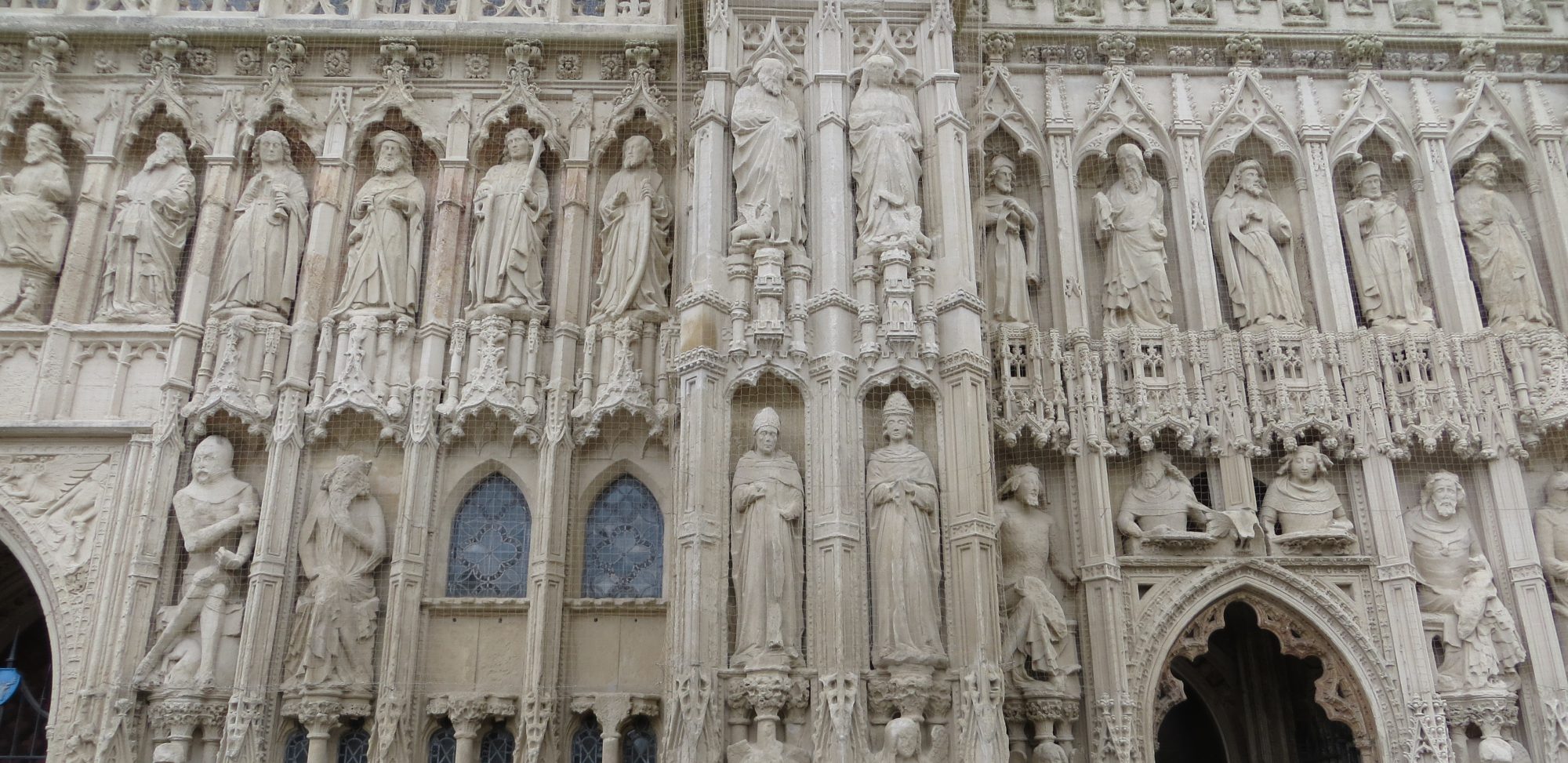
Bonhoeffer

On 9 April the Church of England calendar of saints remembers Dietrich Bonhoeffer.

Archbishop Rowan Williams gave a sermon on Pastor Bonhoeffer at the Berliner Mattäuskirche in 2006

to become a human being and a Christian, to use Bonhoeffer's words in the same letter, is not to separate ourselves and work to become holy in a space that is defined and protected by religious convention; nor is it to seek for perfection by ordinary social or political activism. It is to be present with Christ in the world. It is to be there in God's name and God's presence in both confusion and order alike, standing with Christ, standing in that place in the world where God has chosen to be.

and a short account of what we can learn from Bonhoeffer's ecumenical work.

Bonhoeffer's legacy to the European ideal is not some theory of supranational administration and cultural homogeneity. It is rather the application to national and international affairs of the Christian principle of mutual accountability. A healthy international network is one in which we take responsibility for each other, and recognise the crisis, the suffering or the collapse of one national or local community as an issue for all.

God give us grace to follow him.

Bishop rebuked

The subject is bishops as theologians and theologians as bishops. The Christian world is much indebted to N.T. (Tom) Wright, the Anglican bishop of Durham.

Most of (Bishop Tom's) book (Surprised by Hope) is devoted to making the case for a greater accent in Christian piety and liturgy on the final resurrection of the dead and the coming of the Kingdom of God. Or, as Wright likes to put it, we need to recover the biblical focus on â??life after life after death.â?? I believe Wright is right about that. As he is also on target when he insists that the resurrection â??is not the story of a happy ending but of a new beginning.â?? But his argument is grievously marred by his heaping of scorn on centuries of Christian piety revolving around the hope of â??going to heaven,â?? and his repeated and unseemly suggestion that he is the first to have understood the New Testament correctly, or at least the first since a few thinkers in the patristic era got part of the gospel right.

Unseemly, too, is the pervasive edge of anti-Catholicism, although I suppose that is to be expected from those who must justify their separation from the centering authority of the ancient Church. In refuting Catholic ecclesiology, Wright invokes the authority of what he calls the â??magisterial workâ?? (Ascension and Ecclesia) of Canadian theologian Douglas Farrow in the 1990s, apparently unaware that Farrow has long since become a Catholic. Both unseemly and risible is Wrightâ??s claim that Pope Benedict is coming around to his own view of the traditional doctrine of purgatory, which Wright mockingly repudiates. Paraphrasing a text by Cardinal Ratzinger, Wright claims that it is â??a quite radical climb-down from Aquinas, Dante, Newman, and all that went in between.â?? Bishop Wright would do well to consult Ratzinger-Benedictâ??s encyclical Spe Salvi and what it says about purgatory. As the pope recently said in a meeting with Italian clergy: â??God creates justice. We must keep this in mind. For this reason, it also seemed important to me to write about purgatory in the encyclical, which for me is such an obvious truth, so evident and also so necessary and comforting, that it cannot be omitted.â?? It appears that Bishop Wrightâ??s tutelage of the pope still has a way to go.

Richard John Neuhaus The Possibilities and Perils in Being a Really Smart Bishop

But, dear Father Neuhaus, you agree that we do have a couple of very smart bishops in the Church of England? The media-savvy one (Wright) is occasionally sloppy in his popular work, and on occasion we wish the intellectually careful one (Williams) was a little more circumspect with the media. Now what do you make of the greatest of our Anglican theologians, the Rt Revd Oliver O'Donovan? Do you think we should drag him onto an episcopal throne?

Temple talks

The Temple Church talk series continues. Remember the Archbishop Sharia furore in February? That was one in this series. I hope they can repeat their success.

Coming up

Law and Religion 14 April

Islam in English Law 19 May & 9 July

Law and Politics 7th July

I am also going to these

Wednesday 16th April - Edmund Adamus The Genesis of Humanae Vitae – Memory & Healing

Wednesday 23rd April - Fr Richard Aladics Building the Civilisation of Love in a Media-Driven World

at St Patrick's Soho. See you there.

Cordes at Maryvale

Cardinal Paul Josef Cordes, president of the Pontifical Council "Cor Unum", is to meet with bishops of England and Wales. At the invitation of the Episcopal Conference of England and Wales (CBEW), the cardinal will dialogue with the bishops in the light of the Holy Father's first Encyclical "Deus caritas est" on

how to promote the Catholic identity of the Church's charitable organisations in a rapidly changing environment, characterised by challenges to the Church's traditional outreach in this field.

While the Church in England and Wales has reached out to those in need in an efficacious way historical and cultural changes warrant a reflection upon the role of the bishop as the primordial locus for charitable activity.

Ah, the masters of understatement are back.

On 8 April at Birmingham 's Maryvale Institute, the president of "Cor Unum" will deliver a public lecture on the Church's charitable activities.

What is Maryvale?

The Mission of Maryvale Institute is to be a leader in the provision of lifelong learning for all in Catholic Evangelisation, Catechesis, Theology, Philosophy and Religious Education in order to serve Christ's mandate and his Church's mission of Evangelisation in contemporary society. This provision is through a distinctive combination of the methodology of distance learning and critical engagement with the Word of God in Scripture and Tradition guided by the Church's Magisterium. The work is carried out within an environment of Christian Faith, of academic and administrative quality, of open dialogue and the mutual valuing of the work, gifts and the personal and professional development of every member of the Institute.

One little flickering candle then - in Birmingham.

And in London? Is there a single place on the muddy banks of this river where we may gain a little lifelong learning in Catholic Evangelisation, Catechesis, or guided by the Church's Magisterium serve Christ's mandate and his Church's mission of Evangelisation in contemporary society?

Cultural changes warrant a reflection upon the role of the bishop as the primordial locus for charitable activity.

I think we might do reflection on these cultural changes and on the bishop as the primordial locus for charitable activity on this blog. And I am going to tell my bishop that he is the primordial locus for charitable activity. I know he has at least as good an idea of what this means as I do. No bishop can be afraid, because he is bound to love the people to whom he is sent.

Holy Week cont.

I have got the sermons for Wednesday and Thursday of Holy Week up.

Maunday Thursday is the day when the clergy of the diocese gather in the cathedral with the bishop for foot-washing and repentance, and to receive the oil of charism.

This servant-status, this priestly deaconate, is for those who in Christ have had ‘all things given into their hands’. This weight of glory is yours. It releases you. You have been forgiven. Just as your life is no longer yours to live alone, so your problems and your sin is not your own any longer. You are free to seek more and more of that forgiveness, and to do so with greater and great abandon, more and more publicly. You are free to confess your sins and to lead the rest of us in letting go of our own sins. You may be the most care-free of people.

This means that you are free – for others. You are servants, deacons, waiters-at-table, fetchers and carriers. You will wait at hospital beds, anoint the dying, find words of comfort for the frightened and anguished. You will baptize and teach, you will hear confession, you will marry and bury.

Nottingham on Benedict on Jesus

The Pope and Jesus of Nazareth

19th and 20th June 2008 Nottingham

The publication of the book Jesus of Nazareth on 16 April 2007 was an unprecedented event: never before had a reigning Pope published personal reflections on Jesus.

The book engages not just with New Testament scholarship but also with fundamental methodological questions related to historical criticism. Moreover, it resonates with wider questions of scriptural reading, Christology, ecclesiology and relations with Judaism and Islam. This conference is the first extended theological discussion in the UK on Joseph Ratzinger’s book.

John Milbank Markus Bockmuehl Geza Vermes Archbishop Martínez Fergus Kerr OP Walter Moberly Olivier-Thomas Venard OP Mona Siddiqui

This may really be the first time any work of Pope Benedict is examined by academics in Britain. There is plenty on Benedict's Jesus of Nazareth and other books over at the B16 fanclub and Ignatius Insight.

Maranatha – Crisis and Glory

The Church in this land is now in a totally new situation. After years of enjoying a comparatively privileged position, we are now clearly facing attack, ridicule and even persecution. We are in a counter-culture situation and our position is increasingly similar to the Early Church.

Viewed from the position of the world, the Church is not a single body giving a clear message, but rather a large number of disparate congregations who each have their own interpretation and presentation of the Gospel message and who appear to be in competition with each other. There is a very real danger of the churches ceasing to engage with our culture. At the two extremes, we either withdraw and disconnect from it, or run the risk of being consumed by it. God calls us to invade and transform our culture, not to collaborate with it, capitulate to it, retreat from it.

This engagement is inevitably confrontational. There is clearly much doubt about the central truths of the Gospel in the churches. There is also evidence of some Christians substituting an ethical or a programme of social action for the Gospel.

Maranatha – Crisis and Glory (PDF)

I know a bishop not far from here who talks about 'the coming storm' and a 'tidal wave'. He means secularism, but he doesn't spell out what he means by that, and I am not sure that he knows how to. Sometimes he seems to regret this and to want to do something about it, sometimes not. Our caution and elipticism is becoming a problem. We have to stop worrying about sounding unsophisticated and apocalyptic. We have to bring the people of Maranatha into Church and ask them to teach us how not to be sophisticated or ironic, and we have to learn how to spell this 'new situation' out.

Costly discipleship involves using our heads, consistently, and over the long term. No probs there. But that also means getting to know my own tradtion and speaking consistently from it, without attempting to preserve any ironic distance. It also means learning the old practices and practising them, in public. I am going to start reading my bible (big, black, leather) on the Central Line. I am going to kneel in church, dunk my fingers in the holy water when I enter a Catholic church. I am going to learn to cross myself (every nerve screams No!). I am going to learn a half dozen psalms off by heart. I am going to familiarise myself with the readings for each next Sunday. When you see me, test me.

Catholic theology in the UK?

Catholic Theology and the Public Academy

A colloquium in dual celebration of the establishment of the Durham Centre for Catholic Studies and the Bede Chair of Catholic Theology 8th-10th May, 2008 Durham University

Tina Beattie Gavin D’Costa Eamon Duffy David Ford Paul Griffiths Karen Kilby Michael Kirwan, S.J. Paul Lakeland Nicholas Lash Gerard Loughlin Andrew Louth John Milbank Francesca Murphy Paul D Murray

I would certainly like to hear Gavin D’Costa, Eamon Duffy, and Paul Griffiths. The first Bede Professor of Catholic Theology will be appointed just before this conference, and the appointment will make it clear whether this is the long-awaited new start or not. There have been a lot of international applicants, apparently, so my breath is bated. But why aren't Stratford Caldecott or Aidan Nichols among the speakers? Why doesn't Ex Corde Ecclesia (JP II's Apostolic Constitution on Catholic universities) appear anywhere on the Centre's website? Why is a Protestant giving the opening address on 'The Case for Catholic Theology in a Twenty-first Century University’? How much Protestant permission has to be sought?

From a Catholic point of view the contemporary secular university is not at fault because it is not Catholic. It is at fault insofar as it is not a university…

Alasdair MacIntyre (Commonweal October 20, 2006 / Volume CXXXIII, Number 18)

Truth and goodness

The heart of the problem lies with the prominence given to what are seen to be the supreme values of today, liberty and equality. These are not the supreme values. Truth and goodness are the supreme values. Liberty is seen as the absence of restraint, rather than the freedom to do what is right, with equality being transformed into a justification of the sameness of social institutions. That is why I went to war with the Labour Governments in Westminster and Holyrood last year, due to what is called political correctness, as they made liberty and equality the supreme moral values for the agenda that they wanted to introduce.

In effect, what they were doing was introducing a new kind of morality, a kind of morality that was bou nd to result in moral mayhem, as it was not based on truth and goodness. That is what happened. We now have a kind of state sponsored morality that is at war with our Christian tradition. Mark me well when I tell you why this is so. It is because liberty and equality have replaced truth and goodness. This is the heart of the problem. When liberty and equality are made the supreme values, not truth and goodness, then we have an agenda that is no longer answerable to what is true and what is good. This is by far the most important thing that I am going to say tonight. So write it down. I will repeat if for all of you. When liberty and equality are made the supreme values, not truth and goodness, we have an agenda that is no longer answerable to what is true and good.

* * *

I remind you that the greatest obstacle to halting the advance of the secularist culture has been our failure to recognise the ambition of the protagonists of that agenda. In seven years there has been a massive transformation in our understanding of family life. The plan for that transformation taking place at the time were not widely known and were so ambitious that, even for those in the know, they were not taken seriously.

Bishop Joseph Devine (Motherwell, Scotland) Saying No to Secularism - Gonzaga Lecture, Glasgow

So write it down. I will repeat it for all of you

This is how a bishop speaks

Thanks to the Hermeneutic of Continuity

Saint Paul

Saint Paul's Journeys into Philosophy:An International Conference Vancouver School of Theology at the University of British Columbia Vancouver June 4-6, 2008

Join us for a conference which explores the critical appropriations of Saint Paul by recent and contemporary Continental philosophers, including Kierkegaard, Nietzsche, Heidegger, Benjamin, Jacob Taubes, Alain Badiou, Giorgio Agamben, Slavoj Zizek, and others. An international group of philosophers, theologians, biblical scholars and literary theorists will present papers on a wide range of themes arising from this recent philosophical appropriation of Saint Paul. Plenary speakers include Stephen Fowl, Paul Griffiths, Travis Kroeker and J. Louis Martyn. There will also be presentations by Creston Davis, Neil Elliott, Paul Gooch, Douglas Harink, Chris Huebner, Mark Reasoner, Jeffrey Robbins, Gordon Zerbe, Jens Zimmerman and others.

Paul Griffiths and Lou Martyn are certainly worth going to hear.

Candour

Candour is of the greatest importance for the public realm itself. Candour is a simple public duty, often unperformed, or performed badly, out of simple reluctance to take responsibility for the truth on which the community depends. Behind many a story of tyranny lies collusion between oppressor and oppressed, a community that prefers to accept a shrunken public realm rather than pay the price of discerning and articulating complex truths in public.

Oliver O'Donovan The Ways of Judgment