St Paul's Economics debate

My word is my bond? Rebuilding trust - the G20 and beyond

St Paul's Cathedral Tuesday 31st March, 2009, 11am - 12.30pm

On the eve of the G20, St Paul's is hosting a high level debate about the moral questions raised by the dramatically changing world we find ourselves in. Can opportunities for society's good come from the economic crisis? Has there been a disconnection between morality, policy-making and practice? What are the prospects for remaking the global order, rebuilding financial systems and re-establishing trust? How will a new global order actively include development goals and address climate change?

Médaille explains

A few of the money-center banks, some insurance companies and many hedge funds made a series of bad bets. They are insolvent. There is a procedure for insolvency. The banks should be go into receivership and be broken up. The losses should be written off, and that's that. Nothing new or radical in that solution, it happens time and again...

Even if the [bail-out] plan works, it will fail, because it doesn't address the underlying problem. And that problem is that we no longer make what we consume. Unless we restore the real economy, the economy that makes real things and provides real services, we cannot restore the banks. Even solvent banks require productive enterprises to which they can lend money. But we ran out of these a long time ago. There simply isn't enough demand, even in good times, for loans from our diminishing productive sector. Hence, the banks turned to lending it for houses people couldn't afford and credit they shouldn't be using, but must because the wages are too low. Making the big banks solvent again will not provide them with solvent customers. That can only come from a restructuring of the economy that shifts us back to real production rather than financial black magic. If we restore the economy, restoring the banks will be a trivial problem. If we do not restore the economy, it simply will not matter how â??soundâ?? the banks are.

John Médaille Worst Bailout Ever

Get a copy of his The Vocation of Business: Social Justice in the Marketplace

Liviu

The Romanian Orthodox parish of Saint George invites you to join us in prayer for the celebration the Divine Liturgy and of the sacrament of the ordination to the priesthood of Deacon Liviu Barbu

His Eminence Josif Pop Archbishop of the Romanian Metropolis of Central and Western Europe will preside over the Divine Service

The Fourth Sunday of Great Lent of Saint John Climacus

The Romanian Orthodox Church

St Dunstan in the West

Fleet Street

London EC4

Zizioulas' Dogmatics Lectures

Sense again meets reader in Metropolitan John's (Zizioulas) latest text in translation. Superb editing by Dr. Douglas H. Knight, coupled with a succinct introduction by the same, should move this book to the top of any reading list among students of theology, ecumenism, international politics, sociology, economics, languages and cultures.

Chapters were compiled across three decades by the author's students in Edinburgh, Glasgow, London, and Thessalonika. Therefore, references are far less in number than prior books, but scholarship and precision in language are no less exact. In effect, the method of inquiry is a three-decade long conversation with students, to whom the author dedicates the book. Mainstays of Metropolitan John's "dogmatic hermeneutics" are collected in this book. These include the nature of dogma, doctrine of God and personhood, creation and salvation, and the Church. His approach identifies a relational method by which dogmatics might be interpreted by every age of history, including our own. Relations, he argues, stem from the "what" and "how" of God. God creates and saves according to divine substance or essence ("what"), but divine substance cannot be known. Instead, divine substance must manifest in a particular way, which is to say that God makes known three Persons. Of course, these ideas do not originate with Metropolitan John, but rather with a group of faithful Christians called the Cappadocian Fathers. However, the author does not simply re-state the Fathers. He presents dogma in fresh light.

Thank you, Edward M. Freeman, for that most discerning review
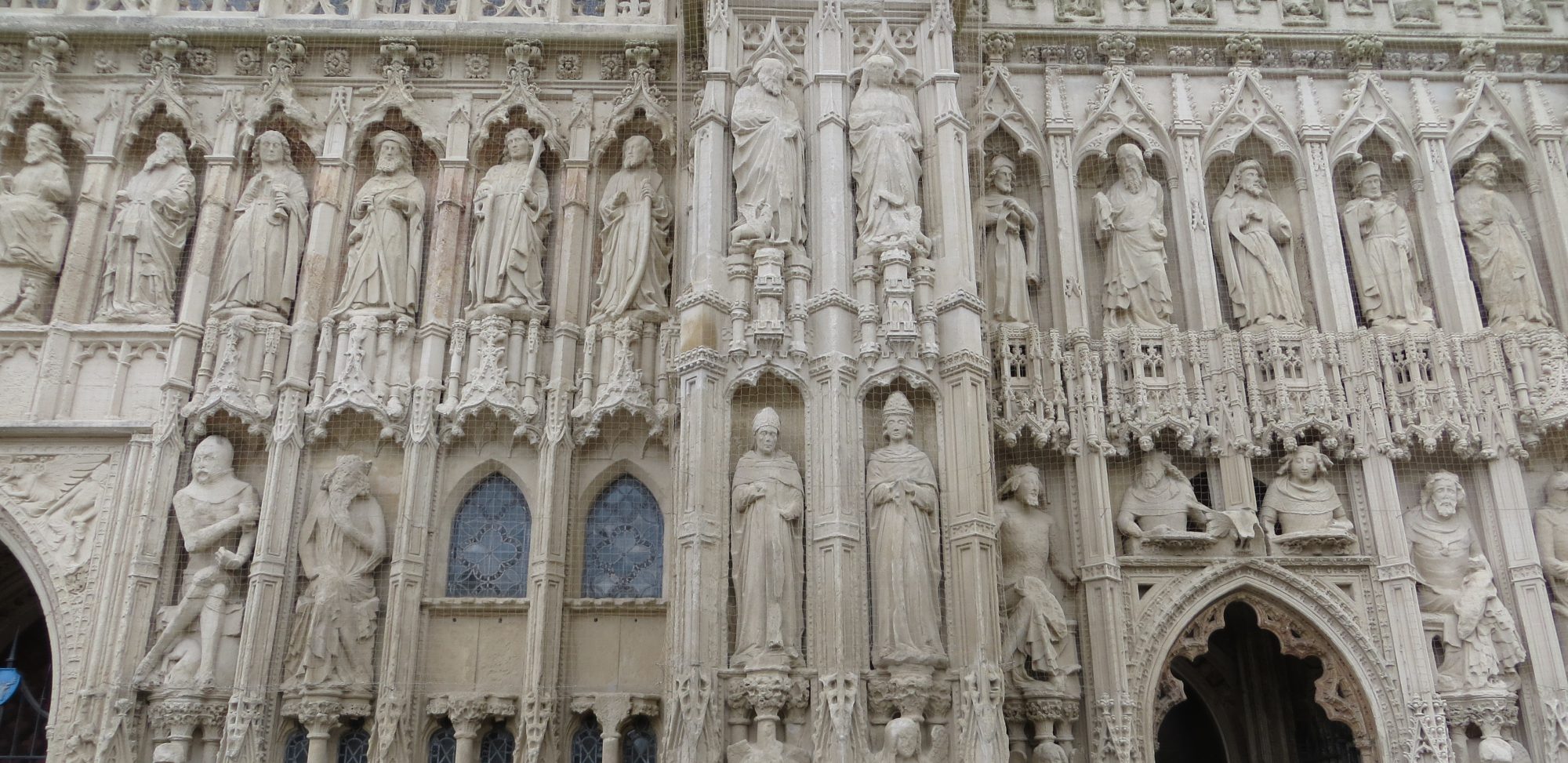
Long Way to Easter 4 A theological economics

The fourth lent talk starts this way:

Christ has laboured on our behalf: he is the provider of mankind’s only free lunch. We may provide for one another as we receive and distribute what he has provided for us. God has acted generously to us, and invites and enables us to be generous and active on one another’s behalf. From him we may receive the abilities by which we can act and trade on our own account, for we are ‘created in Christ Jesus for good works’, as the Letter to the Ephesians puts it. We may discover that labour can be its own reward, for we may take pride in those whom we have served and lift and present them to God in thankfulness, and then we will no longer be alienated from the product of our labour. God is the one who is able to tell the true worth of our labour and our lives.

It continues:

But others came after Smith who were convinced that the entire existing tradition of deliberation about what is good, of Plato and Aristotle, and Augustine and Aquinas and their heirs, had become hopelessly tangled. They decided to give up on it, and cut moral language loose from all previous discussion of what is good or true. This new generation of political philosophers were the Utilitarians, best known of whom is Jeremy Bentham. The utilitarians wanted us to give up talking about right or wrong, or good or bad, even in the sense of ‘good for some purpose’, as when we say ‘this will not look good to other people’. Any good is good to the extent that enough people want to raise its price to the point at which its present owner is prepared to sell it. They have encouraged us to think only in terms of good as this is established by the satisfaction of the person who employs enough money to outbid all others and so claim it. It is the price mechanism that decides on the value of a thing, so the utility or usefulness of a thing is decided by the price that reflects the preferences of all agents in the market. Within this Utilitarian account, all our acts are seen as ‘preferences’, that is, as private.

And ends like this:

When the entertainment industries have opened up the family by driving a torrent of new desires through it. If they cannot resist, family members cease to sacrifice individual desires for family cohesion and are not able to work for one another or welcome one another’s service. As the family starts to break up, the state is there to provide for each of the individual pieces that have been created. We no longer need of one another because the state follows the private sector in to provide each ‘need’ so that it never becomes articulated as the need of one person for another. The result is not that each single parent is that each single parent is married to the state. The state has become the universal mediator, driven to smooth out all inequalities and with them all the complementarities, by which we need one another. The state cannot love. But it may exhaust our national economic resources in compensating for the love that we no longer give.

Lent 4 Lent 4 Douglas Knight

Publish at Scribd or explore others: Study Guides Academic Work lent easter economic

Read the rest here

We will deny until the bitter end

Stuff will be getting a lot more expensive in the not-distant future, and you can bet that the Chinese are not going to be selling it cheaply to us in return for our increasingly worthless greenbacks. Perhaps the only thing more grim than our current economic moment is the economy that is awaiting us. We will either learn thrift by a new commitment to old virtues, or we will learn it the hard way. We will be able to afford fewer things, move around less and we will find ourselves facing a world that is not subject to our notional control. For most, this will be an occasion for lamenting. To my mind, it would generally constitute a better way, but a hard way when it comes by force and not by choice. Hard especially because - like our response to the current â??crisisâ?? (a word that reflects our belief that this is something extraordinary, unexpected, exceptional, a departure from the norm rather than the new norm), we will not believe in the reality of the reality that we face. We will deny its truth and its causes, looking instead for another cause other than ourselves. We will deny until the bitter end, avoiding the bankruptcy that awaits us in the belief that past returns are the guarantee of future results, most of all for no better reason than we wish it to be so.

Patrick Deneen Unreal estate

Long way to Easter 3 A theological economics

The third lent talk begins like this:

Behind this economic crisis is another crisis, one of morale. Have we become the society that each of us individually ceased to believe in? Because we have assumed that we insulate the economy from all other factors, in particular these factors that I have linked to covenant, to confidence and so ultimately to will of this society to continue, and to create another generation, we have not made the connection between economy and morale, and so we been taken by surprise by this financial crisis.

and ends like this:

The Church asks whether we are selling ourselves here, in this ‘temple’ that we have built. Are we being sacrificed here? Are we being sold here, amongst the money-changers? The cross of Christ tests all these temples of our own construction. They may not survive this testing. If it has become a temple in which we are not built up but sold and sacrificed, they will fall. We have to ask whether we have become enthralled and trapped in building a temple of our construction which has enfeebled our society and which its own contradictions is finally beginning to bring down. Can Christ cleanse the temple for us? Shall we pray that he does?

Read it all here

Borrowing against the future

In general, we’re pretty comfortable with ponzi models -we live, quite happily, in a ponzi economy, one in which the concept of perpetual economic growth is sold, divvied up again and resold. We live in a Ponzi ecology where we borrow constantly against the future to pay for our present affluence. Is this truly a Ponzi scheme? I think the answer is yes - a Ponzi scheme never really generates new wealth, it simply relies on a constant stream of new money. And since the eco-Ponzi economy relies most of all on reducing the capacity of future generations to live well - because natural resources and associated wealth are already drawn down, I think that it does meet the criteria at both the economic and ecological levels...

Growth capitalism in general and the real estate bubble in particular depended heavily on the idea that we can’t live together, that everyone has to own their own separate household. So the rise in average material living space from 250 square feet per person in 1950 to 850 square feet for each warm body in 2000 was in part a product of the constant message that living together with one’s family or friends was a measure of failure.

Sharon Astyk The Ponzi Scheme as way of life

Recover

Christians have to recover their genius for showing that there are better ways to live and build a good society; ways which respect freedom, empower individuals, and transform communities. They also have to recover their self-confidence and courage. The secular and religious intolerance of our day needs to be confronted regularly and publicly. Believers need to call the bluff of is, even in most parts of Europe, a small minority with disproportionate influence on the media. This is one of the crucial tasks for Christians in the twenty-first century

Cardinal George Pell of Sydney Varieties of Intolerance, given in Oxford (with thanks to Fr Tim Finigan)

Long way to Easter 2 A theological economics

The second Lent talk starts like this:

To explain why we are facing this flood and these crises we have to think through covenant, love and gift. We will examine them not because these are religious ideas, but because they are fundamental economic ideas. When we attempt to understand economics without them, we achieve incoherence. Economics has indeed tried to understand human interaction and exchange without the concepts of covenant, love and gift, and the result has been the bankruptcy of economics and a crisis that is both social and economic.

You can read it here, or read the whole series here

Free Riding

We are also generally aware of the ways that the culture we oppose - of mobility, deracination and placelessness - is also based upon widespread free-riding. The culture of liberalism - writ large - has always free-ridden on the health and vitality of a pre-liberal, even anti-liberal culture. Most basically it assumes the existence of, but does little to support or replenish, the culture of good families. It relies upon the virtues of children raised in those settings, even as it is suspicious of - even destructive of - what are necessarily â??paternalisticâ?? (or â??maternalisticâ??) features of those settings. It has sought to open every closed association and civil institution, ultimately emptying them of the capacity to elicit loyalty, memory and stability. It relies on the good will and sacrifice of citizens even as it assumes that we are fundamentally rational actors driven by self-interest. Tocqueville wrote of Americans that â??we do more honor to our philosophy than to ourselves,â?? meaning that although we explain all of our actions in terms of self-interest, we actually act out of a deeper wellspring of altruism and fellowship. Over time, he observed, our actions would begin to conform to our words, however, thus eviscerating the deepest and better sources of our behavior.

Similarly, over the past century and a half, liberalism has free-ridden on the millenia-long accumulation of â??resourcesâ?? that it has shown exceptional ability in accessing and utilizing, but very little capacity to spare or save. â??Drill baby drillâ?? is akin to the adolescent refrain of â??itâ??s MINE, itâ??s MINE,â?? uncognizant of the work and fortune that went into every inheritance that we may have come into. We have been free-riding on the back of mountaintops removed, all the while congratulating ourselves for our hard work and accomplishment.

Patrick Deneen Free Riding at the very promising Front Porch Republic

They have already become Muslims

The native Dutch are moving out. Since 2004, more indigenous Dutchmen have emigrated each year than immigrants have moved in. People who have lost faith in God do not fight. They run. Since they do not believe in life after death, this life is the only thing they have to lose. One emigrant Dutchman, a homosexual author who lives in Brussels, writes: "I am not a warrior. I do not fight for freedom. I am only good at enjoying it." This mentality has affected the whole of Western Europe. A young German woman recently said that it is "better to let yourself be raped than risk injuries while resisting, better to avoid fighting than risk death." Europe has chosen the path of submission. Islamization is not the cause but the consequence of the collapse of Europe. The very word Islam means "submission." Many Europeans have submitted already. In that sense, they have already become Muslims.

Paul Belien Reshaping America

Theological economics

What might be some of the most basic faith-derived or faith-related values that we might want to put into our present crisis and its challenges? And I'll simply suggest three. First – keeping promises. On the whole, religious people believe in a divine agent, power or presence that is faithful, consistent, dependable, truthful. As we seek to live a life that is in harmony with that divine reality, then faithfulness and trustworthiness are utterly fundamental to how we approach our sense of the good life. The further away you are from the people you're contracting with, the harder it is to keep a lively and vivid and self-critical sense of the necessity of keeping promises. Second, the sense of living in a world that does not belong to you and is not simply under your control. It is a gift to be stewarded and creatively and justly used. And going with that, of course, the sense that your own will and your own desires don't necessarily define what's good for anybody or anything. …in Leviticus we're told very firmly that the land is, so to speak, lent to you. You don't own land as a thing; you control the profits of the land over certain limited periods, because the land belongs to the Lord. The earth is the Lord's, and all that is in it, and that, I think, is again the fundamental principle. And the third religiously derived and related principle, is the belief that ultimately, what is good for me and what is good for you are not detached, separate, non-connecting things. Finally, my life and your life belong together. My flourishing and your flourishing belong together. …We as Christians talk about the image of God, and Jews also. But however we put it, there is that sense that humanity is, in some sense, one. As a Christian, that would go still further, to the imagery of the body of Christ, in the sense that the suffering of one becomes the suffering of all, and the wealth or welfare of one becomes the wealth or welfare of all.

Archbishop Rowan offers some principles