High anthropology

What makes monotheism a potential ally of humane liberalism is its high anthropology. Historically, of course, this liberal tradition grew up and out of a Christian monotheistic context; so its admiration of human dignity is no coincidence. Nor is it a coincidence, therefore, that Habermasâ?? new-found appreciation for religion comes at a time when he is struggling to articulate reasons against genetic engineering for non-therapeutic purposes, which he deems an assault on the fundamental dignity of the human individualâ??s freedom. Certain versions of monotheismâ??not least, certain versions of Christian monotheismâ?? support the idea of human dignity; which is why humane liberal philosophers on both sides of the Atlanticâ??if not yet on both sides of the English Channelâ??have been edging toward it in recent years. Some philosophers, however, go further. They see in monotheism not only a support for equal human dignity, but perhaps the only support. In his recent study of John Locke, the legal and political philosopher, Jeremy Waldron, observes how silent modern philosophers have been in explaining the equal dignity that they assume all human persons share. He then goes on to demonstrate how Lockeâ??s understanding of such dignity is irreducibly theological; and he ends up by stating that â??I actually donâ??t think it is clear that weâ??nowâ??can shape and defend an adequate conception of basic human equality apart from some religious foundationâ??.

Niger Biggar's Inaugural Lecture at the (Oxford) McDonald Centre for Theology, Ethics and Public Life

People and knowledge flow

With the restructuring of government departments, higher education is now under the control of the Department of Innovation, Universities and Skills (â??DIUSâ??). We no longer have a Department for Education in this country. The idea of a university as â??a place of teaching universal knowledgeâ?? â?? Cardinal Newmanâ??s phrase â?? has, it seems, no relevance in Brownâ??s Britain. Higher education must now justify itself in terms of the â??innovation and skills agendaâ??. Crudely put, academic research must pay its way by generating real returns in the wider economy. The Research Councilsâ?? big new idea, driven by DIUS, is â??knowledge transferâ??. This is defined as â??improving exploitation of the research base to meet national economic and public service objectivesâ?? to be achieved by means of â??people and knowledge flowâ?? together with â??commercialisation, including Intellectual Property exploitation and entrepreneurial activitiesâ??.

Jonathan Bate The Wrong Idea of a University

Priest as ring master

The priest was gradually changed in the popular imagination from the celebrant of the Sacred Mysteries of salvation into the coordinator of the liturgical ministries of others. And this false understanding of the ministerial priesthood produced the ever-expanding role of the â??priest presider,â?? whose primary task was to make the congregation feel welcome and constantly engage them with eye contact and the embrace of his warm personality. Once these falsehoods were accepted, then the service of the priest in the liturgy became grotesquely misshapen, and instead of a humble steward of the mysteries whose only task was to draw back the veil between God and man and then hide himself in the folds, the priest became a ring-master or entertainer whose task was thought of as making the congregation feel good about itself.

Father Jay Scott Newman

Catholic theology in the UK?

Catholic Theology and the Public Academy

A colloquium in dual celebration of the establishment of the Durham Centre for Catholic Studies and the Bede Chair of Catholic Theology 8th-10th May, 2008 Durham University

Tina Beattie Gavin D’Costa Eamon Duffy David Ford Paul Griffiths Karen Kilby Michael Kirwan, S.J. Paul Lakeland Nicholas Lash Gerard Loughlin Andrew Louth John Milbank Francesca Murphy Paul D Murray

I would certainly like to hear Gavin D’Costa, Eamon Duffy, and Paul Griffiths. The first Bede Professor of Catholic Theology will be appointed just before this conference, and the appointment will make it clear whether this is the long-awaited new start or not. There have been a lot of international applicants, apparently, so my breath is bated. But why aren't Stratford Caldecott or Aidan Nichols among the speakers? Why doesn't Ex Corde Ecclesia (JP II's Apostolic Constitution on Catholic universities) appear anywhere on the Centre's website? Why is a Protestant giving the opening address on 'The Case for Catholic Theology in a Twenty-first Century University’? How much Protestant permission has to be sought?

From a Catholic point of view the contemporary secular university is not at fault because it is not Catholic. It is at fault insofar as it is not a university…

Alasdair MacIntyre (Commonweal October 20, 2006 / Volume CXXXIII, Number 18)

Maryvale

The Maryvale Institute - our International Catholic College for Catechesis, Theology, Philosophy and Religious Education at Birmingham shows more energy than any other Catholic institution in the UK than I am aware of. Maryvale wants to see 'the proclamation of the Catholic faith in its fullness and integrity'. In the UK, this sounds like a bold new start.

Maryvale is advertising for a Director of its Marriage and Family Life Programme.

The Maryvale Centre for Marriage and Family Life is a new initiative set up following discussions between the John Paul II Institute in Rome and the Maryvale Institute. Its purpose is to make available, within the Maryvale Institute, a range of courses, modules and suitable educational materials pertaining to the teachings of the Catholic Church on marriage and family life. The range will cover basic parenting information, through a ‘ladder’ of initiatives, co-ordinating with some existing courses already available at Maryvale, leading to the development of a new MA Course in Marriage and Family Life studies, modelled on those of the John Paul II Institute’s Theology of the Body Programme.

I would really like to see this sort of initiative here in London. I suppose I will have to be content with Spes - the School for Evangelism at St Patrick's Soho.

Who sets the production goals for all those cultural factories of meaning?

Does the Harvard-educated manager of cultures function too much as a Nietzschean Ã?bermensch, operating upon the raw material of humanity from the supposed heights of critical understanding rather than leading from within the ranks? Will a person in a position of power who â??readsâ?? his fellow man, rather than listening to what he actually says, end up manipulating rather than serving? And toward what will the Harvard graduate manage culture? Who sets the production goals for all those cultural factories of meaning? Am I too cynical when I suspect that it will be the naked self-interest of those who have convinced themselves that culture makes no real claim of truth upon the human soul? In other words, is the new vision for general education at Harvard alarmingly illiberal?

R. R. Reno Harvard's Postmodern Curriculum

Humanities

Certainly, philosophy, theology, and literature were weakened by the apparently embarrassing comparison to strict science. But the humanities were already in bad shape. The romantic emphasis on personal uniqueness had undermined the belief that universal ideas are conveyed in great texts. Perennial themes about nature and human nature looked like the furniture of grandmaâ??s attic, but the endless stream of facts surrounding each age and author appeared fresh and promising. The nineteenth century, we were repeatedly told, was the era of the factory worker and the assembly line. And since the generalist has no place in any fact-accruing business, the university must emulate the pin factory.

And so the disciplines multiplied, the specialties emerged, and the once-cohesive worldview of the humanities faded, carrying away with it the deep questions college was supposed to teach.

Not everywhere, of course. Realizing the need to educate students in â??the art of living,â?? â??the spirit of learning,â?? â??the best that has been thought and said,â?? many of the older universities retained or reinstated a remnant of their old curricula as core requirements and humanities sequences. Shortly after the Second World War, both Harvard and Yale established programs with the goal, they said, of intellectually defending the values of civilizationâ??liberty, democracy, human dignityâ??for which so many had just given their lives. Where religious convictions and a Christian worldview had once ordered the universityâ??s mission, secular humanism now stepped in.

Amanda Shaw Life, the University, and Everything reviewing Antony T. Kronman Education's End: Why Our Colleges and Universities Have Given Up on the Meaning of Life

Lambeth research degree

The Archbishop of Canterbury, Dr Rowan Williams, has announced a new higher degree programme as an expansion of the Archbishop's Examination in Theology. Applications for PhD and MPhil degrees in Theology will be accepted from early 2008 with the first awards of the new MPhil degrees anticipated in 2012 and Doctorates shortly afterwards. Candidates will be examined to university standards in order to qualify.

Dr Williams said that improving access to higher degree education was a crucial step for the development of the Church's theological resources:

‘We have never had a greater need or a greater chance to extend the opportunity of higher degree theological education to those who might benefit from it. I'm confident that this scheme can go some way to overcome the barriers of cost, competition and access which stop good candidates being able to pursue this kind of detailed study. The Church as a whole has always needed and encouraged the study of theology at its deepest level and this scheme seeks to extend that possibility to those who otherwise wouldn't be able to take advantage of it.’

Anglican Communion News Service

Revitalized classical learning in a Catholic context

Two generations later, new winds of change are blowing through Catholic higher education in America: the bracing winds of dynamic orthodoxy. Some elite Catholic schools are, sadly, lost â?? and quite likely lost for good. Yet others have made significant comebacks in recent years, thanks to generational change in theology departments, courageous presidential and board leadership, students who demand authentic Catholicism from schools that market themselves as â??Catholic,â?? and the work of alert alumni. Moreover, several smaller Catholic liberal arts colleges, in virtually every part of the country, are giving fresh life to Msgr. Ellisâ??s vision of revitalized classical learning in a Catholic context â?? and proving once again that that kind of learning is a better preparation for a professional future that the intellectual disarray that still reigns supreme on some campuses with stratospheric U.S. News & World Report ratings.

These new-wave Catholic schools consider their linkage to the Church an integral part of their lives. In doing so, they remind us that doctrine is liberating, even in institutions dedicated to critical thought.

George Weigel on how catholic colleges are becoming Catholic again

Christian University

Andy Goodliff has posted on The promise of a Christian university -

Christian University? You have got to wonder where he gets these ideas from. Andy posts a handy list of titles then, as these bloggers do, asks for more ideas.

Obviously his list includes Bristol's finest, Gavin D'Costa Theology in the Public Square: Church, Academy and Nation

and the forthcoming Stanley Hauerwas The State of the University: Academic Knowledges and the Knowledge of God

Then what? Well, how about these?

Michael J. Buckley The Catholic University as Promise and Project

John C. Sommerville The Decline of the Secular University: Why the Academy Needs Religion

George M. Marsden The Soul of the American university and his earlier The outrageous idea of Christian Scholarship

Robert Benne Quality with Soul: How Six Premier Colleges and Universities Keep Faith with Their Religious Traditions. The six are Calvin, Wheaton, St. Olaf, Valparaiso, Baylor, and Notre Dame. Hum, not too many Catholic colleges there.

and of course the massive James T. Burtchaell The Dying of the Light: The Disengagement of Colleges and Universities from Their Christian Churches

Then the greatest analysis of the whole project of the university, Alasdair MacIntyre Three Rival Versions of Moral Enquiry: Encyclopaedia, Genealogy, and Tradition

Then on the wider faith-and-public-square issue there is the recent Ratzinger-Habermas dialogue of course Joseph Ratzinger The Dialectics of Secularization: On Reason and Religion

But, wait a minute, the very first thing that should be on this list is the magisterial Ex Corde Ecclesia – the Apostolic Constitution of John Paul II on Catholic Universities

BORN FROM THE HEART of the Church, a Catholic University is located in that course of tradition which may be traced back to the very origin of the University as an institution. It has always been recognized as an incomparable centre of creativity and dissemination of knowledge for the good of humanity. By vocation, the Universitas magistrorum et scholarium is dedicated to research, to teaching and to the education of students who freely associate with their teachers in a common love of knowledge. With every other University it shares that gaudium de veritate, so precious to Saint Augustine, which is that joy of searching for, discovering and communicating truth in every field of knowledge. A Catholic University's privileged task is "to unite existentially by intellectual effort two orders of reality that too frequently tend to be placed in opposition as though they were antithetical: the search for truth, and the certainty of already knowing the fount of truth".

Ah, at last. In the long run, it is not just the Christian university, it is not just the Catholic university, it is the university that is born from the heart of the Church.

From the heart of the Church - the University

In his 1990 apostolic constitution on Christian education, John Paul II insisted that the university is _ex corde ecclesiae_â??from the heart of the Church. He spoke of the Catholic university, of course, but the vision challenges every Christian university. In Ex Corde Ecclesiae, John Paul wrote: â??With every other university [the Christian university] shares that gaudium de veritate, so precious to Saint Augustine, which is the joy of searching for, discovering and communicating truth in every field of knowledge. [Such] a universityâ??s privileged task is to unite existentially by intellectual effort two orders of reality that too frequently tend to be placed in opposition as though they were antithetical: the search for truth, and the certainty of already knowing the fount of truth.â??

There areâ??or there should beâ??different kinds of universities. At least that is the case if there is no such thing as a university pure and simple. A decision must be made, and constantly remade, to be a particular kind of university. It is sometimes said that a Christian university has a â??dual identity,â?? one by virtue of being a university and another by virtue of being Christian. I suggest that is seriously mistaken, since it assumes that the term university is neutral or self-explanatory. Every university is, whether by careful deliberation or by accident, a university of a particular kind.

The Christian university requires a structured form of conversation, both affirmative and critical, with a particular community of Christian faith. In the absence of such accountabilityâ??an accountability that is not imposed but freely soughtâ??the Christian university will most likely succumb to the institutional and ideological dynamics of other kinds of universities. It is not enough that there be a department of theology or a vibrant student chaplaincy. Indeed, as James Burtchaellâ??s demonstrates in The Dying of the Light: The Disengagement of Colleges and Universities from Their Christian Churches, the schools that ended up in repudiating their Christian founding began by assigning the responsibility to be Christian to theology departments and the chapel. The result was that they lost their connection with â??the Churchâ??s heart for learningâ?? and, along with it, the responsibility of inviting students to enter on the high adventure of the Christian intellectual traditionâ??a tradition ever so much richer than the reductionist Enlightenment embraced by schools that claim to be universities pure and simple.

Richard John Neuhaus A University of a Particular Kind

Scots Catholic bishops show how to address the public square

Dear Brothers and Sisters in Christ,

1. We, the Catholic Bishops of Scotland, greet you in the name of the risen Christ. As we continue to celebrate the mystery of Easter, we renew our hope in Jesus Christ as the source of our salvation. 2. Elections to the Scottish Parliament and to Local Authorities are approaching. Each of us is called to make practical political choices for the sake of the common good of the people of Scotland. These choices should be made in conformity with our faith in Christ.

3. The Bishops recognise that many people in politics work conscientiously to achieve good, and we commend them to you. At the same time we cannot fail to notice a conflict of values in society. This conflict of values is reflected in the political sphere in policies, social legislation and regulations which are seriously at odds with the insights and values of our Christian faith and of other faiths.

4. The Bishops remain deeply concerned about legislation which allows abortion, embryo experimentation, easy divorce and civil partnerships. We have always campaigned against poverty, deprivation and injustice. We have raised our voices against a new generation of nuclear weapons. We foresee with apprehension a campaign to legalise euthanasia. We find ourselves having to counter criticism of the very existence of Catholic schools, in large part prompted by an agenda which aims to remove religion from the public sphere.

5. As well as these serious matters, Government has advanced proposals which imply a stealthy and unjust attack on the freedom of religion itself and on the rights of conscience. Earlier this year new regulations were enacted at Westminster which could prevent Catholic adoption agencies from carrying out their work according to the Catholic and Christian vision of family life. Last year, in the face of widespread opposition, the Scottish Parliament extended the right to adopt to unmarried and same sex couples. These dubious innovations are detrimental not just to the good of the Catholic community but to the common good of humanity as a whole. They deserve to be challenged at the ballot box.

6. The coming elections give us an opportunity to vote wisely and to choose the best political representatives for our communities. Many of those standing share our Christian values. There are signs of a desire for an authentic Christian voice in politics serving the common good of people of all faiths and none.

7. Your Bishops urge you to use your vote to support the candidates who offer the best chance of bringing the voice of a truly human and Christian civilisation to the decision-making chambers of our country. We invite you to look beyond the superficially attractive and fashionable to recognise those policies and values which are most in tune with the dignity of the human person and with the common good of our society.

8. To help you vote, we attach with this letter a number of questions you may wish to consider yourself and put to your election candidates.

9. Our faith is in the risen Christ. We are all to witness to Him even in our political choices, in the hope that we can make his love for all men and women more effective in our country!

May God bless you all.

Yours devotedly in Christ,

Scottish Catholic Media Office Catholic Bishops urge voters to challenge attacks on Christian values "at the ballot box"

The Scottish Catholic Media Office provides a service to the press and media, offering them information and guidance on the activities of the Church in Scotland. The Office is responsible to the Bishops' Conference of Scotland through its National Communications Commission, whose President is Bishop Joseph Devine.

"The Church cannot fail to be ever more deeply involved in the burgeoning world of communications. There must be an active and imaginative engagement of the media by the Church." Pope John Paul II

Notice that this statement begins with a doxology. This is the only way an announcement or document of the Christian Church can begin. Let's pick up some of these good habits, shall we?

Now I want to see an English, Anglican (and Catholic) Media Office. It would look like the Anglican Communion Office but will present the views of the Church of England, in the closest possible association with the Roman Catholic Church of England and Wales, to the nation, its government and media. It will be more than a news service (press statements of church news). It will set out the proposals of the Christian Church for the public policy of this nation. Its pronouncements should be shorter versions of the speeches of our remarkable Archbishop of Canterbury, but they will be issued by the bishops of the Church of England as a whole, wherever possible together with the Conference of the Roman Catholic bishops.

Can you fix that for me?

Scripture and Hermeneutics Seminar

The first of The Scripture and Hermeneutics Seminar consultations took place in Cheltenham in April 1998. The theme for this meeting was the crisis in biblical interpretation and the sort of answers to it being proposed by advocates of speech act theory such as Anthony Thiselton, Nicholas Wolterstorff and Kevin Vanhoozer, all of whom were present. We were not agreed at this consultation whether speech act theory has the resources to take biblical interpretation forward, but it became clear that any attempt to renew biblical interpretation in the academy would require a process with multiple consultations to address the key areas we thought required attention.

Thus was born The Scripture and Hermeneutics Seminar, a ten year project based in Theology and Religious Studies at The University of Gloucestershire, where it is headed up by Craig Bartholomew. The Seminar is a partnership project between British and Foreign Bible Society and The University of Gloucestershire. Its ambitious aim is to facilitate a renewal of biblical interpretation in the academy that will help reopen the Book for our cultures.

The Seminar is thus academic. It recognises the fundamental importance of opening the Book at all levels in our cultures but the Seminar itself is an academic initiative, aimed firstly at biblical interpretation in the academy. The Seminar is interdisciplinary. Meir Sternberg rightly notes that biblical studies is at the intersection of the humanities, and The Seminar is based on the understanding that at this intersection interdisciplinary insight is required if biblical studies is to be saved from some of its isolation and fragmentation, and for new ways forward to be forged. It has been a delight at our consultations to find philosophers rubbing shoulders with educationalists and theologians, and missiologists working with literary scholars to renew biblical interpretation.

The Seminar is Christian. Modernity has marginalised faith in the great public areas of culture but this is a travesty of a Christian perspective in which faith relates to the whole of life. The Seminar is ecumenical and has a wide range of Christian perspectives represented within it. However, it is a rule of The Seminar that faith is not to be excluded from the consultative process that forms the heart of The Seminar. We have been asked about Jewish and other faiths being involved, and we are keen that such dialogue should emerge. However, we have judged it important to keep The Seminar’s Christian character intact at this stage so that the interdisciplinary and faith dynamics have time to be nurtured.

The Seminar is communal. The modern academy is deeply individualistic. But we recognise that a renewal of biblical interpretation will require communal work. And a great aspect of The Seminar is the emerging sense of community amongst Christian scholars of diverse disciplines.

Background: The Ethos of SAHS

Aquinas is the only safe home for the Christian intellectual

Aquinas is the cornerstone of Catholic thought, not just for his doctrine, but for his fidelity and prayer; for his constant and humble attitude of inclusion instead of exclusionâ??always open both to the truths coming from the faith and to those coming from every other thinker and tradition. He did not create a philosophical or theological systemâ??from which eventually some truth, either natural or supernatural, would have been ruled out; rather, he was always ready to welcome new philosophical insights, and to see the constant need for finding harmony between them and the depositum fidei. Thomism is not just one out of many Christian traditions of thought; it is the only safe home where every sincere Christian intellectual can find comfortable refuge and establish the constructive dialogue with other thinkers which leads to the truth.

Aquinas is the model of Catholic thinkers also because he was an authentic citizen of his time: the Medieval Renaissance. He traveled all around the XIII-century world [Europe] more than most of his contemporaries. He gave refined and remarkable answers to the most difficult political, legal and ethical issues debated in his culture. Due to his exceptional problem-solving capacity, he was asked to accomplish (or give advise for) difficult political missions and legal tasks; he was even executor of a will. Indeed, his knowledge of law and politics matched his knowledge of theology and philosophy. Today, in a culture that has lost unity of knowledge and is far from being universal; in a society that has to face the new challenges of relativism and nihilism, on the one hand, and of globalization, on the other, Aquinasâ??s life and thought set the right direction for a revival of truth in ethics and metaphysics.

After Aquinas, his spirit has lived over the centuries through other exceptional people who not only studied what he wrote, but incarnated his same love for God and for â??the world and its values;â?? people with the same â??courage of the truth,â?? â??freedom of spirit in confronting new problems,â?? and â??the intellectual honesty of those who allow Christianity to be contaminated neither by secular philosophy nor by a prejudiced rejection of it;â?? people who pass as well â??into the history of Christian thoughtâ?? as pioneers of the new paths of â??philosophy and universal cultureâ?? (Fides et Ratio, 43) and who keep Aquinas alive for the generations to come. These people connect the past to the future by leaving behind them, not just their priceless writings, but also many good students and young scholars trained in fidelity to the Church, intellectual freedom, open mindedness, and respect for diversity: â??by their fruits you will know themâ?? (Matthew 7:20). In our recent history, we can think of Cornelio Fabro, Etienne Gilson, Jacques Maritain, and Ralph McInerny. These â??Thomistsâ?? have always had greater love for the tradition than for themselves: they have looked to each other, respected each other, worked with each other. Thomistic tradition cannot do without these authentic Thomists, and should stick to them if it wants to go on steadily through the centuries.

Thomas International

O'Donovan's successor

Regius Professor of Moral and Pastoral Theology of Oxford The Queen has been pleased to approve that The Reverend Professor Nigel Biggar MA PhD be appointed a Canon of Christ Church and Regius Professor of Moral and Pastoral Theology in the University of Oxford from 1 October 2007,in succession to the Reverend Professor Oliver O'Donovan MA DPhil FBA.

The Reverend Professor Nigel Biggar, aged 51, is currently Professor of Theology in the School of Religions and Theology at Trinity College of the University of Dublin, and he is also a Fellow of that college.

Professor Biggar was ordained to the priesthood in 1991, having studied history at Worcester College, Oxford, and theology at Regent College, Vancouver and the Divinity School of the University of Chicago. From 1985 to 1991 he was Research Fellow and Librarian of Latimer House, Oxford; and from 1987 to 1994 he was a part-time Lecturer in Christian Ethics at Wycliffe Hall. He was made Chaplain of Oriel College, Oxford in 1990, and then Fellow in 1993. In 1999 he was appointed Professor of Theology in the University of Leeds. He took up his current post in 2004. From 1999 to 2004 he was Lecturer at the Leeds Parish Church, and since 2004 he has been a Canon of Christ Church Cathedral, Dublin.

Professor Biggar's many publications include (as editor) Cities of Gods: Faith, Politics and Pluralism in Judaism, Christianity and Islam; a monograph on the ethics of the twentieth century theologian Karl Barth; Good Life: Reflections on What We Value Today; (as editor and contributor) Burying the Past: Making Peace and Doing Justice after Civil Conflict; and most recently, Aiming to Kill, a book on the ethics of suicide and euthanasia.

His current research interests include the doctrine of justified war, the politics of forgiveness, the ethics of (separatist) nationalism and empire, the contribution of religion to public deliberation in a liberal society, the public responsibility of the media, and the bearing of theology on ethics.

This is very good news. My prognostications of last year turn out to have been unjustified. Hooray!

There should be in England a Catholic faculty for theology

We can still, I think, register disquiet that so little is done by collaboration among Catholics themselves in settings where there is taken for granted a Catholic liturgical and spiritual ambience, and a general consensus about the elements which should enter into a Catholic systematics - a suitable philosophical preamble, linked in some way to the ontological concerns that are central for Catholic thought; the Scriptures regarded as an inspired body of literature; the monuments of Tradition that Catholic theologians have customarily consulted in their scanning of Scripture; the rôle of the magisterium in the making of doctrine and the refraction of its teaching in the lives of the faithful.

There should be in England a Catholic faculty for theology and its ancillary and related disciplines, a faculty serving the mission of the entire Church (not least of the episcopate), contextualised in a setting of liturgical and spiritual effort (it would be ideal to have a contemplative monastery, whether of women or of men, using the paradigm Latin liturgy of the Western Church, at its heart), and articulating a theological doctrine which the Church herself would not disown.

Karl Rahner asked that the theology of the next century be at once missionary and mystagogical. To render what Catholic theologians and scholars have already achieved since the Second Vatican Council even more fruitful for the Church in England in the next century some setting more conducive to such mission and mystagogy-in a word, some more ecclesial setting should be provided. This will not of course guarantee that people will write great theology; but it will provide, insofar as human ingenuity under grace can, the conditions in which a more comprehensive Catholic theology could optimally be produced.

Aidan Nichols OP Catholic Theology in Britain: the Scene since Vatican II part I & part II

The Vocation and Formation of Theologians 2

The vocation to the Theologian to reflect, to study, to teach, and to write is placed within the mission of the Church, as one of service to it. Examining the British context for theological work, the document discusses Government policy in higher education in relation to the often vulnerable and difficult entrustment of the theologian to truth.

The vocation of the theologian is brought more sharply into focus through a reflection on the situation of the universities in England and Wales. Catholic involvement in Higher Education institutions and Universities is discussed in the context of their participation in the secular system. Both as institutions and individual theologians, we must engage with whatever understanding of education underlies Government policy; and in our own context the proliferation of university places, the diversity of the types of courses and institutions associated with university work, and the tendency to emphasise the role of universities in terms of building economic strength, are forces with which we have to reckon. The paper addresses philosophical and theological concerns about the role and purpose of the university in human social life. Central to this is the question of what truth has become in a postmodern context, and what the Church’s response can unfold.

We consider the Catholic theological voice as it emerges in our context. In particular, the place of the lay theologian, and to the most commonly ecumenical, ‘lay’, or secular contexts in which Catholic theologians of all states of life are working. The setting of the secular university is challenging and rigorous, often isolating when Christian theologians seek to respond as part of the Church’s missio ad Gentes. Spiritual formation, and the fostering of communion is imperative, in cooperation with the Church’s pastors and those called to form and teach the people of God. We therefore discuss the character of pedagogy and its disciplines in relation to secular and Christian practice.

Summary of Proposals 1. The calling of a colloquium to debate the discussion proposed in this document, under the direction of the Committee for Theology of the Bishops’ Conference of England and Wales.

2. As part of this colloquium, the setting out of specific proposals to strengthen the collaboration between the Bishops and theologians at national and local level. These should concentrate, not on activism – the setting up of committees and so forth – but on the means by which loving and fruitful bonds, rooted in the life of the Church and its prayer, should be founded and nurtured between those called to teach and study and those whose task it is to ensure the proper education and formation of the People of God.

3. A discussion of the means by which lay theologians in particular may be formed, and nourished in their formation.

4. That there be initiated a continuing dialogue between the Bishops, the Catholic Theological Association of Great Britain and other interested groups around the issues of the Church’s missio ad gentes as it takes place in the universities and other institutes of higher education.

5. The bonds between those who teach theology in our seminaries and Catholic theologians who teach in universities should be strengthened.

6. A discussion of the concrete means by which the Church may contribute to the discussion of the meaning of education in national life, through publications, and contributions to national forums.

The Vocation and Formation of Theologians and the Teaching Office of the Bishop in the British Context – A Discussion Sponsored by the Society of St. Catherine of Siena (large PDF)

The education for me

I have just had a look around the John Paul II Institute for Marriage and the Family in Melbourne

Here is the curriculum for the Masters in Sacred Theology

The Human Person Being, Knowing and Choosing Philosophical Foundations of Bioethics St Thomas for the 21st Century Nature and Method of Theology Biblical Theology of Marriage and the Family Marriage in the Catholic Tradition Theology of the Family as the Domestic Church Theology of the Body Theological Anthropology Vatican II, John Paul II and Recent Catholic Thought New Evangelization in Post-Modern Culture Themes in Systematic Theology Foundations of Christian Moral Life Virtues, Norms and Happiness Theology and Practice of Natural Family Planning Social Science of Marriage and the Family Psychology and Pastoral Care of the Family Politics of Marriage, Family and Life Educating in Sexuality, Marriage, Family and Life Authority and Freedom

Being, Knowing, Choosing? Authority and Freedom? Redemption of Sexuality? Happiness?

Wow. I’m off to Oz to get my education started at last.

A tradition without conflict is a dying one

One clear realization to emerge from â?¦ Christianity and the Soul of the University â?¦ is that Protestants may actually have a more difficult time maintaining a meaningfully Christian university than Catholics. As Daniel Williams, a religion professor at Baylor, explains, â??antitraditionalist and antidogmatic perspectives are built into the Protestant religious ethos,â?? and an emphasis on private judgment and personal experience â??as an arbiter of ultimate meaningâ?? render articulable institutional boundaries elusive. This skepticism of tradition and community can leave Protestants rudderless on issues not addressed explicitly by Scripture, which may help explain why Protestant schools that do achieve a robust religious identity tend to rely on rigid codes of conduct.

Judging by the contributorsâ?? frequent invocations of John Paul IIâ??s Ex Corde Ecclesiae as a helpful statement of the Christian universityâ??s mission, Protestants may have realized that Catholics have some insight on how to weave the Gospel into the fabric of a community. But Catholics also stand to learn from Protestants, who can bring a fresh focus on the simplicity and centrality of the Christian story. In this regard Steven Harmon, a theology professor at Campbell University, urges academics to reclaim the story â??as the first-order foundation of Christian intellectual communityâ?? in order to provide â??common ground on which faculty from multiple denominational traditions and theological perspectives may stand together while making their own distinctive contributions to the second-order argument that the integration of faith and learning entails.â??

Perhaps the bookâ??s most helpful contribution is its identification of essential qualities that will mark an intellectual community founded on the truth claims of Jesus Christ. Three in particular stand out.

First, the Christian virtue of hospitality, according to Aurelie Hagstrom, a theology professor at Providence College, â??reflects a radically different and compelling alternative to tolerance.â?? While tolerance is a â??false sort of engagementâ?? given its tendency â??to trivialize what is most important to us,â?? hospitality demands â??a personal, authentic encounter that is self-emptying and open even to those with whom we have deep philosophical, theological, and political disagreements.â?? Under this view, the universityâ??s sponsoring religious community acts as host, and community members from other religious traditions are welcomed as guests. In todayâ??s hyper-egalitarian campus environment, attaching the â??guestâ?? label to non-Christians will smack of paternalism, but the host-guest paradigm may be inescapable if the Christian story is to have a privileged role as a shaper of the institution and its mission.

Second, if the personal engagement contemplated by hospitality is to be authentic, conflict must be embracedâ??even facilitatedâ??at a Christian university. Steven Harmon insists that Christian identity is hindered by a fear, â??not of communal theological reflection per se, but rather of the intellectual conflict arising from this much-needed conversation.â?? Borrowing from the work of the noted philosopher Alasdair MacIntyre, Harmon reminds us that a vital tradition will embody continuing conflict, and that a tradition without conflict is a dead or dying one. This can help reframe our orientation. Passionate debates over the implications of a universityâ??s Christian heritage are too often taken as signals that the heritage is in jeopardy; instead, they may be signs of life.

Third, if the Christian story is to be at the center of the communityâ??s identity, Christian worship must be at the center of the communityâ??s life. Several contributors point out the feebleness of any Christian community that lacks a shared worship experience. Especially for a faculty that purports to be more than the sum of its parts, a regular opportunity to participate in worship together is an essential ingredient. A Christian intellectual community must build up more than the intellect.

Robert K. Vischer Review of Douglas Henry & Michael Beatty (eds) Christianity and the Soul of the University: Faith as a Foundation for Intellectual Community

And see also John Sommerville The Decline of the Secular University: Why the Academy Needs Religion

A Day for the Lord - conference

I have found another place I want to be next summer.

A Day for the Lord: A Sign of Contradiction? June 11 - 13, 2007 at the University of Notre Dame

The thirty-fifth annual conference of the Notre Dame Center for Liturgy will address the relationship between cult and culture by considering what it means to keep a "day holy to the Lord." What does it mean to take seriously the obligation to keep the Lord's Day?

Toward that end, our plenary addresses will draw on the five dimensions of the Lord's Day described in John Paul II's 1998 apostolic letter, Dies Domini. Each of these headings can be treated as a starting point for considering how keeping the Lord's Day implies a stance vis-a-vis elements of contemporary culture.

Session titles

1. Dies Domini - The Celebration of the Creator's Work Hindy Najmann, University of Toronto

2. Dies Christi - The Day of the Risen Lord and the Gift of the Holy Spirit Rev. Hieromonk Dr. Calinic Berger, Holy Cross Church & St. Vladimir's Orthodox Seminary

3. Dies Ecclesiae - The Eucharistic Assembly: Heart of Sunday Owen Cummings, Mt. Angel Seminary

4. Dies Hominis - Sunday: Day of Joy, Rest and Solidarity Frederick Bauerschmidt, Loyola College in Maryland

5. Dies Dierum - Sunday: The Primordial Feast, Revealing the Meaning of Time Larry Cunningham, University of Notre Dame

And as if that wasn't enough, Notre Dame Campus ministry says:

One thing is for sure at Notre Dame: we know how to pray, and we do it well!

Well! I have been looking for someone in London to teach me to pray. No more. I'm off to Indiana.

Where is the Catholic theology for me?

There is some remarkable Catholic institution-building going on around the world.

In the States I see Thomas International with its McInerny Center for Thomistic Studies. I see the University of St Thomas Center for Catholic Studies, the Catholic University of America (where more effort rightly goes into theology than into the faculty website), and the ever-burgeoning institutes for Ethics and Culture, Liturgy, Christian Life and theology at Notre Dame. I see the International Theological Institute for Studies on Marriage and the Family at Gaming in Austria. This blog has links to all of these.

In Australia I see The John Paul II Institute for Marriage and the Family in Melbourne with Tracey Rowland, whose Culture and the Thomist Tradition after Vatican II is the best discussion of the challenge that contemporary Catholic theology is taking on. The John Paul II Institute is headed worldwide by Cardinal Camillo Ruini and Livio Melina, both worth googling.

I have linked to other Catholic theological institutions in the 'theology and the university' category of this blog and there is a longer list under the catholic and academic tags at douglashknight at deli.cio.us

Now you UK Catholics, tell me this:

When is this new Catholic theological institution going to appear in London? I see Heythrop College with its Institute for Religion, Ethics and Public life. I see Second Spring (Oxford) and the Society of St Catholic of Siena (UK-wide) - not, I hope, attempting any simple u-turn to tridentine liturgies.

I see the new ecclesiological institutes at Liverpool and the Durham (neither very near London). Much has been promised. I hope that these will not be so in hock to sociology of religion that they cannot offer the church the theological leadership it needs. I hope they simply relay to Catholics and Catholic theology in the UK the real theological leadership the Church is receiving from Pope Benedict.

I am looking for any theological institution in the UK examining constructively the remarkable theological teaching that has been coming from Rome for the last twenty-five years, and which has very noticeably increased the last two years. Time for you Catholics to hold yours heads up, I would say, and stop aping us Protestants. Can't you see the trouble we have got ourselves into? Don't look at us. We are looking to you.

The hunt for a theological ethics department – Notre Dame

The Notre Dame Center for Ethics and Culture is not a theology department, but it is a goldmine. Here is their mission statement:

The work of the Center is rooted in two basic principles. First, we believe that systematic and rational discussion of ethical problems must be grounded in traditions of thought and practice. Our work is inspired by the Catholic intellectual tradition and moral vision embodied in the Augustinian/Thomistic tradition, which itself has been forged through dialogue between the developing Christian community and other moral and political traditions. This dialogue has always been guided by a commitment to rational discourse seeking truth.

Second, we believe that this moral vision requires that we address particular ethical problems in the broader culture. New technologies and new forms of social organization in late modernity have increased the possibilities for human development, but have also created new threats to human dignity and human life. Pope John Paul II has suggested that the totality of these threats constitutes "a culture of death." The Catholic moral vision has ample resources for responding to these threats-especially in its commitments to the dignity and worth of each person, the absolute character of basic human rights, and the fundamental importance of love and concern for others in need.

These considerations put the Catholic moral vision increasingly at odds with what have become dominant trends in secular culture. It is unsurprising that many of those who are responsive to the Catholic moral vision, particularly young people, also find it difficult to resist the pressures of secularization as these are transmitted in and through contemporary institutions, including the university. Academic centers for ethical inquiry are among the institutions frequently inhospitable to this moral vision, despite their claims of tolerance and neutrality.

Our Vision

And see their magnificent Who inspires us

Bookmark them and return for a leisurely late-night browse

The hunt for a real theology department – Duke

I am wondering about theological education in London, and in particular wondering about this term 'Christian university'. So I am off around the internet to find examples of thriving theological faculties in the hope that they will provide some inspiration. First stop:

Duke Divinity School

The Doctor of Theology program provides students with academically rigorous training, comparable to the demands of the Ph.D., focused on the ministries and practices of Christian communities. The program centers upon areas of study such as worship, preaching, evangelism, and the arts. At the same time, as an integral component of its mission, the Th.D. program seeks to reconfigure the way in which such practices are brought into creative interdisciplinary conversation with the established academic discourses of biblical studies, historical studies, and theology and ethics. Moreover, the interdisciplinary scope of the program extends to other areas of the university and addresses fresh areas of research such as the intersection of Divinity and Health Care, or Peacemaking and Reconciliation.

How about Duke’s

Center for Theological Writing ?

Writing forms a constituent practice of the ministry, as integral as prayer and preaching, rather than a tool employed toward other ends. And like prayer and preaching, writing requires a lifetime's commitment to growth and refinement. For the ministry, even more than other professions, words constitute the very terms of our existence; they are the medium in which we exercise both our beliefs and our fears, our power and our contrition. We sustain and transmit our Christian identity through the written word. The use of language in the Church itself can be rather uninspiring, whether because we appeal to the tired jargon of popular culture or artlessly repeat our own cliches. The danger is not only that the Church's voice be drowned out by others less profound; it is that our understanding of and relationship to God are cheapened. Bad theological writing is an act of bad faith.

* * *

Duke has Stanley Hauerwas, Amy Laura Hall, Reinhard Hütter, Geoffrey Wainnwright, Ellen Davis, Richard Hays, Douglas Campbell and David Steinmetz. If I was able to kidnap and bring to London just one of these it would be Reinhard Hütter. Click on his ‘links’. Of course Geoffrey Wainwright is ours anyway, as are Sam Wells and Jo Bailey Wells.

Christian university?

Conversation keeps turning to theology in London. Sometimes the mood is despondent, sometimes constructive and ambitious. How to begin? Now I appreciate this won't interest the majority of you who are outside the UK. But it does seem as though the Brits have to talk to each other through the Americans – we are noticeably nicer to each other in the States for the AAR-SBL for instance.

Lesslie Newbigin said he read the US religious press because he believed that whatever started there would come here. But it also works the other way around, so I agree with George Weigel, that the US should watch out for this European secularism.

A couple of weeks ago I heard the term 'Christian University' used for the first time in the British context. There are such things in the States of course, and even more there are Catholic universities and colleges, but see Alasdair MacIntyre on The End of Education.

What should be the distinctive calling of the American Catholic university or college here and now? It should be to challenge its secular counterparts by recovering both for them and for itself a less fragmented conception of what an education beyond high school should be, by identifying what has gone badly wrong with even the best of secular universities. From a Catholic point of view the contemporary secular university is not at fault because it is not Catholic. It is at fault insofar as it is not a university….

To help me think about what a university is, and what a Catholic or Christian university is, I am going to post the conferences and the homepages of the theology faculties that look most promising, and occasionally post from the mountain of papal material on the subject (Fides et Ratio and Ex Corde Ecclesia).

From the UK I am most impressed Gavin D’Costa Theology in the Public Square: Church, Academy and Nation (see below). From London I have also found Jeff Astley, Andrew Walker et al The Idea of a Christian University: Essays on Theology and Higher Education. I think we have most to learn from Messrs Williams and O'Donovan.

The hunt for a real theology department – University of St Thomas

The University of St Thomas Center for Catholic Studies is dedicated to the integration of faith and reason in every facet of life. Our programs and services create an environment where students, alumni and others can engage their faith within contemporary culture and grow both intellectually and spiritually.

The Center for Catholic Studies is an academic community within the University of St Thomas dedicated to the ongoing renewal of Catholic higher education. Shaped by the Catholic principles of the unity of knowledge and the complementarity of faith and reason, the Center pursues its mission through interdisciplinary teaching and research, service to the community, and cultivation of spiritual life.

Their Program in Catholic-Orthodox Dialogue promises a Comprehensive Ecumenical Vision

The Program is committed to the pursuit of Christian unity across the following seven dimensions of dialogue:

1. Theological: clarification of doctrinal agreement and disagreement. Formal and informal discussions among scholars and church leaders in the context of international and national consultations leading to the promulgation and publication of joint statements. Program's contribution: Public Lectures; Conferences; Official Documents

2. Historical: "Healing of Memory" project. Study of our shared past in order to understand the causes of divisions and to work towards reconciliation, among other things, through comparative investigation of representative figures (theologians, saints, martyrs, mystics), periods, issues, and practices. Program's contribution: Publications

3. Practical: faith-sharing among Catholics and Orthodox in everyday life. Reflections on the ways in which social context shapes Catholic and Orthodox identity of individuals and communities across the globe (e.g., Orthodox-Catholic intermarriages in the US, Orthodox and Catholic minorities in the Middle East). Program's contribution: Twin Cities Initiatives

4. Liturgical: participation in joint prayer services. Scholarly investigation of conditions for reestablishing communio in sacris; Orthodox studies of western worship; Catholic studies of eastern worship.

5. Social: common response to the modern world. Articulating a common moral vision in light of the major social, economic, and political challenges of the day (globalization, war and peace, science and technology, poverty, and so on). Projects in Ukraine

6. Global: nurturing an ecumenical spirit around the world. Fostering awareness of the need for Church unity in Orthodox and Catholic institutions in North America and Eastern Europe

7. Aesthetic: contemplating the beauty of the divine together. The study of western influences upon eastern Christian art, music, and architecture, and vice versa. Creation of new Christian art and music bearing testimony to Orthodox-Catholic unity.

Seven is a beautiful number of course.

Formation

If you are asked what are the characteristics you would regard as marks of maturity, or having grown up as a human being, what would you say? Let me try a few suggestions. The human adult I imagine is someone who is aware of emotion but not enslaved by it. A human adult is someone who believes that change is possible in their own lives and the lives of those around them. A human adult is someone who is aware of fallibility and death, that is who knows they are not right about everything and that they won’t live forever. An adult is someone sensitive to the cost of the choices they make, for themselves and for the people around them. An adult is someone who is not afraid of difference, who is not threatened by difference. And I would add too, an adult is someone aware of being answerable to something more than just a cultural consensus – someone whose values, choices, priorities are shaped by something other than majority votes…

if we don’t know what it is we are ‘inducting’ people into when we try and help them grow as humans, we cannot be surprised if chaos results.

What if we live in a climate where our emotions are indulged but never educated? That is to say where we never take a thoughtful perspective on how we feel, that brings in other people and their needs. What if we live in an environment where apathy and cynicism are the default positions for most people on issues of public concern? What if our environment is short on dialogue and learning and self-questioning? What if it is characterised by a fear and a denial of human limitations, by a fundamentalist belief in the possibility of technology in solving our problems for example? By the constant bracketing or postponing of the recognition that we have limits and that we are going to die. What if our environment is passive to the culture of the global market, simply receiving that constant streams of messages which flows out from producers and marketers? Because one of the things that implies is that the world ought to be one in which difference doesn’t matter very much because we are all flattened out, as you might say, in the role of consumers. What if our environment is characterised by intense boredom and an addiction to novelty? Or characterised by an obsessive romanticising of victim status, and a lack of empathy? What if it is characterised by secularism, that is to say by an approach to the world which is tone deaf about the sacred and the mysterious?

Archbishop Rowan Williams Formation: Who’s bringing up our children?

The End of Education

What should be the distinctive calling of the American Catholic university or college here and now? It should be to challenge its secular counterparts by recovering both for them and for itself a less fragmented conception of what an education beyond high school should be, by identifying what has gone badly wrong with even the best of secular universities. From a Catholic point of view the contemporary secular university is not at fault because it is not Catholic. It is at fault insofar as it is not a university....

The question of how these bits and pieces might be related to one another, of whether they are or are not parts that contribute to some whole, of what, if anything, it all adds up to, not merely commonly goes unanswered, it almost always goes unasked. And how indeed could it be otherwise when every course, even when introductory, is a course in a specialized discipline taught by a teacher who may be vastly ignorant of everything outside her or his own discipline? Each part of the curriculum is someone’s responsibility, but no one has a responsibility for making the connections between the parts. To whom should this matter?

It should matter to anyone who thinks it important what conception of human nature and the human condition students have arrived at by the time they enter the adult workplace - and therefore to any Catholic. For each of the academic disciplines teaches us something significant about some aspect of human nature and the human condition. Physics tells us which particles and forces compose the body as a material object, while chemistry and biochemistry examine it as the site of various exchanges and reactions. What the functioning structures of complex living organisms, such as ourselves, are and how they have evolved we learn from biology, while sociology, anthropology, economics, and history make human beings intelligible in and through their changing cultural and social relationships. Philosophy - together with the history of inquiry - shows us how and why we are able to move toward a more and more adequate understanding of ourselves and our environments, from time to time transcending the limitations of previous modes of understanding. That human beings are also in key part what they imagine themselves to be, and how, without works of imagination, human life is diminished, we can only learn from literary and other aesthetic studies. Yet, when we have learned what all these different types of discipline have to teach - and the catalogue is far from complete - we confront questions that have so far gone unasked, just because they are not questions answerable from within any one discipline.

Alasdair MacIntyre The End of Education The Fragmentation of the American University

What is a university? 3

The ‘product’ of the university, then, is not simply the person who has acquired skills – technical skills, even research skills; it is the person who has acquired the habit and virtue of learning, and who sees the social world as a place not primarily of struggle and conflict over control but as a context where conversation may be pursued with patience.

And this is a deeply political matter, in the fullest sense of the much abused word ‘political’. It alters what we think we can expect of each other; it challenges any assumption that conflict is the natural position for human beings; when there are clashes of interest, it tells us how to question what we have taken for granted about our own best interests and encourages us to seek for something new that is not just the property of one individual or faction. The university nourishes ‘civility’ – in the narrow sense of patience and courtesy in dispute, and in the much larger sense of concern for proper and open public life in the civitas, the city, the community of citizens.

Archbishop Rowan Williams What is a university? Speech given in Wuhan, China

What is a university? 2

A simple postmodernist assumption that diversity is just a fact of life that needs no exploring and exchange would be a recipe for a depressingly tribal and static intellectual life.

The university, then, sustains a culture of its own, a culture of conversation and mutual criticism and appreciation, in the context of which people may grow into a deeper understanding of what characterises human beings as such in their social interaction. That understanding has to do with seeing human beings as essentially engaged in learning – in enlarging their mental and imaginative worlds and approaching one another with curiosity, patience and welcome, being free to imagine how others ask different questions of the world around them. Within that common culture of a ‘learning humanity’, a university may as matter of historical fact have a visibly dominant cultural presence – perhaps religious, as often in Europe, perhaps deeply bound up with national identity and independence. But if it is to function as a university, this historical legacy will need to be, not neutralised or denied, but understood precisely as a legacy to be used as the soil on which debate can grow. Its tradition, religious, national, or whatever, is not an orthodoxy to be insisted upon (as was the case in English universities until the early nineteenth century) but as a secure space in which other voices are welcome and respected, and where the interaction of different voices and perspectives within the institution is not seen as any sort of contest for dominance. In many circumstances, an intellectual institution that is clear about its history and tradition can be a more rather than a less hospitable place because of this lack of any need to fight for a dominant voice.

Archbishop Rowan Williams What is a university? Speech given in Wuhan, China

A reasonable deliberation of the right ordering of our life together

Between Evangelicals and Catholics there have been long-standing differences on the capacities of human reason. To put it too briefly, Evangelicals (and the Protestant traditions more generally) have accented that human reason has been deeply corrupted by sin. Catholics, on the other hand, while recognizing that human reason has been severely wounded by sin and is in need of healing, have held a higher estimate of reasonâ??s capacity to discern truth, including moral truth. We, as Evangelicals and Catholics together, affirm that the knowledge of God necessary for eternal salvation cannot be attained by human reason alone apart from Divine revelation and the Holy Spiritâ??s gift of faithâ??s response to Jesus Christ the only Saviorâ?¦.

We also affirm together that human reason, despite the consequences of sin, has the capacity for discerning, deliberating, and deciding the questions pertinent to the civil order. Some Evangelicals attribute this capacity of reason to â??common grace,â?? as distinct from â??saving grace.â?? Catholics typically speak of the â??natural law,â?? meaning moral law that is knowable in principle by all human beings, even if it is denied by many (Romans 1 and 2). Thus do we, as Evangelicals and Catholics together, firmly reject the claim that disagreements over the culture of life represent a conflict between faith and reason. Both faith and reason are the gift of the one God. Since all truth has its source in Him, all truth is ultimately one, although our human perception of the fullness of truth is partial and inadequate (1 Corinthians 13:12). Thus do we invite those who disagree, including those who do not share the gift of faith in Christ, to join with us in attempting to move beyond â??culture warsâ?? to a reasonable deliberation of the right ordering of our life together.

That They May Have Life A statement of Evangelicals and Catholics Together

What is a university?

First – and perhaps surprisingly – there is a profoundly political element in the university. It is taken for granted that those who exercise power in a society need to be formed in a particular culture. They need to learn how to reflect on the social interactions around them; they need to learn how to evaluate the reasons that people give for actions and policies. Part of that training in how to evaluate reasons and arguments – and also ideals and aims – has always involved reference to the basic texts of a culture, sacred or not, which are regarded as setting out patterns of human life in society that continue to serve as an orientation….

Universities should devote serious resource and energy to encouraging public debate on the shared values of their society. This does not mean that a university as such should be a nursery of simple activism and criticism; it does mean, though, that a good university is always looking for ways of opening up general intellectual debate about common hopes and values to the community around it. It does not exist only to refine the work of the specialist…

It is only when universities are free to pose their own questions that they fulfil their function of enabling people to ask about the foundations of what others take for granted.

What is distinctive about the university is that it seeks to nurture the ability to understand political processes and to weigh political arguments rather than giving uncritical loyalty to any programme.

The student who is in this sense discovering what it is to be a ‘political agent’ is discovering what it is to exercise thoughtful responsibility in the life of a society. And this is where a narrow definition of what the social and the political might mean has to be balanced by some historical perspective; it is in fact where (in a very broad sense) the ‘classics’ of a society are relevant, so that a good university allows space for students to test their ideals and concepts against a historical tradition expressed not only in opportunities for discussion but also in the university’s public ceremony and its standards and protocols for intellectual exchange. By its very existence, the good university expresses certain philosophical commitments - to civil discourse, to liberty of expression, to careful and honest self-questioning, and to the possibility of creating trust through the processes of fair argument and exploration of evidence. This cannot be reduced to the narrow atmosphere of pressure-groups.

Ideally, then, the elements of awareness of history and tradition, openness to intellectual innovation and concern for the widest possible engagement with public life should come together in the university to help nurture adult and responsible citizens. But for us in Europe, there are, of course, two major factors which complicate still further the position of the university. One of these has already been hinted at: it is a political and economic climate in which the expectation of short-term and practical results has affected attitudes to ‘free’ intellectual endeavour in some very adverse ways. A proper concern for accountability has produced a real anxiety about the volume of work produced by universities, and an increasingly sharp competitive spirit between institutions. Every university has to promote itself in two directions – towards the public, to keep up recruitment, and towards funding bodies, which in Britain and much of continental Europe will be under government direction, to persuade them of its profitability. This is not a climate that will disappear overnight; it is part of the way in which ‘market’ models have come to dominate so many areas of social and institutional life in our context.

The second of these challenges is the sheer diversity of the cultural scene in the modern West; not only has British culture, for example, lost a degree of contact with and confidence in a history or identity shared by British citizens, it is now inclusive of active and often lively immigrant cultures, whose relation with the majority may be in various ways strained. Against such a background, what would it mean to see the university as offering an induction into some kind of culture appropriate to people who will grow into public responsibility? Isn’t this bound to be hopelessly compromised by the existing dominance of one culture or class or ethnic group (as has been the case in Britain)? In the vast perspective of China’s diverse cultures, similar questions are bound to be in evidence; what role has the university in promoting social and political stability in a context where much rests upon the ability of government to sustain national cohesion and a universal pattern of law, welfare and equity?

Any university now attempting to promote the advantage of one racial or class interest would forfeit its credibility and authority. But the alternative is not an acceptance of pure ‘postmodern’ diversity, a chaos of non-communicating discourses for mutually isolated communities.

Archbishop Rowan Williams What is a university? Speech given in Wuhan, China

Benedict at the university of Regensburg

There was a lively exchange with historians, philosophers, philologists and, naturally, between the two theological faculties. Once a semester there was a "dies academicus" (open debate/general studies day?) when professors from every faculty appeared before the students of the entire university, making possible a genuine experience of "universitas": The reality that despite our specializations which at times make it difficult to communicate with each other, we made up a whole, working in everything on the basis of a single rationality with its various aspects and sharing responsibility for the right use of reason -- this reality became a lived experience.

The university was also very proud of its two theological faculties. It was clear that, by inquiring about the reasonableness of faith, they too carried out a work which is necessarily part of the "whole" of the "universitas scientiarum," even if not everyone could share the faith which theologians seek to correlate with reason as a whole. This profound sense of coherence within the universe of reason was not troubled, even when it was once reported that a colleague had said there was something odd about our university: It had two faculties devoted to something that did not exist: God. That even in the face of such radical skepticism it is still necessary and reasonable to raise the question of God through the use of reason, and to do so in the context of the tradition of the Christian faith: This, within the university as a whole, was accepted without question.

Pope Benedict Faith Reason and the University

* * *

The Pope is concerned by the threat of fideism and radical scepticism to the university, to rationality, and to our aspiration to know reality. (Even the way web-names are assigned makes it clearer in Germany that there is really just one university - one universe of knowledge - not ultimately divided by its many campuses.) It is a speech on faith and reason. Benedict regards Christianity, Judaism and Islam as three traditions of faith and reason. He tells us that 'science' and social science are also traditions of faith and reason. All these traditions ('scientific' as well as 'religious') are tempted by fideism (which leads eventually to irrationalism and even violence). But although these traditions are all sometimes tempted to avoid the public examination of rationality within which they can remain truly reasonable and rational, they all have the resources to resist that temptation, and they should all do so, and do so together in the university. If the modern university does not allow the intellellectual exploration of the Christian gospel, the university will operate on a greatly reduced concept of reason and science, and more than that, on a greatly reduced concept of man, which would be impoverishing for that society and for all mankind.

Any attempt to maintain theology's claim to be "scientific" would end up reducing Christianity to a mere fragment of its former self. But we must say more: It is man himself who ends up being reduced, for the specifically human questions about our origin and destiny, the questions raised by religion and ethics, then have no place within the purview of collective reason as defined by "science" …

In this way, though, ethics and religion lose their power to create a community and become a completely personal matter. This is a dangerous state of affairs for humanity, as we see from the disturbing pathologies of religion and reason which necessarily erupt when reason is so reduced that questions of religion and ethics no longer concern it.

Benedict says that God has made himself known, so we do not need to despair of knowing anything about him or about the creation he has set us in. This makes our knowledge of this physical world, his creation, also basically reliable and reasonable. The Christians (often along with Jews and Muslims) can point out that they are the guardians of reason against what Benedict calls 'de-hellenisation', modern irrationalism's retreat from the Logos, and so from the assumption that the world is an ordered and reliable place. The university needs Christianity, and any other tradition that reasons about faith, in order to allow full exploration of the creation and of man, the creature of God.

Reno grades theology graduate schools

At the top of my list is Duke. Richard Hays and Ellen Davis are leading a strong cohort of biblical scholars toward the recovery of a theological voice in biblical interpretation. Add to that the creative mind of Stanley Hauerwas, the rigorous mind of Reinhard Huetter, the learned mind of Geoffrey Wainwright, and the outspoken voice of David Steinmetz, as well as some excellent younger faculty (Amy Laura Hall, Warren Smith, Steve Chapman, and others), and you have a program firing on all cylinders. Three cheers for the Dean, Gregory Jones. He has done wonders in bucking the trends toward the banality and post-Christian distraction that afflict other mainline institutions. It isnâ??t perfect, but itâ??s as good as we have now in the United States.

In the No. 2 spot, I put Notre Dameâ??s Department of Theology. Itâ??s not firing on all cylinders. The biblical scholars pretty much follow the tired old distinction between â??what it meant for themâ?? and â??what it means for us.â?? This guarantees their marginal relevance to the study of theology. Most of the systematic theologians are still living in the 1970s and 1980s. But this is a huge department with some great people. Notre Dame is the best place to study the Church Fathers (Brian Daley, John Cavadini, Robin Darling Young). Gary Anderson and Cyril Oâ??Regan are first-rate Christian intellectuals capable of inspiring a wide range of doctoral students toward genuine vocations in theology rather than careers of expertise. Jean Porter and Jennifer Herdt have creative things to say in moral theology. Itâ??s a strong program, and it is getting better every year.

* * * *

Ephraim Radnerâ??s extraordinary book The End of the Church is the most creative, erudite, and important book of historical theology since Henri de Lubacâ??s Surnaturel. David Hartâ??s The Beauty of the Infinite is a bold (and to my mind brilliantly successful) theological campaign that carries the fight for truth into the deepest reaches of our sad, failing, postmodern academic culture.

These two remarkable theological minds are not just in less-than-ideal places for an aspiring, adventuresome graduate student interested in serious theology in the service of the Church, as is the case with Marshall. Radner and Hart are totally inaccessible. Radner is a parish priest in an Episcopal church in Pueblo, Colorado. Hart has a temporary, one-year appointment at Providence College. For all intents and purposes, both have been excluded from academia. It is a sign of the times. The United States, a wealthy country with vibrant churches, has only two graduate programs in theology that get even a relatively strong thumbs up.

R. R. Reno at First Things

Reno's is an apocalyptically short list. But, even taking into account the relative sizes of the US and UK, the UK list would be shorter still. Since Reno is asking about theology faculties as a team, with a team ethos, it is a very good question whether we could come up with a list for the UK at all. So I will be trying to bring to your attention whatever good work I can find in the UK, and, more of a challenge, in London.

And on a related subject see Jason Byassee's Going Catholic: Six journeys to Rome (the six include Reinhard Hütter, Bruce Marshall, Russell Reno and our very own Douglas Farrow).

Oxford looks for Oliver O'Donovan's replacement

'The Regius Professor of Moral and Pastoral Theology is appointed to lecture and give instruction in Moral and Pastoral Theology, in the duties of the Pastoral Office, and in such subjects as Christian Ethics, both Social and Individual, Ascetic and Mystical Theology, and the study of the various types of Christian Experience. The formal duties are set out below. The appointee will be a scholar of distinction who will exercise leadership in research and develop graduate studies in his or her area of specialisation. He or she will also be expected to take a leading part in developing the work of the Faculty of Theology generally.'

(i) Candidates should either be ordained in Priest’s Orders in the Church of England or in an Episcopal Church in communion with the Church of England or eligible for and prepared to accept ordination. A canonry at Christ Church is annexed to the professorship.

(ii) An outstanding research and publications record in the broad field of Moral and Pastoral Theology, which will contribute to and enhance the profile of Moral and Pastoral Theology and the Faculty of Theology.

(iii) The ability and readiness to lead and inspire academic colleagues, and in particular to take responsibility for Moral and Pastoral Theology and its courses, undergraduate and graduate, and for the scholarly direction of the subject at Oxford.

It will be interesting to see whether Oxford University's appointments panel will appoint somebody who can do this job (Nigel Biggar, Michael Banner, Bernd Wannenwetsch,.. ) or will continue to make appointments without regard to the selection criteria contained in the job description they have published.

Theology redefines religion

Modernity identifies religion as separate from ethics, the discussion of ends. It supposes that we all know what end has been agreed upon, and have now only to concern ourselves with how to get there, and so with comparing one means with another. The modern concept of religion belongs to this idea that there is one single end and all talk is only about how, not about what. Theology should refuse this definition and identify religion as talk about ends, assume open discourse about what the ends are, and insist that there is no meta-discourse that can settle this for us. Then we can say that religion is a matter of the good performance of talk about ends. It is not to be reduced to reaching agreement so that talk can stop, but it aims at getting better at the give-and-take of converse, so the talk can grow, become a good of its own and open space for other goods to emerge. Our talk is then both preparation for, and already good performance of, life in common.

Theological institutions and excellence

The International Theological Institute for Studies on Marriage and the Family has three aims, four pillars and seven principles. It is not only their numerical neatness that I approve of.

Here are the three aims:

1. To provide studies in Theology as well as specialized theological studies on marriage and the family; 2. To form by such studies those who are preparing themselves for tasks in the various areas of the Churchâ??s life, especially in the area of marriage and the family; 3. To organize seminars, symposia and conferences as an aid to the local Churches and to the Holy See in promoting an authentic vision of marriage and family life.

The four pillars

1. The first pillar is the founding intention of Pope John Paul II. ITI was founded for the study of Catholic theology as a unified whole within which particular attention is devoted to the theme of marriage and the family. A solid theological formation is needed for Catholic leaders, lay and clergy, to achieve critical judgment in our culture and the capacity to contribute to the new evangelization, which is especially needed in the area of marriage and the family.

2. The second pillar of ITI, also part of John Paul IIâ??s founding vision, is its international character, its bridge function between East and West. About 50% of the students come from Central and Eastern Europe (the majority of them are Greek Catholic), others come from Western Europe and the Americas. This international character allows a genuine experience of the universal Church, which must â??breathe with both lungsâ?? (John Paul II) East and West.

3. The third pillar of ITI is its pedagogy, which consists in studying the original writings of the great Masters of Theology, in addition to Sacred Scripture, esp. the Fathers and the Doctors of the Church. Contact with original texts develops an eye for quality, especially in theology. The great masters lead faculty and students most directly to the realities discussed in theology, above all God himself. This pedagogy also develops the virtues of active reading, attentive discussion and penetrating understanding.

4. The fourth pillar of ITI is a rich Catholic community that lives and prays together in the same place and its close vicinity. The example of the Christian family life lived by many among the faculty and students offers the most persuasive and practically helpful evidence of the beauty and practicability of that life. It also encourages the formation of religious and priestly vocations and their blossoming.

But the Seven Principles are the knock-out.

The Word of God as Center As the inspired Word of God, Scripture, as the Church receives it, stands at the center of the curriculum. All other courses are ordered to unfolding its meaning.

Ad Fontes, East and West The Curriculum has its point of departure in the primary sources written by the great masters of the theological tradition, from the Fathers of the Church to the present age. It draws on the theological tradition of the East as well as of the West, seeking in this way to â??breathe with both lungs of the Church.â?? The Greek Fathers and St. Thomas Aquinas are particularly important points of reference.

Pedagogy Teachers and students actively collaborate in pursuing the understanding of the Churchâ??s faith through the reading and guided discussion of the masters. Care is taken that students truly prepare the texts and that sufficient room is given to student participation to develop the virtues of active and responsible reading and thinking.

Theology in its Unity Foregoing premature specialization, the Curriculum seeks to unfold theology out of its inner unity, in conformity with its essence as a scientific reflection of the faith of the Church. The Curriculum is ordered around the central mysteries of the faith: the Trinity, the Incarnation, grace, justification, the Church, etc. All particular questions are addressed in the light of these central mysteries.

Theological Rationale The rationale of studies at ITI is theological throughout. Both the sequence of semesters and the composition of courses in each semester are shaped in accord with the above mentioned unity to allow for a systematic building up of the parts of theology. When questions usually classified with other fields (philosophy, psychology, sociology) are discussed, they are discussed for the sake of theology and in an order required by theology.

Primacy of the Theological Question Historical-critical investigations are a necessary aspect of the study of sources. Such investigations, however, find their inner completion only in the properly theological question, "What is the truth of the matter?â??

Above All, Charity Theology stands under the rule of the new commandment and exists for the sake of union with the One whose love for us we come more deeply to understand. It is therefore studied and taught at the heart of his Church.

I will be plagiarizing these principles in their entirety from now on.
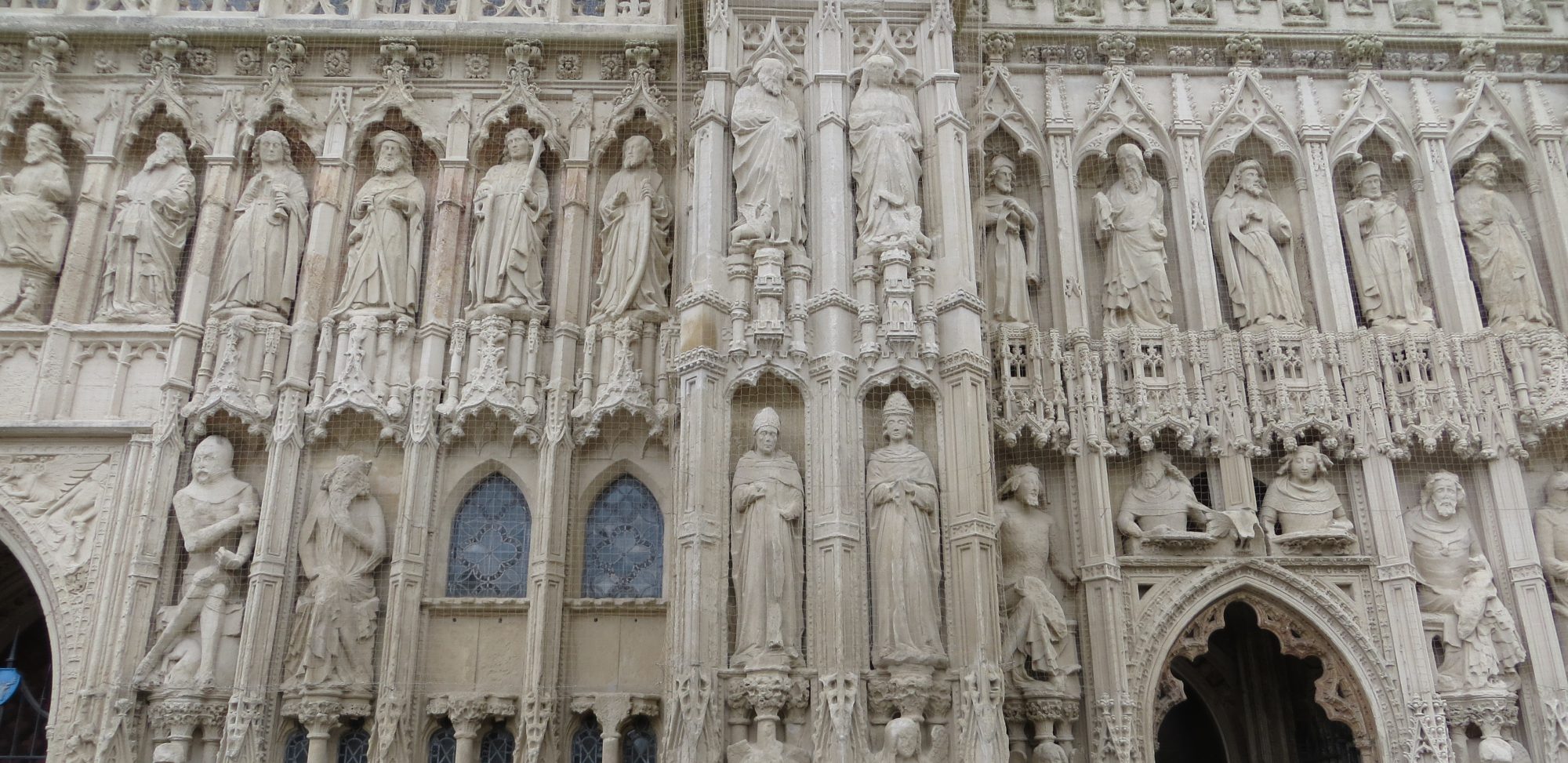
More from D'Costa

Roman Catholics need to revisit their universities in the United States, promoting a genuine difference in scholarship and curriculum so that in five generations a Catholic intellectual culture might possibly be present and transformative of society. The Christian Church at the heart of the university will facilitate such genuine developments that can only enrich intellectual and cull life, facilitate real pluralism and dialogue, and serve the common good. Liberal society owes itself religious universities. American Catholics owe it to their Church and nation.

The other group of critics, those against ‘sectarian’ projects such as mine, and those against outside interference (the Church) in the university, are to be found in strength – within the churches, as well as from non-religious camps. I argue that such criticisms are misplaced and even self-deluding. Since all enquiry and methods of enquiry are tradition-specific, all forms of education are sectarian in certain ways. There is no high ground in this debate, only differing forms of sectarianism, be they liberal, religious, feminist, psychoanalyst, and so on. But there is an advantage to Catholic sectarianism: its conviction, founded in revelation and beautifully expounded by Thomas Aquinas, that reason has a rightful autonomy.

Gavin D'Costa Theology in the Public Square: Church, Academy and Nation.

D'Costa on the university

D'Costa

I have found a new hero - he is Gavin D'Costa. I heard him give an impressive paper last summer on the origins of the university in the medieval Catholic Church. He introduced it by saying that after twenty years of teaching theology in Religious Studies departments he has just come out - as a Christian. This was moderately amusing (and this is the best I can do for an emotional response to D'Costa's revelation). D'Costa's paper was the last thing I ever attended at the systematic theology seminar of King's College London - it might have been an epitaph on what had been until two years previously the last place in England in which Christian theology could be studied. But now, on the day I was in Edinburgh to make the case for Christian theology for the university's sake (see postings in 'Theology and the University') I found D'Costa's Theology in the Public Square: Church, Academy and Nation. It is a joy. Here is a blast from the last page:

Education is central to the development of civilization and if the Church fails to transform education at every level, then the future of the Church and the world are in the deep trouble. If the North American and English public cannot see this, then they should drop all the rhetoric about fostering genuine pluralism and admit the ideological nature of their secularism. This would involve suppressing history – as the recent contested European constitution exemplifies, where the Christian heritage of Europe is passed over in silence. It is up to the churches in North America and English to take up this challenge, to bring the light of God to shine through the portals of the university, to allow for a revitalization of Christian culture so that God may be given glory and the common good thereby served.

This book says what seemed to have become unsayable, in fact it blurts it out.

Theology in the Public Square: Church, Academy and Nation.

The apprenticeship

Christianity is an apprenticeship. All professions - law, medicine, football - require apprenticeships, which involve their own craft skills and vocabulary. The logic of the practices peculiar to each of these cannot be seen immediately seen by the public. Nevertheless we do not demand that each specialism speaks only some neutral language in which all their judgments are completely accessible in the public domain. But it is part of our modern narrative that we should speak only neutral language and that we need no apprenticeship: we can know, everything, immediately, without effort.

Christians say that the Christian life is learned and lived like any other vocation or career, with the same element of adventure, which means that its path is not entirely clear from the outset. In fact they say this is how any life, not just the Christian life, is – everything requires training which means that nothing is immediate or effort-free. This means that the Christian hermeneutic is more sophisticated than the modern hermeneutic of immediacy, which wants us to believe that nothing has to be learned and that life doesn't require any particular skills.

The package of Christian doctrine, which constitutes the Christian apprenticeship, has been taken apart in modern period and some of its components have been re-connected to re-create old Hellenic arrangement of two worlds, in which the world of the individual is prior to the public and political world. This arrangement does not concede that the individual gives or receives anything in his encounter with others, so we appear to have no real stake in other people. We are reluctant to concede that we are beings in time, or that we are really committed to the toil and change that comes with life with other people. Here Christian theology, particularly in its patristic and Eastern Orthodox expression, can contribute decisively. It can show that Christians have an alternative way of regarding the world, a sophisticated ontology which factors in hope. They say that God is making the world more real, and that the ordinary environment of people and things is in process of becoming more vivid, more solid, engaged and interactive. This is what I have learned represented by Orthodox theology. Since catholicity alone says that we cannot leave out the insight of half the Church, though the Eastern tradition may not be better, its difference from our own helps us to see how we may better hold together what we have inherited from Augustine, and prevent it from being purloined by the champions of autonomy who want us to believe that life requires no skills and that we should therefore do without this, or any, apprenticeship.

Whose crisis?

Here is more provoked by O'Donovan’s move (see post below).

In every university in the UK administrators are making it difficult to do any academic theological work. But administrators don’t start out as administrators, but as academics, people excited by ideas. But those academics who do not care to explore the wonderful world of the Western intellectual tradition right back to its beginnings, are very likely to run out of ideas. Then they will lose interest in their subject, be attracted by anything that relieves of what they will then see as the burden of teaching, they will be drawn into preoccupation with syllabuses, examining and funding, and so be drawn into administration. Those who search that long intellectual tradition will find there all sorts of ideas about what it is to be human and what humans have to hope for. Their wonder at the tradition will communicate itself through them. They will not run out of ideas, but will be happy to pass on the excitement they find there, and so they will find satisfaction in teaching and be content to remain academics.

Debate is the real business of the university. But debate costs a lot of nervous energy and the risk of public loss of face is high. It is easy to turn to administration and settle for the satisfactions of paperwork, the more social soul might well get enough satisfaction from rounds of meetings. Demanding paper trails, and complying with the demand for paper trails, is certainly easier than debate.

Administrators are there to serve the university and thus to serve the debate. But because administrators do not attend the seminars in which debate takes place they are never subject to that debate, in the way every academic is. They are not subject to the conflict of ideas or to the testing of those ideas. Debate – the imperative of setting out your ideas before your colleagues and having to defend them – is a very severe discipline. Administrators are those academics who can no longer face that discipline. They place themselves above it. They put themselves beyond the control of the university – that is the universe represented by the various disciples – and so become a separate and superior class, above the academics of the university, who are thereby demoted to the status of the producers of mere product.

The Humanities (literature, history, philosophy, sociology….etc) are that part of the university particularly concerned with what it is to be human, and what humans can do and can hope for. In the long term the health of the humanities is dependent on their staying in touch with the thought of all previous generations on what it is to be human. But it is always tempting for the Humanities to patronise previous generations, to think that they know the long tradition without having read it, or even to believe that they have surpassed all previous generations and no longer need to learn and cultivate that tradition. This temptation always puts the Humanities on the edge of a crisis. When they reach this crisis, produced by laziness or arrogance, they are tempted to believe that the crisis is particularly bad for that discipline most clearly associated with a long history and commitment to things that happened centuries back – Christian theology. But Christianity is very clear about the importance of looking back, faithfully, because it understands that our ability to look forward, hopefully, depends upon it. Christian theology has a very strong definition of what it is to be human and so has a very distinct message. Unlike any other discipline of the humanities, as long as theology listens to the gospel and continues to look back and forward, theology does not lose its way.

It is Christianity (along with Platonism) that is behind whatever agenda other humanities still faintly remember. It is the Humanities which are in crisis, not theology, and this crisis will continue as long as they deny that Christian theology and the ancient tradition of paideia (Plato) offer definitions of human being and what human being may aspire to. Humanities administrators project their crisis onto theology, by appointing to theology teaching positions those who are so poorly acquainted with the Christian theological tradition that they do not understand Christianity as a tradition of thought about how to be human, and a course of education in being human (on the definition revealed in the gospel).

Here is my point. In the UK we have such administrators appointing to theological positions people who have never learned, or learned to love, the Christian tradition of doctrine, and whose assumption that the Christian tradition is in crisis is never challenged by serious engagement with that tradition. These administrators – academics who themselves no longer have anything to teach – appoint to theological positions people like themselves, who pass on this myth of crisis on in their teaching.

I told you this blog is all about stating the blooming obvious.

O'Donovan and Webster

O'Donovan webster

Oliver O'Donovan's departure from Oxford is an omninous event. I wondered whether John Webster (on the right) was over-reacting when he decamped north, but it is now clear that he was not. If you want to see what is at issue, compare Webster with the man who was put in to replace him. Webster, an evangelical theologian and natural teacher and communicator, has done some great work interpreting Barth and Jüngel, the outstanding evangelical theologians of the twentieth century, and has now started on more constructive and creative theology, to show the relationship of Scripture, doctrine and ethics. Webster promises he is at work on a theological commentary of Ephesians, so this theologian is actually doing some interpretation of Scripture to show us what difference it makes, which is exactly what theologians should do, you might think. See his Holiness – it is a gem, and the kind of thing we all wish we could write. Compare this with the man who replaced him as Lady Margaret Professor of Divinity, whose latest offering takes up ‘the critique of theology found in the work of Heidegger’, and whose lecture courses seem hardly aware of Christian doctrine or its great exponents. One cares for the Christian theological tradition, the other does not, indeed believes that theology is crisis, and is intent on running it down.

This is one of those moments when the struggle for the Christian faith impacts on lives and careers in the comfortable West. I doubt whether Oxford’s administrators are troubled about losing these two scholars, because it is these administrators in every university in England who are making it so difficult to do any academic theological work. Administrators, and those who sit on appointments panels, are those teachers of humanities subjects who have run out of things to say and given up teaching. If they believe that theology is in crisis, they are wrong. The humanities are in crisis. Theology is the only part of the humanities that is not in crisis. Because theology has a gospel it has something to say. Theology believes in education and passing on a tradition of thought, and it so it has plenty to contribute to the university. The administrators appoint to theological positions people who have never learned, or learned to love, the Christian tradition of doctrine, and whose assumption that the Christian tradition is in crisis is never challenged by serious engagement with that tradition. There is no one more articulate about the crisis of the humanities and its origin than Oliver O'Donovan, see his Ways of Judgment, and Bonds of Imperfection and The Desire of the Nations - though Webster is not far behind. But what makes this so unusual is that O'Donovan and Webster were Canons of Christ Church, senior clergymen of the Church of England, employed by the Cathedral to teach Christian doctrine in the university. In twenty years time, when the university has finally disappeared up its own backside, the Christians will be meeting in the back of cathedrals and re-inventing the university there, just like last time.

Mihail on theology and religious studies

Dear Mihail, Thanks for your news and photos – I envy you that snow, no sign of a real winter here. We are still in London as before. N is back at work part-time while I alternate between book and baby. That was a great paper and a good read too.

You say that Christian theologians do not read enough religious studies and that this makes them poor conversation partners in the university. But I think that Christian theologians should engage, not with religious studies, but with all studies. Religious studies has no greater claim on our attention than any other discipline. I think that the university is most basically a conversation between Plato and Christ, so Christian theologians should therefore engage with Plato – and through him with the whole wonderful array of sciences and human sciences. In my view, the discipline we have most to do with is politics (and its history). Religious studies is just a form of politics that denies it is political.

I think we should cut Kant out and speak straight to Plato, the master. Why? Because Kant is not honest: he wants to have two roles at once. He wants to be our interlocutor, which is the same status that we and everybody else has round the table, and a member of the university, the round table of knowledge. But he also wants to be chairman and referee, so he can blow his little whistle and rule certain speeches and certain discourse out. So one question we have to ask Kant is: are you in this discourse and dialogue, or are you above it? Do you concede the discipline of this discourse, with the rest of us, or are you certain that you have nothing to learn, that your knowledge is uniquely from some source of your own, so that you are above us? Kant believes that he has no need to submit himself to the university, in which theology is one among many disciplines. He denies that his views are a tradition, one tradition amongst others, that they have a history, which might have been, and could still be, different.

You don't query what Kant has done, Mihail. He has disguised from us that these are all decisions that someone (the political philosophical tradition) has taken for us, and they are political (ie open to our revision and change), not religious (above challenge). ‘Religion’ can only be politics that is not honest about being political. ‘Religion’ is just that politics which the elite has decided is stupid and unacceptable. Kant, Hobbes, Spinoza and company are trying to get the proles to shut up, by ruling out all their rights to participate in the discussion of what is true and good.

So I think that the real ‘other’ and dialogue partner of Christianity is not the ‘religion’ of some ethnicity from some other continent (Asia or Africa), but our very own secular-worldly tradition, which we must examine through its pagan, Greek, Roman history. It is we whom the Christian tradition is addressing, us with all our Greco-Roman baggage. You have not queried the secular-sacred distinction at all. The Christian gospel is addressing our total, and that means our everyday and secular, being. Christianity does not observe the sacred-secular distinction on which religious studies is premised: it refuses this secular distinction, because it claims the world and this present age (saeculum) as every other age.

But you are right. Theologians don't read widely enough, and so are poor conversation-partners in the university. But theologians shouldn’t just read Eliade and disciplines ancillary to religious studies (anthropology, psychology), but politics and economics, and history and literature – all your own favourites. But that is small beer beside the real criticism which must be made of us, that we are Scripturally-illiterate, hard of hearing and ourselves hardly receive the gospel we have to pass on. Anyway a great paper. Send us another.