5. Palm Sunday - Entry to Jerusalem

So Jesus also goes into Jerusalem as into the storm. Starting this coming week we watch him enter this narrow defile which becomes darker until there seems no way out. On the third day we see him crash through and emerge out of the other side, and riding on through all his creation, imperturbable victor. The Lord takes us with him through it all, so though this is always a victory procession, for us, in this present, this victory takes the form of this very public confrontation.

For at this moment, for our sake, and for own people’s sake we are heading right into this most almighty confrontation with all those frightened and arrogant disordered powers and institutions that have grabbed what is not theirs to control. We have to take their battering.  The extent of the opposition coming our way in this country in the coming years will show just how long we have been neglecting own people. We have not told them what they need to hear; we have not even told one another.

A strong healthy community of any sort, whether a business or a nation, has to hear the truth about itself, repent and abandon whatever policies are not working, and start again. Repenting, praying, thanksgiving: Sorry, Please, Thank you – these three instruments are required to keep any community together.  Everything needs regular maintenance. An inspection brings malfunctions to light. Everything needs the caustic of truth, won through the discipline of good self-judgment.  But our nation has avoided for this for so long, that it and we are now thrashing around to avoid the one thing we most urgently need. We were born within a vast covenant of civilisation and of civility, utterly precarious, but also fragile, and now despised and vulnerable. Seventy, maybe even fifty, years ago just enough of the virtues that support that civility was passed on through family and public culture. Now no longer.

More...

With Mary Magdalene on Easter morning

The Lord Jesus is God and man in one figure. When we worship him, we are standing before the open door of the throne room of the Lord. He waits for us through there, or since we are the ones who are constrained by our limits, it would be better to say that he waits for us out there. He calls us out of this stiflingly small place and into the vaster place of his immediate presence. And so we marvel at the Lord and so we worship him. That is what the angels are showing us, and why the disciples stand here open-mouthed, moving from bafflement to amazement, singing Holy, holy, holy… This tomb turns out to be the throne of God, where all his company stands around the Lord, for where the Lord is, there his people are gathered around him. It the gateway which opens for us so that we can go in to that company and his presence. Our future is through there, with them and him, for we were made for undying communion with God, and with one another, in God's glorious company.

Easter morning 2010 He must rise from the dead

Christ the King

Jesus Christ is our king. That means that we have a good king, one who can do the job, actually the only one who can do the job. This king is there to protect us from the incursions and demands of those who want to exercise power without authority and who may be able to start doing us good but cannot keep it up. A king is simply a political leader. All leaders get their political authority from God, and God is the control and limit on them all. The world is full of undeclared chiefs, who want to make themselves our kings, without admitting as much, without allowing their power to become explicit or becoming accountable to us through the normal political channels. We Christians are here to remind all leaders that God commands them to act well for the people they have authority for, and that they will have to give an account of themselves, and will stand before that judge. All our political representatives are ‘kings’, ‘chiefs’: we don’t call them that, but that is how the bible regards them. Part of our job is to tell people and institutions who have effective power that with it they have authority to use it well, for the nation as a whole.

So now what about our own political classes? How are they doing? They exercise a form of kingly authority for us. Our government, from the smallest council employee to the prime minster, is the hand of God for us. We have to encourage them to govern, and tell them that they have a good and honourable task. We have to invite them to judge for themselves whether they are doing a good job. Each of them may and must carry out their office. They may do their job, at whatever point, high or low, in their particular institutional hierarchy, in the knowledge that they do it for us, for our good. This is their share in the kingly office of representative rule. They govern for the common good and so we encourage them to do this well, and we give them our thanks. We can remind them that we are here, and are watching, and that they will present their work to God, the only fair judge and true king.

Christ the King St George the Martyr 22 November 2009

Palm Sunday

From the Kingsland High Road yesterday we walked down Stoke Newington Church Street singing All Glory, Laud and Honour to Thee Redeemer King, and Ride on Ride on in Majesty. In the afternoon we met again at St John’s Hackney and sang our way around the south of borough, We are marching in the light of God and God's got an army marching through the land.. in this march I’ve got a part, stopping to pray at spots where young people have died in the last year. Lord, teach us how to pray.

Long Way to Easter 4 A theological economics

The fourth lent talk starts this way:

Christ has laboured on our behalf: he is the provider of mankind’s only free lunch. We may provide for one another as we receive and distribute what he has provided for us. God has acted generously to us, and invites and enables us to be generous and active on one another’s behalf. From him we may receive the abilities by which we can act and trade on our own account, for we are ‘created in Christ Jesus for good works’, as the Letter to the Ephesians puts it. We may discover that labour can be its own reward, for we may take pride in those whom we have served and lift and present them to God in thankfulness, and then we will no longer be alienated from the product of our labour. God is the one who is able to tell the true worth of our labour and our lives.

It continues:

But others came after Smith who were convinced that the entire existing tradition of deliberation about what is good, of Plato and Aristotle, and Augustine and Aquinas and their heirs, had become hopelessly tangled. They decided to give up on it, and cut moral language loose from all previous discussion of what is good or true. This new generation of political philosophers were the Utilitarians, best known of whom is Jeremy Bentham. The utilitarians wanted us to give up talking about right or wrong, or good or bad, even in the sense of ‘good for some purpose’, as when we say ‘this will not look good to other people’. Any good is good to the extent that enough people want to raise its price to the point at which its present owner is prepared to sell it. They have encouraged us to think only in terms of good as this is established by the satisfaction of the person who employs enough money to outbid all others and so claim it. It is the price mechanism that decides on the value of a thing, so the utility or usefulness of a thing is decided by the price that reflects the preferences of all agents in the market. Within this Utilitarian account, all our acts are seen as ‘preferences’, that is, as private.

And ends like this:

When the entertainment industries have opened up the family by driving a torrent of new desires through it. If they cannot resist, family members cease to sacrifice individual desires for family cohesion and are not able to work for one another or welcome one another’s service. As the family starts to break up, the state is there to provide for each of the individual pieces that have been created. We no longer need of one another because the state follows the private sector in to provide each ‘need’ so that it never becomes articulated as the need of one person for another. The result is not that each single parent is that each single parent is married to the state. The state has become the universal mediator, driven to smooth out all inequalities and with them all the complementarities, by which we need one another. The state cannot love. But it may exhaust our national economic resources in compensating for the love that we no longer give.

Lent 4 Lent 4 Douglas Knight

Publish at Scribd or explore others: Study Guides Academic Work lent easter economic

Read the rest here

Long way to Easter 3 A theological economics

The third lent talk begins like this:

Behind this economic crisis is another crisis, one of morale. Have we become the society that each of us individually ceased to believe in? Because we have assumed that we insulate the economy from all other factors, in particular these factors that I have linked to covenant, to confidence and so ultimately to will of this society to continue, and to create another generation, we have not made the connection between economy and morale, and so we been taken by surprise by this financial crisis.

and ends like this:

The Church asks whether we are selling ourselves here, in this ‘temple’ that we have built. Are we being sacrificed here? Are we being sold here, amongst the money-changers? The cross of Christ tests all these temples of our own construction. They may not survive this testing. If it has become a temple in which we are not built up but sold and sacrificed, they will fall. We have to ask whether we have become enthralled and trapped in building a temple of our construction which has enfeebled our society and which its own contradictions is finally beginning to bring down. Can Christ cleanse the temple for us? Shall we pray that he does?

Read it all here

Long way to Easter 2 A theological economics

The second Lent talk starts like this:

To explain why we are facing this flood and these crises we have to think through covenant, love and gift. We will examine them not because these are religious ideas, but because they are fundamental economic ideas. When we attempt to understand economics without them, we achieve incoherence. Economics has indeed tried to understand human interaction and exchange without the concepts of covenant, love and gift, and the result has been the bankruptcy of economics and a crisis that is both social and economic.

You can read it here, or read the whole series here

Long way to Easter 1 - A theological economics

This year's Lent talks follow the Lectionary readings for the five Sundays of Lent. They will examine our social, political and economic crises and relate them all to a crisis of morale that follows from our uncertainty about the covenant of God. The first talk starts like this:

What the Church says it not only says in Lent and Easter, but in every Church service. Easter simply spells out in large format what is going on every Sunday morning, when on behalf of the whole world the Christian community confesses its sins and receive forgiveness, and so remains a confident people. The Church that is confident of the resurrection is uniquely able to talk about pain and cost, because it is formed by the promise of forgiveness and the hope of redemption.

It continues like this:

We are undergoing a severe economic crisis. What is causing this crisis? Greed is of course some part of the answer but the problem is not only that we have demanded too much, but that we have not demanded enough. We do not value ourselves enough, and all our materialistic impatience and over-reaching is nothing but compensation for this crisis of morale, a failure to value ourselves. We belittle and devalue ourselves in the fear that if we don’t others will denigrate us more. But we denigrate ourselves in defiance of God. God is the true judge of man, and God finds man good and loves him. That is the news of the gospel.

and ends like this:

It is good that creation has limits. It is good that we explore and discover these limits. To burn our way through creation is absolutely impoverishing for us. It gives us no opportunity for moral growth. It does not teach us to husband these resources or to wonder at this creation and care for it. It is only because it is a finite world that we have to learn how to act within it. It is only when we exercise self-restraint that we can act generously and for other people. And it is only the opportunity of acting well and generously, that there is the joy which is the whole point and purpose of creation.

Read it all here

Ask Médaille

John Médaille The Vocation of Business: Social Justice in the Marketplace is far-and-away the best book I have seen on the (bad) theology of economics. It puts economics into its political-philosophical context, with plenty of history, Catholic Social Teaching and immediate relevance to our present situation. It is a big but very well controlled book pretending to be a modest one, and the only book I have not resented buying recently: the title gives no idea of its range or intelligence. Médaille blogs at the Distributist Review

Reliance on the government as consumer of last resort has resulted in a structure that favored global production over national income, the FIRE economy (â??finance, insurance, and real estateâ??) over the real economy (real production of goods), low wages over fair ones, and gargantuan size over human scale. It is this last point that is particularly troubling, since this gargantuan institutions have proclaimed themselves to be â??too big to fail,â?? and exercise economic blackmail over the whole republic. The problem with this claim is that it is correct. But the proper response is not to give into the blackmail, not to negotiate with crooks, but to make sure that the blackmailers are never in a position to control the whole economy, to demand trillions in ransom whenever they get themselves (and us) into trouble. Now, it would be mere carping by distributists to point out the problems if we could not offer solutions. But we do have solutions, and it is time to offer them, time to end the era of big business that depends on big government, on subsidies from the general public to private profits. I have nothing against profitsâ??when they are earned; I have everything against profits that are the result of subsidies and privileges. The distributist solution to all of these problems can be summed-up in a few words: Buy it up! Break it up! Fund it right!

And keep reading The Market Ticker

The Body of Christ

Today the marching season begins. It is Corpus Christi, so let's see that Body.

I am off to All Saints St Margaret Street for 6.30pm High Mass and outdoor Procession of the Blessed Sacrament. St Mary the Virgin Bourne Street has its procession on Sunday.

St Patrick’s Soho has an International Mass with all the different chaplaincies of the Parish at 6pm followed by the Procession with the Blessed Sacrament through the streets with Benediction at St Giles’ at 7pm.

Joanna Bogle tells us about this most awesome experience.

Pange, lingua, gloriosi Corporis mysterium

Sing, my tongue, the Savior's glory, of His flesh the mystery sing; of the Blood, all price exceeding, shed by our immortal King, destined, for the world's redemption, from a noble womb to spring.

Holy Week cont.

I have got the sermons for Wednesday and Thursday of Holy Week up.

Maunday Thursday is the day when the clergy of the diocese gather in the cathedral with the bishop for foot-washing and repentance, and to receive the oil of charism.

This servant-status, this priestly deaconate, is for those who in Christ have had ‘all things given into their hands’. This weight of glory is yours. It releases you. You have been forgiven. Just as your life is no longer yours to live alone, so your problems and your sin is not your own any longer. You are free to seek more and more of that forgiveness, and to do so with greater and great abandon, more and more publicly. You are free to confess your sins and to lead the rest of us in letting go of our own sins. You may be the most care-free of people.

This means that you are free – for others. You are servants, deacons, waiters-at-table, fetchers and carriers. You will wait at hospital beds, anoint the dying, find words of comfort for the frightened and anguished. You will baptize and teach, you will hear confession, you will marry and bury.

Death is defeated

Easter Sunday Fear is natural, and so is grief at the death of another (Jesus, remember, shed tears for the death of a friend). Don't attempt to avoid it or deny its seriousness. On the contrary, keep it in view; remind yourself of it. When the tradition of the Church proposes that you think daily about death and prepare for it, it isn't being morbid but realistic: get used to it and learn to live with the fear. And meanwhile - Shakespeare was being entirely Christian in this respect - get used to loving and valuing things and persons irrespective of the fact that they won't be there for ever. Love them now, and what you would want to do for them, do now. 'Night is coming when no-one can work', says Jesus. (John 9.4)

So what does it mean to say that, despite all this, death is 'defeated'? When death happens and growing stops, there are no more plans, no more hope of control: for the believer, there is only God left. Just as at the very beginning of creation, there is God, and there is the possibility that God has brought into being by his loving will. When death has done all it can do, God remains untouched and his will is the loving and generating will that it eternally is. When we look at death, we look at something that can destroy anything in our universe - but not God, its maker and redeemer. And if we accept that we shall die and all our hopes and schemes fall into the dark, we do so knowing that God is unchanged. So to die is to fall into the hands of the living God.

Archbishop Rowan Williams Easter Day sermon

Bishops, would you kindly follow your Archbishop in getting your Easter Sunday sermons out on Easter Sunday through your own websites? It makes all the difference

The wood of the cross

Easter Saturday The wood of the cross – that is the world. The wood is dead now, but look again and see this wood sprouting shoots and bursting into life again. That is what you see on the mosiac on the north transept side of the dome of St Paul’s Cathedral. There is Christ on the cross, but the cross is supported by him, as though strapped to his back like an easel. He is carrying this world on his back, and the dead wood of the cross has started to push out buds and become a tree.

The cross is all the antagonism and aggression we direct at one another. The cross is this world of cutting-off, letting-go and letting-die, in miniature. And it is the end, refusal and overcoming of this world of letting-go. Christ has taken all our cutting him-and- one-another-off, and absorbed it; he has refused to cut us off, or to let us go or in any way to reciprocate. He took what we gave, without limit, until we had for our part, cut him off entirely. We cut him off, but he did not cut us off. But what we gave him, he took, without giving back, and so he took it away from us. He took what we meted out, and held on, to us. We refused him our humanity, stripping him of every human relationship; all humanity stripped him and removed itself from him. But even our entire act of removing from him the sum of our ‘humanity’ did not result in any diminution of his divinity, that is, of the Father’s determination that this was his Son, and that this Son was us and is us. The sum of our humanity turned out not to conceal any divinity; divinity turned out not to be the sum of our humanity. When we lump all humanity together, all our history, achievement and civilisation, it turns out that divinity is entirely transcendent of it. Divinity is his, not ours, and so life is his to give, and not ours to withhold.

All our refusal of for him, and of one another, and all our effort in cutting him off, and in cutting one another off, proves unable to prevent his divinity from holding us and bringing us back to life. From him life seeps into us. The invincible unity and communion of the Holy Spirit that secures Christ from us and exalts him, will also raise us. Though we put him in a hole in the ground, and the earth closed over him, neither we nor the earth could hold him there. We are unable to prevent this divinity, the life of God, which to us is resurrection, from pulling him out of our grasp and exalting him. We cannot prevent God from exalting this human, and we cannot prevent God from deciding that in Christ all our humanity is safe and secure. For all our cutting ourselves off, from him, from one another, none of us is lost. We are not able to make our refusal stick or to carry our own destruction through. However I cut you off, Christ will raise you to me again, until at last I am ready for you. In him and from him the whole human race will sprout and grow again. The truth of this dead wood is its future as this tree. Joined to him we are this living tree, for on Christ’s back all humanity and all creation is bound to life, and I am bound for you and you are bound for me.

Holy Week 2 Tuesday Unless a grain falls…

Today, according to the Lectionary, our readings are from Isaiah 49 – ‘in the shadow of his hand he hid me’, and I Corinthians 1 ‘The message about the cross is foolishness to those who are perishing’, and John 12. ‘The hour has come for the Son of Man to be glorified. Unless a grain of wheat falls into the earth and dies, it remains just a single grain.’

‘The hour has come for the Son of Man to be glorified. Very truly, I tell you, unless a grain of wheat falls into the earth and dies, it remains just a single grain; but if it dies, it bears much fruit. Those who love their life lose it, and those who hate their life in this world will keep it for eternal life. Whoever serves me must follow me, and where I am, there will my servant be also. Whoever serves me, the Father will honour. Now is the judgement of this world; now the ruler of this world will be driven out. And I, when I am lifted up from the earth, will draw all people to myself.’ John 12.20-36

God has dropped a single seed, into the earth. Christ is this seed. Will he grow, will he survive, will he fruit? He lets go and gives himself away to us. The kingdom of God is like a farmer who sowed, and who does not know whether he will see any crop (Mark 4.). He hands himself over to us, entirely into our hands. The Lord God has taken a punt with us, has risked his own name on us. He does not want us unless we are ready to be wanted, and are ready to love.

Those who love their life lose it, and those who hate their life in this world will keep it for eternal life. This recklessness is our lot now. The Son of God is content to be the Son in the complete disguise – clothed in our creatureliness, our humanity and materiality. This concealment is what the passion of Christ is.

Holy Week 2 Tuesday

Holy Week 1 Monday The house was filled…

Six days before the Passover Jesus came to Bethany, the home of Lazarus, whom he had raised from the dead. There they gave a dinner for him. Martha served, and Lazarus was one of those at the table with him. Mary took a pound of costly perfume made of pure nard, anointed Jesus’ feet, and wiped them with her hair. The house was filled with the fragrance of the perfume. John 12. 1-11

This anointing is the form Mary’s praying takes. Mary is praying without making any requests. She simply presents herself to the Lord, without word. In the same way we do not know what to say, but the Spirit prays for us from within us. She washes his feet and anoints them with this nard so the perfume fills the house. ‘Your prayer as been heard’, Jesus says on another occasion. The perfume is the prayers of the saints which rise up from the worship of the Church.

The whole earth is full of his glory. God has made the world, but his glory is hidden in it. But it is not obvious to us that this place is full of the glory of God. Creation waits for its redemption, and as long as it does so it groans. It is our job to lead this lament, and to say the world is not comfortable or settled, but we look forward to the time when this glory fills the house.

Holy Week 1 Monday

Palm Sunday

On Palm Sunday morning we met on the Kingsland High Road with St Paul’s West Hackney, and Hackney Baptist Church and processed back along Church Street the mile to St Mary’s singing

All glory, laud and honour to thee Redeemer King To whom the lips of children Made sweet hosannas ring. and

Ride on! Ride on Majesty! and

There is a green Hill far away and

Give me oil in my lamp, keep it burning…

We got through the whole lot twice, in rain, in good voice the whole way. The C of E - we have got the best songs.

That was Palm Sunday. Now on to Holy Week and our onward trek through the liturgical year.

Holy and Great Lent

During this period of Holy and Great Lent, our Church calls us to repentance. Doubtless, as contemporary man hears this invitation to repentance, he does not feel comfortable, because he has accustomed himself to a certain way of life, and does not wish to question his own rectitude. Calling one’s own rectitude into question produces feelings of insecurity, because the ideological structure within which you have sure and certain refuge is clearly risked.

The one who constantly repents, ever progresses, ever rejoices through new ascents, finds constant satisfaction in deeper understandings of all things. Through the transformation of mentality and understanding, the one who repents better understands the whole world, becomes wiser, more judicious, more discreet, nobler and a true friend of Christ. Therefore, the preaching of repentance should be favorably received by wise persons who are able to appreciate any improvement that comes from the renewal of the human person through repentance.

Therefore, brothers and sisters and beloved children in the Lord, let us accept the invitation of our Church to repentance. Let us who have fallen short through sin cleanse ourselves from sin through confession. Let us constantly examine our own presuppositions, so our judgments and thoughts may be godly and pure, just and true.

Holy and Great Lent 2008

BARTHOLOMEW of Constantinople The fervent intercessor for you all before God

Holy week talks

The Archbishop of Canterbury’s Holy Week Lectures(PDF)

The Most Reverend and Right Honourable Dr Rowan Williams delivers a series of lectures after Evensong at Westminster Abbey

****Monday 17th March Faith and Science Tuesday 18th March Faith and Politics Wednesday 19th March Faith and History

Holy Week seems a good time to follow the Lectionary rather than to continue the thematic approach. I look forward to the day when our bishops demonstrate how to preach from the bible readings set by the Lectionary. My On the Way to Easter series on Resources for Christian Theology is my latest attempt. I am going to talk about preaching, lectionary and eucharist at Westminster Abbey's Cheneygates Work-in-Progress seminar on April 24 at 12.30 (though the Abbey website gives no sign).

St Francis Episcopal Church San Jose offers an introduction to Lent and Easter. Did you know that 'Maundy' Thursday comes from mandatum novum, 'a new commandment' and Good Friday was originally 'God's Friday'? You can learn more about Lent, Easter and the lectionary from the excellent Ken Collins and from Textweek.

On the way to Easter - Lent 5

In our journey towards Easter we have seen that Christ is anointed and made king by the Holy Spirit. The Spirit has brought us into the communion and body of Christ, so that we are anointed with him and he with us. We have seen that Christ is our universal human-to-human mediator. He is the one who can hear and receive all other humans. The question to us is whether we are ready to receive through him the whole human race and created order as the gifts of God. Christ makes himself present only in this disguised form, so that our freedom to receive this life from him, or not to receive it, is entirely ours.

Consequently man is a mystery that cannot be controlled. It is not just man’s present, defined by the limits of our imagination, but his future that God has at heart here. God is guardian of our freedom: he does not let us give it away. We have seen man wrestle with the question of his own identity. We have seen this wrestling spelled out to us in terms of the accuser wrestling in the wilderness with Christ, Israel wrestling with Moses, Nicodemus and the Samaritan woman at the well wrangling with Christ about where life can be accessed. Through these are many different encounters, we have seen man wrestling with the dark figure of his own future. This future is life with God. This week Lazarus anticipates Israel – All Israel will be raised and the Church will be raised.

On the Way to Easter - Lent 5

On the way to Easter - Lent 4

At Easter God completes his act of creation by raising one of us to the full definition of humankind. In Christ the whole work of creation has been successful, and that success is opened to all of us. Through the Holy Spirit Christ has attached us to himself, so that the resurrection of the first man is the beginning of the resurrection of all humanity. Easter is a preview of the consequences of this for us: Christ’s resurrection is a rehearsal for ours.

In Christ, each of us joined to every other. The Church is the companionship of God making itself tangible and corporal here. The distinctiveness of the Church from the world is the great gift that God gives the world: the world is anointed with the Church. But what the Church knows is not obvious outside the Church – it has to be confessed. The Church has to pray and to speak up for the world. The world relies on us to do this.

On the way to Easter - Lent 4

On the way to Easter - Lent 3

Third Sunday of Lent

Exodus 17.1-7 Psalm 95 Romans 5.1-11 John 4.5-42

In our preparation for Easter we have been looking at the different aspects of the resurrection that are presented to us in the Scripture readings for the five Sundays of Lent. We are thinking through here what we are doing when we gather in Church and spelling out some of what is going on, on Easter Sunday morning. We want to show when we say ‘Christ is risen’ we are referring to a question, and to a promise, about our own identity.

We said that the Christian confession of God helps us to hear the question of God, ‘Where is your brother?’ The Christian faith is a real listening, to the world and to God, and it prevents us from making ourselves secure without one another.

So far we have said that the Church is the fellowship created by the love of God for us and God's act of witness to the world. Next we have to say that the Church is the whole company of heaven, making itself felt here and now for us. This company are our servants, and together they make up the service of Christ to us. This company is also in disguise, so it is not obvious that this is what is happening.

On the way to Easter - Lent 2

Life comes from outside us – we are ‘born from above’. We are not individually in charge of our own existence, means that life also come from outside us. This ‘outside’ John identifies with ‘above’, where God is.

Jesus answered, ‘Very truly, I tell you, no one can see the kingdom of God without being born from above.’ Nicodemus said to him, ‘How can anyone be born after having grown old? You are Israel’s leader. How can you not understand this? John 3.1-17

We are born, again and again, continuously. We are renewed continuously, from above. Our creation is not only a one-time event in the past – and so our relationship with God is not only a single event situated in the past, but it is also live now.

God is full of life and full of freedom and time, for us. He dispenses this life and freedom to us, gently, through time. God gives himself to us, slowly and piecemeal, always preparing us to receive more of him. The work of God is to ratchet us up into increasing participation in the economy of his life, in which new human action may continually come into being – the inexhaustible economy. The life we have comes from the Spirit, from above, our wellhead and headwaters, our source and provider.

On the way to Easter - Lent 2

On the way to Easter - Lent 1

I have been asked to write some talks for Lent. I have followed the readings for the Sundays of Lent. Here is the first of them.

On the way to Easter - Lent 1

We are on our way to Easter. On Easter morning we will say that ‘Christ is risen’. Easter is the moment when the undying and indestructible life that God makes itself apparent. God has set out to bring us into relationship first with himself and then with all other human beings – he will raise us. When we say ‘Christ is risen’ we are pointing to the coming resurrection of all creation in him and so we are pointing to our own resurrection, which is the resurrection that is of real interest to us.

28 January - Saint Thomas Aquinas

In the man Jesus Christ however there was no movement of sense that was not controlled by reason; and even his natural bodily activities were in a sense voluntary, inasmuch as that he willed that his flesh should do and suffer according to its own proper nature. So there is even greater unity of activity in Christ than there is in other men. … Christ’s grace was not just his own personal grace but the grace proper to the head of the whole Church, to whom all members are joined so as to constitute one person mystically. So what Christ earned he earned for all his members, just as what man does with his head serves all his members. The sin of Adam, whom God appointed to beget the whole of humanity, passed on as inheritance to others by bodily propagation; the earnings of Christ, whom God set up as the head of all men by grace, pass on to all his members by spiritual birth of baptism which makes us members of Christ’s body.

Saint Thomas Aquinas Summa Theologiae Part III, chapter 13, 19.1

Humanity is one of the languages of the persons of the Trinity

God so loved the world that he gave his only begotten Son. His Word became flesh in the living, dying and rising of Jesus Christ, God's human face. In response the Son gives himself to the Father and the Father is the Father because the Son, who has answered his call has given him his name. The Spirit enables creation to participate in this dynamic of giving and receiving.

Humanity is one of the languages which the persons of the Trinity use in communicating with one another. The Trinity is not some divine threesome but a union in which the persons call one other into being. They give themselves up to one another in the Spirit and in doing so each evokes in each what else would never come to be. The resurrection opens the door to a participation in this way of being fully human. "Say to my brethren that I ascend to my Father and now your Father and my God and now your God".

The resurrection is a revelation of the life of God which was expressed on the first Easter Day but the resurrection is also the open door to a new creation in which we are called to participate in the life of the Trinity and to discover that life in all its fullness comes not as we hoard up ourselves and set our hopes of happiness on accumulating things but when in the power of his Spirit we give up ourselves to one another and so bring a new world of possibility into being.

This has been proved experimentally in the lives of the saints. Even to those of whom St Peter said "they did eat and drink with him after he rose from the dead."

This keeping him company continues. God holds out the gift to us of life with him and he has started the work of building a holy people. The day of resurrection has dawned. It is accomplished. But the resurrection is also happening and the resurrection is full of future hope in a world where we have only just begun to learn how to speak the language of humanity as God intends.

The Rt Revd Richard Chartres, Bishop of London Sermon for Easter Day

He is a very well-read bishop, so we are very glad to have him.

This is the day that the Lord has made

The Lord is my strength and my might; he has become my salvation. There are glad songs of victory in the tents of the righteous: "The right hand of the Lord does valiantly; the right hand of the Lord is exalted; the right hand of the Lord does valiantly."

I shall not die, but I shall live, and recount the deeds of the Lord. The Lord has punished me severely, but he did not give me over to death.

Open to me the gates of righteousness, that I may enter through them and give thanks to the Lord. This is the gate of the Lord; the righteous shall enter through it. I thank you that you have answered me and have become my salvation.

The stone that the builders rejected has become the chief cornerstone. This is the Lord's doing; it is marvellous in our eyes. This is the day that the Lord has made; let us rejoice and be glad in it.

Easter Day Psalm 118

Death is no longer the ruler of life

Beloved Concelebrants and pious and God-loving children of the Church,

CHRIST HAS RISEN! Once again we hear this joyful Christian greeting within our Christian Communities. But many of these prosperous Communities disregard the question and very real issue of death, and live as though death did not exist and the resurrection was without meaning. However, â??Fearful is the mystery of deathâ??, as the hymnographer says and our daily reality reiterates. The fear of death, which is most acute in those who confront problems of health or old age, even when it is alleviated in a variety of ways, consumes our peace of mind, fills the soul with irrational anxiety and often leads to suicide, for the relentless insecurity becomes unbearable.

The Resurrection of Christ put an end to this insecurity. Death is no longer the ruler of life; it is not the unavoidable end of our existence. Our tomb stones do not overshadow our existence for ever with an everlasting silence. The stone which shut the tomb of Christ was rolled away, and Christ came forth triumphant, master over death, unscathed by its sting, the firstborn of the dead. From that moment, the door of the tomb remained open behind Him for all.

The fear of death has vanished for all who wish to follow in the footsteps of Christ. All things have been filled with joy and hope. â??Where, Death, is your sting? Where, Hell, is your victory?, asked my predecessor Saint John Chrysostom in triumph.

However, brethren and beloved children in the Lord, we live the ever-present death and continuous Resurrection of the Lord, not only in the sacrifice of Golgotha that we see portrayed in our churches, but also in the lives of the saints, ancient and contemporary. The Lord rose and granted life. But He also continues to grant resurrection and life. Death is now a gate of passage to a new state of life. It has ceased to be a prison for souls, a dead end, a state without hope. The boundaries of deathâ??s stronghold were broken down, its gates shattered, and everyone who follows Christ is able to return to life with Christ.

Believe, brethren and children, and have hope! Be free from the fear of death and lifeâ??s anxieties, because for the Faithful, like yourselves, death is no more. Only, cleanse your souls and bodies and enrol as followers of Christ, Who is also your own Resurrection. Christ has risen and you are all potentially risen. The glad and joyful message of the Resurrection is a message for you. It is not something foreign or irrelevant to you. Your mouths should be filled with joy when you say, â??Christ has risen!â?? For â??Truly He has risen!â?? and we are raised with Him.

May His life-giving Grace, â??which heals what is infirm and makes up what is lackingâ??, be with you all. Amen.

Holy Pascha 2007 + Archbishop of Constantinople Bartholomew Fervent Intercessor to The Risen Christ for you all

The spiritual struggle should be practiced with joy

Holy and Great Lent 2007

The goal of spiritual struggle is not the acquisition of virtues, or of any other strange abilities solemnly through human powers, as it is believed by those who belong to various humanistic circles. On the contrary, it is the expression of our desire to meet the person of our Lord Jesus Christ, in whom everything is recapitulated, and though whom everything is derived. The Word of God, the Logos, preaches most clearly that without Him we cannot do anything, and the Hymnographer reminds us that unless the Lord constructs the house of virtues of the soul, we struggle in vain. Therefore, we Christians devote ourselves to the love of Christ, and we give up voluntarily many other kinds of love and devotion that are of secondary importance, so that we will become worthy of His presence in the house of our souls. When this is achieved, with the grace and blessing of God, then peace, joy, and perfect love will have settled permanently in our very existence.

The spiritual struggle should be practiced with joy and its main goal should be to introduce our heart into the love and joy of God, though which every sorrow and vindictiveness, and every complaint and protestation against our fellow men and women is expelled from us. In its place we will then have the unshakable and great peace of God that will radiate all around us.

May we all pass through the arena of Great Lent with spiritual struggles, so that we will be able to enjoy in all its fullness the joy of the Resurrection of our Lord Jesus Christ, Whose Grace and rich Mercy be with all of you.

+ Bartholomew of Constantinople Your fervent intercessor before God

Fourth Sunday of Lent Evensong

Sing praises to the Lord, O you his faithful ones, and give thanks to his holy name. Weeping may linger for the night, but joy comes with the morning. It is good to be in time, and to celebrate these ends and beginnings in our morning and evening prayer. These boundaries of day and night mark out our time for us, allow us to work and to stop working, and to look back and forward.

We are preparing for Easter. At Easter God completes his act of creation by raising one of us. The one he raises has attached himself to all the rest of us, so the raising of the first is the beginning of the raising of the whole lot, all humanity, each of us joined to every other. This human being is complete continuity with us but is now no longer constrained by our biological limits, so his life is not given its form by death, as ours is. He is now able to pass his life on to us without limit. Easter is a preview of the consequences of this for us: Christ’s resurrection is a preview of our resurrection, which is the moment when our boundaries between us and him, and between us and one another, cease to be an end, like death, and instead become just markers, like day and night.

Raised from the dead, Christ is the whole colossal future of humankind. He is our future, present here for us to get used to. In every Church service Christ is the one doing the work. He is praying to the Father, and it is our privilege to listen and join in. He takes away from us what we cannot manage, all those half-truths and misdirected worship, and sends it all to God for its redemption and renewal.

Christ is the universal person. He calls and names, hears and waits for all, he works for all and draws all to make them human, together. The work he is engaged in here is to make us compatible with one another, holy, catholic persons, his communion of saints. He makes himself present to us by making all these other persons, who will together make up our future, present to us.

The Son stands at the front of every Church service, and presents us to God. So when you look up the Church you are seeing Christ holding out to us all the elements of our future selves. We see first the book of Scripture, and then the bread and cup, the Word of God which is also the sacrament, the power of God to make us holy. All the good things that are coming to us are made visible and tangible to us here in these small tokens. There are many ways of spelling this out; the bread is our humanity as it is, tattered and ragged, made of the created earth as we find it, and the wine is humanity as it is with Christ, in complete relation with the Father and thereby fully human. But bread and wine are just the visible front end of the whole created order that serves us and brings us first into existence and then into the communion of God.

You see of course the figure who holds out the bread and cup to us, the priest. Christ makes himself present to us in the strange form of one of us, dressed in the dark cassock of Christ’s poverty and humiliation, and the bright white surplice of humanity made radiant: in that combination we are hologram of ourselves as we are, poor, and as we will be, radiant.

So Christ makes himself present as these elements, and this priest. It wouldn’t be right if we left it like that, for the priest is no priest without the people. That figure up at the front represents all of us with Christ. What Christ chiefly gives us is people, along with the means to receive them, not simply as they presently are, but as they will be. He is the whole human, and the universal human-to-human mediator, who is now opening us up so we can receive one another as gifts of God, and together become members of the vast company that he presents to the Father. He does the work here and we are his passengers. Christ makes himself present in the words that fill our mouths. When we sing Christ’s words we are possessed by the future, in his person.

There are plenty of good resources on these issues of eucharist, church and ministry. Recent crises have brought out some clear statements from the Anglican Communion about the sending and receiving apostles from the worldwide church and learning from them to become a single, holy, catholic and apostolic people. Here are three tiny sound-bites from the Anglican Communion website. One: The bishop serves the communion of the gospel into which the baptised are incorporated by God the Holy Spirit; Two: The bishop’s evangelical office of proclamation and witness is a fundamental means by which those who hear the call of God become one in Christ; Three: The bishop is a teacher and defender of the apostolic faith that binds believers into one body.

The Anglican Communion is teaching us here that the whole Church sends each part of the Church a gift – and that gift is an actual living apostle, whom we call the bishop, from episcope, meaning oversight, because he represents the oversight of the whole Church on us. He is the communion of saints conveniently made available to us as one person. Because he is well versed in the whole gift of Christ given to the historical church from the earliest time until now, he can open the Scriptures with the experience of the whole church, and so he brings the whole Christ to each congregation.

It is the bishop’s job to make sure that what we hear and see here is also explained to us. This service, which is Christ’s service first and our service second, is a reasonable sacrifice, an articulate rational public event. What Christ and we are explaining – and inviting people to – is their own real identity. The mission to explain what is going on here does not begin after the service: but must be part of what is going on in the service. The service extends itself into everyday ordinary time, because we do not leave the service so much as take the service with us wherever we go. Each of us is this church service in person, the presence of the company of God, made visible in one person, for the world.

Our life here is the holy life. If we are holy the world will see it. This is the work of the Holy Spirit, who makes the Church holy, and only the holiness of the Christian people can hold out to the world what it does not yet have. If we do not feast on the whole Word and power of God we let down our society, and are too weak and confused to be able to help them for whom we have been put here. But if we tune out the noises of the world for a bit, we will hear heaven, which is all the earth wants to hear.

What is it we repent of in Lent? We repent of being an untaught church, that substitutes activism for worship, that assumes that it is more inclusive than those who came before us. This cup we drink sometimes is bitter, because there is confession, repentance, even penance in the mix. We must dump at the altar our belief that we know better than the historic Church and let it go. What is it we give up in Lent? We turn down the volume on the world, and in particular on its media, and for these few weeks opt out of their celebration so we can prepare for our celebration – so that at Easter, we can be together in good array, in this place, stopping the traffic with our Palm Sunday songs – so our society can see a holy people and be glad.

So, in the presence of God and of Christ Jesus, who is to judge the living and the dead, and in view of his return I urge you: proclaim the message; be persistent whether the time is favourable or unfavourable; convince, rebuke, and encourage, with the utmost patience in teaching.

You, Israel, "You are my servant, I have chosen you"; do not fear, for I am with you, do not be afraid, for I am your God. To him be the glory forever and ever. Amen.

Ash Wednesday

Shout out, do not hold back! Lift up your voice like a trumpet! Announce to my people their rebellion, to the house of Jacob their sins. Yet day after day they seek me and delight to know my ways, as if they were a nation that practised righteousness and did not forsake the ordinance of their God; they ask of me righteous judgements, they delight to draw near to God. ‘Why do we fast, but you do not see? Why humble ourselves, but you do not notice?’ Look, you serve your own interest on your fast-day, and oppress all your workers. Look, you fast only to quarrel and to fight and to strike with a wicked fist. Such fasting as you do today will not make your voice heard on high. Is such the fast that I choose, a day to humble oneself? Is it to bow down the head like a bulrush, and to lie in sackcloth and ashes? Will you call this a fast, a day acceptable to the Lord?

Is not this the fast that I choose: to loose the bonds of injustice, to undo the thongs of the yoke, to let the oppressed go free, and to break every yoke? Is it not to share your bread with the hungry, and bring the homeless poor into your house; when you see the naked, to cover them, and not to hide yourself from your own kin? Then your light shall break forth like the dawn, and your healing shall spring up quickly; your vindicator shall go before you, the glory of the Lord shall be your rearguard. Then you shall call, and the Lord will answer; you shall cry for help, and he will say, Here I am.

Isaiah 58

Have mercy on me, O God, according to your steadfast love; according to your abundant mercy blot out my transgressions. Wash me thoroughly from my iniquity, and cleanse me from my sin.

Create in me a clean heart, O God, and put a new and right* spirit within me. Do not cast me away from your presence, and do not take your holy spirit from me. Restore to me the joy of your salvation, and sustain in me a willing spirit.

Psalm 51

Praying together

I never had a very high view of the Week of Prayer for Christian Unity. I have just read some of the teaching material on the unity of the Church offered by The Pontifical Council for Promoting Christian Unity and had a change of mind.

The traditional date for the Week of Prayer for Christian Unity is 18-25 January. Those dates were proposed to cover the days between the feast of St Peter and the feast of St Paul, and therefore have a symbolic meaning. In the southern hemisphere churches often find other days to celebrate the week of prayer, for example around Pentecost which is also a symbolic date for the unity of the church.

This year the Week of Prayer for Christian Unity "brings together two themes, two invitations extended to Christian Churches and people: to pray and strive together for Christian unity, and to join together in responding to human suffering. These two responsibilities are deeply intertwined. Both relate to healing the Body of Christ (the Church), hence the principal text chosen for this year's week of prayer is a story of healing."

January 18: In the beginning was the Word. "And God said..." (Genesis 1).

January 19: The Saving Word of Christ. "He makes the deaf to hear and the mute to speak" (Mark 7: 31-37).

January 20: The Holy Spirit gives us the Word. "The Spirit ...will testify on my behalf" (John 15: 26).

January 21: The silence of the forgotten and the cries of the suffering. "If one member suffers all suffer together" (1 Corinthians 12: 26).

January 22: God's judgment on our silence. "Just as you did not do it to one of the least of these..." (Matthew 25: 45).

January 23: Empowered to speak out. "But the woman ... came in fear and trembling ... and told Him the whole truth" (Mark 5: 33).

January 24: Forsakenness. "Why are You so far from helping me?" (Psalm 22:1)

January 25: Resurrection - glorification. "Every tongue should confess that Jesus Christ is Lord" (Philippians 2:11).

This Vatican website is one non-stop online bible study. The pope is an evangelical. But you all knew that already. Once again, I am the last one to realise, aren’t I?

Epiphany

Your light has come, Nations shall come to your light… Lift up your eyes and look around; they all gather together, they come to you.

This is Isaiah 60. God's coming to man represents the re-gathering of Israel, and with them all the lost, forgotten, abandoned of the world. Christ is the light and the star that guides these foreign kings into Israel, that very lowly nation, and lower, to this town, and lower still, to the cowshed out back, where the lowest of the low huddle. This is because

The LORD has remembered His mercy and His faithfulness to the house of Israel. and because

All the ends of the earth have seen the salvation of our God.

God has remembered all Israel, and all the utterly forgotten – this is Psalm 98, which we just sang.

This was well trailed by Advent – remember, the king is coming, but for us it is not clear whether this good news or a warning. Are we with the magi, these foreign kings who come to cast their crowns before this unprepossessing, almost unnoticed unit of humanity?

Or are we with Herod? 'Bring back word to me, that I may come and worship Him, or patronise and co-opt him, or sneer, deride and perhaps crush those who put their hopes in him…'

At Christmas it turns out that the arrival of the king is the birth of this child. The king seems to have put himself in no position to help us. He appears as just another little voice among the many voices in Israel and the world that have to cry for what they want. The king has replied to the complainants by becoming just another petitioner, who prays to us for justice. God help us if we do not hear them. We must become petitioners too – who pray to God, for ourselves but even more from those who petition God against us. For

he has exalted the lowly - the rich He has sent away empty.

We are Mary’s people of course, we have just sung her song, the Magnificat, and this is Mary’s time of year. Her line is

Behold the maidservant of the Lord! Let it be to me according to your word.

Maybe it is easier to understand Mary by comparing her with Abraham, who having heard God, listened out for him again and again, to find out what it was that God was promising. Abraham made no demands about delivery dates, apparently content to see what would unfold in its own time. He listens, waits and so represents all the people of the Old Testament, the named and the unnamed, all to way up to Mary. It was for us that they heard God, suffered and waited, and this makes them little intimations of Christ.

For Christ has listened to the Father, and heard him. And he has heard the cries of every last human being. And he now enables us to hear God, and to hear these cries too, and to hear one another as the creatures of God.

Now Epiphany, the slow week by week revelation of this gift who is the future of all humanity – this boy who is circumcised, bar mitzvah-ed and baptised. The gospel for this evensong is the wedding of Cana, which also appears in our morning eucharist in two Sunday’s time. Mary’s line at Cana, to the servants, is

Whatsoever he saith unto you, do it.

He said to them,

Now draw some out, and take it to the chief steward." So they took it. When the steward tasted the water that had become wine…

Now about this wine. Christ is this wine. He is wine and he has made himself water for us. The water is our humanity, in its present not entirely functional state. Of course it is only when this act is deliberately reversed, water into wine, that we notice it. But it reveals the miracle in which God becomes man, and it points towards the coming miracle in which we become humans with God.

Christ is humanity. He is the truth of us. God has defined human as being in relation, through Christ, with all other humans. So we are human to the extent that we admit all others and concede them the status as ourselves, and so are with them. On this definition Christ is the real future humanity.

Call me Herod. Left to myself I would fight this to the end. I resist being credited with only the same status as everyone else. I want to be king, and I will grant you only the status I have to concede in order that I can remain king, exclusively. But there is no way to say Yes to Christ without this being a Yes to anyone, everyone, he brings with him. Christ warns us that if we open the gate just a crack to let him in, he will bring in John, Judith, Jeremy and Jonathan, and not only those we like but those we don’t, uncle Tom Cobbley and all, stomping past our fortifications and into our well-defended courtyard.

Christ is the full measure of humankind, not as it is now, but as it will be, stretched open to the uttermost. But he does not will to be human without us. He does not consider himself to be entirely himself without us, all of us, the arrogant and smug, and the meek and broken together.

The project of God is to make human beings – that is, those freely able to hear one another without limit, to speak back to God, and thank him for one another. Week by week, in a huge gamble God, is attaching his name and reputation to us. He makes us human, or rather he invites and he enables to become human – by being with him. By the long slow process of sanctification we are being turned into humans on this definition, no longer in-turned, defending ourselves against the world and dictating terms to it, but able to receive every other human creature as the kindness of God to us, and so to take them for our own.

By the weekly addition of the wine of Christ, humanity-with-God, we are being turned from water into wine. This water has no other purpose than that it become wine, but holiness has to be added to us, externally, week by week, by eucharistic dosing. The Holy Spirit adds himself to virgin humanity, drop by drop. So each week one of the servants draws some wine out and brings it to us, as though we were chief steward. Shall we send tell him this water tastes funny, or that it is not what we ordered? Or shall we say that we can definitely taste the wine in this water? Shall we catch on, and get him and all the servants of God to bring us more, because we know that each ladleful will be more wine than the last?

When the wine becomes perceptible we are getting a foretaste of the future, and of our own future reality, when humanity is joined with God, the mortal with the eternal. Then each of us will be joined to all others – and so we will be human at last. So the birth of Jesus is the beginning, of the beginning, of the whole human race. Let us attach our name and reputation to Christ, and declare publicly, hearts in mouth, that we are his holy-people-in-process. There is nothing for it but to become this holy, catholic people. Let us join Christ in hearing God, and saying Amen, Come Lord Jesus.

Epiphany

One of the great things about my church is that they don’t ever let lay people preach in the main Sunday morning eucharist. One or two lay people are allowed to conduct the very much smaller Evensong, which is from the Book of Common Prayer. You lead the service, sing a couple of bits (O Lord, open thou our lips - And our mouths shall shew forth thy praise), read the collects, then provide intercessions and a sermon.

It is my turn this Sunday, so I am having to get to grips with Epiphany. So I have been wondering about the odd transitions – lurches back and forth – between the Magi, the wedding at Cana, the presentation of Jesus in the temple and baptism which appear in the readings for different services between Christmas and Epiphany in the Revised Common Lectionary (The Anglican version of the RCL is only sometimes the same as the RCL for the rest of you).

So, Epiphany.

I have taken a look at the wonderful Dennis Bratcher on Epiphany

In traditional Christian churches Christmas, as well as Easter, is celebrated as a period of time, a season of the church year, rather than just a day. The Season of Christmas begins with the First Sunday of Advent, marked by expectation and anticipation, and concludes with Epiphany, which looks ahead to the mission of the church to the world in light of the Nativity.

I have read the splendid Ken Collins on Epiphany

There was a common belief, which ancient Christians inherited, that the prophets of Israel died on the on the same date as their birth or conception. According to ancient western calculations, Jesus was crucified on 25 March, so they assumed that 25 March was the date of Jesus’ conception. The Annunciation is still commemorated on that date to this day. Nine months after 25 March leads to 25 December, which would be the birthday of Jesus Christ if all those assumptions and calculations were correct. They aren’t correct, but the fact remains that the date has a Christian origin.

Meanwhile, back in the east, Christians calculated the date of the crucifixion independently and came up with 6 April. Nine months after April 6 is January 6. So the birth of Christ was celebrated on that day.

Christmas spread to the east and Epiphany spread to the west and the two days became differentiated. Today, Christmas is the celebration of the Nativy and the Epiphany is the celebration of Jesus’ ministry to the Gentiles.

The purpose of the liturgical calendar is to relive the major events in Jesus’ life in real time. If Jesus were born on 25 December, then He would have been circumcised and given His name on 1 January, the eighth day of His life on earth. Therefore, 1 January is known in the historic church as The Circumcision of Our Lord (See Luke 2:21 and Leviticus 12:3.)

Of course I have looked back to see what Benedict (no epithet required) said at Epiphany last year

The light that shone in the night at Christmas illuminating the Bethlehem Grotto, where Mary, Joseph and the shepherds remained in silent adoration, shines out today and is manifested to all. The Epiphany is a mystery of light, symbolically suggested by the star that guided the Magi on their journey. The true source of light, however, the "sun that rises from on high" (cf. Lk 1: 78), is Christ.

In the mystery of Christmas, Christ's light shines on the earth, spreading, as it were, in concentric circles. First of all, it shines on the Holy Family of Nazareth: the Virgin Mary and Joseph are illuminated by the divine presence of the Infant Jesus. The light of the Redeemer is then manifested to the shepherds of Bethlehem, who, informed by an Angel, hasten immediately to the grotto and find there the "sign" that had been foretold to them: the Child, wrapped in swaddling clothes, lying in a manger (cf. Lk 2: 12).

The shepherds, together with Mary and Joseph, represent that "remnant of Israel", the poor, the anawim, to whom the Good News was proclaimed.

Finally, Christ's brightness shines out, reaching the Magi who are the first-fruits of the pagan peoples...

In the mystery of the Epiphany, therefore, alongside an expanding outward movement, a movement of attraction toward the centre is expressed which brings to completion the movement already written in the Old Covenant. The source of this dynamism is God, One in Three Persons, who draws all things and all people to himself. The Incarnate Person of the Word is presented in this way as the beginning of universal reconciliation and recapitulation (cf. Eph 1: 9-10).

He is the ultimate destination of history, the point of arrival of an "exodus", of a providential journey of redemption that culminates in his death and Resurrection. Therefore, on the Solemnity of the Epiphany, the liturgy foresees the so-called "Announcement of Easter": indeed, the liturgical year sums up the entire parable of the history of salvation, whose centre is "the Triduum of the Crucified Lord, buried and risen".

In the liturgy of the Christmas season this verse of Psalm 98 frequently recurs as a refrain: "The Lord has made his salvation known: in the sight of the nations he has revealed his justice".

But I might just lift Kim Fabricius' list of Ten Propositions on Worship, from Ben Myers' Faith and Theology.

1. Why worship God? Because God is to be worshipped. Worship is a holy tautology.

2. Does worship make God present? No, worship presupposes God’s presence.

3. Is worship necessary? Not for God it isn’t. God does not need our worship – because God is worship, the perichoretic adoration of Father, Son, and Holy Spirit. Worship is, however, necessary for us, for it is only as homo adorans, participating in the very life of the Holy Trinity, that we become truly human.

Not bad, not bad at all.

Now you see why we Anglicans don't try to improvise. We collect the best of what the whole church offers and simply read it out in public.

The eucharist the centre of the cosmos and of history

We are meeting just before Christmas, which is the feast of gifts, as I recalled last Sunday when I visited the new Roman parish dedicated to Our Lady Star of Evangelization. Christmas gifts evoke the gift par excellence which the Son of God made of himself and offered to us in the Incarnation.

For this reason, Christmas is appropriately emphasized by the many gifts that people give to one another in these days. But it is important that the principal Gift of which all other gifts are a symbol not be forgotten. Christmas is the day on which God gave himself to humanity, and in the Eucharist this gift of his becomes, so to speak, perfect.

Under the appearance of a little piece of bread, as I said to the children of the above-mentioned Roman parish who are preparing for First Communion and Confirmation, it is really Jesus who gives himself and wishes to enter our hearts.

Dear young people, this year you are reflecting precisely on the theme of the Eucharist, as you follow the spiritual and pastoral programme prepared by the Diocese of Rome.

The Eucharistic mystery is the privileged point of convergence between the various contexts of Christian life, including that of intellectual research.

Encountered in the liturgy and contemplated in adoration, Jesus in the Eucharist is like a "prism" through which one can penetrate further into reality, in the ascetic and mystical, the intellectual and speculative, as well as the historical and moral perspectives.

In the Eucharist, Christ is really present and Holy Mass is a living memorial of his Pasch. The Blessed Sacrament is the qualitative centre of the cosmos and of history. Therefore, it constitutes an inexhaustible source of thought and action for anyone who sets out to seek the truth and desires to cooperate with it.

It is, so to speak, a "concentrate" of truth and love. It not only illumines human knowledge, but also and above all human action and human life, in accordance with "the truth in love" (Eph 4: 15), as St Paul said, in the daily task of acting as Jesus himself did.

Thus, the Eucharist fosters in those who nourish themselves on it with perseverance and faith a fruitful unity between contemplation and action.

Dear friends, let us enter into the mystery of Christmas, now approaching, through the "door" of the Eucharist; in the grotto of Bethlehem let us adore the Lord himself who, in the Sacrament of the Eucharist, desired to make himself our spiritual food to transform the world from within, starting with the human heart.

Pope Benedict To the teachers and students of Roman universities

The eternal Word became small

We have just heard in the Gospel the message given by the angels to the shepherds during that Holy Night, a message which the Church now proclaims to us: "To you is born this day in the city of David a Saviour, who is Christ the Lord. And this will be a sign for you: you will find a babe wrapped in swaddling clothes and lying in a manger" (Lk 2:11-12).

God’s sign is simplicity. God’s sign is the baby. God’s sign is that he makes himself small for us. This is how he reigns. He does not come with power and outward splendour. He comes as a baby – defenceless and in need of our help. He does not want to overwhelm us with his strength. He takes away our fear of his greatness. He asks for our love: so he makes himself a child. He wants nothing other from us than our love, through which we spontaneously learn to enter into his feelings, his thoughts and his will – we learn to live with him and to practise with him that humility of renunciation that belongs to the very essence of love. God made himself small so that we could understand him, welcome him, and love him. The Fathers of the Church, in their Greek translation of the Old Testament, found a passage from the prophet Isaiah that Paul also quotes in order to show how God’s new ways had already been foretold in the Old Testament. There we read: "God made his Word short, he abbreviated it" (Is 10:23; Rom 9:28). The Fathers interpreted this in two ways. The Son himself is the Word, the Logos; the eternal Word became small – small enough to fit into a manger. He became a child, so that the Word could be grasped by us...

Yet now further questions arise: how are we to love God with all our mind, when our intellect can barely reach him? How are we to love him with all our heart and soul, when our heart can only catch a glimpse of him from afar, when there are so many contradictions in the world that would hide his face from us? This is where the two ways in which God has "abbreviated" his Word come together. He is no longer distant. He is no longer unknown. He is no longer beyond the reach of our heart. He has become a child for us, and in so doing he has dispelled all doubt. He has become our neighbour, restoring in this way the image of man, whom we often find so hard to love. For us, God has become a gift. He has given himself. He has entered time for us. He who is the Eternal One, above time, he has assumed our time and raised it to himself on high. Christmas has become the Feast of gifts in imitation of God who has given himself to us. Let us allow our heart, our soul and our mind to be touched by this fact! Among the many gifts that we buy and receive, let us not forget the true gift: to give each other something of ourselves, to give each other something of our time, to open our time to God. In this way anxiety disappears, joy is born, and the feast is created...

And so, finally, we find yet a third meaning in the saying that the Word became "brief" and "small". The shepherds were told that they would find the child in a manger for animals, who were the rightful occupants of the stable. Reading Isaiah (1:3), the Fathers concluded that beside the manger of Bethlehem there stood an ox and an ass. At the same time they interpreted the text as symbolizing the Jews and the pagans – and thus all humanity – who each in their own way have need of a Saviour: the God who became a child. Man, in order to live, needs bread, the fruit of the earth and of his labour. But he does not live by bread alone. He needs nourishment for his soul: he needs meaning that can fill his life. Thus, for the Fathers, the manger of the animals became the symbol of the altar, on which lies the Bread which is Christ himself: the true food for our hearts. Once again we see how he became small: in the humble appearance of the host, in a small piece of bread, he gives us himself.

All this is conveyed by the sign that was given to the shepherds and is given also to us: the child born for us, the child in whom God became small for us.

Pope Benedict XVI Christmas Eve

God on earth, man in heaven; and all became mingled together

Brothers, Sisters and beloved Children in the Lord,

The human mind finds it difficult to comprehend the immense change the Birth of Christ brought about in the world. He who was born in the manger of Bethlehem was not an ordinary child like the ones that are born every day. He is the Creator of the entire universe, come down to our level, in order to lift up His creature and restore him to the heights from which he had fallen.

According to the plan of the Creator, which is full of love, man was created with the capacity to achieve divinity. Due to his own failings, however, he strayed from the right path and became enslaved to decay and death. In order to restore to man the potential to become divine, God had to become incarnate, to take on flesh, for the sake of fallen, perishable and sinful man who, being a creature of earth, could not by his own means transcend his mortal nature and become like God.

The idea of God's incarnation was something that not even the most vivid human imagination could come up with; no one dared even to consider this unexpected event as a possibility. Only the Prophets, inspired by the Holy Spirit, prophesized that such occurrence would be possible through God. Indeed, the night of Christmas, the unexpected became real. "God [is] on earth, man in heaven", exclaims St. John Chrysostom in admiration.

This world-altering event is not irrelevant to our life. Its significance is not exhausted in the fleeting celebratory festivities. We ought to contemplate the new situation with great seriousness. The Birth of Christ gives us the opportunity to transcend our mortality, ascend to heaven, live with Christ, be reconciled to God, enjoy His adoption, live in the inexhaustible joy of His love unto the ages.

Let us celebrate spiritually the grace of God offered to man together with the Angels and Saints, and let us begin a new life, worthy of the calling of the Incarnate God. The stirring event of Christ’s Birth, although it occurred inconspicuously and humbly, has caused immense changes to the Universe and particularly to the future of each person. We should take care not to undervalue its importance, simply because it took place in historically humble and simple circumstances. Nor should we celebrate the event in a boisterous and superficial manner that would befit a seasonal celebration that had no other significance for our life beyond providing an opportunity for secular revelry.

Although the events surrounding the Birth of our Lord Jesus Christ are not visible by our mortal human eyes, there are some who, by the grace of God, have seen and described the deeper events and the resulting mystical change of the world. Here is how our saintly predecessor on the Patriarchal Throne, John Chrysostom describes this sacred event, dazzled by what he has perceived:

"Angels joined the choirs of men, men had fellowship with the angels and with the other celestial powers; and one might see … reconciliation made between God and our nature, the devil brought to shame, demons in flight, death destroyed, Paradise open, the curse eradicated, sin done away with, error driven off, truth returning, the word of piety everywhere sown and flourishing in its growth, the heavenly City planted on earth, angels continually brought to the earth and abundant hope for things to come" (P.G. 57, 15-16).

Children, brothers and sisters, may we see this very hope for things to come realized in our life through the prayers of great Saint John Chrysostom, who intercedes before us to the Lord in heaven together with all the Saints. This coming year will mark the sixteen hundredth anniversary of the falling asleep in the Lord of this Saint, and thus, the Ecumenical Patriarchate proclaims this to be the year of Saint John Chrysostom, so that we may give the urge to the faithful to study his work and more closely examine his life.

Brothers and Sisters! Christ is born: glorify Him! Christ is come from heaven: go to meet Him! Christ is on earth: be lifted up! To this God who so loves mankind that He was born for us in the flesh at Christmas, be the honor, the thanksgiving, the glory and the worship unto the ages of ages. Amen.

Ecumenical Patriarch Bartholomew Patriarchal Proclamation Upon the Feast of the Christmas 2006

The Word became flesh and lived among us

Long ago, at many times and in many ways, God spoke to our fathers by the prophets, but in these last days he has spoken to us by his Son, whom he appointed the heir of all things, through whom also he created the world. He is the radiance of the glory of God and the exact imprint of his nature, and he upholds the universe by the word of his power. After making purification for sins, he sat down at the right hand of the Majesty on high, having become as much superior to angels as the name he has inherited is more excellent than theirs.

For to which of the angels did God ever say, â??You are my Son, today I have begotten youâ??? Or again, â??I will be to him a father, and he shall be to me a sonâ???

And again, when he brings the firstborn into the world, he says, â??Let all God's angels worship him.â?? Of the angels he says, â??He makes his angels winds, and his ministers a flame of fire.â?? But of the Son he says, â??Your throne, O God, is forever and ever, the scepter of uprightness is the scepter of your kingdom. 9 You have loved righteousness and hated wickedness; therefore God, your God, has anointed you with the oil of gladness beyond your companions.â??

And, â??You, Lord, laid the foundation of the earth in the beginning, and the heavens are the work of your hands; they will perish, but you remain; they will all wear out like a garment, like a robe you will roll them up, like a garment they will be changed. But you are the same, and your years will have no end.â??

Hebrews 1.1-12

In the beginning was the Word, and the Word was with God, and the Word was God. He was in the beginning with God. All things came into being through him, and without him not one thing came into being. What has come into being in him was life, and the life was the light of all people. The light shines in the darkness, and the darkness did not overcome it.

There was a man sent from God, whose name was John. He came as a witness to testify to the light, so that all might believe through him. He himself was not the light, but he came to testify to the light. The true light, which enlightens everyone, was coming into the world. He was in the world, and the world came into being through him; yet the world did not know him. He came to what was his own, and his own people did not accept him. But to all who received him, who believed in his name, he gave power to become children of God, who were born, not of blood or of the will of the flesh or of the will of man, but of God. And the Word became flesh and lived among us, and we have seen his glory, the glory as of a father's only son, full of grace and truth.

The Gospel of John 1. 1-14

Saint Mary Stoke Newington

Christ the King

What a relief to get out of ordinary time.

As I watched, thrones were set in place, and an Ancient One took his throne; his clothing was white as snow, and the hair of his head like pure wool; his throne was fiery flames, and its wheels were burning fire. A stream of fire issued and flowed out from his presence. A thousand thousand served him, and ten thousand times ten thousand stood attending him. The court sat in judgment, and the books were opened. Daniel 7.9-10, 13-14.

The Lord is king, he is robed in majesty; the Lord is robed, he is girded with strength. He has established the world; it shall never be moved; your throne is established from of old; you are from everlasting.

Psalm 93

To him who loves us and freed us from our sins by his blood, and made us to be a kingdom, priests serving his God and Father, to him be glory and dominion for ever and ever. Amen. Look! He is coming with the clouds; every eye will see him, even those who pierced him; and on his account all the tribes of the earth will wail. So it is to be. Amen. Revelation 1

Pilate asked him, ‘So you are a king?’ Jesus answered, ‘You say that I am a king. For this I was born, and for this I came into the world, to testify to the truth. Everyone who belongs to the truth listens to my voice.’ John 18

And from the hymns, this - the single most difficult thing for us at St Mary's Stoke Newington to grasp -

Christ through all ages is the same Place the same great hope in his name With the same faith his word proclaim Alleluya From George Bell’s ‘Christ is the King, O friend rejoice!' Bell, bishop of Chichester, was Bonhoeffer’s chief supporter in England

All Saints Evensong

Isaiah 65.17-25, Psalms 148 & 150, Hebrews 11.32-12.2

Let them praise the name of the LORD, for his name alone is exalted; his splendor is above the earth and the heavens.

Why?

For he commanded and they were created. Kings of the earth and all nations, princes and all rulers on earth, young men and maidens, old men and children.

The line Let everything that hath breath praise the Lord rounds off the book of psalms. We end the day with them in our evensong, and end the year with All Saints. Everything that has a voice receives its existence from the Lord – and as long as we say we receive all things from him we receive new breath. From Hebrews we heard about this great a cloud of witnesses, and then this - ‘God had provided something better so that they would not, apart from us, be made perfect…

The life-work of the saints is not established until we have grasped for ourselves what they want to give us. They not only know something that we don’t know, but they know something about us and have something for us that we don't yet know and don't yet have. They tell us that we do not have to establish ourselves or create an identity for ourselves in the face of the world. Our identity is given by God who has a far higher view of us than we have of ourselves. All the people amongst whom I will find my identity, are gifts given by God, and we must receive them as such. Each person, in particular each saint, brings us some part of this good gift of God to us, and with it some part of our very own identity. By the faithfulness of this company of witnesses the gospel has dropped into our lap.

When we allow that our predecessors in the Christian faith have been faithful, and have handed on to us a fair representation of the faith of Jesus Christ and his apostles, an extraordinary adventure opens up to us.

But of all people how has this extraordinary thing come to us so we find ourselves here, saying and singing these things, that God has spoken and speaks now to us? Why us?

I have been asked to talk about the book that the Theology Discussion group has been reading. This time it is Karl Barth’s Dogmatics in Outline, in which Barth introduces the creed which we have just said together. This evening the group will look at these clauses – ‘I believe in… God the Father, Almighty, Maker of heaven and earth…‘, and two in particular, God the Creator, and God the Father.

The first point Barth makes is that:

It cannot be that first of all we presuppose the reality of the world and then ask whether there is also a God.

It is not the case that the truth about God the Creator is directly accessible to us and that only the truth of the second article needs a revelation.

The existence of the creature is the great puzzle and miracle.

By the Word the world exists

– which is what our psalm 148 means by For he commanded and they were created It is not the existence of God, but the existence of anything besides God, that is the extraordinary thing. The wonder is that there is also us, this creation and existence, and all heaven and earth. Heaven, Barth says, is the earth we do not know yet.

God has allowed us to be his witnesses, and allowed a whole world to be our witnesses as we are God's witnesses. The existence of this world of witnesses is a marvel. We live before them and through them, sometimes against them, but ultimately always among them and with them. We are also their witnesses and make up their world. All existence a mystery: what it amounts to and who we are is knowable as God makes it known - in Christ.

Barth suggests that the first article of the creed – about God the Father Almighty, the Creator, depends on and frames, the second article about Jesus Christ who was born, suffered and died. Each is the condition for the other.

First it is not obvious that God is Father. We call God this because only because Jesus did. Father is therefore a name, and part of the name, Father, Son and Holy Spirit. This non-transferable name relates to the bible's recounting of the event of Israel and Jesus. Their story reveals this complex name. It must always disturb us that the name of God is so odd. All the pressure is to look round for another less controversial, less unilateral name, one on which we can all agree. But …

God named us and called us. He gives us life and breath as we participate in the calling and naming by which he calls all things into existence, and in that hearing and replying by we recognise and learn to love one another as God's creatures. Barth’s point is that God called us into love and existence - existence does not precede love. All love, friendship, relationship and good order are derived from the friendship that God is to us and within which we receive our name and existence.

This love comes with its own definition. If it was down to us to fill this love with meaning that it did not have, it would not be love, but be a new law for us to have to fulfill; then it would not be kind, but another imperative and another opportunity for our narcissism, autonomy and tyranny.

So this God who has introduced himself in Jesus Christ safeguards the mystery of human life. Because of him only I may not presume that I already know you, know what you use you are, and define, manage, manipulate and control you to ends that focus around me. The confession that you and I are gifts of God to one another means that I am not a god myself, so all my attempts to make your existence revolve around me, are vain. Only this God, who has called you into existence-and-fellowship will protect you from me.

That the only name that can protect us from one another is Father, Son and Holy Spirit, has to be taught and learned, just like all the rest of this faith. Use of this name, might put some people against us, and we who confess it in public worship do so with our hearts in our mouths. But that is just as it should be. Not everyone knows this, or agrees with this, or likes this. It is not too obvious to need saying and that is why we have to say it, and that is why we gather here, to be faithful witnesses in our turn, who give thanks to God for all that exists.

St Mary Stoke Newington Third Sunday of Trinity Evensong

I Jeremiah 11 & Romans 13

Do not pray for this people nor offer any plea or petition for them…

Everyone must submit himself to the governing authorities…Give everyone what you owe him: If you owe revenue, then revenue; if respect, then respect….Let no debt remain outstanding, except the continuing debt to love one another… First Jeremiah: The Lord said to me: Do not pray for this people nor offer any plea or petition for them.

God has spoken to Israel. But Israel has not replied. Or rather Israel has replied to every god of every one of the surrounding foreign powers. Israel likes to give itself away to every conceivable nonsense. Israel sells itself very cheap – changes gods with the season, always rolling out an improved model, a tragic fashion victim – that’s what we heard from Jeremiah last week. Who knows perhaps the people of Israel are secretly convinced that, once they had thoroughly wasted themselves and one another, the real God will still be there to come home to.

Jeremiah is God's pray-er for Israel and to Israel, who has to point out that if we don't talk to God we address our petitions, hopes and prayers to the latest re-launched updated contemporary God-image. Now the Lord makes Jeremiah tease and provoke Israel into reclaiming its pride and joy in being God's beloved, in returning respect for respect and love for love. If we peek ahead to next week we find Jeremiah admitting that he cant not pray ‘If I say ‘I will not mention him or speak his name any more in his name, his word is in my heart like a fire, too strong I cant hold it in…..’.

Well, I cant think that that is like our society at all. We’d never do that. We wouldn’t waste the inheritance given to us, or wouldn’t exchange the love of God for us, and the truth of this love, for a series of lesser products just because we told that these other divinities are more exciting or contemporary.

But it was for us that this was written, Saint Paul tells us. Israel went through all distress this so we can see how huge and demanding is the life with God in order to make us want this life and ask for it. It is for us that Israel is different, has suffered all these indignities, recorded them and passed this record to us – out of love.

And it is for the world that we are different. We are the pray-ers and intercessors, and witnesses of God for this society of ours. We gather here to receive the love and truth of the God who let Jeremiah go through the mill for our sake, who sent us gentiles Paul the apostle, who taught the English to pray to the right God, who heard the prayers of the church that wrote the collects in this Prayer Book and built and re-built this building.

II Spirituality in the City

I have been asked to say something about Spirituality in the City - the book the theological discussion group has been reading, and to set out some questions. Let me just remind you of what is in the book, so two broad questions to kick off:

What do we mean by spirituality and what do we mean by city? Spirituality first. In his chapter Rowan Williams tells us that:

1. ‘We need to rescue spirituality from some of the ways in which it has been domesticated,. …. It becomes only a code for techniques of making people feel a bit better about themselves… where the Spirit makes people ‘uncomfortable about themselves and their environment, critical and creative. (p. 24)

When the New Testament speaks of the life of ‘spirit’ it speaks about the virtues gifts of life together. It assumes that to grow in the spiritual life is to become free to give others what has been given to you

Spirituality cannot be treated as a separate issue, it is about the life with Christ and so discipleship as whole. No spirituality without the Spirit of the Son sent into our hearts whereby we call God Father. And the Spirit is engaged in the business of making us human, which of course means being in relationship with God.

2. The Church might open a way to the story of that city whose founder is God, and to citizenship in that community,… ready to explore their own ‘citizenship of heaven’ and to open it up to others in such a way as to transform the citizenship and the cities of this earth. (p.26)

The archbishop says what several contributors say –

3. The church is obliged just to be there speaking a certain language, telling a certain story, witnessing to certain non-negotiable things about humanity.

The contributors point out that spirituality does not mean escaping our grotty urban reality, and that even when polite society has given up and left it, the church does not leave the bad bits of town. Archbishop Williams is concerned by the poverty of imagination of the generation growing up in front of Play Station. He wants a Church to know it has something distinct from the surrounding culture of consumerism and endless re-validated ‘choice’. To be this distinct thing, in which other criteria, those of discipleship, operate. Then we have something distinct to offer this society.

The chapter I chose was ‘Spirituality in Everyday Life, by Andrew Davey. He tells us:

4. ‘The call to enter the new Jerusalem is one to participate in its maintenance, and to practise human formation in the presence of God… it enables us to celebrate and engage with, the life of the city in our quest for the ‘new ordering of God’ on earth as it is in heaven.’ (p. 106)

I think ‘practise human formation in the presence of God’ means that God's presence, here amongst us in the worship, forms us human beings, on God's definition, and that in all our worship and life together we practice being human together. Is that right?

What do we mean by City? Every contributor to this book refers to London then points out the inadequacy of this definition of city, for by city we also mean our Society. Our identity is not given only by our location in London, but also by the calendar..

According to Andrew Davey the calendar of the Church year gives us an alternative identity. We are located by the Scripture set out through the church year. Each reading, of Old testament, psalm, epistle and gospel, adds something and by a process of triangulation the sermon tells the result of all these readings of Scripture for who we are, where we are, which way we are facing and what is coming up.

5. Through the offering of the Eucharist, the offices, prayer and the sharing of Scriptures, Christians have a collection of tactics through which they can begin to reimagine and reshape the communities and context of which they are a part.

6. Liturgy in the city becomes a counter-cultural activity … the means through which Christians stake their interest in a place by creating events, new histories – concrete, historicized acts that proclaim God's new order’.

7. In realising an urban spirituality those strategies come together as the Christian community becomes more aware of a memory that heals, redeems and transforms, of a narrative that, when told and prayed in community, allows the integrating principle to take root. (p. 111).

Finally Andrew Davey quotes Stephen Sykes:

8. ‘Would it not be consistent with the Anglican tradition to see our churches offering praise on behalf of a specific part of the world which God loves, the praise of which it has forgotten to express.'

In other words we have to pray for those who cannot pray for themselves. That is what we doing here. So when Andrew Davey talk about spirituality in everyday life, he says that this is about Christians worshipping God together in public. He says they speak for the whole city when they do.

A couple of questions – fair and unfair – about the book as a whole. Its editor Andrew Walker ‘is developing The London Centre for Spirituality at St Edmund the King’. Now wait a minute, we must say, this is the London Centre for Spirituality, here and now where we confess God, when humbled we ask almighty God if we may approach him with our petitions, meekly on our knees. This happens here and in the Sunday morning eucharist when we are all gathered together in one congregation. Just as that eucharistic loaf is lifted up high, so we are lifted up by the Son and just so in our prayers we lift up the whole world to God.

Isn’t St Mary’s Stoke Newington is the London centre for petitioning God, since it is God who petitions us? We do this when the whole congregation is present – made up as it is of all the unlikely and most contrary elements, the young, old, this and that class and ethnicity, this and that churchmanship, gathered and animated by the Spirit we pray and call on God and so become members of his Son. When the whole congregation is present we are the Spirit-filled, catholic people. Spirituality is not an add-on: it is our main and only business.

So there is plenty for us to extract from Spirituality in the City. But I think the best response to it comes from another little book. Actually it is the most immodest little book. It is the St Mary's Church order of service for Eucharist and Holy Baptism. To read just one snippet:

‘For thou only art holy; thou only art the Lord; thou only, O Christ, with the Holy Spirit, art most High in the Glory of God the Father…’

You sing this without flinching. I am just amazed that the ideology police haven't impounded this little book of ours, or don't come running down the aisles blowing whistles and announcing that we can no longer make such claims in public. The most exciting book, the most controversial, is the very book we sing from, and it should be our next choice as book for the theology discussion group. We sing it – what do we mean by it? A Church that gave good answers to this would be doing its city a big favour.

III A catholic people

The most significant statement in this book is the quote from Sykes: We pray for those who do not pray for themselves. In two senses – we pray to God on their behalf. And we ask the leaders of society for what they should ask for themselves – chiefly some hope, aspiration and leadership.

‘Everyone must submit himself to the governing authorities.’ This doesn’t just mean civil authorities. We are here under authority of Christ, who has given us the more gentle practices of his people the Church, of its worship, which we sing on behalf of London, but also to make London curious and envious. If do not follow this liturgy we will by default follow the liturgy of the many other counterfeit gods of the global marketplace and media.

‘Everyone must submit himself to the governing authorities.’ The authority of Christ is made available to the whole Christian church, and the authority of the whole church is made available to us in the approachable figure of our own church leaders. They authority is good – let us tell them so until they become more convinced of it themselves. They authority is given by God for us, and it is good for us, and bad for us if we don't receive it. Our priests and bishops are under the authority of the whole Christian church and tradition, the experience of many centuries. We must pray for them and encourage them to dispense that largesse to us. It is not only teaching, but it is discipline. By our praying to God for them and making requests to them we have to so change the climate that it is possible for the clergy to lead and give us the correction we need. But by the insistence of our prayers and petitions for them and to them, we have to give them the authority to speak to us in a new way.

I think we should illustrate the catholicity of the church in the eucharist is the hope of this city of ours. I have three suggestions:

1. We have to show that our congregation is not autonomous - not the whole Church - even in stoke Newington. So how would it be if we sent some (pre-sanctified) bread to every other little shop-front church in Hackney, and ask them to give us some word of encouragement, and perhaps even send us some bread back?

2. The economy of London is not autonomous, and the Church in London is not autonomous. So why don’t we send some (pre-sanctified) bread to one or two other cities in the world and ask them to give us some word of encouragement, and even send us some bread back that we can break in our eucharist? We are not a self-sufficient people: for example, in other cities all over the world people sew the clothes we wear in London, and I doubt we in London pay enough for them. How would it be if we sent bread, and whatever other tokens of encouragement we can think of, to whatever churches we can contact in one or two of those cities in the Philippines or South China where our clothes come from?

3. It is the job of this church to pray. I think the intercessions in the Sunday eucharist are one of the great things about this congregation. Here perhaps we could really hope to teach others. We should collect our intercessions and package them so we produce our own Lent course and discussion books in the hope that we can offer something distinct to our diocese and this city.

Every congregation worldwide and through out history is united by God with every other, and each prays for its part of the world, and speaks back to God in thankfulness. St Mary’s is the city on the hill, placed here so the rest of London can see our life together and say this is the people we want to become. This congregation is a city, a new society, inaugurated here. It speaks for those who do not know how to speak for themselves, and the poor and the voiceless can come and find their voice here. It does this because it itself is the product of the love and labour of the Holy Spirit who has placed us here before the world, gathered around Christ, in earshot of the Father so we can pray Lord hear us, Lord graciously hear us.

In the name of Father the Son and Holy Spirit Amen
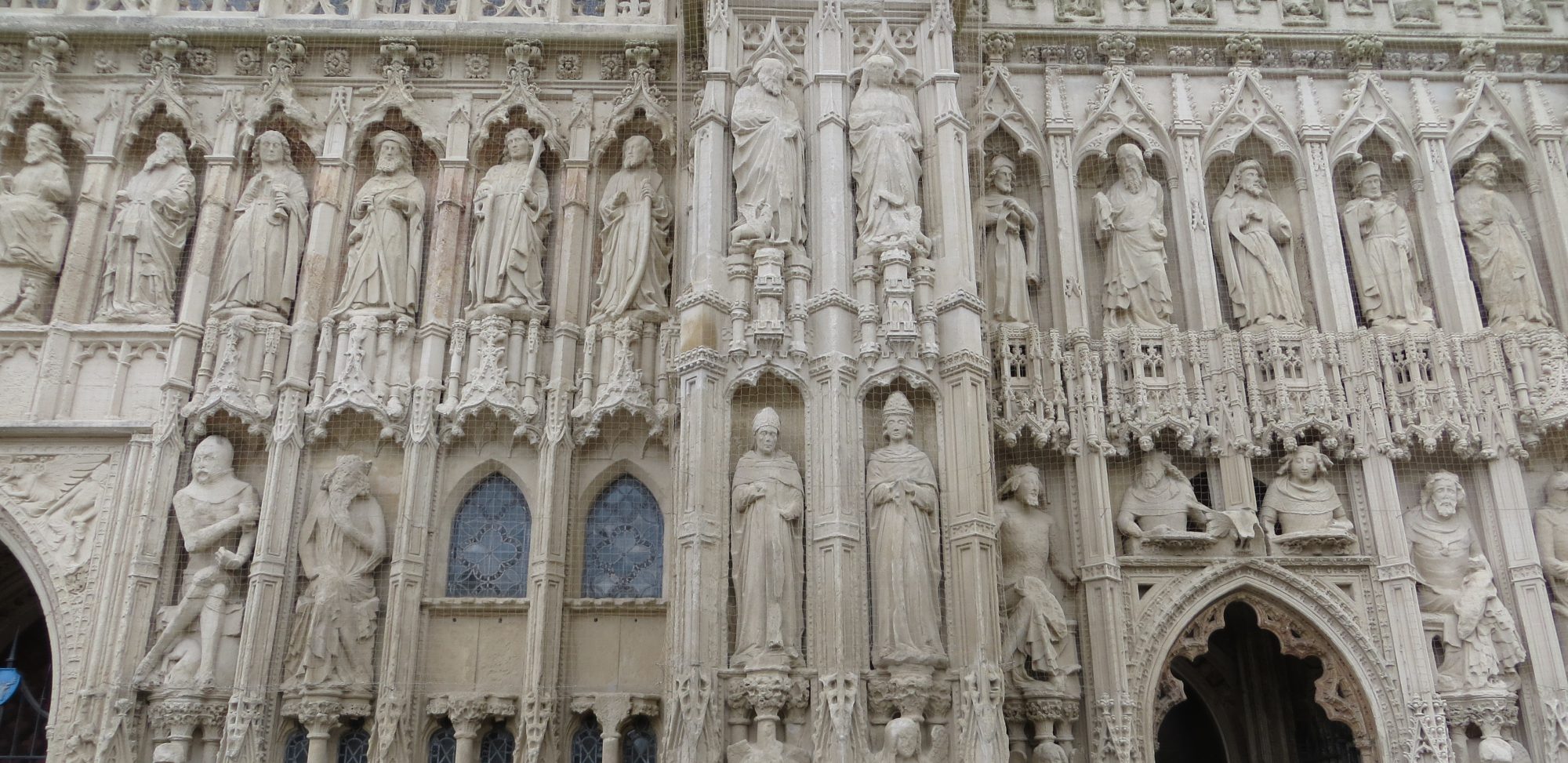
You renew the face of the earth

Praise the LORD, O my soul. O LORD my God, you are very great; you are clothed with splendor and majesty. He wraps himself in light as with a garment; he stretches out the heavens like a tent and lays the beams of his upper chambers on their waters. He makes the clouds his chariot and rides on the wings of the wind. He makes winds his messengers, flames of fire his servants. He set the earth on its foundations; it can never be moved.

These all look to you to give them their food at the proper time. When you give it to them, they gather it up; when you open your hand, they are satisfied with good things. When you hide your face, they are terrified; when you take away their breath, they die and return to the dust. When you send your Spirit, they are created, and you renew the face of the earth. May the glory of the LORD endure forever; may the LORD rejoice in his works- he who looks at the earth, and it trembles, who touches the mountains, and they smoke. I will sing to the LORD all my life; I will sing praise to my God as long as I live

Psalm 104 Pentecost Revised Common Lectionary

Pentecost

The Father gives the Son to the world. God presents the world with this gift of himself in the person of the Son. Then, when many ages have passed, the perfected world presents the Son to the Father, by the Spirit. The Son will present the world, in the form of the church, to the Father, to receive his inspection and approval. But the Son also continually presents the first installments of the future world, the perfected creation, to the Father. The future world is entirely present to the Father in the Son. It is created by that conversation and continuously opened by the Spirit who sustains their conversation. The future and completed world is continually given to the present world by the Spirit in the church, which is itself the body of the Son for the world. The Spirit stands in for the future act of the world. Where the world is going to be one day established in its own free and joyful activity, there the Spirit is now, representing it and preparing it for this future. The someday competent world will accompany the Spirit; it will take the action the Spirit gives it and, in the company of the Spirit, it will take what is the Spirit’s and return it via the Son to the Father. In that joint act of Spirit and world, the world will become living, active, and free.

The church is the visible tip of the not yet visible company of heaven. This company is held together by God, and made visible by him to us on earth. The church understood on this eschatological definition, holds together what would otherwise drift apart. The church sustains the world, which has no unity of its own, and so the church represents that future in which the world will be spacious and free. In raising Jesus Christ, and calling out the church, God has elected the human race. He has made the church to be the body that embodies and guarantees both plurality and unity for the world. As the church is itself the work of the Spirit, it works this priestly task of bringing the world together around the Son.

He ascended into heaven

Everything is changed by the ascension of Christ. The ascent of man is complete, in this man. Jesus Christ has gone to God the Father. But he has not left us and the incarnation is not ended. A human sits with God. Christ is with the Father and with us. We have not returned to the stand-off and enmity between God and man. One of us has at last broken through to heaven. This human being now sits at the right hand of God, and is forever divine and human. He is our man, there, so the incarnation continues now forever. One of us has gained admittance to the palace and throne room of the great King. That Christ is with the Father does not mean that he is not with us. It does mean we do not control how he is visible or available to us.

Jesus is no longer available to us as a single figure we can be alone with. He is no longer in our grasp, but we are in his grasp. We grabbed Christ, but could not hang on to him. He grasped and holds on to us. He is holy, spiritual, with the glory of his whole company. Christ has now attached us to the people of God. They, or rather, we, stand in a line that stretches back through the door of the palace, where he sits with the Father, outside across the courtyard and out into the world. This procession stretches all the way from there to here, where we are. We are part of the procession that stretches from the Son and that loops around, and connects up, all the world. Our leader is at one end, we at the other. We do not see him, but for him this procession is one with him, is part of him. The whole procession, and all the people in it, us included, are made impregnable by his protection. His Spirit holds together the whole long train of the people of the Son and makes them holy so that they are increasingly able to look forward to his coming again in great glory.

The (RCL) readings for Ascension day are

Acts 1:1-11 In the first book, Theophilus, I wrote about all that Jesus did and taught from the beginning until the day when he was taken up to heaven, after giving instructions through the Holy Spirit to the apostles whom he had chosen.

Psalm 93 The Lord is king, he is robed in majesty; the Lord is robed, he is girded with strength. He has established the world; it shall never be moved; your throne is established from of old; you are from everlasting

Ephesians 1:15-23 God put this power to work in Christ when he raised him from the dead and seated him at his right hand in the heavenly places, far above all rule and authority and power and dominion, and above every name that is named, not only in this age but also in the age to come. And he has put all things under his feet and has made him the head over all things for the church, which is his body, the fullness of him who fills all in all.

Luke 24:44-53 Then he led them out as far as Bethany, and, lifting up his hands, he blessed them. While he was blessing them, he withdrew from them and was carried up into heaven. And they worshipped him, and returned to Jerusalem with great joy; and they were continually in the temple blessing God.

Lent as recapitulation

Lent is a recapitulation of our understanding of creation and fall, and of regeneration and sanctification.

Because Lent was seen as a season preliminary to Easter, in some older interpretations Lent was predominantly or even exclusively about the suffering and death of Jesus. Lent was the season of the cross. Period. But those serious about the pursuit of Christian history had to wrestle with the fact that Lent began as a time of final instruction and intensive preparation for baptism. Ancient lectionaries (or at least portions of them) were reconstructed and found to contain Lenten readings such as the story of the man born blind (John 9), for in the early centuries baptism with likened to the recovery of sight. This Lectionary inclusion, grounded in a very old understanding of Lent as preparation for baptism, helped to reestablish Lent in the church as a season for the consideration of the meaning of baptism as related to the new life we have in Christ, the Crucified and Risen One.

Lawrence Hall Stookey Calendar: Christ’s Time for the Church

Getting on the same page – a totally unexpected development

Why use the Lectionary? Who compiled it? Why are there variations and alternative readings, so the Church sometimes is and sometimes isn’t on the same page? Why does my own church, the Church of England, have a different set of readings from the Revised Common lectionary at this time of year? I have just found that some answers are offered by Consultation on Common Texts (CCT). Here they are:

Q: How similar is the ecumenical system to the original Roman scheme?

A: The three-year, three-reading plan is exactly the same. The calendar is virtually the same. The Gospel readings are almost always the same, as are the second-lesson selections, drawn from the Epistles and (after Easter) the books of Acts and Revelation. The only serious divergence is at the point of the Hebrew Bible lessons after Pentecost, where we laid aside the Roman typological choices in favor of a broader kind of linkage that uses the Patriarchal/Mosaic narrative for Year A (Matthew), The Davidic narrative for Year B (Mark), and the Elijah/Elisha/Minor Prophets series for Year C (Luke).

Q: What is the rationale for that?

A: In our initial survey of Protestant use of the denominational variants of the Roman table, we discovered that there was unhappiness at the absence of the Old Testament’s narrative and historical literature, as well as a deficiency of Wisdom texts. So we have tried to remedy that with our more expansive kind of linkage, but for the purposes of ecumenical acceptability we continue to publish an alternative Old Testament set that is closer to the Roman, Episcopal and Lutheran tables in this regard for the Sundays after Pentecost.

Q: How widely is the Revised Common Lectionary now being used?

A: The information we gathered is compelling. Throughout the English-speaking world, most churches that have anything like a tradition of lectionary use are recommending our work.

Q: What is the ecumenical significance of this development?

A: In the first place, it is a totally unexpected development in that after all these centuries since the 16th-century reformation, many of the churches that divided at that time are now committed to reading the scriptures together Sunday by Sunday. This is a kind of ecumenism nobody anticipated, least of all the Roman See. And it makes possible wonderful weekly clergy gatherings all over the world for the purpose of mutual work on sermons and homilies.

Q: The question keeps recurring from just such groups as to why on so many Sundays there seems to be no clear theological or thematic relationship among the readings. Can you explain this?

A: The thematic situation is different depending on whether you are in the core liturgical seasons of Advent through to Lent and Lent through to the Day of Pentecost, or in that long stretch of Sundays between Pentecost and Advent, known in Roman terminology as Ordinary Time. In the festival liturgical seasons there always will be an obvious (we hope) unity that is governed by the Gospel lesson for the day. In post-Pentecost Ordinary Time, however, the situation is quite different, and not even the most sophisticated guides to lectionary preaching seem always to be aware of this. On those Sundays, we cut loose the Old Testament reading from the Gospel on a Sunday-by-Sunday basis, even though we chose those readings from First Testament books that the Gospel author (of- the year) seems most interested in - i.e., Matthew/Patriarchs and Moses, Mark/David, and Luke/Prophets.

In that same time, preacher should notice that the second (New Testament) reading proceeds from week to week on a continuous chapter-by-chapter course, and so there will be no obvious correlation between that lesson and the Gospel or the Old Testament. So on those Sundays the three readings, which have deliberately no thematic interrelationship, are all proceeding on a continuous or semi-continuous track.. If this were thought curious or troublesome, it should be remembered that such an in course sequence of reading is borrowed directly from the synagogue’s use of the Torah and the subsequent practice of the churches of the first several centuries. That is to say, the public reading of the scriptures was never originally conceived simply as source texts for preaching, but rather as the only possible way to acquaint the congregation with as much of the scriptures as possible. And that of course is the expressed intention of the Vatican Council’s desired revision of the Roman lectionary, and therefore of all systems derived from it.

Q: What does that mean for sermon preparation, particularly in those Ordinary Time Sundays after Pentecost?

A: That question regularly comes when someone says that they use the lectionary sometimes, meaning that they avoid it in Ordinary Time. It misses the point of the continuous principle altogether. That is to say, during that time the preacher who is serious about the lectionary must decide which track (Gospel, New Testament or Old Testament) to use Sunday by Sunday. Certainly there should be no attempt to force a thematic unity on all three readings where none in fact exists. Much less should the preacher hop, skip and jump around among three sets of readings that are organized on a week-to-week basis. The radical shift that this system requires is for the preacher to think about weekly preaching as sequential rather than thematic.

You can read more over at Consultation on Common Texts

Epiphany

Epiphany means appearance (See, I told you this is about stating the obvious). Epiphany means revelation and the mystery (secret) now revealed. That God’s appearing, his arrival, here, with us. He, the Lord, has come to us, man. So we can call him Immanuel, God with us. He said he would, his coming and arrival has been forecast and looked forward to for weeks, the weeks of Advent (=coming). So we could regard the Feast of Christ, Christmas, as the first part of Epiphany. Epiphany is a matter of stages. Who God is for us, in Jesus, is revealed to us bit by bit, week by week as it were. So we are in the season of Epiphany. Last week was the naming and circumcision of Christ – the first stage. This week, Epiphany itself, all the kings of the earth come to worship Jesus as king of Israel, and as their own king. Even these gentiles come, while the present puppet king of Israel, Herod, does not recognise or worship him. So this week we had Isaiah 60: 1-6

Arise, shine; for your light has come, and the glory of the Lord has risen upon you. For darkness shall cover the earth, and thick darkness the peoples; but the Lord will arise upon you, and his glory will appear over you. Nations shall come to your light, and kings to the brightness of your dawn. Lift up your eyes and look around; they all gather together, they come to you; your sons shall come from far away… They shall bring gold and frankincense, and shall proclaim the praise of the Lord.

Then we had Psalm 72.

Give the king your justice, O God, and your righteousness to a king's son. May he judge your people with righteousness, and your poor with justice. May the mountains yield prosperity for the people, and the hills, in righteousness. May he defend the cause of the poor of the people, give deliverance to the needy, and crush the oppressor.

We replied with: ALL KINGS BOW DOWN BEFORE HIM; NATIONS ALL ADORE

Then we had Ephesians 3: 1-12 spelling out this epiphany-appearance. What is appearing now is what (though long trailed and previewed to Israel) was quite unknown to the world, a secret the existence of which the world never suspected.

The mystery was made known by revelation.. In former generations this mystery was not made known to humankind, as it has now been revealed to his holy apostles and prophets by the Spirit: that is, the Gentiles have become fellow heirs, members of the same body, and sharers in the promise in Christ Jesus through the gospel… to bring to the Gentiles the news of the boundless riches of Christ, and to make everyone see what is the plan of the mystery hidden for ages in God who created all things; so that through the church the wisdom of God in its rich variety might now be made known to the rulers and authorities in the heavenly places. (In other words, it is not so much that we bring him gold and gifts, but that he represents the wealth of God that is now to be given to us).

Then the gospel is read. Matthew 2: 1-12.

In the time of King Herod, after Jesus was born in Bethlehem of Judea, wise men from the East came to Jerusalem, asking, Where is the child who has been born king of the Jews? For we observed his star at its rising, and have come to pay him homage… When they had heard the king, they set out; and there, ahead of them, went the star that they had seen at its rising, until it stopped over the place where the child was. When they saw that the star had stopped, they were overwhelmed with joy. On entering the house, they saw the child with Mary his mother; and they knelt down and paid him homage. Then, opening their treasure chests, they offered him gifts of gold, frankincense, and myrrh.

These are the readings set down by the Lectionary which, together with Common Worship, determines the course of each service in our Church. So you see, in the next few weeks, through demonstrations (miracles) and instruction, we are taught who Jesus is, and we thereby learn who God is, and we are taught this by God, through these specific Scriptures and the rest of the service. More anon.