Benedict's riposte

Perhaps my favorite comment of Benedict took place during the interview with reporters on the flight over to Great Britain. The pope was asked if there was anything that could be done to make the Church more "attractive." Benedict responded:

A Church which seeks above all to be attractive would already be on the wrong path, because the Church does not work for itself, does not work to increase its numbers so as to have more power. The Church is at the service of Another; it does not serve itself, seeking to be a strong body, but it strives to make the Gospel of Jesus Christ accessible, the great truths, the great powers of love and of reconciliation that appeared in this figure and that came always from the presence of Jesus Christ.

This is a constant Christian theme. We did not invent our religion. We received it and are to keep it in the world in the basic form in which it was handed down. If people listen, fine. But if they do not, we can only accept their choice. "The Church is at the service of Another." James Schall on Benedict in Britain

Benedict

Following St. Benedict's example, "monasteries have, over the course of the centuries, become lively centres of dialogue, of meeting and of beneficial fusion among different peoples, brought together by the evangelical culture of peace. Through work and example, the monks were able to teach the art of peace, giving tangible form to the three elements identified by Benedict as being necessary to conserve the unity of the Spirit among mankind: the cross, which is the very law of Christ; the book, in other words culture; and the plough, which stands for work, mastery over matter and time". The Pope continued: "Thanks to the work of monasteries, divided into the threefold daily commitment to prayer, study and work, entire peoples on the European continent have known real liberation and beneficial moral, spiritual and cultural development, being educated in a sense of continuity with the past, real activity for the common good, and openness to God and the transcendental. Let us pray that Europe may always appreciate this heritage of Christian principles and ideals which represent such an immense cultural and spiritual resource. "This is possible", the Pope added in conclusion, "but only if we accept the constant teaching of St. Benedict: ... that seeking God is man's fundamental task. Human beings do not realise themselves fully, they cannot be truly happy, without God. ... From this place where his mortal remains lie, the patron saint of Europe still invites everyone to continue his work of evangelisation and human promotion".

Benedict on Benedict - from Vatican news

Benedict's Homilies

Sunday sets the rhythm of Church time. It is "the first day of the week" (Matthew 28:1), and therefore the first of the seven days of creation. But it is also the eighth day, the new time that began with the resurrection of Jesus. For Christians, therefore, Ratzinger says, Sunday is "the true measure of time, the unit of measurement of their lives," because at every Sunday Mass the new creation breaks forth. Each time, the Word of God becomes flesh there.

The Scriptures illustrated by Benedict XVI in each of his homilies are naturally those of the Mass of the day, to which they impart a distinctive character. And this brings up another great expression of Church time, which is the cycle of the liturgical year. On top of the basic rhythm, the weekly rhythm marked by Sunday, a second rhythm has been added since the early Christian centuries, an annual cycle centered upon Easter and with Christmas and Pentecost as two other centers of gravity. This second rhythm highlights the Christian mystery in its distinct aspects and moments, along the entire span of sacred history. It begins with the weeks of Advent and continues with the season of Christmas and the Epiphany, with the forty days of Lent, with Easter, with the fifty days of the Easter season, with Pentecost. The Sundays outside of these special seasons are those of ordinary time, "per annum." And there are feasts like the Ascension, Holy Trinity, Corpus Domini, Saints Peter and Paul, the Immaculate Conception, the Assumption.

But the liturgical year is much more then the serial narration of a single great story and its main characters. Advent, for example, is not only the memory of the anticipation of the Messiah, because He has already come and will come again at the end of time. Lent is indeed preparation for Easter, but it is also preparation for baptism as the source of Christian life for each individual, a sacrament that is administered, by ancient tradition, at the Easter vigil. The human and the divine, time and eternity, Christ and the Church, the experience of all and of each one are surprisingly interwoven at every moment of the liturgical year.

Sandro Magister has collected and introduced a collection of Benedict's homilies.

Reality

Benedict's Opening Address to the Synod

Heaven and earth will pass away, but my words will never pass away". Humanly speaking, the word, my human word, is almost nothing in reality, a breath. As soon as it is pronounced it disappears. It seems to be nothing. But already the human word has incredible power. Words create history, words form thoughts, the thoughts that create the word. It is the word that forms history, reality.

Furthermore, the Word of God is the foundation of everything, it is the true reality. And to be realistic, we must rely upon this reality. We must change our idea that matter, solid things, things we can touch, are the more solid, the more certain reality. At the end of the Sermon on the Mount the Lord speaks to us about the two possible foundations for building the house of one's life: sand and rock. The one who builds on sand builds only on visible and tangible things, on success, on career, on money. Apparently these are the true realities. But all this one day will pass away. We can see this now with the fall of large banks: this money disappears, it is nothing. And thus all things, which seem to be the true realities we can count on, are only realities of a secondary order. The one who builds his life on these realities, on matter, on success, on appearances, builds upon sand. Only the Word of God is the foundation of all reality, it is as stable as the heavens and more than the heavens, it is reality.

Sandro Magister on benedict as homilist

We, however, have a different goal

Let us dwell on only two points. The first is the journey towards "the maturity of Christ", as the Italian text says, simplifying it slightly. More precisely, in accordance with the Greek text, we should speak of the "measure of the fullness of Christ" that we are called to attain if we are to be true adults in the faith. We must not remain children in faith, in the condition of minors. And what does it mean to be children in faith? St Paul answers: it means being "tossed here and there, carried about by every wind of doctrine" (Eph 4: 14). This description is very timely!

How many winds of doctrine have we known in recent decades, how many ideological currents, how many ways of thinking. The small boat of the thought of many Christians has often been tossed about by these waves - flung from one extreme to another: from Marxism to liberalism, even to libertinism; from collectivism to radical individualism; from atheism to a vague religious mysticism; from agnosticism to syncretism and so forth. Every day new sects spring up, and what St Paul says about human deception and the trickery that strives to entice people into error (cf. Eph 4: 14) comes true.

Today, having a clear faith based on the Creed of the Church is often labeled as fundamentalism. Whereas relativism, that is, letting oneself be "tossed here and there, carried about by every wind of doctrine", seems the only attitude that can cope with modern times. We are building a dictatorship of relativism that does not recognize anything as definitive and whose ultimate goal consists solely of one's own ego and desires.

We, however, have a different goal: the Son of God, the true man. He is the measure of true humanism. An "adult" faith is not a faith that follows the trends of fashion and the latest novelty; a mature adult faith is deeply rooted in friendship with Christ. It is this friendship that opens us up to all that is good and gives us a criterion by which to distinguish the true from the false, and deceit from truth.

Joseph Cardinal Ratzinger to the College of Cardinals 2005

'Living wills'

The Lord Chancellor has warned doctors they risk going on trial for assault if they refuse to allow patients who have made 'living wills' to die. Lord Falconer set out the determination of the Government to use draconian penalties to enforce living wills in a guide to Labour's Mental Capacity Act for doctors, nurses and social workers. The law, which comes into operation next spring, gives full legal force to living wills, or advance decisions, in which patients say, sometimes years in advance, how they wish to be treated if they become incapacitated and lose the ability to speak for themselves. In a living will a patient can demand that life-preserving treatment be withdrawn if they become too ill to communicate or feed themselves.

The guidelines issued by Lord Falconer - with the backing of Health Secretary Patricia Hewitt - say that doctors may declare themselves conscientious objectors if they have religious or moral objections to carrying out the instructions of a living will. But in that case a doctor must pass his or her patient over to another doctor who will follow the instructions to allow the patient to die.

The warning over damages claims raises the prospect that family or friends of a patient who have a financial interest in their death could sue a doctor who fails to kill them. It also opens the bizarre possibility that a patient who recovers could sue a doctor for not letting them die.

Surgeon Dr Peter Saunders, head of the Christian Medical Fellowship, said: 'Clinical circumstances exist where it is entirely appropriate to withhold food and fluids: for example in a dying patient when their delivery proves both burdensome and ineffective for the patient. 'But we are concerned that patients will make unwise and hasty advance refusals of food and fluids without being properly informed about the diagnosis. It is too easy for patients to be driven by fears of meddlesome treatment and "being kept alive", into making advance refusals that later might be used against them.' He added: 'Commonly patients change their minds about what care they would like, as their condition changes. 'This law does not allow real conscientious objection. A doctor who believes it would be clinically wrong to withdraw food and fluids must pass their patient over to another doctor who will do so. That makes them complicit in the death.'

Philosophy Professor David Conway of the Civitas think tank said: 'This is opening a terrible can of worms and it threatens to cause havoc. 'The best option would be for a doctor to find out if patients have made living wills and refuse to treat those who have.'

Academic lawyer Dr Jacqueline Laing of London Metropolitan University said: 'Many people will have filled in advance decision forms in ignorance of their lethal implications and of alternative courses of action. 'The Act inverts good medical practice by criminalizing medical staff who intervene to save the lives of their patients with simple cures and, in certain cases, even food and fluids. Any conscientious opt-out is nullified by the threat of prosecution.' She added: 'The lethal direction of the Act and the cost-saving implications for the NHS should be obvious.'

Doctors face prison for denying the right to die

Romanus the Melodist

Romanus the Melodist is one of these, poet, theologian and composer. He learned the foundations of Greek and Syrian culture in his native city, and then moved to Beritus (now Beirut), to complete his classical education and knowledge of rhetoric. After being ordained permanent deacon -- around 515 -- he was a preacher in this city for three years. He then moved to Constantinople, until the end of the reign of Anastasius I - around 518 - and from there he settled in at the monastery of the Church of the Theotokos, Mother of God.

A key moment of his life took place there: the Synaxar tells us that Mary appeared to him in his dreams and gave him the gift of poetic charism. Mary, in fact, asked him to swallow a scroll. Upon waking the next day, it was Christmas, Romanus began to recite from the pulpit: "Today the Virgin gives birth to the Transcendent" (Hymn On the Nativity, I. Proemium). He became in this way a preacher-cantor until his death (around 555).

Romanus is known in history as one of the most representative authors of liturgical hymns. At the time the homily was for the faithful practically the only opportunity of catechesis. Thus Romanus was not only an eminent witness of the religious sentiment of his day, but also of a lively and original method of catechesis. Through his compositions we can see the creativity of this form of catechesis, of the creativity of the theological thought, of the aesthetic and the sacred hymnography of the era.

The place where Romanus preached was a shrine on the outskirts of Constantinople: he would ascend the pulpit, located in the center of the Church, and he would speak to the community using a rather elaborate setting -- he used images on the walls or icons on the pulpit to illustrate his homilies, and even used dialogue. He recited chanted metrical hymns, called kontakia.

Benedict on Romanus the Melodist

Without faith, reason is without roots

If however reason, concerned about its supposed purity, fails to hear the great message that comes from the Christian faith and the understanding it brings, it will dry up like a tree with roots cut off from the water that gives it life. It will lose the courage needed to find the truth and thus become small rather than great.

Applied to our European culture this means that if it wants to constitute itself on the basis of its arguments and whatever appears to it to be convincing, with concerns about its own secular nature, it will cut itself off from its life-sustaining roots, and in doing so will not become more reasonable and pure but will instead become undone and fragmented.

Pope XVI Benedict Speech to La Sapienza - the University of Rome

Benedict in the US

The premier example of this was his Regensburg lecture of September 2006 in Germany, widely criticized at the time as offensive to Islamic sensibilities. That lecture, in fact, has shifted both the course of inter-religious dialogue and the internal dynamics of the intra-Islamic debate, precisely as I believe Benedict XVI intended it to do. It has shifted the course of the dialogue by setting in motion a process that has now led to the formation of a Catholic-Muslim forum that will meet twice a year, once in Amman, Jordan, once in Rome, and that will focus its attention on the issues that Benedict XVI has put on the agenda – namely, religious freedom as the first of human rights and a right that can be known by reason, and secondly, the imperative of separating spiritual and political authority in a justly governed state.

There have been attempts from parts of the Islamic world to deflect the conversation off of these two issues, which Benedict regards as at the very heart of inter-religious dialogue, and indeed the Islamic encounter with the modern world, and he refuses to budge. He very calmly and quietly brings the conversation back to these two points, which obviously have a great resonance here in the United States.

In terms of shifting the dialogue, I would also point to the recent initiative by King Abdullah of Saudi Arabia, who proposes to gather in his country a new forum of dialogue among the monotheistic religions, and the Vatican’s reported negotiations, about which John might have some more to say later, with the Saudi government over the unthinkable, or the hitherto unthinkable, namely the building of a Catholic church in Saudi Arabia.

* * *

On the pope and the church in the United States and on American society and culture, very briefly. As you read the works of Joseph Ratzinger, particularly in the last 10 to 15 years as he has become more and more concerned with the corrosive impacts of an aggressive secularism in Europe, you have to be struck by the fact that he comes on several occasions in his writing to the point that it was in the United States that the problem of church and state was first resolved. And when he says problem of church and state, he doesn’t simply mean institutional relationships, questions of establishment and non-establishment, legal relationships; he means more broadly the problem of religion and modernity.

George Weigel The Pope comes to America

Christ-centered Anthropology and the mystery of man

That Pope John Paul II was profoundly formed by and faithful to the general pastoral purpose and style of Gaudium et Spes throughout his pontificate is easy to show. He not only made constant reference to Gaudium et Spes, 22 and 24, referring to the former as encapsulating the motif of his pontificate, his encyclical, Fides et Ratio, stressed the unity of the two orders of knowledge, natural and supernatural. There is a "unity of truth" assured by the fact that God is Creator and Redeemer and thus the Author of what is revealed through creation and through the economy of salvation.

Carl Olson Pope John Paul II and the Christ-centered Anthropology of "Gaudium et Spes"

Here is Gaudium et Spes 22.

The truth is that only in the mystery of the incarnate Word does the mystery of man take on light. For Adam, the first man, was a figure of Him Who was to come,(20) namely Christ the Lord. Christ, the final Adam, by the revelation of the mystery of the Father and His love, fully reveals man to man himself and makes his supreme calling clear. It is not surprising, then, that in Him all the aforementioned truths find their root and attain their crown.

He Who is "the image of the invisible God" (Col. 1:15),(21) is Himself the perfect man. To the sons of Adam He restores the divine likeness which had been disfigured from the first sin onward. Since human nature as He assumed it was not annulled,(22) by that very fact it has been raised up to a divine dignity in our respect too. For by His incarnation the Son of God has united Himself in some fashion with every man. He worked with human hands, He thought with a human mind, acted by human choice(23) and loved with a human heart. Born of the Virgin Mary, He has truly been made one of us, like us in all things except sin.(24)

The Christian man, conformed to the likeness of that Son Who is the firstborn of many brothers,(27) received "the first-fruits of the Spirit" (Rom. 8:23) by which he becomes capable of discharging the new law of love.(28) Through this Spirit, who is "the pledge of our inheritance" (Eph. 1:14), the whole man is renewed from within, even to the achievement of "the redemption of the body" (Rom. 8:23):

Such is the mystery of man, and it is a great one, as seen by believers in the light of Christian revelation.

A world which has to create its own justice is a world without hope

In the modern era, the idea of the Last Judgement has faded into the background: Christian faith has been individualized and primarily oriented towards the salvation of the believer's own soul, while reflection on world history is largely dominated by the idea of progress. The fundamental content of awaiting a final Judgement, however, has not disappeared: it has simply taken on a totally different form. The atheism of the nineteenth and twentieth centuries isâ??in its origins and aimsâ??a type of moralism: a protest against the injustices of the world and of world history. A world marked by so much injustice, innocent suffering, and cynicism of power cannot be the work of a good God. A God with responsibility for such a world would not be a just God, much less a good God. It is for the sake of morality that this God has to be contested.

Since there is no God to create justice, it seems man himself is now called to establish justice. If in the face of this world's suffering, protest against God is understandable, the claim that humanity can and must do what no God actually does or is able to do is both presumptuous and intrinsically false. It is no accident that this idea has led to the greatest forms of cruelty and violations of justice; rather, it is grounded in the intrinsic falsity of the claim. A world which has to create its own justice is a world without hope. No one and nothing can answer for centuries of suffering. No one and nothing can guarantee that the cynicism of powerâ??whatever beguiling ideological mask it adoptsâ??will cease to dominate the world.

This is why the great thinkers of the Frankfurt School, Max Horkheimer and Theodor W. Adorno, were equally critical of atheism and theism. Horkheimer radically excluded the possibility of ever finding a this-worldly substitute for God, while at the same time he rejected the image of a good and just God. In an extreme radicalization of the Old Testament prohibition of images, he speaks of a â??longing for the totally Otherâ?? that remains inaccessibleâ??a cry of yearning directed at world history. Adorno also firmly upheld this total rejection of images, which naturally meant the exclusion of any â??imageâ?? of a loving God. On the other hand, he also constantly emphasized this â??negativeâ?? dialectic and asserted that justice â??true justiceâ??would require a world â??where not only present suffering would be wiped out, but also that which is irrevocably past would be undone.â??

This, would mean, howeverâ??to express it with positive and hence, for him, inadequate symbolsâ??that there can be no justice without a resurrection of the dead.

Benedict XVI Spe Salvi (42)

To suffer out of love is fundamental for humanity

To suffer with the other and for others; to suffer for the sake of truth and justice; to suffer out of love and in order to become a person who truly loves — these are fundamental elements of humanity, and to abandon them would destroy man himself.

Are we capable of this? Is the other important enough to warrant my becoming, on his account, a person who suffers? Does truth matter to me enough to make suffering worthwhile? Is the promise of love so great that it justifies the gift of myself? In the history of humanity, it was the Christian faith that had the particular merit of bringing forth within man a new and deeper capacity for these kinds of suffering that are decisive for his humanity. The Christian faith has shown us that truth, justice and love are not simply ideals, but enormously weighty realities. It has shown us that God —Truth and Love in person—desired to suffer for us and with us. Bernard of Clairvaux coined the marvellous expression: Impassibilis est Deus, sed non incompassibilis — God cannot suffer, but he can suffer with. Man is worth so much to God that he himself became man in order to suffer with man in an utterly real way.

Benedict XVI Spe Salvi (39).

The victory of reason over unreason is a goal of the Christian life

As far as the two great themes of â??reasonâ?? and â??freedomâ?? are concerned, here we can only touch upon the issues connected with them. Yes indeed, reason is God's great gift to man, and the victory of reason over unreason is also a goal of the Christian life. But when does reason truly triumph? When it is detached from God? When it has become blind to God? Is the reason behind action and capacity for action the whole of reason? If progress, in order to be progress, needs moral growth on the part of humanity, then the reason behind action and capacity for action is likewise urgently in need of integration through reason's openness to the saving forces of faith, to the differentiation between good and evil. Only thus does reason become truly human. It becomes human only if it is capable of directing the will along the right path, and it is capable of this only if it looks beyond itself. Otherwise, man's situation, in view of the imbalance between his material capacity and the lack of judgement in his heart, becomes a threat for him and for creation. Thus where freedom is concerned, we must remember that human freedom always requires a convergence of various freedoms. Yet this convergence cannot succeed unless it is determined by a common intrinsic criterion of measurement, which is the foundation and goal of our freedom. Let us put it very simply: man needs God, otherwise he remains without hope. Given the developments of the modern age, the quotation from Saint Paul with which I began (Eph 2:12) proves to be thoroughly realistic and plainly true. There is no doubt, therefore, that a â??Kingdom of Godâ?? accomplished without Godâ??a kingdom therefore of man aloneâ??inevitably ends up as the â??perverse endâ?? of all things as described by Kant: we have seen it, and we see it over and over again. Yet neither is there any doubt that God truly enters into human affairs only when, rather than being present merely in our thinking, he himself comes towards us and speaks to us. Reason therefore needs faith if it is to be completely itself: reason and faith need one another in order to fulfil their true nature and their mission.

Benedict XVI Spe Salvi (23)

Presenting the Word that becomes flesh in the liturgy of the day

The words that Benedict XVI speaks every Sunday at midday, before and after the Angelus are among those most closely followed by the media.

The real and proper message comes before the prayer...is a brief homily on the Gospel and the other readings of that day's Mass.

As in the Wednesday catecheses Benedict XVI is gradually recounting the life of the Church from the Apostles to the Fathers, so in the Sunday Angelus he is presenting to the faithful the figure of Jesus.

But there's more. The path that the pope takes to get to Jesus each week is the same one that every member of the Catholic faithful travels in participating at Mass that same Sunday.

This is clearly a deliberate decision, and one typical of this pope's vision. The Gospel upon which Benedict XVI comments at the Angelus is not "sola Scriptura," it is not a bare book. It is the Word that becomes flesh – the body and blood of Jesus – in the liturgy of the day.

In order to raise to acceptable levels the average quality of the millions of homilies pronounced every Sunday all over the world, Catholic priests could do no better than to enroll themselves in the school of Benedict XVI's Angelus addresses.

Sandro Magister The Secret Angelus Messages of Pope Benedict

Ecclesia in Europa

This loss of Christian memory is accompanied by a kind of fear of the future. Tomorrow is often presented as something bleak and uncertain. The future is viewed more with dread than with desire. Among the troubling indications of this are the inner emptiness that grips many people and the loss of meaning in life. The signs and fruits of this existential anguish include, in particular, the diminishing number of births, the decline in the number of vocations to the priesthood and religious life, and the difficulty, if not the outright refusal, to make lifelong commitments, including marriage.

We find ourselves before a widespread existential fragmentation. A feeling of loneliness is prevalent; divisions and conflicts are on the rise. Among other symptoms of this state of affairs, Europe is presently witnessing the grave phenomenon of family crises and the weakening of the very concept of the family, the continuation or resurfacing of ethnic conflicts, the re-emergence of racism, interreligious tensions, a selfishness that closes individuals and groups in upon themselves, a growing overall lack of concern for ethics and an obsessive concern for personal interests and privileges. To many observers the current process of globalization, rather than leading towards the greater unity of the human race, risks being dominated by an approach that would marginalize the less powerful and increase the number of poor in the world.

In connection with the spread of individualism, we see an increased weakening of interpersonal solidarity: while charitable institutions continue to carry out praiseworthy work, one notes a decline in the sense of solidarity, with the result that many people, while not lacking material necessities, feel increasingly alone, left to themselves without structures of affection and support.

At the root of this loss of hope is an attempt to promote a vision of man apart from God and apart from Christ. This sort of thinking has led to man being considered as â??the absolute centre of reality, a view which makes him occupy â?? falsely â?? the place of God and which forgets that it is not man who creates God, but rather God who creates man. Forgetfulness of God led to the abandonment of manâ??. It is therefore â??no wonder that in this context a vast field has opened for the unrestrained development of nihilism in philosophy, of relativism in values and morality, and of pragmatism â?? and even a cynical hedonism â?? in daily lifeâ??. European culture gives the impression of â??silent apostasyâ?? on the part of people who have all that they need and who live as if God does not exist.

This is the context for those attempts, including the most recent ones, to present European culture with no reference to the contribution of the Christian religion which marked its historical development and its universal diffusion. We are witnessing the emergence of a new culture, largely influenced by the mass media, whose content and character are often in conflict with the Gospel and the dignity of the human person. This culture is also marked by an widespread and growing religious agnosticism, connected to a more profound moral and legal relativism rooted in confusion regarding the truth about man as the basis of the inalienable rights of all human beings. At times the signs of a weakening of hope are evident in disturbing forms of what might be called a â??culture of deathâ??.

John Paul II Ecclesia in Europa 1.8-9

Dialogue is possible if parties do not hide their identity

Pope Benedict XVI's masterly lecture [at Regensburg] tended in fact to highlight a widening of reason that, by going beyond anti-religion Enlightenment thinking ("irrational"), allows for rich and fraternal dialogue with extra-European and non-Western cultures. At the same time, the Pope showed that violence is "irrational" and is therefore worthy neither of God, nor of man, nor of any religion, Islam included.

The fuss which resulted from the Regensburg speech was fuelled by liberalist Westerners and islamist Easterners and belittled the profoundness of Benedict XVI's proposal so as to make it appear a simple dispute between Islam and Christianity, with the latter "obviously" unable to understand Islam and accusing the Pope of having fomented a "war of religions."

But it is only a partial healing. Where in fact healing is slow is in the liberalist Western world where, to avoid questioning its blind closure to the problem of Godless reason, it continues to rail against the Catholic Church and the Pope, and justifies the many forms of violence committed in the name of Islam, fomenting a new war of religion with Islam.

In their ideological blindness, a good part of the so-called "progressive" intellectuals says that the causes of terrorism are American imperialism, colonialism, the state of Israel, globalization. But in this way they do not realize that Islamist terrorism strikes well beyond the West: Buddhists in Thailand, Hindus in India, Muslims themselves, both Sunni and Shia. Even violence against Palestinians does not only come with an Israeli stamp, but also derives from a power struggle between Hamas and Fatah.

Thanks to this blindness in Europe – and in Italy – we are witnessing a veritable alliance between progressivism and violent Islamism. In the name of anti-Americanism and multiculturalism, people are calling for the withdrawal of troops from Iraq, from Afghanistan, and are justifying the violence of males against Islamic women and polygamy. Again yesterday, the Pope was ridiculed in the European Parliament, while great caution was exercised when it was a question of the anti-Mohammad caricatures. And while a benevolent attitude is being preached with regard to a violent Islam, an intransigent and intolerant attitude is spreading against the Catholic Church, "guilty" of displaying crosses and nativity scenes and of expressing its view on life and family in the ("liberal"?) society.

The encounter between Benedict XVI and Khatami shows that dialogue is possible if parties do not hide their identity and work for the good of men and women. To do this, it is necessary that, from East to West, we condemn violence, always and regardless, while guaranteeing religious freedom.

Bernardo Cervellera Benedict XVI and Khatami: the good trail is Regensburg

To promote the maturation of the moral conscience

There is no doubt that we are living in a moment of extraordinary development in the human capacity to decipher the rules and structures of matter, and in the consequent dominion of man over nature. We all see the great advantages of this progress and we see more and more clearly the threat of destruction of nature by what we do.

There is another less visible danger, but no less disturbing: the method that permits us to know ever more deeply the rational structures of matter makes us ever less capable of perceiving the source of this rationality, creative Reason. The capacity to see the laws of material being makes us incapable of seeing the ethical message contained in being, a message that tradition calls lex naturalis, natural moral law. This word for many today is almost incomprehensible due to a concept of nature that is no longer metaphysical, but only empirical. The fact that nature, being itself, is no longer a transparent moral message creates a sense of disorientation that renders the choices of daily life precarious and uncertain.

It is precisely in the light of this contestation that all the urgency of the necessity to reflect upon the theme of natural law and to rediscover its truth common to all men appears. The said law, to which the Apostle Paul refers (cf. Rom 2: 14-15), is written on the heart of man and is consequently, even today, accessible. This law has as its first and general principle, "to do good and to avoid evil". This is a truth which by its very evidence immediately imposes itself on everyone. From it flows the other more particular principles that regulate ethical justice on the rights and duties of everyone. So does the principle of respect for human life from its conception to its natural end, because this good of life is not man's property but the free gift of God. Besides this is the duty to seek the truth as the necessary presupposition of every authentic personal maturation.

Another fundamental application of the subject is freedom. Yet taking into account the fact that human freedom is always a freedom shared with others, it is clear that the harmony of freedom can be found only in what is common to all: the truth of the human being, the fundamental message of being itself, exactly the lex naturalis. And how can we not mention, on one hand, the demand of justice that manifests itself in giving unicuique suum and, on the other, the expectation of solidarity that nourishes in everyone, especially if they are poor, the hope of the help of the more fortunate?

In these values are expressed unbreakable and contingent norms that do not depend on the will of the legislator and not even on the consensus that the State can and must give. They are, in fact, norms that precede any human law: as such, they are not subject to modification by anyone. The natural law, together with fundamental rights, is the source from which ethical imperatives also flow, which it is only right to honour.

In today's ethics and philosophy of Law, petitions of juridical positivism are widespread. As a result, legislation often becomes only a compromise between different interests: seeking to transform private interests or wishes into law that conflict with the duties deriving from social responsibility. In this situation it is opportune to recall that every juridical methodology, be it on the local or international level, ultimately draws its legitimacy from its rooting in the natural law, in the ethical message inscribed in the actual human being.

Natural law is, definitively, the only valid bulwark against the arbitrary power or the deception of ideological manipulation. The knowledge of this law inscribed on the heart of man increases with the progress of the moral conscience.

The first duty for all, and particularly for those with public responsibility, must therefore be to promote the maturation of the moral conscience. This is the fundamental progress without which all other progress proves non-authentic.

Pope Benedict to the International Congress on Natural Law

Benedict on Irenaeus

Dear brothers and sisters, in the catechesis on the prominent figures of the early Church, today we come to the eminent personality of St Irenaeus of Lyons.

...Irenaeus was concerned to describe the genuine concept of the Apostolic Tradition which we can sum up here in three points.

a) Apostolic Tradition is "public", not private or secret. Irenaeus did not doubt that the content of the faith transmitted by the Church is that received from the Apostles and from Jesus, the Son of God. There is no other teaching than this. Therefore, for anyone who wishes to know true doctrine, it suffices to know "the Tradition passed down by the Apostles and the faith proclaimed to men": a tradition and faith that "have come down to us through the succession of Bishops" (Adversus Haereses, 3, 3, 3-4). Hence, the succession of Bishops, the personal principle, and Apostolic Tradition, the doctrinal principle, coincide.

b) Apostolic Tradition is "one". Indeed, whereas Gnosticism was divided into multiple sects, Church Tradition is one in its fundamental content, which - as we have seen - Irenaeus calls precisely regula fidei or veritatis: and thus, because it is one, it creates unity through the peoples, through the different cultures, through the different peoples; it is a common content like the truth, despite the diversity of languages and cultures. A very precious saying of St Irenaeus is found in his book Adversus Haereses: "The Church, though dispersed throughout the world... having received [this faith from the Apostles]... as if occupying but one house, carefully preserves it. She also believes these points [of doctrine] just as if she had but one soul and one and the same heart, and she proclaims them, and teaches them and hands them down with perfect harmony as if she possessed only one mouth. For, although the languages of the world are dissimilar, yet the import of the tradition is one and the same. For the Churches which have been planted in Germany do not believe or hand down anything different, nor do those in Spain, nor those in Gaul, nor those in the East, nor those in Egypt, nor those in Libya, nor those which have been established in the central regions of the world" (1, 10, 1-2). Already at that time - we are in the year 200 - it was possible to perceive the Church's universality, her catholicity and the unifying power of the truth that unites these very different realities, from Germany, to Spain, to Italy, to Egypt, to Libya, in the common truth revealed to us by Christ.

c) Lastly, the Apostolic Tradition, as he says in the Greek language in which he wrote his book, is "pneumatic", in other words, spiritual, guided by the Holy Spirit: in Greek, the word for "spirit" is "pneuma". Indeed, it is not a question of a transmission entrusted to the ability of more or less learned people, but to God's Spirit who guarantees fidelity to the transmission of the faith. This is the "life" of the Church, what makes the Church ever young and fresh, fruitful with multiple charisms. For Irenaeus, Church and Spirit were inseparable: "This faith", we read again in the third book of Adversus Haereses, "which, having been received from the Church, we do preserve, and which always, by the Spirit of God, renewing its youth as if it were some precious deposit in an excellent vessel, causes the vessel itself containing it to renew its youth also.... For where the Church is, there is the Spirit of God; and where the Spirit of God is, there is the Church and every kind of grace" (3, 24, 1).

As can be seen, Irenaeus did not stop at defining the concept of Tradition. His tradition, uninterrupted Tradition, is not traditionalism, because this Tradition is always enlivened from within by the Holy Spirit, who makes it live anew, causes it to be interpreted and understood in the vitality of the Church. Adhering to her teaching, the Church should transmit the faith in such a way that it must be what it appears, that is, "public", "one", "pneumatic", "spiritual".

Starting with each one of these characteristics, a fruitful discernment can be made of the authentic transmission of the faith in the today of the Church. More generally, in Irenaeus' teaching, the dignity of man, body and soul, is firmly anchored in divine creation, in the image of Christ and in the Spirit's permanent work of sanctification. This doctrine is like a "high road" in order to discern together with all people of good will the object and boundaries of the dialogue of values, and to give an ever new impetus to the Church's missionary action, to the force of the truth which is the source of all true values in the world.

Pope Benedict XVI on Irenaeus (General Audience Wednesday 28th March 2007)

Benedict on the Fathers of the Church

Speaking each Wednesday to the thirty to forty thousand faithful who flock to listen to him (twice as many as went to the audiences of his predecessor) Benedict XVI has been holding, since March, a new series of his weekly catecheses. He dedicated the previous series to the twelve Apostles and to the disciples of whom the New Testament speaks. The pope illustrated these one by one. Now he is tracing each time the profile of a â??Father of the Church,â?? one of the great personalities of the ancient Church.

He began on March 7 with Saint Clement, the third bishop of Rome after Saint Peter. And he continued on the following Wednesdays with Ignatius of Antioch, Justin, Irenaeus.

After the Easter break, he resumed on April 18 with Clement of Alexandria, and on the two following Wednesdays with Origen, whom he describes as a person â??so innovative as to give an irreversible new direction to the development of Christian thought.â??

In this way, Benedict XVI is explaining to the faithful not so much the â??whatâ?? of the Church, but the â??who,â?? beginning with those who guided it during the first centuries, building up the great Tradition from which the Church of today draws.

The pope is careful, in fact, to bring to light each time not only the originality but also the perennial relevance of the work of each Father of the Church.

For example, with Saint Clement, Benedict XVI emphasizes his theses on the primacy of the bishop of Rome, on the relationship between laity and hierarchy, on the distinction between the sovereignty of Caesar and that of God.

With Saint Ignatius of Antioch, the pope brings to light his intuition of the catholicity of the Church, its universality.

In Justin, he admires the synthesis between evangelical truth and Greek philosophy, and the primacy he accords to the truth against the â??customâ?? of the time.

With Saint Irenaeus, he exalts his defense of the apostolic tradition against the intellectualist deviations of the Gnostics.

With Clement of Alexandria, he emphasizes his further support for dialogue between the Christian faith and Greek philosophy.

With Origen, the pope praises his genius as an interpreter of the Sacred Scriptures â?? â??as I tried to do somewhat in my book â??Jesus of Nazarethâ??â?? â?? and his profound spirituality.

Here below are presented the first seven catecheses of the new series inaugurated by the pope on March 7, with as many profiles of Fathers of the Church.

Sandro Magister The Fathers of the Church in Installments

Europe's apostasy from itself

From all this it clearly emerges that an authentic European "common home" cannot be built without considering the identity of the people of this Continent of ours. It is a question of a historical, cultural, and moral identity before being a geographic, economic, or political one; an identity comprised of a set of universal values that Christianity helped forge, thus giving Christianity not only a historical but a foundational role vis-à-vis Europe. These values, which make up the soul of the Continent, must remain in the Europe of the third millennium as a "ferment" of civilization. If these values were to disappear, how could the "old" Continent continue to function as a "leaven" for the entire world? If, for the Fiftieth Anniversary of the Treaty of Rome, the Governments of the Union wish to "get nearer" to their citizens, how can they exclude an element essential to European identity such as Christianity, with which a vast majority of citizens continue to identify? Is it not surprising that today's Europe, while aspiring to be regarded as a community of values, seems ever more often to deny the very existence of universal and absolute values? Does not this unique form of "apostasy" from itself, even more than its apostasy from God, lead Europe to doubt its own identity? And so the opinion prevails that an "evaluation of the benefits" is the only way to moral discernment and that the common good is synonymous with compromise. In reality, if compromise can constitute a legitimate balance between different particular interests, it becomes a common evil whenever it involves agreements that dishonour human nature.

A community built without respect for the true dignity of the human being, disregarding the fact that every person is created in the image of God ends up doing no good to anyone. For this reason it seems ever more important that Europe be on guard against the pragmatic attitude, widespread today, which systematically justifies compromise on essential human values, as if it were the inevitable acceptance of a lesser evil. This kind of pragmatism, even when presented as balanced and realistic, is in reality neither, since it denies the dimension of values and ideals inherent in human nature. When non-religious and relativistic tendencies are woven into this pragmatism, Christians as such are eventually denied the very right to enter into the public discussion, or their contribution is discredited as an attempt to preserve unjustified privileges. In this historical hour and faced with the many challenges that confront it, the European Union, in order to be a valid guarantor of the rule of law and an efficient promoter of universal values, cannot but recognize clearly the certain existence of a stable and permanent human nature, source of common rights for all individuals, including those who deny them. In this context, the right to conscientious objection should be protected, every time fundamental human rights are violated.

Dear friends, I know how difficult it is for Christians to defend this truth of the human person. Nevertheless do not give in to fatigue or discouragement! You know that it is your duty, with God's help, to contribute to the consolidation of a new Europe which will be realistic but not cynical, rich in ideals and free from naïve illusions, inspired by the perennial and life-giving truth of the Gospel.

Pope Benedict to the Commission of the Bishops' Conferences of the European Community (COMECE)

Benedict's Jesus of Nazareth

â??Jesus of Nazarethâ?? is the first part of a two-volume work that Joseph Ratzinger conceived many years ago as part of his â??long interior journeyâ?? in search of â??the face of the Lord.â?? In this first volume, the narrative begins with the baptism of Jesus in the Jordan, and continues to his transfiguration on Mount Tabor. The second volume will continue to his passion, death, and resurrection, with another chapter dedicated to the accounts of his infancy: the annunciation, his birth, the wise men, the flight into Egypt.

In this first volume, the narrative begins with the baptism of Jesus in the Jordan, and continues to his transfiguration on Mount Tabor. The second volume will continue to his passion, death, and resurrection, with another chapter dedicated to the accounts of his infancy: the annunciation, his birth, the wise men, the flight into Egypt. In the preface, Ratzinger explains his intention in writing this book: to present the Jesus of the Gospels to the men of today as the historically real Jesus, true God and true man.

In the introduction, Benedict XVI presents Jesus as the â??new Mosesâ?? proclaimed by the Old Testament in the book of Deuteronomy: â??a prophet with whom the Lord spoke face to face.â?? But it goes much further: if Moses could not contemplate the face of God, but could only see his â??shoulders,â?? Jesus is not only the friend of God, but his only-begotten Son; he is â??in the bosom of the Fatherâ?? and therefore can reveal him: â??He who sees me sees the Father.â??

The first chapter is dedicated to the baptism of Jesus in the Jordan. Immersing himself in the water, Jesus â??accepts death for the sins of humanityâ?? â?? while the voice from heaven that proclaims him the beloved Son of God â??is an anticipation of the resurrection.â?? The trajectory of his life is already drawn.

Chapter two: the temptation of Jesus. In order to save humanity, Jesus must overcome the main temptations that, in different forms, threaten men in every era. And by transforming them into obedience, he reopens the way to God, to the true Promised Land that is the â??kingdom of God.â??

The third chapter is dedicated to the Kingdom of God, which is the lordship of God over the world and over history, but is identified with the very person of Jesus, living and present here and now. In Jesus, â??God comes to meet us â?? he reigns in a divine way, meaning without worldly power; he reigns with a love that endures â??to the very endâ??.â??

Chapter four: the sermon on the mount. In this, Jesus appears as the â??new Moses,â?? who brings to fulfillment the Torah, the law. The Beatitudes are the hinge of the new law and, at the same time, a self-portrait of Jesus. He himself is the law: â??This is the point that demands a decision, and thus it is the point that leads to the cross and the resurrection.â??

Chapter five: the Lordâ??s prayer. Having become a follower of Jesus, the believer can call upon the Father with the words that Jesus taught him: the Our Father. Benedict XVI explains this point by point.

Chapter six: the disciples. Their fellowship with Jesus gathers the disciples into the â??weâ?? of a new family, the Church, which is in turn sent out to bring his message to the world.

Chapter seven: the parables. Benedict XVI illustrates the nature and purpose of these, and then comments on three of them, all from the Gospel of Luke: the parable of the good Samaritan, the one about the two brothers and the good father, and the one about the rich pleasuremonger and the poor Lazarus.

Chapter eight: the great Johannine images â?? water, the vine and wine, bread, the shepherd. The pope comments on these one by one, after having explained who the evangelist John was.

Chapter nine: the confession of Peter and the transfiguration. Both of these events are decisive moments for Jesus, and also for his disciples. These clearly show what is the true mission of the Son of God on the earth, and what is the fate of those who want to follow him. Jesus, the Son of the living God, is the Messiah awaited by Israel who, through the scandal of the cross, leads humanity to the kingdom of God, to definitive freedom.

Chapter ten: Jesusâ?? statements about himself. Benedict XVI comments on three of these: â??Son of Man,â?? â??Son,â?? and â??I Am.â?? The last of these is the mysterious name with which God revealed himself to Moses in the burning bush, and through which the Gospels provide a glimpse of the fact that Jesus is that same God.

Sandro Magister And He Appeared in Their Midst

Benedict XVI Jesus of Nazareth

Benedict's hard-to-access homilies

There is a limit beyond which the words of Benedict XVI do not go. They reach completely only those who listen to them in person, whether present physically or thanks to a live television broadcast. The number of these persons is substantial, more than for any earlier pontificate. The Easter â??urbi et orbiâ?? message and the Way of the Cross on Good Friday were followed by huge crowds and retransmitted in more than forty countries. But even more vast is the number of persons who receive the popeâ??s message in an incomplete form â?? or not at all.

Benedict XVI experienced this communications block to an even greater extent in the other celebrations of last Holy Week.

In the Chrism Mass on Thursday morning, the pope dedicated the homily to explaining the profound meaning of being a priest, â??clothed with Christâ?? and thus able to act and speak â??in persona Christi.â?? He did this by reviewing the symbolism of the liturgical vestments. But how many of the more than four hundred thousand Catholic bishops and priests did his words reach?

In the homily for the Mass of the Lordâ??s Supper on Thursday evening, Benedict XVI illustrated the novelty of Jesusâ?? Passover with respect to the one celebrated by the Jews.

In the homily for the Easter Vigil, he described the victory of Jesus over death by using the depictions customary in the Eastern Churches: with the risen Jesus who descends into Hades, and thus â??brings the journey of the incarnation to its completion. By his death he now clasps the hand of Adam, of every man and woman who awaits him, and brings them to the light.â??

But among those present at these Masses, only those who understood Italian were able to listen fruitfully to the popeâ??s homilies. The Catholic media outlets that translated and distributed the texts in various countries barely extended the listening area, to a niche audience.

For a pope like Benedict XVI, who has centered his ministry precisely upon the word, this is a serious limitation. The offices in the Roman curia that deal with communications have to this point done nothing new in order to remedy this, at least in part. For example, no one sees to a quick distribution of the popeâ??s texts by internet to all the bishops and priests of the world, in the various languages.

The only effective initiatives in this area are those of Benedict XVI in person. With his book about Jesus that will be issued in a few days in multiple languages, he will reach in a direct and personal way an extremely high number of readers all over the world.

And it is precisely Jesus, â??true God and true man,â?? who is the heart of Pope Benedictâ??s message. Just as he was the heart of his Easter homilies. Here they are in their entirety:

Magister then includes the following texts in full:

**

1. At the Chrism Mass on the morning of Holy Thursday

2. At the Mass of the Lordâ??s Supper on the evening of Holy Thursday

3. At the Way of the Cross on Good Friday

4. At the Easter Vigil Mass

5. After the Mass on Easter Sunday

**

Sandro Magister Easter in Rome: The Secret Homilies of the Successor of Peter

Logiké latreía

The Lord Jesus, who became for us the food of truth and love, speaks of the gift of his life and assures us that "if any one eats of this bread, he will live for ever" (Jn 6:51). This "eternal life" begins in us even now, thanks to the transformation effected in us by the gift of the Eucharist: "He who eats me will live because of me" (Jn 6:57). These words of Jesus make us realize how the mystery "believed" and "celebrated" contains an innate power making it the principle of new life within us and the form of our Christian existence. By receiving the body and blood of Jesus Christ we become sharers in the divine life in an ever more adult and conscious way. Here too, we can apply Saint Augustine's words, in his Confessions, about the eternal Logos as the food of our souls. Stressing the mysterious nature of this food, Augustine imagines the Lord saying to him: "I am the food of grown men; grow, and you shall feed upon me; nor shall you change me, like the food of your flesh, into yourself, but you shall be changed into me." It is not the eucharistic food that is changed into us, but rather we who are mysteriously transformed by it. Christ nourishes us by uniting us to himself; "he draws us into himself."

Here the eucharistic celebration appears in all its power as the source and summit of the Church's life, since it expresses at once both the origin and the fulfilment of the new and definitive worship of God, the logiké latreía. Saint Paul's exhortation to the Romans in this regard is a concise description of how the Eucharist makes our whole life a spiritual worship pleasing to God: "I appeal to you therefore, my brothers, by the mercies of God, to present your bodies as a living sacrifice, holy and acceptable to God, which is your spiritual worship" (Rom 12:1). In these words the new worship appears as a total self-offering made in communion with the whole Church. The Apostle's insistence on the offering of our bodies emphasizes the concrete human reality of a worship which is anything but disincarnate. The Bishop of Hippo goes on to say that "this is the sacrifice of Christians: that we, though many, are one body in Christ. The Church celebrates this mystery in the sacrament of the altar, as the faithful know, and there she shows them clearly that in what is offered, she herself is offered." Catholic doctrine, in fact, affirms that the Eucharist, as the sacrifice of Christ, is also the sacrifice of the Church, and thus of all the faithful. This insistence on sacrifice – a "making sacred" – expresses all the existential depth implied in the transformation of our human reality as taken up by Christ (cf. Phil 3:12).

SACRAMENTUM CARITATIS s.70 The Eucharistic form of the Christian Life

Logiké latreía (Romans 12.1) - 'reasonable worship' - worship of the true God transforms us from irrational and reasonless to holy, rational and joyful creatures, who no longer seek to makes deities - idols - of ourselves or one another. The Son's true worship of the Father is the act that creates and re-creates truth here on earth, and allows us to participate freely with one another in the Son's life.

The King of Glory

The procession of the Palms is the procession of Christ the King: we profess the Kingship of Jesus Christ, we recognize Jesus as the Son of David, the true Solomon, the King of peace and justice. Recognizing him as King means accepting him as the One who shows us the way, in whom we trust and whom we follow. It means accepting his Word day after day as a valid criterion for our life. It means seeing in him the authority to which we submit. We submit to him because his authority is the authority of the truth.

Psalm 24[23], which speaks of the ascent, ends with an entrance liturgy in front of the temple gate: "Lift up your heads, O gates! and be lifted up, O ancient doors! That the King of glory may come in". In the old liturgy for Palm Sunday, the priest, arriving in front of the church, would knock loudly with the shaft of the processional cross on the door that was still closed; thereupon, it would be opened. This was a beautiful image of the mystery of Jesus Christ himself who, with the wood of his Cross, with the power of his love that is given, knocked from the side of the world at God's door; on the side of a world that was not able to find access to God. With his Cross, Jesus opened God's door, the door between God and men. Now it is open. But the Lord also knocks with his Cross from the other side: he knocks at the door of the world, at the doors of our hearts, so many of which are so frequently closed to God. And he says to us something like this: if the proof that God gives you of his existence in creation does not succeed in opening you to him, if the words of Scripture and the Church's message leave you indifferent, then look at me - the God who let himself suffer for you, who personally suffers with you - and open yourself to me, your Lord and your God.

Pope Benedict Palm Sunday homily

The one Eucharist is celebrated in each Diocese around its own Bishop

The relationship between Eucharist and communio had already been pointed out by the Servant of God John Paul II in his Encyclical Ecclesia de Eucharistia. He spoke of the memorial of Christ as "the supreme sacramental manifestation of communion in the Church". The unity of ecclesial communion is concretely manifested in the Christian communities and is renewed at the celebration of the Eucharist, which unites them and differentiates them in the particular Churches, "in quibus et ex quibus una et unica Ecclesia catholica exsistit". The fact that the one Eucharist is celebrated in each Diocese around its own Bishop helps us to see how those particular Churches subsist in and ex Ecclesia. Indeed, "the oneness and indivisibility of the eucharistic body of the Lord implies the oneness of his mystical body, which is the one and indivisible Church. From the eucharistic centre arises the necessary openness of every celebrating community, of every particular Church. By allowing itself to be drawn into the open arms of the Lord, it achieves insertion into his one and undivided body." Consequently, in the celebration of the Eucharist, the individual members of the faithful find themselves in their Church, that is, in the Church of Christ. From this eucharistic perspective, adequately understood, ecclesial communion is seen to be catholic by its very nature. An emphasis on this eucharistic basis of ecclesial communion can also contribute greatly to the ecumenical dialogue with the Churches and Ecclesial Communities which are not in full communion with the See of Peter. The Eucharist objectively creates a powerful bond of unity between the Catholic Church and the Orthodox Churches, which have preserved the authentic and integral nature of the eucharistic mystery. At the same time, emphasis on the ecclesial character of the Eucharist can become an important element of the dialogue with the Communities of the Reformed tradition.

SACRAMENTUM CARITATIS

Communities, rather than churches, of the Reformed tradition, eh? Still, the emphasis on bishop and diocese is there. Surely it is not too much to ask for an academic forum in the UK in which we can discuss documents such as these?

Christus totus in capite et in corpore

36. The "subject" of the liturgy's intrinsic beauty is Christ himself, risen and glorified in the Holy Spirit, who includes the Church in his work. Here we can recall an evocative phrase of Saint Augustine which strikingly describes this dynamic of faith proper to the Eucharist. The great Bishop of Hippo, speaking specifically of the eucharistic mystery, stresses the fact that Christ assimilates us to himself: "The bread you see on the altar, sanctified by the word of God, is the body of Christ. The chalice, or rather, what the chalice contains, sanctified by the word of God, is the blood of Christ. In these signs, Christ the Lord willed to entrust to us his body and the blood which he shed for the forgiveness of our sins. If you have received them properly, you yourselves are what you have received." Consequently, "not only have we become Christians, we have become Christ himself." We can thus contemplate God's mysterious work, which brings about a profound unity between ourselves and the Lord Jesus: "one should not believe that Christ is in the head but not in the body; rather he is complete in the head and in the body."

Apostolic Exhortation SACRAMENTUM CARITATIS on the Eucharist as the source and summit of the church's life and mission

Is that it? One quote from Augustine, offered without further development? I want to be taught, not tantalised.

Ah well, you can't re-state the basics too often, so I am grateful.

Reductive visions of man hinder dialogue

10. Thus there is an urgent need, even within the framework of current international difficulties and tensions, for a commitment to a human ecology that can favour the growth of the â??tree of peaceâ??. For this to happen, we must be guided by a vision of the person untainted by ideological and cultural prejudices or by political and economic interests which can instil hatred and violence. It is understandable that visions of man will vary from culture to culture. Yet what cannot be admitted is the cultivation of anthropological conceptions that contain the seeds of hostility and violence. Equally unacceptable are conceptions of God that would encourage intolerance and recourse to violence against others. This is a point which must be clearly reaffirmed: war in God's name is never acceptable! When a certain notion of God is at the origin of criminal acts, it is a sign that that notion has already become an ideology.

11. Today, however, peace is not only threatened by the conflict between reductive visions of man, in other words, between ideologies. It is also threatened by indifference as to what constitutes man's true nature. Many of our contemporaries actually deny the existence of a specific human nature and thus open the door to the most extravagant interpretations of what essentially constitutes a human being. Here too clarity is necessary: a â??weakâ?? vision of the person, which would leave room for every conception, even the most bizarre, only apparently favours peace. In reality, it hinders authentic dialogue and opens the way to authoritarian impositions, ultimately leaving the person defenceless and, as a result, easy prey to oppression and violence.

Pope Benedict XVI Message for the World Day of Peace

Thomas the master of faith and reason

A quite special place in this long development [longo itinere] belongs to Saint Thomas, not only because of what he taught [ob ea quae in eius doctrina continentur] but also because of the dialogue which he undertook with the Arab and Jewish thought of his time. In an age when Christian thinkers were rediscovering the treasures of ancient philosophy, and more particularly of Aristotle, Thomas had the great merit of giving pride of place to the harmony which exists between faith and reason. Both the light of reason and the light of faith come from God, he argued; hence there can be no contradiction between them.

More radically, Thomas recognized that nature, philosophy's proper concern, could contribute to the understanding of divine Revelation. Faith therefore has no fear of reason, but seeks it out and has trust in it. Just as grace builds on nature and brings it to fulfillment, so faith builds upon and perfects reason. Illumined by faith, reason is set free from the fragility and limitations deriving from the disobedience of sin and finds the strength required to rise to the knowledge of the Triune God. Although he made much of the supernatural character of faith, the Angelic Doctor did not overlook the importance of its reasonableness; indeed he was able to plumb the depths and explain the meaning of this reasonableness. Faith is in a sense an â??exercise of thoughtâ??; and human reason is neither annulled nor debased in assenting to the contents of faith, which are in any case attained by way of free and informed choice.

This is why the Church has been justified in consistently proposing Saint Thomas as a master of thought and a model of the right way to do theology. In this connection, I would recall what my Predecessor, the Servant of God Paul VI, wrote on the occasion of the seventh centenary of the death of the Angelic Doctor: â??Without doubt, Thomas possessed supremely the courage of the truth, a freedom of spirit in confronting new problems, the intellectual honesty of those who allow Christianity to be contaminated neither by secular philosophy nor by a prejudiced rejection of it. He passed therefore into the history of Christian thought as a pioneer of the new path of philosophy and universal culture. The key point and almost the kernel of the solution which, with all the brilliance of his prophetic intuition, he gave to the new encounter of faith and reason was a reconciliation between the secularity of the world and the radicality of the Gospel, thus avoiding the unnatural tendency to negate the world and its values while at the same time keeping faith with the supreme and inexorable demands of the supernatural order.â??

John Paul II Fides et Ratio 43.

Sunday - a fragment of time imbued with eternity

Sunday is, so to speak, a fragment of time imbued with eternity, for its dawn saw the Crucified and Risen Christ enter victorious into eternal life.

With the event of the Resurrection, creation and redemption reach their fulfillment. On the "first day after Saturday", the women and then the Disciples, meeting the Risen One, understood that this was "the day which the Lord has made" (Ps 118[117]:24), "his" day, the "Dies Domini." In fact, this is what the liturgy sings: "O first and last day, radiant and shining with Christ's triumph".

From the very outset, this has been a stable element in the perception of the mystery of Sunday: "The Word", Origen affirms, "has moved the feast of the Sabbath to the day on which the light was produced and has given us as an image of true repose, Sunday, the day of salvation, the first day of the light in which the Savior of the world, after completing all his work with men and after conquering death, crossed the threshold of Heaven, surpassing the creation of the six days and receiving the blessed Sabbath and rest in God" (Comment on Psalm 91).

Inspired by knowledge of this, St Ignatius of Antioch asserted: "We are no longer keeping the Sabbath, but the Lord's Day" (Ad Magn. 9, 1).

For the first Christians, participation in the Sunday celebrations was the natural expression of their belonging to Christ, of communion with his Mystical Body, in the joyful expectation of his glorious return.

This belonging was expressed heroically in what happened to the martyrs of Abitene, who faced death exclaiming, "Sine dominico non possumus": without gathering together on Sunday to celebrate the Eucharist, we cannot live.

How much more necessary it is today to reaffirm the sacredness of the Lord's Day and the need to take part in Sunday Mass!

The cultural context in which we live, often marked by religious indifference and secularism that blot out the horizon of the transcendent, must not let us forget that the People of God, born from "Christ's Passover, Sunday", should return to it as to an inexhaustible source, in order to understand better and better the features of their own identity and the reasons for their existence.

The Second Vatican Council, after pointing out the origin of Sunday, continued: "On this day Christ's faithful are bound to come together into one place. They should listen to the Word of God and take part in the Eucharist, thus calling to mind the Passion, Resurrection and Glory of the Lord Jesus and giving thanks to God who "has begotten them again, through the Resurrection of Christ from the dead, unto a living hope'" ("Sacrosanctum Concilium," n. 106).

Sunday was not chosen by the Christian community but by the Apostles, and indeed by Christ himself, who on that day, "the first day of the week", rose and appeared to the disciples (cf. Mt 28:1; Mk 16: 9; Lk 24:1; Jn 20:1,19; Acts 20:7; I Cor 16: 2), and appeared to them again "eight days later" (Jn 20:26).

Sunday is the day on which the Risen Lord makes himself present among his followers, invites them to his banquet and shares himself with them so that they too, united and configured to him, may worship God properly.

Papal Letter to Cardinal Arinze on the Anniverary of "Sacrosanctum Concilium"

Faith and reason links

Dear Ealing students

Here are some links to Cardinal Ratzinger – Pope Benedict – on faith and reason, secularity and the public square

On Europe's Crisis of Culture

At Regensburg Faith, Reason and the University (Three Stages in the Program of De-Hellenization) and responses

We’ll be covering some of the issues set out in chapters 4 and 6 of Fides et Ratio

And see also George Weigel On Christianity and the Crisis of Cultures

Sandro Magister Habemus Papam

and see the articles at Ignatius Insight

On Christian worship see

The Theology of the Liturgy

How should we worship? To the priests of Albano Diocese

You can see my summary of our very own Archbishop of Canterbury on faith and the public square

See also Secularism, Faith and Freedom at the pontifical Academy of Social Sciences, Rome

and see the other Rowan Williams links on this blog

Secularity and secularities

The concept of secularity, said the Holy Father in his address to the group, originally referred to "the condition of simple faithful Christian, not belonging to the clergy or the religious state. During the Middle Ages it acquired the meaning of opposition between civil authorities and ecclesial hierarchies, and in modern times it has assumed the significance of the exclusion of religion and its symbols from public life by confining them to the private sphere and the individual conscience. In this way, the term secularity has acquired an ideological meaning quite opposite to the one it originally held."

Secularity today, then, "is understood as a total separation between State and Church, the latter not having any right to intervene in questions concerning the life and behavior of citizens. And such secularity even involves the exclusion of religious symbols from public places." In accordance with this definition, the Pope continued, "today we hear talk of secular thought, secular morals, secular science, secular politics. In fact, at the root of such a concept, is an a-religious view of life, thought and morals; that is, a view in which there is no place for God, for a Mystery that transcends pure reason, for a moral law of absolute value that is valid in all times and situations."

The Holy Father underlined the need "to create a concept of secularity that, on the one hand, grants God and His moral law, Christ and His Church, their just place in human life at both an individual and a social level, and on the other hand affirms and respects the 'legitimate autonomy of earthly affairs'."

The Church, the Pope reiterated, cannot intervene in politics, because that would "constitute undue interference." However, "'healthy secularity' means that the State does not consider religion merely as an individual sentiment that can be confined to the private sphere." Rather, it must be "recognized as a ... public presence. This means that all religious confessions (so long as they do not contrast the moral order and are not dangerous to public order) are guaranteed free exercise of their acts of worship."

Hostility against "any form of political or cultural relevance of religion," and in particular against "any kind of religious symbol in public institutions" is a degenerated form of secularity, said the Holy Father, as is "refusing the Christian community, and those who legitimately represent it, the right to pronounce on the moral problems that today appeal to the conscience of all human beings, particularly of legislators.

"This," he added, "does not constitute undue interference of the Church in legislative activity, which is the exclusive competence of the State, but the affirmation and the defense of those great values that give meaning to people's lives and safeguard their dignity. These values, even before being Christian, are human, and therefore cannot leave the Church silent and indifferent, when she has the duty firmly to proclaim the truth about man and his destiny."

The Pope concluded by highlighting the need "to bring people to understand that the moral law God gave us - and that expresses itself in us through the voice of conscience - has the aim not of oppressing us but of freeing us from evil and of making us happy. We must show that without God man is lost, and that the exclusion of religion from social life, and in particular the marginalization of Christianity, undermines the very foundations of human coexistence. Such foundations, indeed, before being of the social and political order, belong to the moral order."

Benedict to the Union of Italian Catholic Jurists, which is being held in Rome on the theme: "Secularity and secularities."

Two different evaluations of time confront each other

On this evening of 31 December, two different perspectives intersect: one is linked to the end of the civil year, the other to the liturgical Solemnity of Mary Most Holy, Mother of God, which concludes the Octave of Holy Christmas. The first event is common to all, the second concerns believers. Their intersection confers a special character upon this evening celebration, in a particular spiritual atmosphere that is conducive to reflection.

The first, most evocative, theme is linked to the dimension of time.

In the last hours of every solar year we participate in some worldly "rites" which in the contemporary context are mainly marked by amusement and often lived as an evasion from reality, as it were, to exorcise the negative aspects and propitiate improbable good luck. How different the attitude of the Christian Community must be!

The Church is called to live these hours, making the Virgin Mary's sentiments her own. With her, the Church is invited to keep her gaze fixed on the Infant Jesus, the new Sun rising on the horizon of humanity and, comforted by his light, to take care to present to him "the joy and the hope, the grief and the anguish of the people of our time, especially of those who are poor or afflicted" (Gaudium et Spes, n. 1).

Consequently, two different evaluations of the dimension of "time" confront each other, one quantitative and the other qualitative. On the one hand, the solar cycle with its rhythms; on the other, what St Paul called the "fullness of time" (cf. Gal 4: 4), that is, the culminating moment of the history of the universe and of the human race when the Son of God was born in the world. The time of the promises was fulfilled and, when Mary's pregnancy reached its term, "the earth", a Psalm says, "yielded its increase".…

The fundamental truth about Jesus as a divine Person who fully assumed our human nature is condensed in the phrase: "God sent forth his Son born of woman". He is the Son of God, he is generated by God and at the same time he is the son of a woman, Mary. He comes from her. He is of God and of Mary. For this reason one can and must call the Mother of Jesus the Mother of God.

Pope Benedict Thanksgiving and Vespers

The Son of God has in some way united himself with each man and woman

"Salvator noster": this is our hope; this is the message that the Church proclaims once again this Christmas day. With the Incarnation, as the Second Vatican Council stated, the Son of God has in some way united himself with each man and woman (cf. Gaudium et Spes, 22). The birth of the Head is also the birth of the body, as Pope Saint Leo the Great noted. In Bethlehem the Christian people was born, Christ’s mystical body, in which each member is closely joined to the others in total solidarity. Our Saviour is born for all. We must proclaim this not only in words, but by our entire life, giving the world a witness of united, open communities where fraternity and forgiveness reign, along with acceptance and mutual service, truth, justice and love.

A community saved by Christ. This is the true nature of the Church, which draws her nourishment from his Word and his Eucharistic Body. Only by rediscovering the gift she has received can the Church bear witness to Christ the Saviour before all people. She does this with passionate enthusiasm, with full respect for all cultural and religious traditions; she does so joyfully, knowing that the One she proclaims takes away nothing that is authentically human, but instead brings it to fulfilment. In truth, Christ comes to destroy only evil, only sin; everything else, all the rest, he elevates and perfects. Christ does not save us from our humanity, but through it; he does not save us from the world, but came into the world, so that through him the world might be saved (cf. Jn 3:17).

Dear brothers and sisters, wherever you may be, may this message of joy and hope reach your ears: God became man in Jesus Christ, he was born of the Virgin Mary and today he is reborn in the Church. He brings to all the love of the Father in heaven.

Pope Benedict XVI Christmas Urbe et Orbi

How Should We Worship?

Because it is often all too obvious that historical knowledge cannot be elevated straight into the status of a new liturgical norm, this archaeological enthusiasm was very easily combined with pastoral pragmatism: people first of all decided to eliminate everything that was not recognised as original and was thus not part of the "substance", and then they supplemented the "archaeological remains", if these still seemed insufficient, in accordance with "pastoral insights". But what is "pastoral"? The judgments made about these questions by intellectual professors were often influenced by their rationalist presuppositions and not infrequently missed the point of what really supports the life of the faithful. Thus it is that nowadays, after the Liturgy was extensively rationalised during the early phase of reform, people are eagerly seeking forms of solemnity, looking for "mystical" atmosphere and for something of the sacred. Yet because–necessarily and more and more clearly–people's judgments as to what is pastorally effective are widely divergent, the "pastoral" aspect has become the point at which "creativity" breaks in, destroying the unity of the Liturgy and very often confronting us with something deplorably banal. That is not to deny that the eucharistic Liturgy, and likewise the Liturgy of the Word, is often celebrated reverently and "beautifully", in the best sense, on the basis of people's faith. Yet since we are looking for the criteria of reform, we do also have to mention the dangers, which unfortunately in the last few decades have by no means remained just the imaginings of those traditionalists opposed to reform.

I should like to come back to the way that worship was presented, in a liturgical compendium, as a "project for reform" and, thus, as a workshop in which people are always busy at something. Different again, and yet related to this, is the suggestion by some Catholic liturgists that we should finally adapt the liturgical reform to the "anthropological turn" of modern times and construct it in an anthropocentric style. If the Liturgy appears first of all as the workshop for our activity, then what is essential is being forgotten: God. For the Liturgy is not about us, but about God. Forgetting about God is the most imminent danger of our age. As against this, the Liturgy should be setting up a sign of God's presence. Yet what happens if the habit of forgetting about God makes itself at home in the Liturgy itself and if in the Liturgy we are thinking only of ourselves? In any and every liturgical reform, and every liturgical celebration, the primacy of God should be kept in view first and foremost.

How Should We Worship? Preface to The Organic Development of the Liturgy by Alcuin Reid, O.S.B. by Joseph Cardinal Ratzinger

To defend reason

As pope, Benedict XVI doesnâ??t give an inch to the preconceptions that were formed about him as a cardinal. He doesnâ??t thunder condemnations, he doesnâ??t hurl anathemas. He reasons staunchly, but serenely. His criticisms against modernity or against the â??pathologiesâ?? that he sees even within the Church are fully elaborated. _That is part of the reason why he has practically silenced Catholic progressivism: not because this has turned friendly toward him, but because it is not able to reply to him with arguments of similar persuasive power_â?¦.

It isnâ??t a stretch to say that Ratzinger is a herald of the Enlightenment, because he himself has declared that he wants to take up the defense of Enlightenment principles in an age in which few remain to defend reason. Those who expected to find in the former head of the former Holy Office a fideist paladin of dogma have been given their just deserts. For him, it is not only Jerusalem, but it is also the Athens of the Greek philosophers that is at the origin of the Christian faith.

Benedict XVI is not afraid of leveling severe criticism against the religions, beginning with Christianity, precisely in the name of reason. He wants a mutual relationship of oversight and purification to be established between reason and religion. He dedicated two thirds of his lecture in Regensburg to criticizing the phases in which Christianity detached itself from its rational foundations.

Sandro Magister Habemas Papam

Prayer is hope in action

In the Church, the institution is not merely an external structure while the Gospel is purely spiritual. In fact, the Gospel and the Institution are inseparable because the Gospel has a body, the Lord has a body in this time of ours. Consequently, issues that seem at first sight merely institutional are actually theological and central, because it is a matter of the realization and concretization of the Gospel in our time...

I remember, when I used go to Germany in the 1980s and '90s, that I was asked to give interviews and I always knew the questions in advance. They concerned the ordination of women, contraception, abortion and other such constantly recurring problems.

If we let ourselves be drawn into these discussions, the Church is then identified with certain commandments or prohibitions; we give the impression that we are moralists with a few somewhat antiquated convictions, and not even a hint of the true greatness of the faith appears. I therefore consider it essential always to highlight the greatness of our faith -- a commitment from which we must not allow such situations to divert us...

Augustine repeatedly emphasized the two sides of the Christian concept of God: God is Logos and God is Love -- to the point that he completely humbled himself, assuming a human body and finally, giving himself into our hands as bread. We must always keep in mind and help others to keep in mind these two aspects of the Christian conception of God.

God is "Spiritus Creator", he is Logos, he is reason. And this is why our faith is something that has to do with reason, can be passed on through reason and has no cause to hide from reason, not even from the reason of our age. But precisely this eternal, immeasurable reason is not merely a mathematics of the universe and far less, some first cause that withdrew after producing the Big Bang.

This reason, on the contrary, has a heart such as to be able to renounce its own immensity and take flesh. And in that alone, to my mind, lies the ultimate, true greatness of our conception of God. We know that God is not a philosophical hypothesis, he is not something that perhaps exists, but we know him and he knows us. And we can know him better and better if we keep up a dialogue with him.

This is why it is a fundamental task of pastoral care to teach people how to pray and how to learn to do so personally, better and better...

And from this viewpoint one perceives, in my opinion, the significance of the Liturgy also as precisely a school of prayer, where the Lord himself teaches us to pray and where we pray together with the Church, both in humble, simple celebrations with only a few of the faithful and also in the feast of faith.

In St Thomas Aquinas' last work that remained unfinished, the Compendium Theologiae which he intended to structure simply according to the three theological virtues of faith, hope and charity, the great Doctor began and partly developed his chapter on hope. In it he identified, so to speak, hope with prayer: the chapter on hope is at the same time the chapter on prayer.

I think that this is the great task we have before us: on the one hand, not to make Christianity seem merely morality, but rather a gift in which we are given the love that sustains us and provides us with the strength we need to be able to "lose our own life". On the other hand, in this context of freely given love, we need to move forward towards ways of putting it into practice, whose foundation is always offered to us by the Decalogue, which we must interpret today with Christ and with the Church in a progressive and new way.

Pope Benedict with the bishops of Switzerland Prayer is hope in action

Bartholomew and Benedict

Ecumenical Patriarch Bartholomew to His Holiness Pope Benedict XVI

Your Holiness, beloved Brother in the Lord,

It is with sentiments of sincere joy and satisfaction that we welcome you to the sacred and historical city of Istanbul. This is a city that has known a treasured heritage for the growth of the Church through the ages. It is here that St. Andrew, the "first-called" of the Apostles founded the local Church of Byzantium and installed St. Stachys as its first bishop. It is here that the Emperor and "equal-to-the-Apostles," St. Constantine the Great, established the New Rome. It is here that the Great Councils of the early Church convened to formulate the Symbol of Faith. It is here that martyrs and saints, bishops and monks, theologians and teachers, together with a â??cloud of witnessesâ?? confessed what the prophets saw, what the apostles taught, what the church received, what the teachers formulated in doctrine, what the world understood, what grace has shone, namelyâ?¦the truth that was received, the faith of the fathers. This is the faith of the Orthodox. This faith has established the universe.

So it is with open embrace that we welcome you on the blessed occasion of your first visit to the City, just as our predecessors, Ecumenical Patriarchs Athenagoras and Demetrios, had welcomed your predecessors, Popes Paul VI and John Paul II. These venerable men of the Church sensed the inestimable value and urgent need alike of such encounters in the process of reconciliation through a dialogue of love and truth.

Therefore, we are, both of us, as their successors and as successors to the Thrones of Rome and New Rome equally accountable for the steps - just, of course, as we are for any missteps - along the journey and in our struggle to obey the command of our Lord, that His disciples "may be one." ....

Beloved Brother, welcome. "Blessed is he that comes in the name of the Lord."

"Blessed is the Name of the Lord now and forevermore."

Pope Benedict XVI to Ecumenical Patriarch Bartholomew

â??Behold, how good and pleasant it is when brothers dwell in unityâ?? (Ps 133:1)

Your Holiness,

I am deeply grateful for the fraternal welcome extended to me by you personally, and by the Holy Synod of the Ecumenical Patriarchate. I will treasure its memory forever. I thank the Lord for the grace of this encounter, so filled with authentic goodwill and ecclesial significance.

It gives me great joy to be among you, my brothers in Christ, in this Cathedral Church, as we pray together to the Lord and call to mind the momentous events that have sustained our commitment to work for the full unity of Catholics and Orthodox. ...

Signs of this love have been evident in numerous declarations of shared commitment and many meaningful gestures. Both Pope Paul VI and Pope John Paul II were warmly received as visitors in this Church of Saint George, and joined respectively with Patriarchs Athenagoras I and Dimitrios I in strengthening the impetus towards mutual understanding and the quest of full unity. May their names be honoured and blessed!

I also rejoice to be in this land so closely connected to the Christian faith, where many Churches flourished inancient times. I think of Saint Peterâ??s exhortations to the early Christian communities â??in Pontus, Galatia, Cappadocia, Asia, and Bithyniaâ?? (1 Pet 1:1), and the rich harvest of martyrs, theologians, pastors, monastics, and holy men and women which those Churches brought forth over the centuries.

I likewise recall the outstanding saints and pastors who have watched over the See of Constantinople, among them Saint Gregory of Nazianzus and Saint John Chrysostom, whom the West also honours as Doctors of the Church. Their relics rest in the Basilica of Saint Peter in the Vatican, and a part of them were given to Your Holiness as a sign of communion by the late Pope John Paul II for veneration in this very Cathedral. Truly, they are worthy intercessors for us before the Lord.

In this part of the Eastern world were also held the seven Ecumenical Councils which Orthodox and Catholics alike acknowledge as authoritative for the faith and discipline of the Church. They are enduring milestones and guides along our path towards full unity.

I conclude by expressing once more my joy to be with you. May this meeting strengthen our mutual affection and renew our common commitment to persevere on the journey leading to reconciliation and the peace of the Churches.

I greet you in the love of Christ. May the Lord be always with you.

www.patriarchate.org
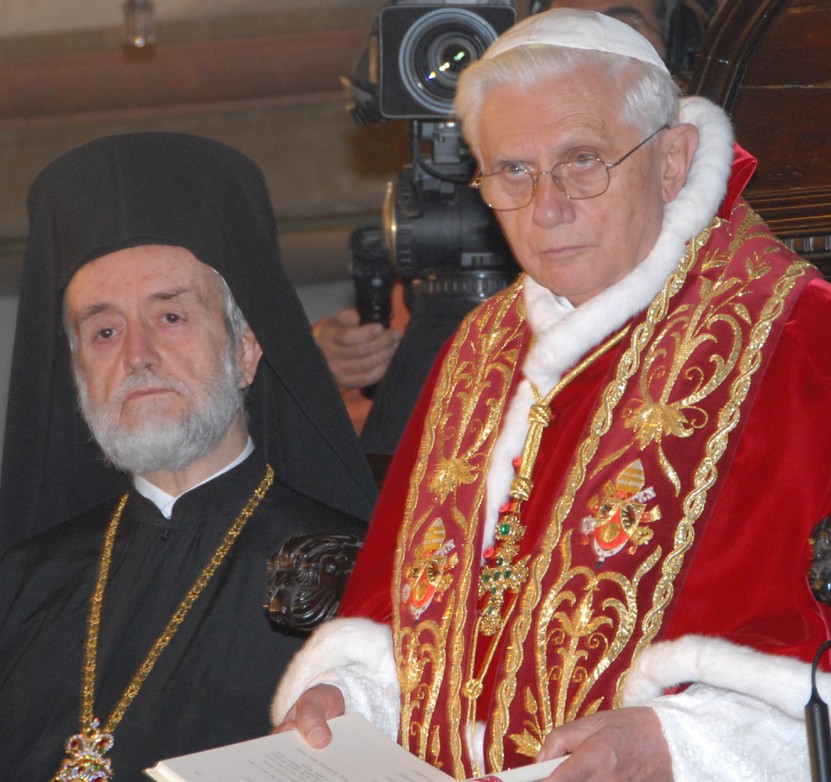
Pope Benedict and Metropolitan John Zizioulas

The other point in the Churchâ??s being received is that of a reception of one Church by another Church â?? and most important aspect of reception, stems from the basic ecclesiological fact that the Church, although one, exists as Churches (in the plural), and these Churches exist as One Church in and through constantly receiving one another as sister Churches. We shall see later how important this aspect is for us today. Metropolitan John Zizioulas The Theological Problem of 'Reception' (One in Christ: A Catholic Ecumenical Review 21, 1985)
Embodiedness and mutuality - John Paul II’s theology of the body

John Paul II’s "theology of the body," which he laid out in 130 general audience addresses between 1979 and 1984, is arguably the most creative Christian response to the sexual revolution and its "pulverization" of the human person to be articulated in the twentieth century. Its philosophical core is Wojtyla’s claim that what we might call a "Law of the Gift" is built into the very structure of human being-in-the-world. Because of that, self–giving, not self–assertion, is the royal road to human flourishing.

This deep truth of the human condition, which John Paul believed could be demonstrated by a careful analysis of human moral agency, had enormous implications for meeting the challenge of the sexual revolution. Sex, as often experienced in today’s sexual free-fire zone, is instinctive and impersonal. But that kind of sex does not rise above the level of animal sexuality, which is also instinctive and impersonal. Sex that is an expression of self–giving love, not a use of the other for temporary gratification, is the only sex worthy of human beings. Chastity, on this analysis, is what John Paul called the "integrity of love," the virtue that makes it possible for one to love another as a person. We are made free, Wojtyla argues, so that we can make a free gift of ourselves to others; we are free so that we can love freely, and thus love truly. Genuine freedom—the freedom that disposes of itself in self–giving—is the context of a genuinely humanistic sexual ethic.

The theological core of John Paul’s "theology of the body" is his profoundly sacramental apprehension of reality. Our embodiedness as male and female is not an accident of evolutionary biology, he insists. Rather, that embodiedness and the mutuality built into it express some of the deepest truths of the world, and teach us something about the world’s Creator. John Paul even goes so far as to propose that sexual love within the bond of marital fidelity is an icon of the interior life of God the Holy Trinity, a community of mutual self–donation and mutual receptivity. Thus sexual love, within the bond of Christian marriage, is an act of worship.

George Weigel John Paul II and the Crisis of Humanism

Pope John Paul's lectures on the theology of the Body have been re-published as Man and Woman He Created Them: A Theology Of The Body

If JP II's Theology of the Body is completely new to you, you could try Christopher West or even Peter Kreeft

Benedict in Constantinople

Pope Benedict and Metropolitan John Zizioulas

Amy Welborn has started covering Pope Benedict'' visit to the Ecumenical Patriarch.

The Vatican has posted details of the services to be celebrated:

The Divine Liturgy begins with an invocation of the Holy Trinity: â??Blessed be the kingdom of the Father and the Son and the Holy Spiritâ?¦â??. Three litanies follow, a longer one and two shorter ones, which invoke the Lordâ??s mercy upon the whole world and the entire Church. Mention is made of the Church, her members and all those in need. These litanies always include an invocation to the Mother of God, who intercedes for everyone and for the Holy Church. After the second litany the christological hymn, â??Only-Begottenâ?? is sung; this is an ancient liturgical hymn that summarizes the principal dogmas of the Christian faith: the Trinity, the Incarnation of the Word of God, the divine maternity of Mary, the salvation that is bestowed on us by Christâ??s passion, death and resurrection. There follows the â??Small Entranceâ??. In a solemn procession, the priest and the deacon take the Gospel from the altar, show it to the faithful and set it again on the altar, in order to indicate the beginning of the proclamation of the word of God: originally this was the entrance procession. Before the readings the Trisagion is chanted: â??Holy God, Holy Mighty, Holy Immortalâ?¦â??.

The third part of the Divine Liturgy is the liturgy of the faithful, in which those who are baptized participate fully. It begins with the â??Great Entranceâ??, the procession with the bread and wine towards the altar. The choir sings the hymn: â??We who mystically represent the Cherubimâ?¦â??, another ancient liturgical text in which the Church of heaven and earth is united in praise and thanksgiving to God for his gifts. The priest incenses the altar, the church, the gifts and the faithful, all of which are icons of Christ. He then solemnly takes the paten and the chalice, and after asking the Lord to remember all those who have been commemorated and the whole Church, he sets them on the altar and covers them with the veil. The priest then recites for himself and the whole Church the words of the Good Thief from his cross: â??Remember me, Lord, in your Kingdomâ?¦â??. The gifts, a symbol of Christ, the Lamb who was slain, are then placed on the altar, as if in the tomb from which, after the consecration or sanctification, the life-giving Body of Christ will be given to each of the faithful. After the entrance, litanies are sung, the sign of peace is exchanged, and the Nicene-Constantinopolitan Creed is recited. There follows the anaphora of Saint John Chrysostom, which has a structure similar to that of the other anaphoras of the Eastern and Western liturgies: an initial trinitarian dialogue, Preface, Sanctus, anamnesis, institution narrative, epiclesis, intercessions and conclusion.

This is followed by the Our Father, the breaking of the bread and communion. Before communion the priest pours some boiling water (called the zéon) into the chalice as a symbol of the outpouring and presence of the Holy Spirit, as well as a sign of the life which comes from communion in the living and life-giving Body and Blood of Christ himself.

The Ecumenical Partriachate has set up a website to cover the Pope's Apostolic journey. There will be no visit to the Theological School of Halki that the Turkish government has kept closed in defiance of the Turkish constitution's defence of minorities and of religious freedom.

Benedict - the reasonableness of faith

These, of course, are points that Joseph Ratzinger has been making for years, indeed decades. In Christianity and the Crisis of Cultures, he synthesizes his arguments into a series of finely-tuned propositions on which all men and women of good will would do well to reflect. Among the most important of these propositions I would list the following, illustrating each with a brief citation from the book:

Proposition 1: We live in a moment of dangerous imbalance in the relationship between the West's technological capabilities and the West's moral understanding.

Thus Ratzinger writes, "Moral strength has not grown in tandem with the development of science; on the contrary, it has diminished, because the technological mentality confines morality to the subjective sphere. Our need, however, is for a public morality, a morality capable of responding to the threats that impose such a burden on the existence of us all. The true and gravest danger of the present moment is precisely this imbalance between technological possibilities and moral energy" [p. 27].

Proposition 2: The moral and political lethargy we sense in much of Europe today is one by-product of Europe's disdain for the Christian roots of its unique civilization, a disdain which has contributed in various ways to the decline of what was once the center of world culture and world-historical initiative.

Thus Ratzinger writes, "...Europe has developed a culture that, in a manner hitherto unknown to mankind, excludes God from public awareness...God is irrelevant to public life...[This contemporary European culture] is the most radical contradiction not only of Christianity, but of all the religious and moral traditions of humanity..." [pp.30-31].

Proposition 3: The abandonment of Europe's Christian roots implies the abandonment of the idea of "Europe" as a civilizational enterprise constructed from the fruitful interaction of Jerusalem, Athens, and Rome. This infidelity to the past has led, in turn, to a truncated idea of reason, and of the human capacity to know, however imperfectly, the truth of things, including the moral truth of things. There is a positivism shaping (and misshaping) much of Western thought today -- a positivism that excludes all transcendent moral reference points from public life. Ratzinger asks whether such a positivism in an exercise of what the Canadian philosopher Charles Taylor describes as "exclusive humanism," and then asks whether such an exclusivist humanism, is, itself, rational. His answer is a resounding "No." As he writes, "This philosophy expresses, not the complete reason of man, but only one part of it. And this mutilation of reason means that we cannot consider it to be rational at all. Hence it is incomplete and can recover its health only through reestablishing contact with its roots. A tree without roots dries up..." [p.43].

And so, evidently, do civilizations.

Proposition 4: The recovery of reason in the West would be facilitated by a reflection on the fact that the Christian concept of God as Logos helped shape the distinct civilization of the West as a synthesis of Athens, Jerusalem, and Rome. If men and women have forgotten that they can, in fact, think their way through to the truth of things, that may have something to do with the European forgetfulness of God which Aleksandr Solzhenitsyn identified as the source of Europe’s 20th century civilizational distress.

Thus Ratzinger writes, "From the very beginning, Christianity has understood itself to be the religion of the Logos, to be a religion in keeping with reason...[But] a reason that has its origin in the irrational and is itself ultimately irrational does not offer a solution to our problems. Only that creative reason which has manifested itself as love in the crucified God can truly show us what life is" [ pp. 47, 49]...

If Europe begins to recover its faith in reason, then at least some in Europe may, in time, rediscover the reasonableness of faith; and in any event, a renewed faith in reason would provide an antidote to the spiritual boredom from which Europe is dying -- and thus open the prospect of a new birth of freedom in Europe, and throughout the West.

George Weigel On Christianity and the Crisis of Cultures

Pope Benedict's 'Europe's Crisis of Culture' in shorter form

Enter into the 'We' of the church

The first dimension is that the celebratio is prayer and a conversation with God: God with us and us with God. Thus, the first requirement for a good celebration is that the priest truly enter this conversation. In proclaiming the Word, he feels himself in conversation with God. He is a listener to the Word and a preacher of the Word, in the sense that he makes himself an instrument of the Lord and seeks to understand this Word of God which he must then transmit to the people. He is in a conversation with God because the texts of Holy Mass are not theatrical scripts or anything like them, but prayers, thanks to which, together with the assembly, I speak to God.

It is important, therefore, to enter into this conversation. St Benedict in his "Rule" tells the monks, speaking of the recitation of the Psalms, "Mens concordet voci". The vox, words, precede our mind. This is not usually the case: one has to think first, then one's thought becomes words. But here, the words come first. The sacred Liturgy gives us the words; we must enter into these words, find a harmony with this reality that precedes us.

In addition, we must also learn to understand the structure of the Liturgy and why it is laid out as it is. The Liturgy developed in the course of two millenniums and even after the Reformation was not something worked out by simply a few liturgists. It has always remained a continuation of this on-going growth of worship and proclamation.

Thus, to be well in tune, it is very important to understand this structure that developed over time and to enter with our minds into the vox of the Church. To the extent that we have interiorized this structure, comprehended this structure, assimilated the words of the Liturgy, we can enter into this inner consonance and thus not only speak to God as individuals, but enter into the "we" of the Church, which is praying. And we thus transform our "I" in this way, by entering into the "we" of the Church, enriching and enlarging this "I", praying with the Church, with the words of the Church, truly being in conversation with God.

This is the first condition: we ourselves must interiorize the structure, the words of the Liturgy, the Word of God. Thus, our celebration truly becomes a celebration "with" the Church: our hearts are enlarged and we are not doing just anything but are "with" the Church, in conversation with God. It seems to me that people truly feel that we converse with God, with them, and that in this common prayer we attract others, in communion with the children of God we attract others...

Benedict XVI To the priests of Albano diocese

Immersing ourselves in the prayer of all times

This is proper to the Pastor, that he should be a man of prayer, that he should come before the Lord praying for others, even replacing others who perhaps do not know how to pray, do not want to pray or do not make the time to pray. Thus, it is obvious that this dialogue with God is pastoral work!

I would say further that the Church gives us, imposes upon us - but always like a good Mother - the obligation to make free time for God with the two practices that constitute a part of our duties: the celebration of Holy Mass and the recitation of the Breviary. However, rather than reciting it, this means putting it into practice by listening to the word which the Lord offers us in the Liturgy of the Hours.

It is essential to interiorize this word, to be attentive to what the Lord is saying to me with this word, to listen, then, to the comments of the Fathers of the Church or also of the Council in the Second Reading of the Office of Readings, and to pray with this great invocation, the Psalms, by which we are inserted into the prayer of all the ages. The people of the Old Covenant pray with us, and we pray with them. We pray with the Lord, who is the true subject of the Psalms. We pray with the Church of all times. I would say that this time dedicated to the Liturgy of the Hours is precious time. The Church offers to us this freedom, this free space of life with God, which is also life for others.

Thus, it seems important to me to see that these two realities - Holy Mass truly celebrated in conversation with God and the Liturgy of the Hours - are areas of freedom, of inner life, an enrichment which the Church bestows upon us. In them, as I said, we do not only find the Church of all the ages but also the Lord himself, who speaks to us and awaits our answer. We thus learn to pray by immersing ourselves in the prayer of all times, and we also encounter the people. Let us think of the Psalms, of the words of the Prophets, of the words of the Lord and of the Apostles, and of the teaching of the Fathers.

Benedict XVI To the priests of Albano diocese

The enlightenment lives from its Christian roots 2

We asked ourselves two questions: if rationalist (positivist) philosophy is strictly rational and, consequently, if it is universally valid, and if it is complete. Is it self-sufficient? Can it, or more directly must it, relegate its historical roots to the realm of the pure past and, therefore, to the realm of what can only be valid subjectively?

We must respond to both questions with a definitive "no." This philosophy does not express man's complete reason, but only a part of it, and because of this mutilation of reason it cannot be considered entirely rational. For this reason it is incomplete, and can only be fulfilled by re-establishing contact with its roots. A tree without roots dries up. In this connection, the Enlightenment is of Christian origin and it is no accident that it was born precisely and exclusively in the realm of the Christian faith.....

Christianity must always remember that it is the religion of the "Logos." It is faith in the "Creator Spiritus," in the Creator Spirit, from which proceeds everything that exists. Today, this should be precisely its philosophical strength, in so far as the problem is whether the world comes from the irrational, and reason is not, therefore, other than a "sub-product," on occasion even harmful of its development or whether the world comes from reason, and is, as a consequence, its criterion and goal.

The Christian faith inclines toward this second thesis, thus having, from the purely philosophical point of view, really good cards to play, despite the fact that many today consider only the first thesis as the only modern and rational one par excellence. However, a reason that springs from the irrational, and that is, in the final analysis, itself irrational, does not constitute a solution for our problems. Only creative reason, which in the crucified God is manifested as love, can really show us the way.

In the so necessary dialogue between secularists and Catholics, we Christians must be very careful to remain faithful to this fundamental line: to live a faith that comes from the "Logos," from creative reason, and that, because of this, is also open to all that is truly rational.

Cardinal Josef Ratzinger Europe’s crisis of culture

The enlightenment lives from its Christian roots 1

The Muslims, who in this respect are often and willingly brought in, do not feel threatened by our Christian moral foundations, but by the cynicism of a secularized culture that denies its own foundations. ... The same is true for the reference to God: It is not the mention of God that offends those who belong to other religions, but rather the attempt to build the human community absolutely without God.

The banishment of Christian roots does not reveal itself as the expression of a higher tolerance, which respects all cultures in the same way, not wishing to privilege any, but rather as the absolutizing of a pattern of thought and of life that are radically opposed, among other things, to the other historical cultures of humanity.

The radical detachment of the Enlightenment philosophy from its roots becomes, in the last analysis, contempt for man. Man, deep down, has no freedom, we are told by the spokesmen of the natural sciences, in total contradiction with the starting point of the whole question. Man must not think that he is something more than all other living beings and, therefore, should also be treated like them, we are told by even the most advanced spokesmen of a philosophy clearly separated from the roots of humanity's historical memory.

Cardinal Josef Ratzinger Europe’s crisis of culture

Benedict - talking to Muslims

Richard Neuhaus at First Things (On the Square 18th September) offers a variety of views on what Pope Benedict said last week at Regensburg. Neuhaus himself says this:

â??Pope Benedict â?¦ is a man of great gentleness and deliberation and extremely careful to say what he means. What he said at Regensburg he has said many times before. Contrary to many reports, he has not apologized or retracted his argument. He has indicated sincere regret that many Muslims have reacted to his statement as they have. The response of those who are properly called jihadists is, â??If you donâ??t stop saying weâ??re violent, weâ??re going to bomb more churches, kill more nuns and priests, and get the pope too.â?? In short, the reaction has powerfully confirmed the problem to which Benedict called our attention.â??

The very reverse of inflammatory or careless, Benedict appeals with very great courtesy and encouragement to beleaguered moderate Muslim, anxious to help them win the argument against extremists. There is no great difference between Benedict and John Paul II here.

And here is part of a longer excerpt from Benedict himself speaking to Muslims:

It is in this spirit that I turn to you, dear and esteemed Muslim friends, to share my hopes with you and to let you know of my concerns at these particularly difficult times in our history. I know that many of you have firmly rejected, also publicly, in particular any connection between your faith and terrorism and have condemned it. I am grateful to you for this, for it contributes to the climate of trust that we need. Terrorist activity is continually recurring in various parts of the world, plunging people into grief and despair. Those who instigate and plan these attacks evidently wish to poison our relations and destroy trust, making use of all means, including religion, to oppose every attempt to build a peaceful and serene life together.

Dear friends, I am profoundly convinced that we must not yield to the negative pressures in our midst, but must affirm the values of mutual respect, solidarity and peace. The life of every human being is sacred, both for Christians and for Muslims. There is plenty of scope for us to act together in the service of fundamental moral values.

You, my esteemed friends, represent some Muslim communities from this Country where I was born, where I studied and where I lived for a good part of my life. That is why I wanted to meet you. You guide Muslim believers and train them in the Islamic faith.

Teaching is the vehicle through which ideas and convictions are transmitted. Words are highly influential in the education of the mind. You, therefore, have a great responsibility for the formation of the younger generation. I learn with gratitude of the spirit in which you assume responsibility.

Christians and Muslims, we must face together the many challenges of our time. There is no room for apathy and disengagement, and even less for partiality and sectarianism. We must not yield to fear or pessimism. Rather, we must cultivate optimism and hope.

I donâ??t see how you can get more gracious or encouraging than that. "I learn with gratitude of the spirit in which you assume responsibility." That is certainly how I feel about Benedict, and only wish he could say it to me and my lot.

For more good sense on this issue, see Amy Welborn and Anne Applebaum in the Washington Post.