Common Declaration by Pope Benedict XVI and Patriarch Bartholomew I

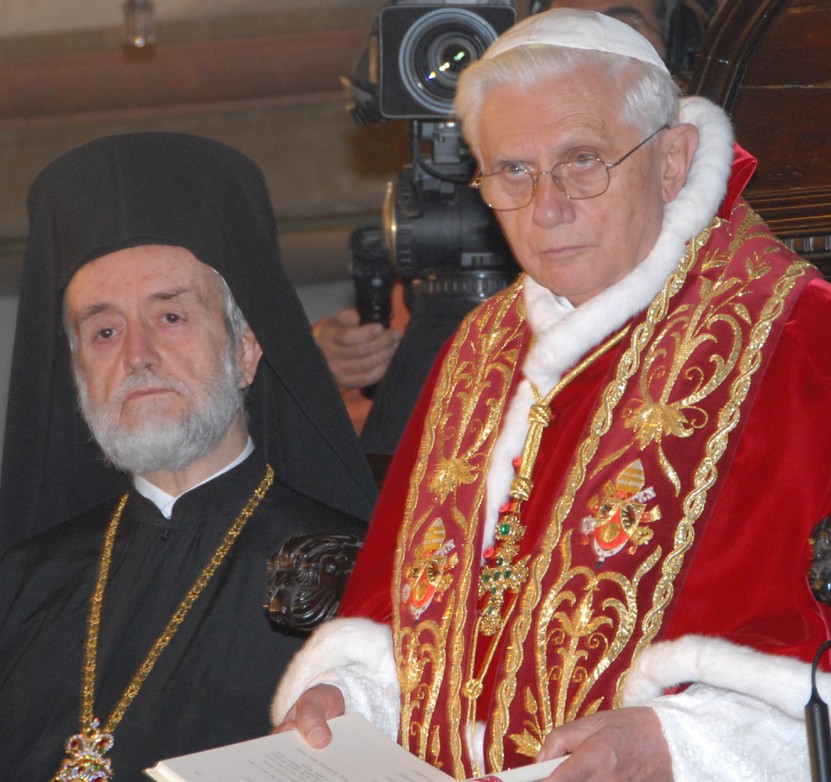
Pope Benedict and Patriarch Bartholomew

This fraternal encounter which brings us together, Pope Benedict XVI of Rome and Ecumenical Patriarch Bartholomew I, is Godâ??s work, and in a certain sense his gift. We give thanks to the Author of all that is good, who allows us once again, in prayer and in dialogue, to express the joy we feel as brothers and to renew our commitment to move towards full communion. This commitment comes from the Lordâ??s will and from our responsibility as Pastors in the Church of Christ. May our meeting be a sign and an encouragement to us to share the same sentiments and the same attitudes of fraternity, cooperation and communion in charity and truth. The Holy Spirit will help us to prepare the great day of the re-establishment of full unity, whenever and however God wills it. Then we shall truly be able to rejoice and be glad.

1. We have recalled with thankfulness the meetings of our venerable predecessors, blessed by the Lord, who showed the world the urgent need for unity and traced sure paths for attaining it, through dialogue, prayer and the daily life of the Church. Pope Paul VI and Patriarch Athenagoras I went as pilgrims to Jerusalem, to the very place where Jesus Christ died and rose again for the salvation of the world, and they also met again, here in the Phanar and in Rome. They left us a common declaration which retains all its value; it emphasizes that true dialogue in charity must sustain and inspire all relations between individuals and between Churches, that it â??must be rooted in a total fidelity to the one Lord Jesus Christ and in mutual respect for their own traditionsâ?? (Tomos Agapis, 195). Nor have we forgotten the reciprocal visits of His Holiness Pope John Paul II and His Holiness Dimitrios I. It was during the visit of Pope John Paul II, his first ecumenical visit, that the creation of the Mixed Commission for theological dialogue between the Roman Catholic Church and the Orthodox Church was announced. This has brought together our Churches in the declared aim of re-establishing full communion.

As far as relations between the Church of Rome and the Church of Constantinople are concerned, we cannot fail to recall the solemn ecclesial act effacing the memory of the ancient anathemas which for centuries had a negative effect on our Churches. We have not yet drawn from this act all the positive consequences which can flow from it in our progress towards full unity, to which the mixed Commission is called to make an important contribution. We exhort our faithful to take an active part in this process, through prayer and through significant gestures.

Common Declaration by Pope Benedict XVI & Patriarch Bartholomew I

* * *

What these two Christians, Benedict and Bartholomew, are doing is what every Christian must do in order to receive Christ â?? go to the Christians you disagree with, make your differences clear to one another, confess and forgive what has to be confessed and forgiven, and together look forward to your reconciliation and unity. Let's do it.

Bartholomew and Benedict

Ecumenical Patriarch Bartholomew to His Holiness Pope Benedict XVI

Your Holiness, beloved Brother in the Lord,

It is with sentiments of sincere joy and satisfaction that we welcome you to the sacred and historical city of Istanbul. This is a city that has known a treasured heritage for the growth of the Church through the ages. It is here that St. Andrew, the "first-called" of the Apostles founded the local Church of Byzantium and installed St. Stachys as its first bishop. It is here that the Emperor and "equal-to-the-Apostles," St. Constantine the Great, established the New Rome. It is here that the Great Councils of the early Church convened to formulate the Symbol of Faith. It is here that martyrs and saints, bishops and monks, theologians and teachers, together with a â??cloud of witnessesâ?? confessed what the prophets saw, what the apostles taught, what the church received, what the teachers formulated in doctrine, what the world understood, what grace has shone, namelyâ?¦the truth that was received, the faith of the fathers. This is the faith of the Orthodox. This faith has established the universe.

So it is with open embrace that we welcome you on the blessed occasion of your first visit to the City, just as our predecessors, Ecumenical Patriarchs Athenagoras and Demetrios, had welcomed your predecessors, Popes Paul VI and John Paul II. These venerable men of the Church sensed the inestimable value and urgent need alike of such encounters in the process of reconciliation through a dialogue of love and truth.

Therefore, we are, both of us, as their successors and as successors to the Thrones of Rome and New Rome equally accountable for the steps - just, of course, as we are for any missteps - along the journey and in our struggle to obey the command of our Lord, that His disciples "may be one." ....

Beloved Brother, welcome. "Blessed is he that comes in the name of the Lord."

"Blessed is the Name of the Lord now and forevermore."

Pope Benedict XVI to Ecumenical Patriarch Bartholomew

â??Behold, how good and pleasant it is when brothers dwell in unityâ?? (Ps 133:1)

Your Holiness,

I am deeply grateful for the fraternal welcome extended to me by you personally, and by the Holy Synod of the Ecumenical Patriarchate. I will treasure its memory forever. I thank the Lord for the grace of this encounter, so filled with authentic goodwill and ecclesial significance.

It gives me great joy to be among you, my brothers in Christ, in this Cathedral Church, as we pray together to the Lord and call to mind the momentous events that have sustained our commitment to work for the full unity of Catholics and Orthodox. ...

Signs of this love have been evident in numerous declarations of shared commitment and many meaningful gestures. Both Pope Paul VI and Pope John Paul II were warmly received as visitors in this Church of Saint George, and joined respectively with Patriarchs Athenagoras I and Dimitrios I in strengthening the impetus towards mutual understanding and the quest of full unity. May their names be honoured and blessed!

I also rejoice to be in this land so closely connected to the Christian faith, where many Churches flourished inancient times. I think of Saint Peterâ??s exhortations to the early Christian communities â??in Pontus, Galatia, Cappadocia, Asia, and Bithyniaâ?? (1 Pet 1:1), and the rich harvest of martyrs, theologians, pastors, monastics, and holy men and women which those Churches brought forth over the centuries.

I likewise recall the outstanding saints and pastors who have watched over the See of Constantinople, among them Saint Gregory of Nazianzus and Saint John Chrysostom, whom the West also honours as Doctors of the Church. Their relics rest in the Basilica of Saint Peter in the Vatican, and a part of them were given to Your Holiness as a sign of communion by the late Pope John Paul II for veneration in this very Cathedral. Truly, they are worthy intercessors for us before the Lord.

In this part of the Eastern world were also held the seven Ecumenical Councils which Orthodox and Catholics alike acknowledge as authoritative for the faith and discipline of the Church. They are enduring milestones and guides along our path towards full unity.

I conclude by expressing once more my joy to be with you. May this meeting strengthen our mutual affection and renew our common commitment to persevere on the journey leading to reconciliation and the peace of the Churches.

I greet you in the love of Christ. May the Lord be always with you.

www.patriarchate.org

Pope Benedict and Metropolitan John Zizioulas

The other point in the Churchâ??s being received is that of a reception of one Church by another Church â?? and most important aspect of reception, stems from the basic ecclesiological fact that the Church, although one, exists as Churches (in the plural), and these Churches exist as One Church in and through constantly receiving one another as sister Churches. We shall see later how important this aspect is for us today. Metropolitan John Zizioulas The Theological Problem of 'Reception' (One in Christ: A Catholic Ecumenical Review 21, 1985)

Embodiedness and mutuality - John Paul II’s theology of the body

John Paul II’s "theology of the body," which he laid out in 130 general audience addresses between 1979 and 1984, is arguably the most creative Christian response to the sexual revolution and its "pulverization" of the human person to be articulated in the twentieth century. Its philosophical core is Wojtyla’s claim that what we might call a "Law of the Gift" is built into the very structure of human being-in-the-world. Because of that, self–giving, not self–assertion, is the royal road to human flourishing.

This deep truth of the human condition, which John Paul believed could be demonstrated by a careful analysis of human moral agency, had enormous implications for meeting the challenge of the sexual revolution. Sex, as often experienced in today’s sexual free-fire zone, is instinctive and impersonal. But that kind of sex does not rise above the level of animal sexuality, which is also instinctive and impersonal. Sex that is an expression of self–giving love, not a use of the other for temporary gratification, is the only sex worthy of human beings. Chastity, on this analysis, is what John Paul called the "integrity of love," the virtue that makes it possible for one to love another as a person. We are made free, Wojtyla argues, so that we can make a free gift of ourselves to others; we are free so that we can love freely, and thus love truly. Genuine freedom—the freedom that disposes of itself in self–giving—is the context of a genuinely humanistic sexual ethic.

The theological core of John Paul’s "theology of the body" is his profoundly sacramental apprehension of reality. Our embodiedness as male and female is not an accident of evolutionary biology, he insists. Rather, that embodiedness and the mutuality built into it express some of the deepest truths of the world, and teach us something about the world’s Creator. John Paul even goes so far as to propose that sexual love within the bond of marital fidelity is an icon of the interior life of God the Holy Trinity, a community of mutual self–donation and mutual receptivity. Thus sexual love, within the bond of Christian marriage, is an act of worship.

George Weigel John Paul II and the Crisis of Humanism

Pope John Paul's lectures on the theology of the Body have been re-published as Man and Woman He Created Them: A Theology Of The Body

If JP II's Theology of the Body is completely new to you, you could try Christopher West or even Peter Kreeft

Theology of the Body in London

I am always ready to talk up any theological discussion going on in the UK, so I'm keeping an eye on Statford Caldecott’s Second Spring which is offering

Theology of the Body - London day conference Give Me Sensible Reasons To Believe: the true teaching of the Catholic Church about SEX SEX and the reasons WHY

A one-day conference for young adults Saturday 24th February 2007 at Westminster Cathedral Hall Ambrosden Avenue London SW1P 1QH

'The speakers are all young committed Catholics who are living in the real world. These issues are a part of their lives as they are of yours.' - Just right for the youth group, then.

Plus - Theology of the Body Explored - lecture course 2006-7 continues into the spring at St. Patrick’s, Soho Square, London

SSCE conference

Society for the Study of Christian Ethics conference 2007

The Ideology of Managerialism in Church, Politics and Society

7th-9th September, Wycliffe Hall, Oxford, UK

Presenters include Professor Michael L. Budde, Chair of the Department of Political Science, DePaul University

Professor John Milbank, Professor in Religion, Politics & Ethics, Nottingham University

Professor Allen Verhey, Professor of Christian Ethics, Duke Divinity School

Dr. Bernd Wannenwetsch, Lecturer in Ethics, Oxford University

Call for papers - The conference committee invite short papers related to the theme of the event and more general outlines of work in progress

* * *

Day Conference on Hans G. Ulrich The day before the SSCE conference the Society will be holding a Symposium on Hans G. Ulrich's (Erlangen) major work on theological ethics, Wie Geschöpfe leben:Konturen evangelischer Ethik (LIT Verlag, 2005) at Harris Manchester College (6th-7th September 2007).

Those responding to Prof Ulrich’s work include: Dr. Markus Bockmuehl (St Andrews); Professor Oliver O’Donovan (New College, Edinburgh); Professor Wolfgang Palaver (Innsbrück); Dr Susan Parsons (Nottingham); Revd Dr Bernd Wannenwetsch (Harris Manchester, Oxford); and Professor John Webster (Aberdeen).

This is an open symposium to which all are invited to attend.

Hans Ulrich, one of Germany's very finest, is scarcely known outside Germany, so this day conference will be quite an opportunity. Ulrich was Docktorvater to Reinhard Hütter whose Suffering Divine Things and (the rather more accessible) Bound to be Free: Evangelical Catholic Engagements in Ecclesiology, Ethics, and Ecumenism have impressed me almost more than any other books in the last three years, and of Oxford's Bernd Wannenwetsch whose Political Worship: Ethics for Christian Citizens is the chunkiest and most exciting piece of theology I have seen recently.

Secularism, Faith and Freedom

The Christian Church began as a reconstructed version of the notion of God’s people – a community called by God to make God known to the world in and through the forms of law-governed common life – the ‘law’ being, in the Christian case, the model of action and suffering revealed in Jesus Christ. It claimed to make real a pattern of common life lived in the fullest possible accord with the nature and will of God – a life in which each member’s flourishing depended closely and strictly on the flourishing of every other and in which every specific gift or advantage had to be understood as a gift offered to the common life. This is how the imagery of the Body of Christ works in St Paul’s letters. There is no Christian identity in the New Testament that is not grounded in this pattern; this is what the believer is initiated into by baptism. And this is a common life which exists quite independently of any conventional political security. Because it depends on the call and empowering of Christ’s Spirit, it cannot be destroyed by change in external circumstances, by the political arrangements prevailing in this or that particular society. So Christian identity is irreducibly political in the sense that it defines a politeia, a kind of citizenship (Philippians 3.20); yet its existence and integrity are not bound to a successful realisation of this citizenship within history. There does not have to be a final and sacred political order created in order for the integrity of the Church to survive.

* * *

The salient point is that a supposedly liberal society which assumes absolutely that it has (as I put it earlier) the resources for producing and sustaining moral motivation independently of the actual moral or spiritual commitments of its citizens, is in danger behaving and speaking as if the only kind of human solidarity that really matters is that of the state. Programmatic secularism, as a shorthand for the denial of the public legitimacy of religious commitment as a partner in political conversation, will always carry the seeds, not of totalitarianism in the obvious sense, but of that ‘totalising’ spirit which stifles critique by silencing the other.

Archbishop Rowan Williams Secularism, Faith and Freedom Pontifical Academy of Social Sciences, Rome 23rd November 2006

The hunt for a real theology department – Duke

I am wondering about theological education in London, and in particular wondering about this term 'Christian university'. So I am off around the internet to find examples of thriving theological faculties in the hope that they will provide some inspiration. First stop:

Duke Divinity School

The Doctor of Theology program provides students with academically rigorous training, comparable to the demands of the Ph.D., focused on the ministries and practices of Christian communities. The program centers upon areas of study such as worship, preaching, evangelism, and the arts. At the same time, as an integral component of its mission, the Th.D. program seeks to reconfigure the way in which such practices are brought into creative interdisciplinary conversation with the established academic discourses of biblical studies, historical studies, and theology and ethics. Moreover, the interdisciplinary scope of the program extends to other areas of the university and addresses fresh areas of research such as the intersection of Divinity and Health Care, or Peacemaking and Reconciliation.

How about Duke’s

Center for Theological Writing ?

Writing forms a constituent practice of the ministry, as integral as prayer and preaching, rather than a tool employed toward other ends. And like prayer and preaching, writing requires a lifetime's commitment to growth and refinement. For the ministry, even more than other professions, words constitute the very terms of our existence; they are the medium in which we exercise both our beliefs and our fears, our power and our contrition. We sustain and transmit our Christian identity through the written word. The use of language in the Church itself can be rather uninspiring, whether because we appeal to the tired jargon of popular culture or artlessly repeat our own cliches. The danger is not only that the Church's voice be drowned out by others less profound; it is that our understanding of and relationship to God are cheapened. Bad theological writing is an act of bad faith.

* * *

Duke has Stanley Hauerwas, Amy Laura Hall, Reinhard Hütter, Geoffrey Wainnwright, Ellen Davis, Richard Hays, Douglas Campbell and David Steinmetz. If I was able to kidnap and bring to London just one of these it would be Reinhard Hütter. Click on his ‘links’. Of course Geoffrey Wainwright is ours anyway, as are Sam Wells and Jo Bailey Wells.

Benedict in Constantinople

Pope Benedict and Metropolitan John Zizioulas

Amy Welborn has started covering Pope Benedict'' visit to the Ecumenical Patriarch.

The Vatican has posted details of the services to be celebrated:

The Divine Liturgy begins with an invocation of the Holy Trinity: â??Blessed be the kingdom of the Father and the Son and the Holy Spiritâ?¦â??. Three litanies follow, a longer one and two shorter ones, which invoke the Lordâ??s mercy upon the whole world and the entire Church. Mention is made of the Church, her members and all those in need. These litanies always include an invocation to the Mother of God, who intercedes for everyone and for the Holy Church. After the second litany the christological hymn, â??Only-Begottenâ?? is sung; this is an ancient liturgical hymn that summarizes the principal dogmas of the Christian faith: the Trinity, the Incarnation of the Word of God, the divine maternity of Mary, the salvation that is bestowed on us by Christâ??s passion, death and resurrection. There follows the â??Small Entranceâ??. In a solemn procession, the priest and the deacon take the Gospel from the altar, show it to the faithful and set it again on the altar, in order to indicate the beginning of the proclamation of the word of God: originally this was the entrance procession. Before the readings the Trisagion is chanted: â??Holy God, Holy Mighty, Holy Immortalâ?¦â??.

The third part of the Divine Liturgy is the liturgy of the faithful, in which those who are baptized participate fully. It begins with the â??Great Entranceâ??, the procession with the bread and wine towards the altar. The choir sings the hymn: â??We who mystically represent the Cherubimâ?¦â??, another ancient liturgical text in which the Church of heaven and earth is united in praise and thanksgiving to God for his gifts. The priest incenses the altar, the church, the gifts and the faithful, all of which are icons of Christ. He then solemnly takes the paten and the chalice, and after asking the Lord to remember all those who have been commemorated and the whole Church, he sets them on the altar and covers them with the veil. The priest then recites for himself and the whole Church the words of the Good Thief from his cross: â??Remember me, Lord, in your Kingdomâ?¦â??. The gifts, a symbol of Christ, the Lamb who was slain, are then placed on the altar, as if in the tomb from which, after the consecration or sanctification, the life-giving Body of Christ will be given to each of the faithful. After the entrance, litanies are sung, the sign of peace is exchanged, and the Nicene-Constantinopolitan Creed is recited. There follows the anaphora of Saint John Chrysostom, which has a structure similar to that of the other anaphoras of the Eastern and Western liturgies: an initial trinitarian dialogue, Preface, Sanctus, anamnesis, institution narrative, epiclesis, intercessions and conclusion.

This is followed by the Our Father, the breaking of the bread and communion. Before communion the priest pours some boiling water (called the zéon) into the chalice as a symbol of the outpouring and presence of the Holy Spirit, as well as a sign of the life which comes from communion in the living and life-giving Body and Blood of Christ himself.

The Ecumenical Partriachate has set up a website to cover the Pope's Apostolic journey. There will be no visit to the Theological School of Halki that the Turkish government has kept closed in defiance of the Turkish constitution's defence of minorities and of religious freedom.

Christ the King

What a relief to get out of ordinary time.

As I watched, thrones were set in place, and an Ancient One took his throne; his clothing was white as snow, and the hair of his head like pure wool; his throne was fiery flames, and its wheels were burning fire. A stream of fire issued and flowed out from his presence. A thousand thousand served him, and ten thousand times ten thousand stood attending him. The court sat in judgment, and the books were opened. Daniel 7.9-10, 13-14.

The Lord is king, he is robed in majesty; the Lord is robed, he is girded with strength. He has established the world; it shall never be moved; your throne is established from of old; you are from everlasting.

Psalm 93

To him who loves us and freed us from our sins by his blood, and made us to be a kingdom, priests serving his God and Father, to him be glory and dominion for ever and ever. Amen. Look! He is coming with the clouds; every eye will see him, even those who pierced him; and on his account all the tribes of the earth will wail. So it is to be. Amen. Revelation 1

Pilate asked him, ‘So you are a king?’ Jesus answered, ‘You say that I am a king. For this I was born, and for this I came into the world, to testify to the truth. Everyone who belongs to the truth listens to my voice.’ John 18

And from the hymns, this - the single most difficult thing for us at St Mary's Stoke Newington to grasp -

Christ through all ages is the same Place the same great hope in his name With the same faith his word proclaim Alleluya From George Bell’s ‘Christ is the King, O friend rejoice!' Bell, bishop of Chichester, was Bonhoeffer’s chief supporter in England

Christian university?

Conversation keeps turning to theology in London. Sometimes the mood is despondent, sometimes constructive and ambitious. How to begin? Now I appreciate this won't interest the majority of you who are outside the UK. But it does seem as though the Brits have to talk to each other through the Americans – we are noticeably nicer to each other in the States for the AAR-SBL for instance.

Lesslie Newbigin said he read the US religious press because he believed that whatever started there would come here. But it also works the other way around, so I agree with George Weigel, that the US should watch out for this European secularism.

A couple of weeks ago I heard the term 'Christian University' used for the first time in the British context. There are such things in the States of course, and even more there are Catholic universities and colleges, but see Alasdair MacIntyre on The End of Education.

What should be the distinctive calling of the American Catholic university or college here and now? It should be to challenge its secular counterparts by recovering both for them and for itself a less fragmented conception of what an education beyond high school should be, by identifying what has gone badly wrong with even the best of secular universities. From a Catholic point of view the contemporary secular university is not at fault because it is not Catholic. It is at fault insofar as it is not a university….

To help me think about what a university is, and what a Catholic or Christian university is, I am going to post the conferences and the homepages of the theology faculties that look most promising, and occasionally post from the mountain of papal material on the subject (Fides et Ratio and Ex Corde Ecclesia).

From the UK I am most impressed Gavin D’Costa Theology in the Public Square: Church, Academy and Nation (see below). From London I have also found Jeff Astley, Andrew Walker et al The Idea of a Christian University: Essays on Theology and Higher Education. I think we have most to learn from Messrs Williams and O'Donovan.

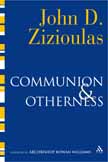
John Zizioulas - Communion and Otherness

Zizioulas Communion and Otherness

One highlight of the AAR, though there was no fanfare, was the arrival of Communion and Otherness: Further Studies in Personhood and the Church, the second volume of Metropolitan John Zizioulas.

I intended to post a chunk from the cracking Preface by Rowan Williams and the author's dedication to George Florovksy and Colin Gunton, but gave my copy to an old student of Zizioulas here in London. So we'll have to make do with a paragraph from the publisher, T & T Clark.

‘Communion and otherness: how can these be reconciled?’ In this wide-ranging study, the distinguished Orthodox theologian, Metropolitan John (Zizioulas) of Pergamon, seeks to answer that question. In his celebrated book, Being as Communion (1985), he emphasised the importance of communion for life and for unity. In this important companion volume he now explores the complementary fact that communion is the basis for true otherness and identity.

With a constant awareness of the deepest existential questions of today, Metropolitan John probes the Christian tradition and highlights the existential concerns that already underlay the writings of the Greek fathers and the definitions of the early ecumenical councils. In a vigorous and challenging way, he defends the freedom to be other as an intrinsic characteristic of personhood, fulfilled only in communion.

After a major opening chapter on the ontology of otherness, written specially for this volume, the theme is systematically developed with reference to the Trinity, Christology, anthropology and ecclesiology. Another new chapter defends the idea that the Father is cause of the Trinity, as taught by the Cappadocian fathers, and replies to criticisms of this view. The final chapter responds to the customary separation of ecclesiology from mysticism and strongly favours a mystical understanding of the body of Christ as a whole. Other papers, previously published but some not easily obtainable, are all revised for their inclusion here.

Benedict - the reasonableness of faith

These, of course, are points that Joseph Ratzinger has been making for years, indeed decades. In Christianity and the Crisis of Cultures, he synthesizes his arguments into a series of finely-tuned propositions on which all men and women of good will would do well to reflect. Among the most important of these propositions I would list the following, illustrating each with a brief citation from the book:

Proposition 1: We live in a moment of dangerous imbalance in the relationship between the West's technological capabilities and the West's moral understanding.

Thus Ratzinger writes, "Moral strength has not grown in tandem with the development of science; on the contrary, it has diminished, because the technological mentality confines morality to the subjective sphere. Our need, however, is for a public morality, a morality capable of responding to the threats that impose such a burden on the existence of us all. The true and gravest danger of the present moment is precisely this imbalance between technological possibilities and moral energy" [p. 27].

Proposition 2: The moral and political lethargy we sense in much of Europe today is one by-product of Europe's disdain for the Christian roots of its unique civilization, a disdain which has contributed in various ways to the decline of what was once the center of world culture and world-historical initiative.

Thus Ratzinger writes, "...Europe has developed a culture that, in a manner hitherto unknown to mankind, excludes God from public awareness...God is irrelevant to public life...[This contemporary European culture] is the most radical contradiction not only of Christianity, but of all the religious and moral traditions of humanity..." [pp.30-31].

Proposition 3: The abandonment of Europe's Christian roots implies the abandonment of the idea of "Europe" as a civilizational enterprise constructed from the fruitful interaction of Jerusalem, Athens, and Rome. This infidelity to the past has led, in turn, to a truncated idea of reason, and of the human capacity to know, however imperfectly, the truth of things, including the moral truth of things. There is a positivism shaping (and misshaping) much of Western thought today -- a positivism that excludes all transcendent moral reference points from public life. Ratzinger asks whether such a positivism in an exercise of what the Canadian philosopher Charles Taylor describes as "exclusive humanism," and then asks whether such an exclusivist humanism, is, itself, rational. His answer is a resounding "No." As he writes, "This philosophy expresses, not the complete reason of man, but only one part of it. And this mutilation of reason means that we cannot consider it to be rational at all. Hence it is incomplete and can recover its health only through reestablishing contact with its roots. A tree without roots dries up..." [p.43].

And so, evidently, do civilizations.

Proposition 4: The recovery of reason in the West would be facilitated by a reflection on the fact that the Christian concept of God as Logos helped shape the distinct civilization of the West as a synthesis of Athens, Jerusalem, and Rome. If men and women have forgotten that they can, in fact, think their way through to the truth of things, that may have something to do with the European forgetfulness of God which Aleksandr Solzhenitsyn identified as the source of Europe’s 20th century civilizational distress.

Thus Ratzinger writes, "From the very beginning, Christianity has understood itself to be the religion of the Logos, to be a religion in keeping with reason...[But] a reason that has its origin in the irrational and is itself ultimately irrational does not offer a solution to our problems. Only that creative reason which has manifested itself as love in the crucified God can truly show us what life is" [ pp. 47, 49]...

If Europe begins to recover its faith in reason, then at least some in Europe may, in time, rediscover the reasonableness of faith; and in any event, a renewed faith in reason would provide an antidote to the spiritual boredom from which Europe is dying -- and thus open the prospect of a new birth of freedom in Europe, and throughout the West.

George Weigel On Christianity and the Crisis of Cultures

Pope Benedict's 'Europe's Crisis of Culture' in shorter form

AAR

Washington DC

Knight went to the AAR. He was briefly allowed to leave his desk, London, and the whole UK for the Annual Conference of the American Academy of Religion and Society of Biblical Literature (SBL) in Washington DC.

Highlights were:

Volf Krötke (Berlin) at the Barth Society, ably introduced by Philip Zeigler.

Luke Bretherton (KCL – English, one of ours) awed the Systematic Theology seminar, but then so did David Haddorff (Saint John's NY).

The Ecclesiological Investigations 's impressive discussion of the Porto Alegre 9th Assembly of the World Council of Churches (WCC) document Called to be the One Church. It was good to find fellow-Zizioulas readers Fr Paul McPartlan and Paul Collins making an impact. I think that the ecclesiology of Metropolitan Zizioulas would be an ideal subject for a session of this seminar next year.

The Christian Theology and the Bible seminar (Webster, Telford Work and many others), though I managed to miss all sessions of Theological Hermeneutics of Christian Scripture Group, which had an equally strong cast.

It was great to importune publishers, particularly at the swanky Eerdmans reception, to be wowed by Brazos’s Theological Theological Commentary on the Bible series, and to meet Amazon reviewer Halden Doerge .

Kings crowd

But above all it was wonderful to catch up with the old Kings College London crowd – those pictured above (Left to right Paul Janz, Oliver Crisp, Luke Bretherton, Chris Roberts, Eric Flett, Randall Rauser and Ryan Murphy), but also and in particular Justyn Terry, Paul Metzger and George Ille.

I am very grateful to Chris Roberts and to Lincoln Harvey. I understand that neither of them want to room with me ever again so I shall be sleeping on the beach at San Diego in 2007.

Benedict and the Future of Europe

So when we think about the processes of production, about the whole pattern of an economy, we should be asking in what sense it is intelligent production – work directed towards the maintenance of a recognisably human environment. That recognisably human environment is, for the Christian believer, one in which the habits of self-examination and the possibilities of self-knowledge are being nourished – one in which the imagination as well as the intellect is matured. Remember, when Benedict speaks about lectio, the goal he presumes is that of self-knowledge, humility and growth in holiness: the dimension of study in the monastic life is not about developing intellectual skills for their own sake, but a way of advancing in understanding of oneself as made in God’s image, as mortal and fragile, subject to temptation and struggle, and as capable by grace of maturing in service. Just as work is there in order to sustain a life in which study may be properly carried out, so study is an activity sustaining a particular kind of human maturity and self-awareness before God. And in turn this is the context in which prayer and praise emerge as the natural crown of the whole pattern of the life of the Rule. The self-aware, intelligent and imaginative disciple who is formed by labour and study knows that the purpose of his or her life is now turning outwards to acknowledge God: proper self-awareness delivers us from self-absorption, since it shows us what kind of beings we are, what we are made for – which is the enjoyment of God.

A civilised life structured around the vision of the Rule is one in which economics is not allowed to set itself up as a set of activities whose goals and norms have no connection with anything other than production and exchange...

And the Benedictine structuring of time stands as a potent reminder of the balances we risk losing in a culture obsessed with production and reluctant to locate that production in a broader picture of human activity and growth. The pressing issue is how we sustain a civilisation capable of asking itself questions about its purpose and its integrity; only a civilisation that can do this will generate people – citizens – who can turn away from individual instinct and self-protection, whether in adoration of God or in compassion for the needy, because they know what sort of beings they are, mortal, interdependent, created out of love and for love.

Archbishop Rowan Williams Benedict and the Future of Europe * * * *

My respect for this Archbishop of ours grows and grows. From now on you may regard this blog as the Papa Williams Fanclub. Do many of you have an archbishop like this? Hands Up. No, as I thought, not many of you. So then, in the Anglican front row we have Oliver O'Donovan, Tom Wright, John Webster and Rowan Williams, all with beautifully complementary gifts, but the one wearing the 'Most Evangelical' shirt at the moment... is Williams. This speech, given in Rome, is a little love missive from us Anglicans to Rome's current Benedict and affirmation of his leadership in the church catholic.

Bibiliography

Up until a couple of years ago I was keeping a bibliography which had reached about a thousand items, representing the trails into non-theological territory which I hoped to follow once I had got The Eschatological Economy out of the way. This bibliography was in MS Access on my overworked laptop – the laptop that blew a gasket one morning when someone, who shall be nameless, switched her hairdryer on and off in the next room. In the cold fear of having lost the book I was working on, I just got the man in the repair shop to recover my Word files and forgot all about the bibliography, which was the only file held in any other application. And so it was gone, and I haven't really kept a single bibliography since. I hope you take more care of your data than I do.

Anyway I have been trying out what looks like a wonderful online bibliography service – LibraryThing. It offers a variety of ways to present your book list, including with library shelf mark/Library of Congress call mark. I haven't found a Sort function yet - I think it all has to be done with tags. And there is a fair amount of crossover of function with Amazon, though you can find people who are reading, or at least own, one particular book, so it is an online book-club too.

The hunt for a real theology department – University of St Thomas

The University of St Thomas Center for Catholic Studies is dedicated to the integration of faith and reason in every facet of life. Our programs and services create an environment where students, alumni and others can engage their faith within contemporary culture and grow both intellectually and spiritually.

The Center for Catholic Studies is an academic community within the University of St Thomas dedicated to the ongoing renewal of Catholic higher education. Shaped by the Catholic principles of the unity of knowledge and the complementarity of faith and reason, the Center pursues its mission through interdisciplinary teaching and research, service to the community, and cultivation of spiritual life.

Their Program in Catholic-Orthodox Dialogue promises a Comprehensive Ecumenical Vision

The Program is committed to the pursuit of Christian unity across the following seven dimensions of dialogue:

1. Theological: clarification of doctrinal agreement and disagreement. Formal and informal discussions among scholars and church leaders in the context of international and national consultations leading to the promulgation and publication of joint statements. Program's contribution: Public Lectures; Conferences; Official Documents

2. Historical: "Healing of Memory" project. Study of our shared past in order to understand the causes of divisions and to work towards reconciliation, among other things, through comparative investigation of representative figures (theologians, saints, martyrs, mystics), periods, issues, and practices. Program's contribution: Publications

3. Practical: faith-sharing among Catholics and Orthodox in everyday life. Reflections on the ways in which social context shapes Catholic and Orthodox identity of individuals and communities across the globe (e.g., Orthodox-Catholic intermarriages in the US, Orthodox and Catholic minorities in the Middle East). Program's contribution: Twin Cities Initiatives

4. Liturgical: participation in joint prayer services. Scholarly investigation of conditions for reestablishing communio in sacris; Orthodox studies of western worship; Catholic studies of eastern worship.

5. Social: common response to the modern world. Articulating a common moral vision in light of the major social, economic, and political challenges of the day (globalization, war and peace, science and technology, poverty, and so on). Projects in Ukraine

6. Global: nurturing an ecumenical spirit around the world. Fostering awareness of the need for Church unity in Orthodox and Catholic institutions in North America and Eastern Europe

7. Aesthetic: contemplating the beauty of the divine together. The study of western influences upon eastern Christian art, music, and architecture, and vice versa. Creation of new Christian art and music bearing testimony to Orthodox-Catholic unity.

Seven is a beautiful number of course.

The Church assembled in Christ's name for instruction

The real Christ for the Orthodox Church is the Christ of the gospels and Acts; the Christ of the writings attributed to the apostles John and Paul, and Peter and James and Jude. There is no other Christ for the Orthodox Church. A Christ produced by scholars, mystics, poets or politicians - or even by creative theologians, charismatic elders or crusading activists within or without the Church - is never the real and whole Christ of Orthodox doctrine, liturgy, spirituality and sanctity. He is surely not the Christ of Orthodox mission.

To know the real Christ requires a diligent and critical study of the Bible. Before anything else, Christians are disciples, i.e. students (mathetai). They are students of Christ before they are his "members" as members of his Church. They are his disciples before they are his apostles and missionaries (i.e., "those who are sent"). And they are certainly his disciples before they are bishops, presbyters, elders, and theologians of his Church.

Jesus appears in the gospel narrative first as rabbi, master and teacher (didaskolos, magister). He instructs his students in the right understanding of the old testament writings. Risen from the dead he opens the minds of his disciples to understand the scriptures and explains to them how "the law, the psalms and the prophets" speak about him (cf. Lk 24).

Critical study of scriptures is a reading and hearing of the biblical words without prejudging or predetermining their meaning. Through such study the student (who may in some circumstances be unable to read) wants to know what the writings actually say and mean, first for those who originally wrote and heard them, and then for people today, beginning with oneself. Such study uses all available means to illumine and explain (but not to constitute or determine) the biblical texts as written and received in the Church. It employs, for example, the knowledge of languages, literature, history, religion, geography and archeology. It welcomes the guidance of those skilled in such fields. But though this study is done within the Church community with the help of others, it must be done for oneself. Each individual believer must personally engage God's Word in the Bible. Without such engagement, especially today in North America, and especially by the Church's leaders, there is no genuine Orthodox mission.

Bible and Liturgy The hearing and reading of the Bible essential to Orthodox missionary work occurs in the context of the Church's self-actualization in corporate worship, i.e. the liturgy. The Church assembled in Christ's name before the Face of God in the Holy Spirit for instruction, petition, praise, remembrance and thanksgiving is the hermeneutical condition and context for interpreting God's Word recorded in the scriptures. As such, it is the point from which the Church's apostolic mission originates and the point toward which its activity is directed.

Not only is the Bible read, heard, contemplated and explained at Church services, but the services themselves are thoroughly biblical in content, form and spirit. Biblically informed believers have an immediate awareness and experience of the Bible's message in Orthodox liturgical worship. Or rather, more accurately, the God and Christ witnessed in the Bible become immediately accessible to believers in liturgical contemplation and communion in the Church.

Protopresbyter Thomas Hopko The Mission of the Orthodox Church in North America with thanks to Matthew Baker

University Christian Unions under threat

Seventy Church of Engand and Roman Catholic bishops were urged today to intervene to help thousands of Christian students at British universities from having the organisations representing them banned.

Among those asked to take action to save Christian Union societies were the Archbishops of Canterbury and Westminster.

The rise of secularism in the UK is among the issues being debated today and tomorrow at the first ever joint meeting of the Anglican and Roman Catholic bishops of England and Wales in Leeds.

Dr Rowan Williams and Cardinal Cormac Murphy-O'Connor were to issue a joint statement later today on the importance of working together and how to surmount the differences that remain between the two churches.

The 40 Anglican and 30 Catholic bishops began their unprecedented two-day meeting at Hinsley Hall at lunchtime. The bishops prayed and worshipped together and discussed how to heal the historic rift between them.

But Christian Union leaders urged them to move away from the usual "bland platitudes" associated with ecumenical gatherings to help the beleaguered Christian student societies under threat of bans.

Ruth Gledhill The Times

Cosmic Liturgy at Second Spring

How about a Cosmic Liturgy retreat-and-conference at Oxford next Easter?

Cosmic Liturgy

Over Easter 2007 we are offering an educational and spiritual retreat in the heart of Oxford to study the meaning of the Liturgy, drawing on Pope Benedict’s book The Spirit of the Liturgy. The intention is to promote a deeper personal engagement with the Easter Liturgy in dialogue with the Orthodox. The retreat will help us rediscover or better appreciate the following things:

·The vertical dimension of the Liturgy (and the Church herself) as containing at its heart the sacrifice of the Cross, joining earth to heaven.

·The sacrificial dimension of the sacred Liturgy, tied to a greater sense of the meaning of Holy Eucharist, the Christian priesthood, etc.

·The eschatological dimension of the Liturgy, as a making present of eternity in time, an actual drawing up of the mundane into the realm of the divine.

·The relationship of the external forms of the Liturgy to catechesis, to interior formation and disposition. The place of beauty, structure, symbol, cosmic orientation, language and music in divine worship.

·The Liturgy as something received, something objective, and not something we are can engineer. The essential role of tradition as a vehicle for the Holy Spirit and the organic development of liturgy and community.

·The intrinsic relationship of contemplation to action, of love for God to love for neighbour, in the Liturgy itself. The nuptial anthropology that makes Mass the consummation of a wedding between divine and human nature.

Out of this course, with the experience of a beautiful Easter Liturgy, and some training in the use of the Divine Office and Gregorian Chant, will come refreshment of spirit and a renewed energy to serve God in the world.

See more at Second Spring. Try 'Mystagogy' and their Noticeboard-Chatroom. Second Spring, I am impressed.

Christianity without discipline

Indifference to form was essential to the Evangelical movement. It stemmed from a conviction that mediation of any kind, whether Catholic or Protestant, posed a barrier to direct communion between God and the individual Christian. Ecclesial forms, the logic went, could be faked; they could result in nominal Christianity or dead orthodoxy.

Evangelicalism, accordingly, sought authentic or genuine faith, unencumbered by rites, dogma, and clergy. As such, born-again Protestantism is a new and highly modern form of Christianity, one that regards dependence on churchly mediation, whether through catechesis or creedal subscription, sacraments or ministerial blessings, pastors or priests, or councils of bishops or presbyteries, as in tension with rather than constituting a personal relationship with Christ.

If real antagonism exists between Evangelicalism and ecclesial Christianity, then why do born-again Protestants who desire historically grounded expression of the faith remain Evangelical? Why not simply join one of the other communions that guard ancient Christianity?

One suspects that the reason has something to do with the advantages of being rootless. Without an Evangelical identity, a born-again Protestant would have to choose one of those other traditions, join it, and reject the others. With an Evangelical identity, he can take the best from all Christian expressions without having to come under the discipline and restraint of a particular church’s ministry, authority, and tradition.

If this is so, then the Evangelical future called for in this statement is more modern than ancient, because it is more voluntary than received, more liberated than restrained, more tolerant than exclusive. Without becoming part of a historic Christian communion, Evangelicalism’s ancient future will yield merely the trappings of antiquity minus its churchly substance.

D. G. Hart 'Born Again Free' – Responses to Call to an Ancient Evangelical Future

Theology in London 2 - Alan Spence

Alan Spence(left)

Alan Spence is the author of The Promise of Peace: A Unified Theory of Atonement

The Promise of Peace offers a defence of a mediatorial interpretation of the atonement, that is one in which Christ is held to have become as we are, so that he might on our behalf make peace with God. It is argued that such an interpretation is not one of a number of valid descriptions of Christ's saving work, but the normative redemptive account. The erosion of this classic view of the atonement can be explained partly by a number of developments that have taken place in theological thought during the past two hundred years. These include the emergence of a christology in which Christ's divinity is linked to his saving ministry; a new interpretation of Pauline theology in which issues of justification are held to be secondary to those of participation; a return to the more dualistic world-view of the Church Fathers; difficulties with the concept of divine judgement; and a culture of relativism in which a unified or coherent account of the atonement not only no longer seems possible, but is generally not even considered desirable. The book achieves its purpose by engaging critically with these various theological ideas. It is as much a clearing of the undergrowth from the foundations of soteriology as it is the construction of a coherent account of Christ Jesus as the one mediator between us and God. It goes on to consider the relation of such an account to the proclamation of the gospel and the response required of its hearers.

The Promise of Peace has won some powerful endorsements:

'Seasoned by years on the front lines of ministry, both in missions and human rights work, the author's profound insights into the logic of redemption bear a sense of urgency and pastoral depth. The Promise of Peace is not simply another summary of Christian doctrine; it is a judicious and passionate - at times even polemical - defense of the heart of the gospel for our time. This is the clarity and wisdom that the church desperately needs in our day if we would turn from fads to faith in the promise-maker of peace.' Professor Michael Horton, Westminster Theological Seminary, California.

'Alan Spence's new book is a very welcome addition to the literature on the doctrine of atonement. Dr Spence has read widely and deeply, and engages seriously and sympathetically with many others in developing his own distinctive proposal. More than that, however, any book so well written will gain a heart-felt welcome from scholars so used to wading through impenetrable prose. With the style and urgency of a true preacher, and the knowledge and insight of a true scholar, Dr Spence offers us a book of genuine interest and worth. I am very happy to commend it.' Dr Steve Holmes, St Andrews.

'Alan Spence advocates and practises a non-nonsense approach to Christian theology: clear, accessible, passionate, not afraid of controversy, but always pastoral, and, above all, eager to be faithful to the Christian Gospel. Even those who do not agree with his conclusions will enjoy engaging in conversation with him.' Professor Christoph Schwöbel, Tübingen.

Alan taught theology in Zimbabwe, was Moderator of the Presbyterian Church of Southern Africa and is now minister of the United Reformed Church in Ealing in London.

Alan is the most incisive, passionate and pastoral teacher of Christian doctrine I know, and invariably galvanises every seminar he turns up at. He has been coaching postgraduates who find him through his work on England's great puritan theologian John Owen. Alan's book on Owen appears from T & T Clark next year. He is powerful proof that you can still find Christian theology in London.

Rowan Williams

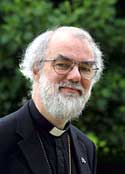
Archbishop Rowan Williams

Yes, we have our very own one-man ‘Deep Church’, right here in London, at Lambeth, and Rowan Williams is his name.

The ‘Sermons and Speeches’ page of the website of the Archbishop of Canterbury is the place to go for contemporary Christian resources.

In the course of a year Archbishop Williams covers a wide range of issues on a large number of occasions and for varied audiences. Some pieces are short and light, and these tend to have the odd titles that reflect the institutions that invited him to be their speaker.

But many of these are big pieces, and we should regard them as our theological resources of first resort. Many of them are about theology in the public square, and so to do with the university as the arena of free public discourse, ‘faith-based education’ and the topic of the moment and foreseeable future – relations with Muslims.

Others are about Anglican unity, Christian unity, and others about discipleship and the ‘religious life’, by which he means the monastic life (which is probably the key for Williams).

His familiarity with the resources represented by the history of the Christian Church and tradition, and his fundamental concern for discipleship and the unity of the Church make his work evangelical. He has a gospel and it is faithful and deep (ludicrous, maybe, that this needs saying). Why doesn't he just preach the gospel? He preaches the gospel – exactly that is what he is doing: not the gospel in half-dozen chords on the charismatic keyboards perhaps, but massively orchestrated, harmonics reaching back and forward. Though he pitches what he says just right for each specific audience, he is also speaking to the longer-term audiences behind them – it is that communion of saints, again. Of course much of it is in a very different idiom than we are used to.

University and public square Though more diffidently, he makes the same case as Benedict XVI that the Christian faith provides the good practices of public reasoning together on which all public discourse, civil society and universities are built.

He gives some of the most revealing and exciting accounts of the Christian faith, or of the contribution of Christianity to the public square, when he is playing away from home and having to go back to first principles – for instance in ‘What is a university?’ in China, in his lecture given to the godless Eurocrats on the Christian contribution to Europe, and ‘What is Christianity?’ in the Islamic University, Islamabad, and his speech to Islamic religious leaders in Cairo. They may not sound inviting, but this is where he is doing the real work of showing the contribution of the Christian faith to public discourse and reason - he usually provides a little history of the relationship of the two - and sometimes his gospel sounds most clearly here.

'What is a university?' Speech given in Wuhan, China. This is my favourite of the moment and I have posted pieces from it on this blog.

Religion, culture, diversity and tolerance – shaping the new Europe - Brussels

Belief, unbelief and religious education – Downing Street 2004

Convictions Loyalties and the Secular State – Chatham lecture 2004

Christian theology and other faiths – Birmingham 2003

What is Christianity? A lecture given at the international Islamic University in Islamabad, Pakistan

Address at al-Azhar al-Sharif - Cairo 2004

Christian unity One Church One Hope – Freibrug 2006 on Christian unity and the churches’ responsibility for Europe

Christ’s own identity and work was to be found in ‘representative action’, Stellvertretung. Christ stands in our place; all he does is done on our behalf. His perfect obedience is lived out in life and death so that we may live, and for no other purpose, certainly for no individual purpose. But if that is the life he lives, then the life that comes into existence through him must likewise be marked by the same representative quality…

One Holy Catholic and Apostolic Church Anglican Global South-to-South Encounter, Ain al Sukhna, Egypt 28th October 2005

The focus of the centre of Anglican energy in the world is very clearly in the global south in our time and it is therefore for me an experience of learning, as well as of fellowship, to be with you…

Christian life – discipleship and ‘spirituality’ Williams’ lectures about Michael Ramsey and Dietrich Bonhoeffer are most definitely about you, me and Williams in the here and now. He is using Bonhoeffer and his situation to talk about us and our situation. (I said this blog would be full of the blooming obvious). He considers this indirect mode intrinsic to Christian discipleship, that we take the cover our predecessors in the faith offer us, and this is an aspect of following them and looking to them for leadership. What we are looking for is not, or not just, resolutions, ways out of our difficulties, but a style of life, an attitude of mind and way of life, which is the way of the disciple, even the way of the cross. See his approval of Ephraim Radner line on the Anglican crisis of faith as the way of the cross in Williams’ Ramsey lecture.

The Lutheran Catholic The Ramsey Lecture – on Michael Ramsey, the UK’s last great theologian-archbishop, gives a very good idea of Williams himself, with links to Bonhoeffer

Sermon at St Matthäus Church Berlin on the centenary of the birth of Dietrich Bonhoeffer

So if we ask about the nature of the true Church, where we shall see the authentic life of Christ’s Body – or if we ask about the unity of the Church, how we come together to recognise each other as disciples - Bonhoeffer’s answer would have to be in the form of a further question. Does this or that person, this or that Christian community, stand where Christ is? Are they struggling to be in the place where God has chosen to be? And he would further tell us that to be in this place is to be in a place where there are no defensive walls; it must be a place where all who have faith in Jesus can stand together, and stand with all those in whose presence and in whose company Christ suffers, making room together for God’s mercy to be seen.

Williams begins from the life of prayer, spirituality, monasticism.

Religious lives’ Romanes Lecture 2004

The Christian Priest Today Throughout Williams tells us that the Christian life is one of suffering witness. It costs and it hurts. It particularly hurts when you are carved up by other Christians, uncomprehending and enraged. The Christian is very likely to be the minority, but must put the Christian proposal out there in the public square for this is the greatest service they can offer their society.

Going through these lectures has made me realise again that whether a leader is good, and able to provide leadership in witness to Christ to the world, is in largely determined by those who follow him - or don't follow him. It is no good Williams saying all this unless the Church (not only Anglican but the whole church in the UK and further afield) receives and affirms this teaching and gives him authority to say these things. He can speak when he speaks from the Church, and this will be when the church hears, assents and gives its audible Amen to all this. We must wake up to the fact that we have a good leader, and stop slouching along as though still led by the B-team. I should have got to grips with the mountain of Williams' Christian teaching before now. We must get stuck into this.

There is more about Rowan Williams at Wikipedia, which has a bibliography.

Deep Church

You know what London really needs is a seminar in which ministers and worship leaders can re-discover the worship resources of the whole historic Church and discover a thicker, or deeper, exegesis of Scripture.

We did have such a seminar briefly a couple of years ago. It was called Deep Church. It was looking for ways to recover the practices of preaching, prayer, proper emphasis on communion and baptism, and to improving our catechism and theological teaching. I wonder what happened to it?

It produced a book The Gospel-Driven Church: Retrieving Classical Ministries for Contemporary Revivalism, billed as the first of a Deep Church Series.

New Deep Church lectures I see that Andrew Walker is giving a series of lectures at the brand new Westminster Theological Centre, under the same Deep Church title. I wonder if these two deep churches are related? Professor Walker is a charismatic evangelical member of the Russian Orthodox Church (worth going along just to ask) and well known for his work on C.S. Lewis and the Inklings.

Yet we do have our very own one-man ‘Deep Church’, right here in London, at Lambeth, and Williams is his name. The Sermons and Speeches page of the website of the Archbishop of Canterbury is a trough deep with Christian resources. You want to know more about what he says without actually reading them yourself? Shame on you. All right. Let me see what I can do.

Salvation is health

In the Eastern Orthodox Church, we speak of the impulses that move us toward any kind of sin as â??passions.â?? You shouldnâ??t think of this term as related to â??passionate.â?? Itâ??s more like â??passiveâ?? (as in â??the Passion of Christâ??; his passion is what he endured).

These impulses beat us up. They originate as thoughts, sometimes as thoughts that evade full consciousness. The roots are tangled with memories, shame, anger, fearâ??and the thoughts are also very often inaccurate.

All this mess damages our ability to see the world clearly. We go on misreading situations and other people, and venture further into confusion. The illness compounds itself, to the delight of the Evil One, who nurtures lies and has no compassion on the weak. To him, the weak are breakfast. Eastern Christianity speaks of this as the darkening of the nous, that is, of the perceptive center of a person. (Most English bibles translate nous as mind, but thatâ??s not quite it; the nous is not the rational intellect but a perceiving faculty. Thoughts and emotions are subsequent reactions to the nousâ??s perceptions.) The damaged nous is like a pair of glasses fitted with distorting lenses. It needs healing.

The Greek word represented by this kind of â??passionâ?? is pathos. It means â??suffering.â?? It is because we are helpless in our suffering that Christ came. He took on vulnerable human form and went into the realm of death and defeated the Evil One. Now we are invited to gradually return to health by fully assimilating the truth that sets us freeâ??by assimilating the presence and life of Christ himself. â??It is no longer I who live, but Christ who lives in me,â?? St. Paul said. This life fills and changes us like fire fills a piece of coal.

In the Eastern Christian understanding, sins are not â??bad deedsâ?? that must be made up in order to satisfy justice. They are instead like bad fruit, which indicates a sickness inside the tree (the analogy Jesus uses in Matthew 7:7â??8). Sin is infection, not infraction. And God not only forgives freely but also sent his Son to rescue us when we were helpless.

With Godâ??s help, we begin to heal. Like an athlete striving for the prize (I Cor. 9:24, Phil. 3:14, 2 Tim. 2:5), we resist succumbing to lying thoughts. The ancient spiritual disciplinesâ??continual prayer, fasting, and love of othersâ??are like the exercises in a time-tested workout routine. They make us stronger. When we fall, we get up. This is a life of continual repentanceâ??and you can see in that word re-pent, â??re-think.â?? Salvation is health, and health comes from knowing the truth and resisting lies. This gradually heals the nous so that it is restored to its original purpose: to perceive Godâ??s light permeating all Creation.

St. Paul writes, â??Be transformed by the renewal of your nous.â?? The biblical word for repentance, meta-noia, means literally the transformation of the nous. We are welcomed into Godâ??s kingdom in an instant, as we see in the story of the Good Thief; but full healing comes slowly and will continue every day that we live.

So it is a mistake to present Christianity the way some churches do, as if it is the haven of seamlessly well-adjusted, proper people. That results in a desperate artificial sheen. It results in treating worship as a consumer product, which must deliver better intellectual or emotional gratification than the competition. And that sends suffering people home again, still lonely, in their separate metal capsules.

What all humans have in common is our pathos. Getting honest about that binds us together. And then we begin to see how the mercy of God is pouring down on all of us all the time, just as the Good Samaritan bound the wounds of the beaten man with healing oil.... May God have mercy on all of us.

First Things Frederica Mathewes-Green

Two from Calvin for Summer 07

Two of the seminars Calvin is offering next summer look interesting. They are not conferences, since they run over several weeks.

Liturgical Identities: Global, National, Ecclesial Michael L. Budde and D. Stephen Long June 25-July 20, 2007

Liturgies form identities. They set forth what is important, focus our attention, shape our bodies through particular practices, and bear communal memory in ways that form who we are, whose we are, and what matters most in life.

Liturgical practices bear in themselves an intentionality about how to live. This is true not only for the church, but other associations such as the nation-state and economic entities. The nation-state, for example, has its own hymns, ritual practices, saints and martyrs, and sacred calendar. Corporations increasingly construct â??liturgiesâ?? that create brand loyalty and allegiance, and shape the affections, dispositions and desires of people.

This seminar will draw upon traditional patterns of Christian worship in order to highlight similarities and difference, points of convergence and conflict, among formative communities â?? ecclesial and secular. It will provide participants the opportunity to explore how Christian ecclesiologies and forms of worship interact with other powerful practices that shape allegiances, identities and loyalties in our world.

Biblical Studies Across the Curriculum: Discerning Scripture for the Disciplines James K.A. Smith and J. Richard Middleton

July 9-27, 2007

Over the past decade, a vision of integral Christian scholarship across the disciplines has flourished. But curiously absent from much of this discussion is any robust role for Scripture. While Christian scholars across the disciplines mine the resources of the Christian theological tradition for constructive work in their field, they often donâ??t dig down to the level of first-hand, rigorous engagement with the Bible. Or when Christian scholars do invoke Scripture, too often it is in the mode of â??proof-texting,â?? drawing on a less-than-sufficient acquaintance with the Bible that tends to de-contextualize Scripture, wresting passages from their canonical and historical context, or simply reducing them to propositions for logical operations.

The paucity of biblical engagement in Christian scholarship stems from a lack of opportunity for faculty development in this area. (In fact, it first stems from a certain failure of churches to provide solid formation in biblical interpretation.) Scholars are formed in ways that donâ??t provide opportunities to learn how to read Scripture well, and how to read it as scholarsâ??and along with scholars in biblical studies. The goal of this proposed summer seminar is to provide a faculty development opportunity that will rectify this situation. We aim to bring together a team of 12 scholars from across the disciplines who are eager to acquaint themselves with the best of critical, confessional scholarship on Scripture with a view to its impact for thinking across the curriculum. As such, we believe the seminar will have both scholarly and pedagogical impact.

Christian secularism

It is by means of this thinking â?? and not without irony â?? that we arrive at secularism and the concept of the secular public square. The word â??secularâ??, originally from a Latin word meaning â??generationâ?? or â??ageâ?? was adopted in early Christian writings to mean â??this ageâ?? or, more precisely, â??confined to this present age that is passing awayâ??. The secular was Christianityâ??s gift to the world, denoting a public space in which authorities should be respected but could legitimately be challenged and could never accord to themselves absolute or ultimate significance.

This was something the early Church understood well. In Peterâ??s letter to Christians scattered around the eastern Mediterranean, he told them they were â??a people belonging to Godâ??, but that didnâ??t mean they owed nothing to the earthly rulers under whom they lived. On the contrary, they were to â??submit â?¦ to every authority instituted among men: whether â?¦ king â?¦ or â?¦ governors, who â?¦ punish those who do wrong and to commend those who do right.â?? (1 Peter 2.13-14) But this, in turn, does not mean that such kings and governors are, by definition, right, and Peter proceeds to advise his readers what they should do when injustice is done. Similarly, the anonymous second-century writer of the Letter to Diognetus, explains to his reader: Though [Christians] are residents at home in their own countries, their behaviour there is more like that of transients; they take their full part as citizens, but they also submit to anything and everything as if they were aliens â?¦ their days are passed on earth, but their citizenship is above in the heavens. They obey the prescribed laws, but in their own private lives they transcend the laws. The Old Testamentâ??s nervousness about a single individual mediating Godâ??s rule for the people crystalises into the Christian denial that any particular political order is sacred, and, in doing so, produces the concept of a secular public square of which we are inheritors.

But we are only inheritors of it, as Rowan Williams has argued, because we are inheritors of the Judaeo-Christian intellectual foundations on which it is built. A belief in the provisionality and impermanence of political power, which forms the basis of political liberalism, is Christendomâ??s legacy to the modern world. Accordingly:

Western modernity and liberalism are at risk when they refuse to recognise that they are the way they are because of the presence in their midst of that partner and critic which speaks of â??alternative citizenshipâ?? â?? the Christian community â?¦ the distinctively European style of political argument and debate is made possible by the Churchâ??s persistent witness to the fact that states do not have ultimate religious claims on their citizens. Societies that forget this seminal Christian vision of â??dual citizenshipâ?? stumble towards absolutism, (Archbishop Rowan Williams)

either in the form of religious theocracy or state totalitarianism, in such a way as dehumanises its own people. This is an error into which theophobic secularism can fall.

God and Caesar

When the Church is regarded as an enemy to be overcome or a private body that must be resolutely excluded from public debate, liberal modernity turns itself into a fixed and absolute thing, another pseudo-religion, in fact â?¦

Unless the liberal state is engaged in a continuing dialogue with the religious community, it loses its essential liberalism. It becomes simply dogmatically secularâ?¦ (Archbishop Rowan Williams)

By concluding in this way we have consciously moved from a negative argument â?? defending Christianity against the largely baseless accusation that it is an inherently private phenomenon â?? towards a positive one â?? that the secular public square, properly understood, is a Christian legacy and one that requires an ongoing Christian presence to remain true to itself**.**

Theos - Doing God: A Future for Faith in the Public Square

Formation

If you are asked what are the characteristics you would regard as marks of maturity, or having grown up as a human being, what would you say? Let me try a few suggestions. The human adult I imagine is someone who is aware of emotion but not enslaved by it. A human adult is someone who believes that change is possible in their own lives and the lives of those around them. A human adult is someone who is aware of fallibility and death, that is who knows they are not right about everything and that they won’t live forever. An adult is someone sensitive to the cost of the choices they make, for themselves and for the people around them. An adult is someone who is not afraid of difference, who is not threatened by difference. And I would add too, an adult is someone aware of being answerable to something more than just a cultural consensus – someone whose values, choices, priorities are shaped by something other than majority votes…

if we don’t know what it is we are ‘inducting’ people into when we try and help them grow as humans, we cannot be surprised if chaos results.

What if we live in a climate where our emotions are indulged but never educated? That is to say where we never take a thoughtful perspective on how we feel, that brings in other people and their needs. What if we live in an environment where apathy and cynicism are the default positions for most people on issues of public concern? What if our environment is short on dialogue and learning and self-questioning? What if it is characterised by a fear and a denial of human limitations, by a fundamentalist belief in the possibility of technology in solving our problems for example? By the constant bracketing or postponing of the recognition that we have limits and that we are going to die. What if our environment is passive to the culture of the global market, simply receiving that constant streams of messages which flows out from producers and marketers? Because one of the things that implies is that the world ought to be one in which difference doesn’t matter very much because we are all flattened out, as you might say, in the role of consumers. What if our environment is characterised by intense boredom and an addiction to novelty? Or characterised by an obsessive romanticising of victim status, and a lack of empathy? What if it is characterised by secularism, that is to say by an approach to the world which is tone deaf about the sacred and the mysterious?

Archbishop Rowan Williams Formation: Who’s bringing up our children?

To win the world to Christ without his Body

After World War II, conservative Protestants fled oppressively liberal mainline denominations and formed parachurch mission boards, seminaries, and publishing houses, as a matter of survival and faithfulness. As they did so, however, they downplayed their ecclesial differences to the point that establishment Evangelicalism forgot there really was anything important about baptism, the Lordâ??s Supper, or, sadly, the Church itselfâ?¦.

Now, after a half-century, we see Evangelical parachurch institutions and ministries almost indistinguishable in their broadness from the mainline institutions for which they were created as a conservative alternative. The Call hits exactly on some of the reasons for this: a hyper-confident Evangelical movement that thought it could win the world to Christ apart from his Body. Inasmuch as the Call directs us to reconsider the Kingdom communities of our churches, as opposed to databases of donors, we should listenâ?¦.

At the end of the day, the â??Ancient/Futureâ?? Evangelicalism is a natural extension of American Evangelicalismâ??s besetting sins of faddishness and consumerism. Thatâ??s the reason it is fanned (as so many Evangelical winds of doctrine are) by publishing houses. This project comes to us just as Evangelicalism is in the throes of an infatuation with the so-called emerging church, which is also fueled by publishing houses (the sellers of youth ministry curricula) and which is also enamored simultaneously with postmodern cynicism, egalitarianism, doctrinal flexibility, and ancient-seeming worship...

The emerging worshipers and the ancient futurists want to borrow some of the trappings of a time when Christianity was countercultural (dark rooms and candles simulating catacombs, for instance) while embracing primary aspects of contemporary cultural libertarianism (including feminism and pluralism)â?¦.

If the Ancient/Future Evangelicals wish to counter this culture, they will be forced to do so in more than the generalities theyâ??ve outlined. To take on consumerism, do you dare take on the dual-income family structure of contemporary Americanism? To take on the â??culture of death,â?? do you dare speak bluntly about welcoming the gift of children, about the personhood of the embryo, about the way in vitro fertilization turns a child into a means?

To speak against â??civil religion,â?? do you dare call for public prayers in the name of Jesus? To speak against â??political correctness,â?? do you dare say that only in Jesus Christ is salvation found, thus fueling the evangelism of the world religions, including the Jewish people?

Russell D. Moore â??Listen Closelyâ?? â?? Responses to Call to an Ancient Evangelical Future

All Saints Evensong

Isaiah 65.17-25, Psalms 148 & 150, Hebrews 11.32-12.2

Let them praise the name of the LORD, for his name alone is exalted; his splendor is above the earth and the heavens.

Why?

For he commanded and they were created. Kings of the earth and all nations, princes and all rulers on earth, young men and maidens, old men and children.

The line Let everything that hath breath praise the Lord rounds off the book of psalms. We end the day with them in our evensong, and end the year with All Saints. Everything that has a voice receives its existence from the Lord – and as long as we say we receive all things from him we receive new breath. From Hebrews we heard about this great a cloud of witnesses, and then this - ‘God had provided something better so that they would not, apart from us, be made perfect…

The life-work of the saints is not established until we have grasped for ourselves what they want to give us. They not only know something that we don’t know, but they know something about us and have something for us that we don't yet know and don't yet have. They tell us that we do not have to establish ourselves or create an identity for ourselves in the face of the world. Our identity is given by God who has a far higher view of us than we have of ourselves. All the people amongst whom I will find my identity, are gifts given by God, and we must receive them as such. Each person, in particular each saint, brings us some part of this good gift of God to us, and with it some part of our very own identity. By the faithfulness of this company of witnesses the gospel has dropped into our lap.

When we allow that our predecessors in the Christian faith have been faithful, and have handed on to us a fair representation of the faith of Jesus Christ and his apostles, an extraordinary adventure opens up to us.

But of all people how has this extraordinary thing come to us so we find ourselves here, saying and singing these things, that God has spoken and speaks now to us? Why us?

I have been asked to talk about the book that the Theology Discussion group has been reading. This time it is Karl Barth’s Dogmatics in Outline, in which Barth introduces the creed which we have just said together. This evening the group will look at these clauses – ‘I believe in… God the Father, Almighty, Maker of heaven and earth…‘, and two in particular, God the Creator, and God the Father.

The first point Barth makes is that:

It cannot be that first of all we presuppose the reality of the world and then ask whether there is also a God.

It is not the case that the truth about God the Creator is directly accessible to us and that only the truth of the second article needs a revelation.

The existence of the creature is the great puzzle and miracle.

By the Word the world exists

– which is what our psalm 148 means by For he commanded and they were created It is not the existence of God, but the existence of anything besides God, that is the extraordinary thing. The wonder is that there is also us, this creation and existence, and all heaven and earth. Heaven, Barth says, is the earth we do not know yet.

God has allowed us to be his witnesses, and allowed a whole world to be our witnesses as we are God's witnesses. The existence of this world of witnesses is a marvel. We live before them and through them, sometimes against them, but ultimately always among them and with them. We are also their witnesses and make up their world. All existence a mystery: what it amounts to and who we are is knowable as God makes it known - in Christ.

Barth suggests that the first article of the creed – about God the Father Almighty, the Creator, depends on and frames, the second article about Jesus Christ who was born, suffered and died. Each is the condition for the other.

First it is not obvious that God is Father. We call God this because only because Jesus did. Father is therefore a name, and part of the name, Father, Son and Holy Spirit. This non-transferable name relates to the bible's recounting of the event of Israel and Jesus. Their story reveals this complex name. It must always disturb us that the name of God is so odd. All the pressure is to look round for another less controversial, less unilateral name, one on which we can all agree. But …

God named us and called us. He gives us life and breath as we participate in the calling and naming by which he calls all things into existence, and in that hearing and replying by we recognise and learn to love one another as God's creatures. Barth’s point is that God called us into love and existence - existence does not precede love. All love, friendship, relationship and good order are derived from the friendship that God is to us and within which we receive our name and existence.

This love comes with its own definition. If it was down to us to fill this love with meaning that it did not have, it would not be love, but be a new law for us to have to fulfill; then it would not be kind, but another imperative and another opportunity for our narcissism, autonomy and tyranny.

So this God who has introduced himself in Jesus Christ safeguards the mystery of human life. Because of him only I may not presume that I already know you, know what you use you are, and define, manage, manipulate and control you to ends that focus around me. The confession that you and I are gifts of God to one another means that I am not a god myself, so all my attempts to make your existence revolve around me, are vain. Only this God, who has called you into existence-and-fellowship will protect you from me.

That the only name that can protect us from one another is Father, Son and Holy Spirit, has to be taught and learned, just like all the rest of this faith. Use of this name, might put some people against us, and we who confess it in public worship do so with our hearts in our mouths. But that is just as it should be. Not everyone knows this, or agrees with this, or likes this. It is not too obvious to need saying and that is why we have to say it, and that is why we gather here, to be faithful witnesses in our turn, who give thanks to God for all that exists.
Mihail and Emanuela

Mihail and Ema

Mihail and Emanuela will be married on 5 November 2006 in the Orthodox Cathedral of Arad, Romania

The bride belongs to the bridegroom. The friends who attend the bridegroom wait and listen for him, and are full of joy when they hear the bridegroom's voice. That joy is ours and it is now complete.

Resources re-sourced

My tireless webmaster James Knight has put the whole content of Resources for Christian Theology into Wordpress. It doesn't look pretty, but at least it is all available again. One day we will find a better website management system - suggestions are very welcome.

I have added more links to this blog – to the Ecumenical Patriarch, two Barth sites, Generous Orthodoxy, and Alan Brown’s new Glaswegian Orthodoxy.

Meanwhile in London, a rare event of public theology:

Canon Andrew Walker Professor in Theology and Education at Kings College London is giving

The Deep Church Lectures: Series 1 Every Thursday evening

2nd November – 7th December 2006 7.15 – 9.30pm

A commitment to truth that entails dialogue with the other

The communion that Anglicans share is a precious gift. The present crisis in the Anglican Communion constitutes an opportunity to re-commit ourselves to one another in renewed obedience to God’s call. A covenant which expressed that commitment would not be something entirely de novo but rather a development of the ‘bonds of affection’ which bind us to one another. In making such a covenant at the present time we would be acknowledging that in specific situations, especially situations of conflict, threat or opportunity, God calls his people to discern his will afresh and to re-commit themselves to him and to one another. There is much we can learn here from the annual Methodist Covenant Service as it has been incorporated into the Church of North India.

In a situation of conflict the discernment of God’s will for his people is not an easy task. It demands fresh study of scripture, the careful presentation of arguments, patient listening to one another and preparedness to wait in uncertainty and hope until a clearer understanding of the truth emerges. All of this will, for God’s people, be grounded in love for one another, trust that we are together committed to seeking God’s way, and hope that the Holy Spirit will indeed lead us into all truth (John 16.13). This need for patience with some person, or with an entire body, that expresses contrary views is expressed very clearly by Augustine, when he says,

Let him, again, who says, when he reads my book, ‘Certainly I understand what is said, but it is not true’, assert, if he pleases, his own opinion, and refute mine if he is able. And if he do this with charity and truth, and take the pains to make it known to me (if I am still alive), I shall then receive the most abundant fruit of this my labour. ... Yet, for my part, 'I meditate in the law of the Lord' (Psalm 1:2) ... hoping by the mercy of God that he will make me hold steadfastly all truths of which I feel certain; 'but if in anything I be otherwise minded, that he will himself reveal even this to me' (Philippians 3:15), whether through secret inspiration and admonition, or through his own plain utterances, or through the reasonings of my brethren. This I pray for … (De Trinitate 1.1.5).

Augustine speaks of a commitment to truth that entails dialogue with the other – who is my sister or my brother in Christ. He speaks of an increasing understanding of truth within the Body of Christ and of the human grasp on truth as corporate and fallible. Within the communion of the Church he looks to the other as someone through whom he may grow in knowledge of Father, Son and Holy Spirit.

In the same Spirit, Anglicans, bound together in communion, need each other in order to grow in faith, knowledge and love (cf. 2 Peter 1.5-7). We are committed to encouraging one another and to learning from one another’s experience of discipleship in particular situations. Since we are weak, fallible and living in a fallen world, there is always the need for humility and mutual forgiveness. Anglicans, like all Christians, have to face honestly the ways in which hurt has been given within the Body of Christ, for example, through colonialism, patriarchy and other mechanisms of exclusion. We know that truly to discover the mind of Christ we have to go by the way of self-emptying, humility and obedience which is also the way of the cross (Philippians 2.5-11). A re-affirmation of our commitment to one another in covenant would thereby become a re-commitment in hope of the reconciliation of all things in Christ, who has established our peace by the blood of his cross (Colossians 1.20).

Inter Anglican Theological and Doctrinal Commission Responding to a proposal of a covenant October 2006

The End of Education

What should be the distinctive calling of the American Catholic university or college here and now? It should be to challenge its secular counterparts by recovering both for them and for itself a less fragmented conception of what an education beyond high school should be, by identifying what has gone badly wrong with even the best of secular universities. From a Catholic point of view the contemporary secular university is not at fault because it is not Catholic. It is at fault insofar as it is not a university....

The question of how these bits and pieces might be related to one another, of whether they are or are not parts that contribute to some whole, of what, if anything, it all adds up to, not merely commonly goes unanswered, it almost always goes unasked. And how indeed could it be otherwise when every course, even when introductory, is a course in a specialized discipline taught by a teacher who may be vastly ignorant of everything outside her or his own discipline? Each part of the curriculum is someone’s responsibility, but no one has a responsibility for making the connections between the parts. To whom should this matter?

It should matter to anyone who thinks it important what conception of human nature and the human condition students have arrived at by the time they enter the adult workplace - and therefore to any Catholic. For each of the academic disciplines teaches us something significant about some aspect of human nature and the human condition. Physics tells us which particles and forces compose the body as a material object, while chemistry and biochemistry examine it as the site of various exchanges and reactions. What the functioning structures of complex living organisms, such as ourselves, are and how they have evolved we learn from biology, while sociology, anthropology, economics, and history make human beings intelligible in and through their changing cultural and social relationships. Philosophy - together with the history of inquiry - shows us how and why we are able to move toward a more and more adequate understanding of ourselves and our environments, from time to time transcending the limitations of previous modes of understanding. That human beings are also in key part what they imagine themselves to be, and how, without works of imagination, human life is diminished, we can only learn from literary and other aesthetic studies. Yet, when we have learned what all these different types of discipline have to teach - and the catalogue is far from complete - we confront questions that have so far gone unasked, just because they are not questions answerable from within any one discipline.

Alasdair MacIntyre The End of Education The Fragmentation of the American University

What is a university? 3

The ‘product’ of the university, then, is not simply the person who has acquired skills – technical skills, even research skills; it is the person who has acquired the habit and virtue of learning, and who sees the social world as a place not primarily of struggle and conflict over control but as a context where conversation may be pursued with patience.

And this is a deeply political matter, in the fullest sense of the much abused word ‘political’. It alters what we think we can expect of each other; it challenges any assumption that conflict is the natural position for human beings; when there are clashes of interest, it tells us how to question what we have taken for granted about our own best interests and encourages us to seek for something new that is not just the property of one individual or faction. The university nourishes ‘civility’ – in the narrow sense of patience and courtesy in dispute, and in the much larger sense of concern for proper and open public life in the civitas, the city, the community of citizens.

Archbishop Rowan Williams What is a university? Speech given in Wuhan, China