"Rocket fuel"
Read more hype here
"Rocket fuel"
Read more hype here
The spiritual sons of Abraham are the ones who can tell the story of Abraham. Their narration of the action of God is witness to their paternity. God, the first actor of Scripture, creates a community, composed of patriarchs, prophets and saints, into which are to be integrated. He makes this cloud of witnesses and this diversity of speech and action shape us. God creates these many words and voices, and this crowd, for us. This crowd surrounds and accompanies us, and gives us our place. The witnesses of the old and new testaments form a single chorus that cheers, and shouts warning and encouragement. They line the road on which we now travel after the Son, willing us on, lifting us with their breath, and driving us along after him. They urge us not to give ourselves away to those other lords who prey on us, and they tell us to pass their encouragement and warning on. They are conveyors and amplifiers of prayers, who make the requests we do not yet know how to make for ourselves. The Holy Spirit utters these patriarchs, prophets and saints, and bears their voices to us. In turn they bear and utter the Son, and are made holy in the process. But these many witnesses are not replaced by the Son. The new testament does not replace or displace the old testament. These many witnesses, the old testament as much as the new, now mediate Christ to us. As he mediates them, they mediate him, and all their mediation is his work.
I have found a new hero - he is Gavin D'Costa. I heard him give an impressive paper last summer on the origins of the university in the medieval Catholic Church. He introduced it by saying that after twenty years of teaching theology in Religious Studies departments he has just come out - as a Christian. This was moderately amusing (and this is the best I can do for an emotional response to D'Costa's revelation). D'Costa's paper was the last thing I ever attended at the systematic theology seminar of King's College London - it might have been an epitaph on what had been until two years previously the last place in England in which Christian theology could be studied. But now, on the day I was in Edinburgh to make the case for Christian theology for the university's sake (see postings in 'Theology and the University') I found D'Costa's Theology in the Public Square: Church, Academy and Nation. It is a joy. Here is a blast from the last page:
Education is central to the development of civilization and if the Church fails to transform education at every level, then the future of the Church and the world are in the deep trouble. If the North American and English public cannot see this, then they should drop all the rhetoric about fostering genuine pluralism and admit the ideological nature of their secularism. This would involve suppressing history – as the recent contested European constitution exemplifies, where the Christian heritage of Europe is passed over in silence. It is up to the churches in North America and English to take up this challenge, to bring the light of God to shine through the portals of the university, to allow for a revitalization of Christian culture so that God may be given glory and the common good thereby served.
This book says what seemed to have become unsayable, in fact it blurts it out.
Scripture is the learner's articulation of the lesson she receives from her instructor. This lesson can only be read in partnership with Israel, by the baptised community given the Spirit by the obedient Son. Thus the Christian can learn only within the Christian community, and only as this community itself learns from Israel, properly recapitulated by the Son. The Son transforms our movements into those of the community re-figured by him. Scripture is the orthopaedic tool by which a new set of practices are taught. It is the set of protocols which learners must learn to internalise, so the Word of God becomes their own mind and word. The single intention of the law is to propel its students towards adulthood and to the stature of Jesus Christ. The process of the production of the holy people is not finished. The discernment of progress, and thus the exercise of judgement, is part of the process of refinement. But if the law itself has become disordered, or Scripture is no longer properly heard, it can no longer order people into the place right for each. The Law without the Spirit effects only to stall our growth. Then the law, good and necessary to us in each specific stage, would confine us within it, just when we should be released and encouraged forwards to the next stage. The law designed to build us up, itself needs be maintained, and Christian doctrine kept in good order, so it performs this purpose of building up a people. The law is effective as long as Christ is present to his community by the Spirit.
Hermeneutics is the discipline the moderns had to invent after they had rejected ecclesiology. The Christian community is the proper reader of Scripture, and Scripture builds that community. Scripture and the Church are mutually constituting. The Church, the Body of Christ, is the only hermeneutic of Scripture you’ll ever need.
Surely it cannot be all that difficult to understand what Norman Kember is about. The man is a witness. ‘Witness’ is a Christian technical term of very long standing (Greek: martyr). The witness simply goes, watches and speaks out about what he sees. He is a witness when he observes the brutal grind of life in much of the world, for example, at the Israeli checkpoints that blight life in the West Bank, and then comes home after a couple of months to tell us about them. He is a witness when in Iraq he hears about people’s experiences, and is seized and held hostage, and afterwards is able to come home to tell us about it. And he is a witness when he is seized and put to death, as one of Kember’s colleagues was.
The witness just takes the knocks he is given. He witnesses to his master’s victory by not being frightened of violence and death, or of the incomprehension and derision of the on-looking media.
In terms of family and of his own career as a doctor Norman Kember had made his contribution already. In the UK, if you are over seventy years of age it is thought that you can have nothing more to contribute, and can only hope not to become a burden. But a man with grandchildren might well decide that is something that he can do for his grandchildren’s generation. He can point towards an alternative form of politics, of truth and peace, by witnessing the violence in Iraq. At the same time Kember’s was also an act of witness against the our attitudes towards older people.
Obviously the media do not understand how there could ever be anything worth dying for. But I think we owe it them to explain, and we could do this in terms of peace, truth and justice. Or, to baffle them completely, let us tell them that Christ compels us.
There can be no ghetto mentality within Orthodox theology. Theology which contents itself with speaking to a closed group, or which happily ignores intellectual trends outside its own ambit, or, still worse, which adopts an abusive attitude to those ‘outside’ its group (especially if they are ‘western’) to that extent adopts an anti-Trinitarian mode of being. In so doing, it turns away from Christ, and so loses touch with the principle of its own theological life, thus forfeits its identity as theology, and certainly fails to be Orthodox theology. Just as truly personal, communal and kenotic prayer is for the whole world, and disregards all badges or labels, so Orthodox theology must explicitly concern itself with that which lies beyond the walls of the Orthodox academy. All Orthodox theology must have a concern for that which lies outside the Church in the world.
Nonetheless, whilst all theology must be concerned with what lies outside the Church, there can be no theology which is outside the Church. The theologian can only draw his or her life from the eschatological Christ, and theological speech is an eschatological ek-stasis and witness which attempts to stand outside all the pettiness and smallness of the world we live in at the moment and speak to that world from the vantage point of the Kingdom of God, a Kingdom which is tasted and shared in in the Church.
Alan Brown
And what is the ideal of theology in the spiritual tradition of which St. Maximos is such a leading light? In that tradition, the patristic Orthodox tradition, the word ‘theology’, as Orthodox theologian Alexander Golitsin points out in another context, is used in at least five different levels of meaning—not five different meanings, but hierarchically, five different levels, of which only the fifth and lowest is rational, academic discourse on religious doctrine. When Dionysios or Maximos and others in the Philokalic ascetic tradition use the word ‘theology’, they mean first of all God in Trinity, then secondly, the unitive experience or gnosis of God in Trinity; then, thirdly, they mean by theology the worship of God, in particular the unity of the liturgy of the angels in heaven and the liturgy of the Church on earth; and fourthly, they use theology to refer to the Holy Scriptures. In other words, to ‘do’ theology properly in the Maximian, Palamite, Philokalic sense, is in some way to participate in Divinity. It is in that sense that Evagrios of Pontos, one of Maximos’ spiritual forefathers, can declare, in his work, On Prayer: ‘If you are a theologian, you will pray truly. And if you pray truly, you are a theologian’ (On Prayer 61). It is in this sense also, in the most Evagrian of his writings, the Centuries on Charity, that Maximos himself can say, using the same formula, which sounds almost impossibly severe: ‘He who truly loves God prays entirely without distraction, and he who prays entirely without distraction loves God truly. But he whose intellect is fixed on any worldly thing does not pray without distraction, and consequently he does not love God’ (Char. 2:1) True theology, even on the fifth level, must be free of distraction and grounded in prayer and love for God. And this is perhaps where I failed Alan Brown and Douglas Knight.
When I think of what another of St. Maximos’ eminent spiritual forefathers, St. Diadochos of Photiki (5th Cent.) had to say about theology, I am acutely aware of how far I am from this ideal. He writes, in his ‘On Spiritual Knowledge 7’:
‘Spiritual discourse fully satisfies our intellectual perception, because it comes from God through the energy of love. It is on account of this that the intellect (nous) continues undisturbed in its concentration on theology. It does not suffer then from the emptiness which produces a state of anxiety, since in its contemplation it is filled to the degree that the energy of love desires. So it is right always to wait, with a faith energized by love, for the illumination which will enable us to speak. For nothing is so destitute as a mind philosophizing about God when it is without Him.’
The Orthodox patristic theological tradition is, above all, an energetic theology, grounded in the energy of love. I cannot say with absolute conviction that my earlier post was the fruit of something that came from God through the energy of love. And for this I must ask the forgiveness of all who have read it. And when one thinks of what Diadochos says further on in ‘On Spiritual Knowledge’, one cannot help but be even further chastened, especially as this text embraces all four of the higher levels of theology mentioned above:
‘God is not prepared to grant the gift of theology to anyone who has not first prepared himself by giving away all his possessions for the glory of the Gospel; then in godly poverty he can proclaim the riches of the divine kingdom…All God’s gifts of grace are flawless and source of everything good; but the gift which inflames our heart and moves it to the love of His goodness more than any other is theology. It is the early offering of God’s grace and bestows on the soul the greatest gifts. First of all, it leads us gladly to disregard all love of this life, since in the place of perishable desires we possess inexpressible riches, the oracles of God. Then it embraces our intellect with the light of a transforming fire, and so makes it a partner of the angels in their liturgy. Therefore, when we have been made ready, we begin to long sincerely for this gift of contemplative vision, for it is full of beauty, frees us from every worldly care, and nourishes the intellect (nous) with divine truth in the radiance of inexpressible light. In brief, it is the gift which, through the help of the holy prophets, unites the deiform soul with God in unbreakable communion. So, among men as among angels, divine theology—like one who conducts the wedding feast—brings into harmony the voices of those who praise God’s majesty’ (On Spiritual Knowledge, 66-67)
And so, my friends, if my contribution to this theological conversation has not also contributed to bringing into harmony the voices of those who praise God’s majesty, then I ask your forgiveness for that lapse.
Vincent Rossi
You can read Vicent Rossi's comment in its entirety here
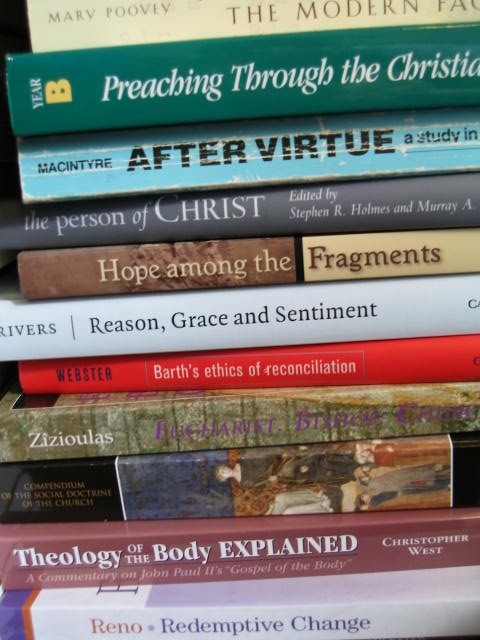
Christianity is an apprenticeship. All professions - law, medicine, football - require apprenticeships, which involve their own craft skills and vocabulary. The logic of the practices peculiar to each of these cannot be seen immediately seen by the public. Nevertheless we do not demand that each specialism speaks only some neutral language in which all their judgments are completely accessible in the public domain. But it is part of our modern narrative that we should speak only neutral language and that we need no apprenticeship: we can know, everything, immediately, without effort.
Christians say that the Christian life is learned and lived like any other vocation or career, with the same element of adventure, which means that its path is not entirely clear from the outset. In fact they say this is how any life, not just the Christian life, is – everything requires training which means that nothing is immediate or effort-free. This means that the Christian hermeneutic is more sophisticated than the modern hermeneutic of immediacy, which wants us to believe that nothing has to be learned and that life doesn't require any particular skills.
The package of Christian doctrine, which constitutes the Christian apprenticeship, has been taken apart in modern period and some of its components have been re-connected to re-create old Hellenic arrangement of two worlds, in which the world of the individual is prior to the public and political world. This arrangement does not concede that the individual gives or receives anything in his encounter with others, so we appear to have no real stake in other people. We are reluctant to concede that we are beings in time, or that we are really committed to the toil and change that comes with life with other people. Here Christian theology, particularly in its patristic and Eastern Orthodox expression, can contribute decisively. It can show that Christians have an alternative way of regarding the world, a sophisticated ontology which factors in hope. They say that God is making the world more real, and that the ordinary environment of people and things is in process of becoming more vivid, more solid, engaged and interactive. This is what I have learned represented by Orthodox theology. Since catholicity alone says that we cannot leave out the insight of half the Church, though the Eastern tradition may not be better, its difference from our own helps us to see how we may better hold together what we have inherited from Augustine, and prevent it from being purloined by the champions of autonomy who want us to believe that life requires no skills and that we should therefore do without this, or any, apprenticeship.
Solly is reading Chapter Three of The Eschatological Economy. Here is a snippet of his commentary:
'It needs a reminder here that for Knight the idea that sacrifice means 'making holy' comes in part from the Latin roots of the English word 'sacrifice'. It is necessary to see that this is also how the practice appears in scripture of course, supplemented by such insights of the practice that anthropologists can supply us with. Sacrifice is here presented not only as the work of the Israelite, but the work of God on the Israelite, of making him a son, of making him a person.
Knight returns to the modern sensitivities to the notion of vicarious and substitutionary action, as exemplified in Kant's philosophy of religion, and how this encapsulates in nuce the economy of modernity's understanding of individuality, and resistance to the idea of relationism. You cannot do something for me, in my place, A is A, and A is not not-A.
Given, Knight explains, modern theology's appropriating this position, and the con-joined idea that we are already persons [though really only individuals] then that explains the difficulties found with the doctrine that we are God's work, our becoming is basic, not our being. Existentialism expressed that garishness and angst of this position, of man no longer in relation with man, but isolated in spheres of completeness, yet knowing it was not really so. R R Reno Redemptive Change: Atonement and the Christian Cure of the Soul has also criticised modern thought for its inability to propound a doctrine of personal and moral change when it also holds to an idea of humanity that does not need change, each individual is complete in themself.'
Solly's commentary is a model of clarity. I am beginning to wish he had intervened a bit earlier, when the book was still a-writing. Here is more of Solly's analysis of this Israel-and-Adam Christology.

I have put my Introduction to John Zizioulas over on the Resources website, since it is too long to post here. It is my best shot at saying what we may learn from the Eastern Church, what makes Zizioulas a great exponent of the Eastern tradition, and why he has not been particularly well understood by us Westerners. I deal briefly with person and individual, monarchy and communion, eschatology and history, Christ and the Spirit , bishop and people, and catholicity and ecumenism – all your favourite issues. And as ever I would be grateful for your comments.
It starts like this:
John Zizioulas is one of the best known theologians of the contemporary Orthodox Church, a central figure of the ecumenical scene and one of the most cited theologians at work today. This volume demonstrates the unity of Zizioulas’ work by setting out the connections he has established between theology, philosophy and the community of the Church. Zizioulas’ central concern is human freedom, and his work offers a radical discussion of the relationship between freedom and community. Freedom is not restricted, but enabled, by our relationships with other persons, Zizioulas argues, for the community in which God includes us is the place in which our personal identity and freedom come into being. God is intrinsically communion and free, and his communion and freedom he shares with us. The Father, Son and Holy Spirit are the source of the communion of the universal Church, and the promise of real freedom for the world. This communion is being actualized by God in the community of the Church. The persons gathered into this communion will participate in the freedom of God, and through them the world will participate in this freedom too.
I have just discovered Katherine Sonderegger That Jesus Christ Was Born a Jew: Karl Barth's ‘Doctrine of Israel’ (Penn State 1992). I don’t know why it has taken me so long to get my hands on this book, since I was dimly aware of the title. It might save Solly and me a lot of work on the Christ and Israel issue. You can read sections of it on Google Book Search. You probably knew all this already - I am often the last to find out about these things. But did you know that Katherine Sonderegger will be in the UK, at the Society for the Study of Theology conference at Leeds 4-6 April 2006?
Robert Jenson has been talking about the atonement at the Center for Theological Inquiry at Princeton. Over at Generous Orthodoxy Kevin Hector has been taking notes.
Jenson insists … ‘that the crucifixion is a sacrifice …an enacted prayer for the forgiveness of sins; in the crucifixion, Christ prays that the Father would forgive our sins, and he enacts this prayer in his self-sacrifice.’
I think we get a little further by saying that it was a labour, rather than a (self-)sacrifice. Christ is at work: he is bringing us into existence, and into life and into freedom, to the point at which we develop our own voices with which we can freely acknowledge this work of God and acknowledge all others as his creatures and be glad about them.
The ‘sacrifice’ approach works when we link it to Jenson’s view that Christ speaks everything into existence, and everything becomes what Christ says it is, when it is vindicated and received by the Father - ‘The resurrection, on this account, is the Father's acceptance of this prayer for us.’ This is a theology of the Word, or of promise, learned from Luther, that works as a speech-act theory. Christ speaks up for us, intercedes for us (Augustine provides plenty of support for this) and so we come to participate in Christ’s being and action. It is wonderful stuff. You can find something similar in TF Torrance’s Royal Priesthood, neglected, out of print, but absolutely priceless.
‘Christ's there-and-then work can have an effect on us, accordingly, in the same way that my prayer for others can have an effect on them.’ – there, you see, it is speech that does work – and the work it does is make us holy (which is what terms like sanctification, sacrament, sacrifice all point to).
You can’t beat Jenson for a sound bite:
‘What would we say about God, the world, and humanity if we matched our metaphysics to the Gospel, rather than the Gospel to our metaphysics?’
A life investigating this question would be a life well spent
This is actually quite a Christologically focussed chapter, despite the title, and brings together the idea of what it means to be a son of Israel, as well as God's Son, not only as Israel, but also as Christ. Knight also brings in an Adam Christology, a theme found in scripture but, he believes, not utilised to the maximum benefit, and proposes a new lease of life for adoptionist language in line with his thesis that 'doing makes being', 'becoming' precedes rather than flows from 'being'. The question is then asked, What the work of the Son is, and this brings in the idea of sacrifice, and discussion about theories of atonement, and the modern rejection of vicarious and substitutionary actions.
His concern in the opening of this chapter is whether his theological proposals are backed up by biblical studies; can the text support the weight put upon it. Adam Christology is the scriptural theme he uses to draw the various threads of his thought together:
Solly gives you more analysis of the relationship of this Israel-Adam Christology.
[I have shortened Alan Brownâ??s response to Vincent Rossi. You can see Alanâ??s whole reply in the comments to Vincent Rossiâ??s piece â??Participationâ??]
â??For Maximus, communion means precisely mystagogy, and mystagogy means initiation into and participation in the Great Mystery, and the Great Mystery is the Incarnation of the Logos, One of the Holy Trinity, through which, by perchoresis or reciprocal indwelling, human beings may be deified and all nature transfigured.â??
It is nice that Mr Rossi knows the meaning of Ï?εÏ?ιÏ?Ï?Ï?ηÏ?ιÏ?. However, he does not seem to be aware of the difference between μÏ?Ï?Ï?αγÏ?γία, which means the leading-into the mystery that is communion, and communion itself. (This is evident from the two occurrences of the term μÏ?Ï?Ï?αγÏ?γία in the Mystagogy, both of which occur in ch. 2 of the text.)
Mr Rossi continues: â??We have heard a lot about â??relational ontologyâ?? over the past decade or so. St. Maximosâ?? ontology is the authentic relational ontology of patristic Orthodoxyâ??.
Such talk of â??relational ontologyâ??, however, is likewise vacuous (as is of course the meaningless term â??authenticâ??). Certainly for Maximus, neither communion nor participation (which are not simply synonymous) fall within the category of relation. For participation in the Logos is constitutive of the being of things, whilst communion actualises the identity (Ï?αÏ?Ï?Ï?Ï?ηÏ?) of all things - something not true of relation. Possibly, Mr Rossi means to say this by the language of relation. However, his language â?¦ seems to betray aâ?¦ commitment to a univocal ontology of the entity, according to which different entities can only have ontological connection through the category of relation. Such is typical of Roman Catholic scholastic interpretation of St Maximus. After this, Mr Rossi commits himself (and Maximus) to belief in â??the timeless essence of beingsâ??. Again, this is â?¦ betrays a foreign ontology to that of St Maximus. For, according to our Holy Father in God, all being apart from God is temporal, so that the essence of any created being is the essence of a temporal being. As such, temporality is intrinsic to the essence of any such being - for the essence has real existence only in a temporal being. Here it seems to me that Mr Rossi betrays unthinking commitment to a modernist Neoscholastic understanding of essence.
Moreover, his equation of â??substance-languageâ?? with â??hellenismâ?? is disingenuous. Maximus has no doctrine of â??substanceâ?? at all. Î?Ï?Ï?ία means â??beingâ?? (participle) and does not possess the same meaning as â??substanceâ?? at any stage in the history of that term, from Cicero onwards. Again, it is unhelpful to assimilate Maximusâ?? thought to the conceptual structures of scholasticism. And there is nothing hellenic about the notion of being.
After this, we read Mr Rossi speaking of â??an ontology that grounds the unity, union and communion of the Uncreated and the created in the everpresent hypostatic reality of Christâ??s Godmanhood and the everpresent energetic grace of the Life-giving Holy Spirit.â??
Here we note with unease the use of Solovievâ??s term â??Godmanhoodâ??. Perhaps Mr Rossi could explain why he thinks it appropriate to correlate conceptually Maximusâ?? thought with that of nineteenth-century Russian religious philosophy? He critiques Zizioulasâ?? interpretation of Maximus by assimilating Maximusâ?? thought to that of Soloviev.

It dares the thought that, if Barth is right, the Bible understood the Enlightenment better than it understood the Bible, and, indeed, better than the Enlightenment understood itself: according to its own canons of inquiry it ought not to have lost faith with the Bible in the way that it did.
This is the blurb for Neil Macdonald Karl Barth and the Strange New World Within the Bible: Barth, Wittgenstein, and the Metadilemmas of the Enlightenment
My own vicar (rector, actually) does not like to lead. He does not see his ministry in terms of leadership, but in terms of enabling. But being an enabler or facilitator does not mean not leading: leading is exactly what facilitating is. Is it really such a great paradox, that some ministry (that is some Christian servanthood) takes the form of leadership? He serves us by giving us a lead, he is set over us because he is our servant.
Of course, in some way he is leading us just by saying that he is not leading us. He corrects when we come to him with what he sees as wrongly prescriptive requests. He is leading, but denying it. This distorts the relationship between us, taking away removing the language by which we can appeal to one another for aid and support and leadership. We have to intercede with our clergy and beg them to take our needs seriously. We really do need to hear from Christ, and they really are the ones appointed for this purpose. They promised to do this for us in their ordination vows, and repeated it when they were licensed.
Let us remind them in our prayers that they do not now need any extra permission to do this. But let us tell them often that we give them this permission, and encourage them to lead and teach and train us in the whole discipleship package of Christ.
Who is it that they are looking over their shoulder at? Who is it who has more appeal to them than us? Who is it carries more authority with them? It is of course the liberal elite outside the Church, who deride the Christian faith, that our clergy are listening to and want affirmation from. So then let us raise our voices to make them louder and gladder, and more desperate and importunate, than all these other voices.
Today we have to take into account that there is a variety of views and differences among Christians as to how reception operates. It is also peculiar to our actual situation that the divided Churches are called to receive from one another or indeed to receive one another, which raises all sorts of fundamental ecclesiological questions, since the highest form of reception in this context is that of mutual ecclesial recognition and not simply agreement on doctrine.
The notion and experience of reception is deeply rooted in the historical origins and the very being of the Church. The Church was born out of a process of reception and has grown and existed through reception. The Church receives: she receives from God through Christ in the Holy Spirit; but she receives also from the world, its history, its culture, even its tragic and sinful experiences and failures, for she is the body of the crucified Lord who takes upon himself the sins of the world.
The second aspect is that the Church is received: this involves two points; on the one hand the Church as a distinct community within the world exists in constant dialogue with whatever constitutes the ‘non-ecclesial’ realm, in an attempt to make herself acceptable to the world. What we used to call ‘mission’ is better rendered with the notion of reception, because ‘mission’ is loaded with ideas of aggressiveness, whereas the Church should be offering herself to the world for reception instead of imposing herself on it. (It is interesting that in the prologue of the Fourth Gospel the Son of God is spoken of as not having been received by the world: his own did not receive him).
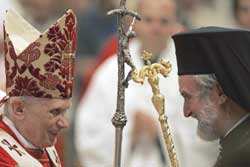
The other point in the Church’s being received is that of a reception of one Church by another Church – a most important aspect of reception, stems from the basic ecclesiological fact that the Church, although one, exists as Churches (in the plural), and these Churches exist as One Church in and through constantly receiving one another as sister Churches.
What is received in the first place, and also in the final analysis, is the love of God the Father incarnate in his own unique and beloved Son and given to us in Holy Spirit. The Church exists in order to give what she has received as the love of God for the world. Because the content of reception is this love of God for the world incarnate in Christ, St Paul uses the technical term (and it is technical) of parelabon and paralabete with reference to the person of Our Lord. In Colossians 2.6 he writes ‘as you have received Christ.’ Equally it is interesting that in Hebrews 12.28 the verb ‘to receive’ is used in the sense of ‘receiving the kingdom’. Reception is not a dry, practical idea.
John Zizioulas The Theological problem of Reception
Solly is right: ‘When YHWH said to Israel 'I am your redeemer' this is not a past tense statement.’ The relationship is live and ongoing (for God is faithful) and Israel is not Israel apart from God’s faithfulness. Israel is always re-supplied with her identity by God. Here is how I introduced the subject:
The doctrine of the election of Israel, and thus of the Jewish people, returned to the centre of dogmatics in the twentieth century, in large part due to Karl Barth. He insisted that God is faithful, and worthy of trust, to the extent that he keeps his promise to this people. Barth’s recovery of typology, in the form of pairs of election-rejection, man-woman and Jew-Gentile, made possible the recovery of the whole Old Testament for christology. But Barth contrasted the pairs of types he identified in the Old Testament, one of which stands for election, the other for rejection. What will prevent these becoming static, and creating two opposing sorts of people? Only the Spirit, God himself, can make one people out of two. So Jesus Christ is the rejected and the elected man. But the power of Jesus Christ is an abstraction if it is not bound to the act of a particular community. Barth avoids an abstraction from Christ, Eugene Rogers believes, but he abstracts from the Spirit (‘Supplementing Barth on Jews and Gender’ Modern Theology 14, 1998). Though God has a particular relationship with Israel, Barth cannot say what that is, because he does not show that God's relationship to the Jewish people is ongoing. The ‘Old Testament in abstracto’ for Barth, is the ‘passing’ form of the human being. Then the people of Israel, the Jewish people, is just a shadow that gives way to the coming community, a different community. Rogers argues that Barth has allowed us to believe that the people of Israel are no longer led by the Spirit of God; the Synagogue is what human beings need to be saved from. Barth has re-established the centrality of the election of the people of Israel, while also seeming to suggest that Israel is replaced by the Christian community. Robert Jenson offers a solution to the problem . He proposes that to Barth's phrase ‘Jesus Christ is the electing God’, we add that ‘the Holy Spirit is the electing God’. Rogers agrees that we must supplement each of Barth’s contrasted types with the Spirit as their third term. It is not individuals that correspond to types, but community, this specific community, that is elect. We should then identify God not by focusing on Jesus Christ as individual, but on Jesus and the community the Holy Spirit gives to him. By doing so we refuse to abstract from God's concrete self-determination to be for Israel.
Much of this is paraphrase of Eugene Rogers. But it is Robert Jenson who has been leading the way here, but when he talks about Israel jenson is talking about God and the future of all humankind, not picking winners in the Middle East conflict. We talk about Israel in order to talk faithfully about Christ and his witnesses, the patriarchs, prophets and people. The people of Christ are first (and by the generosity of God) the people of Israel, and second (by the truly surprising generosity of God) all the others, the rest of us, the gentiles. When we talk about Christ we must do so from the resurrection, Christ vindicated and glorified, so Christ with his people added to him – the whole Christ. Christ is many and one: we do not make him many, he makes us many. Christ is not first an individual to whom the subsequent arrival of his people represents company he didnt have before: rather he is communion intrinsically, and in him (his communion) we become distinct and particular persons, a great company of us, made plural by him. To put it at it strongest – Christ is the Church before the Church is, and Christ is the people of Israel before the people of Israel are. I try to link all this to the New perspective on Paul later in this chapter. Meanwhile, Christ is risen, while we are not yet risen, but can only look forward to the completion of his resurrection, by which we will be joined to him.
Solly's phrase for all this eschatology is: God's work in Christ is the great reverse engineering of the Cosmos.
To show that persons come from God, we have to link a number of Christian doctrines. We have to show that persons come into being through other persons, and that they therefore come into being as they come into relationship with other people, making their appearance in the great assembly of all persons. We come into being as we become distinct and particular persons. Being a body – flesh, in the biblical term – is the means by which we are available to one another. Then we have to say that we become particular persons as we grow into one very particular sort of human being, that comes from exactly one human being, Jesus Christ. All human being is sourced from Jesus Christ and given its definition by him, so he is the criterion of humanity, and therefore of what it is to be a particular human, present to the rest of us as a particular body. This means that our being as persons is not given to us complete at birth, but is part of a process, caused by the Holy Spirit, which unfolds through time. As we are sanctified we become more human, more responsive and available to God, and through God to one another, and so we become real. This happens to us when we properly identify God, from whom all persons come, and praise him for them.
On this definition, becoming human is about becoming better able to concede the otherness of other people. We come to be ourselves by properly seeing people for who they are and who they will be, attributing to them the distinctiveness that God is giving them. Our ability properly to respect others, giving them neither too little nor much recognition, is itself given to us by God. The worship of God allows us to see others as his creatures, and thus to understand that they are ours only because they are first his. By this act of worship we are witnesses of the act by which they are called first into existence and then into their full future stature. We not only see them for what they are, but in the Holy Spirit we contribute to making them what they will be. Worship of the true God is decisive in letting others become freely human, and only this allows us to grow into our own full stature.
You know what a shirker I am when it comes to prayer. But thanks to the persistence of mates who tell me to pray - and to give thanks - I think I am beginning to get it. After all, we always have to ask people for whatever we want, and ask them many times. I pester people for things. And so it is with those God has set over us. We have to ask them for what we want, and we have to persist, and not to change our minds. Our leaders need that constant drip, drip of our requests for more of everything – and most of all, for more Christ. We have to nag them to teach us and to act like they are responsible for us.
I get nagged too, though I am not set over anybody. Wai Luen sends me his papers to read, and once a month he emails me a single line, saying something like, ‘Well, you lazy Englishman, have you read my paper yet and are you going to respond to it at last?’ Wai Luen is smart. He gave us a little yellow blanket, very soft, that lines Michael’s buggy. I look at that blanket every time I take Michael out for a walk so I think of Wai Luen three times daily. That blanket is a kind of intercessory flag, that intercedes for its giver and it accuses me to God for my neglect of Wai Luen, and oh, well, a list of others, who came to London to study but who have been abandoned here without teaching, supervision or support. All their voices go to God. Will the English and the deaf theology departments of their irresponsible universities crack under this pressure?
The Christian political tradition represents one side of a conversation. The gospel is in conversation and confrontation with pagan thought. In part at least, modernity is pagan, so pagan thought must be the other half of the conversation. Or rather not pagan thought, but pagan practice, the practices of captivity, sloth and compulsion must be the other half of the conversation. Pagan practice cannot be opened to us by pagan thought alone. Only the Scriptures can reveal pagan thought to us as pagan, as that which is present temptation to us, and indeed as our own present practice. The bible is the Scriptures of the Church, not of the West: the Church is not the West, but only the leaven of the West.
The pagan practices most constitutive for modernity are represented by the political philosophy of the ancient world rediscovered in the sixteenth and seventeenth centuries, which Kant formalised into the modern political-and-epistemological separation of powers. This is the effective scripture of the modern West. It has brought about the division and reduction of public discourse into the techniques of our withdrawal into ever smaller spheres of selfhood. The West attempts to lay aside the tools by which its own version of its history can be challenged. We must ask whether, in response, God has withdrawn the Scriptures from the West, with the result that the bible is quite closed to us, held closed by God.

You know I never read books (from idleness, not principle), but if I ever did I would take a peek inside this one:
Alexandru Popescu Petre Tutea Between Sacrifice and Suicide
Here is Ashgate's description of the book
Petre Tutea (1902-91) was one of the outstanding Christian dissident intellectuals of the Communist era in Eastern Europe. Revered as a saint by some, he spent thirteen years as a prisoner of conscience and twenty-eight years under house arrest at the hands of the Securitate. This book explores his unique response to the horrors of torture and 're-education' and reveals the experience of a whole generation detained in the political prisons. Tutea’s understanding of human needs and how they can be fulfilled even amidst extreme adversity not only reflects huge learning and great brilliance of mind, but also offers a spiritual vision grounded in personal experience of the Romanian Gulag. Following the fall of the Ceausescus, he has begun to emerge as a significant contributor to ecumenical Christian discourse and to understanding of wider issues of truth and reconciliation in the contemporary world. As Tutea's pupil and scribe for twelve years, as a psychiatrist, and as a theologian, Alexandru Popescu is uniquely placed to present the work of this twentieth-century Confessor of the faith. Drawing on bibliographical sources which include unpublished or censored manuscripts and personal conversations with Tutea and with other prisoners of conscience in Romania, Popescu presents extensive translations of Tutea, which make his thought accessible to the English-speaking reader for the first time. Through his stature as a human being and his authority as a thinker, Petre Tutea challenges us to question many of our assumptions. The choice he presents between ‘sacrifice’ and ‘moral suicide’ focuses us on the very essence of religion and human personhood. Resisting any ultimate separation of theology and spirituality, his work affirms hope and love as the sole ground upon which truth can be based. At the same time, hope and love are not mere ideal emotions, but are known and lived in engagement with the real world - in politics, economics, science, ecology, and the arts, and in participation in the Divine Liturgy that is at once the traditional offering of the Church and the cosmic drama of the incarnate Word.
Ashgate also quotes some powerful commendations
Here is a wonderful response to the 'By grace and participation' post (below) from Vincent Rossi:
As a student of St. Maximos the Confessor for 20 years, and particularly of the Mystagogia, I would say that it is precisely the first paragraph quoted of Chapter 24, which you say is â??hard to takeâ??, that is absolutely essential for an understanding of the work, focus, theological method, metaphysical depth and spiritual vision of the Confessor. Without understanding what he is doing theologically in that first paragraph of Chapter 24, which sums up what he articulates in Chapters 1 through 7 of the Mystagogia, one can have only the vaguest and most superficial understanding of what Maximos means by that all important word â??participationâ?? (Gr: methexis, metousia). For Maximos, communion means precisely mystagogy, and mystagogy means initiation into and participation in the Great Mystery, and the Great Mystery is the Incarnation of the Logos, One of the Holy Trinity, through which, by perchoresis or reciprocal indwelling, human beings may be deified and all nature transfigured. We have heard a lot about â??relational ontologyâ?? over the past decade or so. St. Maximosâ?? ontology is the authentic relational ontology of patristic Orthodoxy, but more precisely it is a Trinitarian, liturgical, doxological, perichoretic ontology, one that is neither Hellenic nor Hebraic, that is, neither downplaying the timeless essence of beings because of the supposed â??hellenismâ?? of substance-language, nor overly privileging the eschatological dimension because of its hebraic scriptural basis, an ontology that grounds the unity, union and communion of the Uncreated and the created in the everpresent hypostatic reality of Christâ??s Godmanhood and the everpresent energetic grace of the Life-giving Holy Spirit. It may well be true that Zizioulas learned everything he knows from Maximos, but it does not necessarily follow that everything Zizioulas says about Maximos is true. Anyone who seeks truly to learn in St. Maximosâ?? school had better wear his presuppositions lightly and, yes, be prepared to be humbled.
When we celebrate the eucharist we must start sending some eucharistic bread round to every other church in the area. We should send our bishop to knock on the door of every congregation in the borough, ask to be admitted and allowed to bring them some bread, wine (not consecrated, but blessed) and a little encouragement from us. Yes, that’s right, he must go to every denomination, which means other denominations, those which do not recognise his authority. If they admit him they admit us, and so start to recognise the catholicity of the church – which means that we cannot be Church without them, and they cannot be Church without us, and that we represent a proper discipline on each other. Of course he must walk, all right, take the bus, and of course he must wear his robes and take his crozier, and stand outside each Church and knock. He must offer himself to those who did not ask for him. He must beg to be received and heard by them, and to be encouraged and taught by them, and he must bring back to us what he has learned from them. He has to beg their forgiveness for our separation and aloofness, and in our name he has to forgive them for separating themselves from us. He has to teach and correct them, warn them of the results of their separation, and he has to receive their teaching and correction, and together with them look forward to the day when we can celebrate together at last. Every eucharist looks forward to this and every exchange of the peace anticipates this. Obvious, isn’t it?
Thank God for friends. They are always trying to get my education started again, particularly Alan, who mailed yesterday:
‘Have you read Maximus' Mystagogia (ET in Berthold's Classics of Western Spirituality edn.) - absolutely superb, esp. ch 24 which is the ecclesiastical exterminator of all Thomist-Aristotelian understandings of communion.’
When he comes I will ask Alan what ‘the ecclesiastical exterminator of all Thomist-Aristotelian understandings of communion’ means. But meanwhile, here is Maximus, summing up what he has said in The Church’s Mystagogy. The first paragraph is not easy to take, but the second is just extraordinary. Just hang onto this little phrase: ‘by grace and participation’:

The holy Church, we said, is the figure and image of God, inasmuch as through it, he effects in his infinite power and wisdom an unconfused unity from the various essence of beings, attaching them to himself as a Creator at their highest point, and this operates according to the grace of faith for the faithful, joining them all to each other in one form according to a single grace and calling of faith, the active and virtuous ones in a single identity of will, the contemplative and gnostic ones in an unbroken and undivided concord as well. It is figure of both the spiritual and sensible world, with the sanctuary as symbol of the intelligible world and the nave as symbol of the world of sense. Sons are the ones who out of neither fear of threat nor desire of promised things but rather out of character and habit of the voluntary inclination and disposition of the soul towards the good never become separated from God, as that son to whom it was said ‘Son, you are always with me, and everything I have is yours.’
For if the Word has shown that the one who is in need of having good done to him is God – for as long, he tells as, as you did it for one of these least ones, you did it for me – on God's very word, then, he will much more show that the one who can do good and who does it is truly God by grace and participation because he has taken on in happy imitation the energy and characteristics of God's own doing good. And if the poor man is God, it is because of God's condescension in becoming poor for us and taking upon himself by his own suffering the sufferings of each one and ‘until the end of time’, always suffering mystically out of goodness in proportion to each one’s suffering. All the more reason then will that one be God who by loving men in imitation of God heals by himself in divine fashion the hurts of those who suffer and shows that he has in his disposition, safeguarding all proportion, the same power and of saving Providence that God has.
Zizioulas learned everything he knows from Maximus, so it looks as though it is time to school with Maximus (humbling, this theology lark) and see what we can learn from him.
The Church is the visible tip of the not yet visible company of heaven. This company is held together by God, and made visible by him to us on earth. The Church understood on this eschatological definition, holds together what would otherwise drift apart. The Church sustains the world, which has no unity of its own, and so the Church represents that future in which the world will be spacious and free. In raising Jesus Christ, and calling out the Church, God has elected the human race. He has made the Church to be the body that embodies and guarantees both plurality and unity for the world. As the Church is itself the work of the Spirit, it works this priestly task of making the world one, and no part of the world is able to secure itself in unfreedom, against this end. The doctrine of creation is an eschatological doctrine that sets out the future of man as the priest of creation, a future in which he is freely with God.
I have that weird feeling you get when you put yourselves in the hands of a doctor or barber and are then under their control, not your own. I have got an interpreter and I am being interpreted to within an inch of my life. Solly is reading The Eschatological Economy and giving a running commentary on his blog, Solly Gratia. He summarises what I am saying, find labels for the positions I take, and puts everything that I say in the context of our evangelical hopes and hang-ups - and he has made me remember how I got started on the great adventure of Christian theology. As a reader he is fast, he has stamina, and above all he has insight. I went to university to do a PhD, and paid a lot of fees, for the sort of feedback and criticism I am getting from Solly. But I am getting real analysis now, into Chapter two already, and I am taking notes on Solly’s notes.
Here is how it happened. I offered a PDF of The Eschatological Economy to whoever asked. Solly asked. If you would like to see a PDF of The Eschatological Economy, just ask in the comment box here or in ‘Pages’. Your email will appear to me (though it will not appear with your comment) and I will send The Eschatological Economy for you to read – and then you can comment on Solly, and tell him he is too charitable a reader.
Lent is a recapitulation of our understanding of creation and fall, and of regeneration and sanctification.
Because Lent was seen as a season preliminary to Easter, in some older interpretations Lent was predominantly or even exclusively about the suffering and death of Jesus. Lent was the season of the cross. Period. But those serious about the pursuit of Christian history had to wrestle with the fact that Lent began as a time of final instruction and intensive preparation for baptism. Ancient lectionaries (or at least portions of them) were reconstructed and found to contain Lenten readings such as the story of the man born blind (John 9), for in the early centuries baptism with likened to the recovery of sight. This Lectionary inclusion, grounded in a very old understanding of Lent as preparation for baptism, helped to reestablish Lent in the church as a season for the consideration of the meaning of baptism as related to the new life we have in Christ, the Crucified and Risen One.
Lawrence Hall Stookey Calendar: Christ’s Time for the Church
The disciplining necessity of work foreshadows the commandment to keep the Sabbath holy. It is not the case that worship is optional. As Paul teaches in his genealogy of morals (Romans 1), the question is not whether we shall worship, but only what. Promethean fantasies of a purely human-centered existence are as difficult to realise as fantasies of aristocratic indolence. We are propelled by an inner need to bow down, and, as a consequence, unless true worship is always before us, there is always the danger that we will work feverishly in order to propitiate Baal, whether in his bloody martial form or in the bloodless image of lucre.
Fantasizing that worship will ‘just happen’. Running a Church is hard work, and illusions to the contrary feed clerical sloth, anger and despair. The same holds for lay people. I have often heard friends complain that their involvement in the Church is just ‘too much like work’. Or they complain about the regular routine of regular worship. They want the Church to be a form of leisure or entertainment, something fresh and new that will be a deliverance from the all-too-human limitations of the working day. Yet, this is not the meaning of Sabbath. The ‘rest’ of Christian worship occurs in, and not in spite of, the world and sin and death. The joy of worship addresses the bitter cup of sin.
Russell Reno 'Working towards Worship'
Advocacy of this kind certainly begins in worship, where people learn to lend their mouths to other people in principle, unasked. Advocacy does not consist primarily of spectacular actions which in general peter out quite quickly; it means speaking up ‘perseveringly’ on behalf of others, as is to be the case in intercession (Ephesians 6.18) Advocacy of this kind is not a natural ability – ‘we do not know how to pray as we ought’; it must be learnt. And the Spirit as the Parakletos, the advocate per se, represents believers (Romans 8.26) and teaches them as it does so. Advocacy must be learnt in the intercessory practice of the community, but it can also be a guide to mediation, to ‘good offices’ apart from prayer. Anyone who before God opens his mouth for the dumb can also raise his voice before the world and the powerful on behalf of the people who have no voice of their own, or whose voices are not listened to.
Bernd Wannenwetsch Political Worship
[This continues from the posting 'NT Wright - where to begin?', my response to the FD Maurice lectures, given by Tom Wright Feb-March 2006 - see below]
The Bishop of Durham:
Well, so it’s one sort of power-play (disclosing that my reading is in service of my tradition) or another sort of power-play (not disclosing it and thus being cunning). Welcome to the wonderful world of Nietzsche! The readings I am proposing are in fact often very critical of my own traditions, and I live with that tension much of the time. I think what you have your finger on is the fact that these are the FD Maurice Lectures at a half- (but not fully-)secularized department, in an increasingly (but not utterly) secularized university. In that setting, the problem of a private Christian language is very real, and I have spent my entire adult life trying to avoid such a thing (speaking only within the in-house world, rather than across the wall to the world outside)...
Knight:
Dear Bishop Tom,
...I began to think about you in more Church terms as a result of reading the impressive piece you addressed to your clergy on the state of play after the Windsor report. There you were talking like a Church-man and bishop. It seems to me that one can also do that to a degree in the university. I do not think that there is a simple contrast to be made between Church and secular audiences, or that well-argued Christian theology is simply a private language. When a law lecturer or medic talks in public, he or she talks like a lawyer or medic, from the assumptions, and using the conceptuality of their profession, but this does not make theirs a private language. We do not insist that they find some value-free domain and neutral language in which everything they say is instantly comprehensible to every member of the public. We are all aware of the appropriateness of the vocabulary and conceptuality of each distinct area of expertise. These two vocations require long apprenticeships: not everything can be immediately seen by the public or comprehended by those only at the beginning of that apprenticeship.
The same is true for Christian discipleship, another form of expertise. In this life, lived by faith, not everything is comprehensible all at once (Christians can point out that this is not only true of the Christian life, but of any life and lifestyle – again, demonstrating that the Christian hermeneutic is more sophisticated than the modern, not less). We argue for the truth of what we say, by demonstrating the plausibility of the Christian faith – that it is productive of real insight. This does not mean that we cannot point out that it requires an apprenticeship (indeed is an apprenticeship). We can freely concede that what Christianity is, is not entirely clear from the outset – it is an adventure.
The Christian tradition is a good tradition, and we can say this in public, and it is good for the public forum that we do so. My musings on this point are owed to the remarkable Reinhard Hütter (at Duke, ‘Suffering Divine Things, and more recently ‘Bound to be Free’) and to Bernd Wannenwetsch, who after the departure of O'Donovan and Webster is now Oxford’s finest (‘Political Worship: Ethics for Christian Citizens’ OUP 2004).
Hütter and Wannenwetsch insist that we learn through tradition (this is the point that modernity is in denial about) and that the right tradition (relating to the distinct Christian citizenship and form of life) makes us free, mature and human, reconciled by God to one another. The Christian tradition doesn't do this all at once, but it does embark us on a long hard course of paideia, in which baptism is an important milestone.
On the secular v. religious issue, one aspect of O'Donovan’s argument is crucial: the secularizing impulse is not opposed to Christian theology only, but is rubbishing the Western tradition as a whole. It not only finds Christianity problematic, it is no willing to see any part of the Western intellectual tradition (Plato, Aristotle – founders of the Academy) as a living tradition, which we have to remain in conversation with in order to flourish. This is the sort of secularizing that we are now seeing in universities. Only the Christians can point out that moderns equally talk their own in-house, private language, that by flattering us, encourages us to think of ourselves as consumers, accountable to no one. The issue is that Christians (I at least) are so well absorbed by that language of modernity that we don't forget that it is a merely sectional language, that excludes those whom God does not exclude.
Why should a bishop be reluctant to speak from the Church in the university? I only ask you this because you are a powerful advocate of the plausibility of the Christian gospel – and precisely so a (God-given) assert to the university, as much as the Church. Few enough of your colleagues can make any contribution within the university. But every bishop can remind the university that it can only aspire to be a real public square if it properly considers the claim of the Christian tradition, understood as a demanding apprenticeship.
In all this, I am not getting at you at all, but musing appreciatively, grateful for the opportunity to think these things through with you. Despite all my understatement I hope you feel my real gratitude for your life's work
Many thanks DK
[I hadn't realised what a lot of splendid teaching material there is on the NT Wright Page - see the 'Wrightsaid' pieces, for instance]