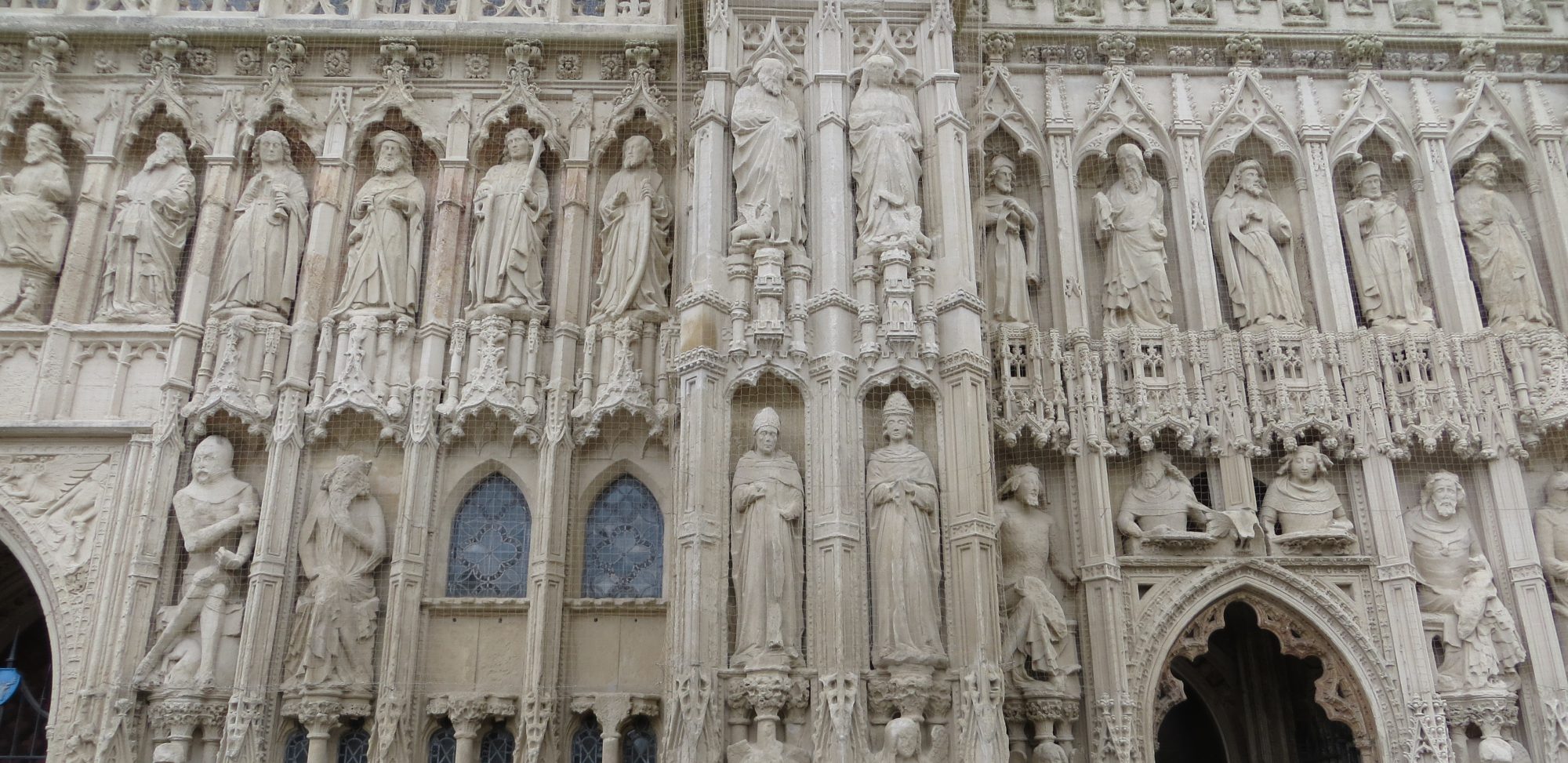
God on earth, man in heaven; and all became mingled together

Brothers, Sisters and beloved Children in the Lord,

The human mind finds it difficult to comprehend the immense change the Birth of Christ brought about in the world. He who was born in the manger of Bethlehem was not an ordinary child like the ones that are born every day. He is the Creator of the entire universe, come down to our level, in order to lift up His creature and restore him to the heights from which he had fallen.

According to the plan of the Creator, which is full of love, man was created with the capacity to achieve divinity. Due to his own failings, however, he strayed from the right path and became enslaved to decay and death. In order to restore to man the potential to become divine, God had to become incarnate, to take on flesh, for the sake of fallen, perishable and sinful man who, being a creature of earth, could not by his own means transcend his mortal nature and become like God.

The idea of God's incarnation was something that not even the most vivid human imagination could come up with; no one dared even to consider this unexpected event as a possibility. Only the Prophets, inspired by the Holy Spirit, prophesized that such occurrence would be possible through God. Indeed, the night of Christmas, the unexpected became real. "God [is] on earth, man in heaven", exclaims St. John Chrysostom in admiration.

This world-altering event is not irrelevant to our life. Its significance is not exhausted in the fleeting celebratory festivities. We ought to contemplate the new situation with great seriousness. The Birth of Christ gives us the opportunity to transcend our mortality, ascend to heaven, live with Christ, be reconciled to God, enjoy His adoption, live in the inexhaustible joy of His love unto the ages.

Let us celebrate spiritually the grace of God offered to man together with the Angels and Saints, and let us begin a new life, worthy of the calling of the Incarnate God. The stirring event of Christ’s Birth, although it occurred inconspicuously and humbly, has caused immense changes to the Universe and particularly to the future of each person. We should take care not to undervalue its importance, simply because it took place in historically humble and simple circumstances. Nor should we celebrate the event in a boisterous and superficial manner that would befit a seasonal celebration that had no other significance for our life beyond providing an opportunity for secular revelry.

Although the events surrounding the Birth of our Lord Jesus Christ are not visible by our mortal human eyes, there are some who, by the grace of God, have seen and described the deeper events and the resulting mystical change of the world. Here is how our saintly predecessor on the Patriarchal Throne, John Chrysostom describes this sacred event, dazzled by what he has perceived:

"Angels joined the choirs of men, men had fellowship with the angels and with the other celestial powers; and one might see … reconciliation made between God and our nature, the devil brought to shame, demons in flight, death destroyed, Paradise open, the curse eradicated, sin done away with, error driven off, truth returning, the word of piety everywhere sown and flourishing in its growth, the heavenly City planted on earth, angels continually brought to the earth and abundant hope for things to come" (P.G. 57, 15-16).

Children, brothers and sisters, may we see this very hope for things to come realized in our life through the prayers of great Saint John Chrysostom, who intercedes before us to the Lord in heaven together with all the Saints. This coming year will mark the sixteen hundredth anniversary of the falling asleep in the Lord of this Saint, and thus, the Ecumenical Patriarchate proclaims this to be the year of Saint John Chrysostom, so that we may give the urge to the faithful to study his work and more closely examine his life.

Brothers and Sisters! Christ is born: glorify Him! Christ is come from heaven: go to meet Him! Christ is on earth: be lifted up! To this God who so loves mankind that He was born for us in the flesh at Christmas, be the honor, the thanksgiving, the glory and the worship unto the ages of ages. Amen.

Ecumenical Patriarch Bartholomew Patriarchal Proclamation Upon the Feast of the Christmas 2006
Communion and Otherness

Communion and Otherness

Metropolitan John Zizioulas’ earlier work, Being as Communion, has a fair claim to be one of the most influential theological books of the later twentieth century; it had a lasting effect on ecumenical discussions and on the vocabulary and assumptions of many churches as they sought to clarify their self-understanding and indeed their understanding of ordained ministry. But what Zizioulas had to say about the church was firmly anchored in a set of arguments about what we mean about the word ‘God’, and how our understanding of being itself had to be wholly informed by our understanding of God. In the following pages, these reflections are worked out at greater and greater depth, producing finally a comprehensive model for the whole of Christian theology.

This book is, in effect, a systematic theology, though it is not structured like one. But it is also a work of apologetics in its way. Zizioulas mounts a formidable challenge to atheism by affirming very simply that it is meaningless to discuss ‘whether or not’ God exists in abstraction from the question of ‘how’ God exists. To ask whether God exists is really to ask about what the relations are that you can recognise yourself as involved in – because God is irreducibly a living complex of relation, Father, Son and Holy Spirit. But this complex is not just a given plurality, it is the work of freedom – the Father’s personal liberty and love generate the inseparable Other, the eternal Son, and ‘breathe out’ the eternal Spirit. The Father is never alone, nor is the Father simply one among three divine beings alongside each other; it is his absolute freedom to be completely for and in the Other that is the root and rationale of Trinitarian life. And this utter freedom for the Other becomes the insight that allow us to make sense of the freedom of creation, with all that this implies...

On page after page of this outstanding book our assumptions are challenged and our minds led back to the most deeply significant aspects of the Christian faith, and to the conceptual and practical map drawn not only in Scripture but in the Greek Fathers, including the Fathers of the desert and their teaching on practice and prayer. The discussion of what is implied in classical Christological statement is of special note; so is the chapter on the Spirit. But insights abound, into death and sexuality, individualism and postmodernity, prayer and ecology. Zizioulas engages boldly with different strands of modern philosophy, refuting most effectively the idea that he is simply recycling some kind of existentialism or secular personalism, and offering a deeply suggestive religion and correction of Levinas on the Other as fundamental for ethics.

Few will read this book without sensing that they have been invited to rediscover Christianity in its richest traditional form….

A great book and a converting one, which reintroduces us to the essential Christian conviction that there is no life without relation with God, as God himself is eternally life in and only in the relations initiated by the free love of God the Father, generating the everlasting Son in whom and for whom all things exist, growing into their fullest possible connectedness with God through the gift of the Spirit’s presence.

Archbishop Rowan Williams' Foreword to Communion and Otherness by John Zizioulas

The assurance of friendship

One of the most chilling things on this journey to the Holy Land was the almost total absence in both major communities of any belief that there was a political solution to hand. So step back from that for a moment and ask, â??What do both the communities in the Holy Land ask from us â?? not just from that convenient abstraction, the â??international communityâ??, but from you and me?â?? Both deserve the best; and the best we can give them in such circumstances is at least the assurance of friendship. Go and see, go and listen; let them know, Israelis and Palestinians alike, that they will be heard and not forgotten. Both communities in their different ways dread â??with good reason â?? a future in which they will be allowed to disappear while the world looks elsewhere. The beginning of some confidence in the possibility of a future is the assurance that there are enough people in the world committed to not looking away and pretending it isnâ??t happening. It may not sound like a great deal, but it is open to all of us to do; and without friendship, it isnâ??t possible to ask of both communities the hard questions that have to be asked, the questions about the killing of the innocent and the brutal rejection of each otherâ??s dignity and liberty.

Archbishop Rowan Williams The Poor deserve the best Christmas sermon

Ten theses on the Significance of the Episcopal Office for the Communion of the Church

Thesis One:

The Bishop serves the koinonia of the gospel into which the baptised are incorporated by God the Holy Spirit

Through the gospel God calls all people into relationship and establishes a covenant of love, mercy and justice. By baptism the people of God become participants in the visible body of Jesus Christ. The bishop is called to serve this new fellowship by actively fostering the koinonia of the Body of Christ. Just as the eucharist is the focal event which connects communities of faith together so the bishop is the focal person who links communities of faith not only to one another but to the wider Church. As a result the bishop has a universal and ecumenical role. This fundamental theological truth challenges all parochial conceptions of the episcopate that fail to transcend ethnic, social, and cultural realities in which the episcopate is, by nature, necessarily embedded.

Bishops of the Anglican Communion have primary responsibility for Anglicans. However, the nature of the episcopal office means that bishops are called to lead the Church towards a deeper koinonia amongst all God’s people, and in so doing represent the wider Christian community to the diocese. This universal and ecumenical ministry belongs to the bishop’s role as a symbol of unity. Yet this symbol is ambiguous because the Church is divided and torn. In this context the bishop is a sign of a broken Church looking to its Lord for healing and hope through the power of the Spirit.

Inter Anglican Theological and Doctrinal Commission The Anglican Way: The Significance of the Episcopal Office for the Communion of the Church

The Word became flesh and lived among us

Long ago, at many times and in many ways, God spoke to our fathers by the prophets, but in these last days he has spoken to us by his Son, whom he appointed the heir of all things, through whom also he created the world. He is the radiance of the glory of God and the exact imprint of his nature, and he upholds the universe by the word of his power. After making purification for sins, he sat down at the right hand of the Majesty on high, having become as much superior to angels as the name he has inherited is more excellent than theirs.

For to which of the angels did God ever say, â??You are my Son, today I have begotten youâ??? Or again, â??I will be to him a father, and he shall be to me a sonâ???

And again, when he brings the firstborn into the world, he says, â??Let all God's angels worship him.â?? Of the angels he says, â??He makes his angels winds, and his ministers a flame of fire.â?? But of the Son he says, â??Your throne, O God, is forever and ever, the scepter of uprightness is the scepter of your kingdom. 9 You have loved righteousness and hated wickedness; therefore God, your God, has anointed you with the oil of gladness beyond your companions.â??

And, â??You, Lord, laid the foundation of the earth in the beginning, and the heavens are the work of your hands; they will perish, but you remain; they will all wear out like a garment, like a robe you will roll them up, like a garment they will be changed. But you are the same, and your years will have no end.â??

Hebrews 1.1-12

In the beginning was the Word, and the Word was with God, and the Word was God. He was in the beginning with God. All things came into being through him, and without him not one thing came into being. What has come into being in him was life, and the life was the light of all people. The light shines in the darkness, and the darkness did not overcome it.

There was a man sent from God, whose name was John. He came as a witness to testify to the light, so that all might believe through him. He himself was not the light, but he came to testify to the light. The true light, which enlightens everyone, was coming into the world. He was in the world, and the world came into being through him; yet the world did not know him. He came to what was his own, and his own people did not accept him. But to all who received him, who believed in his name, he gave power to become children of God, who were born, not of blood or of the will of the flesh or of the will of man, but of God. And the Word became flesh and lived among us, and we have seen his glory, the glory as of a father's only son, full of grace and truth.

The Gospel of John 1. 1-14

Saint Mary Stoke Newington

How Should We Worship?

Because it is often all too obvious that historical knowledge cannot be elevated straight into the status of a new liturgical norm, this archaeological enthusiasm was very easily combined with pastoral pragmatism: people first of all decided to eliminate everything that was not recognised as original and was thus not part of the "substance", and then they supplemented the "archaeological remains", if these still seemed insufficient, in accordance with "pastoral insights". But what is "pastoral"? The judgments made about these questions by intellectual professors were often influenced by their rationalist presuppositions and not infrequently missed the point of what really supports the life of the faithful. Thus it is that nowadays, after the Liturgy was extensively rationalised during the early phase of reform, people are eagerly seeking forms of solemnity, looking for "mystical" atmosphere and for something of the sacred. Yet because–necessarily and more and more clearly–people's judgments as to what is pastorally effective are widely divergent, the "pastoral" aspect has become the point at which "creativity" breaks in, destroying the unity of the Liturgy and very often confronting us with something deplorably banal. That is not to deny that the eucharistic Liturgy, and likewise the Liturgy of the Word, is often celebrated reverently and "beautifully", in the best sense, on the basis of people's faith. Yet since we are looking for the criteria of reform, we do also have to mention the dangers, which unfortunately in the last few decades have by no means remained just the imaginings of those traditionalists opposed to reform.

I should like to come back to the way that worship was presented, in a liturgical compendium, as a "project for reform" and, thus, as a workshop in which people are always busy at something. Different again, and yet related to this, is the suggestion by some Catholic liturgists that we should finally adapt the liturgical reform to the "anthropological turn" of modern times and construct it in an anthropocentric style. If the Liturgy appears first of all as the workshop for our activity, then what is essential is being forgotten: God. For the Liturgy is not about us, but about God. Forgetting about God is the most imminent danger of our age. As against this, the Liturgy should be setting up a sign of God's presence. Yet what happens if the habit of forgetting about God makes itself at home in the Liturgy itself and if in the Liturgy we are thinking only of ourselves? In any and every liturgical reform, and every liturgical celebration, the primacy of God should be kept in view first and foremost.

How Should We Worship? Preface to The Organic Development of the Liturgy by Alcuin Reid, O.S.B. by Joseph Cardinal Ratzinger

Theological scrutiny in service of the Communion

Anglicans value being part of a world Communion, but successive controversies have made it increasingly unclear what it is that they have in common. The contention of this document is that Anglican ‘communion’ will be maintained and nurtured, not just by preserving existing ecclesiastical structures but through a renewal of the theological tradition which brought the Communion into being.

To speak in this way of ‘renewal’ does not mean just a reinforcement of that tradition. As will be seen as the argument progresses, Anglicanism has developed by way of faithful responses to the gospel by churches facing concrete challenges in particular circumstances. At critical moments in their history they have been inspired to draw resources from their theological and spiritual inheritance which enabled them to address seemingly new situations in new ways. Such moments of renewal were eventually judged to be consistent with the tradition from which it was drawn, and generally won recognition and support from others who shared its patrimony. It is that sort of response which is required by the Anglican Communion at the present point of its history, as it faces circumstances threatening to disrupt its life and call into question the tradition itself....

A covenant, which rehearses the theological tradition from which Anglicanism has developed, and establishes clear commitments for the way it can maintain its cohesiveness, seems the most likely way to secure its communion for the foreseeable future. The one thing that Anglicans cannot permit at this time is for disputants to refuse to allow their opinion to be submitted to theological scrutiny. Those involved in disputes must not only listen to each other, but also attend to the wisdom of the wider Christian community.

The Anglican theological tradition cannot be content with any claim to communion which separates the gospel of Christ from the reality of his Church.

Inter Anglican Theological and Doctrinal Commission Summary Argument from the IATD's 'Communion Study' October 2006

Blogged

Sorry. What with the grind of term and the excitement of events this autumn I never got around to doing any actual blogging. I haven’t posted anything of my own since August. It takes me much longer to post something I have written that to post a couple of paragraphs, already polished and published, by someone else. There is no limit to the number of times I can change what I have written, and a day later it will still look like gibberish to me – to you too probably. I wasn’t born to blog, being neither spontaneous nor self-controlled enough.

But I have enjoyed everything I have posted here, in particular that Regensberg moment, but also all the rest of Pope Benedict’s wonderful teaching that the secular or public sphere depends on the church, and reason and the possibility of truthful discourse depends on the gospel. I was amazed that the British media, and British evangelicals, failed to see what was at stake here. So once again:

Fellow members of the British public square: Benedict is arguing for the public testing of ideas and all the other good practices required for rationality and society.

Fellow evangelicals, Benedict is a Christian. It may be that this Christian is being hammered by the media because the world sometimes opposes the gospel; the extent of the world’s opposition may even be indication of the depth of the gospel he is holding out to it. When the mob is giving some Christian a kicking, joining that mob may endanger your salvation.

You phenomenologists, Benedict is intellectually far more rewarding than all of the the epigones of Heidegger put together.

Benedict produces wonderful, insightful evangelical teaching. His output, written and apparently off the cuff is extraordinary. I enjoyed his visit to the Ecumenical Patriarch Bartholomew in Constantinople for a brief reprise of the ‘two lungs’ of the Church. The unity of the Church is all the evidence of his power and love that God offers the world. No part of the church catholic will grow without finding the humility to examine the teaching and perhaps even accept the discipline of the rest of the Church.

There have also been a good number of pieces from Archbishop Rowan Williams, on the church, public sphere, university and Christian calling, and from Oliver O'Donovan at Fulcrum on how to we may learn the skills of judgment, and so learn how to make decisions on the vexed questions of church order and sexuality, and how to live together within those decisions. I am staggered by how slow we are in the UK to take up the material provided by Williams, O'Donovan, and even more provided by the Church's own councils. About the discussions of the future of the Anglican church and covenant, I refer you to the Windsor process and covenant discussion documents. I find it extraordinary that there is no theological discussion of these thoroughly theological documents in any academic theological setting, in London or the UK. Let me know if you hear of any.

There is a mountain of work in front of me, almost none of it paid, but I am going to enjoy it anyway. There are books on their way, and still more rumours of books, that will delight readers of Colin Gunton and of John Zizioulas. It is good to see the emergence of some serious scholarship on the theological revolution represented by Zizioulas’ eschatological ontology. Of course, since this is a theological revolution, is also just a recovery of what we should never have forgotten. So get yourself a copy of Communion and Otherness for a happy new year. Meanwhile brother webmaster is building a content management system for a renewed ‘Resources’ website, with new buttons to click on, but one that I will be able to work this time, he thinks. When that is done, I will mend broken links to Zizioulas’ work.

The first truly post-Christian generation

Who would have thought that, in the early years of the twenty-first century, the most vibrant and serious field of Christian study would be the Church Fathers? But it is true. They are returning.

We certainly need their help. I teach at a Catholic university that employs hundreds of professors, and the evidence is plain to see. Only two or three scientists seem willing or able to speak about the relation between the truths of faith and the hypotheses of science. Nobody studies or teaches Dante. The extensive modern tradition of Catholic social teaching has no role to play in political science. The history department employs no one to teach the Middle Ages. Administrative initiatives consistently emphasize â??diversity,â?? and the practical effect, whether intended or not, is a slow reorientation of faculty and curriculum away from a collective focus on the Western Christian intellectual tradition. The retiring professor who specialized in Dryden and Pope is replaced by a young Ph.D. whose interests run to gender studies and postcolonial theory.

If this is happening at a self-consciously Catholic university, imagine what the situation is like at Yale and UCLA. Intellectual life is now dominated by the first truly post-Christian generation. A friend of mine at Yale two decades ago wrote his senior paper on James Joyce. He was fascinated by Joyceâ??s use of trinitarian language. Ignorant of Christian doctrine, he set out to find a faculty member who might provide guidance. I remember his dismay when he told me that he could not find anyone who could explain to him the classical Christian doctrine of the Trinity.

The situation has only gotten worse in the intervening years. A student at Princeton and Harvardâ??or Georgetown and Boston College, for that matterâ??now studies with teachers who have no knowledge of Christianity other than the crude caricatures long retailed by progressive illuminati. Christianity no longer exists as an integrated worldview that shapes the education and mental habits of modern people in the West. The loss is significant: None of us can reinvent a Christian literary imagination, political theory, scientific culture, or systematic theology on our own, because a Christian intellectual culture is a collective, multigenerational project.

It is not the case, however, that we must live alone in the ruins of Christendom. The poverty of the present need not cut us off from the wealth of the past. One of the most important new facts about Christian theology in North America is the sudden popularity of the theologians and pastors, monks and bishops, martyrs and missionaries, who first fashioned a Christian culture nearly two thousand years ago. The Church Fathers are returning as agents of renewal, guiding us toward the biblical source of a truly Christian culture.

R.R. Reno The Return of the Fathers

Catholicity 10

We cannot know other people in a full sense without love. We have want to be in relationship with them, and be recognised by them. We must look for their response, and respond to it gladly when we receive it. The highest form of recognition is mutual recognition in friendship, fellowship and love. Any other form of knowledge, may effect to keep its object just an object and no more. If it refuses to allow it its proper context and purpose, it may prevent that object from reaching its telos and becoming fully a creature.

All things become themselves as they participate in Christ. Christ draws them into this participation. What starts solely his act, and always remains his act, also becomes their act. From his life and his relatedness to all other persons and things, their life and relatedness to all others grow. They participate in his communion with the Father and in the freedom of God that this involves. In Christ knowledge and being are inseparable – God's word and act are one.

Christ’s knowledge is the giving, taking and returning again of the proper final identity of all creatures – as creatures of God. The participation of his people in the life of God means that they participate in Christ’s act of creation and reception of creation. They receive all creation, each creature, person and thing, from Christ, by giving their public acknowledgement of the origin and destiny of that creature. In giving this acknowledgement, and so in some measure returning this creature back to God, they have a relationship with this creature, but neither they nor the other creature is solely defined by it. This relationship does not become necessary to either of them, so they remain free in it and they survive when it changes.

A covenanted community

Everything about being Christian – worship, prayer, mission, fellowship, holiness, works of mercy and justice – is rooted in the basic belief that the one God who made the world has acted in sovereign love to call out a people for himself, a people through whom he is already at work to anticipate his final purpose of reconciling all things to himself, things in heaven and things on earth (Ephesians 1.10). This is what the creator God has done, climactically and decisively, in and through Jesus Christ, and is now implementing through the Holy Spirit. But this notion of God calling a people to be his own, a people through whom he will advance his ultimate purposes for the world, did not begin with Jesus. Jesus himself speaks of the time being fulfilled, and his message and ministry look back, as does the whole of earliest Christianity, to the purposes of God in, through and for his people Israel. The Gospels tell the story of Jesus as the story of how God’s purposes for Israel and the world reach their intended goal. Paul writes of the gospel of Jesus being ‘promised beforehand through God’s prophets in the holy scriptures’, and argues that what has been accomplished in Jesus Christ is what God always had in mind when he called Abraham (Galatians 3; Romans 4). The earliest Christian writers, in their different ways, all bear witness to this belief: that those who follow Jesus, those who trust in his saving death and believe in his resurrection, are carrying forward the purposes for which God called Abraham and his family long before. And those purposes are not for God’s people only: they are for the whole world. God calls a people so that through this people – or, better, through the unique work of Jesus Christ which is put into effect in and through this people in the power of the Spirit – the whole world may be reconciled to its creator.

* * *

A covenant for the Anglican Communion should reflect the memory of Anglican historical traditions and also summarise our present understanding of ‘the Anglican way’. In addition, it should provide a way forward, a way of re-committing to the whole project of an Anglican Communion understood as God’s gift and God’s commandment: a vocation to be realised rather than a fact already achieved. The covenant as a vision for mission both stresses the importance of the work to be done and binds its members to one another for greater effectiveness in accomplishing it.

Most importantly the covenant envisioned for the Anglican Communion is not static. Instead, it is a dynamic process like a marriage covenant. Just as the marriage partnership grows as it is tested by unforeseen circumstances and new situations, so the provinces of the Communion can expect to change and grow in ways they might never have expected. In a marriage, the partners grow together, walking alongside one another into the unknown future. So also in the Church ‘we walk by faith and not by sight’.

Inter Anglican Theological and Doctrinal Commission A theology for the life of a covenanted community

Through our willingness to say 'no' or 'enough' we rediscover our true human place

Bartholomew I has become known as "the Green Patriarch" for his environmental leadership. More than a decade ago, Bartholomew first announced on an island in the Aegean Sea that pollution and other attacks on the environment should be considered sins.

In a widely-quoted Venice address in 2002, Bartholomew I urged Christians "to act as priests of creation in order to reverse the descending spiral of ecological degradation." Towards that end, he did not mince words.

"We are to practice a voluntary self-limitation in our consumption of food and natural resources," Bartholomew said bluntly. "Each of us is called to make the crucial distinction between what we want and what we need. Only through such self-denial, through our willingness sometimes to forgo and to say, 'no' or 'enough,' will we rediscover our true human place in the universe."....

Given this growing convergence between pope and patriarch, it's no surprise that the two men addressed environmental concerns in their Nov. 30 Common Declaration in Istanbul.

"In the face of the great threats to the natural environment, we want to express our concern at the negative consequences for humanity and for the whole of creation which can result from economic and technological progress that does not know its limits," Benedict and Bartholomew said.

"As religious leaders, we consider it one of our duties to encourage and to support all efforts made to protect God's creation, and to bequeath to future generations a world in which they will be able to live."

Of course, neither man arrived at these convictions ex nihilo. They build upon the teachings of their predecessors and traditions with deep roots in their churches, which in turn reflect the clear Biblical mandate to be good stewards of creation.

John Allen

Did you know that Patriarch Bartholomew will be in London at the end of January to present the result of the last series of Orthodox - Anglican discussions? You heard it here first.

To defend reason

As pope, Benedict XVI doesnâ??t give an inch to the preconceptions that were formed about him as a cardinal. He doesnâ??t thunder condemnations, he doesnâ??t hurl anathemas. He reasons staunchly, but serenely. His criticisms against modernity or against the â??pathologiesâ?? that he sees even within the Church are fully elaborated. _That is part of the reason why he has practically silenced Catholic progressivism: not because this has turned friendly toward him, but because it is not able to reply to him with arguments of similar persuasive power_â?¦.

It isnâ??t a stretch to say that Ratzinger is a herald of the Enlightenment, because he himself has declared that he wants to take up the defense of Enlightenment principles in an age in which few remain to defend reason. Those who expected to find in the former head of the former Holy Office a fideist paladin of dogma have been given their just deserts. For him, it is not only Jerusalem, but it is also the Athens of the Greek philosophers that is at the origin of the Christian faith.

Benedict XVI is not afraid of leveling severe criticism against the religions, beginning with Christianity, precisely in the name of reason. He wants a mutual relationship of oversight and purification to be established between reason and religion. He dedicated two thirds of his lecture in Regensburg to criticizing the phases in which Christianity detached itself from its rational foundations.

Sandro Magister Habemas Papam

Multicultural liberality - or secular fundamentalism?

A very good spiel from the Archbishop. I think the matter needs to be pressed a little harder though.

We have a secular liberal ideology; forms of evangelical Christianity; forms of traditional Christianity (which themselves subdivide into smaller, usually acquiescent groups); and we have forms of Islam. These different groups have co-existed in our de facto multicultural society governed by norms of political liberality (with virtues of tolerance, respect, distance from those who are different such that you don’t invade their own cultural space with your ideas, etc.).

Now, what the incidents with the college Christian Unions represent, I think, is the beginning of the end of this liberal multiculturalism. And the irony is that the problem is not really with the Muslims (who are usually the ones pilloried as being the problem case). The real problem – and the biggest threat to our British ways of life – are the secular liberals.

For the secular liberals (as is reflected in their name) deliberately misrepresent themselves within the framework of multicultural British life. De facto, they remain one ‘community’ (perhaps ‘interest group’ is better) within British society, with their own values and agenda. However, they present themselves as the guardians of political liberality itself, which is to say, as the guardians of the social-legal fabric which constitutes the structure of our multicultural society itself. And what they are doing - whilst pretending to defend our multiculturalism – is in fact forcing the values of their community/interest group onto British society as a whole. Thereby forcing other people and other groups to accept (at least in public), not a standpoint of political multicultural liberality and respect, but instead the values of secular liberalism.

This, it seems to me, is what is at stake in the issue over the CUs. The right to meet in a particular public context as a public group is being denied them by secular liberals who – when they have power – will not allow communities which do not share their values to meet together as a publically recognised body.

Whilst pretending to safeguard multicultural liberality, they in fact impose their own form of secular liberalism. Essentially their argument is: ‘You are being unjustly descriminatory unless you accept our values; since you don’t accept our values, we do not permit you to exist as a public body.’

Now, let’s face it, hard-line Muslims are not going to be writing public policy; nor are they going to be voting on its acceptance in the House of Commons. But already, and over the coming years, secular liberals, with exactly the same attitudes as displayed by the student politicians who have outlawed CUs will be forming and passing public policy in Government. This is the biggest threat to our British ways of life, and its beginnings are seen quite clearly with the controversies over the CUs.

Alan Brown

The call to communion springs from the reality of the body of Christ

The question of how, with whom, and to what end the Church makes decisions is not a secondary one; it gets to the core of the Gospel (not the only thing that does this, of course; but still it is an essential). Bp. Wrightâ??s vehemence is understandable, whether well or poorly expressed: he feels as if those with whom he has shared faith and ministry â?? â??my companion, my own familiar friend, with whom we took sweet counselâ?? (Ps. 55:14f.) â?? are now working to undermine the very vows of pastoral oversight to which he was asked to subject himself, and within which he has labored. He is a bishop for the whole church, after all. Something we have tried hard, with little effect, to tell TEC bishops. But that is part of his point: you canâ??t have it both ways, calling people to the accountability of the whole church, and then throwing that wholeness out when it doesnâ??t suit you.

â??Congregationalismâ?? does indeed bother many of us and deeply. There are, after all, real reasons why many of us are not â??free churchâ?? evangelicals; it is a conscious choice, in fact, since most free-church evangelicals are a lot better at hosting bible studies, mission outreach, church growth, and the rest than are evangelical Anglicans, and if those were our priorities before all else, we would certainly be in the wrong place. â??Communion orderâ??, however, is something we believe is biblical, Christ-called, and therefore a primary imperative. It is not something way down the totem pole on the list of â??nice things to do if you have the timeâ??. The call to communion â?? and the disciplines involved, which include the ordering of the Church life in common counsel, honesty, and mutual accountability, rather than simply declaring independence when things get rough â?? springs from the reality of the Body of Christ, and hence it is bound up with the essential doctrines of the Son of God. It is in this light that Paul writes what he does in Philippians 2:1-18, where â??being of the same mind, having the same love, and being in full accord and of one mindâ?? are images of the God who became the servant of those who are weak, disobedient, and dying, that we might exalt him as our Lord, and ourselves, in following His way and being transformed in His Spirit, may act as â??lightsâ?? in a perverse world. The forces pressing Anglicans into congregationalism are ones pressing Anglicans into a contradiction of the Apostleâ??s desire and command, and into a drifting away from Christ Jesus himself. So I believe, at any rate.

It continues to astonish me that so many conservative Anglicans think that their witness is so weak and so unsupported by Godâ??s promises that continued, ordered, and loving efforts at discerning and embodying â??one-mindednessâ?? in Christ with those who are in error, are leading people to hell. I suppose there is no guarantee that such engagement will not do damage; but there is just as good (better to my mind) reason to believe that the whole-scale throwing over of our common commitments to an ordered life in Communion is producing scandals that are ruining the faith of Christâ??s â??little onesâ??. I know of no conservative congregation that has scandalized the faithful by preaching, teaching, and witnessing faithfully, even within the Episcopal Church, or even more certainly, within the Church of England. There are good reasons people might give to leave TEC at this time, to be sure; but they tend either to be based on a firm conviction that Anglicanism itself (and not just TEC) is a failed ecclesial experiment, or on the personal and particular levels at which conflict can be tolerated. I do not consider â??Scriptural faithfulnessâ??, which Wright properly sees to be a wax nose in these kinds of polemics, to be such a reason, since in its substantive sense such faithfulness can be upheld even in the lionâ??s den.

Ephraim Radner - comment to Bishop Tom Wright's 'A Confused Covenant' Titus 1.9

Don't pretend it's Anglican

Bishop Tom Wright responds to 'A Covenant for the Church of England', issued by Paul Perkin and Chris Sugden and others

So to 'action'. This is divided into five areas: mission, appointments, fellowship, money and oversight. I am delighted that this document begins with mission; one of the great gains of the last decade has been to shift the whole church into a mission focus. But the six points made under 'mission' seem scatty and uneven, and turn out not to be about mission as such - indeed, it has nothing creative to say about mission at all, and appears to lack any engagement with the fresh and lively thinking on the subject that has gone on in the last decade or two - but about the politics of a 'mission' which wants to clone certain types of churches at the cost, if necessary, of driving a coach and horses through normal Anglican life. The first point, quoting the 'great commission', is fine so far as it goes, though what sort of renewed force it has in our post-Christian society is not explored. If it had been, quite different things might have emerged. Instead, we are projected at once into what appears to be the real agenda of the whole document: a break away from any normal ecclesial practice and into a free-for-all. This is justified by the claim that 'as is being increasingly recognized [by whom, we might ask?], the historic focus [clergy, buildings, etc]...is now inadequate by itself...etc' - in other words, we can't do what we want in the existing structures so we shall go elsewhere. The third point, which is put in quotation marks though without a reference ('Existing ecclesiastical legal boundaries should be seen as permeable') is not, in this context, a way of saying 'we are working within the framework of Mission-Shaped Church, but is rather, in this context, a way of saying, 'we intend to plant churches wherever we like and claim that they are Anglican'. This becomes clear in the fourth point: 'there cannot be any no-go areas for gospel growth and church planting'. Here, I'm afraid - and this is not a cynical interpretation, but the reflection of a reality I have witnessed - 'gospel growth' means 'the spread of our particular type of church'. The attempt to hook this agenda back into the official parlance of the contemporary church ('we will support mission-shaped expressions of church...') is disingenuous, as becomes clear in the final clause, 'even when official permission is unreasonably withheld.' The report in question was quite clear that mission-shaped church doesn't mean 'churches which do their own thing and cock a snook at any bishop who questions them'. But that, alas, has sometimes been the reality.

But the real shocker is the next section, 'Appointments'. This begins with a breathtaking statement of congregationalism: 'The local congregation is the initial and key seed-bed for recognizing, authorizing, raising up and releasing new leaders.' Recognising, perhaps. Raising up, quite possibly. Authorizing? Not within any recognizable Anglican polity. The authors should read Article 23 once more: 'It is not lawful for any man to take upon him the office of public preaching, or ministering the Sacraments in the congregation, before he be lawfully called, and sent to execute the same. And those we ought to judge lawfully called and sent, which be chosen and called to this work by men who have public authority given unto them in the Congregation, to call and send Ministers into the Lord's vineyard.' The rest of the Articles make it clear that 'Congregation' here cannot mean 'the local church, doing its own thing'. The following sentences (points 2-6) concede that wider recognition and authorization are needed, but say, in effect, 'since we don't trust the church to select, train and ordain, we'll do it ourselves.' Fine, if that's what you want to do; don't pretend it's Anglican, and don't be surprised when Anglicans, including a great many evangelicals, regard you as radically out of line. It is no surprise, reading the seventh point ('If the local Bishop unreasonably withholds authorization, we will pay for, train and commission the ministers that are needed, and seek official Anglican recognition for them'), that the two principal authors of this report were present and supportive at the irregular ordinations - with a bishop from the 'Church of England in South Africa', a body with whom the Church of England is not in communion - which took place in the Southwark diocese a year or so ago. Basically, this section is a way of declaring UDI and must be seen as such. Is that really what the constituency of CEEC and the other relevant bodies want? Have they reflected on the consequences of such a move - not least for those of us who don't live in the affluent parts of the country where 'we will pay for this' is a cheerful, sometimes even arrogant, statement of social status?

Bishop Tom Wright A Confused 'Covenant'

Catholicity 9

So far I have said that, in the church, we already participate in that future complete assembly, which is the whole body of Christ. In this future body we will be relationship with all, and they will all participate in us. We will belong, not any smaller or lesser group, but to the whole, the universal or catholic entity of Christ. We are not complete, and not ourselves without them, and they are not complete without us. We will not be raised from the dead without them: they are essential to our final identity: in the resurrection body, the universal, catholic, body, when Christ is all in all, all will be in all. This means that we may now know Christ only with all whom the Father has given him. Christ prepares now them for us, and us for them.

All these people have received from Christ a piece of the future creation, and in this future creation they have also received a little bit of us. They have a piece of our own true selves that we do not yet have. They have to teach this new aspect of our proper identity to us, and we have to receive it from them. They have to give this piece to us, and we have to receive it from them, and must wait until they do. We receive ourselves only from them. This means that we must want to receive this from them: it requires that we are open and willing to receive them, and so to receive Christ, and our own identity, freely. Love makes us free to receive them. Only when we take it from them (and have learned how to do this) are we really and freely ourselves.

Christ meets us. But that meeting involve us in a search in which we look everywhere for him, even in that company that we consider ungodly. We find him where he, in his freedom, meets us. He meets us in the form of that very set of persons against whom we had most recently and most fervently been defending ourselves. Christ is there – only – for us, in the person we were trying to avoid. Christ is there at that moment turning this rival into our friend. We cannot turn away from them without turning away from the piece of ourselves that they, and only they, have to give us. We cannot turn away from them without turning away both our Lord, and our own future. We have to go the Christians we don't like, whose doctrine and churchmanship are repellant to us, in order to meet Christ.

This means that ‘ecumenism’ is an event of repentance, reconciliation and forgiveness. The eucharist is the ecumenical event. Though an unlovely word, ‘ecumenical’ simply means communion. This communion comes through being reconciled with those who oppose us. Of course this reconciliation cannot come at the expense of truth, so ‘there must differences among you’ and forthright exchanges of view. But we must be reconciled with those who oppose us, and that most often means from those at opposite ends of the church, the ‘evangelicals’ or the ‘catholics’ or whoever’s churchmanship you regard as least acceptable.

We meet Christ in the event in which our opponent becomes our brother. We have to put into words what we hold against him, and we have to forgive him and ask him for his forgiveness. Every time we meet, we must look forward to and pray for this reconciliation and unity.

See other 'Catholicity' posts

It looks like a fear of open argument

The Archbishop of Canterbury, Dr Rowan Williams, has defended the rights of university Christian Unions, saying that Student Union bodies should not discriminate against them simply because they donâ??t approve of their views.

"The danger in issuing sanctions against a body whose views you disapprove of is that it looks like a fear of open argument. If disagreement is to be silenced because offence may be caused, that is not good for intellectual life; it personalises and â??psychologisesâ?? all conflict of ideas and denies the possibility of appropriate detachment in debating issues."

Writing in an article in the Times Higher Educational Supplement, to be published today [Friday 8th December 2006], Dr Williams says that the judgement that religious views ought to banned because they may cause some kind of offence damages the culture of free exchange on which so much in a university depends:

â??A good institution of HE is one in which students learn that their questions are not everyoneâ??s questions, and their answers are not everyoneâ??s answers. Simply in the fact of being alongside people who are following other academic disciplines, you learn that different people want to know different sorts of thing. You learn that your world is not the obviously right and true one just because you say it is. Whatever convictions you emerge with will have been tested by this critical exposure to other ways of seeing and other sorts of investigation.â??

Student Unions had to consider, he argued, whether their essential role was brokering between different communities from which they drew their membership, or whether they were to function in a central licensing capacity:

â??â?¦ the question that ought to be asked is what those student unions that have sought to withdraw recognition from Christian Unions think their powers are; do they see themselves as â??brokeringâ?? the business of a wide variety of bodies, many of whose views they (naturally) do not endorse? Or do they think of themselves as representing a central authority that can create or abolish associations?"

Christian Unions, he said, certainly had their own questions to answer:

â?? â?¦ some CUâ??s might do well to undertake a little hard self-examination about whether their language is vulnerable to proper challenge; they may need to affirm more clearly and credibly the distinction between declaring behaviour unacceptable and effectively passing judgement on a whole category of persons. But that does not alter the fundamental point about freedom of association. The integrity of the whole educational process in a democracy depends on getting this right, and it should not be obscured by hasty and superficial reactions to what are regarded as unacceptable opinions by the fashion of the day."

Archbishop Rowan Williams Christian Unions should be defended

Prayer is hope in action

In the Church, the institution is not merely an external structure while the Gospel is purely spiritual. In fact, the Gospel and the Institution are inseparable because the Gospel has a body, the Lord has a body in this time of ours. Consequently, issues that seem at first sight merely institutional are actually theological and central, because it is a matter of the realization and concretization of the Gospel in our time...

I remember, when I used go to Germany in the 1980s and '90s, that I was asked to give interviews and I always knew the questions in advance. They concerned the ordination of women, contraception, abortion and other such constantly recurring problems.

If we let ourselves be drawn into these discussions, the Church is then identified with certain commandments or prohibitions; we give the impression that we are moralists with a few somewhat antiquated convictions, and not even a hint of the true greatness of the faith appears. I therefore consider it essential always to highlight the greatness of our faith -- a commitment from which we must not allow such situations to divert us...

Augustine repeatedly emphasized the two sides of the Christian concept of God: God is Logos and God is Love -- to the point that he completely humbled himself, assuming a human body and finally, giving himself into our hands as bread. We must always keep in mind and help others to keep in mind these two aspects of the Christian conception of God.

God is "Spiritus Creator", he is Logos, he is reason. And this is why our faith is something that has to do with reason, can be passed on through reason and has no cause to hide from reason, not even from the reason of our age. But precisely this eternal, immeasurable reason is not merely a mathematics of the universe and far less, some first cause that withdrew after producing the Big Bang.

This reason, on the contrary, has a heart such as to be able to renounce its own immensity and take flesh. And in that alone, to my mind, lies the ultimate, true greatness of our conception of God. We know that God is not a philosophical hypothesis, he is not something that perhaps exists, but we know him and he knows us. And we can know him better and better if we keep up a dialogue with him.

This is why it is a fundamental task of pastoral care to teach people how to pray and how to learn to do so personally, better and better...

And from this viewpoint one perceives, in my opinion, the significance of the Liturgy also as precisely a school of prayer, where the Lord himself teaches us to pray and where we pray together with the Church, both in humble, simple celebrations with only a few of the faithful and also in the feast of faith.

In St Thomas Aquinas' last work that remained unfinished, the Compendium Theologiae which he intended to structure simply according to the three theological virtues of faith, hope and charity, the great Doctor began and partly developed his chapter on hope. In it he identified, so to speak, hope with prayer: the chapter on hope is at the same time the chapter on prayer.

I think that this is the great task we have before us: on the one hand, not to make Christianity seem merely morality, but rather a gift in which we are given the love that sustains us and provides us with the strength we need to be able to "lose our own life". On the other hand, in this context of freely given love, we need to move forward towards ways of putting it into practice, whose foundation is always offered to us by the Decalogue, which we must interpret today with Christ and with the Church in a progressive and new way.

Pope Benedict with the bishops of Switzerland Prayer is hope in action

The hunt for theology in the UK

Second Aquinas Colloquium - Blackfriars Oxford

We are pleased to reveal that the principal speaker at the 2nd annual colloquium on St Thomas will be Professor John O'Callaghan, Director of Maritain Centre at the University of Notre Dame. Prof. O'Callaghan, author of Thomist realism and the linguistic turn (2003) will be reflecting on the concept of the soul in Aquinas.

He will be joined by two further speakers, Fr Fergus Kerr OP, Director of the Aquinas Institute at Blackfriars, and Fr Vivian Boland OP, lecturer at Blackfriars and Strawberry Hill.

Fergus Kerr will be looking at what St Augustine, St Thomas, and Wittgenstein say about our knowledge of other people's thoughts.

Vivian Boland will be reflecting on virtue ethics in St Thomas.

Here is the punch-line: Attendance at the colloquium is by invitation only.

Enough said?

The hunt goes on. Exciting isn't it?

That transforming fact

'He comes the prisoners to release, In Satan's bondage held.' These are words from one of my favourite Advent hymns, 'Hark the glad sound!' And they draw our minds towards an aspect of Christmas that is often neglected because we prefer some of the 'softer' elements in the story.

Jesus of Nazareth was born, lived, died and rose because human beings were not free. Since the dawn of human history, men and women had been trapped – even the very best of them – by the heritage of suspicion and alienation towards God and fear of each other. They had been caught up in the great rebellion against God that began even before human history, the revolt of God's creatures against God out of pride and self-assertion. Satan, the fallen angel, stands as a sign of this primordial tragedy, showing that even the most highly endowed being can be corrupted by self-assertion. All of the intelligence and spiritual dignity belonging to the angels did not stop Lucifer from the ultimate madness of rejecting the God in whose presence he stood.

And this corruption of intelligence and dignity spreads like an epidemic through the universe. We know and sense that we are living in something less than truth or justice, but don't know how to get out of the trap. The birth and life of Jesus don't first of all change our ideas – they change what's actually possible for us. They set us free.

They set us free by re-establishing our dignity on a new footing. Because God himself, God the Son, has taken our human nature to be his, every human being is touched by that transforming fact. The epidemic of rebellion is countered by something almost like a benign 'infection', the touch of God communicated to human nature. We still have to choose to co-operate with God – but he has opened the door for us first by re-creating human nature in Jesus Christ.

Archbishop Rowan Williams Christmas message to the Anglican Communion

Lessons in Democracy

Tocqueville viewed democracy not only as a political regime, but, above all, as an intellectual regime that shapes a societyâ??s customs in general, thereby giving it a sociological and psychological dimension. Democratic regimes, Tocqueville argued, determine our thoughts, desires, and passions. Just as there was Renaissance man and, in the twentieth century, homo sovieticus, â??democratic manâ?? is a form of human being.

For Tocqueville, democracyâ??s systemic effects could lead citizens to deprive themselves of reasoned thought. They could only pretend to judge events and values on their own; in reality, they would merely copy the rough and simplified opinions of the masses. Indeed, what Tocqueville called the hold of â??social powerâ?? on opinion is probably strongest in democratic regimes â?? a view that foretells the growth of modern-day demagogy and media manipulation.

Tocqueville believed that there are no effective long-term constraints on this tendency. Neither local democracy nor small societies, neither governmental checks and balances nor civil rights, can prevent the decline of critical thought that democracy seems to cause. Schools have the power to be little more than enclaves from the corrosive strength of social influences on how the mind works. Similarly, while Tocqueville thought that pursuing virtue as the ancients did, or having a religious faith, could sometimes elevate the soul, both conflict with the democratic ideal if they become officially prescribed in public life.

In this sense, Tocquevilleâ??s intellectual heirs include the neo-Marxist theorists of the Frankfurt School, as well as Hannah Arendt, all of whom feared above all the disintegration of reason in modern societies. Indeed, the French philosopher Marcel Gauchet entitled a recent book Democracy Against Itself. The democratic way of life, these writers argue, tends to destroy original thought and to suppress â??highâ?? culture, yielding a mediocrity that leaves citizens vulnerable to democracyâ??s enemies.

But, while history is replete with murderous regimes applauded by cowed and deceived masses, the greater risk for democratic nations is that their citizens withdraw into apathy and short-term thinking for immediate gratification. The past â?? despite rituals that seek to commemorate historic moments â?? is obliterated by an addiction to the now and the new. Even the supposedly well-educated ruling class is subject to this bewitchment. The essential problem of the democratic mind is its lack of historical consciousness.

Do the defects of democracy really mean, as Tocqueville claimed, that resigned pessimism is the only â?? realistic but unsustainable â?? path open to us? I donâ??t think so. There are means to fight against what might be called todayâ??s growing â??democratic stupidity.â??

The first defense is to push for an educational system that really forms critical minds, namely through the (nowadays) largely neglected subjects of literature, history, and philosophy. If the informed and critical citizenry that democracy requires is to be formed, our schools must stop pandering to the latest popular fads and begin to sharpen the analytical capacities of students.

The biggest impediment to such an education are the mass media, with its tendency to cultivate superficiality and amusement. Many people nowadays spend more of their lives watching television than they do in classrooms. The passivity that mass media encourages is the polar opposite of the active engagement that democratic citizens need. But it is hard to imagine that the mass media (other than quality newspapers) would, of their own volition, become instruments of an education that enhances citizensâ?? critical capacities.

This concern about mass media is no mere elitist scorn for popular culture. The question is not one of popularity alone â?? after all, Mozart was popular in his day, and Shakespeareâ??s plays attracted the poor as well as the rich â?? but of mass cultureâ??s refusal to challenge and provoke. The result of the failure is a generalized indifference and passivity in audiences.

Indeed, for a long time a globalized media culture, one unable to inspire the capacity for critical thought or create elevated feelings, has been on the rise. It is a culture that, through its carelessness, threatens democratic freedom because it fails to create any sense of obligation â?? to society, to history, to community.

Is it too late to do anything about a culture that so deadens the spirit? Tocqueville despised the elites of his time for their complacency in the face of the deracinating force of mass democracy. Will the myopia of our leaders also serve as an agent of his disquieting prophecy?

Nicolas Tenzer Tocquevilleâ??s Lessons in Democracy

So now, you Christians, you may understand why you have been taught a different lesson, and have to teach it.

Advent Year C

* The journey begins with a preview. The lessons for the First Sunday in Advent dovetail with the theme for the last week in the liturgical year when we celebrated Christ as King. We begin our Advent journey by remembering that the Son of Man, proclaimed to be King of Kings last week will, one day in the future, return in glory (Luke 21:25-36). He is the righteous Branch (Jeremiah 33:15) sprung up from Jesse's root.

* On the Second Sunday of Advent our attentions turn to the ministry of John the Baptist (Luke 3:1-6), the forerunner to the Christ promised by the Old Testament prophets (Malachi 3:1-4). Though we meet John as an adult, we flash back to his father's song of rejoicing (Luke 1:68-79), as we remember the circumstances of his birth. Notice, in the gospel reading, that John is not a child. He is an adult, preparing for the appearance of Jesus in his adulthood.

* On the Third Sunday of Advent, we flash back to Zephaniah's descriptions of the coming Messiah, who will deal with Israel's oppressors and turn their shame into praise and renown (Zephaniah 3:19). John's powerful images of the coming Messiah's winnowing fork and unquenchable fire (Luke 3:17) help us see previews of Zephaniah's Messiah (3:17), yet to come. John the Baptist serves as a bridge between the promises of the Old Testament prophets (Zephaniah 3:14-20), and the New Testament ministry of the Christ (Luke 3:7-18). Thus far, Advent's focus has not been upon the manger but rather upon the actions of the coming Christ and of John, his forerunner.

* By the Fourth Sunday of Advent, our hearts and our ears are ready for the promises made to the city of Bethlehem (Micah 5:2a-5a), for Mary's Magnificat (Luke 1:46b-55), and for descriptions of the shared stories of pregnant Mary and pregnant Elizabeth (Luke 1:39-45).

Worship United Methodist General Board of Discipleship

The Communion Procession

When we come forward to receive Holy Communion at the Eucharist, we are not lining up as isolated individuals, couples, families or groups to be nourished and sustained for our Christian lives. We come forward together as the Body of Christ to receive the Body of Christ. We receive the Body of Christ so that we may be more truly together the Body of Christ in the world. As St Augustine of Hippo reminded us, at the Eucharist we receive what we are, and we become what we receive: â??You reply â??Amenâ?? to that which you are, and by your reply you consent. For you hear â??the Body of Christâ?? and you reply â??Amenâ??. Be a member of the Body of Christ so that your â??Amenâ?? may be true.â??

One Bread One Body

The Communion procession expresses the humble patience of the poor moving forward to be fed, the alert expectancy of Godâ??s people sharing the Paschal meal in readiness for their journey, the joyful confidence of Godâ??s people on the march toward the Promised Land. In England and Wales it is through this action of walking solemnly in procession that the faithful make their sign of reverence in preparation for receiving Communion.

Celebrating the Mass

The Communion Procession is not simply about getting up out of oneâ??s seat, walking to the minister, receiving communion and walking back to oneâ??s seat and sitting down again. The procession is

* ï? a procession accompanied by song which is to express unity in spirit by means unity in song and to show joy of heart

* ï? a communal action and not simply a private, individual action

* ï? not merely action but action as prayer, a visible sign of reverence

The Church makes quite some demands of this procession. They are not always going to be easy for particular communities of the Church to fulfil. One common reason for this in England and Wales is that many of our church buildings were designed before the renewal of the Liturgy over the past 100 years. A good number of them were designed before the encouragement to frequent communion by Saint Pope Pius X, and their design did not envisage the whole congregation coming forward to receive Holy Communion. Still more were designed before the more recent encouragement to the ministering of Holy Communion under both kinds, and the additional number of ministers and communion stations that this will usually require.

Yet if the Communion Procession, and our reception of Holy Communion itself is to be carried out in a worthy fashion we need to overcome these common difficulties. We need to achieve a sense of order and rhythm in the procession, so that it can signify reverence and a communitarian corporate quality in what we do.

The Communion Procession

Liturgy Office of the Catholic Church in England and Wales

The risk-free society versus taking responsibility

Abortion is not simply about abortion, however; it is the foundation stone of the risk-free societyâ??from bedroom to boardroomâ??that these once-youthful liberals believe America owes them and the world.

The fact is, responsible people will be responsible, and the socially responsible thing is to allow the rest to take responsibility for their own messes. Adolescents were once trained in that way to become successful adults. As bright, liberal Boomers came of age in the seventies, however, they threw overboard all the habits by which they themselves became successful and, indeed, by which our forefathers passed on social capital to the next generation. Moving through the media, the law, and the courts, they institutionalized the practices of their youth, namely, â??do your own thing,â?? starting with abortion. Every single liberal program that has been instituted is predicated on a basic adolescent fantasy: You shouldnâ??t have to suffer, much less pay, for your mistakes. In the process, self-reliance, self-control, indeed responsibility, have been rechristened as repressive if not racist. As American society has become increasingly affluent, avoidance has infected a large portion of the population, Republicans included. It was hardly to be expected that they would lead us from the wilderness of fiscal irresponsibility and personal insolvency. In the meantime, abortion continues to be the ultimate safety net for avoiding responsibility while having fun, even, or especially, among the most educated, so that adolescence now extends to late middle age.

The Boomer generation inherited a thriving economic system created by the labor of our fathers, but it has grown to adulthood and beyond while overlooking the most basic obligation of adults: to train the next generation in the habits and standards that will renew the nationâ??s material and intellectual resources. Republicans have made their case badly, but the insouciance of liberals and Democrats concerning generational continuity is evident in the amount of energy they continue to devote to abortion, which is also the major reason why contemporary liberalism is doomed to extinction: Liberal Boomers and the Democrats among them are simply aging out and have not produced enough children to replicate their values.

Elizabeth Powers at First Things

The hunt for a theological ethics department – Notre Dame

The Notre Dame Center for Ethics and Culture is not a theology department, but it is a goldmine. Here is their mission statement:

The work of the Center is rooted in two basic principles. First, we believe that systematic and rational discussion of ethical problems must be grounded in traditions of thought and practice. Our work is inspired by the Catholic intellectual tradition and moral vision embodied in the Augustinian/Thomistic tradition, which itself has been forged through dialogue between the developing Christian community and other moral and political traditions. This dialogue has always been guided by a commitment to rational discourse seeking truth.

Second, we believe that this moral vision requires that we address particular ethical problems in the broader culture. New technologies and new forms of social organization in late modernity have increased the possibilities for human development, but have also created new threats to human dignity and human life. Pope John Paul II has suggested that the totality of these threats constitutes "a culture of death." The Catholic moral vision has ample resources for responding to these threats-especially in its commitments to the dignity and worth of each person, the absolute character of basic human rights, and the fundamental importance of love and concern for others in need.

These considerations put the Catholic moral vision increasingly at odds with what have become dominant trends in secular culture. It is unsurprising that many of those who are responsive to the Catholic moral vision, particularly young people, also find it difficult to resist the pressures of secularization as these are transmitted in and through contemporary institutions, including the university. Academic centers for ethical inquiry are among the institutions frequently inhospitable to this moral vision, despite their claims of tolerance and neutrality.

Our Vision

And see their magnificent Who inspires us

Bookmark them and return for a leisurely late-night browse

Orthodox Readings of Augustine

All the stars will be coming out at the

First International Conference on the

Orthodox Readings of Augustine at Fordham, NY 14-16 June 2007

Andrew Louth Lewis Ayres John Behr David Bradshaw Brian Daley, S.J. Elizabeth Fisher Carol Harrison David Hart Joseph Lienhard, S.J. Jean-Luc Marion John McGuckin John Milbank David Tracy

I most admire the work of Brian Daley and Andrew Louth. I am chauvinistically proud of the English at the top of their game, Andrew Louth again, John Behr and John Milbank of course. But why isn't conference organiser Aristotle Papanikolaou giving a paper?

'Tradition' threatens modern liberalism's fixation on individual autonomy

I have added a link to Mirror of Justice - the development of Catholic legal theory blog, where Rob Vischer is talking about MacInytre and David Mills on 'engaging modernity'. He quotes Mills:

By "imagination," I mean the faculty that controls what we, and especially children, think the world is like. It give us the map by which we plot our course. It gives us our vision of the world about which our mind thinks and on which our will works. It tells us what feels normal, average, to be expected, what feelings should go with what actions.

To the extent a child has learned it in childhood, it changes his whole life, even when he thinks he has left his childhood behind. Even if he insists on losing his faith, it limits the sort of faith he will adopt instead. If he insists on sinning, it limits the sorts of sins he can commit with (so to speak) a clear conscience. It will determine how he rationalizes his sins.

. . . . Revulsion is a much better protection from the force of the passions than an intellectual understanding by itself. To feel "This is yucky" is not a final protection from sin, but it is better than thinking "This is wrong" but feeling "This is okay." Lust offers the paradigmatic case (examples come quickly to mind), but this is true of pride, gluttony, envy, and all the rest, even sloth.

[We have an obligation to] try and form [children's] imaginations, to give them an alternative to the worldly lessons even the sheltered child absorbs as if from the air, by immersing them in books that express the Christian understanding of the world. . . . A good story will not make him good, but it should help him understand goodness a little better and make doing good a little easier by making it feel more normal. It will teach him that the world is this kind of place and not that kind.

This is why traditions - as championed by MacIntyre and by David Mills - can be so threatening to modern liberalism's fixation on individual autonomy. Christianity is not reducible to a set of propositions to be introduced to a person at an age when they are capable of critical reflection. Charting a course between fundamentalism and secularism requires, at a minimum, a recognition that Christianity shapes our minds, but not just our minds, and that while Christianity stands in tension with modern culture, it is not closed off to it. In the words of Gaudium et spes, "nothing genuinely human does not raise an echo in [our] hearts."

The public space must be broad and permeable

I take heart from a remarkable 24-hour meeting last week when Anglican and Roman Catholic bishops from England and Wales came together to spend time in shared prayer, reflection, study and recreation. Our encounter, characterised by a warm sense of fraternity, was hugely beneficial not only to the bishops, but also to the development of a shared vision about the public space our Churches occupy nationally. We were united in resolving to defend that space, for the sake of the common good. Standing firmly on that ground, we seek to pursue dialogue with everyone of good will.

There is an urgent need for respectful dialogue and co-operation between all interested parties, whether Christians or members of other faiths, agnostics or secularists. The dialogue needs to be well-informed: the easiest but not the most honest way to dismiss an idea one does not agree with is to misrepresent it, as Professor Dawkins does.

Pope Benedict XVI, in his well-publicised address in Regensburg, spoke of the crucial link between faith, reason and culture. He was stating that the only honest basis for dialogue is reason rooted in goodness and love. This applies not only to dialogue with religious believers whose understanding and spiritual traditions are different from Christians, but also to secular Europe.

Shallow multiculturalism that fails to appreciate the basis of culture in faith, leads us away from social cohesion. In its deeper meaning, multiculturalism is about mutual respect and understanding for those of different beliefs. It is not about fulfilling the secularist dream of banishing faith from the public square, but about admitting new varieties of faith and inviting them to join the public conversation and valuing what they have to say.

I am becoming tired of the mockery of those who seem to regard faith communities, especially Christian ones, as intrusive and contrary to the common good. I label them Christophobic. They wish to close off every voice and contribution other than their own. Their inability to see the Christian seed in what is noble and good in Western culture chills the possibility of a true pluralism. Sometimes it spills over into the kind of anti-Christian bigotry that has appeared on some university campuses.

The great majority of people in our country do not want the erosion of a culture that is ultimately rooted in Christianity and its values. The presence in Britain of Muslims and other faith communities is leading to a renewed interest in Christian identity, boiled down if you like to the simple proposition that if a Muslim woman may wear a headscarf, a Christian woman should be able to wear a cross.

What is lacking in the new secular aggressiveness is the very Christian virtue of doubt. Only secularists such as Professor Dawkins seem to have no doubt when it comes to faith. We cannot build a truly human society on such narrow and rigid foundations.

Religion is not safe or easy. The new presence in Britain of an angry expression of Islam is a challenge; but the right response is not an angry dismissal of faith. We will not bring about a society at greater ease with itself by attempting to declare faith-free zones. British society is not a secular fortress needing to repel boarders, but a society permeated by belief as well as non-belief. The public space must be broad and permeable if it is to be truly public.

Cardinal Cormac Murphy-Connor, Archbishop of Westminster Time to stand up for our beliefs

* * *

It is high time we heard from the Roman Catholics in the UK. So this muted and belated roar is better than nothing. There was a much more convincing roar from Vincent Nichols, Archbishop of Birmingham, but I have found only quotes from it, the speech itself has not made it to the web.

Here are excerpts:

Archbishop Nichols declared that ministers were "engaged in an intense and at times aggressive reshaping of our moral framework…. those who are elected to fashion our laws are not elected to be our moral tutors. They have no mandate or competence to be so."

"The Government must realise that it is not possible to seek co-operation with us while at the same time trying to impose upon us conditions which contradict our moral values."

"It is simply unacceptable to suggest that the resources of faith communities, whether in schools, adoption agencies, welfare programmes, halls and shelters can work in co-operation with public authorities only if the faith communities accept not simply a legal framework but also the moral standards at present being touted by the Government."

Don't impose your morality

Our worship coincides with the worship in heaven and throughout history

With the grace of God, Your Holiness, we have been blessed to enter the joy of the Kingdom, to "see the true light and receive the heavenly Spirit." Every celebration of the Divine Liturgy is a powerful and inspiring con-celebration of heaven and of history. Every Divine Liturgy is both an anamnesis of the past and an anticipation of the Kingdom. We are convinced that during this Divine Liturgy, we have once again been transferred spiritually in three directions: toward the kingdom of heaven where the angels celebrate; toward the celebration of the liturgy through the centuries; and toward the heavenly kingdom to come.

This overwhelming continuity with heaven as well as with history means that the Orthodox liturgy is the mystical experience and profound conviction that "Christ was, is, and ever shall be in our midst!" For in Christ, there is a deep connection between past, present, and future. In this way, the liturgy is more than merely the recollection of Christ's words and acts. It is the realization of the very presence of Christ Himself, who has promised to be wherever two or three are gathered in His name....

Thus our worship coincides with the same joyous worship in heaven and throughout history. Indeed, as St. John Chrysostom himself affirms: "Those in heaven and those on earth form a single festival, a shared thanksgiving, one choir" (PG 56.97). Heaven and earth offer one prayer, one feast, and one doxology. The Divine Liturgy is at once the heavenly kingdom and our home, "a new heaven and a new earth" (Rev. 21.1), the ground and center where all things find their true meaning. The Liturgy teaches us to broaden our horizon and vision, to speak the language of love and communion, but also to learn that we must be with one another in spite of our differences and even divisions. In its spacious embrace, it includes the whole world, the communion of saints, and all of God's creation. The entire universe becomes "a cosmic liturgy", to recall the teaching of St. Maximus the Confessor. This kind of Liturgy can never grow old or outdated.

The only appropriate response to this showering of divine benefits and compassionate mercy is gratitude (eucharistia). Indeed, thanksgiving and glory are the only fitting response of human beings to their Creator. For to Him belong all glory, honor, and worship: Father, Son, and Holy Spirit; now and always, and to the ages of ages. Amen.

Ecumenical Patriarch Bartholomew Homily during the Divine Liturgy The Feast Day of St. Andrew at the Patriarchal Cathedral of St. George

Fewer Christian voices than there should be

On the Orthodox side, where theological differences are relatively small, the prospect of common witness is elusive. The two principal centers of Orthodoxy are Constantinople, by precedence, and Moscow, by numbers. In both cases the patriarchs are under intense pressure from their respective states, and their freedom to act on the global stage is circumscribed. The visit of the pope to the patriarch of Constantinople is, in part, an act of solidarity with a beleaguered brother under the thumb of the secularist Turkish state.

It is remarkable that the visit of the pope to Turkey would be considered a critical test of Christian-Muslim relations. Given that the patriarch of Constantinople lives in Turkey, it might be thought that there is no need to await the arrival of Rome for that interreligious encounter. Constantinople used to be Christendom’s second city; after all Bartholomew’s official title is Archbishop of Constantinople and New Rome. Yes, much has happened since 1453, but the fact that Turkey is no longer considered a place of Christian-Muslim encounter is evidence of how far Orthodoxy has been pushed to the margins.

Indeed, the last week has highlighted how it now falls to the pope to speak for global Christianity in a way that was not anticipated 40 years ago. While it was thought then that Rome would always have a certain primacy, the hope was that ecumenism would produce a stronger Christian voice, a joint voice of powerful evangelical witness. The contrary is happened; over the course of four decades Rome has declared itself irrevocably committed to the ecumenical path, and has found itself increasingly the only voice on the global stage. Who else can speak for Christianity? Call it the man in white’s burden, if you will.

Archbishop Williams confirmed the increasingly marginal role of Anglicanism in world Christianity on his October trip to China. He was permitted to visit China on the condition that he only met with people approved by the government. That the Chinese government, still a ferocious persecutor of religion, would consider Canterbury harmless enough for a visit speaks volumes. In their judgment, there was no danger of a troublesome Christian witness from Dr. Williams. He has a voice, but little to say. As for Patriarch Bartholomew, the Turkish government does not even recognize his international status as the primus inter pares of all Orthodoxy. He has something to say, but he is not permitted to have a voice.

The net result is that there are fewer Christian voices than there should be — the exact opposite of what the ecumenical project would have foreseen. This is a troublesome situation — to say the least —in a world where religious forces are growing more influential, and the challenge of religious violence is more pressing. Benedict’s trip to Turkey highlights one of the incongruities of the current situation; almost anyone can speak for Islam, but who speaks for Christians? It is usually put the other way around, observing that Islam has no central doctrinal authority. True enough, but on matters Islamic, it is customary for any Islamic head of government to speak for Islam in a way Christian heads of government do not. This reached absurd proportions in Turkey, where Benedict consented to meet with the president of the state religious-affairs bureaucracy, Ali Burdakoglu, in his own offices. No doubt a gracious olive branch after the unpleasantness of post-Regensburg, it was odd to see the pope of Rome speaking to Islam in the person of a state bureaucrat. That this was selected as the primary Christian-Muslim encounter of the trip only underscored the strangeness at which we have arrived: Only the pope is seen to speak for Christians, but anyone can speak for Islam.

This is not a good situation; the world needs more Christian voices in conversation with Islam, not fewer. But Benedict’s ecumenical week has demonstrated that those other voices are faint indeed.

Father Raymond J. de Souza The Man in White’s Burden: Who else but the pope can speak for Christianity?

For much more comment on Benedict and Bartholomew's meeting see the wonderful Amy Welborn

Sacrifice and Israel’s holy witness

The Eschatological Economy

To understand the theological concept of sacrifice we need to learn the connections between all the various parts of the theology of the Old Testament. The election of this people, the covenant, and the whole life of this people in obedience, and disobedience to God, is the key to sacrifice. This is what I wanted to explain in The Eschatological Economy.

Christian theology must proclaim clearly that God calls and forms his people, bring them up as a parent brings up a child, and that God makes his people holy. But when the narrative of God nurturing and forming his people is lost the meaning of sacrifice was lost. When this narrative is lost, so is the point of what Israel did in the temple at Jerusalem. There God’s elect people, publicly, before the watching world showed (and of course said and sung in worship) that Israel’s holy God provides for his people, is creator of all the earth and that all the gentile nations are wrong to believe that they have to please and provide for their various divinities. The Israel's temple practices were publicly demythologising the violent cosmologies of the nations around. Israel is critic of the world of the pagans, and witness to the true God, who provides for and hears all who pray to him. Israel not only says this, but acts it out in the drama and ritual, that we call ‘sacrifice’ in the temple at Jerusalem.

You can find out more about The Eschatological Economy at Amazon.com or at Amazon.co.uk or at Eerdmans