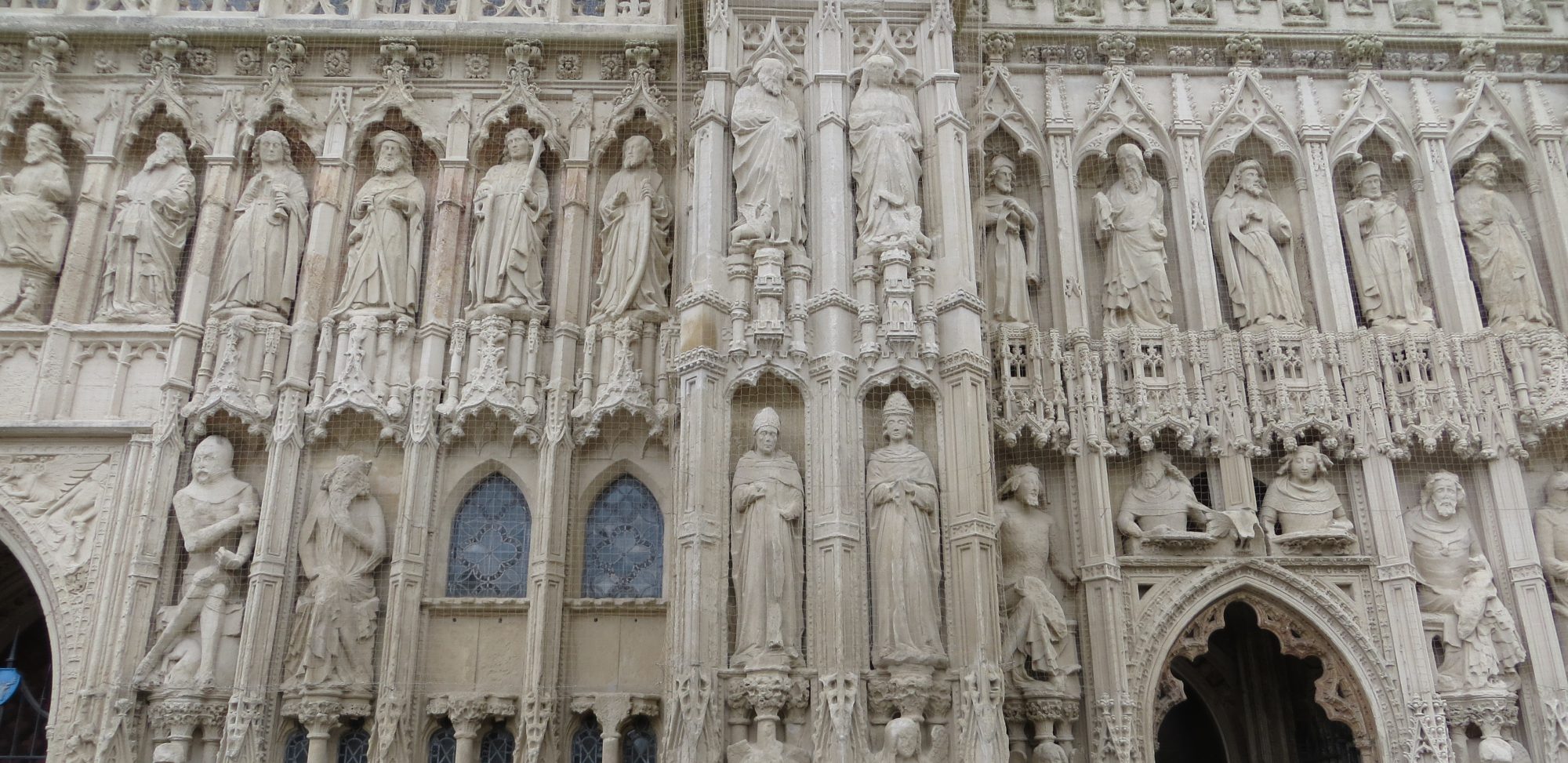
Off to the Society for the Study of Theology conference, at Durham, with my half-finished short paper 'The Whole Christ and the High Priest' which, as usual, attempts to summarise what I have learned from everyone in the last 12 months. I'll post it when I get back, and those Holy Week pieces too.
Family at Notre Dame
The Notre Dame Center for Ethics and Culture Fall conference 2008 is on
The Family: Searching for Fairest Love
Only the truth will prepare you for a love which can be called â??fairest love.â?? Pope John Paul II Letter to Families
We are mindful of the fundamental role played by the family in civil society, in the political order, and in the life of the Church. The conference will celebrate the anniversaries of two papal documents, Mulieris Dignitatem and Humanae Vitae.
Curious that theology, that is, the Christian doctrine of God, does not appear in the list of possible topics for papers. I presume there is room for some actual theology of the body, and not all by Angelo Scola ?
On the same subject, have you seen Robert George's remarkable Law and Moral Purpose?
Bodily union is thus personal union, and comprehensive personal unionâ??marital unionâ??is founded on bodily union. What is unique about marriage is that it truly is a comprehensive sharing of life, a sharing founded on the bodily union made uniquely possible by the sexual complementarity of man and womanâ??a complementarity that makes it possible for two human beings to become, in the language of the Bible, â??one flesh,â?? and for this one-flesh union to be the foundation of a relationship in which it is intelligible for two persons to bind themselves to each other in pledges of permanence, monogamy, and fidelity.
So, then, how should we understand what marriage is? Marriage, considered not as a mere legal convention or cultural artifact, is a one-flesh communion of persons that is consummated and actualized by acts that are procreative in type, whether or not they are procreative in effect. It is an intrinsic human good, and, precisely as such, it provides a more than merely instrumental reason for choice and action.
The bodily union of spouses in marital acts is the biological matrix of their marriage as a comprehensive, multilevel sharing of life: a relationship that unites the spouses at all levels of their being. Marriage is naturally ordered to the good of procreation (and is, indeed, uniquely apt for the nurturing and education of children) as well as to the good of spousal unity. At the same time, it is not a mere instrumental good whose purpose is the generating and rearing of children. ÂMarriage, considered as a one-flesh union, is intrinsically valuable.
Fit for Mission II
The Goal of a Catholic School is the Promotion of the Fully Human Person
I came that they may have life, and have it abundantly (John 10:10)
The Church’s recent teaching on the purpose of Catholic education states clearly that its goal is the promotion of the human person. What does thismean for the schools and colleges of our diocese? I think it means the following:
The fundamental needs of the human person are the focus of Catholic education – intellectual, physical, emotional, social, and spiritual, and eschatological (Our eternal destiny).
These fundamental needs can only be truly fulfilled through a rich and living encounter with the deepest truths about God and the human person.
This is why Christ and His Gospel must be the foundation of the educational project of each school and college, because He is the ‘the perfect Man in whom all human values find their fullest perfection’ (Congregation for Catholic Education, The Religious Dimension of Education in a Catholic School).
Therefore, the Catholic school or college is called to keep the Gospel whole and alive amongst pupils, families, and staff.
Robert Spaemann
One clue about the significance of Robert Spaemann is that Oliver O'Donovan translated his Persons: The Difference between 'Someone' and 'Something'.
Now have you seen
Das unsterbliche Gerücht. Die Frage nach Gott und die Täuschung der Moderne and at Amazon.de ?
Das unsterbliche Gerücht Gottesbeweise nach Nietzsche Deszendenz und Intelligent Design Christentum und Philosophie der Neuzeit Funktionale Religionsbegründung und Religion Religiöse Identität Sollten universalistische Religionen auf Mission verzichten? Religion und ›Tatsachenwahrheit‹ Über einige Schwierigkeiten mit der Erbsündenlehre Die christliche Sicht des Leidens Über die gegenwärtige Lage des Christentums
And there is also Grenzen: Zur ethischen Dimension des Handelns (Klett-Cotta 2001) and Der letzte Gottesbeweis (Pattlock 2007)
And his Begotten nor Made? (PDF). There are more articles by Spaemann at Das Portal zur katholischen Geisteswelt. You can see a video of the man himself. The interviewer asks Spaemann to comment on his own father's (Heinrich Spaemann) saying that 'We drift towards what we see and become what we look at'. Robert Spaemann responds by quoting from the Eucharist, 'Looking up, Jesus gave thanks'.
Learn more about him at de.wikipedia.org
(For something between the gist and gibberish, paste the words "Robert Spaemanns Vater, Heinrich Spaemann" into Google and click on 'Translate this page') Spaemann is not hard to read either. Other great Germans for PhD purposes? Try Oswald Bayer, Ingolf Dalferth or Hans Ulrich
The Grandeur of Reason
The Centre of Theology and Philosophy
presents
The Grandeur of Reason: Religion, Tradition and Universalism 1-4 September 2008 Rome
The Popeâ??s argument for an enlarged sense of reason is an argument for a re-hellenization of reason. In this context the universalism of Christianity has a concrete role to play as that particular cultural exemplar of the symphonic synthesis of the spirit of rational human inquiry with faith in divine revelation. Therein Christianityâ??s universalism is a universalism grounded in a cultural tradition that cherishes at once the â??grandeurâ?? of human reason and the personal revelation of the One God.
Oliver O'Donovan Robert Spaemann David Schindler Bentley Hart van Inwagen Fergus Kerr Hauerwas Agamben Zizek
A mix of saints and rascals, and a bit short on talent from the Catholic hierarchy. Still, â??guests of honourâ?? - I wonder who they can have in mind?
We are interested in papers that cover any topic relevant to the conference theme, but are especially interested in questions of religion and empire, Christianity and Islam, humanism and universalism, the reunification of the Apostolic Churches, and Scripture and Metaphysics.
Cardinal O'Brien - the government has no mandate for these changes
At this time as well as thinking of the death and resurrection of Jesus Christ we are asked to consider again what I have described as the â??essential aspect of a Christian vocation â?? namely to be a missionary peopleâ??. I think that there is a greater need than ever before for each and every Christian to be aware of that call at this present time.
I think that a fundamental concern of all of our people at this present time and one which we ourselves as Christians must take very seriously is that concerning the future of human life itself. The beliefs which we have previously held, and the standards by which we have lived throughout our lives and by which Christians have lived for the last 2000 years are being challenged at this present time in ways in which they have never been challenged before!
The norm has always been that children have been born as the result of the love of man and woman in the unity of a marriage. That belief has of course long been challenged. However I believe that a greater challenge than that even faces us â?? the possibility now facing our country is that animal â?? human embryos be produced with the excuse that perhaps certain diseases might find a cure from these resulting embryos.
What I am speaking of is the process whereby scientists create an embryo containing a mixture of animal and human genetic material. If I were preaching this homily in France, Germany, Italy, Canada or Australia I would be commending the government for rightly banning such grotesque procedures. However here in Great Britain I am forced to condemn our government for not only permitting but encouraging such hideous practices.
Our Prime Minister, Gordon Brown has given the Governmentâ??s support to the Human Fertilisation and Embryology Bill. It is difficult to imagine a single piece of legislation which, more comprehensively, attacks the sanctity and dignity of human life than this particular Bill.
With full might of government endorsement, Gordon Brown is promoting a Bill that will allow the creation of animal â?? human hybrid embryos. He is promoting a Bill which will add to the 2.2 million human embryos already destroyed or experimented upon. He is promoting a Bill allowing scientists to create babies whose sole purpose will be to provide, without consent of anyone, parts of their organs or tissues. He is promoting a Bill which will sanction the raiding of dead peoples tissue to manufacture yet more embryos for experimentation. He is promoting a Bill which denies that a child has a biological father, allows tampering with birth certificates, removing biological parents, and inserting someone altogether different. And this Bill will indeed be used to further extend the abortion laws.
This Bill represents a monstrous attack on human rights, human dignity and human life. In some other European countries one could be jailed for doing what we intend to make legal. I can say that the government has no mandate for these changes: they were not in any election manifesto, nor do they enjoy widespread public support. The opposite has indeed taken place â?? the time allowed for debate in Parliament and indeed in the country at large has been shockingly short. One might say that in our country we are about to have a public government endorsement of experiments of Frankenstein proportion â?? without many people really being aware of what is going on.
Today as we celebrate in the resurrection the triumph of life over death I urge you to ensure that life continues to triumph over these deathly proposals. Being a Christian and acting as a Christian must be one and the same thing. Gathered here on this Easter Day we realise that we are indeed followers of Jesus Christ and with that comes responsibilities. May God indeed help us all to be missionary at this present time and to hand on the saving message of Jesus Christ in a world which does not seem prepared to receive it
Cardinal Keith O'Brien bishop of Edinburgh and St Andrew's
Another bishop without his own website, who has only the Daily Record by which to communicate with his flock. But, this time, in Scotland, the whole sermon is faithfully reproduced.
***
Finally - a website. Marvellous.
Species-bending
In his Easter Sunday message, given at Durham Cathedral, Rt Rev Tom Wright issued a rallying call to all faiths to object to the "1984-style" proposals.
As pressure from religious leaders mounted on prime minister Gordon Brown to allow a free vote on the issue of embryo research in the Commons, Bishop Wright warned that society was in danger of learning nothing from the "dark tyrannies" of the last century.
He told his congregation: "Our present government has been pushing through, hard and fast, legislation that comes from a militantly atheist and secularist lobby. "In this 1984-style world, we create our own utopia by our own efforts, particularly our science and technology.
"The irony is that this secular utopianism is based on a belief in an unstoppable human ability to make a better world, while at the same time it believes that we have the right to kill unborn children and surplus old people, and to play games with the humanity of those in between.
"Gender-bending was so last century; we now do species-bending.
"It shouldn't just be Roman Catholics who are objecting. It ought to be Anglicans and Presbyterians and Baptists and Russian Orthodox and Pentecostals and all other Christians, and Jews and Muslims as well."
BBC report of Bishop Tom Wright's Easter Day sermon
Dear bishops, get your sermons out on your own diocesan websites.
How do we know that this is an accurate report of what you said? A bishop who relies on the BBC to communicate with his people cannot wonder at the hurt and confusion that flock experiences when the BBC's interpretation introduces distortions. We want to read the whole sermon in order to see how all this ethics fits within the theology, that is, how the resurrection frees us from the fears of which this legislation is the expression. Sermons of this sort should be simultaneously pastoral letters read from every pulpit at each mass on the Sunday they are issued.
Death is defeated
Easter Sunday Fear is natural, and so is grief at the death of another (Jesus, remember, shed tears for the death of a friend). Don't attempt to avoid it or deny its seriousness. On the contrary, keep it in view; remind yourself of it. When the tradition of the Church proposes that you think daily about death and prepare for it, it isn't being morbid but realistic: get used to it and learn to live with the fear. And meanwhile - Shakespeare was being entirely Christian in this respect - get used to loving and valuing things and persons irrespective of the fact that they won't be there for ever. Love them now, and what you would want to do for them, do now. 'Night is coming when no-one can work', says Jesus. (John 9.4)
So what does it mean to say that, despite all this, death is 'defeated'? When death happens and growing stops, there are no more plans, no more hope of control: for the believer, there is only God left. Just as at the very beginning of creation, there is God, and there is the possibility that God has brought into being by his loving will. When death has done all it can do, God remains untouched and his will is the loving and generating will that it eternally is. When we look at death, we look at something that can destroy anything in our universe - but not God, its maker and redeemer. And if we accept that we shall die and all our hopes and schemes fall into the dark, we do so knowing that God is unchanged. So to die is to fall into the hands of the living God.
Archbishop Rowan Williams Easter Day sermon
Bishops, would you kindly follow your Archbishop in getting your Easter Sunday sermons out on Easter Sunday through your own websites? It makes all the difference
The wood of the cross
Easter Saturday The wood of the cross – that is the world. The wood is dead now, but look again and see this wood sprouting shoots and bursting into life again. That is what you see on the mosiac on the north transept side of the dome of St Paul’s Cathedral. There is Christ on the cross, but the cross is supported by him, as though strapped to his back like an easel. He is carrying this world on his back, and the dead wood of the cross has started to push out buds and become a tree.
The cross is all the antagonism and aggression we direct at one another. The cross is this world of cutting-off, letting-go and letting-die, in miniature. And it is the end, refusal and overcoming of this world of letting-go. Christ has taken all our cutting him-and- one-another-off, and absorbed it; he has refused to cut us off, or to let us go or in any way to reciprocate. He took what we gave, without limit, until we had for our part, cut him off entirely. We cut him off, but he did not cut us off. But what we gave him, he took, without giving back, and so he took it away from us. He took what we meted out, and held on, to us. We refused him our humanity, stripping him of every human relationship; all humanity stripped him and removed itself from him. But even our entire act of removing from him the sum of our ‘humanity’ did not result in any diminution of his divinity, that is, of the Father’s determination that this was his Son, and that this Son was us and is us. The sum of our humanity turned out not to conceal any divinity; divinity turned out not to be the sum of our humanity. When we lump all humanity together, all our history, achievement and civilisation, it turns out that divinity is entirely transcendent of it. Divinity is his, not ours, and so life is his to give, and not ours to withhold.
All our refusal of for him, and of one another, and all our effort in cutting him off, and in cutting one another off, proves unable to prevent his divinity from holding us and bringing us back to life. From him life seeps into us. The invincible unity and communion of the Holy Spirit that secures Christ from us and exalts him, will also raise us. Though we put him in a hole in the ground, and the earth closed over him, neither we nor the earth could hold him there. We are unable to prevent this divinity, the life of God, which to us is resurrection, from pulling him out of our grasp and exalting him. We cannot prevent God from exalting this human, and we cannot prevent God from deciding that in Christ all our humanity is safe and secure. For all our cutting ourselves off, from him, from one another, none of us is lost. We are not able to make our refusal stick or to carry our own destruction through. However I cut you off, Christ will raise you to me again, until at last I am ready for you. In him and from him the whole human race will sprout and grow again. The truth of this dead wood is its future as this tree. Joined to him we are this living tree, for on Christ’s back all humanity and all creation is bound to life, and I am bound for you and you are bound for me.
Christ sings along with us, we sing along with him
Good Friday
My God, my God, why have you forsaken me? why are you so far from helping me, from the words of my groaning?
Why did Jesus quote these specific lines during his suffering, â??unless he was somehow trying to catch our attention, to make us understand, â??this psalm was written about me?â?? (Exp 2.3 of Ps 21). Augustine draws the attention of his congregation to Christâ??s utterance of these verses to explicate the meaning of their Good Friday service, a service designed to make present what took place in time past, and in this way it moves us as if we were actually watching our Lord hanging on the cross, but watching as believers, not mockers (exp 2.1 of ps. 21 (ie. Psalm 22). Christ prayer on the cross continues today in the commemoration of the church. He emphasises that the world and his congregation both stand before that cross, either as mockers or as those who groan with the sufferings of Christ. â??The chaff on his threshing floor mocks him and the wheat groans to hear its Lord deridedâ?? (exp 2.1 of Ps 21).
Augustine is unpacking for his congregation what it means to sing this psalm, as Christâ??s body, part of the Totus Christus). Christ was praying the prayer of his church, presenting their fear and trial as he carried their sin, and quoting the very words that they too sing today as a memorial of his passion.
Brian Brock on Augustine in Singing the Ethos of God
And from Matthew Baker
God created man in the year 33, on a hill in Palestine called Golgotha. On the sixth day of the week â?? on Holy Friday â?? the true man in the image of God is heralded by Pontius Pilate, as he brings forth the thorny-crowned, purple-robed Christ and announces â??Behold the man!â?? .
Holy Week 2 Tuesday Unless a grain falls…
Today, according to the Lectionary, our readings are from Isaiah 49 – ‘in the shadow of his hand he hid me’, and I Corinthians 1 ‘The message about the cross is foolishness to those who are perishing’, and John 12. ‘The hour has come for the Son of Man to be glorified. Unless a grain of wheat falls into the earth and dies, it remains just a single grain.’
‘The hour has come for the Son of Man to be glorified. Very truly, I tell you, unless a grain of wheat falls into the earth and dies, it remains just a single grain; but if it dies, it bears much fruit. Those who love their life lose it, and those who hate their life in this world will keep it for eternal life. Whoever serves me must follow me, and where I am, there will my servant be also. Whoever serves me, the Father will honour. Now is the judgement of this world; now the ruler of this world will be driven out. And I, when I am lifted up from the earth, will draw all people to myself.’ John 12.20-36
God has dropped a single seed, into the earth. Christ is this seed. Will he grow, will he survive, will he fruit? He lets go and gives himself away to us. The kingdom of God is like a farmer who sowed, and who does not know whether he will see any crop (Mark 4.). He hands himself over to us, entirely into our hands. The Lord God has taken a punt with us, has risked his own name on us. He does not want us unless we are ready to be wanted, and are ready to love.
Those who love their life lose it, and those who hate their life in this world will keep it for eternal life. This recklessness is our lot now. The Son of God is content to be the Son in the complete disguise – clothed in our creatureliness, our humanity and materiality. This concealment is what the passion of Christ is.
Holy Week 1 Monday The house was filled…
Six days before the Passover Jesus came to Bethany, the home of Lazarus, whom he had raised from the dead. There they gave a dinner for him. Martha served, and Lazarus was one of those at the table with him. Mary took a pound of costly perfume made of pure nard, anointed Jesus’ feet, and wiped them with her hair. The house was filled with the fragrance of the perfume. John 12. 1-11
This anointing is the form Mary’s praying takes. Mary is praying without making any requests. She simply presents herself to the Lord, without word. In the same way we do not know what to say, but the Spirit prays for us from within us. She washes his feet and anoints them with this nard so the perfume fills the house. ‘Your prayer as been heard’, Jesus says on another occasion. The perfume is the prayers of the saints which rise up from the worship of the Church.
The whole earth is full of his glory. God has made the world, but his glory is hidden in it. But it is not obvious to us that this place is full of the glory of God. Creation waits for its redemption, and as long as it does so it groans. It is our job to lead this lament, and to say the world is not comfortable or settled, but we look forward to the time when this glory fills the house.
Palm Sunday
On Palm Sunday morning we met on the Kingsland High Road with St Paul’s West Hackney, and Hackney Baptist Church and processed back along Church Street the mile to St Mary’s singing
All glory, laud and honour to thee Redeemer King To whom the lips of children Made sweet hosannas ring. and
Ride on! Ride on Majesty! and
There is a green Hill far away and
Give me oil in my lamp, keep it burning…
We got through the whole lot twice, in rain, in good voice the whole way. The C of E - we have got the best songs.
That was Palm Sunday. Now on to Holy Week and our onward trek through the liturgical year.
Holy and Great Lent
During this period of Holy and Great Lent, our Church calls us to repentance. Doubtless, as contemporary man hears this invitation to repentance, he does not feel comfortable, because he has accustomed himself to a certain way of life, and does not wish to question his own rectitude. Calling one’s own rectitude into question produces feelings of insecurity, because the ideological structure within which you have sure and certain refuge is clearly risked.
The one who constantly repents, ever progresses, ever rejoices through new ascents, finds constant satisfaction in deeper understandings of all things. Through the transformation of mentality and understanding, the one who repents better understands the whole world, becomes wiser, more judicious, more discreet, nobler and a true friend of Christ. Therefore, the preaching of repentance should be favorably received by wise persons who are able to appreciate any improvement that comes from the renewal of the human person through repentance.
Therefore, brothers and sisters and beloved children in the Lord, let us accept the invitation of our Church to repentance. Let us who have fallen short through sin cleanse ourselves from sin through confession. Let us constantly examine our own presuppositions, so our judgments and thoughts may be godly and pure, just and true.
BARTHOLOMEW of Constantinople The fervent intercessor for you all before God
Holy week talks
The Archbishop of Canterbury’s Holy Week Lectures(PDF)
The Most Reverend and Right Honourable Dr Rowan Williams delivers a series of lectures after Evensong at Westminster Abbey
****Monday 17th March Faith and Science Tuesday 18th March Faith and Politics Wednesday 19th March Faith and History
Holy Week seems a good time to follow the Lectionary rather than to continue the thematic approach. I look forward to the day when our bishops demonstrate how to preach from the bible readings set by the Lectionary. My On the Way to Easter series on Resources for Christian Theology is my latest attempt. I am going to talk about preaching, lectionary and eucharist at Westminster Abbey's Cheneygates Work-in-Progress seminar on April 24 at 12.30 (though the Abbey website gives no sign).
St Francis Episcopal Church San Jose offers an introduction to Lent and Easter. Did you know that 'Maundy' Thursday comes from mandatum novum, 'a new commandment' and Good Friday was originally 'God's Friday'? You can learn more about Lent, Easter and the lectionary from the excellent Ken Collins and from Textweek.
Fit for Mission
Bishop Patrick O'Donoghue of Lancaster is my hero. In Fit for Mission? he has produced the single most evangelical document that I have seen from any bishop in Britain. Every page is quotable. Here is his Introduction.
. . .
As you will be aware, the diocese is undertaking the ‘Fit for Mission’ review, the overall aim of which is to strengthen the sacramental and missionary life of each area of the diocese so that this and future generations, can have a rich and living encounter with our Lord, Jesus Christ. This is the mission of the Church, this is why we exist – to proclaim the Gospel of Christ and bring each person closer to our loving Father, through the power of the Holy Spirit.
I have come to the conclusion that our hopes to strengthen and deepen the missionary and sacramental life of the Church in this diocese depend largely on the engagement and commitment of our schools and colleges. For many pupils and parents the local Catholic school is their only experience of Church – our schools are at the cutting edge of the new evangelisation, called to make Christ known and loved in our communities.
As your bishop, it is my responsibility to help you create and deepen this authentic Catholic ethos in our schools and colleges. My answer to the question is this – I encourage everyone to unite their energy, creativity, and gifts in this threefold service for their pupils:
1. To share the Father’s passion to liberate His children from the slavery of sin, into the freedom and dignity of being created in the ‘image and likeness of God’.
How do we enable our pupils to experience the wonder and richness of possessing the freedom and dignity of being made in God’s image? How do we allow the Father to free those pupils who suffer the slavery of materialism, pre-marital sexual activity, alcohol, and substance abuse, the slavery of violence and bullying?
2. To follow the Son’s loving service of impoverished and suffering humanity, through advocating and establishing a culture of justice that originates in the purpose, will, and character of God.
How do we encourage our pupils to live in the transforming grace of Christ’s power and promises? How do we allow the Son to heal those pupils who are impoverished by neglect, social exclusion, physical, emotional, and sexual abuse?
3. To be exemplars of the freedom and dignity in intellectual, social, and moral life that comes from being transformed by the Holy Spirit.
How do we empower our pupils with the absolute truth of Catholic doctrinal and moral teaching? How do we allow the Holy Spirit to inspire those pupils imprisoned by doubt, cynicism, atheism, and nihilism?
These may appear to some as abstract, even impractical, but they express the heart of the Gospel, which is God’s development plan for each one of us! Throughout this document I will propose practical ways of realising this threefold service.
Fit for Mission? (67 page PDF) You can find the build-up to Fit for Mission? here
Bishop O'Donoghue's Four Pillars?
The Profession of Faith – devotion to the Apostles’ teaching Sacraments – devotion to the breaking of bread The Moral Life – devotion to the fellowship Prayer – devotion to prayer
I am in awe. You'll find intelligent comment on Bishop O'Donoghue's initiative from Archbishop Cranmer and from the Hermeneutic of Continuity
Alive and kicking
MPs prepare to vote on abortion for the first time in 18 years
The Human Fertilisation and Embryology Bill, currently before the House of Commons, provides an opportunity for MPs to vote on amendments to the abortion law. With your active participation we can change the law, save unborn lives and create a society where women with an unplanned pregnancy are offered real alternatives to abortion.
The Alive and Kicking Alliance strongly supports the following amendments that will help to substantially reduce the number of abortions in the UK:
1. A substantial lowering of the 24-week abortion upper limit. Public, parliamentary and medical opinion supports a reduction of the abortion time limit. This is a direct result of 4D ultrasound, improved neonatal survival and live births following late abortion.
2. An end to discriminatory abortion of disabled babies up to birth, whilst a 24-week upper limit is in place for babies without disability. This constitutes discrimination against those with special needs.
3. A charter of informed consent for women seeking abortion. Women contemplating abortion require the information, support and space necessary to make a fully informed decision.
Alive and Kicking are running a petition (for those in the UK)
Holy week talks
The Bishop of London
Tracing the Drama of Holy Week:Preparing for the Resurrection Life Monday 17th March, 1pm Tuesday 18th March, 1pm Wednesday 19th March, 1pm
St Stephen Walbrook
Roman Catholic theology
Bede Professor of Catholic Theology at the University of Durham
The Department of Theology & Religion seeks to appoint a Roman Catholic scholar of international standing who is engaged in the critical-constructive analysis of issues of contemporary significance in Catholic thought and practice, evidenced through extensive publication at the highest academic level. This is a newly established post, permanently endowed by a number of Catholic donors. As a theological advisor to the Bishop of Hexham & Newcastle, the postholder must be in full and active communion with the Roman Catholic Church.
Critical-constructive, but I hope also receptive, analysis of the documents of the Roman Catholic church, than which there is no finer body of theological texts, and none more neglected in the United Kingdom
Patriarch and Zizioulas on tour
The Saint-Serge Institute in Paris has awarded the title of Docteur Honoris Causa to Metropolitan John Zizioulas. Here are details and video of his acceptance speech. Bishop John responded with 'La contribution de la théologie orthodoxe occidentale' (PDF). The Laudatio by Michel Stavrou included this:
Il faut noter que votre style littéraire est simple et dépouillé, cultivant presque une esthétique de la pauvreté. Quant à votre réflexion, tout en s'alimentant chez les Pères et dans la tradition canonique et liturgique, elle est en prise étroite avec la philosophie et la culture contemporaines, et se déploie en dialogue constant avec des théologiens de différents horizons, cherchant, sans crispation confessionnelle, à mettre en lumière la tradition indivise de l'Eglise ancienne.
Comme en retour, vos travaux ont fait l’objet d’une quarantaine d’articles de théologiens de toutes confessions et également d’une douzaine d’ouvrages (excusez du peu) dont le dernier paru, The Theology of John Zizioulas, édité par l’anglais Douglas Knight en 2007, regroupe en 200 pages les évaluations de 12 théologiens anglicans, réformés, catholiques et orthodoxes.
Meanwhile Ecumenical Patriarch Bartholomew has been at the Pontifical Oriental Institute to give a paper Theology, Liturgy and Silence. Asia news gives an account of Patriarch and Metropolitan in Rome.
I owe these links to Matthew Baker (St Tikhon's Orthodox Seminary), this blog's editor of Orthodox Affairs
Bucharest
Back now from an extraordinary and wonderful weekend in Bucharest for the ‘Christian Faith and Metaphysical Reason’ Colloquium hosted by Mihail Neamtu at the New Europe College.
David Bradshaw and Russell Reno were the hired hands, both impressive and delightful, curious about everything and everyone they met. There was a fair cast of young local talent mostly from the Philosophy faculty of Bucharest University. In the evenings as we were being feasted there was lots of conversation about Church and State, about relations between the Orthodox and other much smaller churches in Romania. We agreed that there was a certain schizophrenia of public secular and private Christian intellectual lives - always easier to identify in other people of course.
Most wonderful was walking through the hectic streets of Bucharest, with other delegates after the conference, past the first floor flat of the twentieth century Father of the Romanian Church Dimitru Staniloae (and video) and then on to the streets on which a thousand people died in the last days of 1989 – nearly twenty years ago already.
But best, and beyond my ability to describe it, was Vespers and Liturgy at Stavropoleus. Here is the interior and iconostasis from the Stauropoleus Flickr group. The liturgy came down from heaven. The Stavropoleus site may give you some idea.
The trip was an extraordinary privilege: there is a very great deal to learn about the Christian life from these folk, obviously, particularly the habits of that long-term discipleship which has carried them through the hard years. You have got to know your psalms off by heart. I am looking forward to going back.
As instructed, I gave a paper on Oliver O'Donovan - who was in London last week (here's a picture). Christoph Schneider and I wondered about the possibility of setting up a conference on Maximus at the Cambridge Orthodox Institute and getting David Bradshaw (Aristotle East and West) over to the UK.
Tyndale House summer conference
The Tyndale Fellowship groups - OT, NT, Biblical Theology, Doctrine and more - meet in Cambridge in July.
'Political Theology' is the theme for the Ethics and Social Theology group. Papers include
Jonathan Chaplin The Bible, the State and Religious Diversity: Theological Foundations for ‘Principled Pluralism’
David McIlroy The Right Reason for Caesar to Confess Christ as Lord: O’Donovan and Arguments for a Christian State
Douglas Knight The Church, the State and the Archbishop: the Fretful Audiences of Rowan Williams
Human Fertisation and Embryology Bill
We believe the issues raised in this Bill are among the most important we will confront politically in our lifetime.
Catholic cabinet ministers, such as Transport Secretary Ruth Kelly, Defence Secretary Des Browne and Welsh Secretary Paul Murphy, are finding themselves in a difficult position over the Human Fertilisation and Embryology Bill. Their religious beliefs mean they would have conscience problems voting in support of parts of this Government Bill, such as the creation of animal-human hybrids, removal of the need for a father, and further experimentation on embryos.
Christian Concern for our Nation has produced a briefing paper on the Bill and there's a Time to Draw the Line video
MPs have expressed "dismay" that the fertility watchdog, the Human Fertilisation and Embryology Authority, granted licences to researchers to create animal-human hybrid embryos before the House of Commons has voted on whether the creation of these embryos is legal. In a letter to The Daily Telegraph, the MPs said the Human Fertilisation and Embryology Authorityâ??s decision â??makes a mockery of Parliamentâ??.
On the way to Easter - Lent 5
In our journey towards Easter we have seen that Christ is anointed and made king by the Holy Spirit. The Spirit has brought us into the communion and body of Christ, so that we are anointed with him and he with us. We have seen that Christ is our universal human-to-human mediator. He is the one who can hear and receive all other humans. The question to us is whether we are ready to receive through him the whole human race and created order as the gifts of God. Christ makes himself present only in this disguised form, so that our freedom to receive this life from him, or not to receive it, is entirely ours.
Consequently man is a mystery that cannot be controlled. It is not just man’s present, defined by the limits of our imagination, but his future that God has at heart here. God is guardian of our freedom: he does not let us give it away. We have seen man wrestle with the question of his own identity. We have seen this wrestling spelled out to us in terms of the accuser wrestling in the wilderness with Christ, Israel wrestling with Moses, Nicodemus and the Samaritan woman at the well wrangling with Christ about where life can be accessed. Through these are many different encounters, we have seen man wrestling with the dark figure of his own future. This future is life with God. This week Lazarus anticipates Israel – All Israel will be raised and the Church will be raised.
Nation of Bastards
Douglas Farrow Nation of Bastards: Essays on the End of Marriage
"Erudite and impassioned - an act of faith and of resistance to the insidious claims of the post-Christian and post-liberal state." F. C. Decoste, Professor of Law, University of Alberta
A brilliant exposé of the implications of same-sex marriage - and a compelling analysis of what it will take for society to reclaim the birthright of freedom it has lost in a reckless social experiment.
To some, same-sex marriage is evidence that society has finally come of age. To others, it is yesterday's issue, posing no danger to traditional marriage. To still others - McGill University's Douglas Farrow among them - it has turned civil society on its ear, creating a new political situation in which several things are no longer clear:
Is the state the property of the citizenry? Or are citizens, with their cherished personal associations, including marriage, now the property of the state?
Who "owns" the children, now that natural parenthood had been replaced by legal parenthood?
Is the family still "the natural and fundamental group unit of society," as the Universal Declaration of Human Rights claims? Or is the concept of the "natural" moribund?
See McGill's Pluralism, Religion and Public Policy. Farrow's first and colossal book was Ascension and Ecclesia. Ten years on I am still living out of it.
And an equally wonderful work that takes a long look at the theological history of marriage is
Christopher C Roberts Creation and Covenant:The Significance of Sexual Difference in the Moral Theology of Marriage
R. R. Reno, Creighton University "Sexual ethics and gay marriage -- Creation and Covenant is essential reading for anyone who wants to think about these issues in light of the Western Christian tradition. Roberts helps us see and resist the Gnostic temptation that so dominates the moral imagination of modern culture....A very fine book - just the sort of patient survey of the classical tradition we need, and absolutely on target as far as the core theological issue is concerned. It's the sort of book that will be very helpful for teaching a seminar on sexual ethics."
-Timothy Radcliffe, OP "The question of the significance of sexual difference is at the heart of many divisions within contemporary society. ...Roberts' contribution to the debate is forceful and scholarly, while always charitable. This powerfully argued case for the abiding importance of our sexual identity shows how rich can be the contribution of the Christian tradition to our society's present search to understand the meaning of our lives. ...It will help us all in our journey towards understanding who we are in Christ."
First time
This is the first time that church-going has been adduced as a reason for declaring a couple to be unsuitable for fostering.
Eucharist
All Saints St Margaret Street School of Worship 2007-8
THE LITURGY OF THE EUCHARIST Peace and Preparation of the Table Wednesday 12 March 7pm
Giving Thanks - The Eucharistic Prayer Wednesday 9 April 7pm
Breaking of the Bread and Holy Communion Wednesday 7 May 7pm
Blessing and Dismissal Wednesday 11 June 7pm
India's two plagues
Cardinal Telesphore Toppo, archbishop of Ranchi, after a visit to the stricken zones, described what he had seen to the agency "Asia News" in this way:
"An expanse of ashes is what remains in the areas stricken by anti-Christian violence at Christmas in Orissa. It was diabolical; churches desecrated and houses burned. The villages upon which the extremist Hindu violence fell are today a vast cremation ground."
Raphael Cheenath, the archbishop of Cuttack and Bhubaneswar, the diocese hardest hit, in an assessment of the attacks released at the end of January numbered the victims at 6 dead and 5,000 homeless, and the destruction at 70 churches, 600 houses, 6 convents, and 3 seminaries. The Indian bishops' conference gave the same report in a memorandum delivered to the national commission for human rights.
In his report, archbishop Cheenath points the finger at those whom he maintains are the promoters of aggression against Christians: the ideologues of intolerant Hinduism, ensconced in the group Vishva Hindu Parishad, and the members of the high castes, who are unfavorable toward the social advancement of the Dalits, the poorest, the outcast and "impure," many of whom are converts to Christianity.
Sandro Magister India's Two Plagues: The "Missing Women" and Violence Against Christians
On the way to Easter - Lent 4
At Easter God completes his act of creation by raising one of us to the full definition of humankind. In Christ the whole work of creation has been successful, and that success is opened to all of us. Through the Holy Spirit Christ has attached us to himself, so that the resurrection of the first man is the beginning of the resurrection of all humanity. Easter is a preview of the consequences of this for us: Christ’s resurrection is a rehearsal for ours.
In Christ, each of us joined to every other. The Church is the companionship of God making itself tangible and corporal here. The distinctiveness of the Church from the world is the great gift that God gives the world: the world is anointed with the Church. But what the Church knows is not obvious outside the Church – it has to be confessed. The Church has to pray and to speak up for the world. The world relies on us to do this.