Robert Spaemann

One clue about the significance of Robert Spaemann is that Oliver O’Donovan translated his Persons: The Difference between ‘Someone’ and ‘Something’.

Now have you seen

Das unsterbliche Gerücht. Die Frage nach Gott und die Täuschung der Moderne and at Amazon.de ?

Das unsterbliche Gerücht
Gottesbeweise nach Nietzsche
Deszendenz und Intelligent Design
Christentum und Philosophie der Neuzeit
Funktionale Religionsbegründung und Religion
Religiöse Identität
Sollten universalistische Religionen auf Mission verzichten?
Religion und ›Tatsachenwahrheit‹
Über einige Schwierigkeiten mit der Erbsündenlehre
Die christliche Sicht des Leidens
Über die gegenwärtige Lage des Christentums

And there is also Grenzen: Zur ethischen Dimension des Handelns (Klett-Cotta 2001) and Der letzte Gottesbeweis (Pattlock 2007)

And his Begotten nor Made? (PDF). There are more articles by Spaemann at Das Portal zur katholischen Geisteswelt. You can see a video of the man himself. The interviewer asks Spaemann to comment on his own father’s (Heinrich Spaemann) saying that ‘We drift towards what we see and become what we look at’. Robert Spaemann responds by quoting from the Eucharist, ‘Looking up, Jesus gave thanks’.

Learn more about him at de.wikipedia.org

(For something between the gist and gibberish, paste the words “Robert Spaemanns Vater, Heinrich Spaemann” into Google and click on ‘Translate this page’) Spaemann is not hard to read either. Other great Germans for PhD purposes? Try Oswald Bayer, Ingolf Dalferth or Hans Ulrich

Cardinal O'Brien – the government has no mandate for these changes

At this time as well as thinking of the death and resurrection of Jesus Christ we are asked to consider again what I have described as the â??essential aspect of a Christian vocation â?? namely to be a missionary peopleâ??. I think that there is a greater need than ever before for each and every Christian to be aware of that call at this present time.

I think that a fundamental concern of all of our people at this present time and one which we ourselves as Christians must take very seriously is that concerning the future of human life itself. The beliefs which we have previously held, and the standards by which we have lived throughout our lives and by which Christians have lived for the last 2000 years are being challenged at this present time in ways in which they have never been challenged before!

The norm has always been that children have been born as the result of the love of man and woman in the unity of a marriage. That belief has of course long been challenged. However I believe that a greater challenge than that even faces us â?? the possibility now facing our country is that animal â?? human embryos be produced with the excuse that perhaps certain diseases might find a cure from these resulting embryos.

What I am speaking of is the process whereby scientists create an embryo containing a mixture of animal and human genetic material. If I were preaching this homily in France, Germany, Italy, Canada or Australia I would be commending the government for rightly banning such grotesque procedures. However here in Great Britain I am forced to condemn our government for not only permitting but encouraging such hideous practices.

Our Prime Minister, Gordon Brown has given the Governmentâ??s support to the Human Fertilisation and Embryology Bill. It is difficult to imagine a single piece of legislation which, more comprehensively, attacks the sanctity and dignity of human life than this particular Bill.

With full might of government endorsement, Gordon Brown is promoting a Bill that will allow the creation of animal â?? human hybrid embryos. He is promoting a Bill which will add to the 2.2 million human embryos already destroyed or experimented upon. He is promoting a Bill allowing scientists to create babies whose sole purpose will be to provide, without consent of anyone, parts of their organs or tissues. He is promoting a Bill which will sanction the raiding of dead peoples tissue to manufacture yet more embryos for experimentation. He is promoting a Bill which denies that a child has a biological father, allows tampering with birth certificates, removing biological parents, and inserting someone altogether different. And this Bill will indeed be used to further extend the abortion laws.

This Bill represents a monstrous attack on human rights, human dignity and human life. In some other European countries one could be jailed for doing what we intend to make legal. I can say that the government has no mandate for these changes: they were not in any election manifesto, nor do they enjoy widespread public support. The opposite has indeed taken place â?? the time allowed for debate in Parliament and indeed in the country at large has been shockingly short. One might say that in our country we are about to have a public government endorsement of experiments of Frankenstein proportion â?? without many people really being aware of what is going on.

Today as we celebrate in the resurrection the triumph of life over death I urge you to ensure that life continues to triumph over these deathly proposals. Being a Christian and acting as a Christian must be one and the same thing. Gathered here on this Easter Day we realise that we are indeed followers of Jesus Christ and with that comes responsibilities. May God indeed help us all to be missionary at this present time and to hand on the saving message of Jesus Christ in a world which does not seem prepared to receive it


Cardinal Keith O’Brien bishop of Edinburgh and St Andrew’s

Another bishop without his own website, who has only the Daily Record by which to communicate with his flock. But, this time, in Scotland, the whole sermon is faithfully reproduced.

***

Finally – a website. Marvellous.
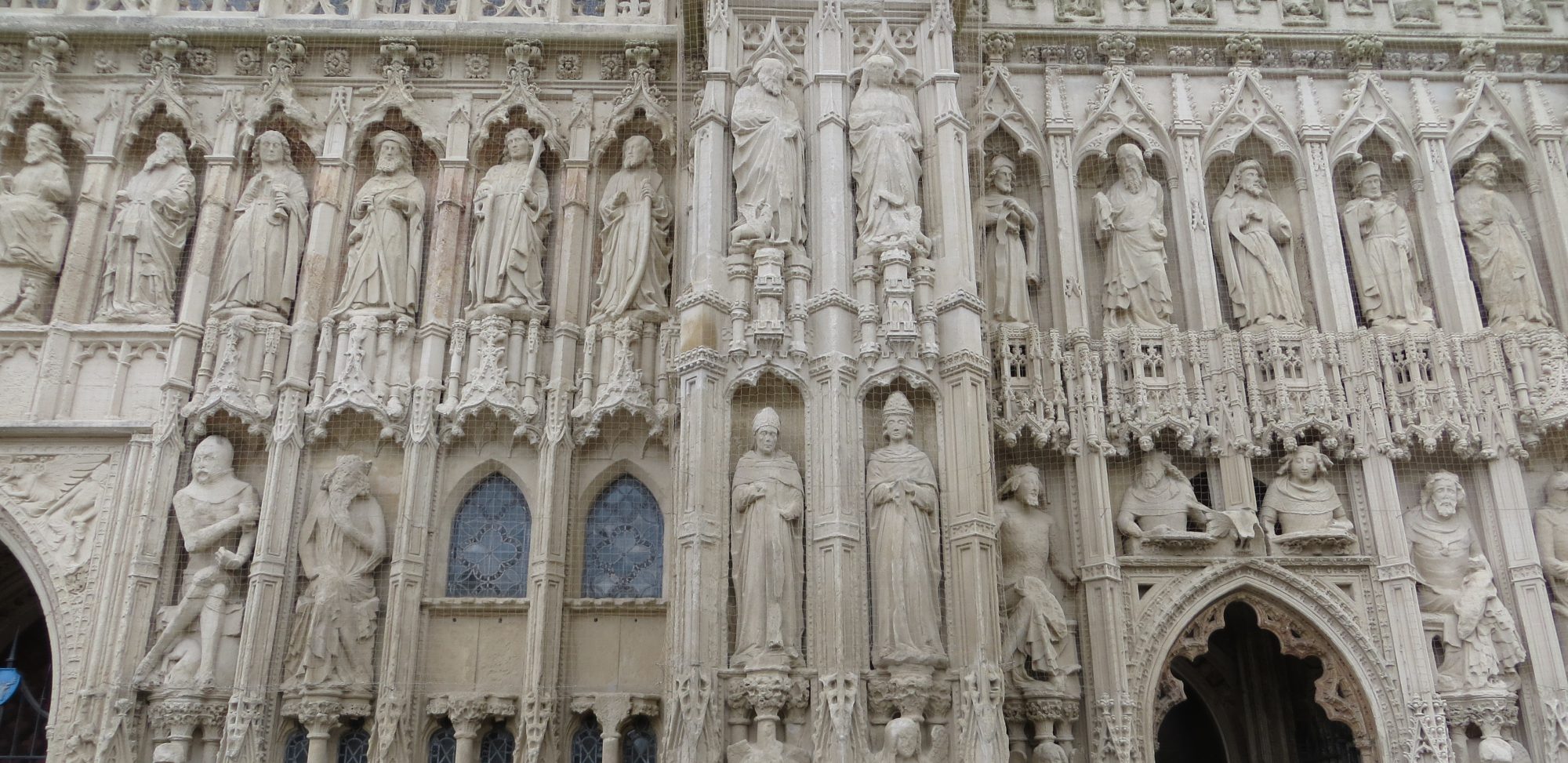
Christ sings along with us, we sing along with him

Good Friday

My God, my God, why have you forsaken me? why are you so far from helping me, from the words of my groaning?

Why did Jesus quote these specific lines during his suffering, â??unless he was somehow trying to catch our attention, to make us understand, â??this psalm was written about me?â?? (Exp 2.3 of Ps 21). Augustine draws the attention of his congregation to Christâ??s utterance of these verses to explicate the meaning of their Good Friday service, a service designed to make present what took place in time past, and in this way it moves us as if we were actually watching our Lord hanging on the cross, but watching as believers, not mockers (exp 2.1 of ps. 21 (ie. Psalm 22). Christ prayer on the cross continues today in the commemoration of the church. He emphasises that the world and his congregation both stand before that cross, either as mockers or as those who groan with the sufferings of Christ. â??The chaff on his threshing floor mocks him and the wheat groans to hear its Lord deridedâ?? (exp 2.1 of Ps 21).

Augustine is unpacking for his congregation what it means to sing this psalm, as Christâ??s body, part of the Totus Christus). Christ was praying the prayer of his church, presenting their fear and trial as he carried their sin, and quoting the very words that they too sing today as a memorial of his passion.

Brian Brock on Augustine in Singing the Ethos of God

And from Matthew Baker

God created man in the year 33, on a hill in Palestine called Golgotha. On the sixth day of the week â?? on Holy Friday â?? the true man in the image of God is heralded by Pontius Pilate, as he brings forth the thorny-crowned, purple-robed Christ and announces â??Behold the man!â?? .

Alive and kicking

MPs prepare to vote on abortion for the first time in 18 years

The Human Fertilisation and Embryology Bill, currently before the House of Commons, provides an opportunity for MPs to vote on amendments to the abortion law. With your active participation we can change the law, save unborn lives and create a society where women with an unplanned pregnancy are offered real alternatives to abortion.

The Alive and Kicking Alliance strongly supports the following amendments that will help to substantially reduce the number of abortions in the UK:

1. A substantial lowering of the 24-week abortion upper limit. Public, parliamentary and medical opinion supports a reduction of the abortion time limit. This is a direct result of 4D ultrasound, improved neonatal survival and live births following late abortion.

2. An end to discriminatory abortion of disabled babies up to birth, whilst a 24-week upper limit is in place for babies without disability. This constitutes discrimination against those with special needs.

3. A charter of informed consent for women seeking abortion. Women contemplating abortion require the information, support and space necessary to make a fully informed decision.

Alive and Kicking are running a petition (for those in the UK)

Roman Catholic theology

Bede Professor of Catholic Theology at the University of Durham

The Department of Theology & Religion seeks to appoint a Roman Catholic scholar of international standing who is engaged in the critical-constructive analysis of issues of contemporary significance in Catholic thought and practice, evidenced through extensive publication at the highest academic level. This is a newly established post, permanently endowed by a number of Catholic donors. As a theological advisor to the Bishop of Hexham & Newcastle, the postholder must be in full and active communion with the Roman Catholic Church.

Critical-constructive, but I hope also receptive, analysis of the documents of the Roman Catholic church, than which there is no finer body of theological texts, and none more neglected in the United Kingdom

Bucharest

Back now from an extraordinary and wonderful weekend in Bucharest for the ‘Christian Faith and Metaphysical Reason’ Colloquium hosted by Mihail Neamtu at the New Europe College.

David Bradshaw and Russell Reno were the hired hands, both impressive and delightful, curious about everything and everyone they met. There was a fair cast of young local talent mostly from the Philosophy faculty of Bucharest University. In the evenings as we were being feasted there was lots of conversation about Church and State, about relations between the Orthodox and other much smaller churches in Romania. We agreed that there was a certain schizophrenia of public secular and private Christian intellectual lives – always easier to identify in other people of course.

Most wonderful was walking through the hectic streets of Bucharest, with other delegates after the conference, past the first floor flat of the twentieth century Father of the Romanian Church Dimitru Staniloae (and video) and then on to the streets on which a thousand people died in the last days of 1989 – nearly twenty years ago already.

But best, and beyond my ability to describe it, was Vespers and Liturgy at Stavropoleus. Here is the interior and iconostasis from the Stauropoleus Flickr group. The liturgy came down from heaven. The Stavropoleus site may give you some idea.

The trip was an extraordinary privilege: there is a very great deal to learn about the Christian life from these folk, obviously, particularly the habits of that long-term discipleship which has carried them through the hard years. You have got to know your psalms off by heart. I am looking forward to going back.

As instructed, I gave a paper on Oliver O’Donovan – who was in London last week (here’s a picture). Christoph Schneider and I wondered about the possibility of setting up a conference on Maximus at the Cambridge Orthodox Institute and getting David Bradshaw (Aristotle East and West) over to the UK.

India's two plagues

Cardinal Telesphore Toppo, archbishop of Ranchi, after a visit to the stricken zones, described what he had seen to the agency “Asia News” in this way:

“An expanse of ashes is what remains in the areas stricken by anti-Christian violence at Christmas in Orissa. It was diabolical; churches desecrated and houses burned. The villages upon which the extremist Hindu violence fell are today a vast cremation ground.”

Raphael Cheenath, the archbishop of Cuttack and Bhubaneswar, the diocese hardest hit, in an assessment of the attacks released at the end of January numbered the victims at 6 dead and 5,000 homeless, and the destruction at 70 churches, 600 houses, 6 convents, and 3 seminaries. The Indian bishops’ conference gave the same report in a memorandum delivered to the national commission for human rights.

In his report, archbishop Cheenath points the finger at those whom he maintains are the promoters of aggression against Christians: the ideologues of intolerant Hinduism, ensconced in the group Vishva Hindu Parishad, and the members of the high castes, who are unfavorable toward the social advancement of the Dalits, the poorest, the outcast and “impure,” many of whom are converts to Christianity.

Sandro Magister India’s Two Plagues: The “Missing Women” and Violence Against Christians

Reasoned debate never had a chance

Peter Rippon (editor of the World at One, which broadcast an interview the Archbishop before his lecture) forgets to mention (or completely misses) the following facts:

1. The story was trailed at the top of the news programme with the headline: The Archbishop of Canterbury has said that the adoption of Sharia Law in some parts of Britain is inevitable. (No he didnâ??t, or not in the way that your headline was inevitably going to make people think.)

2. The BBC was running an article before it broadcast the interview under the heading: Sharia law in UK is â??unavoidableâ??, with the first paragraph: The Archbishop of Canterbury Rowan Williams says the adoption of Islamic Sharia law in the UK is â??unavoidableâ??. (ditto)

3. The BBC website is a key source of news for ALL the media, and has 13 million unique visitors per week.

4. Reactions from bloggers to the headlines were coming in before the 9 minute interview had even finished .

So it turns out that the Beeb was reporting inaccurate statements about â??ABC says Sharia is inevitableâ?? even before the interview was broadcast. Rowan (and a well-tempered debate) never had a chance.

Matt Wardman Archbishop Rowan Firestorm was started by the BBC

Wright on Williams on law and religion

The fundamental issue [Archbishop Rowan] was addressing is the relation between the law of the land and the religious conscience of the citizen. For 200 years it has been assumed that these operated in separate spheres: the law regulates my public life, faith or religion operate in private. This was always a dangerous half-truth, since many of the great world faiths, including Christianity itself, actually claim that all of life is included within religious obedience. As some of us used to be taught, if Jesus is not Lord of all, he is not Lord at all. In recent years various governments, including our own, have pushed the other way, to suggest that the secular state is itself master of all of life, including religious conviction. That’s why we’ve seen an airline worker sacked for wearing a cross, while in France the government has tried similarly to ban Muslim women from wearing their traditional head-covering. Because we haven’t had to address these issues before, our society has tended to slide round them by emphasizing words like ‘multiculturalism’, which often doesn’t actually mean that we celebrate our different cultures but rather that we subordinate them all to whatever the secular state wants. That is as much a problem for Catholic adoption agencies, as we saw last year, as it is for Muslims who want to follow their traditional teaching about (for instance) the prohibition of interest on loans while living within a society where the mortgage system is endemic. +Rowan was going to the roots of these problems and coming up not only with fresh analysis but fresh solutions, particularly what he calls ‘interactive pluralism’. The question of how we live together as a civil and wise society while cherishing different faiths is a deep and serious one and can’t be pushed away just because people take fright at certain misunderstandings. His point was precisely that neither the secular state nor any particular religion can ‘monopolise’.

Bishop Tom Wright Letter to Durham clergy on Religion and Public Life

Freedom of religion and public accountability

Despite everything you’ve heard and read, the most striking thing about Rowan Williams’ lecture is that he mounts a serious and impassioned defence of ‘Enlightenment values’.

That is, he balances on the one hand a defence of one of the key achievements of the Enlightenment, freedom of religion, with on the other hand a strong call for public accountability in the ways that religions contribute to our public life. And my judgment is that it is the latter that is the stronger note in what he says.

Mike Higton on Rowan Williams