Mihail and Emanuela

Mihail and Ema

Mihail and Emanuela will be married on 5 November 2006 in the Orthodox Cathedral of Arad, Romania

The bride belongs to the bridegroom. The friends who attend the bridegroom wait and listen for him, and are full of joy when they hear the bridegroom’s voice. That joy is ours and it is now complete.

Resources re-sourced

My tireless webmaster James Knight has put the whole content of Resources for Christian Theology into WordPress. It doesn’t look pretty, but at least it is all available again. One day we will find a better website management system – suggestions are very welcome.

I have added more links to this blog – to the Ecumenical Patriarch, two Barth sites, Generous Orthodoxy, and Alan Brown’s new Glaswegian Orthodoxy.

Meanwhile in London, a rare event of public theology:

Canon Andrew Walker Professor in Theology and Education at Kings College London is giving

The Deep Church Lectures: Series 1

Every Thursday evening

2nd November – 7th December 2006 7.15 – 9.30pm

Effective heritage of Christian interpretation

Bray

I was scooting through 1 Corinthians for a group of students last week, and assumed that I knew what I want to say about chapter 15 on the resurrection of the body, but somehow I made rather a mess of it. What I wanted to say was that the resurrection of each Christian and the resurrection of the body of the whole church is one resurrection. I needed to find some patristic commentary on 1 Corinthians, but what New Testament commentary provides that? Since I have remembered Thomas Oden’s Ancient Christian Commentary of Scripture series.

Gerald Bray has edited the volume on 1 & 2 Corinthians Here’s the blurb:

Paul’s letters to the Corinthian church have left a mark on Christian Scripture in a way that could never have been predicted. Here the pastoral issues of a first-century Christian community in what Chrysostom identified as “still the first city in Greece” stand out in bold relief. How was a community shaped by the cross to find its expression in a city that Chrysostom knew to be “full of orators and philosophers” and that “prided itself . . . above all on its great wealth”? How was church unity to be maintained in a setting where prominent believers, bending truth and morality to their own advantage, divided the body of Christ? Here lay the challenge for the apostle Paul. And as the apostle writes, the fathers lean over his shoulder, marveling and commenting on his pastoral wisdom.

Best known among these patristic commentators is Chrysostom, whose seventy-seven homilies on the two Corinthian epistles are a treasury of exposition and application. The fragmentary works of Didymus the Blind and Severian of Gabala give us samples of Greek exegesis from the Alexandrian and Antiochene schools. The partial work of Theodore of Mopsuestia, a commentator of great skill and insight, was long valued in the church. And the comments of Theodoret of Cyrus are notable for their sensitivity to the intertextuality of Scripture. Then there are Origen and Pelagius, whose names resonate with notable error, to the needless obscuring of their brilliant insights into Scripture. But pride of place goes to the unknown fourth-century commentator long mistaken for Ambrose and now dubbed “Ambrosiaster.” His excellent commentary on 1 and 2 Corinthians has been unavailable in English translation, and for that reason it is excerpted more generously in this volume.

This Ancient Christian Commentary on 1-2 Corinthians opens a whole new way of reading these New Testament texts. The pastoral and theological interpretation of the fathers offers spiritual and intellectual sustenance to those who would read Paul again with open minds and hearts. Here we find the Pauline wisdom of the cross generating an effective heritage of Christian interpretation.

Bet you there is not a single copy in any theological library in London. Never mind. The tide is going to turn in this city. I’ll put it on my Amazon wish-list.

Knight re-appears

Knight ascends mountain

First the DK blog slowed to a crawl. Then it disappeared entirely.

The beginning of term always means a pile of work. I am teaching a couple of courses on Scripture, which means becoming rapidly re-acquainted with the bible. At the same time various friends arrived with dissertations. It is a joy to read a good piece of systematic theology, and in recent months I have read parts and wholes of some cracking PhD theses on Pannenberg, Barth, Jüngel, Gunton and Jenson, and on the doctrines of creation and mediation. All vital for my education, but I have fallen behind, particularly with correspondence. But:

Congratulations Dr Marion Gray – ‘Time and Eternity in the Theology of Robert Jenson and Wolfhart Pannenberg’
London PhD 2006

Then the DK blog disappeared entirely for some days. I admit I felt as much relief as grief. But after a night-long struggle it was restored by valiant webmaster James Knight. JK is the real power behind this blog and I am always very grateful to him.

All this means that I am behind on the series I promised you. So coming up on the DK blog:

‘Catholicity’ (four posts still to come)

‘Our Giant – Oliver O’Donovan’

‘Theology in London’

‘Evangelical’

and something on atonement and penal substitution.

Comments

As my hope of becoming an intellectual slips away I have begun to hope – much more ambitiously – that I could one day become a disciple.

So I don’t know why those who leave comments on this site believe that their comments have to be so fantastically learned. This isnâ??t Pontifications you know. If I can post statements of the blooming obvious on this blog, so can you.

But I have got to show you two comments which seem to hope that intellect yet may serve discipleship.

From Brian Hamilton:

Could it be, I wonder, that the while Christian community is rightfully and graciously ordered, it never be ordered in a way that is structurally final except to reflect the dependence of all on the guiding presence of Christ? The church is ordered and re-ordered in each moment, always participating in Godâ??s work through the lives of all its members, but with the profound knowledge that this as often throws us on back on the lives of our children as it does on our trained theologians and pastors. It is the mark of our humility that there are no â??professionalâ?? or â??expertâ?? disciples, only all of us together pilgrims on a journey. And yet this does not imply a naive and disembodied â??equality,â?? or else it would also imply a rejection a rejection that the Spirit gives gifts of authority to all its members. And so it does not imply the rejection of a regular order that the church must rely on for regular guidance and strength. It only refuses to institutionalize and absolutize a particular order that God may at any moment interrupt, since all Godâ??s people are charged with the task of leading the faithful through in those moments for which they have been prepared. And this cannot be only an abstract point, since it is also an ecclesiological one about the multiplicity of the gifts of the Spirit.

Iâ??m not sure if this way of putting it quite works; Iâ??m aware of the tension in the trajectories Iâ??m trying to hold together. That may well be, however, a good picture of the (Anabaptist-Mennonite) tradition Iâ??m trying to represent, who at the same time rejects the absolute and untouchable ordering of a church that is fundamentally hierarchical, and still wants to speak in deep appreciation of the necessity of shepherds for guiding the church through the world. Or to illustrate the same thing in a different way: mine is a tradition that has at once maintained that all Godâ??s faithful are saints in the truest sense of the word, yet has insisted on telling stories of the memorably faithful. I find it an incredibly pressing project to articulate an ecclesiology that does not forsake the sort of ordering you are insisting on, but neither absolutizes particular structures of particular people that prohibit structurally the churchâ??s right dependence on, for example, its newly baptized.

And A. Steward says:

I appreciate your comment that,

â??Christianity stands for that order and reason that, by Godâ??s grace, will make us happy to share one anotherâ??s experience without wanting it exclusively for ourselves, and to participate in one another without trying to absorb or replace one another.â??

It might be the case that poor listening skills are predicated by this sort of failure to recognize the uniqueness of other people. We assume that anotherâ??s experience of life fits with our idea of â??timeless truthâ?? as we have experienced it, and so we end up hearing not them, but ourselves. I think your ideas here are particularly relevant to our American racial myth of the â??melting pot.â?? Perhaps Lutherâ??s doctrine of the Word might be helpful for redressing this, particularly where he talks about the need for the Word to be spoken, and this not by our own mouth, but by another, addressed to us. I always liked Bonhoefferâ??s line, â??The Word of God is always stronger in the mouth of our brother.â??

Yes, the Word of God is stronger in the mouth of our brother. Could it be that you are that brother? And all Godâ??s people are charged with the task of leading the faithful through in those moments for which they have been prepared. So speak up and say it plainly. Perhaps some aspect of our education in this faith is in your hands.

At the beginning of the academic year

If your college allows you to pay your academic fees in instalments, bring each payment with you to the theology seminar, lay it on the table in a big envelop.

But before you do this, go to the cathedral, stand inside the door and as people emerge from the morning eucharist ask them for a pound each to pay for your theological education. Tell them that you will come back to tell them what you have learned. And do so. Better still, ask the bishop, publicly and every time you see him, what his Cathedral theology school is teaching today, this week, this term.

Write the name of your church, or your several sponsors, on the envelop, and enclose letters from these congregations on their headed notepaper.

Mark the envelop ‘For the doctrine of God …. as taught by Irenaeus, Athanasius, Augustine, Anselm, Aquinas, Luther, Calvin, Owen, Edwards, Newman, Barth, Congar, John Paul II …. ‘

Always ask your teacher which Father or doctor of the church you should read on the matter under consideration. Whenever you ask your professor a question (do this often) preface it with ‘What shall I tell the people of St Mary’s, Stoke Newington (or whatever your church is called) when they ask me … ’ then put your question to them. This will help focus the group and open the conversation up, and your teacher may very well find it helpful.

Benedict: Human beings share in reason

It may sound strange, but the pope’s main point is that the most pressing problem we face in the world is not the nature of faith, but the nature of reason. How could he say this? Isn’t the problem today simply religious fanaticism and the intolerance associated with it? The pope certainly thinks these things are problems; he’s not a stupid man.

Yet in the course of his very brief treatment of Islam, he points to another dimension of the issue: How do we understand the relationship of reason to the divine?

The quotation that caused all the furor involves a 14th-century dialogue between a Byzantine emperor and an educated Persian on the subject of Christianity and Islam. The pope quotes the emperor, who says: “Show me just what Muhammad brought that was new, and there you will find things only evil and inhuman, such as his command to spread by sword the faith he preached.” Fighting words to be sure, but the pope does not quote them favorably. Rather, Benedict uses the quote to illustrate his deeper point. For Christians, it is always wrong to spread the faith through violence, precisely because of what the Christian faith claims about God. The pope says that “violence is incompatible with the nature of God” because acting against reason is contrary to God’s nature. God is reasonable, not willful or arbitrary.

This may seem like an abstract theological point, but much of our common life hangs on it. By analogy, what if the people who ruled our country were willful and arbitrary? What if they said they were above reason or even acted contrary to it? If they made no pretension to being reasonable, there would be no reason for them to shirk away from threats and violence.

By contrast, we demand reasons from our fellow citizens, and especially from people in charge, when they act in the public sphere. In turn, we (hopefully) respect our fellow citizens’ intelligence and good will enough to give them reasons when they ask us to justify our own actions.

When we do this, we are making a large statement about the way things are: Human beings share in reason, and we need to justify the decisions that govern our common life by appealing to reason so that we can persuade rather than manipulate. Manipulation and violence are wrong because they violate who we are most deeply as human beings.

The pope’s point is partly that religious people believe God is the fundamental ground of reality. If we think that what is most real is willful and arbitrary, we can justify all sorts of irrational domination and violence. He is urging us to rethink the essential connection between God and reason.

Thomas W. Smith Pope’s focus: Reason
Europeans and debate

I have to say I am stunned by the way some sectors of the European left appear to be reacting. I had heard they were rallying to Benedict’s defense, which may be true generally, but not in two stories from The Guardian. Both are bitter, bitter attacks on Benedict, who they say is the bigot in profound need of repentance.

Never mind that they quite obviously haven’t understood the speech, that Catholics aren’t blowing up mosques this week or burning anybody in effigy, and that Benedict’s remarks were mild compared to the anti-Christian and anti-Jewish stuff that is routine amongst Muslims.

I am really shocked. I would have thought that the defense of Benedict – at least along the lines that free debate is necessary & isn’t helped by violent temper tantrums when somebody critiques you, and that the spread of Islam by violence is a legitimate talking point – was a no-brainer for liberals, but apparently not.

I hope what I’m reading isn’t a general trend. Perhaps I’ve been naive, but it frightens me about European Enlightenment rationality; what I think we see here are pundits who are more interested in venting pre-existing anti-Catholic prejudice than in taking the case on its merits, and that worries me about their intellectual capacity for the work that needs to be done in the next few decades.

Chris Roberts

Christology from London

Person of christ

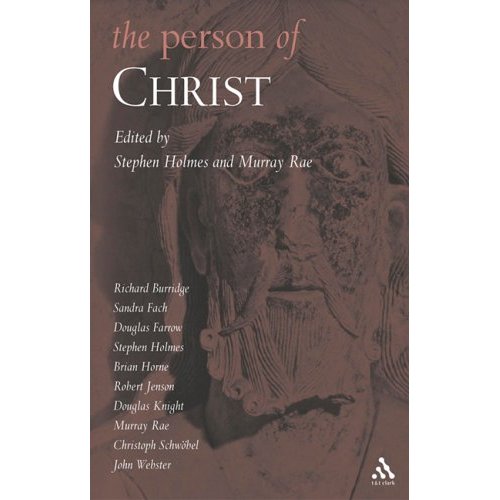
The Person of Christ is a product of King’s College London – before the glory departed. Here is what T & T Clark says about it:

Understanding the Person of Christ affects our understanding of all Christian theology. All ten contributors to this volume share a commitment to the orthodox theological tradition in Christology as expressed in the creedal heritage of the Christian church, and seek to explicate the continuing coherence and importance of that theological tradition. The book’s ten essays cover such topics as prolegomena to Christology, the incarnation, the person and nature of Christ, the communicatio idiomatum, the baptism of Christ, the redemptive work of Christ, the ascended Christ, and New Testament Christology, and offers critical engagements with such diverse theologians as John Calvin, Charles Williams and John Zizioulas. The contributors, all leading academics, include: John Webster, Richard Burridge, Robert Jenson, Stephen Holmes, Douglas Farrow, Brian Horne, Murray, Douglas Knight, Sandra Fach, Christoph Schwoebel.

More great work from Kings is appearing in November and spring of next year, five volumes that I know of, among them Colin Gunton’s Lectures on Karl Barth, so the old place is enjoying a great afterlife. Friends will find advance notice of Alan Spence’s The Promise of Peace: A Unified Theory of Atonement at T & T Clark, but for the rest of you I am saving Alan for my ‘theology in London’ series (for which I’d welcome suggestions for candidates).

Benedict – talking to Muslims

Richard Neuhaus at First Things (On the Square 18th September) offers a variety of views on what Pope Benedict said last week at Regensburg. Neuhaus himself says this:

â??Pope Benedict â?¦ is a man of great gentleness and deliberation and extremely careful to say what he means. What he said at Regensburg he has said many times before. Contrary to many reports, he has not apologized or retracted his argument. He has indicated sincere regret that many Muslims have reacted to his statement as they have. The response of those who are properly called jihadists is, â??If you donâ??t stop saying weâ??re violent, weâ??re going to bomb more churches, kill more nuns and priests, and get the pope too.â?? In short, the reaction has powerfully confirmed the problem to which Benedict called our attention.â??

The very reverse of inflammatory or careless, Benedict appeals with very great courtesy and encouragement to beleaguered moderate Muslim, anxious to help them win the argument against extremists. There is no great difference between Benedict and John Paul II here.

And here is part of a longer excerpt from Benedict himself speaking to Muslims:

It is in this spirit that I turn to you, dear and esteemed Muslim friends, to share my hopes with you and to let you know of my concerns at these particularly difficult times in our history.
I know that many of you have firmly rejected, also publicly, in particular any connection between your faith and terrorism and have condemned it. I am grateful to you for this, for it contributes to the climate of trust that we need.
Terrorist activity is continually recurring in various parts of the world, plunging people into grief and despair. Those who instigate and plan these attacks evidently wish to poison our relations and destroy trust, making use of all means, including religion, to oppose every attempt to build a peaceful and serene life together.

Dear friends, I am profoundly convinced that we must not yield to the negative pressures in our midst, but must affirm the values of mutual respect, solidarity and peace. The life of every human being is sacred, both for Christians and for Muslims.
There is plenty of scope for us to act together in the service of fundamental moral values.

You, my esteemed friends, represent some Muslim communities from this Country where I was born, where I studied and where I lived for a good part of my life. That is why I wanted to meet you. You guide Muslim believers and train them in the Islamic faith.

Teaching is the vehicle through which ideas and convictions are transmitted. Words are highly influential in the education of the mind. You, therefore, have a great responsibility for the formation of the younger generation. I learn with gratitude of the spirit in which you assume responsibility.

Christians and Muslims, we must face together the many challenges of our time. There is no room for apathy and disengagement, and even less for partiality and sectarianism. We must not yield to fear or pessimism. Rather, we must cultivate optimism and hope.

I donâ??t see how you can get more gracious or encouraging than that. “I learn with gratitude of the spirit in which you assume responsibility.” That is certainly how I feel about Benedict, and only wish he could say it to me and my lot.

For more good sense on this issue, see Amy Welborn and Anne Applebaum in the Washington Post.