Catholicity 12

The Christian is a member of an assembly that participates in the future assembly of all things. Under the instruction and supervision of that assembly the Christian begins to grow into their place and role, and to learn that this assembly has more in store for him or her. However the individual Christian may delay taking up their identity, this assembly refuses to let him or her become less, or become an object, they do not allow that everything has been said about them. To know them we have to open ourselves to the point at which we can let them surprise us.

The completion and catholicity depends on our Amen, which is the public event of the acknowledgment, which we give in freedom. As we give this Amen, we grow, our ability to grant the freedom of others, and with it our own freedom, grows.

The basis of knowledge is communion, and bound by love, in which we participate in one another in friendship, brotherhood and many other forms. It is as we respond to people, and they to us, that we know people. To come to know them more fully we have to respond them, and wait for them, and receive their response gladly, and learn to give them whatever will direct them towards their fulfilment. We have to give them Christ and all his hospitality and its truth, and not thank them for anything but Christ and all his truth. There is no knowledge without love. This love is that fellowship which is the whole loaf of Christ and his people. Thus catholicity, of which the eucharist is the event, is the origin of the universality of knowledge. It is this catholicity and comprehensiveness to which all the sciences of the university aspire. The university is universal to the extent that it participates in the catholicity that derives from the eucharist and observes the anticipatory character and so observes the proper limits of our knowledge.
Previous Catholicity posts

The Vocation and Formation of Theologians

In 1997 the Bishops of England and Wales reminded us that â??the basic understanding of education [is] human development . . . at the heart of it is a human being within whom as far as human willfulness allows, the creator will perfect the image of his divine Sonâ??. At the same time we have been reminded that â??manâ??s nature calls him to seek the truth while ignorance keeps him in servitudeâ??. In the struggle to discern and make plain the truth, the theologian, as the one entrusted with the task of theology, is entrusted to the searching out of truth in a special way. If, as John Paul II has said, truth â??is the precondition for a true and sincere dialogue among men and womenâ??, he has added that in the context of this quest for truth â??the principal task of theology consists in this, to provide both an understanding of Revelation and the teaching of faithâ??.

The theologian is entrusted to the truth in a particular way, therefore, entrusted both to its discernment and the discovery of its being and causes and to its becoming and being made manifest. It is this double nature of truth that the theologian has a special calling to witness to â?? truth insofar as it is wisdom, insofar as what it is that thinking (or what is often called reason and the artes or sciences) discovers and unfolds; and truth as it is manifest in being called in the activity of the Spirit to discover through the person of Jesus the Christ an encounter with the Father. These are then the two wings â??by which the human spirit is raised up toward the contemplation of truthâ?? which, as it were, the theologian is called in a particular way to assume and become skilled in the use of, and by which the theologian both rises and draws others up to assume.

Yet the theologian, as the one so entrusted, finds himself especially at risk in this task. If â??theology has importance for the Church in every ageâ?? and if it is â??also exposed to risks since it must strive to â??abideâ?? in the truthâ?? in taking account of the new problems which confront the human spirit, it is the theologian who must often bear the anguish of this exposure to risks whilst at the same time striving to remain in the truth and pointing, both in his teaching and in his life, to where the truth remains and is yet again to be found.

Properly have the greatest amongst the theologians been declared doctors of the Church, and have been called from among all of the ranks of the People of God, from the Martyrs, the Apostles, the lay and the ordained, the secular and professed. If some have been proficient in the schools, some have rightly claimed as their first and only teacher Christ the Lord himself (this has been particularly true of those women who stand among the doctors of the Church), since those who are doctores are first doctus, ones taught, and so schooled in the Lordâ??s service, and in the service of his Church. Those among us who would teach must then be first among those who would be taught. In this, the theologian, though often experiencing his vocation as a lonely task, is never alone, since he is called always to share in the life of the Church, and to share with the Church the fruits of his learning and teaching. Called to be conjoined to the body of Christ in the sacraments, and nourished also by contemplation of the word, he manifests his vocation in a special relation to the Magisterium and in the particular or local situation, to the Bishop.

The Vocation and Formation of Theologians and the Teaching Office of the Bishop in the British Context (large PDF) â?? A Discussion Sponsored by the Society of St. Catherine of Siena (UK)

Shouts of joy

Acclamations 53. The acclamations are shouts of joy which arise from the whole assembly as forceful and meaningful assents to God’s Word and Action. They are important because they make some of the most significant moments of the Mass (gospel, eucharistic prayer, Lord’s Prayer) stand out. It is of their nature that they be rhythmically strong, melodically appealing, and affirmative. The people should know the acclamations by heart in order to sing them spontaneously. Some rite is abbreviated in accord with the General Instruction on The Liturgy of the Hours.

The Liturgy of the Word 45. Readings from scripture are the heart of the liturgy of the word. The homily, responsorial psalms, profession of faith, and general intercessions develop and complete it. In the readings, God speaks to his people and nourishes their spirit; Christ is present through his word. The homily explains the readings. The chants and the profession of faith comprise the people’s acceptance of God’s Word. It is of primary importance that the people hear God’s message of love, digest it with the aid of psalms, silence, and the homily, and respond, involving themselves in the great covenant of love and redemption.

The Alleluia 55. This acclamation of paschal joy is both a reflection upon the Word of God proclaimed in the liturgy and a preparation for the gospel. All stand to sing it. After the cantor or choir sings the alleluia(s), the people customarily repeat it. Then a single proper verse is sung by the cantor or choir, and all repeat the alleluias

Responsorial Psalm 63. This unique and very important song is the response to the first lesson. The new lectionary’s determination to match the content of the psalms to the theme of reading is reflected in its listing of 900 refrains. The liturgy of the Word comes more fully to life if between the first two readings a cantor sings the psalm and all sing the response. Since most groups cannot learn a new response every week, seasonal refrains are offered in the lectionary itself and in the Simple Gradual. Other psalms and refrains may also be used, including psalms arranged in responsorial form and metrical and similar versions of psalms, provided they are used in accordance with the principles of the Simple Gradual and are selected in harmony with the liturgical season, feast or occasion.

Committee on the Liturgy, US Conference of Catholic Bishops – Music in Catholic Worship

London Theology of the Body

The Theology of the Body lectures continue on Friday evenings St. Patrickâ??s Soho Square, London. The lectures are going through the theological teaching on marriage given by Pope John Paul II in his general audiences (GA)

II. Blessed are the Pure of Heart
Jan 12 Rod Isaacs: â??The Heart â?? A Battlefield between Love & Lust.â?? (GA July 23rd 1980)
Jan 26 Matthew Nichols: â??Establishing the Ethical Sense.â?? (GA Oct 1st 1980)
Feb 2 Fr. Mark Withoos: â??The Human Body, Subject of Works of Artâ?? (General Audience April 15th 1981)

III. The Theology of Marriage & Celibacy
Feb 23 Robert Colquhoun â??To be Imitators of God & to Walk in Loveâ?? (GA Aug 4th 1982)
Mar 2 Fr. Mark Withoos: â??Virginity or Celibacy for the sake of the Kingdomâ?? (G A. March 10th 1982)
March 23 Jane Deegan: â??Love is Victorious in the Struggle between Good and Evilâ?? (GA June 27th 1984)

IV. Reflections on Humanae Vitae
April 27 Edmund Adamus: â?? The Churchâ??s Position on the Transmission of Lifeâ?? (GA August 22nd 1984)
May 11 Dan & Anne Hill: â??A Discipline that Ennobles Human Love.â?? (GA Aug 28th 1984)
May 25 Alison Gray â??The dignity and vocation of woman and her role in the Churchâ??
June 8 Love and Responsibility â?? Theology of the Body

Pope John Paul II Man and Woman He Created Them: A Theology of the Body

Meanwhile, from the basement of that very same St Patrick’s in Soho, London, Nicole Syed provides advice on Natural Fertility Management. Nicole says this:

Through the content of the course and a lot of my own reading of John Paul IIâ??s Theology of the Body, I found the holistic way of life that I had been looking for, integrating every aspect of our lives, physical, emotional, sexual and spiritual. I realised that promoting this message was what I wanted to do to help transform the lives of those around me. It became increasingly clear to me from a health perspective, that the contraceptive industry had manipulated the way people think about fertility, treating it as an illness that needs to be suppressed and controlled at all costs. Because of my nursing background I could see how the pill and most other artificial contraceptives were physically destructive to the body, but as I studied more of the theology, I could also see how contraception was spiritually and relationally damaging to couples on a totally different level â?? one that was subtle and often undetected.

Many young couples who are interested in NFP, tell me itâ??s really difficult to find out about it now, because most priests are too embarrassed or afraid to mention it, and it seems it is rarely talked about on marriage preparation courses any more. Itâ??s just assumed that if people are interested they will find out about it themselves, but often they donâ??t know where to look, so they just end up using artificial means because thatâ??s all they know about and no one has explained to them what the Church teaches and why. The contraceptive industry is a massive money making industry and its propoganda has really formed the way our whole society thinks about this issue, so if we are going to challenge this, the Church really needs to get its act together.

And see the Couple to Couple League or Couple to Couple League (UK). Don’t say I don’t provide you with a service.

Toward an Anglican Theology in the Spirit of Windsor

I am in the wrong London. It is all happening in London, Ontario, today at Huron University College

Faith Seeking Understanding: The Windsor Report, the St. Michael Report, and the Challenge Ahead

Much has been said and written about the conflicts that have arisen over the past decade in the Anglican Communion and the Anglican Church of Canada. This two-day conference for Canadian Anglicans about Anglicanism in Canada will provide an opportunity for clergy and laity to learn, discuss and understand the reality and rhetoric of the recent public documents such as “The Windsor Report” and Canada’s own “St. Michael’s Report,” as well as to discuss such related larger issues as the use of scripture, the theological dimension of human sexuality, and the nature of authority in the Church. As the intent is understanding and not advocacy, the conference will close with a Eucharistic gathering.

Some great papers are promised:

Timothy Connor & George Sumner Toward an Anglican Theology in the Spirit of Windsor

Gary D. Badcock What is a Communion, Anyway?

and in particular

Darren C. Marks Overcoming the New Gnosticism: Re-founding Theological Anthropology

Over the course of modernity embodiment has become a major theme of theology and as such has introduced a theological anthropology that is at variance with its origin in Christology or Christ as the pneumatic human. As a result of this morphing of theological anthropology, sexuality, as echoed in the work of Foucault, has become a dominant dialogue partner in identity let alone theological anthropology by assuming nature as antithetical to spirit. This, I argue, introduces a host of issues that are centripetal to the hope of dialogue with a Christian culture in the Global South that has not undergone this morphing of [sexuality] identity and embodiment. Instead, a re-founding of theological anthropology in Christology, and specifically in the concept that God only knows the human person as sinner (Bonhoeffer), might provide a way forward that proves acceptable to both Western and Global minds, or at least provide a place from which a theological anthropology can initiate a dialogue. Finally, and tethering to the St Michael Report, I suggest that just such a theological assumption resolves the centripetal forces in the document’s conclusions and mixed message on the nature of adiaphora and core doctrine.

Is this the Darren Marks of ‘The Windsor Report: A Theological Commentary’ (Journal of Anglican Studies Vol 4.2 pp157-76)? It is ‘a profound piece of writing influenced greatly by John Webster’ according to my informant. Now I am really am interested – John Webster is one of the UK’s finest – Anglican of course, but I hadn’t noticed a lot of ecclesiology from him yet. Please rush me a copy.

Catholicity 11

This theological doxological mode of knowing enables all other forms of knowing, amongst them natural science. It provides the framework which prevents science from imposing an unlimited power over its object. This framework guarantees that we are distinct from what we know, that the world and other creatures are distinct from us. It is the assurance that neither the world nor any object in it are divine, and that they are not constructed by us, and thus we are not divine. The acknowledgment that we are not God is the real foundation that we may have real knowledge of anything, and thus it underwrites and enables science.

For the human without God however, the highest form of mastery is that of the scientist who can place before them the object of their enquiry before them. Whether this object is a thing or a person, the form of scientific knowing, makes an inert object of it. This object of enquiry is not expected to introduce itself, to speak back or to play any part in the process by which it becomes known. The scientist can control it so that it cannot become anything that it is not already. To such science the object is inert so that it will never be able to surprise or threaten the knower. Such knowledge will require the regular re-assertion of the mastery of the knower, and this act of subjugation will impoverish the knower as well as the known.

But this is not an adequate form of knowing. Knowledge, or science, without love, is just an act of control and mastery. Knowledge without love means that we never have the confidence or self-mastery to be not only a master, controller and manipulator, but also a friend and even a servant.

To cast ourselves on novelty

It is, of course, right that philosophers should speak as believing Christians. It is right that they should do their philosophising in a conscious openness to theology… But it is not good that they should confuse the philosophical task of understanding the world as it presents itself with elements randomly introduced from Christian proclamation. The result of that will be a deformation both of theology and philosophy. Theology needs the philosopher’s reflection on the moral sense of the world, in order to think seriously about the fulfilment of creation. For without the love of what is, the “new creation” is an empty symbol – or is it a clanging cymbal? New creation is creation renewed, a restoration and enhancement, not an abolition. Not everything that can be thought of as future can be thought of as the Kingdom of God. A brave new world of cyborgs is not a Kingdom of God. God has announced his kingdom in a Second Adam, and “Adam” means “Human”.

One thing that is at risk in this approach, as in a thousand less articulate and less measured approaches along the same path, is the disappearance of scientific knowledge from the criteria of moral responsibility. We are invited to set the observation of nature aside, to cast ourselves on novelty. It is, indeed, striking how scientific curiosity – inadequate, one-sided and inconclusive as much of it may have been – has come to be banished from the discussion of homosexuality. Adams has done us the service of displaying the intellectual underpinnings of this development: a concept of value that has parted company with a concept of reality, a division between the good and the real. But moral responsibility to the real is precisely what the dialectic of creation and redemption in Christian theology safeguarded.

Oliver O’Donovan Creation, Redemption and Nature

Ecumenical failures of the Reformation – Witt

My own theory is that Modernism is divine judgment on Western Christendom for the ecumenical failures of the Reformation. Because both Rome and the Churches of the Reformation were unable to recognize the face of Christ in each other, including even Reformation churches who refused to recognize that face in each other, the divine judgment is that those churches are becoming ones in which the face of Christ is no longer able to be recognized at all.

But in that case, the last thing confessing Christians in all the churches need is once again to draw lines in the sand against one another, to refuse to recognize Christ’s face in those who affirm the same Scriptures and confess the same Creeds. I can only regard the voices of those who ask me to leave Anglicanism for either Rome or Orthodoxy or some other Reformation Church as asking me to deny that the face of Christ can be seen in this Church.

I believe that a sorting out is taking place—that in fact a separation must and will take place between those in the Churches who continue to affirm historic Christian faith, and those who have exchanged Christ for the world’s pottage. The struggle is against apostasy and heresy, and it is both. Those who offer the safety of Rome or Orthodoxy are right about that. But in that struggle, I think it important that those who continue to confess Christ in each Church in which the divine judgment strikes, stand firm and resist the apostasy together. We stand our ground, shoulder to shoulder, where Christ has placed us in the battle.

And, of course, one of the things that Anglicanism shares with both Roman Catholicism and Orthodoxy is that, unlike many Reformation Churches, we do not stand alone, but are part of an international Communion, a Communion that has held firm to the faith.

William Witt Why not leave?

Sacrifice and Israel’s witness to the nations

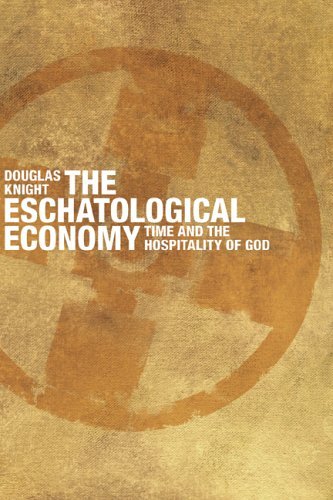
The Eschatological Economy

It is time for another in the series of little pieces on the logic of sacrifice and atonement, which I set out in the central chapters of The Eschatological Economy.

The reason we find sacrifice, along with other accounts of salvation, hard to accept is that we tend to overlook the crowd watching the event in the temple. A sacrifice is not a deal done between just two parties, man and God, but between at least three parties. The third is the crowd of onlookers – made up the whole people of Israel. In fact there are two crowds – Israel is the first and nearest, but all the rest of the world is also there, watching Israel and her God from a distance.

But modern biblical studies does not find it easy to account for the public nature of performance. In The Eschatological Economy I wondered whether this is because we assume that writing is the only valid, because verifiable, mode of communication. Do we assume that what cannot be written down is not significant? Yet publicly enacted drama, played out before vast crowds and the world’s media in public civil occasions, is significant – think of the ceremony attached to Olympics, or public acts of flag-burning. If do not concede the meaningfulness of such large scale public ceremonies, or ‘ritual’, how will we understand what was going on in the public events of sacrifice that took place in Israel’s temple at Jerusalem?

In the theology of Israel, the nations were represented by animals: Israel was represented by the lamb. The presentation of the lamb in the temple in Jerusalem was the enactment of the promise of God that Israel would triumph over all the predatory gentile nations of the world.

Though this is not directly theological work, it does build the case that modernity is in denial about crowds and plurality, and about other more embodied forms of rationality than its own, and it helps show that sacrifice does make good sense as an account of the atonement. This will help us show that the atonement makes good sense as account of the relationship of God and us, and also that it makes for a better account of relationships between ourselves. Theology makes for a better sociology than sociology itself does.

You can find out more about The Eschatological Economy at Amazon.com or at Amazon.co.uk or at Eerdmans

Ten theses on the Significance of the Episcopal Office for the Communion of the Church

Thesis Four:

The Bishop has oversight (episcope) of the household of God for the good order of the Church.

Bishops are commissioned and sent to be stewards or overseers of God’s household within their jurisdiction. They call the people of God into the full expression of the diverse gifts and ministries given by the Holy Spirit. They oversee processes of discernment and selection of candidates for holy orders, ensuring they are well prepared for their ministries, supporting them pastorally and practically, and providing for the good order of ministry in the diocese.

Oversight includes sharing of responsibilities among clergy and lay people. This involves mutual accountability, good communication and willingness to learn from one another. This reciprocity between bishop and people is reflected in the decision making processes of synodical life. This pattern of working together is empowering for all and is a gift to be nurtured at all levels of the life of the Church.

The bishop has to ensure the well-being (e.g., spiritual, social, economic) of the diocese in service of its mission. Harnessing resources, fund-raising and financial management of diocesan affairs involves complexities of oversight requiring specialized ministries. Providing episcope in this area highlights the administrative and managerial character of the work of a bishop, somewhat akin to a CEO (Chief Executive Officer) of a large organisation. Bishops ought not to underestimate the distorting effects on their oversight of management models associated with the global market economy. This can lead to a management ethos focussed on strategic plans, goal setting, tasks, competition and successful outcomes. This is appealing because it seems to offer clarity and control but the price is often loss of the personal and relational dimension of ecclesial life. The bishop who manages well is one who is aware of the danger of management becoming the basic lens through which episcope is practised. This issue raises a question of how bishops handle matters across diocesan and provincial boundaries. At these levels even koinonia may become a thing to be ‘managed’ at a distance (i.e., avoiding face-to-face relations) rather than resolutely pursued together with patience.

Inter Anglican Theological and Doctrinal Commission The Anglican Way: The Significance of the Episcopal Office for the Communion of the Church October 2006