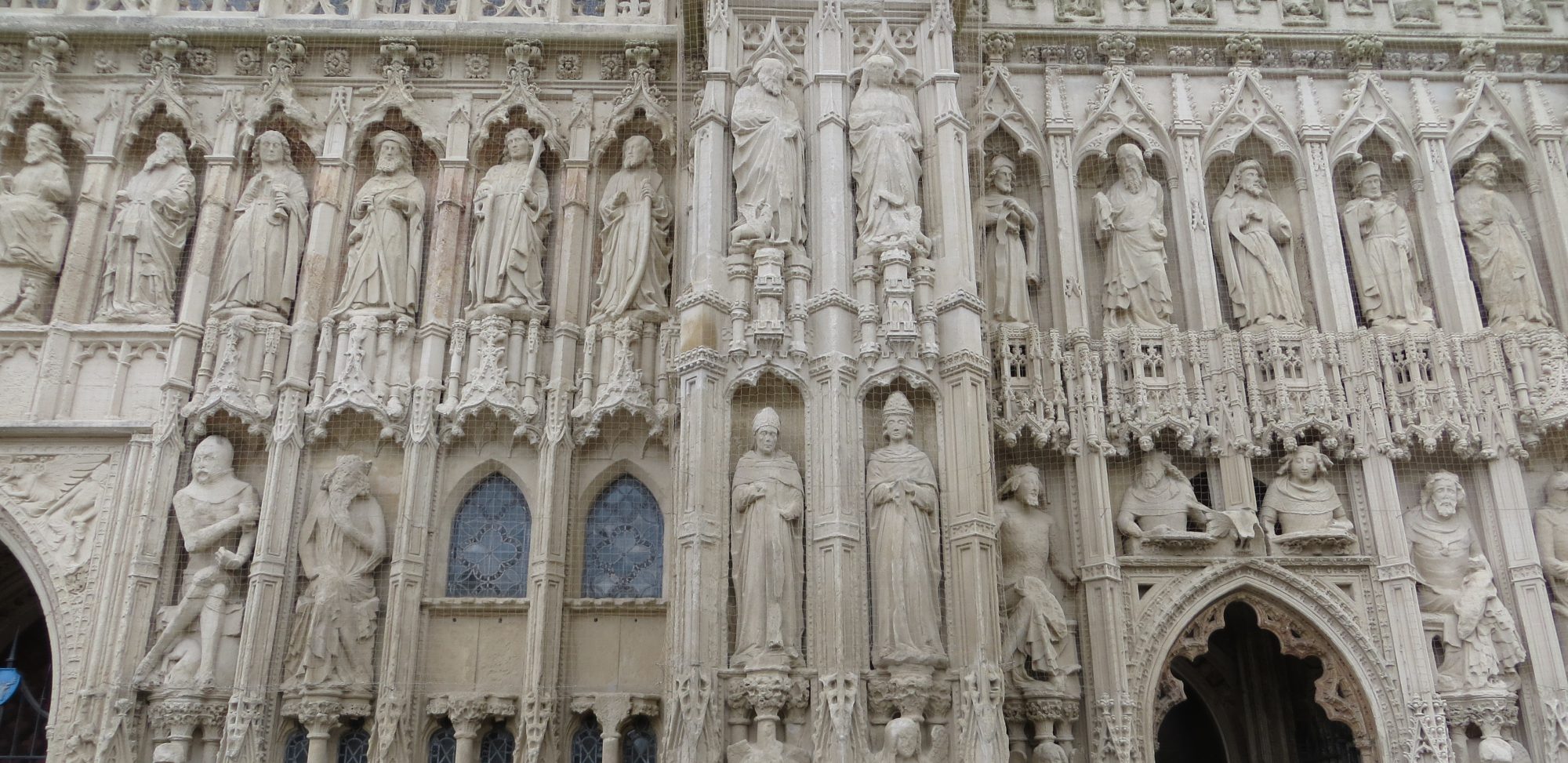
Whenever I face another human being, I face a mystery

Christianity teaches that each person is created by God with a distinct calling and capacity. For the Christian believer, human dignity – and therefore any notion of human rights – depends upon the recognition that every person is related to God before they are related to anything or anyone else; that God has defined who they are and who they can be by his own eternal purpose, which cannot be altered by any force or circumstance in this world. People may refuse their calling or remain stubbornly unaware of it; but God continues to call them and to offer them what they need to fulfil their calling. And the degree to which that calling is answered or refused has consequences for eternity.

This means that whenever I face another human being, I face a mystery. There is a level of their life, their existence, where I cannot go and which I cannot control, because it exists in relation to God alone – a secret word he speaks to each one, whether they hear or refuse to hear, in the phrase from the prophecy of Ezekiel. The reverence I owe to every human person is connected with the reverence I owe to God’s creative Word which brings them into being and keeps them in being. I stand before holy ground when I encounter another person – not because they are born with a set of legal rights which they can demand and enforce, but because there is a dimension of their life I shall never fully see, the dimension where they come forth from the purpose of God into the world, with a unique set of capacities and possibilities. The Christian will have the same commitment to human rights and human dignity; but they will have it because of this underlying reverence, not because of some legal entitlement.

. . . .

The churches do not campaign for political control (which would undermine their appeal to the value of personal freedom) but for public visibility – for the capacity to argue for and defend their vision in the public sphere, to try and persuade both government and individuals of the possibility of a more morally serious way of ordering public life.

Archbishop Rowan Williams Christianity Public Religion and the Common Good St Andrew’s Cathedral, Singapore 12th May 2007.

Islamic self-criticism

In a striking example of self-analysis, about 500 delegates, including both practising and nominal Muslims, attended an inaugural Secular Islam Summit this month in St Petersburg, Florida.

The declaration was signed by such luminaries as Ibn Warraq, a widely published author, whoA group of prominent secular Muslims has shown the kind of unconditional willingness to engage in self-criticism which is so well-established in the non-Muslim West. The declaration points the finger at some of the pillars of institutional Islam, calling on governments to â??reject Sharia law, fatwa courts, clerical rule, and state-sanctioned religion in all their formsâ??, and to â??oppose all penalties for blasphemy and apostasy, in accordance with Article 18 of the Universal Declaration of Human Rightsâ??.

Rather than trumpeting the message of Muslim conservatives, who call for obedience to authority structures, this new group demands â??the release of Islam from its captivity to the totalitarian ambitions of power-hungry men and the rigid strictures of orthodoxyâ??.
In perhaps the most controversial statement of all, the group calls for â??a fearless examination of the origins and sources of Islamâ??. This suggests that the scriptural foundations of Islam, the Qurâ??an and Hadith, should be subject to scrutiny.

Of course, there must be some doubt about the extent to which the secular Muslims will have any impact in Muslim-majority countries. Yet theirs is a voice that is long overdue. Under the right circumstances, they might trigger a process of profound self-examination among some Muslims.

Peter G. Riddell A breath of Islamic fresh air – Secular Muslims are creating signs of hope: donâ??t knock them

The St Petersburg Declaration There is a noble future for Islam as a personal faith, not a political doctrine

Europe’s predicament is self-inflicted

Europe’s current problems are entirely self-inflicted. This does not mean, however, that the result will be less catastrophic. By subverting the roots of its own Judeo-Christian culture – a process that started with the French Enlightenment (as opposed to the Scottish Enlightenment, which was not anti-religious) – a religious and cultural vacuum was created at the heart of European civilization. The collapse of faith in its own values has, not surprisingly, led to a demographic collapse because a civilization that no longer believes in its own future also rejects procreation. Today, a new religion and culture is supplanting the old one. There is little one can do about it, but hope for a miracle.

America’s immigration problems pale in comparison with what confronts Europe. America’s major ethnic minorities – Blacks as well as Hispanics – are Christian, while the meanstream culture is also rooted in Christianity. In Europe a secularized post-Christian culture is facing a Muslim one. The secularized culture is hedonist and values only its present life, because it does not believe in an afterlife. This is why it will surrender when threatened with death because life is the only thing it has to lose. This is why it will accept submission without fighting for its freedom. Nobody fights for the flag of hedonism, not even the hedonists themselves.

I suppose one could feel sad about all this, but sadness is not what I feel. One can feel compassion for those who die in accidents, fall in battle or get murdered (like the countless unborn children that perish every day) but can one pity those who have killed their own future for the pleasures of the present? Europe’s predicament, I repeat, is entirely self-inflicted. Not Islam is to blame. Secularism is.

Paul Belien The Closing of Civilization in Europe

The reduction of scripture

One of the points made was that many religious houses, whilst centred deeply on prayer and the eucharist, have allowed the study of scripture to fall into neglect. When it does take place, it is predominantly the individual religious who ‘studies scripture’, meditating alone with his or her Bible. Aside from recitation of the psalms and the lections in worship, there is little if any communal engagement with scripture – and its use in worship is in any case a thing distinct from study.

It is not only the ‘catholic’ tradition that faces worries about the quality of scripture study in the life of the Church today. Many of those gathering in the Deep Church group in London come from charismatic and/or evangelical backgrounds, and feel that their traditions while professing to be ‘biblically based’ often engage with scripture in a relatively superficial way. This can be because a strong doctrinal paradigm acts to preempt a sustained attentiveness to the possibilities and nuances of a text – the reader already ‘knows’ what she is going to find; she thus hears what she expects to hear. It can also be because scriptural texts are deployed in relative dissociation from each other (in bite-sized chunks, used for very specific pastoral or teaching purposes, and thereby prematurely instrumentalized), or else through very controlled forms of association with specific other passages or verses (again, it is often doctrinal concerns that dictate which associations are considered legitimate).

‘Bible Studies’ in the contemporary church often manifest precisely an evasion of scripture, rather than a willingness to take it seriously. This is true at every level of the Church’s life: I saw exactly the same symptoms at work in the Bible Study groups of senior bishops at the Lambeth Conference in 1998 as in many student or parish groups.

Broadly, two tendencies tend to emerge – neither of them wholly satisfactory. The first is the reduction of scripture to propositional statements, which are then deployed as authoritative descriptions (of the world, human beings, the facts of sin and redemption, or
whatever), or else as irresistible ethical instructions or injunctions. As a mode of reasoning which works from the establishment of clear first principles and then works out from them, this approach to scripture might be described as rather like ‘deductive’ reasoning.

The other dominant tendency – even more prevalent in my experience – is one which uses the reading of scripture as an occasion to tell stories about oneself and one’s own religious experience. Scripture is thus made a vehicle or opportunity for self-expression, rather than being read as something with its own internal ‘logic’ and power to resist and reconfigure the reader’s expectations and understanding. As a mode of reasoning which seeks to derive judgements from experience, this might be likened to an ‘inductive’
approach to scripture.

Ben Quash Deep calls to Deep

Ben is moving from Peterhouse Cambridge, where he was Dean, to become Professor of Theology and the Arts at King’s College London

The reach of the State

I think weâ??ve reached a point where certain things need to be clarified about the rights, liberties and dignities of independent bodies with the State (the Archbishop of Canterbury to Robert Pigott of the BBC on Jan 24th 2007).

In what follows I want to explore why I think that the Archbishop has offered that careful and profoundly serious observation and to ask, in the light of recent events and with the publication imminent of the long-awaited Sexual Orientation Regulations for the UK Mainland, whether there are limits to the â??reachâ?? of the State?

The Government – basing itself in a range of convictions and ideas quite widely but by no means universally held, and often loosely linked to the Human Rights Act – is behaving increasingly as if Government and Parliament were the sole arbiter of what is right and good and wholesome, whether for individuals or for society.

There is appearing a jealous, if somewhat edgy, and a rather poorly informed intolerance of alternative moral and ethical authorities, and especially of those based in the life and the traditions of communities of Faith.

And unless, to use the Archbishops judicious language, â??certain things……are clarifiedâ?? and certain people think about all this with rather more care, there seems to be a real danger that this country will come to lose the contributions made to every aspect and level of its life by its range of independent voluntary bodies, many but by no means all of which have their roots and motivation in the Churches or in other communities of Faith.

At stake is the status of marriage in British society. Government and Parliament are imposing upon the country â?? and especially upon the Churches â?? alternative concepts of the family and of parenting as the equivalents of marriage.

Where does this leave this countryâ??s hard-won traditions of religious freedom and of the freedom of the individual?

The Government is rightly concerned that the Human Rights Act should be valued and welcomed, not misused as whipping-boy by means of all sorts of fantastic charges against it. The Government could have used the HR Act, as the Polish Government used it, to exempt Roman Catholic and other adoption agencies from the SORs. But instead it has chosen to privilege secular over religious ideologies, perhaps because it thinks it opportune to cut the Churches down to size after the autumnâ??s arguments over (so-called) â??Faith Schoolsâ??.

And Government is colluding with those who would corral the Churches and the Faiths into the private sphere, so as to leave â??the street, public life and political decision-making open to the influence only of secular ideologies.

No wonder the RC Archbishop of Southwark has called the recent decisions about Faith-based adoption agencies â??a triumph of dogmatism over freedom of conscienceâ??.

Nor are these the first examples. Registrars are required, at the risk of their jobs, to officiate at marriages of transgendered people and at registrations of Civil Partnerships, even if they have conscientious hesitations about doing so. Verified stories abound of Faith-based, and especially Church-based, organisations that offer social care, often to some of the most disadvantaged and demanding individuals and groups, which have had their public funding threatened as officialdom is anxious about a crucifix on the wall or Grace before meals.

Is this ignorance? Or prejudice? Or is it intolerance, even fear of an influence and a source of authority beyond and implicitly challenging the authority of the State? Must diversity of provision have been designed and authorised by Whitehall and Town Hall, rather than developed over centuries in a society that has had to struggle hard and long to win its freedom from Government.

How close are we getting to the point when a religiously-formed conscience will be seen as an obstacle to, rather than an inspiration for, service in Parliament, and still more in high political office? What an irony, as we celebrate William Wilberforce and all the others, of many churches and more than one Faith, through whose efforts in Parliament the Slave Trade was abolished.

The Rt Revd Michael Scott-Joynt, Bishop of Winchester, When the State decides what the Church believes

Christians in the UK public square

Communicating Bible to Babel
– Exploring and shaping the debate on Christian language and communication in the public square

Liverpool Hope University Friday 28 – Saturday 29 September 2007

For a long time religious discourse has had limited access and impact in politics. In the UK, it is generally acknowledged that Christian political discourse has not been effective in speaking truth with grace in our contemporary mediascape. However, given the growing number of challenges to secularism, it is clear that God is very much back on the political agenda. In this new context, it is important to explore the themes and issues that define language and communication of a Christian worldview in the public square.

Following Bible Society Discourse Process events at political party conferences and a Parliamentary symposium, the colloquium will provide for a more detailed theological and philosophical exploration. With an interdisciplinary approach, it will offer a forum to
facilitate discussion about the development of Christian political discourse.

Bishop of Liverpool, Rt Revd James Jones
Dr Jolyon Mitchell, School of Divinity, University of Edinburgh
Nick Spencer, Theos – the public theology think tank
Professor John Sullivan, Centre for Christian Education

Building on themes and issues raised in the earlier events, the colloquium facilitates a more sophisticated theological and philosophical exploration of the language and communication of Christians in the public square. On the basis of what we understand and experience about the challenges and opportunities for ‘Doing God’ in contemporary political discourse, this event develops thinking about the necessary connections between worldview and discourse in public theology.

Catholic in London

I have found three events organised by the Roman Catholic Diocese of Westminster in London

1. First Sunday Plus Young Adult Ministries launches THEOLOGY-on-TAP, a speaker series for young adults 18-39 straight talk, hard facts and real answers about our Catholic faith and how to live it in real, everyday life.

2. Society and its problems: The Catholic perspective
A series of four Monday evening talks and questions at St Mary Moorfields entitled: ‘Society and its problems: The Catholic perspective’ by Edward Hadas.

1. Wealth and work: Economic issues in an industrial age (Monday 4th June at 6.30pm)

2. The ruling class: The right way for government (Monday 11th June at 6.30pm)

3. War and peace: Idealism, realism and hope (Monday 18th June at 6.30pm)

4. Modern society: Light and shadows (Monday 25th June at 6.30pm)

Edward Hadas is Associate Editor at Breakingviews.com. His book, Human Goods, Economic Evils; A Moral Look at the Dismal Science will be published by ISI Books in August. He has also written a coursebook on political and social philosophy for the Maryvale Institute in Birmingham.

3. Marriage: the rock on which the family is built; the rock on which society is built. An evening with Dr. William E. May Vaughan House, Francis St (behind Westminster Cathedral) Monday 21st May, 6pm – 8pm.

Dr. May will share his reflections for discussion on male/female complementary,and the importance of the role of the family as the domestic Church in the work of evangelisation.

Dr May is the Author of ‘Marriage: the rock on which the family is built’ (1995) and the Michael J. McGivney Professor of Moral Theology, Pontifical John Paul II Institute for Studies on Marriage and Family, The Catholic University of America, Washington, DC. Member of the International Theological Commission from 1986 through 1996.

I’ll go to that last one – even I have heard of William E May .

Humility is the beginning of sanity

The â??common goodâ?? is more than a political slogan. Itâ??s more than what most people think they want right now. Itâ??s not a matter of popular consensus or majority opinion. It canâ??t be reduced to economic justice or social equality or better laws or civil rights, although all these things are vitally important to a healthy society.

The common good is what best serves human happiness in the light of what is real and true. Thatâ??s the heart of the matter: What is real and true? If God exists, then the more man flees from God, the less true and real man becomes. If God exists, then a society that refuses to acknowledge or publicly talk about God is suffering from a peculiar kind of insanity.

What can the â??common goodâ?? mean in the context of Nietzscheâ??s superman or Marx or Freud or Darwin? These men became the architects of our age. But they were also just the latest expressions of a much deeper and more familiar temptation to human pride. We want to be gods, but weâ??re not. When we try to be, we diminish ourselves.

Thatâ??s our dilemma. Thatâ??s the punishment we create for ourselves. Thereâ??s a terrible humor in a man who claims that God is dead, then starts believing heâ??s Dionysius or Jesus Christ, and then ends up on a candy bar made by out-of-work philosophers for middle-class consumers who just want some â??chocolaty goodness.â??

Humility is the beginning of sanity. We canâ??t love anyone else until we can see past ourselves. And man canâ??t even be man without God. The humility to recognize who we are as creatures, who God is as our Father, what God asks from each of us, and the reality of Godâ??s love for other human persons as well as ourselvesâ??this is the necessary foundation that religion brings to every discussion of free will, justice, and truth, and to every conversation about â??the common good.â?? Sirach and the Psalms and the Gospel of Luke and the Letter of Jamesâ??these Scriptures move the human heart not because theyâ??re beautiful writings. Theyâ??re beautiful writings because they spring from what we know in our hearts to be true.

Bernanos once said that â??the world will be saved only by free men. We must make a world for free men.â?? He also said that prudenceâ??or rather, the kind of caution and fear that too often pose as prudenceâ??is the one piece of advice he never followed. â??When trouble is looking for you,â?? he said, â??itâ??s primarily a question of facing it, since it would be still more dangerous to turn your back on it. In that case, prudence is only the alibi of the cowardly.â??

We most truly serve the common good by having the courage to be disciples of Jesus Christ. God gave us a free will, but we need to use it. Discipleship has a cost. Jesus never said that we didnâ??t need a spine. The world doesnâ??t need affirmation. It needs conversion. It doesnâ??t need the approval of Christians. It needs their witness. And that work needs to begin with us. Bernanos said that the â??scandal of Creation [isnâ??t] suffering but freedom.â?? He said that â??moralists like to regard sanctity as a luxury; actually it is a necessity.â?? He also said that â??one may believe that this isnâ??t the era of the saints; that the era of the saints has passed. [But] it is always the era of the saints.â??

Charles J. Chaput Archbishop of Denver Religion and the Common Good at First Things – with some discussion of George Bernanos

The faith of the Church through the ages – Kasper on Windsor

Though we are fundamentally encouraged by the Windsor Report, and note that its recommendations reflect the major insights of our common ecumenical documents, there are two points also found in the ARCIC [Anglican Roman Catholic International Commission] texts which we hope can be more clearly articulated and directly addressed in the ongoing reception and implementation of the Windsor Report.

The first point concerns the textâ??s ecclesiological approach itself. While the Report stresses that Anglican provinces have a responsibility towards each other and towards the maintenance of communion, a communion rooted in the Scriptures, little attention is given to the importance of being in communion with the faith of the Church through the ages. In addressing the exercise of authority in the Church, â??The Gift of Authorityâ?? speaks not only of the necessity of a synchronic communion of churches but also of a diachronic consensus; in fundamental matters of faith and discipline, the decisions of a local or regional church must not only foster communion in the present context, but must also be in agreement with the Church of the past, and in a particular way, with the apostolic Church as witnessed in the Scriptures, the early councils and the patristic tradition. While the Windsor Report stresses the catholicity of the Church, we believe that in the discussion that will follow, it might be helpful for the Anglican Communion to place more stress on the Churchâ??s apostolicity. This aspect also has important ecumenical ramifications, since we share a common tradition of one and a half millennia. This common patrimony – what Pope Paul VI and Archbishop Michael Ramsey called our â??ancient common traditionsâ?? – is worth being appealed to and preserved.

Walter Cardinal Kasper Letter to the Archbishop of Canterbury – on the publication of the Windsor Report

Deep Church

The Deep Church ecclesiology seminars at Notre Dame’s London Centre will continue to explore the resources of the whole Christian tradition for contemporary church worship and life.

Friday 11 May 3-5pm David Hilborn – ‘Why should evangelicals be Anglican?’

David is Director of Studies and acting Principal of the North Thames Ministerial Training Course. Previously he was the Evangelical Alliance’s Theologian, convenor of the Alliance Commission on Unity and Truth among Evangelicals, and editor of ‘Evangelicalism and the Orthodox Church’.

These seminars are open to anyone in Christian ministry or theological study in London. If you would like to come to any one of these please email, using the address in ‘About Us’

The Book of the Series
There will be a book launch for Remembering our Future: Explorations in Deep Church, the papers from the last Deep Church series, edited by Luke Bretherton and Andrew Walker, on June 6th at Kings College London, Strand. Evening prayers in the King’s Chapel at 6.00 are followed by a reception in the Council Room at 6.30.