Solly: Eschatological Economy part 9 CHAPTER 3.2 Israel as Son

This is actually quite a Christologically focussed chapter, despite the title, and brings together the idea of what it means to be a son of Israel, as well as God’s Son, not only as Israel, but also as Christ. Knight also brings in an Adam Christology, a theme found in scripture but, he believes, not utilised to the maximum benefit, and proposes a new lease of life for adoptionist language in line with his thesis that ‘doing makes being’, ‘becoming’ precedes rather than flows from ‘being’. The question is then asked, What the work of the Son is, and this brings in the idea of sacrifice, and discussion about theories of atonement, and the modern rejection of vicarious and substitutionary actions.

His concern in the opening of this chapter is whether his theological proposals are backed up by biblical studies; can the text support the weight put upon it. Adam Christology is the scriptural theme he uses to draw the various threads of his thought together:

Solly gives you more analysis of the relationship of this Israel-Adam Christology.

Alan Brown responds to Vincent Rossi on Maximus on participation

[I have shortened Alan Brownâ??s response to Vincent Rossi. You can see Alanâ??s whole reply in the comments to Vincent Rossiâ??s piece â??Participationâ??]

â??For Maximus, communion means precisely mystagogy, and mystagogy means initiation into and participation in the Great Mystery, and the Great Mystery is the Incarnation of the Logos, One of the Holy Trinity, through which, by perchoresis or reciprocal indwelling, human beings may be deified and all nature transfigured.â??

It is nice that Mr Rossi knows the meaning of Ï?εÏ?ιÏ?Ï?Ï?ηÏ?ιÏ?. However, he does not seem to be aware of the difference between μÏ?Ï?Ï?αγÏ?γία, which means the leading-into the mystery that is communion, and communion itself. (This is evident from the two occurrences of the term μÏ?Ï?Ï?αγÏ?γία in the Mystagogy, both of which occur in ch. 2 of the text.)

Mr Rossi continues: â??We have heard a lot about â??relational ontologyâ?? over the past decade or so. St. Maximosâ?? ontology is the authentic relational ontology of patristic Orthodoxyâ??.

Such talk of â??relational ontologyâ??, however, is likewise vacuous (as is of course the meaningless term â??authenticâ??). Certainly for Maximus, neither communion nor participation (which are not simply synonymous) fall within the category of relation. For participation in the Logos is constitutive of the being of things, whilst communion actualises the identity (Ï?αÏ?Ï?Ï?Ï?ηÏ?) of all things – something not true of relation. Possibly, Mr Rossi means to say this by the language of relation. However, his language â?¦ seems to betray aâ?¦ commitment to a univocal ontology of the entity, according to which different entities can only have ontological connection through the category of relation. Such is typical of Roman Catholic scholastic interpretation of St Maximus.
After this, Mr Rossi commits himself (and Maximus) to belief in â??the timeless essence of beingsâ??. Again, this is â?¦ betrays a foreign ontology to that of St Maximus. For, according to our Holy Father in God, all being apart from God is temporal, so that the essence of any created being is the essence of a temporal being. As such, temporality is intrinsic to the essence of any such being – for the essence has real existence only in a temporal being. Here it seems to me that Mr Rossi betrays unthinking commitment to a modernist Neoscholastic understanding of essence.

Moreover, his equation of â??substance-languageâ?? with â??hellenismâ?? is disingenuous. Maximus has no doctrine of â??substanceâ?? at all. Î?Ï?Ï?ία means â??beingâ?? (participle) and does not possess the same meaning as â??substanceâ?? at any stage in the history of that term, from Cicero onwards. Again, it is unhelpful to assimilate Maximusâ?? thought to the conceptual structures of scholasticism. And there is nothing hellenic about the notion of being.

After this, we read Mr Rossi speaking of â??an ontology that grounds the unity, union and communion of the Uncreated and the created in the everpresent hypostatic reality of Christâ??s Godmanhood and the everpresent energetic grace of the Life-giving Holy Spirit.â??

Here we note with unease the use of Solovievâ??s term â??Godmanhoodâ??. Perhaps Mr Rossi could explain why he thinks it appropriate to correlate conceptually Maximusâ?? thought with that of nineteenth-century Russian religious philosophy? He critiques Zizioulasâ?? interpretation of Maximus by assimilating Maximusâ?? thought to that of Soloviev.
Encourage one another

My own vicar (rector, actually) does not like to lead. He does not see his ministry in terms of leadership, but in terms of enabling. But being an enabler or facilitator does not mean not leading: leading is exactly what facilitating is. Is it really such a great paradox, that some ministry (that is some Christian servanthood) takes the form of leadership? He serves us by giving us a lead, he is set over us because he is our servant.

Of course, in some way he is leading us just by saying that he is not leading us. He corrects when we come to him with what he sees as wrongly prescriptive requests. He is leading, but denying it. This distorts the relationship between us, taking away removing the language by which we can appeal to one another for aid and support and leadership.
We have to intercede with our clergy and beg them to take our needs seriously. We really do need to hear from Christ, and they really are the ones appointed for this purpose. They promised to do this for us in their ordination vows, and repeated it when they were licensed.

Let us remind them in our prayers that they do not now need any extra permission to do this. But let us tell them often that we give them this permission, and encourage them to lead and teach and train us in the whole discipleship package of Christ.

Who is it that they are looking over their shoulder at? Who is it who has more appeal to them than us? Who is it carries more authority with them? It is of course the liberal elite outside the Church, who deride the Christian faith, that our clergy are listening to and want affirmation from. So then let us raise our voices to make them louder and gladder, and more desperate and importunate, than all these other voices.

What I received from the Lord I passed on to you

Today we have to take into account that there is a variety of views and differences among Christians as to how reception operates. It is also peculiar to our actual situation that the divided Churches are called to receive from one another or indeed to receive one another, which raises all sorts of fundamental ecclesiological questions, since the highest form of reception in this context is that of mutual ecclesial recognition and not simply agreement on doctrine.

The notion and experience of reception is deeply rooted in the historical origins and the very being of the Church. The Church was born out of a process of reception and has grown and existed through reception. The Church receives: she receives from God through Christ in the Holy Spirit; but she receives also from the world, its history, its culture, even its tragic and sinful experiences and failures, for she is the body of the crucified Lord who takes upon himself the sins of the world.

The second aspect is that the Church is received: this involves two points; on the one hand the Church as a distinct community within the world exists in constant dialogue with whatever constitutes the ‘non-ecclesial’ realm, in an attempt to make herself acceptable to the world. What we used to call ‘mission’ is better rendered with the notion of reception, because ‘mission’ is loaded with ideas of aggressiveness, whereas the Church should be offering herself to the world for reception instead of imposing herself on it. (It is interesting that in the prologue of the Fourth Gospel the Son of God is spoken of as not having been received by the world: his own did not receive him).

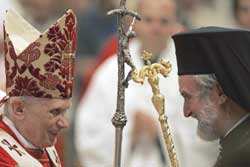
Benedict XVI and Metropolitan John Zizioulas

The other point in the Church’s being received is that of a reception of one Church by another Church – a most important aspect of reception, stems from the basic ecclesiological fact that the Church, although one, exists as Churches (in the plural), and these Churches exist as One Church in and through constantly receiving one another as sister Churches.

What is received in the first place, and also in the final analysis, is the love of God the Father incarnate in his own unique and beloved Son and given to us in Holy Spirit. The Church exists in order to give what she has received as the love of God for the world. Because the content of reception is this love of God for the world incarnate in Christ, St Paul uses the technical term (and it is technical) of parelabon and paralabete with reference to the person of Our Lord. In Colossians 2.6 he writes ‘as you have received Christ.’ Equally it is interesting that in Hebrews 12.28 the verb ‘to receive’ is used in the sense of ‘receiving the kingdom’. Reception is not a dry, practical idea.

John Zizioulas The Theological problem of Reception

Christ and Israel 2

Solly is right: ‘When YHWH said to Israel ‘I am your redeemer’ this is not a past tense statement.’ The relationship is live and ongoing (for God is faithful) and Israel is not Israel apart from God’s faithfulness. Israel is always re-supplied with her identity by God. Here is how I introduced the subject:

The doctrine of the election of Israel, and thus of the Jewish people, returned to the centre of dogmatics in the twentieth century, in large part due to Karl Barth. He insisted that God is faithful, and worthy of trust, to the extent that he keeps his promise to this people. Barth’s recovery of typology, in the form of pairs of election-rejection, man-woman and Jew-Gentile, made possible the recovery of the whole Old Testament for christology. But Barth contrasted the pairs of types he identified in the Old Testament, one of which stands for election, the other for rejection. What will prevent these becoming static, and creating two opposing sorts of people? Only the Spirit, God himself, can make one people out of two. So Jesus Christ is the rejected and the elected man. But the power of Jesus Christ is an abstraction if it is not bound to the act of a particular community. Barth avoids an abstraction from Christ, Eugene Rogers believes, but he abstracts from the Spirit (‘Supplementing Barth on Jews and Gender’ Modern Theology 14, 1998). Though God has a particular relationship with Israel, Barth cannot say what that is, because he does not show that God’s relationship to the Jewish people is ongoing. The ‘Old Testament in abstracto’ for Barth, is the ‘passing’ form of the human being. Then the people of Israel, the Jewish people, is just a shadow that gives way to the coming community, a different community. Rogers argues that Barth has allowed us to believe that the people of Israel are no longer led by the Spirit of God; the Synagogue is what human beings need to be saved from. Barth has re-established the centrality of the election of the people of Israel, while also seeming to suggest that Israel is replaced by the Christian community. Robert Jenson offers a solution to the problem . He proposes that to Barth’s phrase ‘Jesus Christ is the electing God’, we add that ‘the Holy Spirit is the electing God’. Rogers agrees that we must supplement each of Barth’s contrasted types with the Spirit as their third term. It is not individuals that correspond to types, but community, this specific community, that is elect. We should then identify God not by focusing on Jesus Christ as individual, but on Jesus and the community the Holy Spirit gives to him. By doing so we refuse to abstract from God’s concrete self-determination to be for Israel.

Much of this is paraphrase of Eugene Rogers. But it is Robert Jenson who has been leading the way here, but when he talks about Israel jenson is talking about God and the future of all humankind, not picking winners in the Middle East conflict. We talk about Israel in order to talk faithfully about Christ and his witnesses, the patriarchs, prophets and people. The people of Christ are first (and by the generosity of God) the people of Israel, and second (by the truly surprising generosity of God) all the others, the rest of us, the gentiles. When we talk about Christ we must do so from the resurrection, Christ vindicated and glorified, so Christ with his people added to him – the whole Christ. Christ is many and one: we do not make him many, he makes us many. Christ is not first an individual to whom the subsequent arrival of his people represents company he didnt have before: rather he is communion intrinsically, and in him (his communion) we become distinct and particular persons, a great company of us, made plural by him. To put it at it strongest – Christ is the Church before the Church is, and Christ is the people of Israel before the people of Israel are. I try to link all this to the New perspective on Paul later in this chapter. Meanwhile, Christ is risen, while we are not yet risen, but can only look forward to the completion of his resurrection, by which we will be joined to him.

Solly’s phrase for all this eschatology is: God’s work in Christ is the great reverse engineering of the Cosmos.

Growing up

To show that persons come from God, we have to link a number of Christian doctrines. We have to show that persons come into being through other persons, and that they therefore come into being as they come into relationship with other people, making their appearance in the great assembly of all persons. We come into being as we become distinct and particular persons. Being a body – flesh, in the biblical term – is the means by which we are available to one another. Then we have to say that we become particular persons as we grow into one very particular sort of human being, that comes from exactly one human being, Jesus Christ. All human being is sourced from Jesus Christ and given its definition by him, so he is the criterion of humanity, and therefore of what it is to be a particular human, present to the rest of us as a particular body. This means that our being as persons is not given to us complete at birth, but is part of a process, caused by the Holy Spirit, which unfolds through time. As we are sanctified we become more human, more responsive and available to God, and through God to one another, and so we become real. This happens to us when we properly identify God, from whom all persons come, and praise him for them.

On this definition, becoming human is about becoming better able to concede the otherness of other people. We come to be ourselves by properly seeing people for who they are and who they will be, attributing to them the distinctiveness that God is giving them. Our ability properly to respect others, giving them neither too little nor much recognition, is itself given to us by God. The worship of God allows us to see others as his creatures, and thus to understand that they are ours only because they are first his. By this act of worship we are witnesses of the act by which they are called first into existence and then into their full future stature. We not only see them for what they are, but in the Holy Spirit we contribute to making them what they will be. Worship of the true God is decisive in letting others become freely human, and only this allows us to grow into our own full stature.

Pester power

You know what a shirker I am when it comes to prayer. But thanks to the persistence of mates who tell me to pray – and to give thanks – I think I am beginning to get it. After all, we always have to ask people for whatever we want, and ask them many times. I pester people for things. And so it is with those God has set over us. We have to ask them for what we want, and we have to persist, and not to change our minds. Our leaders need that constant drip, drip of our requests for more of everything – and most of all, for more Christ. We have to nag them to teach us and to act like they are responsible for us.

I get nagged too, though I am not set over anybody. Wai Luen sends me his papers to read, and once a month he emails me a single line, saying something like, ‘Well, you lazy Englishman, have you read my paper yet and are you going to respond to it at last?’ Wai Luen is smart. He gave us a little yellow blanket, very soft, that lines Michael’s buggy. I look at that blanket every time I take Michael out for a walk so I think of Wai Luen three times daily. That blanket is a kind of intercessory flag, that intercedes for its giver and it accuses me to God for my neglect of Wai Luen, and oh, well, a list of others, who came to London to study but who have been abandoned here without teaching, supervision or support. All their voices go to God. Will the English and the deaf theology departments of their irresponsible universities crack under this pressure?

The Church is the leaven of the West

The Christian political tradition represents one side of a conversation. The gospel is in conversation and confrontation with pagan thought. In part at least, modernity is pagan, so pagan thought must be the other half of the conversation. Or rather not pagan thought, but pagan practice, the practices of captivity, sloth and compulsion must be the other half of the conversation. Pagan practice cannot be opened to us by pagan thought alone. Only the Scriptures can reveal pagan thought to us as pagan, as that which is present temptation to us, and indeed as our own present practice. The bible is the Scriptures of the Church, not of the West: the Church is not the West, but only the leaven of the West.
The pagan practices most constitutive for modernity are represented by the political philosophy of the ancient world rediscovered in the sixteenth and seventeenth centuries, which Kant formalised into the modern political-and-epistemological separation of powers. This is the effective scripture of the modern West. It has brought about the division and reduction of public discourse into the techniques of our withdrawal into ever smaller spheres of selfhood. The West attempts to lay aside the tools by which its own version of its history can be challenged. We must ask whether, in response, God has withdrawn the Scriptures from the West, with the result that the bible is quite closed to us, held closed by God.

Petre Tutea

Petre Tutea

You know I never read books (from idleness, not principle), but if I ever did I would take a peek inside this one:

Alexandru Popescu Petre Tutea Between Sacrifice and Suicide

Here is Ashgate’s description of the book

Petre Tutea (1902-91) was one of the outstanding Christian dissident intellectuals of the Communist era in Eastern Europe. Revered as a saint by some, he spent thirteen years as a prisoner of conscience and twenty-eight years under house arrest at the hands of the Securitate. This book explores his unique response to the horrors of torture and ‘re-education’ and reveals the experience of a whole generation detained in the political prisons. Tutea’s understanding of human needs and how they can be fulfilled even amidst extreme adversity not only reflects huge learning and great brilliance of mind, but also offers a spiritual vision grounded in personal experience of the Romanian Gulag. Following the fall of the Ceausescus, he has begun to emerge as a significant contributor to ecumenical Christian discourse and to understanding of wider issues of truth and reconciliation in the contemporary world.
As Tutea’s pupil and scribe for twelve years, as a psychiatrist, and as a theologian, Alexandru Popescu is uniquely placed to present the work of this twentieth-century Confessor of the faith. Drawing on bibliographical sources which include unpublished or censored manuscripts and personal conversations with Tutea and with other prisoners of conscience in Romania, Popescu presents extensive translations of Tutea, which make his thought accessible to the English-speaking reader for the first time.
Through his stature as a human being and his authority as a thinker, Petre Tutea challenges us to question many of our assumptions. The choice he presents between ‘sacrifice’ and ‘moral suicide’ focuses us on the very essence of religion and human personhood. Resisting any ultimate separation of theology and spirituality, his work affirms hope and love as the sole ground upon which truth can be based. At the same time, hope and love are not mere ideal emotions, but are known and lived in engagement with the real world – in politics, economics, science, ecology, and the arts, and in participation in the Divine Liturgy that is at once the traditional offering of the Church and the cosmic drama of the incarnate Word.

Ashgate also quotes some powerful commendations