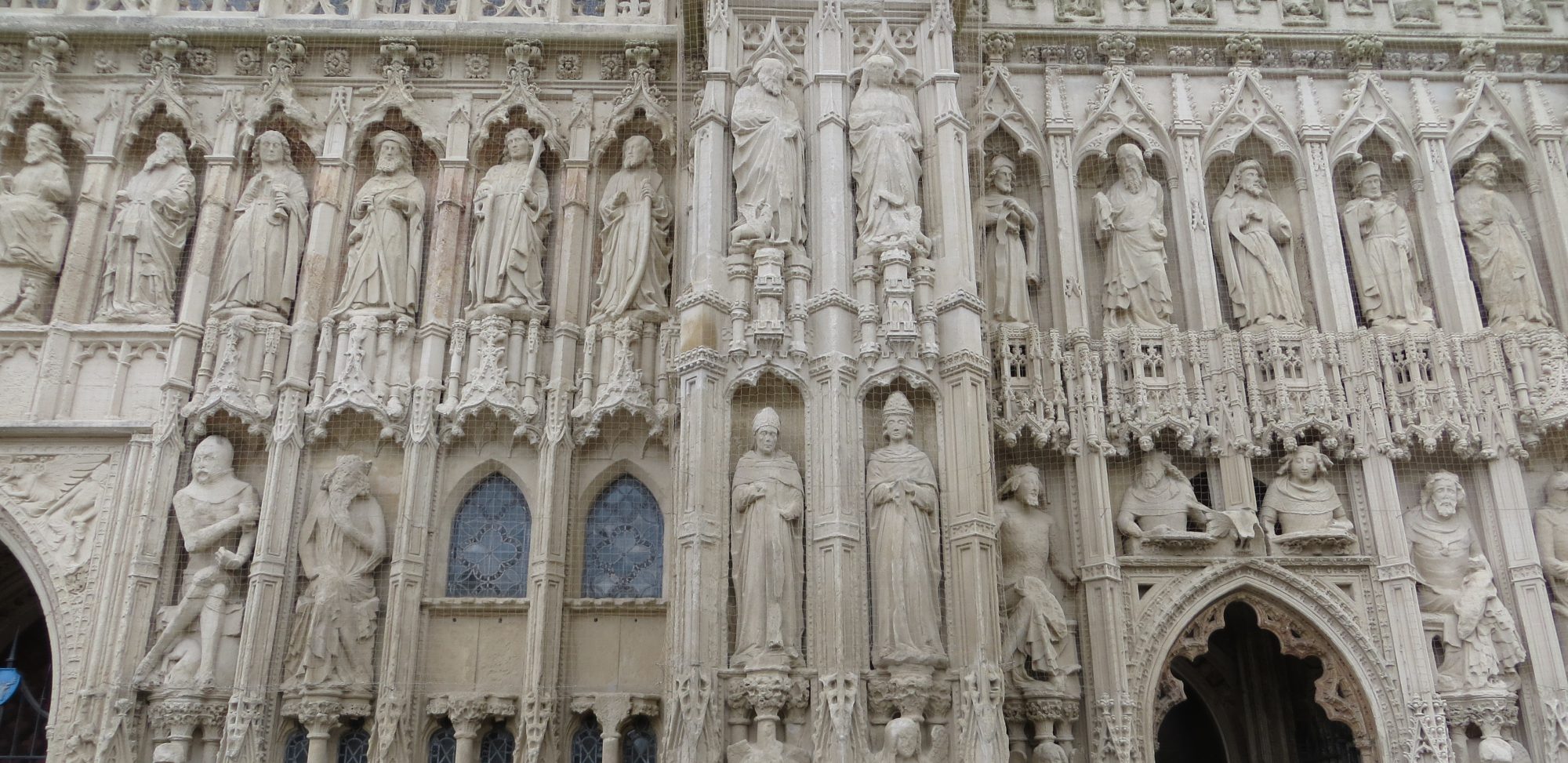
Let the young look up

I have been dismissed from every teaching job I have ever done. I arrive wanting to give my students something of what I have received. But I find the whole college is giant conspiracy not to deliver what is promised, and to squeeze out anyone who points this out. I find greatest difficulty in raising their expectations enough that students become capable of receiving even a first instalment, or of realising what it is, or of picking up the attitude and practices of knowledge-seeking, or of coming to understand that there is more, much more, all available to them. Our ancestors in the Church have kept for us, and are anxious to supply to us, a mountain of life experience. They can set off an avalanche for anyone ready to jump into it. I don’t see why in this short time in this college dedicated to learning, we should hold one another back from this vast accumulation of experience, any part of which will make you very much happier, stronger and more resilient. You have a long life ahead of you which is very likely to go much better if you do in these short years of study, what we all say we want to do – learn, by making our forebears’experience our own.

I want these students, and expect my colleagues, to load their pockets with the wisdom of ages. By the way, if your colleagues do not read and debate papers with each other in a senior seminar it is a sure sign that they have stopped learning and the place is dead. I want to see the young ambitious and greedy. But they arrive at college bored and listless, made old and dependent by years of Powerpoint and handouts.

My colleagues, however, want to be like their students, and to be liked by their students, so staff and students enter a covenant of demanding nothing, of mutual holding back. That way no one is left behind, and no one, by walking on ahead, is allowed to hint that the whole crowd are being robbed and are robbing one another.

In my own school and university years I never managed to find respect for any teacher who wanted to make friends with me. I wanted to look up to them. I considered a pedestal to be the proper place for them. They were not my equals, but my superiors. Their first job was to show just by their demeanour what a lot I had to learn, by which I mean, what a huge amount there is to learn. Then I would know that I was at the foot of the mountain, in the right place to learn it.

I don’t expect you to want less than I did. In any college I am paid to raise your expectations. If I can’t, I am not earning my money. I expect you to want what I wanted or more. You think that you can keep your expectations modest, but learning is a semi-communal activity, so you can’t keep your expectations low without pulling ours down too. The Lord is calling us. You stay here if you want to, but we are off, for we want to catch up with him. Where is the Lord? He is in conversation with Irenaeus and Athanasius. If you go into the library and start with these two saints, you can listen in. You can’t stay here anyway. Satan is coming with his bulldozer and every place vacated by the Lord’s people he will raze. Satan always leaves rubble and ugliness as his monument to those who dawdled and got caught.

Similarly, ministers who want to attract the young and who want to be liked play amplified worship music played by a band. They believe that this is ‘contemporary music, ‘modern’ music. Modern – is there any concept more old-fashioned, quainter, than ‘modern’? Modern – it sounds so tired. It seems such a long time ago now. Modern – it means nostalgia for people with paunches. The young are through all that and out the other side. Play your modern music if you want them to get up and leave the room.

But if you are hoping they will stay, ignore them. That’s right. Ignore them. Get down on your knees as though they weren’t there. Say Evensong. Sing the responses. Apart from the psalms, you can do it without the book. When Evensong does its work the congregations and choirs of saints of all ages will sing to them. You won’t need to worry about the young people after that. Desire will awake and curiosity will lead them on. Stop reading the bible, and start singing it. Once they have got used to hearing Scripture and singing the service, they will want to know what they are hearing and singing. Then they will want someone to open Scripture for them. They will want to know what the teaching of the Church and is and has always been. They will be at the foot of the mountain. Maybe they’ll come to you. You ready?

The clergy and other centralisers

The clergy have created over these last decades a ‘gospel’ which is both unattractive and inaudible. The British people long since decided that the clergy are saying nothing of any consequence. And they are right.

For the clergy are saying nothing that is in any way different from the offering of the media, corporations and governments, with their long determination to remove decisions from us. The corporations know how to delight and entertain, while the government knows how to buy loyalty with jobs and incomes. Only the Church knows that humans must not sell themselves or give up responsibility for themselves and their neighbours. The clergy have not challenged any of the abandonment of responsibility through centralisation or the growth of regulation, or challenged the distractions and compensations offered for them. The have given into to the temptation to commit our all health, education and welfare to the all-centralising powers, and been part of the prejudice against actual people making decisions in their own towns and villages.

The clergy themselves are centralisers. They are here to take decisions away from us. They seem ready to amalgamate parishes into oblivion, replace the wide-spectrum gifts and ministries of congregations, parcelling up the various aspects of Christian witness into jobs and careers reserved for a few in a central office.

Lucky for them, we are here to oppose them. We insist that all life and wellbeing begins at the altar in the worship of God, and that our refreshment and restoration depends on our manning our station at the altar at every parish church in every place, small as well as large. Only the prayer of Christians can prevent man from surrendering himself to, and being swallowed up by, the overweening Leviathan.

Scripture is the source of all education

We are in the grip of a vast cultural pessimism. All diagnosis of this pessimism merely adds to it, unless it is preceded by the original and optimism that bubbles out of Christian worship. This cultural pessimism has been taught in schools from the moment that schools ceased to be witnesses of the gospel, and gave up schooling generations in hope that comes from the gospel. The bible that was once the one and only book of our studies, and then the first step for all other studies has been made the one book that may never be opened again. As long as the bible is shut, and Christian worship not sung, these are schools in name only. The literature and thought that once formed our culture, believed to be too difficult for our children has been withheld from them. Our new leaders believe that they are not worthy of it. In schools, the very place where children should be introduced to the writers and thinkers of our culture, they are given only what is easy and undemanding, and encouraged to dismiss whatever is not contemporary and immediate. They are not introduced to this literature, but they do pick the sense that it is too difficult for them or that is to be sneered at. They are introduced to ‘critical’ thought that despises this great tradition.

So get that bible open. It is your only way out of the cult that is driving this pessimism

The Shock of Truth

What is wrong with this Church of ours, that it makes no impact, that it is silent, has nothing to say or contribute to the world around us? What is wrong is that this church has muffled the gospel, and concealed from itself that this is what it has done. This suppression has been going on for so long that we are now only very tenuously connected to the true Church, the true Church that is created and sustained by the gospel. But we have to hear and return to that one, holy catholic and apostolic Church, the Church of all places and all ages, if the ‘Church of England’ is to be what its name claims.

But we have taken out the cross. We have a gospel without truth and judgement, a message of mere empathy and affirmation, an inoffensive and irrelevant gospel, no longer able to cut through any of the contrary claims it meets.

Our church does not see how much trouble our neighbours are in and does not go to their aid. Its ‘gospel’ offers them no diagnosis, no warning, no corrective, no medicine and no surgery. Our neighbours are in the hands of forces that have no sympathy for them. It is for us to go to their aid. It is for us to challenge the thugs who hold them captive. We have to identify what it is that holds people back and ties them down. We have to point out what troubles them and who is inflicting those troubles on them. We need to find some compassion for our neighbours and for the society around us. We have to find enough compassion for them to tell them the truth, although the truth is just what they do not want to hear. For their sake we have to give them what they don’t want. We have to tell them that they have been preyed on, and they have identified themselves with those who prey on them, and they have been preying on one another. They have been suffering a delusion, and they have been inflicting it on each other. They are both victims and perpetrators, and all have been complicit in a long concealment of the truth. The gospel comes with the shock and hurt of a plaster being ripped off, of the light being suddenly and blindingly switched on, of being dragged forcibly out of bed, of being thrown out of the vehicle and left on the side of road. The gospel shocks, hurts and exposes us.

The Resurrection opens the world 2

There is a divine character to West society which comes from its aspiration to freedom. Freedom is a characteristic of God and is the gift of God to man. Where that gift is given, there the Church appears. The Church is the community of those who meet in freedom, in which every person is willing to associate themselves with all these others and to be counted as one of them, and is available to called upon by them and put themselves at the disposal of these others. In the Christian conception freedom is unthinkable without love. And love is unthinkable without freedom. You may love, but whoever you love is not bound to return that love, or to return in the way you give it. Your love cannot bind them, and certainly cannot confine them. It can only wait for them. The Lord waits at the door. He does not come and pull us out. He waits, for days, years, lifetimes and periods of time beyond definition. The Lord waits, for us. We make him wait, and yet he waits only because he wants to. This waiting is the passion of God. Christians are enabled to share in the divine patience.

God lives where men live because men live where God has set us. He is the space in which we live. Creation exists before him, where he has placed it. Creation exists in the space given to into within heaven. Heaven gives creation a place. We live where God places us. We live here in this material creation. We live in one another’s proximity, able to see and hear and touch one another through the materiality of our bodies. We are not ethereal. And if we were, how would any disembodied being be able to meet any other disembodied being? You perceive me because you see my body. Even when you write to me, you send your message to any of the various addresses from which I, through my body, will eventually hear or read it. Our body is our ultimate address. Wherever my body is, there you will find me. This will continue to be true until the day I die, after which it will no longer be possible to say anything about me with certainty.

The created and material world does not hold God in or hold God out. God may be distant or he may be close – we cannot say. We can say only what scripture says: ‘Where two or three are gathered together in my name, there am I in the midst of them.’ The Lord may be right here where we are. The space we live in is our place; it confines us and it enables us to find one another. The space we live in does not confine God, either to keep him away or to fix him here where we are so that we may draw him into the field of our perception. He may come and go without our ever being aware of it. We live in the place he has made available to us. Perhaps he is present here first, and we are only present here because of his hospitality.

We may be at once mortal-and-immortal. We do not jettison our biology with its limits, but by the grace of God its Creator, our biology may become the idiom of our ongoing, unlimited life in communion with God and with all creatures.

Public prayer

A man who stands and prays to God. God hears him and replies. And through the scripture and prayers he reads, he hears the response of God and prays again. In that act and event of conversation that man is not just an individual acting incomprehensively in isolation. He is there together with the Lord, and the Lord with God and God. The man who stands and prays speaks with God, and speaks with and through all the generations who have prayed in this way. Though we only see only one man, two are present there. The man we see draws our attention to the Lord he speaks with. He makes visible or at least draws our attention to the otherwise invisible Lord. As long as he stands there, an upright and unmoving figure in a town centre, he is communicating with God and with man.

Perhaps our concern with written words means that we do not notice the much more direct form of public communication that takes place through this simple act of standing. The Christian communicates simply by standing still there, in public. The act of the single Christian who stands in one place and prays is effective because it is visible and public. It is an address to God and an audience with God that is simultaneously an address to the neighbourhood and nation. He simply stands there where he can be seen, and is immediately noticeable because, unlike all around him, he is still. He prays, worships and intercedes so that the world around him can hear and grasp that they are witnessing a public conversation of man and God, and they may realise, rightly, that this sets a challenge before them. Will they respond? What response can they make? When Daniel heard about the publication of Darius’ decree he went home to his upstairs room where the windows opened toward Jerusalem. Three times a day he got down on his knees and prayed together just as he had always done (Daniel 6.10).
Continue reading “Public prayer”

The Resurrection opens the world 1

The resurrection renews the world. It makes it new so that it is a new world. The resurrection has opened and so transformed the world in which we live. Of course it is not until we are baptised that we begin to learn this, and through years of discipleship begin to grasp the dimensions of this transformation. The pagans – that is, anyone untouched by the gospel – live in a closed world, in which every man must fear that a gain for his neighbour is a loss for himself. They are locked in and set one against another in unending conflict. This was the world of our ancestors, until the gospel arrived. The gospel told them that God has broken through into this world, has made himself at home in it, and comes and goes in and out of our sight, beyond our control and beyond our ability to summons him or deny him. He is Lord of time and space. Every barrier and confinement we meet opens before him to let him enter. Though solid to us all, creation is porous to him. The master comes goes as he please. The elements of the world divide to his right and left and bow before him as he passes. No time or place confines or contains him. All places and times are the places that he creates and opens to us, so that we may meet and encounter one another and live together there. All places are his hospitality to us. As this realisation sunk into our pagan forebears they learned a much more benign and tolerant attitude to one another, the mighty to the weak, and they ceased to fear one another, learned to trust those with whom they had no ties of blood, and so learned to live together in much greater units. They gave up living in tribes that were committed to aggrandisement through war, and became a nation, a community of people under one law.

The gospel our ancestors received, released them and delivered them from ties of blood and the cycles of retaliation, and ceased to be so afraid of one another. They were on their way toward a civil society.

The Christian gospel makes very great claims for the dignity of human beings. Impossibly great, some have said. The gospel commands us to regard every single human being as a person, so claiming for them a great range of godlike attributes. They are free. They are sovereign, independent and autonomous. They are rational. We may speak to them and they may speak to us. Each is available and accountable to every other. None is too mighty to be held accountable. You may address them and attempt to persuade them and expect that they will respond rationally. They speak for themselves so no one speak for them or take their voice away. They are not interchangeable, and one cannot substitute for another. They cannot be collectivised or conglomerated. Each of them is unique, an irreplaceable one-off. This is a very high view of man. On this basis, man – every single human being – is like God, a true counterpart and companion of God. That is the new thing that the Christian gospel into human culture. It made public what was implicit in Israel’s Law. Other than that, no human political culture had conceived such a revolution as this.

The culture created, or at least, transformed by the gospel, is evidence of the divine nature. It is evidence of God. It is of course not proof of God; the evidence that it represents may be overlooked, the pattern not recognised. Yet the pattern is there that reveals a history and causality. Western society is the product of the Church and the Church is the product of the resurrection.

Drill, train, patrol

We Christians are like the troops of a faraway, forgotten garrison. We do not train or appear on parade or carry out the exercises that would keep us fit and prepared to meet the trouble which will inevitably come one day. It is a long since we have taken their weapons out of the armoury and spent time on the range, squinting down sights at distant targets. Do we check their stores? Do we man the walls? Do we scan the horizon? Do we go out and patrol the neighbourhood? Do we listen for the rumours? And why? Because we Christians believe we have no enemies. Perhaps we think that the world has grown up, left strife behind, reached a kind of worldwide consensus called ‘modern world’ or ‘globalism’ and there is therefore nothing to defend, because everybody already subscribes to all this. No one wants to destroy this society, because it includes everyone, no one is excluded or feels so. Everyone feels included, we believe. Perhaps.

Not every is as confident as we. Some are panicked. Some are ready enough to lash out and destroy whatever they can because they fear that our culture has no place for them. Some are discovering that the modern world, that promised increasing prosperity and opportunity for everyone, isn’t going to deliver on that promise. The global economy has no place for them. Some see the door closing, and realise that they are shut out. Western infrastructure and technical and medical advances have for a few decades encouraged and supported such vast populations that there is no going back to a peasant economy. These populations are trapped in vast urban proletarian cauldrons. Hard to find your dignity amid such rapid dissolution of familial and cultural bonds. Who can imagine their desperation? Much though our broadcasters would like to conceal it, we have seen the destruction of Christianity in the Middle East in our time. Our brothers and sisters in Christ have been butchered, burned and driven out with all cameras running. We don’t have to imagine the future. We can see it approaching, if we look.

We may not like to believe we have enemies, but we have enemies nonetheless. But the greatest mischief comes from those who are in denial about these threats, and are in power and are using their power to prevent us from protecting ourselves. So how shall we become an effective garrison of troops prepared to defend what needs to be defended?

What shall we do? We must do what Christians did in the first centuries, by which so impressed our pagan ancestors that they converted and adopted this faith, and so commenced the great political development take-off. We must take Christian worship out, wherever our people can see it, so it becomes public again. We must take it out through our streets, on our feast and festivals and get used to the weight of public hostility and learn to control our own fear. We drill, we train and we patrol. We occupy the territory and fill it with our song and thanksgiving. That’s how the blessing comes.

Religion and defiance of the cults of power

Our rulers tell us that they are not religious. They may believe this to be true because in their self-justifications they make no use of the word ‘God’. Because they believe that we should do as they do, and be like them, our managerial classes believe that we should not be religious. Each of us is working with a slightly different definition of ‘religion’. Implicitly our leaders mean that we wrongly hold on to a tradition which they regard as old and mistaken, and which wrongly encourages us to hold out against the wave of the future, and to make trouble for those charged with leading us into future.

Christians use the word ‘religion’ to refer to whoever or whatever people acknowledge as source of their identity. We always use the word in awareness that our leaders wrongly consider it our religious duty to worship what they worship and obey them who intend to lead us towards greater conformity with it. They want our acknowledgement and obedience. Though they don’t put it these terms, they want our worship. Christians live with this awareness that something is demanded of them that they cannot give. We know that it is our religious duty not to give them the worship that, whether explicitly or not, they seek from us. We consider it our religious duty to worship only the God of Jesus Christ and so continually to question and turn away from every other power-claim. Ceaselessly questioning – that is the habit we gain through obedience to the God of Jesus Christ. When we question God himself, and ask questions about his motives and intentions and we call this lament or petition or prayer, all of which are intrinsic to our worship and our religion.

When our leaders demand that we should do as they do and believe what they believe, and give us no reasons that are sufficient, they are being religious. More than a simply political loyalty, they are demanding an absolute and religious obedience from us. Though they may never put it in these terms, they are insisting that we convert and become members of the cult of which they are the priests. When they say that they are not religious, they mean only that, though they are making divine claims for themselves, they do not wish to admit it. Perhaps they have never been presented with this description of their claims. We have not confronted them with the absurdity of the claims they make. Much of the time, of course, they succeed in keeping their claims implicit. But if we do not make explicit what they wish only to imply, we become complicit with them. We give our assent to entitlements that are taken without being made public. If we give assent or otherwise surrender power to political entities that demand obedience yet refuse to be accountable, not only do we become the victims of these ‘gods’, but we become their votaries and collaborators. Whatever political cult we do not describe and identify, and then reject and publicly separate ourselves from, continues to exert a power over us. Continue reading “Religion and defiance of the cults of power”

Two Kingdoms

There are two kingdoms. They are rivals. There is the kingdom of NOW, and there is the kingdom of the Future, or to give it its full title, the kingdom of the Present-and-FUTURE. The rule in the kingdom of NOW is of gratification now, without delay, of welfare without limit and of the instantaneity of all communication and consumption is life. All considerations of what else life could be, are ruled out. Thinking about what good life consists of can only mean delay, which cannot be tolerated. Life at all costs, and our present standard of living at all costs, but do not bother us with questions of how difficult this is going to make the future. It is a Now which seeks to make itself permanent, and is just as rapacious as it has to be to maintain that claim.

Christians are citizens of the Kingdom of the Present-and-FUTURE, or the NOW-AND-NOT-YET. But Christians live surrounded by the people of the Kingdom of NOW. Christians are not NOWists but they live with them. Christians always hold out to the NOWists the prospects of a future not confined by this NOWism. Christians are critics and sometimes opponents of the Present Dispensation.

Those who hold power are always narked by Christian caution and refusal to join in, and they respond with ridicule. Christians, alone sometimes, represent a refusal to believe. We are the dissidents and unbelievers. We do not place our trust in the Present Dispensation or subscribe to the myths the Present Regime creates about its authority. We hold out against over-inflated accounts of the Powers-That-Be, and insist that they are not beyond challenge. We point out that when you imply that you have no need to give an account of yourself, you raise yourself above the rest of us. When you insist that you have authority but you give no account of that authority, you are claiming an entirely different and superior status from the rest of us. You are making a claim to divinity. You present the regime you identify with, and you yourself, as the centre towards which the rest of us must turn. You may be making these claims only implicitly, and when challenged you may deny them. Nonetheless, you are setting your regime up as an object for our devotion and obedience, and so as a form of god.

We call this temptation to present yourself as determinative for us, and as the image around which we should gather, ‘idolatry’. We see this as an attempt to take away from us what is real and replace it with what is fake, and so to rob us. Moreover, we consider that any time anyone attempts to rob or harm us, they are also doing an injury to themselves, and the best thing we can do for them is resist them by insistently pointing out that they are also hurting themselves. Every crime diminishes us, shrivels our habits and character, both of those who commit it and those who do not oppose it, making it more difficult for all of us to do what it right. So for their sake and for our own we vocally and publicly challenge and defy those who do not wish to be called to account. We are not defined and constrained by the Present Dispensation and Regime. We are not slaves in the kingdom of NOW. We are all members of the much larger kingdom that stretches forward into the FUTURE