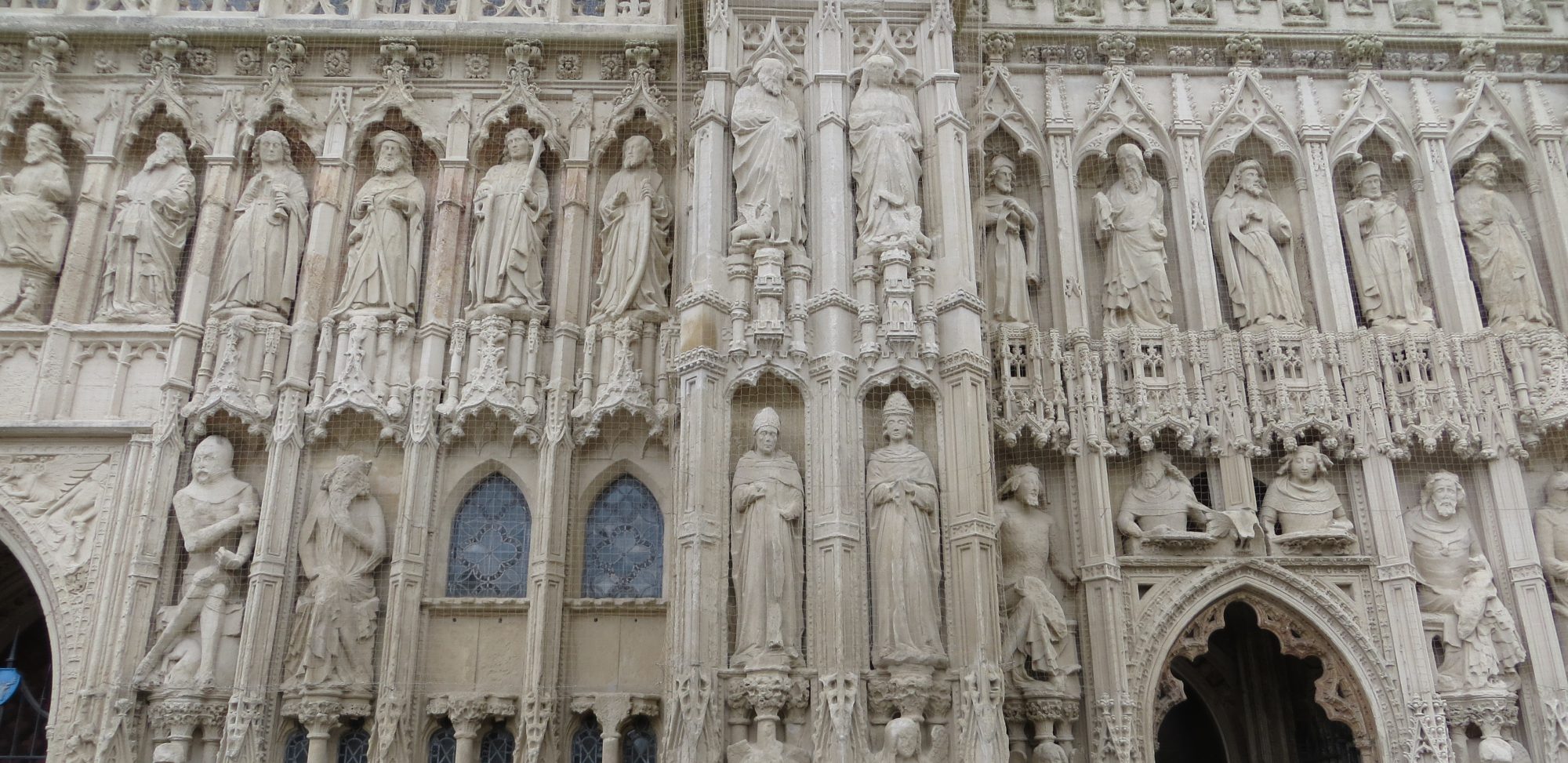
Chris asked: Who/what is the Holy Spirit? That is the kind of question I like.
The Holy Spirit is our Lord. He is God, the real, the holy, the only God. There are many masters and authorities that have power over us (the Christian tradition calls them ‘gods’), but they all want something from us because they are needy. Only the real God does not need anything from us, and this is what we mean by saying he is holy. He does not engage with us because this is in his own interests, but he is interested in us anyway, and is determined that we should know this, which involves us becoming holy too.
There is no way to know God except as the Holy Spirit. When we say he is holy we mean amongst others things that he is ungraspable, we don’t grasp or get him or know him via any route we establish without his cooperation. He makes himself known, and he does so in the (holy) Son of the (holy) Father. He provides the breath, life and words by which we come together and praise God, and say publicly that God knows us, and wants us to know that he knows us. Simply by praising him we will move a little way out of the dim half-life we presently know and will shuffle very slightly closer to reality, in which you will be holy to me, me holy to you, and thus, as his holy people, you and I will become real to each other.
As the Holy Spirit powers our praise, which is our acknowledgment and appreciation of reality, we will grow into the life that he shares with us, so we won’t ever run out of things to say about him – or to one another. It is fine to ask ‘what’ questions about the Holy Spirit (or about anyone), but the answer can only be in terms of ‘Who’. The Holy Spirit is the source of all ‘Who-ness’, even yours and mine.
encourage that bishop
Last week’s Church of England Synod discussed the issue of how to look after those who will not accept a woman as their bishop. It didn’t deal with the issue of woman bishops, but merely this lesser issue of how to look after those who, after the decision to ordain woman as bishops has been made, hold out against their (woman) bishop. The Synod was beginning to consider whether they should be offered another bishop to report to, under a measure allowing for ‘transferred episcopal oversight’? (Should they? What do you think?)
According to my source (my vicar is a member of Synod), the Synod doesn’t know how to talk through the issue of women bishops directly, but the majority assumes that they are inevitable.
This is not the problem at all, however. The problem is that we do not know what a bishop is, and this is because we are so confused about authority. Being under authority is good for us, and it is a fundamental part of the good news of Jesus Christ. A bishop is quite simply our trainer and our disciplinarian, given to us by our Lord, to train, discipline, form and disciple us. He and his discipline is good news, central to the gospel and to our salvation. We are not left alone, but in Christ we are now to be shaped, moulded and loved, by the Church, the whole Church, the whole historical tradition and worldwide catholicity that is the body of Christ. This Church has authority over us for our sake, to bring us up and make Christians of us. But the Body of Christ is not a merely theoretical or amorphous authority that we choose to receive as we want, that we may choose the acceptable and discard the unacceptable parts of. It is a specific sets of authorities, and indeed one specific authority, one person, this bishop. The bishop was chosen, by Church, for you. You were chosen, by Christ, for the Church, for the world. The logic is exactly the same. We have to put up with you, and receive you gladly as the gift of Christ to us. So individually we don’t choose our bishop, our teacher, but they are imposed on us, by the Church. Of course we are under many authorities in the Church, but this one particular person, the bishop is all these authorities conveniently packaged in one person, whom you can ring and go and see. (In your church, the bishop is called the Moderator, or the Superintendant, or something similar).
The snag is that our (Church of England) bishops forget how to be under discipline. They forget how to take discipline themselves, and so they forget how to give discipline. They don’t know how to lead or disciple us. No one ever tells them that they are the discipline of Christ for us – and we seldom pray for them. A Church without real leaders and disciplinarians is as confused and unhappy as children without parental discipline. They don’t know where the boundaries are, and so are always pushing a bit further to se if they can find them. Each episode of childish misbehaviour is a question to their parents. Do you love me? Show me, grasp me more firmly. So with bishops, if our bishops don’t push back, and reprimand us, it may be because they love us too little. Let us pray for them, and whenever you see your bishop, remind him of who he is and what he has to say to Church.
tinkering
You are wondering where this blog is going. You are not alone. The thing is that I have been tinkering with all three books, with the result that none of them has moved forward very fast. The Eschatological Economy proofs arrived last weeks, with the instruction that I had to get them back within three weeks, and do the index. After a day, and thanks to the ‘Find’ function on a PDF file, the index no longer looked such an impossible task. I have quite enjoyed showing the links between chapters to emphasise the book’s unity. I have entries for ‘agency’, ‘analogy’, ‘being’, ‘becoming’, ‘blood’… The hassle is that a number of footnotes don’t work and I want to delete them, but cannot do so now without pages changing. If pages change I will have to re-do the index. I also have been trying to re-write the Introduction to the Zizioulas book, and hope that Demetrios will offer some critical comment on it when he appears tonight. Because they are fasting on Wednesdays and Fridays, these are the days I invite tall bearded Greeks round. I hope to be shot of books 1 and 2 in a month, and then can get going on the doctrine again, and try to take an interest in where we are in the church year.
being and doing
That is the thing about the blooming obvious. You have to keep saying it over and over again. So…
Being and doing are one and the same thing. The work of each creature is the being of all other creatures. Their work is not only the well-being of all other creatures, but their very being. But there is more at issue even than this. It is not only the being but the freedom of other creatures that is our purpose. The freedom of all creatures is the task of all other creatures, and it is sustained only by live relationship with all other creatures. This nexus of relationship which sustains the freedom of each, is itself sustained by the ongoing relationship of Creator with the creation that he has made and now maintains. Our Creator intends not that we merely are, but that we live, that we become animate and vocal, and able to respond to one another. He intends that we participate in one another’s formation, and do so freely and willingly. An account of man must therefore include an account of the place and work into which he is to grow, and so of the ongoing co-labour of creation. The perfection of creation is dependent on the finished and perfected freedom and personhood of man. Man does not yet have freedom. His freedom depends on God’s determination not to cease from his work until man has grown into that freedom. The freedom of man is the task of God, then, and very subordinately, it is the task into which God introduces man. Under God, we bring one another into being. This is a participative ontology. Obvious, isn’t it?
Protestants will always hold out against the rest of the Church
Protestant identity is defined by opposition to Rome. Protestants may disagree vehemently on various doctrinal and ecclesiological issues, but they are firmly united in their rejection of the Pope and other Catholic distinctives. The Protestant Churches will never ever ever, not in a million zillion years, give up their freedom from papal authority; they will never give up their private judgment. That’s why Protestants are Protestant and like being Protestant. This is why they enthusiastically embrace denominationalism and branch theories of the Church. To be Protestant is to enjoy the freedom to choose one’s own church or even create a better one. Bottomline: All Protestants agree that the Catholic Church must abandon her claim to be the true Church: she must become a denomination just like everyone else. The Protestant commitment to denominationalism will never change, because to change on this point is to cease to be Protestant. I do not know if Catholic ecumenists really understand the Protestant mind and spirit at this point. It doesn’t matter how many ecumenical agreements are reached. Such agreements only express the views of the ecumenism experts; they do not impact the essential structure of Protestant identity.
Read the rest of Al Kimel’s post at Catholicism and the Ecumenical Adventure over at Pontifications.
Chris Seitz OT, Rule of Faith, NT, Christian Scripture and Church
Three reigning misconceptions, based upon faulty scriptural and church historical premises, with incalculable fallout
1. There is no scripture until the church creates such
* the flaw here is not the usual one entailing a Reformation debate over sola scriptura or disputes over the relationship between church/tradition and scripture (these are important topics in their own right)
* rather, what is in error here is imprecision or an improper understanding of the character of the Scriptures as inherently a dual witness of prophets (OT) and apostles (NT)
* the OT canon is sufficiently stable that it is an antecedent witness, not only to the Church but to Jesus Christ; so there is no church without scripture in the sense of the scriptures of Israel existing both prior to NT and a two-testament Canon of Christian Scripture
* when the creed says that Jesus Christ died and rose again ‘in accordance with the scriptures’ the antecedent character of the scriptures of Israel is stipulated
* to state it more ambitiously, one might want to speak about a proper dialectical or reciprocal understanding of the relationship between Church and NT scriptures, or between Church and an emerging collection of apostolic writings
* but this discussion ought not confuse the fact that the OT scriptures preceded the church; that this precedence required careful examination was due to the authority of the Church’s Risen Lord, and the need to correlate Easter faith and the memory of Jesus’ own bearing toward the scriptural witness from the bosom of Israel, with the maintained conviction, especially strong among Gentiles outside that household, that the God of Israel, the LORD, and the Lord of the Church, Jesus Christ, were one (see Philippians 2);
2. Creedal confessions follow in a straight-forward, sequential way, from the Canonical Scriptures
* we have already touched on this above
* here it is important to observe that creeds emerge in the life of the Church as the formation of the NT canon is still a developing matter
* A false kind of sequentiality assumes that creeds are the third in a line of canonical developments, from OT to NT to Church confession, when in reality, creeds exist in the lived life of the Church, and stipulate not just matters of belief, based upon or independent of, a scriptural witness (depending on one’s view of this), but how the scriptures—first OT and then NT and then both together—are to be heard and received, from faith to faith;
* That is, creeds stipulate the ontological identity of the LORD with Christ (‘my Lord and my God’)
* It is for this reason that recourse is made in apostolic writings to what is termed a ‘rule of faith’
* The rule of faith—whatever else it is—is a guide to reading the scriptures of Israel, in the light of apostolic teaching, as the Church’s received authority
* The rule of faith is a doxological, threshold, affirmation that the LORD of the Old Testament and Jesus Christ are one, and that the Holy Spirit ‘spake by the prophets’
3. The post-apostolic Church is to be understood as self-evidently more connected to the NT than the OT, and so Christian Scripture leans from Old to New
* on this understanding, the post-apostolic church sees the relationship between OT and NT as one chiefly of religious development
* on this understanding, the concern for establishing ontological identity, in the time of the formation of the NT, between the LORD of heaven and earth and Jesus his eternal Word, becomes secondary to an understanding of religious development;
* and so the OT ceases to be heard as a witness to the Father of Jesus Christ; or to Christ as central to its claims about God; or to the Holy Spirit in a dispensation before the NT
* The Church finds its theological and its ecclesial rootage in a second testament which carries over and adapts what went before in the first;
* The Church has a relationship to the NT which improves upon an earlier witness
* This developmental understanding of Church and the two testaments of Scripture is what lies underneath the crisis of and widespread confusion over use of the Church’s Scriptures in our present neuralgic times
Chris Seitz The Anglican Crisis in Interpretation and the Two Testament Voice of Christian Scripture
Chris Seitz on the Old and New Testaments
Adolph Schlatter lived at the turn of the 20th century and taught New Testament and Theology, Church History and Metaphysics; he was a keen churchman, and much loved pastor. The shadow cast by Harnack was long enough to keep him on his mettle and the young Bultmann had not yet made his mark, though his challenges would soon occupy formal theology. Schlatter was known for his work on God’s action in the world. He is a New Testament scholar who worked closely in the Old Testament and especially Genesis 1-3. Nowhere does Schlatter work to establish the philosophical warrant for his using the Old Testament doctrinally, to account for how God might be said to act in time and space. There is a natural movement between Old and New Testaments and into the doctrines of Christian believing and living. Schlatter takes it as a given—at the level of metaphysics—that in order to know who God is and how he acts, in ‘creation, preservation, and in all the blessings of this life’ one reads as closely as possible the sentences about this activity as the Old Testament sets them forth. One feels nothing of the later environment of the history of religions; or of theories of development in authorship of the Pentateuch or in comparative Near Eastern studies of creation accounts. And yet there is nothing of the air of creationism or defensive apologetics either, and in this he is rightly regarded a sophisticated forerunner of Karl Barth. There is just the exhilarating task of letting scripture—OT and NT—have its theological say, tracking as closely as possible the way in which it says that according to its own idiom.
I found myself asking: how can Schlatter do this? And why has it been my instinct as a teacher of the Old Testament to believe it has the capacity to speak of God as God is, and not as a God en route to some subsequent recalibration or development? Why has it become almost impossible for one to speak of the ‘ontological trinity’ in the Old Testament? Or, of the eternal word Jesus Christ bound up within the words, and sentences and paragraphs of the Old Testaments? And why would I sense the absence of this as a great loss, and so read a Barth or a Schlatter and discover in them something of the same tacit knowledge, of God’s word and self, which animated the earlier history of biblical interpretation, in figures as diverse as Origen, Augustine, Aquinas, Calvin and Luther?
I believe the answer lies in the way a kind of Prayer Book worship I was exposed to in my upbringing as an Episcopalian functioned to reinforce what was in the early church called the rule of faith. This same kind of exposure could account for why Schlatter was able to use the Bible the way he was, and also remain committed to preaching, pastoral care and the no doubt messy counsels of German Protestant church life and mission, before the onslaught of two world wars.
The rule of faith made certain threshold claims about the character of God in that time before the formation of a second testament of scripture, one whose name and authoritative character as a ‘New Testament’ drew for its inspiration the sole scriptural witness handed to disciples of Jesus Christ from the bosom of Israel, what would in time be called the Old Testament. The rule of faith, whatever else it may have been and however we understand its actual usage, insisted that the Risen Lord of Christian worship, Jesus Christ, was one with the named LORD of the scriptures. This Lord and creator had given his name, the name above every name, to Jesus, so that at his name, every knee would bow, to the glory of the Father. The triune God was the LORD of Israel in reality and in promise both. In turn, this confession assured that one now knew how to read these scriptures, as setting forth Christ in a wide variety of ways: not just in prophetic promise pointing beyond itself, but also primarily inside its world, as a type and a figure, alongside the new covenant church itself, prefigured, in judgment and in blessing, in Israel herself.[xi] For no other reason than this would it have been felt apt to speak of Christian ministers as new covenant priests with a High Priest Jesus Christ, or of promises related to the name of Israel’s God among the nations now having to do with naming in Christian baptism, and so forth.
It would be possible to enlarge on this theme, but the basic point should be secure. My own conviction is that precisely these threshold assumptions about God, established by the rule of faith, have their liturgical reinforcement in the Prayer Book worship of Anglicanism, and have governed my own theological instincts at levels as difficult to detect as what I sensed in Schlatter. When in the worship of Morning Prayer one says or sings a canticle, as the Jubilate Deo or the Venite, these fancy Latin names never disguised the fact that we were citing specific words from an Old Testament Psalm and by so doing were introducing ourselves at the very start of worship, at the threshold of our attending to our lives before God, to the only God with whom we had to do in Jesus Christ. The rule of faith was never anything more or less that the doxological affirmation with which these Old Testament psalms were concluded: ‘Glory to the Father and to the Son and to the Holy Spirit, as it was in the beginning, is now, and ever shall be.’ Here we encountered, in succinct form, the logic behind prayers of this same ordered worship, addressed to the Father, in the Son, by the power of the Holy Spirit. No one was being called upon here other than the one Lord of the Old Testament’s scriptural declaration, understood, from the standpoint of our inclusion in Jesus Christ, as the LORD, the Father, the Son, and Holy Spirit.
Read the whole of Chris Seitz The Anglican Crisis in Interpretation and the Two Testament Voice of Christian Scripture
Christian doctrine relates to a narrative
Christian doctrine comes in the form of summaries. But summaries are always summaries of something, an experience, like a journey. It is the many little intangible things, and the order in which they came, that make your journey what it is, each event only interesting because it was unforeseen and surprising given the previous event. So a summary is not self-standing. We can summarise only in order the better to come back to the story. The story cannot be substituted for. It is irreplaceable because it relates to this series of unpredicted events. So Christian doctrine is a summary that relate the of a story, and in the course of doing Christian doctrine, we toggle between the story and the summary. But all the pagan part of the Western tradition is in denial about story. It wants to remove the narrative from our history. It attempt to undo all the (stochastic) little histories and chance meetings that made the whole thing what it was. This is like refusing to believe that your parents met for example, just because it was a chance meeting that brought them together. It is a form of autism. You are the evidence of the reality of that contingent event, and thus of the reality of contingency. We cannot do without the story, the narrative, and the is one of the first things we must say in any account of Christian doctrine. Of course we will be discussing sets of propositions, they do not substitute for the narrative of God’s dealings with us. The manual of Christian doctrine I am winding up to is different from others in being heavy on the narrative, and it will keep the narrative of the history of the West under the control of Scripture and the evangelical narrative.
Getting on the same page – a totally unexpected development
Why use the Lectionary? Who compiled it? Why are there variations and alternative readings, so the Church sometimes is and sometimes isn’t on the same page? Why does my own church, the Church of England, have a different set of readings from the Revised Common lectionary at this time of year? I have just found that some answers are offered by Consultation on Common Texts (CCT). Here they are:
Q: How similar is the ecumenical system to the original Roman scheme?
A: The three-year, three-reading plan is exactly the same. The calendar is virtually the same. The Gospel readings are almost always the same, as are the second-lesson selections, drawn from the Epistles and (after Easter) the books of Acts and Revelation. The only serious divergence is at the point of the Hebrew Bible lessons after Pentecost, where we laid aside the Roman typological choices in favor of a broader kind of linkage that uses the Patriarchal/Mosaic narrative for Year A (Matthew), The Davidic narrative for Year B (Mark), and the Elijah/Elisha/Minor Prophets series for Year C (Luke).
Q: What is the rationale for that?
A: In our initial survey of Protestant use of the denominational variants of the Roman table, we discovered that there was unhappiness at the absence of the Old Testament’s narrative and historical literature, as well as a deficiency of Wisdom texts. So we have tried to remedy that with our more expansive kind of linkage, but for the purposes of ecumenical acceptability we continue to publish an alternative Old Testament set that is closer to the Roman, Episcopal and Lutheran tables in this regard for the Sundays after Pentecost.
Q: How widely is the Revised Common Lectionary now being used?
A: The information we gathered is compelling. Throughout the English-speaking world, most churches that have anything like a tradition of lectionary use are recommending our work.
Q: What is the ecumenical significance of this development?
A: In the first place, it is a totally unexpected development in that after all these centuries since the 16th-century reformation, many of the churches that divided at that time are now committed to reading the scriptures together Sunday by Sunday. This is a kind of ecumenism nobody anticipated, least of all the Roman See. And it makes possible wonderful weekly clergy gatherings all over the world for the purpose of mutual work on sermons and homilies.
Q: The question keeps recurring from just such groups as to why on so many Sundays there seems to be no clear theological or thematic relationship among the readings. Can you explain this?
A: The thematic situation is different depending on whether you are in the core liturgical seasons of Advent through to Lent and Lent through to the Day of Pentecost, or in that long stretch of Sundays between Pentecost and Advent, known in Roman terminology as Ordinary Time. In the festival liturgical seasons there always will be an obvious (we hope) unity that is governed by the Gospel lesson for the day. In post-Pentecost Ordinary Time, however, the situation is quite different, and not even the most sophisticated guides to lectionary preaching seem always to be aware of this. On those Sundays, we cut loose the Old Testament reading from the Gospel on a Sunday-by-Sunday basis, even though we chose those readings from First Testament books that the Gospel author (of- the year) seems most interested in – i.e., Matthew/Patriarchs and Moses, Mark/David, and Luke/Prophets.
In that same time, preacher should notice that the second (New Testament) reading proceeds from week to week on a continuous chapter-by-chapter course, and so there will be no obvious correlation between that lesson and the Gospel or the Old Testament. So on those Sundays the three readings, which have deliberately no thematic interrelationship, are all proceeding on a continuous or semi-continuous track.. If this were thought curious or troublesome, it should be remembered that such an in course sequence of reading is borrowed directly from the synagogue’s use of the Torah and the subsequent practice of the churches of the first several centuries. That is to say, the public reading of the scriptures was never originally conceived simply as source texts for preaching, but rather as the only possible way to acquaint the congregation with as much of the scriptures as possible. And that of course is the expressed intention of the Vatican Council’s desired revision of the Roman lectionary, and therefore of all systems derived from it.
Q: What does that mean for sermon preparation, particularly in those Ordinary Time Sundays after Pentecost?
A: That question regularly comes when someone says that they use the lectionary sometimes, meaning that they avoid it in Ordinary Time. It misses the point of the continuous principle altogether. That is to say, during that time the preacher who is serious about the lectionary must decide which track (Gospel, New Testament or Old Testament) to use Sunday by Sunday. Certainly there should be no attempt to force a thematic unity on all three readings where none in fact exists. Much less should the preacher hop, skip and jump around among three sets of readings that are organized on a week-to-week basis. The radical shift that this system requires is for the preacher to think about weekly preaching as sequential rather than thematic.
You can read more over at Consultation on Common Texts
reality
Here is a thought. The Church service is making its participants holy. More ontologically, it is bringing its participants into being, which is to say being-in-relationship with God, and through him, with one another. In that service the Christians are let in on the reality of things. Much of what we presently take to be real, may turn out not to be. In the church service we are given a glimpse of the future, in which some of what the weekday world takes to be real, turns out to be without reality. In that service we are woken from that weekday dream world, though we can only very slowly be brought round. Only when everybody is brought round, the mass hallucination will be over and gone, and we will live in reality, able to see and acknowledge everyone, all those whose reality we were in denial about. We will be able to name every other person and so to call every other person into being, and sustain them in being, and thus we will all be raised and finally become real. The resurrection and reality of each one of us depends on the resurrection into reality of the very last.
