What Christians have to say is seldom acceptable to the governing authorities as long as those authorities make the assumption that the rest of us are morally deficient. They regard us as lesser people, best dealt with en masse by large solutions. They do not easily regard us as persons who rightly demand person to person interaction and dignity. They grow complacent, patronising and arrogant, or to attempt to place themselves beyond challenge, to refuse to give an account of themselves, to conceal the truth.
No one is above the law
The police not enforce the law against the criminal manifestations of the slave cult. But they do enforce silence on whoever points out the criminal manifestations of the cult. We can only reply that it is our duty as citizens to report crime to the police. We can only ask the police to uphold the law. We can remind them that they are officers of the law. We remind them that they are we are all equal under the law, that no one is above the law, that there is no special group that may not be criticised, challenged or offended. We can hold them accountable. We can stand outside police stations, Crown Prosecution Service (CPS) offices and courts as reminder to those who work there of the responsibility of public office, of the absolute nature of justice. Justice is impartial, we can say. There is an impartial judge, he is the source of law and arbiter between all men. We worship him, and to do so we defy all other powers.
Faithful and public
The gospel proclaimed by the worship of the Church is a public event. It not only takes place in public and intends to be heard by the public but it creates the public that can hear it, and which can take part in it. Each church understands that it is speaking to its own community and nation, and that they can hear what this church is communicating to them. This worship gathers together and reconciles persons representative of different and hitherto antagonistic groups, bringing their enmity to an end. It demonstrates that the power that cuts persons and groups off from one another is itself overcome. It establishes that that human relationship cannot be broken or brought to an end by any power, not even by our mortality and death. Relationship between person and person may continue without limit, and thus the universe is open, and man is the creature of hope, directed towards his future.
So Christians ask, is twenty-first century Christian theology faithful to the teaching of the great Church? Would ancient or medieval Christians recognise us as fellow Christians? Or would they say that we have turned from the faith towards some simulacrum of it? Would they charge us with robbing our own future generations to the point which our society is disintegrating and its culture disappearing before us? How could we reply? Lord, have mercy. What other reply could we make? Lord, have mercy.
Telling the truth
Our government does not yet want to acknowledge that these are not random individual acts of criminality, but deliberate attacks on our law, political culture and our identity. Many working class people do see what all these individual attacks have in common and point out that they are not simply many individual incidents but a concerted attack on all of us. And this is of course what the representatives of the Slave Cult themselves are telling us, that each attack must be understood as part of a campaign and that they intend to replace our law with theirs. The greatest problem at the moment is that the media have so far failed to challenge the government account and ask whether it is mistaken. The greatest failure is always the failure to tell the truth, or to allow the conditions within which the truth can be heard in public
Detaching each individual from the protection of our society
The problem of the British is only that they don’t not realise that this envy and rage are directed against them, and they do not take any steps to defend themselves. Our political culture and institutions seem incapable of recognising their opposite, or of recognising that they have enemies and must defend themselves against them. The institutions of our government, the judiciary in particular seem incapable of acknowledging that these insults and assaults may not be simply individual criminal acts, but political and ideological acts, directed against us as a society. Each attack attempts to weaken our society by detaching each individual from its protection, so that our society no longer identifies with any individual the savages set upon. Each attack on an individual is also an attack on our law and our national cohesion.
With the saints, with one accord
The Church is an assembly of people, each different from the other, so it is a plurality of voices. This assembly is given to each particular location in order to proclaim the gospel to the community in that place. That these many different voices agree and speak with one accord, and that all these different churches of different times and places give the same witness, is itself evidence of the authority of the gospel, the power of God and the truth that he, and no other, is Lord.
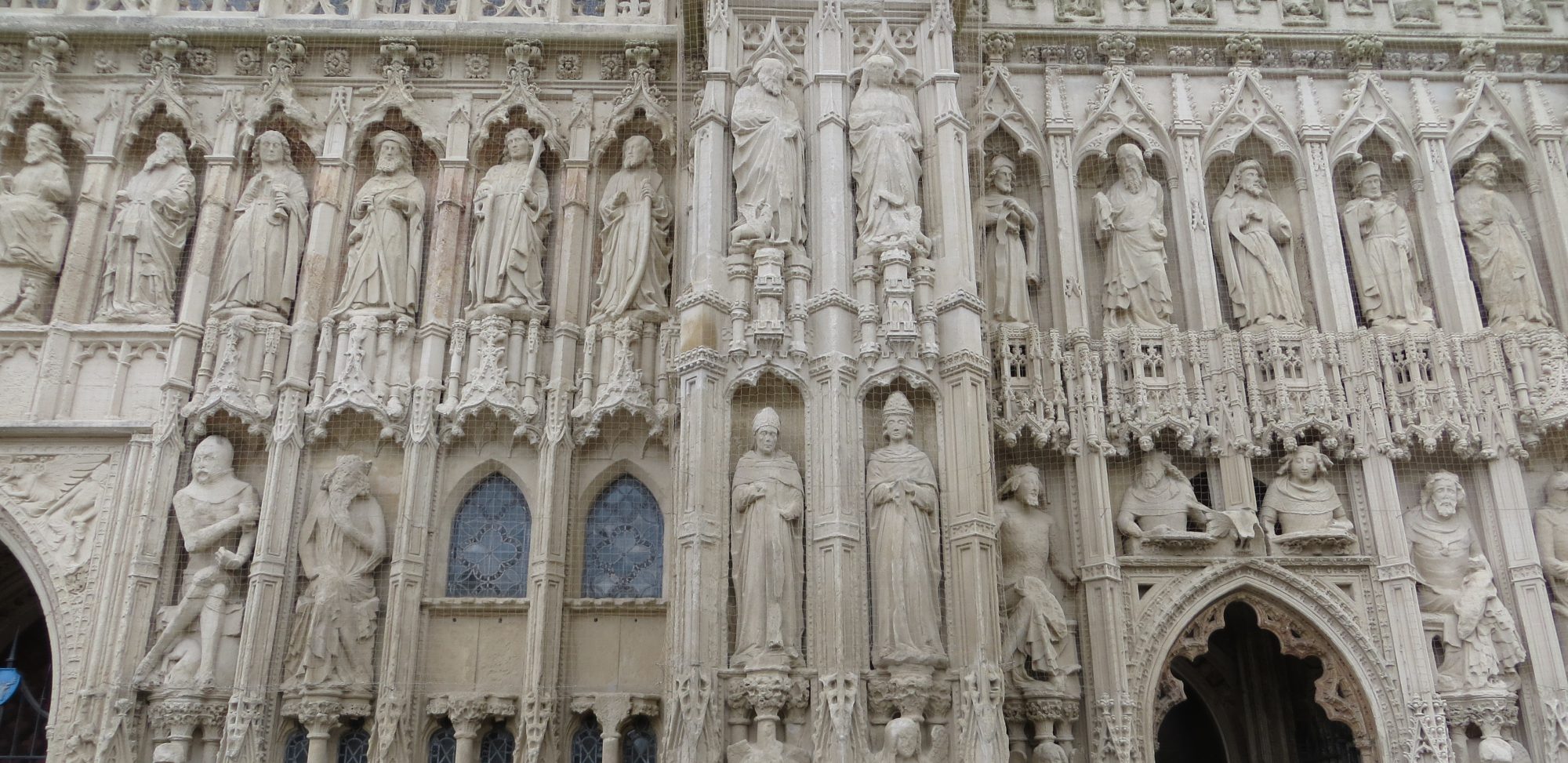
The Church teaches that the whole company of heaven, some of whom are the patriarchs, prophets and apostles portrayed in Scripture, are heard and even glimpsed in its worship. This heavenly company makes itself heard through the worship in the voices that make up each local congregation. It gives us the speech of Jesus Christ to his listeners, both disciples and adversaries, and it relays the speech of Abraham, Moses, David, Isaiah and all the patriarchs and prophets as they reply with their worship to Christ. In church the singing voices of our neighbours are amplifications of the voices of the patriarchs, prophets and apostles alerting us to the arrival of the Lord among us.
The true God and the fakes
The Christian doctrine of God derives from the service of Christian worship. In this worship Christians gather to distinguish publicly the true God from the false gods, to thank the true God and to defy and deride all other gods. Christians proclaim and chant in public, in every town centre that You alone are the holy one, you alone are the Lord, you alone are the most high, Jesus Christ, with the Holy Spirit in the glory of God the Father. They perform this service for the benefit of the surrounding community; all those who hear this worship may understand which gods are false and are owed nothing, and which God is true and truly for us.
There are a multitude of powers. When these powers act beyond their authority and remain out of control, they are gods – and demons – to whomever falls under their influence. To worship the God of Jesus Christ is simultaneously not to worship any other gods. It is to realise that there are other claimants and so there are plenty of powers making claims on us, and so claiming semi-divine status over us; when they do so they are false gods. But Christian theology that takes its mandate from the worship of the whole Christian people must distinguish the true God from false gods and the powers of our age. These gods exert a power over us, and so we have to concede that we are captive to them until we are free of them.
The Christianity of recent decades has ignored one central question. It asks whether we believe in God. It does not ask which God we believe in? Which gods are our gods? Which powers are we committed to? Of course we cannot remember surrendering to any gods, but this is only because it happens too slowly and subtly for us to notice that this is what is happening. Of course we may refer to them as powers, forces or fundamental principles rather than as gods. Christians assume that we do acknowledge and defer to gods, and we have to name them and question whether they are worth our worship. We do not agree that moderns are atheist as they claim. They have their own gods, but their cult conceals this from them. They tell themselves that they are the master, and that each self is the centre of the world; that all things exist to please them, and that they can be anything they want to be. But they live in a perpetual battlefield of the gods, in which every power and every spirit competes with every other, and they are competing for us. They want what we have. They want power over us. They want us to be theirs. It is up to us to learn from Christian worship how to identify, give names to and defend ourselves from these powers.
Forces without pity
This is a time of transition, the centralisers always tell us. They tell us that they are increasing our chance of democratic decision-making, but to do so, they have to make some changes which they must take for us. Power will soon be returned to you, they claim. This transition, this state of emergency, is just temporary. The changes are unilaterally foisted on us because we do not speak up and protest, and each failure to speak up makes them stronger and us weaker. The centralisers don’t want feisty, independent people. They want malleable, easily-directed people. So it is never a good idea to ‘see what our leaders decide for us’. Those in positions of authority who tell us this, are telling us that we have no authority of our own. We do. They may not deny it. We have authority. They have no authority to tell us that we have no authority. This authority was given to us in our baptism, when we were made Christians, and as Christians, we first come to share in the priestly, prophetic and kingly office of Christ. Parishes can be amalgamated only because the people in each parish have got out of the habit of saying morning and evening prayer. There is no one at the altar rail in the mornings in these churches, no one performing their public office as Christians, so the churches are not being used, and occasional services apart, are effectively closed. The lights are off and no one can see where they are going. The church is stumbling around in the dark and, as a consequence, our society is stumbling around in the dark. The darkness grow with the huge amount of artificial lighting emitted by every building and every electronic device. Only the Christian hunched over bible and then singing and praying before the altar lit by one candle can see where we are all going. Those who do not pray to God, of course, unwittingly direct prayers to other forces which are only too ready hear and take advantage. Those who appeal to anyone other than God are surrendering themselves to forces without pity.
Ah, the British
The British have in their possession a vast political, legal and cultural gift. They have received a legacy that is deep and wide. It has as much future as it has past. But this makes them the objects of the envy and resentment of other people. These other people do not tell the British people how great this legacy is or how lucky they are. Rather they do whatever they can to obscure this fact. They mock what they envy. They charge the British with imagined offences, who foolishly listen and believe that the blame is theirs. The British do not realise that is envy and rage that motivates other people. They do not realise that others are their enemy. They never concede how great this legacy is or reveal any desire for it or admit that they are. They suffer the cruse they have imposed on themselves. They are their own enemy, and they wish to spread their unhappiness, and so they are the enemy of all. Envy and rage are their sole motivating force. Anyone who listens to them is vulnerable to them.
What’s new?
New? There is nothing remotely new about any of this ‘new agenda’. The policy that this latest clerical cabal wants to push through in our parishes locally is the same policy that they have been trying on us nationally for these last four decades. It has had the results we see. It has emptied the churches, and allowed social devastation nationwide. They have offered us a cup with less and less in it, and amazingly, the English people are less and less interested in it. The clergy and the very few over-seventies are the only people who still do not realise that no one is listening and no one is any longer receiving the great package of Christian discipleship. British families and the nation are in trouble just exactly because this modern clergy has replaced the Gospel and put in its place a perfectly tasteless substitute. Apart from the current generation of clergy still attempting this same trick, no one is fooled.
Many people have left the Church. Outside the cities, no one is coming into the churches. Many clergy have left the ministry or gone over to the Catholics or Orthodox. Many of these said clearly that the result of ordaining women would be the end of the Church of England as part of the worldwide catholic Church, in which notionally a Church of England bishop was recognised as a bishop by all other bishops in Roman catholic and Orthodox churches across the world. The Church of England has claimed and hoped that its bishops are recognised as fellow bishops by other bishops of other provinces and churches. The activists for ordained pseudo-priestly ministry did not want to hear this. They did not consider themselves bound to the churches around the world, or to previous generations of Christians who did not appoint women to public ministry. They promoted themselves over all actual bishops, whether of all previous generations of the Church of England or of Catholic or Orthodox churches in other parts of the world. They would rather have the appearance of tradition and apostolic continuity than wait for the reality, which can only ever come by waiting for agreement and consensus.
The question is whether the Church of England is now anything but a sect. The answer we seem to get from the activists of women’s rights is that they don’t care. They don’t feel the force of the question. They don’t feel that sort of loyalty to the whole Church, because they don’t see themselves as inheritors of an unchanging deposit of faith or as its transmitters. They don’t share the awareness that the Church is the community that unlike any other stretches across time, continents and cultures – and yet is always the same. They are people in a hurry, driven by the conviction that whatever worked then, cannot work now. Whatever was, must be abandoned. ‘New’ and ‘change’ appear in their every utterance.
But we must continue to be members of the Church of England in the sense that our parents and grandparents were. These parishes, church buildings, were built by them and handed on by them to us, with the expectation that we will do the same. Those who close churches, lock the prayer books and hymnbooks in cupboards from which they never expect to come out, have been turning the Church of England into a sect. It is the same old Arian unfaithfulness, motivated by a love of power. The Church of England has suffered it many times over the centuries, and eventually and at great cost, overcome and been restored. Of course we must treat these activists with the same respect we treat every other Christian, and always ask them to show us how they claim to be members of the one, holy, catholic and apostolic Church. Meanwhile, stand your ground, and hold tight onto that altar rail. Our agenda is public worship as public witness, through Morning and Evening Prayer in this and every parish church, and on feast days, in every public square.
