Properly worldly

The Church looks conservative only because the Church is the only public place in which the issues of what is worth doing, and so of truth and goodness – which previous generations used to talk freely about – get a public hearing. Because the Church is not in as much of a panic about time as the world is, the Church has the patience to host discussion of how to be human. No particular moment seems the right moment to get into a long discussion. It is always more convenient to carry on assuming that we all already know what is worth doing, how to live well, and that we don’t need to talk it all through again.

The Christians re-enter this discussion every Sunday when they line up behind the Son of Man, who is God’s own definition of life lived well, and they sing along with him back to God.

So it is the Church which knows how to be properly worldly. It has a better idea of what the world is to be than this world does. The Church tells the world how best to be worldly – by asking its maker if it may join his conversation on this subject.

The best thing the Church can do for the world is be distinct from it, and so remind the world that it has not yet arrived. The world is not yet all in all. So the Church must hold out hope to the world – and point out that this time is not yet the fullness of time, but it is the time to live well and to talk life through in good company.
Logiki latreia – rational worship

St. Cyril explicitly rejects the Apollinarian thesis, and stresses the complete humanity assumed by Christ into a real ‘physical’ or ‘hypostatic’ unity with the Word. Cyril associates Christ’s High-priesthood with specifically with His humanity, and makes frequent reference to the Epistle to the Hebrews in his discussion of the human soul of Christ. Against Nestorius, he writes: Christ carried up the mind of believers into the one nature of the Godhead. Cyril describes Christian worship as ‘rational’, and constantly speaks of Christ as the ‘High Priest of our souls’. For Cyril, Christ fulfills His priesthood both as one who receives and as one who offers prayer. Since Christ is not two but indissolubly one, our rational worship is offered to Him as well as through and in union with Him, and by Him to God the Father. In his third epistle against Nestorius, Cyril affirms clearly the vicarious and high priestly character of Christ’s humanity: Christ ‘offers Himself for us and us through and in himself to the Father’. He worships for he has assumed the nature that pays worship. Although the host above and the holy spirits worship him, Cyril writes, when he became as we are, he worshipped with us as a man offering as fragrant incense, himself on our behalf, and us through himself and in himself to God the Father.

Matthew Baker Logiki Latreia and the Mind of Christ

Logiki latreia – rational worship

It has been one of the distinguishing marks of Western culture, from the nominalists of the late Middle Ages onward, that ‘mystery’ and ‘reason’ are continually held apart, even seen as opposed. In particular, in the development from the skepticism of the radical Enlightenment to 20th century positivism, the idea of rationality has taken on an increasingly narrowed definition, one which excludes, and is even pit against, notions of revelation, transcendence, and tradition. Yet the faith of the Apostles and Fathers is otherwise. The substance of this faith is that ‘the mystery hidden for ages in God’ and now revealed in Jesus Christ, is none other than the Logos, the infinite and uncreated Reason and Word of God. It is that this Logos assumed full humanity in the womb of the Virgin, uniting to Himself a human mind, with all its structures of created rationality, redeeming and sanctifying them, so that we might be transformed in the renewal of our minds (Rom. 12:2).

A positive and balanced understanding of the role of reason in the redemptive work of Christ and the life of the Church is reflected in the Pauline notion of logiki latreia, ‘rational worship’,which is to be found in the Orthodox liturgies themselves and in the writings of the Fathers. In Romans 12:1-2, St. Paul writes: I appeal to you, therefore, brethren, by the mercies of God, to present your bodies as a living sacrifice, holy and acceptable to God, which is your rational worship. Do not be conformed to this world but be transformed in the renewal of your mind, that you may prove what is the will of God, what is good and acceptable and perfect.

Paul’s discussion of rational worship and the transformation of the mind comes in a context in which the role of body is given place as well. This is indicative of the wholistic anthropology of St. Paul, in continuity with the Old Testament, in which body and mind are distinguished but held together in essential unity. This holistic anthropology is important for the theology of worship as it will also become important for the Fathers’ defense of the full humanity of Christ against the Apollinarian denial of a human mind to the Incarnate Savior. There seems little doubt that in its original context of Romans 12, Paul’s concept of logiki latreia refers not to the Church’s liturgy in the narrow sense of the term, but rather to the entire ‘liturgy’ of the Christian life, lived as an offering of worship to God.

Matthew Baker Logiki Latreia and the Mind of Christ

The episcopate is one, each part of which is held by each one for the whole

So koinonia / communio is a foundational term which gained fundamental significance for the early church, and which in the eyes of many once more occupies a pre-eminent place in defining the essence of the Church today. The Church is shared participation in the life of God, therefore koinonia with God and with one another (1 Jn, 1,3).

So from the beginning the episcopal office was ‘koinonially’ or collegially embedded in the communion of all bishops; it was never perceived as an office to be understood or practised individually. In his history of the Church Eusebius describes in detail the endeavours to maintain peace, unity, love and communion during the violent conflicts of the second century regarding the correct fasting practices and the dating of Easter (Hist. eccl., v,23f; cf. vii,5). The collegial nature of the episcopal office achieves its most impressive expression in the consecration of bishops.

‘The episcopate is one, each part of which is held by each one for the whole’ (Cyprian of Carthage De ecclesiae catholicae unitate, 1,5). Such statements and admonitions recur again and again in Cyprian’s letters (Ep., 55,21; 59,14 et al.). Most familiar is the statement that the Church is the people united with the bishop and the flock devoted to its shepherd. ‘The bishop is in the church and the church is in the bishop, and if anyone is not with the bishop he is not with the church.’ But Cyprian goes even one step further: he not only emphasises the unity of the people of God with its own individual bishop, but also adds that no one should imagine that he can be in communion with just a few, for ‘the Catholic Church is not split or divided’ but ‘united and held together by the glue of the mutual cohesion of the bishops’ (Ep., 66,8).

Cardinal Walter Kasper An address given to the Church of England Bishops’ Meeting (5 June 2006)

The holy community forms Scripture, and is formed by it

The action of Israel that we have received in the form of scripture and liturgy topples the alternative constructions of the gentiles, and prevents the world knitting itself together into any form other than the form of Christ. It is the one action that keeps the world open, reminding us that the Messiah is not here, and that what the world presently is, is not the end. True reading produces the transformation of the readers, so hermeneutics is ethics, the reading of people into the Church.

Maximus: participation 2

In such a person the apostolic word is fulfilled. In him we live and move and have our being (Acts 17.28). For whoever does not violate the logos of his own existence that pre-existed in God is in God through diligence; and he moves in God according to the logos of his well-being that pre-existed in God when he lives virtuously; and he lives in God according to the logos of his eternal being that pre-existed in God… In this Way he becomes a ‘portion of God’ insofar as he exists through the logos of his being which is in God and insofar as he is good through the logos of his well-being which is in God; and insofar as he is God through the logos of his eternal being which is in God, he prizes the logoi and acts according to them. Through them he places himself wholly in God alone, wholly imprinting and forming God alone in himself, so that by grace he himself ‘is God and is called God’. By his gracious condescension God became man and is called man for the sake of man, and by exchanging his condition for ours revealed the power that elevates man to God through his love for God and brings God down to man because of his love for man. By this blessed inversion, man is made God by divinization and God is made man by hominisation. For the Word of God and God wills always and in all things to accomplish the mystery of his embodiment.

Maximus Ambiguum 7

The Son turns around the regress of man

In teaching the coherence of all things around the incarnate Word, Irenaeus was safeguarding not only the integrity of Jesus but the integrity of every particular. Whereas the gnostics saw in the redemptive work of the logos ‘the separation of what was unnaturally united,’ Irenaeus saw in Jesus the reunion of what was unnaturally separated.

Irenaeus placed heavy emphasis on the Christ-event as the climactic moment in a long history of God’s approach to man. Only after a protracted period of preparation does the Word appear among us – not as a retort to the old covenant or its deity, but as that very deity in person…. It is under their tutelage (the prophets) that we are slowly readied to receive him, for he does not come to us unannounced. When he finally does come of course a great threshold is crossed and a new age begun; under the tutelage of the incarnate one, in the communion of the Spirit, we ourselves may now advance towards God…. But we have missed an important turning if we proceed to operate on the premise that the incarnation takes place at the point where mankind as such is truly ready for God, where sacred history can therefore broaden out at last into universal history. …As Irenaeus sees it, our evolution has actually become our devolution the Son does not appear at the middle of history, then but at the end; not somewhere near the top, but at the bottom. The Son comes to offer his summing up just where it is necessary for history to begin all over again.

Douglas Farrow Ascension and Ecclesia

Divine Sovereignty

God’s sovereignty transcends and stands in judgment on all worldly sovereignties. Because God is God, Caesar is not God and neither are Caesar’s successors, be they kings, presidents, prime ministers, or party general secretaries. And because Caesar and his successors aren’t God, their power is limited, not absolute; in addition to Caesar’s legitimate power, there are other legitimate powers in the world.

So the state cannot be all there is. Long before Enlightenment political theorists began challenging royal absolutism with ideas like Montesquieu’s “separation of powers,” Western civilization learned the idea of “limited government” in the school of Christian reflection. When medieval Catholic thinkers insisted on a sharp distinction between “society” and the “state,” they created a vaccine against absolutism in either its royal or modern (totalitarian) form. The vaccine wasn’t completely effective. But its potency may help explain why the age of absolutism was a rather short one, as these things go in history.
Medieval Catholicism also helped plant in the Western mind the idea that “consent” is crucial to just governance. Government isn’t simply coercion, medieval Catholic political theory insisted; just governance requires consent. Consent would be forthcoming if governance were just. And who would judge the justice of a particular form or style of governance, or the justice of a particular act of state? The Church’s claim to be able to judge princes, and the Catholic teaching that “the people” have an inherent sense of justice within them, injected a crucial idea into the political-cultural subsoil of the West—the idea that “justice” isn’t simply what those in authority say it is. There are moral standards of justice that are independent of governments; we can know those moral standards, and they ought to be applied in public life. All of these ideas, fundamental to democracy, were nurtured in the civilization of the Middle Ages by the Catholic Church.

George Weigel Divine Sovereignty Letters to a Young Catholic

Divine Energies and Orthodox Soteriology

Papanikolaou

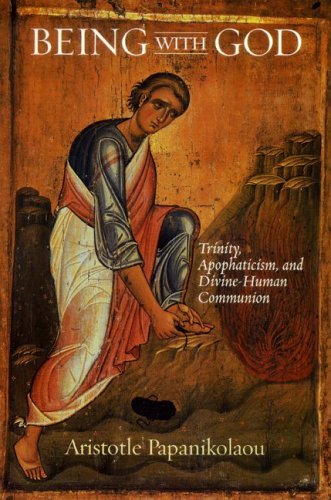
The ever-excellent Peter Leithart has been reading Aristotle Papanikolaou’s new book Being with God: Trinity, Apophaticism, And Divine-Human Communion.

Papanikolaou is comparing the trinitarian theology of Vladimir Lossky and John Zizioulas. According to Papanikolaou:

Zizioulas “emphatically affirms that an energy is never apersonal. The energies of God are communicated only through the persons of the Trinity. This emphasis on the personal character of energies is indicative of the primacy of an ontology of personhood and communion in Zizioulas’s thought. Second, salvation is not described for Zizioulas as an increase in participation in the divine energies, but as the transformation of being into true personhood in the person of Christ. For Zizioulas, the essence/energies distinction is ‘nothing else essentially, but a device created by the Greek Fathers to safeguard the absolute transcendence of God without alienating Him from the world.’ The energies are God’s actions in the world and are saving events. The ultimate saving event, though not excluding the divine energies, is not simply a matter of God’s action, but a relational event of communion that constitutes human personhood as true personhood in the image of Christ.”

Read Leithart’s summary

Resurrection

The resurrection of Jesus was not the general resurrection, but the provision of a longer gentler way to the general resurrection. This resurrection, that is both commenced and delayed, is the mode of God’s hidden work of holding and training a people. By the resurrection, the crucifixion of Christ was lifted from Christ and placed instead on the many who had crucified him. Their act rebound to catch them. The many have been corralled by the death that his resurrection has imposed upon them. Their death is now not at all their death, but entirely his death, the death that holds, not him, but them on whom he has imposed it. Now they can be slowly supplied, by the Spirit, with the resurrection. It can be supplied by the one who has risen from them and is therefore able to be with them, without their sin and death. The resurrected one is the Lord, the Spirit, the true and faithful servant who will not waste his talents, or lose a single member of the flock he has gathered. He has worked, and his work is united with its harvest. He has paid with his labour, and he now receives the reward due to him.