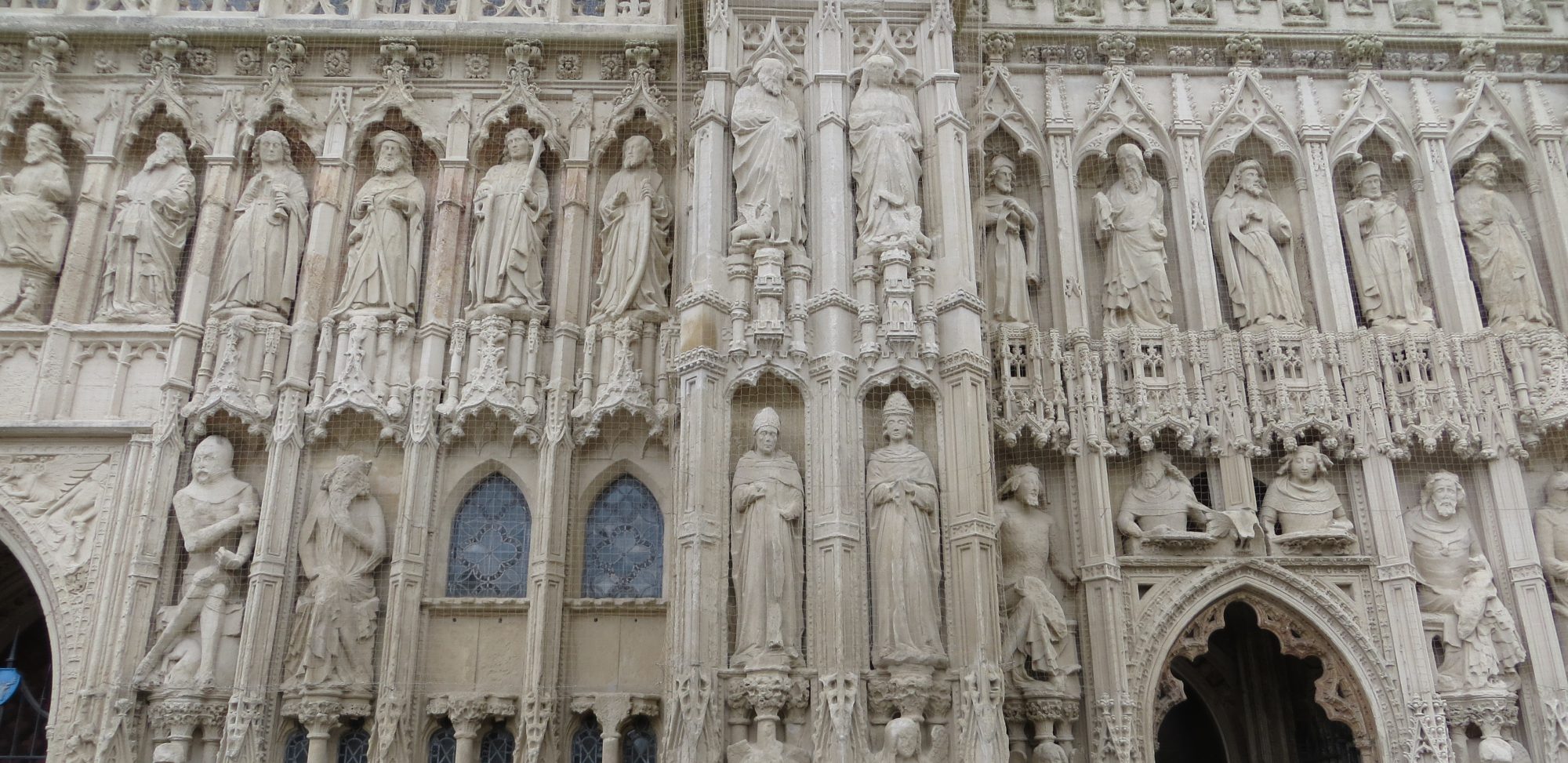
Flight from embodiedness

Why is it that we moderns are so confused about the sources of our identity? We cannot decide whether we are essentially bodies, and must obey the dictates of our biology, or whether our bodies are simply vehicles which we can use or abuse, as though nothing our body does really touched us.

The modern self is a solitary and solipsistic being. It regards itself as the only real thing, and is determined not to be interrupted and inconvenienced by anything or anyone not itself. The Christian tradition calls this attitude ‘gnosticism’. This is the belief that I am solely my mind, and that I am trapped in my body, and in this world. It asserts that my mind can know the world, and other people, entirely without their aid and begin to extract itself from the limits they represent. Gnosticism is a panicked attempt to escape my past, my present situatedness, and all the plurality and ambiguity of life. It views embodiedness as entanglement and misfortune. It is a permanent temptation to believe that we are to remove ourselves from what it regards as the entangling, disgusting materiality and complications of this world and set ourselves above them.

Modernity is not simply a new phenomenon. It is also a timeless temptation. But it is only properly identified as this by the Church disciplined by the full gospel. The whole Christian tradition is our very own corporate memory. From this bank of resources constituted of all previous Christian experience, we may select parallels to our present experience. From these parallels we can see the range of options open to us for dealing with the challenges of our situation. If we have less memory, we have fewer resources by which to understand our circumstances and fewer options for dealing with them. The grace of God provides us with these resources for the very purpose that we grow through them and are empowered by them. The Christian life and teaching is the grace of God mediated through the experience of previous generations of Christians. It allows to us grow and become a holy people, able to hold out to our society what it cannot receive from any other source.

The whole surrounding culture of modernity is a flight from embodiedness and situatedness. Without the Christian gospel mediated through the Christian life and teaching, our culture is obliged to construct for itself what it refuses to accept from God. It is under a harsh law, entirely self-imposed. Unable to receive its shaping with gratitude, it is then only able to perceive others as a threat. This appears in its belief that all previous experience is rendered redundant by time, and its insistence that we abandon our experience and we flee whatever we identify as ‘the past’.

No Lack of Love – the Fulcrum sermons of Oliver O’Donovan

The secularity of the state does not mean the secularisation of society

The first symptom is Europe’s refusal to mention its Judeo-Christian roots in the Preamble to the European Constitutional Treaty, which, following the French and Dutch referendums, has now failed. The title itself is revealing of an ambiguity. A Treaty is not a Constitution and a Constitution cannot be a Treaty. The European Constitutional Treaty is something in between, a document hanging in lim­bo with no precise form, despite its more than 400 pages, running from major principles to the most analytic norms.

Regarding Europe’s cultural and spiritual origins, the Treaty adopts two slightly different formulations which were accepted after a long debate and many quarrels. One states that “the peoples of Europe…[are] conscious of its spiritual and moral heritage.” The other refers to the “cultural, religious and humanistic heritage of Europe.” It is patent that both statements are extremely poor and reticent, because neither of them defines exactly what heritage and what religion Europe stems from. The question then is: Can Europe unify economically, socially, and politically if it lacks the strength even to mention that Judeo-Christian religion without which it would not even exist? My answer is: No, it cannot.

The second symptom of the European crisis is the antecedent of the first. What role is played by religion in European society? After the wars of religion, Europe slowly attained the separation be­tween State and Church. This separation—which actually stems from the Gospels—is a civil achieve­ment of which we should be proud but about which we should not be confused. It refers to polit­ical institutions and their mutual relations, not to personal dimensions and their autonomy of expres­sion. In other words, the separation between State and Church, sets limits to the legislation of them both, in the sense that one is forbidden to pass norms over the domain of the other, but it does not imply that religion must be expelled from social life, or that it should be considered only a private affair. In still other words, the secularity of the state, which is a juridical regime, does not imply the sec­ularism of the society, which is an ideological phi­losophy. It is one thing to separate State and Church; it is quite a different thing to separate reli­gion from the lives of the people.

This is however what is happening in Europe. Today, religion is not allowed to express itself in public. As a consequence, religion cannot nourish our civil customs, provide a spiritual ground for our societies, or act in support of our public rules and behavior. And, of course, once the links with the religious tradition are severed, the allegiance to the very same values which are the core of our living together starts losing its strength and gets weaker and weaker.

Marcello Pera Europe, America and the Continental Drift

Oswald Bayer

Just seen the bibliography of Oswald Bayer at Wiki.de and remembered what a colossus Bayer is.

He is Professor Emeritus at Tübingen, a Lutheran, but more than that, he is a Luther – really shocking evangelical power, wielded with very great intellectual sophistication and gentleness. His line is that the Reformation is much more modern than ‘modernity’ will ever be. He has lots in common with Jüngel, but more spiritual authority (ludicrous, to say so, but…). I’ll translate some of his titles:

• Promise: Luther’s Reformation Turn

• Creation as Address: Towards a Hermeneutic of creation

• Living Word: Reformation and Modernity in Conflict

• Freedom as Response: Theological Ethics

• Contemporaries in Confrontation: Johann Georg Hamann as Radical Enlightener

• God as Author: Theological Poetics

• Reason is Speech (or discourse/conversation): Hamann’s demolition of Kant ‘critique’)

Hamann is one of Germany’s least explored Christian theologians. He was a contemporary, friend yet crushing opponent of Kant, with much in common with Kierkegaard and Coleridge.

Oswald Bayer would be the perfect subject for a PhD on Christian theological hermeneutics.

WHICH AMBITIOUS PUBLISHER IS GOING TO BE THE FIRST TO TRANSLATE BAYER’S WORK?

Thomas International

The Thomas International is the first stage in the establishment of a new Christian/Catholic university. It is offering conferences, courses, teaching material, links – inspiration and aspiration aplenty.

So far it has set up the Ralph McInerny Center for Thomistic Studies

The purpose of the Ralph McInerny Center for Thomistic Studies is to foster a renewal of Thomistic studies in the contemporary world. Today, in a culture that has lost unity of knowledge and faces new challenges of relativism and nihilism, on the one hand, and of globalization, on the other, Thomas Aquinasâ??s life and thought set the right direction for a revival of truth in ethics and metaphysics. The Ralph McInerny Center aims at promoting a strong and accurate rereading of Aquinasâ?? philosophy and theology but, at the same time, it aims at making Aquinasâ?? thought fruitfully converse with contemporary culture, especially in the areas of bioethics, legal theory, economics, political theory, literature, science, and sociology.

Why Aquinas?

Aquinas is the cornerstone of Catholic thought, not just for his doctrine, but for his fidelity and prayer; for his constant and humble attitude of inclusion instead of exclusionâ??always open both to the truths coming from the faith and to those coming from every other thinker and tradition. He did not create a philosophical or theological systemâ??from which eventually some truth, either natural or supernatural, would have been ruled out; rather, he was always ready to welcome new philosophical insights, and to see the constant need for finding harmony between them and the depositum fidei. Thomism is not just one out of many Christian traditions of thought; it is the only safe home where every sincere Christian intellectual can find comfortable refuge and establish the constructive dialogue with other thinkers which leads to the truth.

Aquinas is the model of Catholic thinkers also because he was an authentic citizen of his time: the Medieval Renaissance. He traveled all around the XIII-century world [Europe] more than most of his contemporaries. He gave refined and remarkable answers to the most difficult political, legal and ethical issues debated in his culture. Due to his exceptional problem-solving capacity, he was asked to accomplish (or give advise for) difficult political missions and legal tasks; he was even executor of a will. Indeed, his knowledge of law and politics matched his knowledge of theology and philosophy. Today, in a culture that has lost unity of knowledge and is far from being universal; in a society that has to face the new challenges of relativism and nihilism, on the one hand, and of globalization, on the other, Aquinasâ??s life and thought set the right direction for a revival of truth in ethics and metaphysics.

After Aquinas, his spirit has lived over the centuries through other exceptional people who not only studied what he wrote, but incarnated his same love for God and for â??the world and its values;â?? people with the same â??courage of the truth,â?? â??freedom of spirit in confronting new problems,â?? and â??the intellectual honesty of those who allow Christianity to be contaminated neither by secular philosophy nor by a prejudiced rejection of it;â?? people who pass as well â??into the history of Christian thoughtâ?? as pioneers of the new paths of â??philosophy and universal cultureâ?? (Fides et Ratio, 43) and who keep Aquinas alive for the generations to come. These people connect the past to the future by leaving behind them, not just their priceless writings, but also many good students and young scholars trained in fidelity to the Church, intellectual freedom, open mindedness, and respect for diversity: â??by their fruits you will know themâ?? (Matthew 7:20). In our recent history, we can think of Cornelio Fabro, Etienne Gilson, Jacques Maritain, and Ralph McInerny. These â??Thomistsâ?? have always had greater love for the tradition than for themselves: they have looked to each other, respected each other, worked with each other. Thomistic tradition cannot do without these authentic Thomists, and should stick to them if it wants to go on steadily through the centuries.

McInerny Center for Thomistic Studies

Thomas International makes a substantial contribution to the list of institutions in this blog’s ‘Theology and the university’ category. Now if we could reproduce just a fraction of this effort in London, even just a little colony of TI, CUA, Notre Dame… Anybody?

Oakes on Catholics, Protestants and heresy

Doctrinal clarity is lost when Catholics call Protestant hereticsâ?¦

First of all, I wish to stress that I am not trying to ban the word heresy by Catholics when speaking of Protestants out of some wishy-washy ecumenical latitudinarianism, as if dogmas are merely matters of opinion without objective truth value of their own. Nor I am denying that there are genuine doctrinal disputes that have become church-dividing. I have no doubt that the prospect of eventual ecclesial unity can only be achieved when, among other milestones, consensus is reached about the dogmas that separate Christians.

When the Western Church fissiparated in the sixteen century, the Reformers took a portion of the essential patrimony of the Church with them, and they thereby left both the Roman Church and themselves the poorer for it.

I wish I could come up with a term that Catholics could use when they want to speak of the church-dividing doctrines of classical Protestantism without having to be either insulting or falling to the trap of â??anything goesâ?? latitudinarianism. But I canâ??t. Canon law unfortunately only recognizes schism and heresy, the former being a refusal to recognize duly constituted church authority without any attendant doctrinal deviation (like the Donatists in Augustineâ??s time), while the latter term is applied to those who explicitly deny key doctrines of the faith, however conceived, and whether theyâ??ve abjured their membership in the Church or not.

All I can say is this: We live in strange times when I find greater doctrinal fellowship among many Protestants than I do among far too many Catholic theologians!

Edward T. Oakes, S.J. Are Protestants Heretics?, in which Oakes takes apart Roger Haight (whose ‘Jesus: Symbol of God’ was the doctrine textbook at one London Anglican ordination course). Oakes followed this by:

I meant my reflections merely to serve as a trial balloon in my search for a better word than heresy to describe the doctrinal differences that are still outstanding between Catholics and Protestants; and given my own confusion on the matter I am neither surprised nor dismayed that reaction was heated. At the very least, the controversy will give me a chance to try to get my own mind clear on the exact meaning of such terms as heresy, dissent, schism, ecumenical dialogue, and so forthâ?¦.

I fear that unless we get clear about what heresy is and is not, then either doctrinal rigor will be lost or the prospect of ecumenical progress will be scuppered by a too-sweeping and too-univocal application of the word heresy.

Edward T. Oakes, S.J. On Heresy: A Final Word

Anxiety and confidence in London

The secular phalanx, rather like religious fundamentalists, is blinded by a certainty which conceals anxiety. The process of modernisation in the rest of the world is not following the pattern established in NW Europe. We are the exception and we are beginning to understand for example how the ecological challenge we face is a function of a way of being in the world which is arrogant and lacks reverence and awareness; and which arises from a false estimate of ourselves as masters and possessors of the earth rather than its stewards.

Yet there is no cause for religious people to be triumphalistic and try to outdo the God-deniers in shrillness. Suddenly it has also become urgent to distinguish in our country between healthful and lethal religion and to find the way to initiate the young into the former rather than the latter.

Lethal religion is one version of the idolatry which the prophets spend so much time denouncing. It is the manufacture of gods out of our own rage and impotence. A bruised ego finds a surreptitious way to re-ascend by making a god in its own image. This is a problem for all religions. When we are so sure that we have the right idea about God and want to clone or condemn all the others, then we are like the god deniers almost certainly on the wrong track. As the poet said of God, â??You have such a quiet manner of existence that those who name you with a loud insistence show that theyâ??ve forgotten your proximity.â??

Richard Charters, Bishop of London Induction of the Revd Nicholas Papadopulos

* * *
Evensong at Westminster Abbey

You are invited to attend Evensong in the presence of His All-Holiness Bartholomew I Archbishop of Constantinople, New Rome and Ecumenical Patriarch and of His Grace Dr Rowan Williams Archbishop of Canterbury, Primate of All England and Metropolitan John (Zizioulas) of Pergamon to celebrate the publication of:

The Church of the Triune God, the Agreed Statement of the International Commission for Anglicanâ??Orthodox Theological Dialogue, 1989â??2006.

30 January 2007, Tuesday 5 p.m. at Westminster Abbey, London

All are welcome

Freedom and Authority in the Christian Life

The Annual Conference of the Center for Catholic and Evangelical Theology June 10-12, 2007 St. Olaf College, Northfield, MN

Freedom and Authority in the Christian Life

The assumption of our culture is that authority and freedom are a zero-sum game: some decry the loss of authority in an age of freedom and others lament the persistent oppression of freedom by various authorities. For the Christian, however, this assumption cannot be so, for it is the truth, the authoritative truth of Christ’s gospel, that sets us free (John 8:32). Unfortunately, how authority and freedom are realized in Christian life has been a point at which Christians and churches have sharply disagreed.

The conference will focus on how authority and freedom come together in the life of the Church and the Christian: our freedom under the authority of Scripture; the authority of holiness in the saints, the liturgy, and sacraments; the authority of the pastoral (including magisterial) office. If true freedom requires true authority (and vice versa!), what is the nature of evangelical authority and evangelical freedom? How are they fostered in our churches?

Speakers will include:

Gilbert Meilaender
Margaret O’Gara
Ephraim Radner
Michael Root

Secularity and secularities

The concept of secularity, said the Holy Father in his address to the group, originally referred to “the condition of simple faithful Christian, not belonging to the clergy or the religious state. During the Middle Ages it acquired the meaning of opposition between civil authorities and ecclesial hierarchies, and in modern times it has assumed the significance of the exclusion of religion and its symbols from public life by confining them to the private sphere and the individual conscience. In this way, the term secularity has acquired an ideological meaning quite opposite to the one it originally held.”

Secularity today, then, “is understood as a total separation between State and Church, the latter not having any right to intervene in questions concerning the life and behavior of citizens. And such secularity even involves the exclusion of religious symbols from public places.” In accordance with this definition, the Pope continued, “today we hear talk of secular thought, secular morals, secular science, secular politics. In fact, at the root of such a concept, is an a-religious view of life, thought and morals; that is, a view in which there is no place for God, for a Mystery that transcends pure reason, for a moral law of absolute value that is valid in all times and situations.”

The Holy Father underlined the need “to create a concept of secularity that, on the one hand, grants God and His moral law, Christ and His Church, their just place in human life at both an individual and a social level, and on the other hand affirms and respects the ‘legitimate autonomy of earthly affairs’.”

The Church, the Pope reiterated, cannot intervene in politics, because that would “constitute undue interference.” However, “‘healthy secularity’ means that the State does not consider religion merely as an individual sentiment that can be confined to the private sphere.” Rather, it must be “recognized as a … public presence. This means that all religious confessions (so long as they do not contrast the moral order and are not dangerous to public order) are guaranteed free exercise of their acts of worship.”

Hostility against “any form of political or cultural relevance of religion,” and in particular against “any kind of religious symbol in public institutions” is a degenerated form of secularity, said the Holy Father, as is “refusing the Christian community, and those who legitimately represent it, the right to pronounce on the moral problems that today appeal to the conscience of all human beings, particularly of legislators.

“This,” he added, “does not constitute undue interference of the Church in legislative activity, which is the exclusive competence of the State, but the affirmation and the defense of those great values that give meaning to people’s lives and safeguard their dignity. These values, even before being Christian, are human, and therefore cannot leave the Church silent and indifferent, when she has the duty firmly to proclaim the truth about man and his destiny.”

The Pope concluded by highlighting the need “to bring people to understand that the moral law God gave us – and that expresses itself in us through the voice of conscience – has the aim not of oppressing us but of freeing us from evil and of making us happy. We must show that without God man is lost, and that the exclusion of religion from social life, and in particular the marginalization of Christianity, undermines the very foundations of human coexistence. Such foundations, indeed, before being of the social and political order, belong to the moral order.”

Benedict to the Union of Italian Catholic Jurists, which is being held in Rome on the theme: “Secularity and secularities.”

The Vocation and Formation of Theologians

In 1997 the Bishops of England and Wales reminded us that â??the basic understanding of education [is] human development . . . at the heart of it is a human being within whom as far as human willfulness allows, the creator will perfect the image of his divine Sonâ??. At the same time we have been reminded that â??manâ??s nature calls him to seek the truth while ignorance keeps him in servitudeâ??. In the struggle to discern and make plain the truth, the theologian, as the one entrusted with the task of theology, is entrusted to the searching out of truth in a special way. If, as John Paul II has said, truth â??is the precondition for a true and sincere dialogue among men and womenâ??, he has added that in the context of this quest for truth â??the principal task of theology consists in this, to provide both an understanding of Revelation and the teaching of faithâ??.

The theologian is entrusted to the truth in a particular way, therefore, entrusted both to its discernment and the discovery of its being and causes and to its becoming and being made manifest. It is this double nature of truth that the theologian has a special calling to witness to â?? truth insofar as it is wisdom, insofar as what it is that thinking (or what is often called reason and the artes or sciences) discovers and unfolds; and truth as it is manifest in being called in the activity of the Spirit to discover through the person of Jesus the Christ an encounter with the Father. These are then the two wings â??by which the human spirit is raised up toward the contemplation of truthâ?? which, as it were, the theologian is called in a particular way to assume and become skilled in the use of, and by which the theologian both rises and draws others up to assume.

Yet the theologian, as the one so entrusted, finds himself especially at risk in this task. If â??theology has importance for the Church in every ageâ?? and if it is â??also exposed to risks since it must strive to â??abideâ?? in the truthâ?? in taking account of the new problems which confront the human spirit, it is the theologian who must often bear the anguish of this exposure to risks whilst at the same time striving to remain in the truth and pointing, both in his teaching and in his life, to where the truth remains and is yet again to be found.

Properly have the greatest amongst the theologians been declared doctors of the Church, and have been called from among all of the ranks of the People of God, from the Martyrs, the Apostles, the lay and the ordained, the secular and professed. If some have been proficient in the schools, some have rightly claimed as their first and only teacher Christ the Lord himself (this has been particularly true of those women who stand among the doctors of the Church), since those who are doctores are first doctus, ones taught, and so schooled in the Lordâ??s service, and in the service of his Church. Those among us who would teach must then be first among those who would be taught. In this, the theologian, though often experiencing his vocation as a lonely task, is never alone, since he is called always to share in the life of the Church, and to share with the Church the fruits of his learning and teaching. Called to be conjoined to the body of Christ in the sacraments, and nourished also by contemplation of the word, he manifests his vocation in a special relation to the Magisterium and in the particular or local situation, to the Bishop.

The Vocation and Formation of Theologians and the Teaching Office of the Bishop in the British Context (large PDF) â?? A Discussion Sponsored by the Society of St. Catherine of Siena (UK)

Ecumenical failures of the Reformation – Witt

My own theory is that Modernism is divine judgment on Western Christendom for the ecumenical failures of the Reformation. Because both Rome and the Churches of the Reformation were unable to recognize the face of Christ in each other, including even Reformation churches who refused to recognize that face in each other, the divine judgment is that those churches are becoming ones in which the face of Christ is no longer able to be recognized at all.

But in that case, the last thing confessing Christians in all the churches need is once again to draw lines in the sand against one another, to refuse to recognize Christ’s face in those who affirm the same Scriptures and confess the same Creeds. I can only regard the voices of those who ask me to leave Anglicanism for either Rome or Orthodoxy or some other Reformation Church as asking me to deny that the face of Christ can be seen in this Church.

I believe that a sorting out is taking place—that in fact a separation must and will take place between those in the Churches who continue to affirm historic Christian faith, and those who have exchanged Christ for the world’s pottage. The struggle is against apostasy and heresy, and it is both. Those who offer the safety of Rome or Orthodoxy are right about that. But in that struggle, I think it important that those who continue to confess Christ in each Church in which the divine judgment strikes, stand firm and resist the apostasy together. We stand our ground, shoulder to shoulder, where Christ has placed us in the battle.

And, of course, one of the things that Anglicanism shares with both Roman Catholicism and Orthodoxy is that, unlike many Reformation Churches, we do not stand alone, but are part of an international Communion, a Communion that has held firm to the faith.

William Witt Why not leave?