Secularity and secularities

The concept of secularity, said the Holy Father in his address to the group, originally referred to “the condition of simple faithful Christian, not belonging to the clergy or the religious state. During the Middle Ages it acquired the meaning of opposition between civil authorities and ecclesial hierarchies, and in modern times it has assumed the significance of the exclusion of religion and its symbols from public life by confining them to the private sphere and the individual conscience. In this way, the term secularity has acquired an ideological meaning quite opposite to the one it originally held.”

Secularity today, then, “is understood as a total separation between State and Church, the latter not having any right to intervene in questions concerning the life and behavior of citizens. And such secularity even involves the exclusion of religious symbols from public places.” In accordance with this definition, the Pope continued, “today we hear talk of secular thought, secular morals, secular science, secular politics. In fact, at the root of such a concept, is an a-religious view of life, thought and morals; that is, a view in which there is no place for God, for a Mystery that transcends pure reason, for a moral law of absolute value that is valid in all times and situations.”

The Holy Father underlined the need “to create a concept of secularity that, on the one hand, grants God and His moral law, Christ and His Church, their just place in human life at both an individual and a social level, and on the other hand affirms and respects the ‘legitimate autonomy of earthly affairs’.”

The Church, the Pope reiterated, cannot intervene in politics, because that would “constitute undue interference.” However, “‘healthy secularity’ means that the State does not consider religion merely as an individual sentiment that can be confined to the private sphere.” Rather, it must be “recognized as a … public presence. This means that all religious confessions (so long as they do not contrast the moral order and are not dangerous to public order) are guaranteed free exercise of their acts of worship.”

Hostility against “any form of political or cultural relevance of religion,” and in particular against “any kind of religious symbol in public institutions” is a degenerated form of secularity, said the Holy Father, as is “refusing the Christian community, and those who legitimately represent it, the right to pronounce on the moral problems that today appeal to the conscience of all human beings, particularly of legislators.

“This,” he added, “does not constitute undue interference of the Church in legislative activity, which is the exclusive competence of the State, but the affirmation and the defense of those great values that give meaning to people’s lives and safeguard their dignity. These values, even before being Christian, are human, and therefore cannot leave the Church silent and indifferent, when she has the duty firmly to proclaim the truth about man and his destiny.”

The Pope concluded by highlighting the need “to bring people to understand that the moral law God gave us – and that expresses itself in us through the voice of conscience – has the aim not of oppressing us but of freeing us from evil and of making us happy. We must show that without God man is lost, and that the exclusion of religion from social life, and in particular the marginalization of Christianity, undermines the very foundations of human coexistence. Such foundations, indeed, before being of the social and political order, belong to the moral order.”

Benedict to the Union of Italian Catholic Jurists, which is being held in Rome on the theme: “Secularity and secularities.”
Two different evaluations of time confront each other

On this evening of 31 December, two different perspectives intersect: one is linked to the end of the civil year, the other to the liturgical Solemnity of Mary Most Holy, Mother of God, which concludes the Octave of Holy Christmas. The first event is common to all, the second concerns believers. Their intersection confers a special character upon this evening celebration, in a particular spiritual atmosphere that is conducive to reflection.

The first, most evocative, theme is linked to the dimension of time.

In the last hours of every solar year we participate in some worldly “rites” which in the contemporary context are mainly marked by amusement and often lived as an evasion from reality, as it were, to exorcise the negative aspects and propitiate improbable good luck. How different the attitude of the Christian Community must be!

The Church is called to live these hours, making the Virgin Mary’s sentiments her own. With her, the Church is invited to keep her gaze fixed on the Infant Jesus, the new Sun rising on the horizon of humanity and, comforted by his light, to take care to present to him “the joy and the hope, the grief and the anguish of the people of our time, especially of those who are poor or afflicted” (Gaudium et Spes, n. 1).

Consequently, two different evaluations of the dimension of “time” confront each other, one quantitative and the other qualitative.
On the one hand, the solar cycle with its rhythms; on the other, what St Paul called the “fullness of time” (cf. Gal 4: 4), that is, the culminating moment of the history of the universe and of the human race when the Son of God was born in the world. The time of the promises was fulfilled and, when Mary’s pregnancy reached its term, “the earth”, a Psalm says, “yielded its increase”.…

The fundamental truth about Jesus as a divine Person who fully assumed our human nature is condensed in the phrase: “God sent forth his Son born of woman”. He is the Son of God, he is generated by God and at the same time he is the son of a woman, Mary. He comes from her. He is of God and of Mary. For this reason one can and must call the Mother of Jesus the Mother of God.

Pope Benedict Thanksgiving and Vespers

The Son of God has in some way united himself with each man and woman

“Salvator noster”: this is our hope; this is the message that the Church proclaims once again this Christmas day. With the Incarnation, as the Second Vatican Council stated, the Son of God has in some way united himself with each man and woman (cf. Gaudium et Spes, 22). The birth of the Head is also the birth of the body, as Pope Saint Leo the Great noted. In Bethlehem the Christian people was born, Christ’s mystical body, in which each member is closely joined to the others in total solidarity. Our Saviour is born for all. We must proclaim this not only in words, but by our entire life, giving the world a witness of united, open communities where fraternity and forgiveness reign, along with acceptance and mutual service, truth, justice and love.

A community saved by Christ. This is the true nature of the Church, which draws her nourishment from his Word and his Eucharistic Body. Only by rediscovering the gift she has received can the Church bear witness to Christ the Saviour before all people. She does this with passionate enthusiasm, with full respect for all cultural and religious traditions; she does so joyfully, knowing that the One she proclaims takes away nothing that is authentically human, but instead brings it to fulfilment. In truth, Christ comes to destroy only evil, only sin; everything else, all the rest, he elevates and perfects. Christ does not save us from our humanity, but through it; he does not save us from the world, but came into the world, so that through him the world might be saved (cf. Jn 3:17).

Dear brothers and sisters, wherever you may be, may this message of joy and hope reach your ears: God became man in Jesus Christ, he was born of the Virgin Mary and today he is reborn in the Church. He brings to all the love of the Father in heaven.

Pope Benedict XVI Christmas Urbe et Orbi

How Should We Worship?

Because it is often all too obvious that historical knowledge cannot be elevated straight into the status of a new liturgical norm, this archaeological enthusiasm was very easily combined with pastoral pragmatism: people first of all decided to eliminate everything that was not recognised as original and was thus not part of the “substance”, and then they supplemented the “archaeological remains”, if these still seemed insufficient, in accordance with “pastoral insights”. But what is “pastoral”? The judgments made about these questions by intellectual professors were often influenced by their rationalist presuppositions and not infrequently missed the point of what really supports the life of the faithful. Thus it is that nowadays, after the Liturgy was extensively rationalised during the early phase of reform, people are eagerly seeking forms of solemnity, looking for “mystical” atmosphere and for something of the sacred. Yet because–necessarily and more and more clearly–people’s judgments as to what is pastorally effective are widely divergent, the “pastoral” aspect has become the point at which “creativity” breaks in, destroying the unity of the Liturgy and very often confronting us with something deplorably banal. That is not to deny that the eucharistic Liturgy, and likewise the Liturgy of the Word, is often celebrated reverently and “beautifully”, in the best sense, on the basis of people’s faith. Yet since we are looking for the criteria of reform, we do also have to mention the dangers, which unfortunately in the last few decades have by no means remained just the imaginings of those traditionalists opposed to reform.

I should like to come back to the way that worship was presented, in a liturgical compendium, as a “project for reform” and, thus, as a workshop in which people are always busy at something. Different again, and yet related to this, is the suggestion by some Catholic liturgists that we should finally adapt the liturgical reform to the “anthropological turn” of modern times and construct it in an anthropocentric style. If the Liturgy appears first of all as the workshop for our activity, then what is essential is being forgotten: God. For the Liturgy is not about us, but about God. Forgetting about God is the most imminent danger of our age. As against this, the Liturgy should be setting up a sign of God’s presence. Yet what happens if the habit of forgetting about God makes itself at home in the Liturgy itself and if in the Liturgy we are thinking only of ourselves? In any and every liturgical reform, and every liturgical celebration, the primacy of God should be kept in view first and foremost.

How Should We Worship? Preface to The Organic Development of the Liturgy by Alcuin Reid, O.S.B. by Joseph Cardinal Ratzinger

To defend reason

As pope, Benedict XVI doesnâ??t give an inch to the preconceptions that were formed about him as a cardinal. He doesnâ??t thunder condemnations, he doesnâ??t hurl anathemas. He reasons staunchly, but serenely. His criticisms against modernity or against the â??pathologiesâ?? that he sees even within the Church are fully elaborated. That is part of the reason why he has practically silenced Catholic progressivism: not because this has turned friendly toward him, but because it is not able to reply to him with arguments of similar persuasive powerâ?¦.

It isnâ??t a stretch to say that Ratzinger is a herald of the Enlightenment, because he himself has declared that he wants to take up the defense of Enlightenment principles in an age in which few remain to defend reason. Those who expected to find in the former head of the former Holy Office a fideist paladin of dogma have been given their just deserts. For him, it is not only Jerusalem, but it is also the Athens of the Greek philosophers that is at the origin of the Christian faith.

Benedict XVI is not afraid of leveling severe criticism against the religions, beginning with Christianity, precisely in the name of reason. He wants a mutual relationship of oversight and purification to be established between reason and religion. He dedicated two thirds of his lecture in Regensburg to criticizing the phases in which Christianity detached itself from its rational foundations.

Sandro Magister Habemas Papam

Prayer is hope in action

In the Church, the institution is not merely an external structure while the Gospel is purely spiritual. In fact, the Gospel and the Institution are inseparable because the Gospel has a body, the Lord has a body in this time of ours. Consequently, issues that seem at first sight merely institutional are actually theological and central, because it is a matter of the realization and concretization of the Gospel in our time…

I remember, when I used go to Germany in the 1980s and ’90s, that I was asked to give interviews and I always knew the questions in advance. They concerned the ordination of women, contraception, abortion and other such constantly recurring problems.

If we let ourselves be drawn into these discussions, the Church is then identified with certain commandments or prohibitions; we give the impression that we are moralists with a few somewhat antiquated convictions, and not even a hint of the true greatness of the faith appears. I therefore consider it essential always to highlight the greatness of our faith — a commitment from which we must not allow such situations to divert us…

Augustine repeatedly emphasized the two sides of the Christian concept of God: God is Logos and God is Love — to the point that he completely humbled himself, assuming a human body and finally, giving himself into our hands as bread. We must always keep in mind and help others to keep in mind these two aspects of the Christian conception of God.

God is “Spiritus Creator”, he is Logos, he is reason. And this is why our faith is something that has to do with reason, can be passed on through reason and has no cause to hide from reason, not even from the reason of our age. But precisely this eternal, immeasurable reason is not merely a mathematics of the universe and far less, some first cause that withdrew after producing the Big Bang.

This reason, on the contrary, has a heart such as to be able to renounce its own immensity and take flesh. And in that alone, to my mind, lies the ultimate, true greatness of our conception of God. We know that God is not a philosophical hypothesis, he is not something that perhaps exists, but we know him and he knows us. And we can know him better and better if we keep up a dialogue with him.

This is why it is a fundamental task of pastoral care to teach people how to pray and how to learn to do so personally, better and better…

And from this viewpoint one perceives, in my opinion, the significance of the Liturgy also as precisely a school of prayer, where the Lord himself teaches us to pray and where we pray together with the Church, both in humble, simple celebrations with only a few of the faithful and also in the feast of faith.

In St Thomas Aquinas’ last work that remained unfinished, the Compendium Theologiae which he intended to structure simply according to the three theological virtues of faith, hope and charity, the great Doctor began and partly developed his chapter on hope. In it he identified, so to speak, hope with prayer: the chapter on hope is at the same time the chapter on prayer.

I think that this is the great task we have before us: on the one hand, not to make Christianity seem merely morality, but rather a gift in which we are given the love that sustains us and provides us with the strength we need to be able to “lose our own life”. On the other hand, in this context of freely given love, we need to move forward towards ways of putting it into practice, whose foundation is always offered to us by the Decalogue, which we must interpret today with Christ and with the Church in a progressive and new way.

Pope Benedict with the bishops of Switzerland Prayer is hope in action

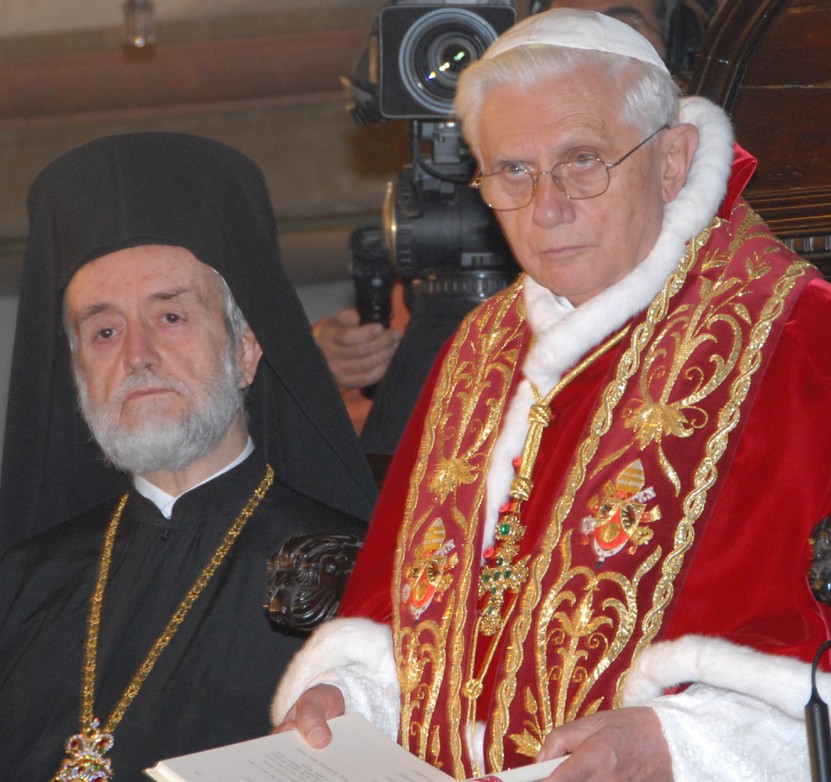
Bartholomew and Benedict

Ecumenical Patriarch Bartholomew to His Holiness Pope Benedict XVI

Your Holiness, beloved Brother in the Lord,

It is with sentiments of sincere joy and satisfaction that we welcome you to the sacred and historical city of Istanbul.
This is a city that has known a treasured heritage for the growth of the Church through the ages. It is here that St. Andrew, the “first-called” of the Apostles founded the local Church of Byzantium and installed St. Stachys as its first bishop. It is here that the Emperor and “equal-to-the-Apostles,” St. Constantine the Great, established the New Rome. It is here that the Great Councils of the early Church convened to formulate the Symbol of Faith. It is here that martyrs and saints, bishops and monks, theologians and teachers, together with a â??cloud of witnessesâ?? confessed what the prophets saw, what the apostles taught, what the church received, what the teachers formulated in doctrine, what the world understood, what grace has shone, namelyâ?¦the truth that was received, the faith of the fathers. This is the faith of the Orthodox. This faith has established the universe.

So it is with open embrace that we welcome you on the blessed occasion of your first visit to the City, just as our predecessors, Ecumenical Patriarchs Athenagoras and Demetrios, had welcomed your predecessors, Popes Paul VI and John Paul II. These venerable men of the Church sensed the inestimable value and urgent need alike of such encounters in the process of reconciliation through a dialogue of love and truth.

Therefore, we are, both of us, as their successors and as successors to the Thrones of Rome and New Rome equally accountable for the steps – just, of course, as we are for any missteps – along the journey and in our struggle to obey the command of our Lord, that His disciples “may be one.” ….

Beloved Brother, welcome. “Blessed is he that comes in the name of the Lord.”

“Blessed is the Name of the Lord now and forevermore.”

Pope Benedict XVI to Ecumenical Patriarch Bartholomew

â??Behold, how good and pleasant it is when brothers dwell in unityâ?? (Ps 133:1)

Your Holiness,

I am deeply grateful for the fraternal welcome extended to me by you personally, and by the Holy Synod of the Ecumenical Patriarchate. I will treasure its memory forever. I thank the Lord for the grace of this encounter, so filled with authentic goodwill and ecclesial significance.

It gives me great joy to be among you, my brothers in Christ, in this Cathedral Church, as we pray together to the Lord and call to mind the momentous events that have sustained our commitment to work for the full unity of Catholics and Orthodox. …

Signs of this love have been evident in numerous declarations of shared commitment and many meaningful gestures. Both Pope Paul VI and Pope John Paul II were warmly received as visitors in this Church of Saint George, and joined respectively with Patriarchs Athenagoras I and Dimitrios I in strengthening the impetus towards mutual understanding and the quest of full unity. May their names be honoured and blessed!

I also rejoice to be in this land so closely connected to the Christian faith, where many Churches flourished inancient times. I think of Saint Peterâ??s exhortations to the early Christian communities â??in Pontus, Galatia, Cappadocia, Asia, and Bithyniaâ?? (1 Pet 1:1), and the rich harvest of martyrs, theologians, pastors, monastics, and holy men and women which those Churches brought forth over the centuries.

I likewise recall the outstanding saints and pastors who have watched over the See of Constantinople, among them Saint Gregory of Nazianzus and Saint John Chrysostom, whom the West also honours as Doctors of the Church. Their relics rest in the Basilica of Saint Peter in the Vatican, and a part of them were given to Your Holiness as a sign of communion by the late Pope John Paul II for veneration in this very Cathedral. Truly, they are worthy intercessors for us before the Lord.

In this part of the Eastern world were also held the seven Ecumenical Councils which Orthodox and Catholics alike acknowledge as authoritative for the faith and discipline of the Church. They are enduring milestones and guides along our path towards full unity.

I conclude by expressing once more my joy to be with you. May this meeting strengthen our mutual affection and renew our common commitment to persevere on the journey leading to reconciliation and the peace of the Churches.

I greet you in the love of Christ. May the Lord be always with you.

www.patriarchate.org

Pope Benedict and Metropolitan John Zizioulas

The other point in the Churchâ??s being received is that of a reception of one Church by another Church â?? and most important aspect of reception, stems from the basic ecclesiological fact that the Church, although one, exists as Churches (in the plural), and these Churches exist as One Church in and through constantly receiving one another as sister Churches. We shall see later how important this aspect is for us today.

Metropolitan John Zizioulas The Theological Problem of ‘Reception’ (One in Christ: A Catholic Ecumenical Review 21, 1985)

Embodiedness and mutuality – John Paul II’s theology of the body

John Paul II’s “theology of the body,” which he laid out in 130 general audience addresses between 1979 and 1984, is arguably the most creative Christian response to the sexual revolution and its “pulverization” of the human person to be articulated in the twentieth century. Its philosophical core is Wojtyla’s claim that what we might call a “Law of the Gift” is built into the very structure of human being-in-the-world. Because of that, self–giving, not self–assertion, is the royal road to human flourishing.

This deep truth of the human condition, which John Paul believed could be demonstrated by a careful analysis of human moral agency, had enormous implications for meeting the challenge of the sexual revolution. Sex, as often experienced in today’s sexual free-fire zone, is instinctive and impersonal. But that kind of sex does not rise above the level of animal sexuality, which is also instinctive and impersonal. Sex that is an expression of self–giving love, not a use of the other for temporary gratification, is the only sex worthy of human beings. Chastity, on this analysis, is what John Paul called the “integrity of love,” the virtue that makes it possible for one to love another as a person. We are made free, Wojtyla argues, so that we can make a free gift of ourselves to others; we are free so that we can love freely, and thus love truly. Genuine freedom—the freedom that disposes of itself in self–giving—is the context of a genuinely humanistic sexual ethic.

The theological core of John Paul’s “theology of the body” is his profoundly sacramental apprehension of reality. Our embodiedness as male and female is not an accident of evolutionary biology, he insists. Rather, that embodiedness and the mutuality built into it express some of the deepest truths of the world, and teach us something about the world’s Creator. John Paul even goes so far as to propose that sexual love within the bond of marital fidelity is an icon of the interior life of God the Holy Trinity, a community of mutual self–donation and mutual receptivity. Thus sexual love, within the bond of Christian marriage, is an act of worship.

George Weigel John Paul II and the Crisis of Humanism

Pope John Paul’s lectures on the theology of the Body have been re-published as Man and Woman He Created Them: A Theology Of The Body

If JP II’s Theology of the Body is completely new to you, you could try Christopher West or even Peter Kreeft

Benedict in Constantinople

Pope Benedict and Metropolitan John Zizioulas

Amy Welborn has started covering Pope Benedict” visit to the Ecumenical Patriarch.

The Vatican has posted details of the services to be celebrated:

The Divine Liturgy begins with an invocation of the Holy Trinity: â??Blessed be the kingdom of the Father and the Son and the Holy Spiritâ?¦â??. Three litanies follow, a longer one and two shorter ones, which invoke the Lordâ??s mercy upon the whole world and the entire Church. Mention is made of the Church, her members and all those in need. These litanies always include an invocation to the Mother of God, who intercedes for everyone and for the Holy Church. After the second litany the christological hymn, â??Only-Begottenâ?? is sung; this is an ancient liturgical hymn that summarizes the principal dogmas of the Christian faith: the Trinity, the Incarnation of the Word of God, the divine maternity of Mary, the salvation that is bestowed on us by Christâ??s passion, death and resurrection. There follows the â??Small Entranceâ??. In a solemn procession, the priest and the deacon take the Gospel from the altar, show it to the faithful and set it again on the altar, in order to indicate the beginning of the proclamation of the word of God: originally this was the entrance procession. Before the readings the Trisagion is chanted: â??Holy God, Holy Mighty, Holy Immortalâ?¦â??.

The third part of the Divine Liturgy is the liturgy of the faithful, in which those who are baptized participate fully. It begins with the â??Great Entranceâ??, the procession with the bread and wine towards the altar. The choir sings the hymn: â??We who mystically represent the Cherubimâ?¦â??, another ancient liturgical text in which the Church of heaven and earth is united in praise and thanksgiving to God for his gifts. The priest incenses the altar, the church, the gifts and the faithful, all of which are icons of Christ. He then solemnly takes the paten and the chalice, and after asking the Lord to remember all those who have been commemorated and the whole Church, he sets them on the altar and covers them with the veil. The priest then recites for himself and the whole Church the words of the Good Thief from his cross: â??Remember me, Lord, in your Kingdomâ?¦â??. The gifts, a symbol of Christ, the Lamb who was slain, are then placed on the altar, as if in the tomb from which, after the consecration or sanctification, the life-giving Body of Christ will be given to each of the faithful. After the entrance, litanies are sung, the sign of peace is exchanged, and the Nicene-Constantinopolitan Creed is recited. There follows the anaphora of Saint John Chrysostom, which has a structure similar to that of the other anaphoras of the Eastern and Western liturgies: an initial trinitarian dialogue, Preface, Sanctus, anamnesis, institution narrative, epiclesis, intercessions and conclusion.

This is followed by the Our Father, the breaking of the bread and communion. Before communion the priest pours some boiling water (called the zéon) into the chalice as a symbol of the outpouring and presence of the Holy Spirit, as well as a sign of the life which comes from communion in the living and life-giving Body and Blood of Christ himself.

The Ecumenical Partriachate has set up a website to cover the Pope’s Apostolic journey. There will be no visit to the Theological School of Halki that the Turkish government has kept closed in defiance of the Turkish constitution’s defence of minorities and of religious freedom.

Benedict – the reasonableness of faith

These, of course, are points that Joseph Ratzinger has been making for years, indeed decades. In Christianity and the Crisis of Cultures, he synthesizes his arguments into a series of finely-tuned propositions on which all men and women of good will would do well to reflect. Among the most important of these propositions I would list the following, illustrating each with a brief citation from the book:

Proposition 1: We live in a moment of dangerous imbalance in the relationship between the West’s technological capabilities and the West’s moral understanding.

Thus Ratzinger writes, “Moral strength has not grown in tandem with the development of science; on the contrary, it has diminished, because the technological mentality confines morality to the subjective sphere. Our need, however, is for a public morality, a morality capable of responding to the threats that impose such a burden on the existence of us all. The true and gravest danger of the present moment is precisely this imbalance between technological possibilities and moral energy” [p. 27].

Proposition 2: The moral and political lethargy we sense in much of Europe today is one by-product of Europe’s disdain for the Christian roots of its unique civilization, a disdain which has contributed in various ways to the decline of what was once the center of world culture and world-historical initiative.

Thus Ratzinger writes, “…Europe has developed a culture that, in a manner hitherto unknown to mankind, excludes God from public awareness…God is irrelevant to public life…[This contemporary European culture] is the most radical contradiction not only of Christianity, but of all the religious and moral traditions of humanity…” [pp.30-31].

Proposition 3: The abandonment of Europe’s Christian roots implies the abandonment of the idea of “Europe” as a civilizational enterprise constructed from the fruitful interaction of Jerusalem, Athens, and Rome. This infidelity to the past has led, in turn, to a truncated idea of reason, and of the human capacity to know, however imperfectly, the truth of things, including the moral truth of things. There is a positivism shaping (and misshaping) much of Western thought today — a positivism that excludes all transcendent moral reference points from public life. Ratzinger asks whether such a positivism in an exercise of what the Canadian philosopher Charles Taylor describes as “exclusive humanism,” and then asks whether such an exclusivist humanism, is, itself, rational. His answer is a resounding “No.” As he writes, “This philosophy expresses, not the complete reason of man, but only one part of it. And this mutilation of reason means that we cannot consider it to be rational at all. Hence it is incomplete and can recover its health only through reestablishing contact with its roots. A tree without roots dries up…” [p.43].

And so, evidently, do civilizations.

Proposition 4: The recovery of reason in the West would be facilitated by a reflection on the fact that the Christian concept of God as Logos helped shape the distinct civilization of the West as a synthesis of Athens, Jerusalem, and Rome. If men and women have forgotten that they can, in fact, think their way through to the truth of things, that may have something to do with the European forgetfulness of God which Aleksandr Solzhenitsyn identified as the source of Europe’s 20th century civilizational distress.

Thus Ratzinger writes, “From the very beginning, Christianity has understood itself to be the religion of the Logos, to be a religion in keeping with reason…[But] a reason that has its origin in the irrational and is itself ultimately irrational does not offer a solution to our problems. Only that creative reason which has manifested itself as love in the crucified God can truly show us what life is” [ pp. 47, 49]…

If Europe begins to recover its faith in reason, then at least some in Europe may, in time, rediscover the reasonableness of faith; and in any event, a renewed faith in reason would provide an antidote to the spiritual boredom from which Europe is dying — and thus open the prospect of a new birth of freedom in Europe, and throughout the West.

George Weigel On Christianity and the Crisis of Cultures

Pope Benedict’s ‘Europe’s Crisis of Culture’ in shorter form