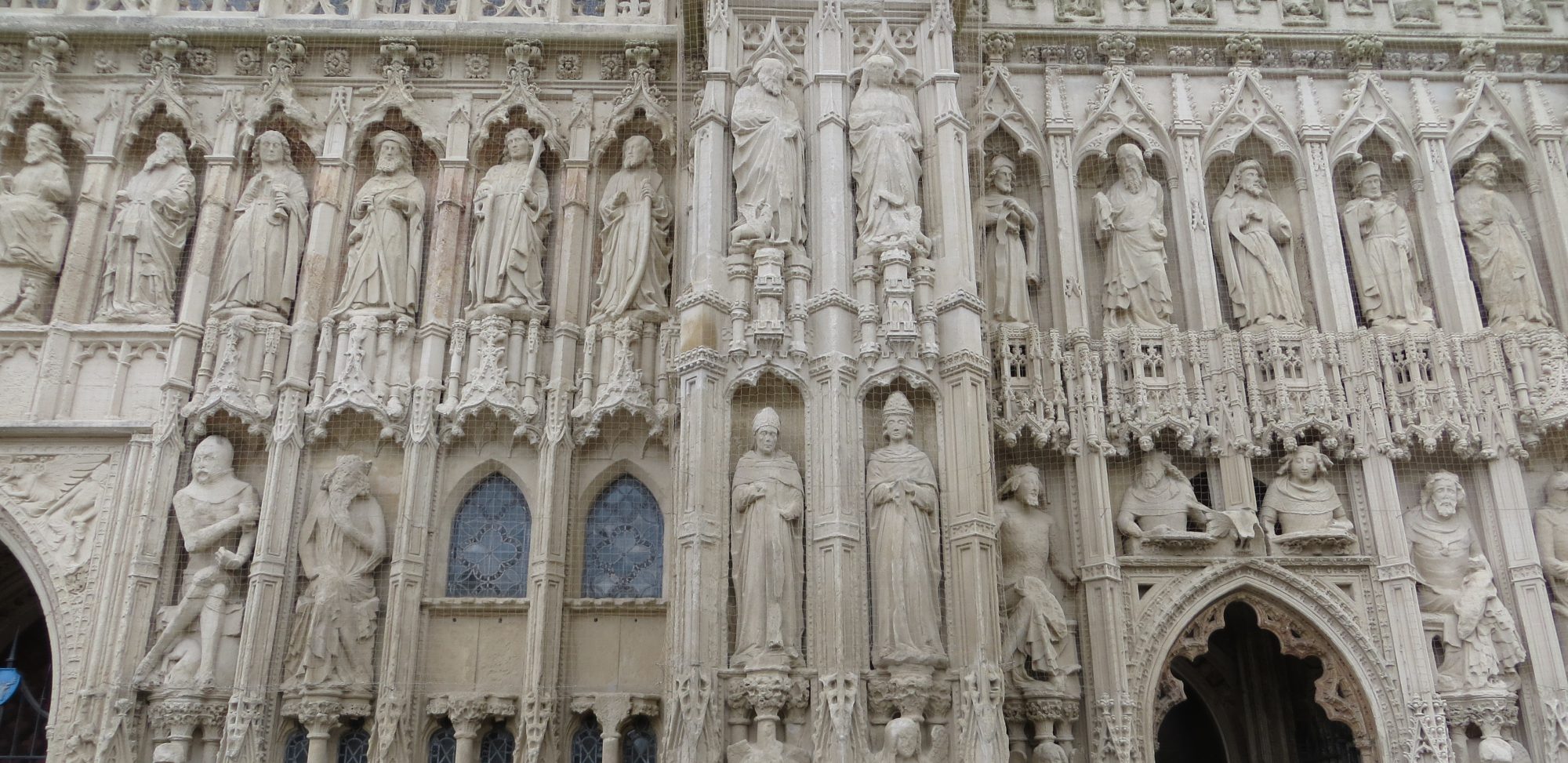
Crucified

Jesus was abandoned by all. He was hung on the cross to display his complete isolation and shame. All resources of support drained away from him, until he had nothing. In this visible world he was cleared out of all resources of public reputation and recognition. He descended through all intermediary levels of status and being until he reached the lowest point, left altogether without being, in total shame. But the forces of this world could not keep him down. Being unable to make their judgment stick, they have been publicly revealed to be without power. When he was raised by the Father, Jesus was set at the highest place. The Father reversed the action of mankind by overturning this public assessment of his servant. Because Jesus is raised from this total absence of status, those who shamed him are now shamed.

By his Spirit the victorious Son calls and draws out of the earth all the dispersed elements, all the bodies of the poor, hidden by wicked men, and brings them together to form one bright new body – the resurrection body, united with himself.

Jesus is handed over

Jesus is handed over to the world. He is made passive. Passivity and passion become his action. Although Jesus is the circumcision, baptism and anointing, he is circumcised, baptised and anointed. Although he is the resurrection, the one who may never die, he suffers and dies. He suffers the world. If we are allowed to abuse the language a little, we could say that Jesus is worlded. He calls out from the world what is most intrinsic to it – death – and summons it together to a single point, that of the cross. When Jesus calls, death comes out of the world. He is able to break open the world and separate death from it. The indivisible Spirit drives division out. The world is Jesused. Death has no claim on him, so finds nothing in him by which it can gain purchase. Death is deathed. The Spirit makes the Son indivisible and so impregnable: the world cannot break him. God has allowed the tares to grow in the field, and though, like the kings of the earth, they grow very confident, their destruction is assured, for he has all this time prepared a place for them, a no-place. In entering the enclosure of death the Son is not enclosed, but breaks open what only he had held shut.

Sons

My wonderful Eerdmans editor asked me whether I could change some of my references to ‘sons’ to ‘sons and daughters’ to make it seem a bit more fair. On the spur of the moment I couldn’t say why I didn’t want to make the change. But now I have found the admirable Ken Collins deftly explaining what is at stake.

You are all sons of God through faith in Jesus Christ, for all of you who were baptized into Christ have clothed yourselves with Christ. There is neither Jew nor Greek, male nor female, for you are all one in Christ Jesus (Galatians 3:26-28)

Paul did not write â??sons and daughters of God,â?? because he wasnâ??t thinking of sons as masculine offspring. He was thinking of sons as legal agents. If Paul had written â??sons and daughters,â?? he would have been empowering the men but not the women. By saying that women are also adopted sons of God, he is saying that women are equally Godâ??s agents in this world. Now we have a whole new idea about what it means to be a Christian.

In the household of God, we are slaves who are being adopted as sons of God through the blood of Jesus Christ, the only begotten Son of God. In our new status of sons, we are heirs, but more importantly we are Godâ??s business agents in this world. God gives us a commission to preach the gospel, to feed the hungry, to clothe the naked, and to do all the good deeds that He has set out for us to do. When Scripture says that we are adopted sons, it does not mean that we are only loved and cuddled, it means that we are the agents of Godâ??s providence, the distributors of Godâ??s blessings, the instruments of Godâ??s grace, and the ambassadors of Godâ??s love to sinners, because it is for sinners that Christ died. It is through our words and deeds that God answers other peopleâ??s prayers, because we are His agents in this world.

Ken Collins Cultural Differences – ‘Son’

More from D'Costa

Roman Catholics need to revisit their universities in the United States, promoting a genuine difference in scholarship and curriculum so that in five generations a Catholic intellectual culture might possibly be present and transformative of society. The Christian Church at the heart of the university will facilitate such genuine developments that can only enrich intellectual and cull life, facilitate real pluralism and dialogue, and serve the common good. Liberal society owes itself religious universities. American Catholics owe it to their Church and nation.

The other group of critics, those against ‘sectarian’ projects such as mine, and those against outside interference (the Church) in the university, are to be found in strength – within the churches, as well as from non-religious camps. I argue that such criticisms are misplaced and even self-deluding. Since all enquiry and methods of enquiry are tradition-specific, all forms of education are sectarian in certain ways. There is no high ground in this debate, only differing forms of sectarianism, be they liberal, religious, feminist, psychoanalyst, and so on. But there is an advantage to Catholic sectarianism: its conviction, founded in revelation and beautifully expounded by Thomas Aquinas, that reason has a rightful autonomy.

Gavin D’Costa Theology in the Public Square: Church, Academy and Nation.

the unity of the Church waits outside for us

To the extent that the church of England bishops only go to church of England parishes and churches, they have forgotten what the office of bishop is. To the extent that Methodist bishops (in the States) only go the Methodist congregations they have not understood that office of bishop is intrinsically ecumenical, because it is intrinsically the very office of Christ, who calls all men to obedience. He commands them, and they must hear and obey. The ecumenism is not an option but the evangelical command of God, the assertion, for our sake, of his lordship. And what we have said for bishops is so for all Superintendents and Moderators, who if they know themselves to be under the discipline of the whole Church are all bishops by another name.

So it is the job of the bishop to knock humbly on the door of every church in his diocese, not only those churches which ostensibly recognise bishops because their structure is Anglican or Episcopalian, but most particularly those who do not recognise bishops and assure us that they are independent of all that hierarchy. He must go to every charismatic assembly and little house church and wait until they get over themselves and let him in, and with him, the rest of the catholic Church. Until that time he must wait out in the rain. He is the icon of Christ, the sign of unity of the whole church that is presently waiting out on the street for each of us in our assembly to let them in. He is the icon of the Church because the suffering of Christ is visisble in him – for those who can see it. It is us who are making our Lord wait for us out there.

The Son and his people

The one Son does not replace the many people who belong to him. He is the guarantor of their continuing manyness. He starts a community, and is its definition, but he does not represent its end. He rather grows and expands it without limit. The manyness of these witnesses to the Son, themselves provided by him, are our protection against the intensity of his otherwise unmediated presence.

Scripture prepares us. To this end it protects us, and in stages removes this protection from us. The resurrection has already raised this protection from one of our number. It is his unity with the Father, that effects the unity and efficacy of scripture. The patriarchs are presently mediated to us as one single instantiation of Israel, the co-presence of the whole company in the one person, Jesus Christ. As one and complete, he is the arrival of the many. We are being trained to perceive and receive this host in him, the one they have sent ahead.

Gospel and 'pluralism'

Chris Seitz

Christian ministry in a pluralistic society begins with the capacity to speak the faith intelligently and persuasively to ourselves and to one another within the household of faith. We should not be ashamed or concerned to have this as our primary goal. For the pluralism the Gospel seeks to address is as omnipresent as the air we breathe, and exists within our midst as much as outside of it. The challenge is not how to address pluralism with some sure thing we presume to know that then must be adapted or modified in order to get an effective hearing; the challenge is how to identify the faith we claim to hold, that laid hold on us in baptism, in the face of a pluralism that is already our daily bread

Christopher Seitz

Many witnesses

The spiritual sons of Abraham are the ones who can tell the story of Abraham. Their narration of the action of God is witness to their paternity. God, the first actor of Scripture, creates a community, composed of patriarchs, prophets and saints, into which are to be integrated. He makes this cloud of witnesses and this diversity of speech and action shape us. God creates these many words and voices, and this crowd, for us. This crowd surrounds and accompanies us, and gives us our place. The witnesses of the old and new testaments form a single chorus that cheers, and shouts warning and encouragement. They line the road on which we now travel after the Son, willing us on, lifting us with their breath, and driving us along after him. They urge us not to give ourselves away to those other lords who prey on us, and they tell us to pass their encouragement and warning on. They are conveyors and amplifiers of prayers, who make the requests we do not yet know how to make for ourselves. The Holy Spirit utters these patriarchs, prophets and saints, and bears their voices to us. In turn they bear and utter the Son, and are made holy in the process. But these many witnesses are not replaced by the Son. The new testament does not replace or displace the old testament. These many witnesses, the old testament as much as the new, now mediate Christ to us. As he mediates them, they mediate him, and all their mediation is his work.

D'Costa on the university

D'Costa

I have found a new hero – he is Gavin D’Costa. I heard him give an impressive paper last summer on the origins of the university in the medieval Catholic Church. He introduced it by saying that after twenty years of teaching theology in Religious Studies departments he has just come out – as a Christian. This was moderately amusing (and this is the best I can do for an emotional response to D’Costa’s revelation). D’Costa’s paper was the last thing I ever attended at the systematic theology seminar of King’s College London – it might have been an epitaph on what had been until two years previously the last place in England in which Christian theology could be studied.
But now, on the day I was in Edinburgh to make the case for Christian theology for the university’s sake (see postings in ‘Theology and the University’) I found D’Costa’s Theology in the Public Square: Church, Academy and Nation. It is a joy. Here is a blast from the last page:

Education is central to the development of civilization and if the Church fails to transform education at every level, then the future of the Church and the world are in the deep trouble. If the North American and English public cannot see this, then they should drop all the rhetoric about fostering genuine pluralism and admit the ideological nature of their secularism. This would involve suppressing history – as the recent contested European constitution exemplifies, where the Christian heritage of Europe is passed over in silence. It is up to the churches in North America and English to take up this challenge, to bring the light of God to shine through the portals of the university, to allow for a revitalization of Christian culture so that God may be given glory and the common good thereby served.

This book says what seemed to have become unsayable, in fact it blurts it out.

Theology in the Public Square: Church, Academy and Nation.