Thomas Aquinas on a better concept of freedom 2

We are made for excellence. Developed through the four cardinal virtues prudence (practical wisdom), justice, courage, and temperance (perhaps better styled today, â??self-commandâ??) freedom is the method by which we become the kind of people our noblest instincts incline us to be: the kind of people who can, among other possibilities, build free and virtuous societies in which the rights of all are acknowledged, respected, and protected in law. Law is thus intertwined with freedom. Law can educate us in freedom. Law is not a work of heteronomous (external) imposition but a work of wisdom, and good law facilitates our achievement of the human goods that we instinctively seek because of who we are and what we are meant to be as human beings.
Virtue and the virtues are crucial elements of freedom rightly understood, and the journey of a life lived in freedom is a journey of growth in virtue, growth in the ability to choose wisely and well the things that truly make for our happiness and for the common good. Itâ??s a bit like learning to play a musical instrument. Anyone can bang away on a piano; but that is to make noise, not music, and itâ??s a barbaric, not humanistic, expression of freedom. At first, learning to play the piano is a matter of some drudgery as we master exercises that seem like a constraint, a burden. But as our mastery grows, we discover a new, richer dimension of freedom: we can play the music we like, we can even create new music on our own. Freedom, in other words, is a matter of gradually acquiring the capacity to choose the good and to do what we choose with perfection.

George Weigel A better concept of freedom

With the aid of the Holy Spirit we must judge for ourselves

The Scripture tells us not to bear false witness against our neighbour. Whether this particular ambiguous statement we have it in mind to make will be false, or merely discreet, is something that the Scripture will not tell us; we must judge that for ourselves with the aid of the Holy Spirit. Yet everything the Scripture does tell us about truth and falsehood will contribute to making that judgment possible. The authority of Scripture is proved, then, precisely as it does, in fact, shed light on the decisions we are faced with, forcing us to re-evaluate our situation and correct our assumptions about what we are going to do….

The most mysterious question anyone has to face is not, what does Scripture mean?, but, what does the situation I am facing mean? If we have even begun to appreciate the nature of this question, and how a false judgment of ourselves can lead us to destruction, we shall be on our guard against any hermeneutic proposal to reverse the sequence of discernments, starting with our own situation and turning back to Scripture to look for something there to fit it. That presupposes that we already know the answer to the one question we dare not presuppose an answer to. Nevertheless, such proposals are common enough in theological discussion, sometimes with a liberal, sometimes with a conservative slant. It hardly matters which, since the two come closest to each other precisely at the point where they are both furthest from the truth. If the conservative thinks that all the Scriptural witness to moral behaviour can and must be honoured somehow, and the liberal that only some of it, or only most of it, must be honoured, what difference does that make if each thinks that conclusion has been reached from some self-evident intuition about what the times require, so that the appeal to the Scripture merely confirms what has already been decided? This is not to take Scripture seriously as an authority. And it is not to take living in the present seriously as a risky business….

Oliver O’Donovan Scripture and Obedience

A real desire for unity 2

When people ask me, for example, why the Orthodox jurisdictions in America are not united, the answer is very clear: because our leaders donâ??t want it. If they wanted it, we would have had it yesterday. There is nothing stopping themâ?¦ you may have to suffer a lot. You may have to give up some things: power, pre-eminence, prominence, property, possessions, prestige, positions, privilege and pleasure. Weâ??re not ready to give up those things because of pride, passion and prejudice. Forget it. Thereâ??s not going to be any unity. Thatâ??s what divides people generally, and it is certainly what divides churches.
Now here I would allow myself one little â??not my businessâ?? remark: I have a hunch those same things are operating in the Eastern Catholic Churches, tooâ?¦

We will never be one unless we desire it with all our hearts, and are ready to put away everything that we can to have itâ?¦. Everything that doesnâ??t belong to the essence of the faith. Language doesnâ??t belong to the essence of the faith. Calendars donâ??t belong to the essence of the faith. Certain liturgical customs donâ??t belong to the essence of the faith. Even the Byzantine Rite Liturgy for us does not belong to the essence of the faith.

There was a whole thousand years when the Church had multiple rites of praise to God. In fact, the irony is, the time when there were the most multiple rituals for the sacraments and the services was the time there was the greatest unity in doctrine and spiritual life, evangelism, etc. In any case, the ritual is not of the essence of the faith. Language isnâ??t, calendars are notâ?¦ all those things are not part of the essence of the faith. But unless we have the desire for unity, which then would lead us to feel that we have an absolute obligation from God to distinguish between what is really essential and what is not, we are never going to be united.

Father Thomas Hopko What would the Orthodox have to do to have unity?

Catholicity 7

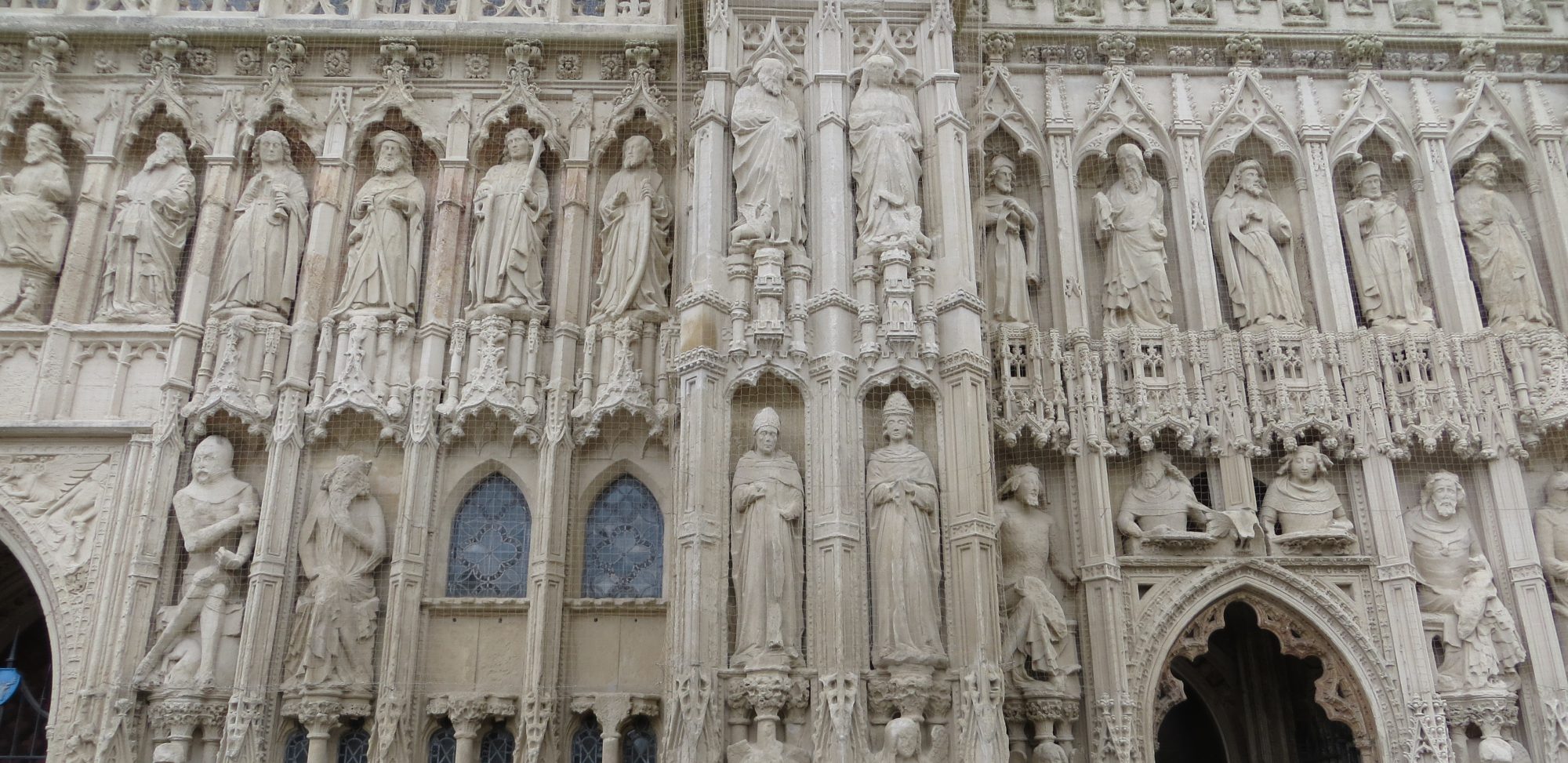
The bishop represents the whole history of the Church, all its apostles and doctors, to his congregation. He is the catholicity of the Church, in one person. In him the worldwide church makes itself present to each local congregation. A bishop is a member of the assembly of the whole church, drawn from every corner of the world. If the bishop is present, the whole Church is present in each particular congregation, so that the whole geographic and historic catholicity of the Church is present in that particular part of the world. This Church on earth is the form in which Christ together with all his people is presently visible to the world.

Bishops are apostles. The point about apostles is that there is a plurality of them. Twelve indicates completeness, so there is one apostle for every part of the world (The same is true of the seventy apostles, for there are notionally seventy nations in the world). When one apostle falls, his place is filled by another. Apostolic succession does not run individual to individual, so the power of consecration does not run bishop to bishop in unbroken quasi-physical transmission, no single gap in all those centuries. It is ‘possessed’ by the assembly and council of apostles and bishops as a whole, represented in the council of the whole church as this participates in the whole Christ. Thus the worldwide council of the church is a foretaste of the ultimate assembly of all creatures in worship of God.

The bishop teaches his people the doctrine of the whole Church, and when the Church refuses any part of these gifts and disciplines, and sets out to found its faith on something less than the full deposit of faith, the bishop will exercise the discipline that will bring it back to obedience, and he will endure the suffering that this will involve.

Postbag

EE

Dear Dr Knight

I am on my second reading of â??EEâ??. As a Lutheran layman I am a reader of First Things and Touchstone. My pastor and good friend has just left our Lutheran church and communion for the Church of Rome. About the time he announced his decision to leave, I ordered â??EEâ?? on a whim and a few reviews. I have found it to be an excellent work in addressing the problems of church division and modernity. I have been quite frustrated with the very questions you address: Creation, Israel, the work of the Holy Spirit, and how I raise my children in the midst of screaming cultural conversations. Thus my second reading. I am captivated by the bookâ??s premise of a Trinitarian theology in which God is bringing his people to a fullness and freedom through his dynamic work: Father, Son and Holy Spirit. I have often struggled in this highly individualized culture with how to participate in the life of God as Body of Christ and how the time afforded me fits with that of the fullness of that Body in its history. Thank you for your diligent work. It has helped to clarify much of what was bothering me so much. I shall probably have a number of questions â?? one of which I will ask you now. Do you have an outline of â??EEâ?? that would enable me to teach an adult class in my church? I really believe that Christians of all educational levels (and economic levels) are struggling with the questions your book so helpfully addresses. I intend on developing such a series of classes that relies on scriptural readings, parables, and questions pertinent to the development of an eschatology that informs faith and inspires Christian formation. Can you help me with this?
Sincerely your in Christ,
CG

* * * *

Dear Christopher
Many thanks for your wonderful mail.

Yes I do have an outline of The Eschatological Economy, though it needs more work. I have written a series of posts on EE for the blog and to post on Amazon. I will send you what I have, though I don’t know if it will help your class.

As for scriptural material for classes on eschatology that informs faith and Christian formation, I am working on that too. I have been putting together some chapters on Christian formation which I hope will be of some use to the church. I am going to call it The Apprenticeship, and it will cover much of the same ground as The Eschatological Economy, but more accessibly.

Everything that Christians say about time, history and the purpose of the world, which is that we come to share life with God, can be lumped together as eschatology. It is a catch-all for all the issues around our looking forward in hope and faith to his coming again in great glory. This means that we have to say that the world has a plot, but it doesn’t really know what it is, so there are two rival accounts of the plot â?? the worldâ??s and the Lordâ??s. There is a double history: secular history and salvation history. It is the Christian privilege to point out the difference between them. That is the line I would take with a class.

But there are many other and better people working in these areas, I commend their works to you. I have started to compile lists of books on my Amazon homepage, but it is a long job and James Merrick (there is a link from my blog) for example does it better than I do. You can find out what my suggestions are by looking through those lists. It would be a lot quicker than waiting for me to produce new material.

I don’t think there is any need to leave the mainline denominations, Lutheran, Presbyterian, Episcopalian, nor to feel abandoned when someone near, dear or senior does. There are many reasons why individuals might leave this or that congregation, but whether we leave or stay, the Christian life is always going to hurt, but we should always be glad of it.

We English used to think that we were in possession of the gospel: then we decided that we had seen through the gospel. Now we really don’t know what the gospel is, but are still too proud to say that it matters to us. So churches don’t run classes in England, and almost no one asks for classes. Where classes are run, by charismatic churches for example, they tend not to make connections between discipleship and intellect, and don’t see the intellectual side work as real work. The Christian here is a student without a teacher (or teacher without a class) – a sparrow on the rooftop. Thanks. If you want more, please ask me again.

Douglas

You can find out more about The Eschatological Economy at Amazon.com or at Amazon.co.uk or at Eerdmans
Comments

As my hope of becoming an intellectual slips away I have begun to hope – much more ambitiously – that I could one day become a disciple.

So I don’t know why those who leave comments on this site believe that their comments have to be so fantastically learned. This isnâ??t Pontifications you know. If I can post statements of the blooming obvious on this blog, so can you.

But I have got to show you two comments which seem to hope that intellect yet may serve discipleship.

From Brian Hamilton:

Could it be, I wonder, that the while Christian community is rightfully and graciously ordered, it never be ordered in a way that is structurally final except to reflect the dependence of all on the guiding presence of Christ? The church is ordered and re-ordered in each moment, always participating in Godâ??s work through the lives of all its members, but with the profound knowledge that this as often throws us on back on the lives of our children as it does on our trained theologians and pastors. It is the mark of our humility that there are no â??professionalâ?? or â??expertâ?? disciples, only all of us together pilgrims on a journey. And yet this does not imply a naive and disembodied â??equality,â?? or else it would also imply a rejection a rejection that the Spirit gives gifts of authority to all its members. And so it does not imply the rejection of a regular order that the church must rely on for regular guidance and strength. It only refuses to institutionalize and absolutize a particular order that God may at any moment interrupt, since all Godâ??s people are charged with the task of leading the faithful through in those moments for which they have been prepared. And this cannot be only an abstract point, since it is also an ecclesiological one about the multiplicity of the gifts of the Spirit.

Iâ??m not sure if this way of putting it quite works; Iâ??m aware of the tension in the trajectories Iâ??m trying to hold together. That may well be, however, a good picture of the (Anabaptist-Mennonite) tradition Iâ??m trying to represent, who at the same time rejects the absolute and untouchable ordering of a church that is fundamentally hierarchical, and still wants to speak in deep appreciation of the necessity of shepherds for guiding the church through the world. Or to illustrate the same thing in a different way: mine is a tradition that has at once maintained that all Godâ??s faithful are saints in the truest sense of the word, yet has insisted on telling stories of the memorably faithful. I find it an incredibly pressing project to articulate an ecclesiology that does not forsake the sort of ordering you are insisting on, but neither absolutizes particular structures of particular people that prohibit structurally the churchâ??s right dependence on, for example, its newly baptized.

And A. Steward says:

I appreciate your comment that,

â??Christianity stands for that order and reason that, by Godâ??s grace, will make us happy to share one anotherâ??s experience without wanting it exclusively for ourselves, and to participate in one another without trying to absorb or replace one another.â??

It might be the case that poor listening skills are predicated by this sort of failure to recognize the uniqueness of other people. We assume that anotherâ??s experience of life fits with our idea of â??timeless truthâ?? as we have experienced it, and so we end up hearing not them, but ourselves. I think your ideas here are particularly relevant to our American racial myth of the â??melting pot.â?? Perhaps Lutherâ??s doctrine of the Word might be helpful for redressing this, particularly where he talks about the need for the Word to be spoken, and this not by our own mouth, but by another, addressed to us. I always liked Bonhoefferâ??s line, â??The Word of God is always stronger in the mouth of our brother.â??

Yes, the Word of God is stronger in the mouth of our brother. Could it be that you are that brother? And all Godâ??s people are charged with the task of leading the faithful through in those moments for which they have been prepared. So speak up and say it plainly. Perhaps some aspect of our education in this faith is in your hands.

Thomas Aquinas on a better concept of freedom 1

The monumental achievement of Thomas Aquinas was to marry the wisdom of a millennium of Christian philosophy and theology to the new philosophy of Aristotle that had been rediscovered in Europe (largely through the mediation of Arabic philosophers) in the early thirteenth century. This intellectual marriage yielded a rich, complex, and (to use the precisely right word a few centuries before its time) deeply humanistic vision of the human person, human goods, and human destiny. Embedded in that vision of the human person was a powerful concept of freedom.

Freedom, for St. Thomas, is a means to human excellence, to human happiness, to the fulfillment of human destiny. Freedom is the capacity to choose wisely and to act well as a matter of habit or, to use the old-fashioned term, as an outgrowth of virtue. Freedom is the means by which, exercising both our reason and our will, we act on the natural longing for truth, for goodness, and for happiness that is built into us as human beings. Freedom is something that grows in us, and the habit of living freedom wisely must be developed through education, which among many other things involves the experience of emulating others who live wisely and well. On St. Thomas’ view, freedom is in fact the great organizing principle of the moral life and since the very possibility of a moral life (the capacity to think and choose) is what distinguishes the human person from the rest of the natural world, freedom is the great organizing principle of a life lived in a truly human way. That is, freedom is the human capacity that unifies all our other capacities into an orderly whole, and directs our actions toward the pursuit of happiness and goodness understood in the noblest sense: the union of the human person with the absolute good, who is God.

George Weigel A Better Concept of Freedom

A real desire for unity

By popular demand, and at the insistence of Matthew Baker, it is time for more from the wonderful Fr Thomas Hopko. What goes for the Orthodox goes for the rest of us. I have taken some liberties with Fr Hopko’s paragraphs.

* * * *

If you are in Eucharistic communion, you are one church. That’s what makes the Church one. It’s the unity in the body broken,
the blood shed of Jesus before the face of God. That’s where the Church is actualized on earth in the celebration of the mysteries: baptism, chrism, Eucharist. That’s what makes us one. That is where the unity of our doctrine is shown, our unity of worship, our unity of morals, our ethics, the unity of spiritual life.

We claim to belong to the one, holy, catholic and apostolic church of Christ, the church that teaches the gospel truly, fully, that prays properly, that acts and teaches the right way to behave according to Christ, according to God Almighty, according to the Holy Scriptures, the canons, the saints, the fathers, etc.

So what is really required… all above everything, is a real desire for unity…to want to be one, to suffer over the division, to weep over it, to carry it around like a sword in your soul that we who claim Christ and praise God in Christ (especially in this world which is getting less and less Christian as the clock ticks) are divided…

Father Thomas Hopko What would the Orthodox have to do to have unity?

Equality, inclusivity and confusion

The liberal gospel is that we are all the same and that we should all be the same. It demands the equalization of access and experience. This is a gospel of natural rights that says that no experience should be denied any of us, and that we should all be able to experience everything directly for ourselves. We should not have to experience anything at second hand through the mediation of other people.

But Christians can afford to be more relaxed than this about what we are able to experience. We can admit that it is fine to enjoy most things at second hand, and we say that enjoying experiences through other people, rather than first hand, is real and valid enough. We can say this because we insist that other people cannot be substituted for. We cannot replace other people, we cannot be them. We live through other people, and they live through us, and this of course requires that we are properly ordered one to another. This ordering by which we can be with other people is given to us – it is not a work of our own. Our Lord hosts us, provides us with these other people and orders us one to another. By giving his order to us, even imposing it on us, he makes it possible for us to be together and to participate in one another’s experience.

The Christian faith says that good order makes for a good life, which means a life lived together with others. For the sake of this good order, the Christian life is ordered and can even admit to being hierarchical. The Christian faith identifies what is good, it searches for those skills, capabilities and virtues that enable us to identify with increasing accuracy what is good. It promotes what it calls discernment, or judgment (or insight, taste, sensibility). It praises excellence, and it gives recognition to those who are best, and who are best able to lead the rest of towards what is good. So the Christian faith is intrinsically about excellence. Excellence is a nice word for it, while is elitism a less pretty word for it – but the same thing is meant. Christianity is intrinsically elitist – it confesses a Lord and it involves us in following those apostles and disciples who can pass to us the order and authority of this Lord.

Yet the greater part of the leadership of my (Anglican) church does not believe in leadership. It is elite that declares that all elitism is wrong (though elitism is intrinisic to excellence) and denies that it is itself an elite. It holds its authority in order to stop anyone else (those it calls conservatives or fundamentalists) from doing so.

Our church leadership, the liberal clergy, is in a state of confusion about what it wants. It decides that the gospel is too complex for its hearers and sets about simplifying it down to inclusivity and equality of opportunity. But the simplification and falsification of the gospel represented by the agenda of inclusivity brings unending confusion. There is no way of answering the question of how we shall make everyone equal without taking the powers of an elite.

There is also no way of answering the question ‘equal to….what’? What is the criterion and measure to which we are going to equalize everything?

They dislike the thought that one is better than another (better taught and discipled in the Christian life, for instance). But there is no way around this, and confusion will reign until the leaders of our civilisation are prepared to re-admit the idea that not everything is the same as everything else, and that the differences between people are themselves gifts.

Christianity theology now stands alone in the Humanities for the case that difference and otherness means order and hierarchy, and for the truth that there is no particularity or uniqueness without difference, and there is no difference without order. Christianity stands for that order and reason that, by God’s grace, will make us happy to share one another’s experience without wanting it exclusively for ourselves, and to participate in one another without trying to absorb or replace one another. The grace of God will make humans of us yet.

Catholicity 6

The whole Christian community is under a discipline imposed upon it by an external authority. It is formed and disciplined, as it is redeemed, by Christ who comes to it from outside. But Christ is no absentee landlord who exercises only a distant or theoretical authority. The authority of Christ is exercised by Christ, made present to us in his whole people the Church, and carried out by the office-holders of the Church. The lordship of Christ presently makes itself felt as these specific overseers.

No community of Christians is under its own authority, and so no individual community can ordain its own leaders. This must be done for it by the rest of the church, by all other congregations, as it were. Such overseers are sent by the whole Church to each local church, which must receive this overseer and his discipline willingly, as a gift received from the whole Church. Because these overseers must be trained in the full deposit of faith, we need a trained and ordained clergy. Christ makes himself present to us in the form of these disciplinarians, who are responsible for connecting us to all the people of Christ, mediating to us the whole Church, and passing on to us all the characteristics of the servanthood of Christ. Obedience to the God who is really God is freedom, and obedience to his word and then, to those he made his apostles, is the form Christ takes for us now.

Our overseers are the love and discipline of Christ for us as they pass on what they have received from Christ and enable us to receive it in full and thankfully. We have to help these overseers to be good transmitters of the faith, and we do this by encouraging them to instruct us, and by taking our complaints to them and to God when they fail to do so. So discussion of the office of the bishop is no defence of clerical interests, but an essential part of the living witness of the contemporary Church.

Next we must relate the bishop to the assembly and to the plurality-and-unity of the whole Christ.