Mihail and Emanuela

Mihail and Ema

Mihail and Emanuela will be married on 5 November 2006 in the Orthodox Cathedral of Arad, Romania

The bride belongs to the bridegroom. The friends who attend the bridegroom wait and listen for him, and are full of joy when they hear the bridegroom’s voice. That joy is ours and it is now complete.

Resources re-sourced

My tireless webmaster James Knight has put the whole content of Resources for Christian Theology into WordPress. It doesn’t look pretty, but at least it is all available again. One day we will find a better website management system – suggestions are very welcome.

I have added more links to this blog – to the Ecumenical Patriarch, two Barth sites, Generous Orthodoxy, and Alan Brown’s new Glaswegian Orthodoxy.

Meanwhile in London, a rare event of public theology:

Canon Andrew Walker Professor in Theology and Education at Kings College London is giving

The Deep Church Lectures: Series 1

Every Thursday evening

2nd November – 7th December 2006 7.15 – 9.30pm

A commitment to truth that entails dialogue with the other

The communion that Anglicans share is a precious gift. The present crisis in the Anglican Communion constitutes an opportunity to re-commit ourselves to one another in renewed obedience to God’s call. A covenant which expressed that commitment would not be something entirely de novo but rather a development of the ‘bonds of affection’ which bind us to one another. In making such a covenant at the present time we would be acknowledging that in specific situations, especially situations of conflict, threat or opportunity, God calls his people to discern his will afresh and to re-commit themselves to him and to one another. There is much we can learn here from the annual Methodist Covenant Service as it has been incorporated into the Church of North India.

In a situation of conflict the discernment of God’s will for his people is not an easy task. It demands fresh study of scripture, the careful presentation of arguments, patient listening to one another and preparedness to wait in uncertainty and hope until a clearer understanding of the truth emerges. All of this will, for God’s people, be grounded in love for one another, trust that we are together committed to seeking God’s way, and hope that the Holy Spirit will indeed lead us into all truth (John 16.13). This need for patience with some person, or with an entire body, that expresses contrary views is expressed very clearly by Augustine, when he says,

Let him, again, who says, when he reads my book, ‘Certainly I understand what is said, but it is not true’, assert, if he pleases, his own opinion, and refute mine if he is able. And if he do this with charity and truth, and take the pains to make it known to me (if I am still alive), I shall then receive the most abundant fruit of this my labour. … Yet, for my part, ‘I meditate in the law of the Lord’ (Psalm 1:2) … hoping by the mercy of God that he will make me hold steadfastly all truths of which I feel certain; ‘but if in anything I be otherwise minded, that he will himself reveal even this to me’ (Philippians 3:15), whether through secret inspiration and admonition, or through his own plain utterances, or through the reasonings of my brethren. This I pray for … (De Trinitate 1.1.5).

Augustine speaks of a commitment to truth that entails dialogue with the other – who is my sister or my brother in Christ. He speaks of an increasing understanding of truth within the Body of Christ and of the human grasp on truth as corporate and fallible. Within the communion of the Church he looks to the other as someone through whom he may grow in knowledge of Father, Son and Holy Spirit.

In the same Spirit, Anglicans, bound together in communion, need each other in order to grow in faith, knowledge and love (cf. 2 Peter 1.5-7). We are committed to encouraging one another and to learning from one another’s experience of discipleship in particular situations. Since we are weak, fallible and living in a fallen world, there is always the need for humility and mutual forgiveness. Anglicans, like all Christians, have to face honestly the ways in which hurt has been given within the Body of Christ, for example, through colonialism, patriarchy and other mechanisms of exclusion. We know that truly to discover the mind of Christ we have to go by the way of self-emptying, humility and obedience which is also the way of the cross (Philippians 2.5-11). A re-affirmation of our commitment to one another in covenant would thereby become a re-commitment in hope of the reconciliation of all things in Christ, who has established our peace by the blood of his cross (Colossians 1.20).

Inter Anglican Theological and Doctrinal Commission Responding to a proposal of a covenant October 2006

The End of Education

What should be the distinctive calling of the American Catholic university or college here and now? It should be to challenge its secular counterparts by recovering both for them and for itself a less fragmented conception of what an education beyond high school should be, by identifying what has gone badly wrong with even the best of secular universities. From a Catholic point of view the contemporary secular university is not at fault because it is not Catholic. It is at fault insofar as it is not a university….

The question of how these bits and pieces might be related to one another, of whether they are or are not parts that contribute to some whole, of what, if anything, it all adds up to, not merely commonly goes unanswered, it almost always goes unasked. And how indeed could it be otherwise when every course, even when introductory, is a course in a specialized discipline taught by a teacher who may be vastly ignorant of everything outside her or his own discipline? Each part of the curriculum is someone’s responsibility, but no one has a responsibility for making the connections between the parts. To whom should this matter?

It should matter to anyone who thinks it important what conception of human nature and the human condition students have arrived at by the time they enter the adult workplace – and therefore to any Catholic. For each of the academic disciplines teaches us something significant about some aspect of human nature and the human condition. Physics tells us which particles and forces compose the body as a material object, while chemistry and biochemistry examine it as the site of various exchanges and reactions. What the functioning structures of complex living organisms, such as ourselves, are and how they have evolved we learn from biology, while sociology, anthropology, economics, and history make human beings intelligible in and through their changing cultural and social relationships. Philosophy – together with the history of inquiry – shows us how and why we are able to move toward a more and more adequate understanding of ourselves and our environments, from time to time transcending the limitations of previous modes of understanding. That human beings are also in key part what they imagine themselves to be, and how, without works of imagination, human life is diminished, we can only learn from literary and other aesthetic studies. Yet, when we have learned what all these different types of discipline have to teach – and the catalogue is far from complete – we confront questions that have so far gone unasked, just because they are not questions answerable from within any one discipline.

Alasdair MacIntyre The End of Education The Fragmentation of the American University

What is a university? 3

The ‘product’ of the university, then, is not simply the person who has acquired skills – technical skills, even research skills; it is the person who has acquired the habit and virtue of learning, and who sees the social world as a place not primarily of struggle and conflict over control but as a context where conversation may be pursued with patience.

And this is a deeply political matter, in the fullest sense of the much abused word ‘political’. It alters what we think we can expect of each other; it challenges any assumption that conflict is the natural position for human beings; when there are clashes of interest, it tells us how to question what we have taken for granted about our own best interests and encourages us to seek for something new that is not just the property of one individual or faction. The university nourishes ‘civility’ – in the narrow sense of patience and courtesy in dispute, and in the much larger sense of concern for proper and open public life in the civitas, the city, the community of citizens.

Archbishop Rowan Williams What is a university? Speech given in Wuhan, China

These ecclesial communities are schisms of a schism from the Holy Orthodox Church

Unfortunately, I feel compelled to scorn here…

Arius was from ALEXANDRIA, not Antioch!

This guy doesn’t know his Church history.

The Antiochenes stressed the full reality of divinity and the full reality of humanity in Jesus Christ. The Alexandrians stressed that the one active and passive subject in Jesus Christ was the Logos.

At its extreme, Alexandrian theology tended either to deny the divinity of the Logos (this is what Arius did: the Logos is a creature), or to fuse divinity and humanity in their insistence upon the ‘one Incarnate nature of God the Word’ (Cyril’s phrase).

At its extreme, Antiochene theology in Nestorianism so fully stressed the divine reality and the human reality in Jesus that it developed the notion that in Christ there were two beings, one divine and one human, acting in unison.

In fact, the Church ultimately accepted neither of these positions on its own, but rather recognised the truth to lie in their synthesis, a synthesis that was definitively achieved in the Constantinoplitan Ecumenical Councils of 553 and 680. The one divine hypostasis of God the Word, fully divine by nature, assumed (enhypostasised) human nature in Incarnation, thereby divinising it entirely: it only existed in the divine hypostasis of the Logos and was fully permeated by divine energy. Thus the Cyrillene ‘one nature’ of God the Word is to be understood as the one hypostasis of God the Word (as per Trinitarian theology), and the divine and human realities in Jesus – which remain unconfused – are indivisibly united, existing in the one subject of the hypostasis of God the Word.

The author is confusing two issues: Arius the Alexandrian’s denial that Christ is divine (so that in Christ no union of divine and human takes place), and the Nestorian denial of union in the one hypostasis of God the Word (so that in Christ no union of divine and human takes place). Neither, however, denied the need for Christology.

Also, the author, I fear, remains caught in the Protestant confusion of thinking of Nicaea 325 as a terminus of dogmatic Orthodoxy, when in fact, it is the starting-point, comprehensible to us only in light of the subsequent Councils of the Church. If you take the Symbol of Nicaea out of the historical transmission (paradosis) of the one Christian faith, then you do not have ‘Nicene Orthodoxy’ – you do not have ‘Orthodoxy’ of any sort – for a symbol wrenched from the context in which it has its home can mean anything or nothing. You cannot turn to just one or two choice items which you happen to take a shine to in the history of the Church and appeal to them as ‘Orthodoxy’. Affirmation of the Nicene Creed no more ensures Orthodoxy than the Bible does. Orthodoxy exists only in the one, holy, catholic and apostolic Church, which, incorporated into Christ and illumined by the Holy Spirit, preserves and hands over the one Orthodox faith from generation to generation. It is only through the adoption of this faith in its wholeness (kath holon) that the true meaning of the Scriptures and all in which Holy Tradition consists can be understood.

And part of this faith the adoption of whose wholeness is a precondition of Christian understanding is communion with a validly-ordained Bishop of the Orthodox faith in communion with the other Bishops of the Orthodox Church.

There is no use in Protestants playing in some half-way house of ‘Nicene Orthodoxy’ designed to assuage their bad feelings and partial recognitions that the ecclesial communities in which they have until now existed are but schisms of a schism from the Holy Orthodox Church.

Alan Brown in reponse to Harry L. Chronis Alexandria or Antioch?
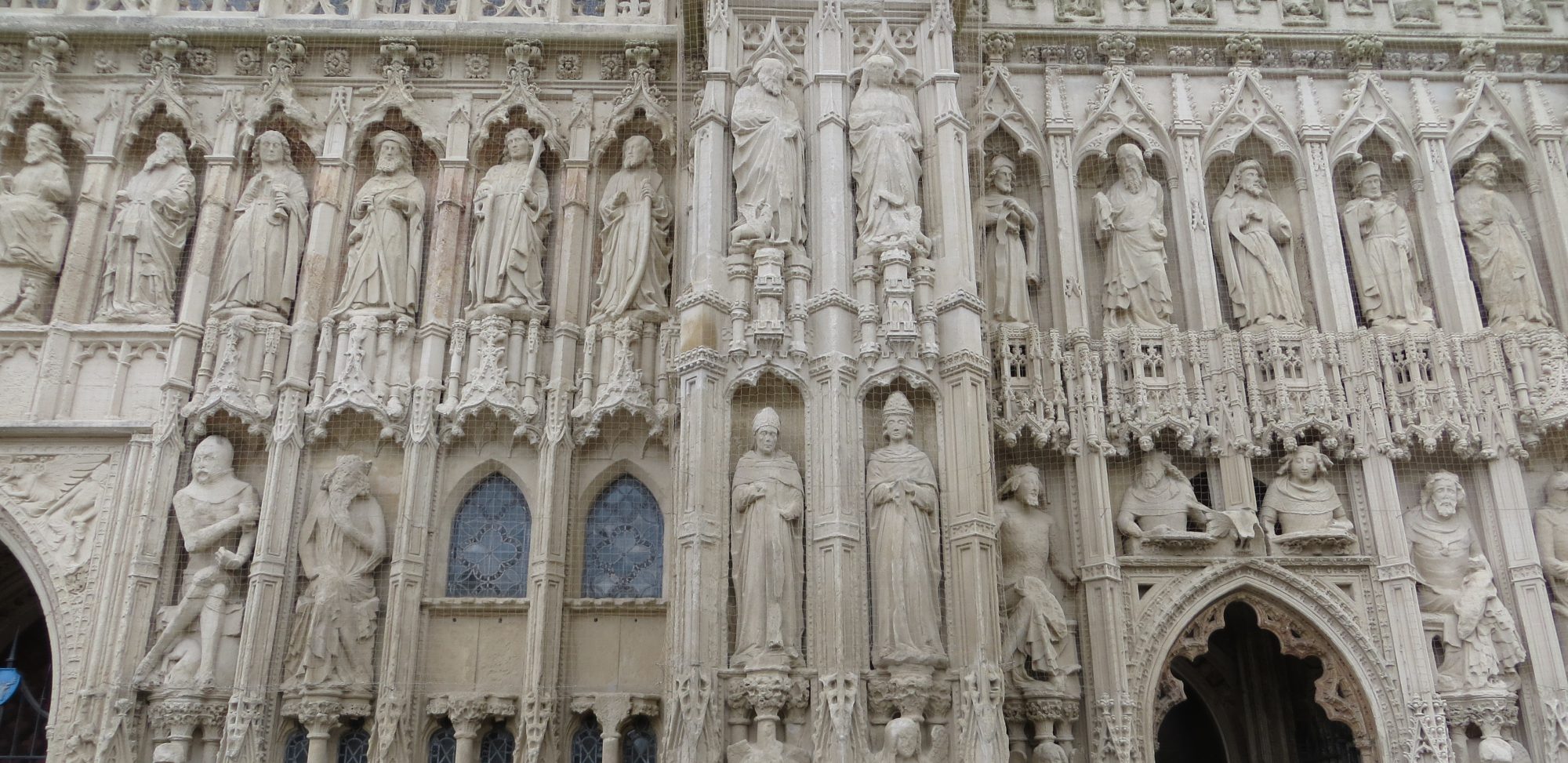
Enter into the 'We' of the church

The first dimension is that the celebratio is prayer and a conversation with God: God with us and us with God. Thus, the first requirement for a good celebration is that the priest truly enter this conversation. In proclaiming the Word, he feels himself in conversation with God. He is a listener to the Word and a preacher of the Word, in the sense that he makes himself an instrument of the Lord and seeks to understand this Word of God which he must then transmit to the people. He is in a conversation with God because the texts of Holy Mass are not theatrical scripts or anything like them, but prayers, thanks to which, together with the assembly, I speak to God.

It is important, therefore, to enter into this conversation. St Benedict in his “Rule” tells the monks, speaking of the recitation of the Psalms, “Mens concordet voci”. The vox, words, precede our mind. This is not usually the case: one has to think first, then one’s thought becomes words. But here, the words come first. The sacred Liturgy gives us the words; we must enter into these words, find a harmony with this reality that precedes us.

In addition, we must also learn to understand the structure of the Liturgy and why it is laid out as it is. The Liturgy developed in the course of two millenniums and even after the Reformation was not something worked out by simply a few liturgists. It has always remained a continuation of this on-going growth of worship and proclamation.

Thus, to be well in tune, it is very important to understand this structure that developed over time and to enter with our minds into the vox of the Church. To the extent that we have interiorized this structure, comprehended this structure, assimilated the words of the Liturgy, we can enter into this inner consonance and thus not only speak to God as individuals, but enter into the “we” of the Church, which is praying. And we thus transform our “I” in this way, by entering into the “we” of the Church, enriching and enlarging this “I”, praying with the Church, with the words of the Church, truly being in conversation with God.

This is the first condition: we ourselves must interiorize the structure, the words of the Liturgy, the Word of God. Thus, our celebration truly becomes a celebration “with” the Church: our hearts are enlarged and we are not doing just anything but are “with” the Church, in conversation with God. It seems to me that people truly feel that we converse with God, with them, and that in this common prayer we attract others, in communion with the children of God we attract others…

Benedict XVI To the priests of Albano diocese

Trafficking in theological syncretism

Even casual observers of American Christianity, in all its ecclesial manifestations, cannot help but notice these days a common and deep division in all the old-line churches â?? Methodist, Lutheran, Episcopal, and Presbyterian, to name the most prominent of them. What divides them all in nearly identical fashion is most visibly and audibly profound disagreement about human sexuality…
this deeper dispute â?? it is much deeper than a disagreement about human sexuality â?? involves a critical choice between two age-old destinations. One is Alexandria and the other is Antioch.

I have these great ancient cities in mind, not just because one, Alexandria, was home to Nicene and Athanasian orthodoxy and the other, Antioch, to Arian heterodoxy in the early trinitarian controversies. But that is a good place to start, if â?? as I suggested above â?? the ethical confusion about human sexuality is only a presenting symptom of a deeper theological illness afflicting the whole old-line. I reckon it, actually, to be an Antiochene illness, for which only a Nicene cure of 4th century proportions will do. And the whole old-line will have to go to Alexandria (as it were) to get it.

Let me support this diagnosis, first, by citing my experience in my own presbytery. There Arius himself, for whom finally it was just not credible that God could empty the fullness of his divine majesty into the merely human Jesus, would be right at home. At one of our recent meetings, for example â?? and this is by no means as bad as it can get â?? we were treated to hearing (a) one of our ordained ministers reporting cheerfully about teaching the Bible (or, more precisely, Marcus Borgâ??s slant on the Bible) in her part-time position on the staff of a Unitarian church, (b) several new members of the presbytery sharing at some length what God was doing in their lives and ministries without once mentioning the name of Jesus Christ, and (c) our worship leader eschewing use of the triune name revealed by Christ (and substituting, with what is now nauseating predictability, the economic job-description â??Creator, Redeemer, Sustainerâ??) in our closing doxology. Nor is mine the only presbytery tilting toward Antioch and the confusion that ensues once God is unyoked from Christ. More than a few â?? many of them the same presbyteries that, along with my own, routinely ride the tectonic plate opposite me in the human sexuality controversy â?? appear to be trafficking regularly in theological syncretism. A number of friends around the denomination describe coming home from meetings as amazed as I at the endless novelty, the obsession to explore and mine feminist imaginings and even other religious traditions â?? anything but Nicene orthodoxy, apparently â?? for their liturgical â??riches,â?? the preoccupation with any â??spiritualityâ?? that knows nothing of the Holy Spirit, and especially the assumption on principle that theology can and should only be done now without any vestige of patriarchy (hence the sanction against the triune name) and â?? most incredibly â?? without Christology. It reminds me of Chestertonâ??s assertion that when men give up belief in the one true God, they donâ??t believe in nothing, they believe in anything.

Harry L. Chronis Alexandria or Antioch? The Hermeneutical Choice Confronting the American Old-Line

Featured Article at The Center for Catholic and Evangelical Theology

What is a university? 2

A simple postmodernist assumption that diversity is just a fact of life that needs no exploring and exchange would be a recipe for a depressingly tribal and static intellectual life.

The university, then, sustains a culture of its own, a culture of conversation and mutual criticism and appreciation, in the context of which people may grow into a deeper understanding of what characterises human beings as such in their social interaction. That understanding has to do with seeing human beings as essentially engaged in learning – in enlarging their mental and imaginative worlds and approaching one another with curiosity, patience and welcome, being free to imagine how others ask different questions of the world around them. Within that common culture of a ‘learning humanity’, a university may as matter of historical fact have a visibly dominant cultural presence – perhaps religious, as often in Europe, perhaps deeply bound up with national identity and independence. But if it is to function as a university, this historical legacy will need to be, not neutralised or denied, but understood precisely as a legacy to be used as the soil on which debate can grow. Its tradition, religious, national, or whatever, is not an orthodoxy to be insisted upon (as was the case in English universities until the early nineteenth century) but as a secure space in which other voices are welcome and respected, and where the interaction of different voices and perspectives within the institution is not seen as any sort of contest for dominance. In many circumstances, an intellectual institution that is clear about its history and tradition can be a more rather than a less hospitable place because of this lack of any need to fight for a dominant voice.

Archbishop Rowan Williams What is a university? Speech given in Wuhan, China

Marriage is not the creation of the state

Marriage isnâ??t the creation of the state or even of â??religionâ?? (as construed as a syncretistic sectarian entity). Rather, marriage is a pre-political institution with its own nature and contours; people are free to enter into a marital relationship, but people are not free to redefine and reconfigure marriage (for that is simply impossible). That religions have norms protecting marriage or elevating its status doesnâ??t undermine but further demonstrates its natural, primary status. The task of the state, then, isnâ??t to create marriage but to enshrine its nature in law accurately, and to support and promote it in policy. Attempts to redefine the contours of marriage inevitably preclude any principled argument against polygamy, polyamory, and other diverse expressions. If marriage can be between two people of the same sex, why not among three or four people? In fact, a group of prominent scholars have made just these claims, in a document titled â??Beyond Gay Marriage.â??

But there is a deeper, cultural problem. Marriage exists to bring a man and a woman together as a husband and a wife to become a father and a mother for any children their union may yield. The legal imposition of same-sex â??marriageâ?? intentionally deprives children of a mother or a father. It sends a cultural message that mothers and fathers are interchangeable or unnecessary. And just as â??no-fault divorceâ?? and widespread premarital and extramarital sex removed the cultural norms and expectations for adult sexual and reproductive lives, so too same-sex â??marriageâ?? continues this retreat from the marital ideal.

Ryan T. Anderson First Things