Christian university?

Conversation keeps turning to theology in London. Sometimes the mood is despondent, sometimes constructive and ambitious. How to begin? Now I appreciate this won’t interest the majority of you who are outside the UK. But it does seem as though the Brits have to talk to each other through the Americans – we are noticeably nicer to each other in the States for the AAR-SBL for instance.

Lesslie Newbigin said he read the US religious press because he believed that whatever started there would come here. But it also works the other way around, so I agree with George Weigel, that the US should watch out for this European secularism.

A couple of weeks ago I heard the term ‘Christian University’ used for the first time in the British context. There are such things in the States of course, and even more there are Catholic universities and colleges, but see Alasdair MacIntyre on The End of Education.

What should be the distinctive calling of the American Catholic university or college here and now? It should be to challenge its secular counterparts by recovering both for them and for itself a less fragmented conception of what an education beyond high school should be, by identifying what has gone badly wrong with even the best of secular universities. From a Catholic point of view the contemporary secular university is not at fault because it is not Catholic. It is at fault insofar as it is not a university….

To help me think about what a university is, and what a Catholic or Christian university is, I am going to post the conferences and the homepages of the theology faculties that look most promising, and occasionally post from the mountain of papal material on the subject (Fides et Ratio and Ex Corde Ecclesia).

From the UK I am most impressed Gavin D’Costa Theology in the Public Square: Church, Academy and Nation (see below). From London I have also found Jeff Astley, Andrew Walker et al The Idea of a Christian University: Essays on Theology and Higher Education. I think we have most to learn from Messrs Williams and O’Donovan.

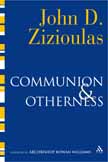
John Zizioulas – Communion and Otherness

Zizioulas Communion and Otherness

One highlight of the AAR, though there was no fanfare, was the arrival of Communion and Otherness: Further Studies in Personhood and the Church, the second volume of Metropolitan John Zizioulas.

I intended to post a chunk from the cracking Preface by Rowan Williams and the author’s dedication to George Florovksy and Colin Gunton, but gave my copy to an old student of Zizioulas here in London. So we’ll have to make do with a paragraph from the publisher, T & T Clark.

‘Communion and otherness: how can these be reconciled?’ In this wide-ranging study, the distinguished Orthodox theologian, Metropolitan John (Zizioulas) of Pergamon, seeks to answer that question. In his celebrated book, Being as Communion (1985), he emphasised the importance of communion for life and for unity. In this important companion volume he now explores the complementary fact that communion is the basis for true otherness and identity.

With a constant awareness of the deepest existential questions of today, Metropolitan John probes the Christian tradition and highlights the existential concerns that already underlay the writings of the Greek fathers and the definitions of the early ecumenical councils. In a vigorous and challenging way, he defends the freedom to be other as an intrinsic characteristic of personhood, fulfilled only in communion.

After a major opening chapter on the ontology of otherness, written specially for this volume, the theme is systematically developed with reference to the Trinity, Christology, anthropology and ecclesiology. Another new chapter defends the idea that the Father is cause of the Trinity, as taught by the Cappadocian fathers, and replies to criticisms of this view. The final chapter responds to the customary separation of ecclesiology from mysticism and strongly favours a mystical understanding of the body of Christ as a whole. Other papers, previously published but some not easily obtainable, are all revised for their inclusion here.

Benedict – the reasonableness of faith

These, of course, are points that Joseph Ratzinger has been making for years, indeed decades. In Christianity and the Crisis of Cultures, he synthesizes his arguments into a series of finely-tuned propositions on which all men and women of good will would do well to reflect. Among the most important of these propositions I would list the following, illustrating each with a brief citation from the book:

Proposition 1: We live in a moment of dangerous imbalance in the relationship between the West’s technological capabilities and the West’s moral understanding.

Thus Ratzinger writes, “Moral strength has not grown in tandem with the development of science; on the contrary, it has diminished, because the technological mentality confines morality to the subjective sphere. Our need, however, is for a public morality, a morality capable of responding to the threats that impose such a burden on the existence of us all. The true and gravest danger of the present moment is precisely this imbalance between technological possibilities and moral energy” [p. 27].

Proposition 2: The moral and political lethargy we sense in much of Europe today is one by-product of Europe’s disdain for the Christian roots of its unique civilization, a disdain which has contributed in various ways to the decline of what was once the center of world culture and world-historical initiative.

Thus Ratzinger writes, “…Europe has developed a culture that, in a manner hitherto unknown to mankind, excludes God from public awareness…God is irrelevant to public life…[This contemporary European culture] is the most radical contradiction not only of Christianity, but of all the religious and moral traditions of humanity…” [pp.30-31].

Proposition 3: The abandonment of Europe’s Christian roots implies the abandonment of the idea of “Europe” as a civilizational enterprise constructed from the fruitful interaction of Jerusalem, Athens, and Rome. This infidelity to the past has led, in turn, to a truncated idea of reason, and of the human capacity to know, however imperfectly, the truth of things, including the moral truth of things. There is a positivism shaping (and misshaping) much of Western thought today — a positivism that excludes all transcendent moral reference points from public life. Ratzinger asks whether such a positivism in an exercise of what the Canadian philosopher Charles Taylor describes as “exclusive humanism,” and then asks whether such an exclusivist humanism, is, itself, rational. His answer is a resounding “No.” As he writes, “This philosophy expresses, not the complete reason of man, but only one part of it. And this mutilation of reason means that we cannot consider it to be rational at all. Hence it is incomplete and can recover its health only through reestablishing contact with its roots. A tree without roots dries up…” [p.43].

And so, evidently, do civilizations.

Proposition 4: The recovery of reason in the West would be facilitated by a reflection on the fact that the Christian concept of God as Logos helped shape the distinct civilization of the West as a synthesis of Athens, Jerusalem, and Rome. If men and women have forgotten that they can, in fact, think their way through to the truth of things, that may have something to do with the European forgetfulness of God which Aleksandr Solzhenitsyn identified as the source of Europe’s 20th century civilizational distress.

Thus Ratzinger writes, “From the very beginning, Christianity has understood itself to be the religion of the Logos, to be a religion in keeping with reason…[But] a reason that has its origin in the irrational and is itself ultimately irrational does not offer a solution to our problems. Only that creative reason which has manifested itself as love in the crucified God can truly show us what life is” [ pp. 47, 49]…

If Europe begins to recover its faith in reason, then at least some in Europe may, in time, rediscover the reasonableness of faith; and in any event, a renewed faith in reason would provide an antidote to the spiritual boredom from which Europe is dying — and thus open the prospect of a new birth of freedom in Europe, and throughout the West.

George Weigel On Christianity and the Crisis of Cultures

Pope Benedict’s ‘Europe’s Crisis of Culture’ in shorter form
AAR

Washington DC

Knight went to the AAR. He was briefly allowed to leave his desk, London, and the whole UK for the Annual Conference of the American Academy of Religion and Society of Biblical Literature (SBL) in Washington DC.

Highlights were:

Volf Krötke (Berlin) at the Barth Society, ably introduced by Philip Zeigler.

Luke Bretherton (KCL – English, one of ours) awed the Systematic Theology seminar, but then so did David Haddorff (Saint John’s NY).

The Ecclesiological Investigations ‘s impressive discussion of the Porto Alegre 9th Assembly of the World Council of Churches (WCC) document Called to be the One Church. It was good to find fellow-Zizioulas readers Fr Paul McPartlan and Paul Collins making an impact. I think that the ecclesiology of Metropolitan Zizioulas would be an ideal subject for a session of this seminar next year.

The Christian Theology and the Bible seminar (Webster, Telford Work and many others), though I managed to miss all sessions of Theological Hermeneutics of Christian Scripture Group, which had an equally strong cast.

It was great to importune publishers, particularly at the swanky Eerdmans reception, to be wowed by Brazos’s Theological Theological Commentary on the Bible series, and to meet Amazon reviewer Halden Doerge
.

Kings crowd

But above all it was wonderful to catch up with the old Kings College London crowd – those pictured above (Left to right Paul Janz, Oliver Crisp, Luke Bretherton, Chris Roberts, Eric Flett, Randall Rauser and Ryan Murphy), but also and in particular Justyn Terry, Paul Metzger and George Ille.

I am very grateful to Chris Roberts and to Lincoln Harvey. I understand that neither of them want to room with me ever again so I shall be sleeping on the beach at San Diego in 2007.

Benedict and the Future of Europe

So when we think about the processes of production, about the whole pattern of an economy, we should be asking in what sense it is intelligent production – work directed towards the maintenance of a recognisably human environment. That recognisably human environment is, for the Christian believer, one in which the habits of self-examination and the possibilities of self-knowledge are being nourished – one in which the imagination as well as the intellect is matured. Remember, when Benedict speaks about lectio, the goal he presumes is that of self-knowledge, humility and growth in holiness: the dimension of study in the monastic life is not about developing intellectual skills for their own sake, but a way of advancing in understanding of oneself as made in God’s image, as mortal and fragile, subject to temptation and struggle, and as capable by grace of maturing in service. Just as work is there in order to sustain a life in which study may be properly carried out, so study is an activity sustaining a particular kind of human maturity and self-awareness before God. And in turn this is the context in which prayer and praise emerge as the natural crown of the whole pattern of the life of the Rule. The self-aware, intelligent and imaginative disciple who is formed by labour and study knows that the purpose of his or her life is now turning outwards to acknowledge God: proper self-awareness delivers us from self-absorption, since it shows us what kind of beings we are, what we are made for – which is the enjoyment of God.

A civilised life structured around the vision of the Rule is one in which economics is not allowed to set itself up as a set of activities whose goals and norms have no connection with anything other than production and exchange…

And the Benedictine structuring of time stands as a potent reminder of the balances we risk losing in a culture obsessed with production and reluctant to locate that production in a broader picture of human activity and growth. The pressing issue is how we sustain a civilisation capable of asking itself questions about its purpose and its integrity; only a civilisation that can do this will generate people – citizens – who can turn away from individual instinct and self-protection, whether in adoration of God or in compassion for the needy, because they know what sort of beings they are, mortal, interdependent, created out of love and for love.

Archbishop Rowan Williams Benedict and the Future of Europe

* * * *

My respect for this Archbishop of ours grows and grows. From now on you may regard this blog as the Papa Williams Fanclub. Do many of you have an archbishop like this? Hands Up. No, as I thought, not many of you. So then, in the Anglican front row we have Oliver O’Donovan, Tom Wright, John Webster and Rowan Williams, all with beautifully complementary gifts, but the one wearing the ‘Most Evangelical’ shirt at the moment… is Williams. This speech, given in Rome, is a little love missive from us Anglicans to Rome’s current Benedict and affirmation of his leadership in the church catholic.

Bibiliography

Up until a couple of years ago I was keeping a bibliography which had reached about a thousand items, representing the trails into non-theological territory which I hoped to follow once I had got The Eschatological Economy out of the way. This bibliography was in MS Access on my overworked laptop – the laptop that blew a gasket one morning when someone, who shall be nameless, switched her hairdryer on and off in the next room. In the cold fear of having lost the book I was working on, I just got the man in the repair shop to recover my Word files and forgot all about the bibliography, which was the only file held in any other application. And so it was gone, and I haven’t really kept a single bibliography since. I hope you take more care of your data than I do.

Anyway I have been trying out what looks like a wonderful online bibliography service – LibraryThing. It offers a variety of ways to present your book list, including with library shelf mark/Library of Congress call mark. I haven’t found a Sort function yet – I think it all has to be done with tags. And there is a fair amount of crossover of function with Amazon, though you can find people who are reading, or at least own, one particular book, so it is an online book-club too.

The hunt for a real theology department – University of St Thomas

The University of St Thomas Center for Catholic Studies is dedicated to the integration of faith and reason in every facet of life. Our programs and services create an environment where students, alumni and others can engage their faith within contemporary culture and grow both intellectually and spiritually.

The Center for Catholic Studies is an academic community within the University of St Thomas dedicated to the ongoing renewal of Catholic higher education. Shaped by the Catholic principles of the unity of knowledge and the complementarity of faith and reason, the Center pursues its mission through interdisciplinary teaching and research, service to the community, and cultivation of spiritual life.

Their Program in Catholic-Orthodox Dialogue promises a Comprehensive Ecumenical Vision

The Program is committed to the pursuit of Christian unity across the following seven dimensions of dialogue:

1. Theological: clarification of doctrinal agreement and disagreement.
Formal and informal discussions among scholars and church leaders in the context of international and national consultations leading to the promulgation and publication of joint statements.
Program’s contribution: Public Lectures; Conferences; Official Documents

2. Historical: “Healing of Memory” project.
Study of our shared past in order to understand the causes of divisions and to work towards reconciliation, among other things, through comparative investigation of representative figures (theologians, saints, martyrs, mystics), periods, issues, and practices.
Program’s contribution: Publications

3. Practical: faith-sharing among Catholics and Orthodox in everyday life.
Reflections on the ways in which social context shapes Catholic and Orthodox identity of individuals and communities across the globe (e.g., Orthodox-Catholic intermarriages in the US, Orthodox and Catholic minorities in the Middle East).
Program’s contribution: Twin Cities Initiatives

4. Liturgical: participation in joint prayer services.
Scholarly investigation of conditions for reestablishing communio in sacris; Orthodox studies of western worship; Catholic studies of eastern worship.

5. Social: common response to the modern world.
Articulating a common moral vision in light of the major social, economic, and political challenges of the day (globalization, war and peace, science and technology, poverty, and so on). Projects in Ukraine

6. Global: nurturing an ecumenical spirit around the world.
Fostering awareness of the need for Church unity in Orthodox and Catholic institutions in North America and Eastern Europe

7. Aesthetic: contemplating the beauty of the divine together.
The study of western influences upon eastern Christian art, music, and architecture, and vice versa. Creation of new Christian art and music bearing testimony to Orthodox-Catholic unity.

Seven is a beautiful number of course.

The Church assembled in Christ's name for instruction

The real Christ for the Orthodox Church is the Christ of the gospels and Acts; the Christ of the writings attributed to the apostles John and Paul, and Peter and James and Jude. There is no other Christ for the Orthodox Church. A Christ produced by scholars, mystics, poets or politicians – or even by creative theologians, charismatic elders or crusading activists within or without the Church – is never the real and whole Christ of Orthodox doctrine, liturgy, spirituality and sanctity. He is surely not the Christ of Orthodox mission.

To know the real Christ requires a diligent and critical study of the Bible. Before anything else, Christians are disciples, i.e. students (mathetai). They are students of Christ before they are his “members” as members of his Church. They are his disciples before they are his apostles and missionaries (i.e., “those who are sent”). And they are certainly his disciples before they are bishops, presbyters, elders, and theologians of his Church.

Jesus appears in the gospel narrative first as rabbi, master and teacher (didaskolos, magister). He instructs his students in the right understanding of the old testament writings. Risen from the dead he opens the minds of his disciples to understand the scriptures and explains to them how “the law, the psalms and the prophets” speak about him (cf. Lk 24).

Critical study of scriptures is a reading and hearing of the biblical words without prejudging or predetermining their meaning. Through such study the student (who may in some circumstances be unable to read) wants to know what the writings actually say and mean, first for those who originally wrote and heard them, and then for people today, beginning with oneself. Such study uses all available means to illumine and explain (but not to constitute or determine) the biblical texts as written and received in the Church. It employs, for example, the knowledge of languages, literature, history, religion, geography and archeology. It welcomes the guidance of those skilled in such fields. But though this study is done within the Church community with the help of others, it must be done for oneself. Each individual believer must personally engage God’s Word in the Bible. Without such engagement, especially today in North America, and especially by the Church’s leaders, there is no genuine Orthodox mission.

Bible and Liturgy

The hearing and reading of the Bible essential to Orthodox missionary work occurs in the context of the Church’s self-actualization in corporate worship, i.e. the liturgy. The Church assembled in Christ’s name before the Face of God in the Holy Spirit for instruction, petition, praise, remembrance and thanksgiving is the hermeneutical condition and context for interpreting God’s Word recorded in the scriptures. As such, it is the point from which the Church’s apostolic mission originates and the point toward which its activity is directed.

Not only is the Bible read, heard, contemplated and explained at Church services, but the services themselves are thoroughly biblical in content, form and spirit. Biblically informed believers have an immediate awareness and experience of the Bible’s message in Orthodox liturgical worship. Or rather, more accurately, the God and Christ witnessed in the Bible become immediately accessible to believers in liturgical contemplation and communion in the Church.

Protopresbyter Thomas Hopko The Mission of the Orthodox Church in North America with thanks to Matthew Baker

University Christian Unions under threat

Seventy Church of Engand and Roman Catholic bishops were urged today to intervene to help thousands of Christian students at British universities from having the organisations representing them banned.

Among those asked to take action to save Christian Union societies were the Archbishops of Canterbury and Westminster.

The rise of secularism in the UK is among the issues being debated today and tomorrow at the first ever joint meeting of the Anglican and Roman Catholic bishops of England and Wales in Leeds.

Dr Rowan Williams and Cardinal Cormac Murphy-O’Connor were to issue a joint statement later today on the importance of working together and how to surmount the differences that remain between the two churches.

The 40 Anglican and 30 Catholic bishops began their unprecedented two-day meeting at Hinsley Hall at lunchtime. The bishops prayed and worshipped together and discussed how to heal the historic rift between them.

But Christian Union leaders urged them to move away from the usual “bland platitudes” associated with ecumenical gatherings to help the beleaguered Christian student societies under threat of bans.

Ruth Gledhill The Times

Cosmic Liturgy at Second Spring

How about a Cosmic Liturgy retreat-and-conference at Oxford next Easter?

Cosmic Liturgy

Over Easter 2007 we are offering an educational and spiritual retreat in the heart of Oxford to study the meaning of the Liturgy, drawing on Pope Benedict’s book The Spirit of the Liturgy. The intention is to promote a deeper personal engagement with the Easter Liturgy in dialogue with the Orthodox. The retreat will help us rediscover or better appreciate the following things:

·The vertical dimension of the Liturgy
(and the Church herself) as containing at its heart the sacrifice of the Cross, joining earth to heaven.

·The sacrificial dimension of the sacred Liturgy, tied to a greater sense of the meaning of Holy Eucharist, the Christian priesthood, etc.

·The eschatological dimension of the Liturgy, as a making present of eternity in time, an actual drawing up of the mundane into the realm of the divine.

·The relationship of the external forms of the Liturgy to catechesis, to interior formation and disposition. The place of beauty, structure, symbol, cosmic orientation, language and music in divine worship.

·The Liturgy as something received, something objective, and not something we are can engineer. The essential role of tradition as a vehicle for the Holy Spirit and the organic development of liturgy and community.

·The intrinsic relationship of contemplation to action, of love for God to love for neighbour, in the Liturgy itself. The nuptial anthropology that makes Mass the consummation of a wedding between divine and human nature.

Out of this course, with the experience of a beautiful Easter Liturgy, and some training in the use of the Divine Office and Gregorian Chant, will come refreshment of spirit and a renewed energy to serve God in the world.

See more at Second Spring. Try ‘Mystagogy’ and their Noticeboard-Chatroom. Second Spring, I am impressed.