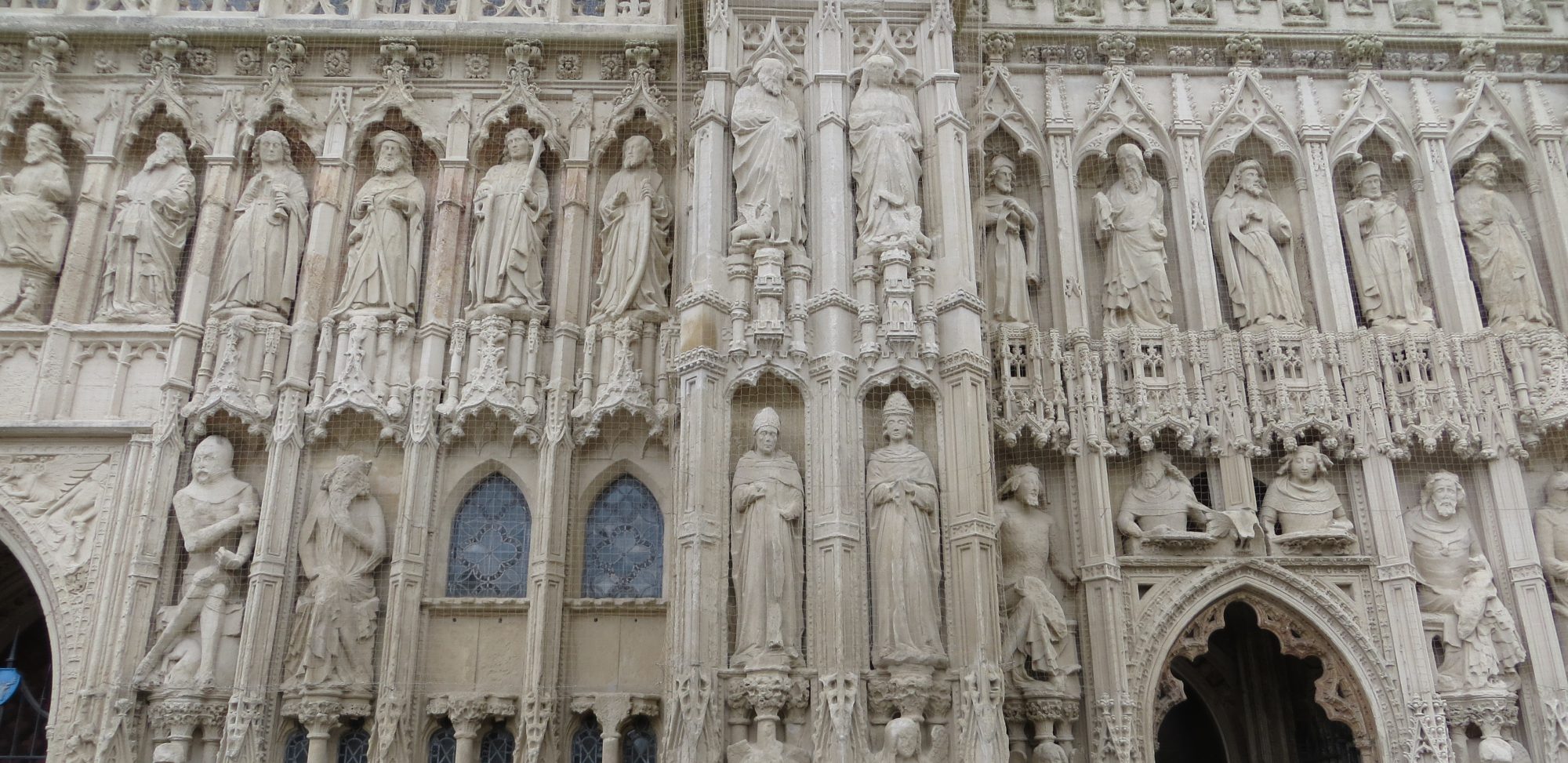
Providence and the doctrine of God

Every Christian doctrine is an exemplification of the Christian doctrine of God. The Christian confession of God and that God is for us, requires an account of the generous provision of God, which is what providence is, and it requires all the other doctrines that make our talk about providence meaningful. The Christian doctrine of God tells us that we are not God, and so we are discharged from the exhausting though self-imposed duty to make ourselves divine, that is to take ourselves to be everything, and also to be able to stand outside this everything and decide whether or not to affirm it. One corollary is that we can really know other people, but we cannot know them and master them utterly, because they belong not in the first place to us, but to God, who has high ambitions for them. We are not ourselves by being ‘just-human’, without God. Thus the doctrine of God gives us the truth of man, but the truth of man cannot be extracted from this doctrine and cashed out into a theory about man. Because God mystery, by which we mean he is knowable only to extent he makes himself known, and man is the creature of God, man is a mystery too. The assessment of God is that we along with rest of the world are worth waiting for, and the Church is the demonstration that this is still the good judgment – of God. The secret of being human, is hidden with God, and only in communion with him, can we be human, together, with other humans.

The Son and the Spirit in the Providence of God – John Zizioulas on time and communion

Better citizens, more faithful Catholics

Catholic Identity in the American Public Square

When we speak about a nation’s culture, we mean the entire fabric of its common life, from art and music to sports and schools. But since this is an election year, I want to apply the idea of Catholic witness specifically to our public life as citizens. Here are ten simple points to remember.

1. George Orwell said that one of the biggest dangers for modern democratic life is dishonest political language. Dishonest language leads to dishonest politics-which then leads to bad public policy and bad law. So we need to speak and act in a spirit of truth.

2. Catholic is a word that has real meaning. We don’t control or invent that meaning as individuals. We inherit it from the gospel and the experience of the Church over the centuries. We can choose to be something else, but if we choose to call ourselves Catholic, then that word has consequences for what we believe and how we act. We can’t truthfully claim to be Catholic and then act as though we’re not.

3. Being a Catholic is a bit like being married. We have a relationship with the Church and with Jesus Christ that’s similar to being a spouse. If a man says he loves his wife, his wife will want to see the evidence in his love and fidelity. The same applies to our relationship with God. If we say we’re Catholic, we need to show that by our love for the Church and our fidelity to what she teaches and believes. Otherwise we’re just fooling ourselves, because God certainly won’t be fooled.

10. The heart of truly faithful citizenship is this: We’re better citizens when we’re more faithful Catholics. The more authentically Catholic we are in our lives, choices, actions and convictions, the more truly we will contribute to the moral and political life of our nation.

Archbishop of Denver Charles J Chaput shows his fellow bishops how to do it. Even his website demonstrates a determination to communicate clearly, generously and evangelically. Can’t we do that?

Pray without ceasing

This is the Week of Prayer for Christian Unity 2008

The Week of Prayer for Christian Unity is an expression of the ecumenical movement – a worldwide movement among Christians to heal the divisions within the Church; to promote dialogues among churches and Christian communities; and to encourage Christians everywhere to better understand and reflect the implications of “one Lord, one faith, one baptism.” Each year from January 18 – 25, Christians are encouraged to pray together as a sign of the unity that is already theirs in Christ and that that unity will become complete.

Here are some very considerable resources, giving the background to the week, and a form of worship for each day of the week, from the Pontifical Council for Promoting Christian Unity, jointly produced with the World Council of Churches Faith and Order

Children in worship

6.9.2 The Church needs children present in its worship, as patterns of discipleship, as reminders that we come into the presence of God not through our own deserving, but because we are creatures of God’s creation. But children also need to be present in worship because it is the locus of Christian formation. Worship is fundamental if children are to grow in the knowledge and love of God.

Christian formation is lifelong, and it begins in infancy; children who are excluded from worship suffer significant deprivation. Of course, we can make up for experiences missed in childhood, but it is hard work. We know that in many areas of experience, learning in childhood is much easier than later in life: this applies in worship no less than in learning a language. The language, gesture and attitudes which facilitate both our worship and our growth in faith are acquired most easily in childhood, and what is learnt then forms the foundation on which all subsequent learning is to be built. It is constantly necessary to challenge the prevailing misapprehension that children do not ‘understand’ what is happening in worship, and that education for worship is a top-down didactic exercise.

Transforming Worship: Report of the Liturgical Commission

No access to Jordan

No immersion in the waters of the Jordan River this year for Orthodox believers who gathered on its shores to celebrate the Feast Day of the Baptism of Jesus. They were prevented by Israeli security forces.

Several thousands of pilgrims were able never the less to take part in a prayer service celebrated by the Greek Orthodox Patriarch of Jerusalem Theophilus III at the Qasr el-Yahud Monastery dedicated to St John the Baptist on the west bank of the river, a site which the Israelis closed at the start of the second Intifada in 2000 and have generally kept off limits ever since. Even on this exceptional occasion Israeli soldiers were all over the place.

At the end of the ceremony the faithful walked in procession to the river bank where according to tradition Jesus was baptised.

Asia News

Priest, pray, don't chat

In the not so distant past, I attended a Mass. It was a typical parish Mass. There was a choir in the back, there were Eucharistic ministers, there were lay lectors, there were altar servers. There was laity galore.

But the impression I took away with me – after an hour and a half – was the person of the priest. His voice echoed in my ears, his presence dominated my memory of that time. He introduced the Mass, he explained things, there was an RCIA rite, so he explained that, he preached a 25 minute homily, and at the end of Mass, after the lector ran through 6 announcements, he stood and added two rather lengthy announcements of his own.

I’m not kidding when I say that my reaction, at one point was, If you want to turn around, face the crucifix and whisper for a while, THAT WOULD BE FINE WITH ME. PLEASE. FEEL FREE.

It’s possible for a priest to allow his own personality to be subsumed into the liturgical rites as they are presently constructed. I’ve seen it done, often. But the opposite temptation is intensely evident in the present structure, and it seems to me to be a temptation that is not necessarily succumbed to out of ego – there is just a space and an expectation there that the priest’s personality is an essential element of the liturgy – if you read articles on this from the 70’s, it’s very clearly stated. Personally, the pressure involved in that seems unimaginable and exhausting to me.

Amy Welbourn A brief note on clericalism

Church and vacuum

Dr Nazir-Ali does not simply blame the Saudis, or other foreign governments who might have been funding militant Islam in the mosques of Great Britain, for the rise in Muslim chauvinism in this country. He blames the British people themselves, arguing that there has been a catastrophic collapse in Christian-based morality and spirituality in this country over the past 40 or so years and that this has created a “moral vacuum” in society as a whole, which has been increasingly filled – at least in the minds of impressionable youth – by fundamentalist Islam.

Here, as a leading figure in the Church of England, Dr Nazir-Ali is swimming in dangerous waters. Is it the British people who should be blamed for deserting, in their millions, the once-dominant Church of England? Or should not the Church of England look at its own performance and try to understand why it has lost such a vast proportion of its audience – at least as defined by regular churchgoing, rather than notional affiliation?

Dominic Lawson

Maryvale

The Maryvale Institute – our International Catholic College for Catechesis, Theology, Philosophy and Religious Education at Birmingham shows more energy than any other Catholic institution in the UK than I am aware of. Maryvale wants to see ‘the proclamation of the Catholic faith in its fullness and integrity‘. In the UK, this sounds like a bold new start.

Maryvale is advertising for a Director of its Marriage and Family Life Programme.

The Maryvale Centre for Marriage and Family Life is a new initiative set up following discussions between the John Paul II Institute in Rome and the Maryvale Institute. Its purpose is to make available, within the Maryvale Institute, a range of courses, modules and suitable educational materials pertaining to the teachings of the Catholic Church on marriage and family life. The range will cover basic parenting information, through a ‘ladder’ of initiatives, co-ordinating with some existing courses already available at Maryvale, leading to the development of a new MA Course in Marriage and Family Life studies, modelled on those of the John Paul II Institute’s Theology of the Body Programme.

I would really like to see this sort of initiative here in London. I suppose I will have to be content with Spes – the School for Evangelism at St Patrick’s Soho.