Singing psalms

Augustine’s Expositions of the Psalms are a lifetime investment. There are five volumes (translated by Boulding, edited by Ramsey, Fiedrowicz) which might set you back $140. Sell some of the books you bought last year, then with the money you have got left over, buy

Jason Byassee Praise Seeking Understanding: Reading the Psalms With Augustine, of which a fair amount is available at Google Book

and

Brian Brock Singing the Ethos of God: On the Place of Christian Ethics in Scripture of which a certain amount is also available at Google Book

The only name in whose powers the Christian can hope is Christ, and that hope excludes any hope for the outcome of history other than the triumph of that name. the essential point for Christian ethics is that it must serve this church., the community waiting in hope for God’s action. The church must thus remain clear about its true threat, says Augustine: the turning away of God’s face.

An older edition of Augustine Expositions on the Psalms is online

Durham, and London

Andy,

You ask about the SST (the Society for the Study of Theology annual conference) last week.

The conference was good, the company was great, and I found a fellow Spaemann fan. My paper was feeble, but everyone was very polite. England’s greatest living theologian was just great – master of self-control and understatement. He talked about Augustine and refused to be pushed into any of moral clichés that the assembly loves.

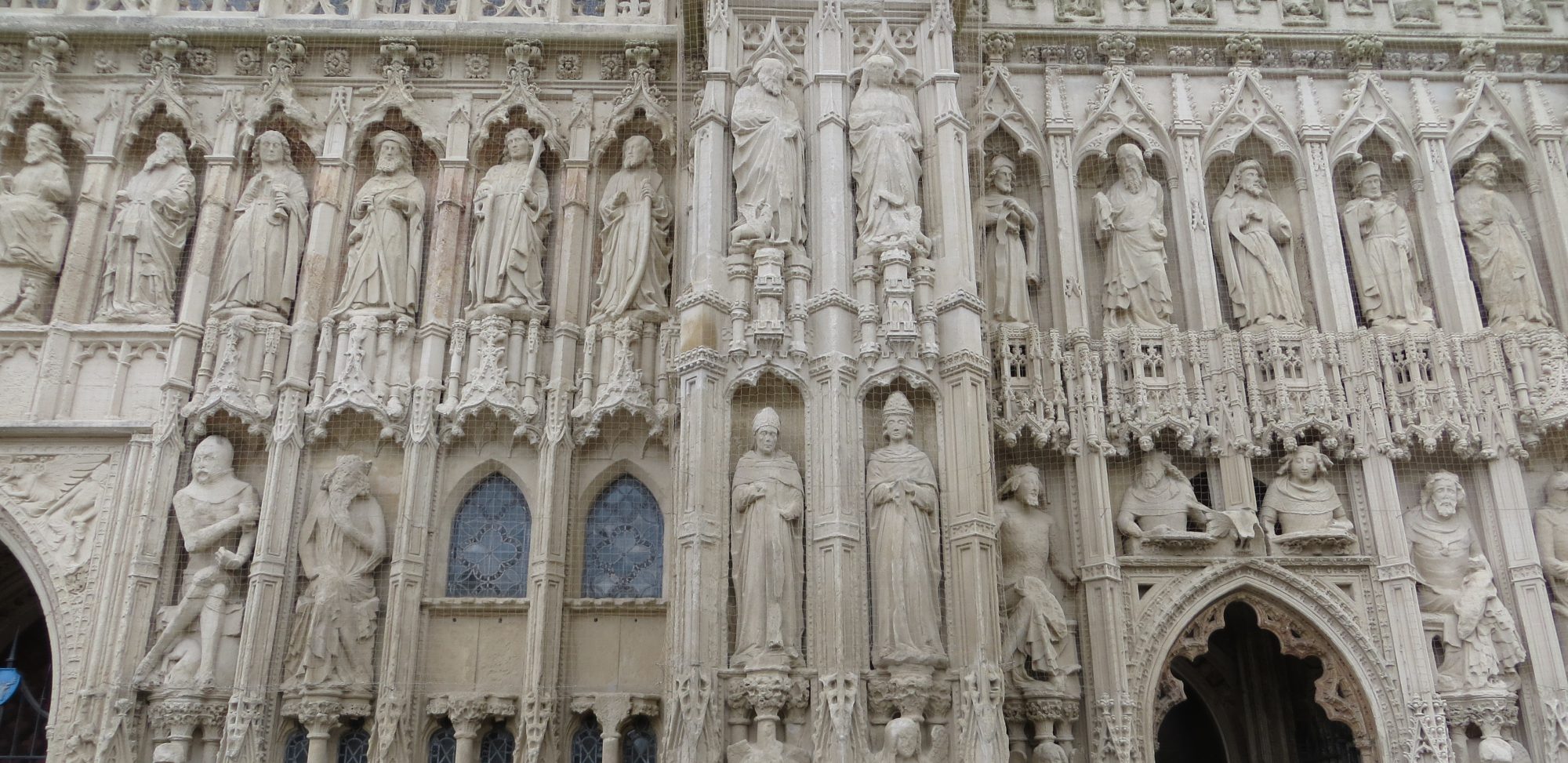
Durham itself was more wonderful even than I had imagined. Durham Cathedral is planted on a hill, good defensive position, with a river below. There is no clutter in the cathedral: the light blazes through the East rose window over the altar at mattins and through the West window at evensong. On the south are the cloisters, Chapterhouse and library, on the north a large green. The building nearest the cathedral is the music school on one side (the lex orandi – cantati) and the department of divinity (lex credendi) on the other, then further down the green, and in neighboring streets, all the other departments of the university, each science and discipline, and all human wonder flowing from the worship that goes on in the cathedral, and the town is beyond them. The whole arrangement is an image of the relationship of Church to society.

Chris Jones showed a group of us round one afternoon. He took us to Bede at one end of the cathedral and behind the altar to Cuthbert at the other. As we approached Cuthbert’s tomb he told us to stop nattering, and when we reached it, there was a momentary silence and that posture of reverence that told us that we were standing before God’s incorruptible saint. We alighted as briefly as flies on Cuthbert’s eternity .

The cathedral was a Benedictine abbey. Our guide couldn’t tell us whether the cathedral and bishop came before the monks (that company dedicated to singing the praise of God) and their abbey. If I was bishop, I would put the monks back in the cloisters and in that Quire, and have them singing around the clock. (I would have monks just between the ages of twenty-one and thirty, and then again those over sixty. At thirty, I would insist that they marry. They would not be released from vows: it would simply become a different vow, to the chaste life with one woman.)

Now I tell you this because in London we have a cathedral and an abbey, two separate institutions. Westminster Abbey is down on the river, and about a mile and a half, on slightly higher ground, in the city of London, is St Paul’s Cathedral. This is just the right distance for processing. So I would have my monks processing, singing the psalms of ascent, from abbey in the morning to the cathedral, where they would sing the office during the day, and back down to the abbey after evensong. Behind them would be the young and the old from every church in London (on yearly rota perhaps). Your baptists would be there, HTB and Jesus House. They know how to sing the praises of God. They would do so past parliament, the length of Whitehall, past the entertainment industry of the West End, past the lawyers, universities and media of the Strand and Fleet Street, and past the finance houses of Ludgate hill. If they sang over the course of this most un-Sacred Way, from Abbey to Cathedral, twice daily, our clergy might stop telling us that this or that can’t be done and tell us that it can indeed be done, and that this Christian life can indeed be lived, and in public too.

This is what I learned from Durham. Can you organise this for me? I know a couple of bishops who are looking for a lead and who would be very glad to hear from you.
Bonhoeffer

On 9 April the Church of England calendar of saints remembers Dietrich Bonhoeffer.

Archbishop Rowan Williams gave a sermon on Pastor Bonhoeffer at the Berliner Mattäuskirche in 2006

to become a human being and a Christian, to use Bonhoeffer’s words in the same letter, is not to separate ourselves and work to become holy in a space that is defined and protected by religious convention; nor is it to seek for perfection by ordinary social or political activism. It is to be present with Christ in the world. It is to be there in God’s name and God’s presence in both confusion and order alike, standing with Christ, standing in that place in the world where God has chosen to be.

and a short account of what we can learn from Bonhoeffer’s ecumenical work.

Bonhoeffer’s legacy to the European ideal is not some theory of supranational administration and cultural homogeneity. It is rather the application to national and international affairs of the Christian principle of mutual accountability. A healthy international network is one in which we take responsibility for each other, and recognise the crisis, the suffering or the collapse of one national or local community as an issue for all.

God give us grace to follow him.

Bishop rebuked

The subject is bishops as theologians and theologians as bishops. The Christian world is much indebted to N.T. (Tom) Wright, the Anglican bishop of Durham.

Most of (Bishop Tom’s) book (Surprised by Hope) is devoted to making the case for a greater accent in Christian piety and liturgy on the final resurrection of the dead and the coming of the Kingdom of God. Or, as Wright likes to put it, we need to recover the biblical focus on â??life after life after death.â?? I believe Wright is right about that. As he is also on target when he insists that the resurrection â??is not the story of a happy ending but of a new beginning.â?? But his argument is grievously marred by his heaping of scorn on centuries of Christian piety revolving around the hope of â??going to heaven,â?? and his repeated and unseemly suggestion that he is the first to have understood the New Testament correctly, or at least the first since a few thinkers in the patristic era got part of the gospel right.

Unseemly, too, is the pervasive edge of anti-Catholicism, although I suppose that is to be expected from those who must justify their separation from the centering authority of the ancient Church. In refuting Catholic ecclesiology, Wright invokes the authority of what he calls the â??magisterial workâ?? (Ascension and Ecclesia) of Canadian theologian Douglas Farrow in the 1990s, apparently unaware that Farrow has long since become a Catholic. Both unseemly and risible is Wrightâ??s claim that Pope Benedict is coming around to his own view of the traditional doctrine of purgatory, which Wright mockingly repudiates. Paraphrasing a text by Cardinal Ratzinger, Wright claims that it is â??a quite radical climb-down from Aquinas, Dante, Newman, and all that went in between.â?? Bishop Wright would do well to consult Ratzinger-Benedictâ??s encyclical Spe Salvi and what it says about purgatory. As the pope recently said in a meeting with Italian clergy: â??God creates justice. We must keep this in mind. For this reason, it also seemed important to me to write about purgatory in the encyclical, which for me is such an obvious truth, so evident and also so necessary and comforting, that it cannot be omitted.â?? It appears that Bishop Wrightâ??s tutelage of the pope still has a way to go.

Richard John Neuhaus The Possibilities and Perils in Being a Really Smart Bishop

But, dear Father Neuhaus, you agree that we do have a couple of very smart bishops in the Church of England? The media-savvy one (Wright) is occasionally sloppy in his popular work, and on occasion we wish the intellectually careful one (Williams) was a little more circumspect with the media. Now what do you make of the greatest of our Anglican theologians, the Rt Revd Oliver O’Donovan? Do you think we should drag him onto an episcopal throne?

Temple talks

The Temple Church talk series continues. Remember the Archbishop Sharia furore in February? That was one in this series. I hope they can repeat their success.

Coming up

Law and Religion 14 April

Islam in English Law 19 May & 9 July

Law and Politics 7th July

I am also going to these

Wednesday 16th April – Edmund Adamus
The Genesis of Humanae Vitae – Memory & Healing

Wednesday 23rd April – Fr Richard Aladics
Building the Civilisation of Love in a Media-Driven World

at St Patrick’s Soho. See you there.

Cordes at Maryvale

Cardinal Paul Josef Cordes, president of the Pontifical Council “Cor Unum”, is to meet with bishops of England and Wales. At the invitation of the Episcopal Conference of England and Wales (CBEW), the cardinal will dialogue with the bishops in the light of the Holy Father’s first Encyclical “Deus caritas est” on

how to promote the Catholic identity of the Church’s charitable organisations in a rapidly changing environment, characterised by challenges to the Church’s traditional outreach in this field.

While the Church in England and Wales has reached out to those in need in an efficacious way historical and cultural changes warrant a reflection upon the role of the bishop as the primordial locus for charitable activity.

Ah, the masters of understatement are back.

On 8 April at Birmingham ‘s Maryvale Institute, the president of “Cor Unum” will deliver a public lecture on the Church’s charitable activities.

What is Maryvale?

The Mission of Maryvale Institute is to be a leader in the provision of lifelong learning for all in Catholic Evangelisation, Catechesis, Theology, Philosophy and Religious Education in order to serve Christ’s mandate and his Church’s mission of Evangelisation in contemporary society. This provision is through a distinctive combination of the methodology of distance learning and critical engagement with the Word of God in Scripture and Tradition guided by the Church’s Magisterium. The work is carried out within an environment of Christian Faith, of academic and administrative quality, of open dialogue and the mutual valuing of the work, gifts and the personal and professional development of every member of the Institute.

One little flickering candle then – in Birmingham.

And in London? Is there a single place on the muddy banks of this river where we may gain a little lifelong learning in Catholic Evangelisation, Catechesis, or guided by the Church’s Magisterium serve Christ’s mandate and his Church’s mission of Evangelisation in contemporary society?

Cultural changes warrant a reflection upon the role of the bishop as the primordial locus for charitable activity.

I think we might do reflection on these cultural changes and on the bishop as the primordial locus for charitable activity on this blog. And I am going to tell my bishop that he is the primordial locus for charitable activity. I know he has at least as good an idea of what this means as I do. No bishop can be afraid, because he is bound to love the people to whom he is sent.

Holy Week cont.

I have got the sermons for Wednesday and Thursday of Holy Week up.

Maunday Thursday is the day when the clergy of the diocese gather in the cathedral with the bishop for foot-washing and repentance, and to receive the oil of charism.

This servant-status, this priestly deaconate, is for those who in Christ have had ‘all things given into their hands’. This weight of glory is yours. It releases you. You have been forgiven. Just as your life is no longer yours to live alone, so your problems and your sin is not your own any longer. You are free to seek more and more of that forgiveness, and to do so with greater and great abandon, more and more publicly. You are free to confess your sins and to lead the rest of us in letting go of our own sins. You may be the most care-free of people.

This means that you are free – for others. You are servants, deacons, waiters-at-table, fetchers and carriers. You will wait at hospital beds, anoint the dying, find words of comfort for the frightened and anguished. You will baptize and teach, you will hear confession, you will marry and bury.

Nottingham on Benedict on Jesus

The Pope and Jesus of Nazareth

19th and 20th June 2008 Nottingham

The publication of the book Jesus of Nazareth on 16 April 2007 was an unprecedented event: never before had a reigning Pope published personal reflections on Jesus.

The book engages not just with New Testament scholarship but also with fundamental methodological questions related to historical criticism. Moreover, it resonates with wider questions of scriptural reading, Christology, ecclesiology and relations with Judaism and Islam. This conference is the first extended theological discussion in the UK on Joseph Ratzinger’s book.

John Milbank
Markus Bockmuehl
Geza Vermes
Archbishop Martínez
Fergus Kerr OP
Walter Moberly
Olivier-Thomas Venard OP
Mona Siddiqui

This may really be the first time any work of Pope Benedict is examined by academics in Britain. There is plenty on Benedict’s Jesus of Nazareth and other books over at the B16 fanclub and Ignatius Insight.

Maranatha – Crisis and Glory

The Church in this land is now in a totally new situation. After years of enjoying a comparatively privileged position, we are now clearly facing attack, ridicule and even persecution. We are in a counter-culture situation and our position is increasingly similar to the Early Church.

Viewed from the position of the world, the Church is not a single body giving a clear message, but rather a large number of disparate congregations who each have their own interpretation and presentation of the Gospel message and who appear to be in competition with each other. There is a very real danger of the churches ceasing to engage with our culture. At the two extremes, we either withdraw and disconnect from it, or run the risk of being consumed by it. God calls us to invade and transform our culture, not to collaborate with it, capitulate to it, retreat from it.

This engagement is inevitably confrontational. There is clearly much doubt about the central truths of the Gospel in the churches. There is also evidence of some Christians substituting an ethical or a programme of social action for the Gospel.

Maranatha – Crisis and Glory (PDF)

I know a bishop not far from here who talks about ‘the coming storm’ and a ‘tidal wave’. He means secularism, but he doesn’t spell out what he means by that, and I am not sure that he knows how to. Sometimes he seems to regret this and to want to do something about it, sometimes not. Our caution and elipticism is becoming a problem. We have to stop worrying about sounding unsophisticated and apocalyptic. We have to bring the people of Maranatha into Church and ask them to teach us how not to be sophisticated or ironic, and we have to learn how to spell this ‘new situation’ out.

Costly discipleship involves using our heads, consistently, and over the long term. No probs there. But that also means getting to know my own tradtion and speaking consistently from it, without attempting to preserve any ironic distance. It also means learning the old practices and practising them, in public. I am going to start reading my bible (big, black, leather) on the Central Line. I am going to kneel in church, dunk my fingers in the holy water when I enter a Catholic church. I am going to learn to cross myself (every nerve screams No!). I am going to learn a half dozen psalms off by heart. I am going to familiarise myself with the readings for each next Sunday. When you see me, test me.

Catholic theology in the UK?

Catholic Theology and the Public Academy

A colloquium in dual celebration of the establishment of the Durham Centre for Catholic Studies and the Bede Chair of Catholic Theology 8th-10th May, 2008 Durham University

Tina Beattie
Gavin D’Costa
Eamon Duffy
David Ford
Paul Griffiths
Karen Kilby
Michael Kirwan, S.J.
Paul Lakeland
Nicholas Lash
Gerard Loughlin
Andrew Louth
John Milbank
Francesca Murphy
Paul D Murray

I would certainly like to hear Gavin D’Costa, Eamon Duffy, and Paul Griffiths. The first Bede Professor of Catholic Theology will be appointed just before this conference, and the appointment will make it clear whether this is the long-awaited new start or not. There have been a lot of international applicants, apparently, so my breath is bated. But why aren’t Stratford Caldecott or Aidan Nichols among the speakers? Why doesn’t Ex Corde Ecclesia (JP II’s Apostolic Constitution on Catholic universities) appear anywhere on the Centre’s website? Why is a Protestant giving the opening address on ‘The Case for Catholic Theology in a Twenty-first Century University’? How much Protestant permission has to be sought?

From a Catholic point of view the contemporary secular university is not at fault because it is not Catholic. It is at fault insofar as it is not a university…

Alasdair MacIntyre (Commonweal October 20, 2006 / Volume CXXXIII, Number 18)