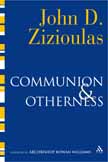
Metropolitan John Zizioulas’ earlier work, Being as Communion, has a fair claim to be one of the most influential theological books of the later twentieth century; it had a lasting effect on ecumenical discussions and on the vocabulary and assumptions of many churches as they sought to clarify their self-understanding and indeed their understanding of ordained ministry. But what Zizioulas had to say about the church was firmly anchored in a set of arguments about what we mean about the word ‘God’, and how our understanding of being itself had to be wholly informed by our understanding of God. In the following pages, these reflections are worked out at greater and greater depth, producing finally a comprehensive model for the whole of Christian theology.
This book is, in effect, a systematic theology, though it is not structured like one. But it is also a work of apologetics in its way. Zizioulas mounts a formidable challenge to atheism by affirming very simply that it is meaningless to discuss ‘whether or not’ God exists in abstraction from the question of ‘how’ God exists. To ask whether God exists is really to ask about what the relations are that you can recognise yourself as involved in – because God is irreducibly a living complex of relation, Father, Son and Holy Spirit. But this complex is not just a given plurality, it is the work of freedom – the Father’s personal liberty and love generate the inseparable Other, the eternal Son, and ‘breathe out’ the eternal Spirit. The Father is never alone, nor is the Father simply one among three divine beings alongside each other; it is his absolute freedom to be completely for and in the Other that is the root and rationale of Trinitarian life. And this utter freedom for the Other becomes the insight that allow us to make sense of the freedom of creation, with all that this implies…
On page after page of this outstanding book our assumptions are challenged and our minds led back to the most deeply significant aspects of the Christian faith, and to the conceptual and practical map drawn not only in Scripture but in the Greek Fathers, including the Fathers of the desert and their teaching on practice and prayer. The discussion of what is implied in classical Christological statement is of special note; so is the chapter on the Spirit. But insights abound, into death and sexuality, individualism and postmodernity, prayer and ecology. Zizioulas engages boldly with different strands of modern philosophy, refuting most effectively the idea that he is simply recycling some kind of existentialism or secular personalism, and offering a deeply suggestive religion and correction of Levinas on the Other as fundamental for ethics.
Few will read this book without sensing that they have been invited to rediscover Christianity in its richest traditional form….
A great book and a converting one, which reintroduces us to the essential Christian conviction that there is no life without relation with God, as God himself is eternally life in and only in the relations initiated by the free love of God the Father, generating the everlasting Son in whom and for whom all things exist, growing into their fullest possible connectedness with God through the gift of the Spirit’s presence.
Archbishop Rowan Williams’ Foreword to Communion and Otherness by John Zizioulas
