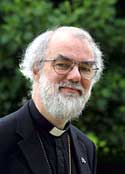
Yes, we have our very own one-man ‘Deep Church’, right here in London, at Lambeth, and Rowan Williams is his name.
The ‘Sermons and Speeches’ page of the website of the Archbishop of Canterbury is the place to go for contemporary Christian resources.
In the course of a year Archbishop Williams covers a wide range of issues on a large number of occasions and for varied audiences. Some pieces are short and light, and these tend to have the odd titles that reflect the institutions that invited him to be their speaker.
But many of these are big pieces, and we should regard them as our theological resources of first resort. Many of them are about theology in the public square, and so to do with the university as the arena of free public discourse, ‘faith-based education’ and the topic of the moment and foreseeable future – relations with Muslims.
Others are about Anglican unity, Christian unity, and others about discipleship and the ‘religious life’, by which he means the monastic life (which is probably the key for Williams).
His familiarity with the resources represented by the history of the Christian Church and tradition, and his fundamental concern for discipleship and the unity of the Church make his work evangelical. He has a gospel and it is faithful and deep (ludicrous, maybe, that this needs saying). Why doesn’t he just preach the gospel? He preaches the gospel – exactly that is what he is doing: not the gospel in half-dozen chords on the charismatic keyboards perhaps, but massively orchestrated, harmonics reaching back and forward. Though he pitches what he says just right for each specific audience, he is also speaking to the longer-term audiences behind them – it is that communion of saints, again. Of course much of it is in a very different idiom than we are used to.
University and public square
Though more diffidently, he makes the same case as Benedict XVI that the Christian faith provides the good practices of public reasoning together on which all public discourse, civil society and universities are built.
He gives some of the most revealing and exciting accounts of the Christian faith, or of the contribution of Christianity to the public square, when he is playing away from home and having to go back to first principles – for instance in ‘What is a university?’ in China, in his lecture given to the godless Eurocrats on the Christian contribution to Europe, and ‘What is Christianity?’ in the Islamic University, Islamabad, and his speech to Islamic religious leaders in Cairo. They may not sound inviting, but this is where he is doing the real work of showing the contribution of the Christian faith to public discourse and reason – he usually provides a little history of the relationship of the two – and sometimes his gospel sounds most clearly here.
‘What is a university?‘ Speech given in Wuhan, China. This is my favourite of the moment and I have posted pieces from it on this blog.
Religion, culture, diversity and tolerance – shaping the new Europe – Brussels
Belief, unbelief and religious education – Downing Street 2004
Convictions Loyalties and the Secular State – Chatham lecture 2004
Christian theology and other faiths – Birmingham 2003
What is Christianity? A lecture given at the international Islamic University in Islamabad, Pakistan
Address at al-Azhar al-Sharif – Cairo 2004
Christian unity
One Church One Hope – Freibrug 2006 on Christian unity and the churches’ responsibility for Europe
Christ’s own identity and work was to be found in ‘representative action’, Stellvertretung. Christ stands in our place; all he does is done on our behalf. His perfect obedience is lived out in life and death so that we may live, and for no other purpose, certainly for no individual purpose. But if that is the life he lives, then the life that comes into existence through him must likewise be marked by the same representative quality…
One Holy Catholic and Apostolic Church Anglican Global South-to-South Encounter, Ain al Sukhna, Egypt 28th October 2005
The focus of the centre of Anglican energy in the world is very clearly in the global south in our time and it is therefore for me an experience of learning, as well as of fellowship, to be with you…
Christian life – discipleship and ‘spirituality’
Williams’ lectures about Michael Ramsey and Dietrich Bonhoeffer are most definitely about you, me and Williams in the here and now. He is using Bonhoeffer and his situation to talk about us and our situation. (I said this blog would be full of the blooming obvious). He considers this indirect mode intrinsic to Christian discipleship, that we take the cover our predecessors in the faith offer us, and this is an aspect of following them and looking to them for leadership. What we are looking for is not, or not just, resolutions, ways out of our difficulties, but a style of life, an attitude of mind and way of life, which is the way of the disciple, even the way of the cross. See his approval of Ephraim Radner line on the Anglican crisis of faith as the way of the cross in Williams’ Ramsey lecture.
The Lutheran Catholic The Ramsey Lecture – on Michael Ramsey, the UK’s last great theologian-archbishop, gives a very good idea of Williams himself, with links to Bonhoeffer
Sermon at St Matthäus Church Berlin on the centenary of the birth of Dietrich Bonhoeffer
So if we ask about the nature of the true Church, where we shall see the authentic life of Christ’s Body – or if we ask about the unity of the Church, how we come together to recognise each other as disciples – Bonhoeffer’s answer would have to be in the form of a further question. Does this or that person, this or that Christian community, stand where Christ is? Are they struggling to be in the place where God has chosen to be? And he would further tell us that to be in this place is to be in a place where there are no defensive walls; it must be a place where all who have faith in Jesus can stand together, and stand with all those in whose presence and in whose company Christ suffers, making room together for God’s mercy to be seen.
Williams begins from the life of prayer, spirituality, monasticism.
‘Religious lives’ Romanes Lecture 2004
The Christian Priest Today
Throughout Williams tells us that the Christian life is one of suffering witness. It costs and it hurts. It particularly hurts when you are carved up by other Christians, uncomprehending and enraged. The Christian is very likely to be the minority, but must put the Christian proposal out there in the public square for this is the greatest service they can offer their society.
Going through these lectures has made me realise again that whether a leader is good, and able to provide leadership in witness to Christ to the world, is in largely determined by those who follow him – or don’t follow him. It is no good Williams saying all this unless the Church (not only Anglican but the whole church in the UK and further afield) receives and affirms this teaching and gives him authority to say these things. He can speak when he speaks from the Church, and this will be when the church hears, assents and gives its audible Amen to all this. We must wake up to the fact that we have a good leader, and stop slouching along as though still led by the B-team. I should have got to grips with the mountain of Williams’ Christian teaching before now. We must get stuck into this.
There is more about Rowan Williams at Wikipedia, which has a bibliography.
