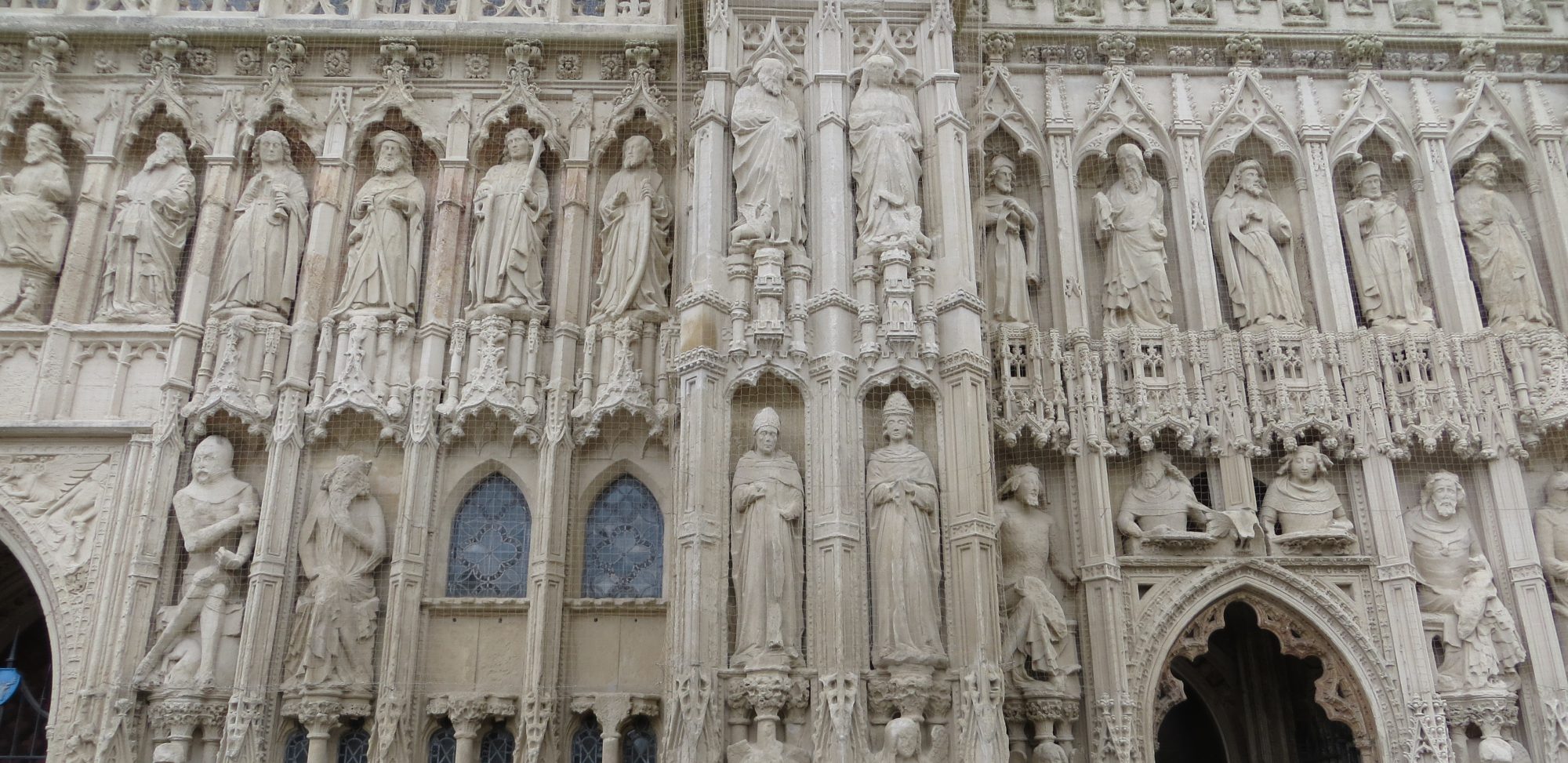
Effective heritage of Christian interpretation

Bray

I was scooting through 1 Corinthians for a group of students last week, and assumed that I knew what I want to say about chapter 15 on the resurrection of the body, but somehow I made rather a mess of it. What I wanted to say was that the resurrection of each Christian and the resurrection of the body of the whole church is one resurrection. I needed to find some patristic commentary on 1 Corinthians, but what New Testament commentary provides that? Since I have remembered Thomas Oden’s Ancient Christian Commentary of Scripture series.

Gerald Bray has edited the volume on 1 & 2 Corinthians Here’s the blurb:

Paul’s letters to the Corinthian church have left a mark on Christian Scripture in a way that could never have been predicted. Here the pastoral issues of a first-century Christian community in what Chrysostom identified as “still the first city in Greece” stand out in bold relief. How was a community shaped by the cross to find its expression in a city that Chrysostom knew to be “full of orators and philosophers” and that “prided itself . . . above all on its great wealth”? How was church unity to be maintained in a setting where prominent believers, bending truth and morality to their own advantage, divided the body of Christ? Here lay the challenge for the apostle Paul. And as the apostle writes, the fathers lean over his shoulder, marveling and commenting on his pastoral wisdom.

Best known among these patristic commentators is Chrysostom, whose seventy-seven homilies on the two Corinthian epistles are a treasury of exposition and application. The fragmentary works of Didymus the Blind and Severian of Gabala give us samples of Greek exegesis from the Alexandrian and Antiochene schools. The partial work of Theodore of Mopsuestia, a commentator of great skill and insight, was long valued in the church. And the comments of Theodoret of Cyrus are notable for their sensitivity to the intertextuality of Scripture. Then there are Origen and Pelagius, whose names resonate with notable error, to the needless obscuring of their brilliant insights into Scripture. But pride of place goes to the unknown fourth-century commentator long mistaken for Ambrose and now dubbed “Ambrosiaster.” His excellent commentary on 1 and 2 Corinthians has been unavailable in English translation, and for that reason it is excerpted more generously in this volume.

This Ancient Christian Commentary on 1-2 Corinthians opens a whole new way of reading these New Testament texts. The pastoral and theological interpretation of the fathers offers spiritual and intellectual sustenance to those who would read Paul again with open minds and hearts. Here we find the Pauline wisdom of the cross generating an effective heritage of Christian interpretation.

Bet you there is not a single copy in any theological library in London. Never mind. The tide is going to turn in this city. I’ll put it on my Amazon wish-list.

A real desire for unity 3

So the most important thing of all is the desire to be one, and to prove that desire, not only by praying â?? because we pray for unity at every single liturgy â?? but prayer without activity, without work, is just blasphemous. To be praying all these things and not to be working, not be ready to make any possible sacrifice you could make that doesnâ??t violate the essence of the faith. In other words, the Orthodox have to desire unity and be ready to sacrifice everything that they can without violating their convictions about the gospel in order to be one, particularly with Roman Catholics.

I believe that the Orthodox, if we were serious about unity, would need not only to desire it, sacrifice for it, forgive everything, admit our own sins, distinguish between what is essential and what is not, but also would have to be ready to practice â??economiumâ?? on certain issues. This would mean, in my opinion, that we would have to be ready not just to admit that there
can be different ways of singing, and different styles of liturgy, and different uses of psalmsâ?¦there are some issues, especially between Orthodox and Catholics, that Orthodox would have to be ready to tolerate for a while (even though they think the issues are bad) for the sake of unity.

What do I have in mind? Things like the â??filioqueâ?? clause in the Creed [the clause in the Nicene Creed that says that the Holy Spirit proceeds, not only from the Father, but also, â??filioqueâ?? â?? from the Son]… If Rome would say it was not there originally, that the way it was explained was not right, we now can agree on certain aspects â?? I think the Orthodox would have to say, â??OK, let them keep itâ?? rather than insist that every last church in Portugal drop the â??filioqueâ?? before we can have unity.

In other words, the Orthodox may have to go along with something for a while, as long as itâ??s clear how we understand it.

Father Thomas Hopko What would the Orthodox have to do to have unity?

The Word of God gives us authority to live – well

The liberal hermeneutic paradigm, fashioned by the controversy over historical biblical criticism, failed precisely because it thought it could count on there being a concrete moral truth immediately and categorically known to all, a peremptory and unchallengeable moral certainty. In this it failed to allow for danger. Action is always exposed to danger: we may turn out to have acted on false assumptions about the facts, to have misunderstood the situation in which we acted, to have formed an inadequate conception of our task, to have failed to envisage the good to be pursued, etc. etc. Nothing can guarantee us against such failures; nothing except perpetual vigilance can protect us from them. In failing to allow for danger, the liberal hermeneutic failed to pose the questions that engage us supremely in our self-disposal: questions of intelligibility and purpose in the life we live, questions of our responsibility for ourselves. Always pressing forward in pursuit of some speculative truth, it dared to take the answers to all these questions as read; in doing so, it by-passed deliberative reason and short-circuited the role of the intellect in the living of life.

The Word of God… operates to elicit moral decision from us about the kind of life we are to live in faithfulness to its judgment. Its role is to authorise us to live well, not to take authority away from us. So any judgment we make on the authority of that text is, at the same time, a judgment on ourselves, a moment of self-transcendence that it has brought us to achieve.

If only we understood what freedom really meant, and how difficult freedom is to accomplish, we would surely ask that text to give us rivers of living water!

Oliver O’Donovan Scripture and Obedience

Knight re-appears

Knight ascends mountain

First the DK blog slowed to a crawl. Then it disappeared entirely.

The beginning of term always means a pile of work. I am teaching a couple of courses on Scripture, which means becoming rapidly re-acquainted with the bible. At the same time various friends arrived with dissertations. It is a joy to read a good piece of systematic theology, and in recent months I have read parts and wholes of some cracking PhD theses on Pannenberg, Barth, Jüngel, Gunton and Jenson, and on the doctrines of creation and mediation. All vital for my education, but I have fallen behind, particularly with correspondence. But:

Congratulations Dr Marion Gray – ‘Time and Eternity in the Theology of Robert Jenson and Wolfhart Pannenberg’
London PhD 2006

Then the DK blog disappeared entirely for some days. I admit I felt as much relief as grief. But after a night-long struggle it was restored by valiant webmaster James Knight. JK is the real power behind this blog and I am always very grateful to him.

All this means that I am behind on the series I promised you. So coming up on the DK blog:

‘Catholicity’ (four posts still to come)

‘Our Giant – Oliver O’Donovan’

‘Theology in London’

‘Evangelical’

and something on atonement and penal substitution.

Catholicity 8

The Church is whole when all parts of the church are in communion with all others. For this reason each church must insist on the centrality of ecumenism and be disciplined by it. Notionally, all the leaders of the church meet together in councils in which the whole church is present. This council or assembly is a function of the mercy of God to his Church and by which the Church is renewed and sustained.

Ecumenism is not an extra, but an evangelical imperative. ‘The divided Churches are called to receive from one another or indeed to receive one another.’ This does not mean simply agreement on doctrine, but mutual ecclesial recognition, ‘the reception of one Church by another Church’ – in the eucharist. ‘The Church, although one, exists as churches (in the plural), and these churches exist as One Church in and through constantly receiving one another as sister Churches.’ (Zizioulas ‘The Theological Problem of Reception’)

Conciliarity is the practice of communion, that is, of sending apostles to, and receiving apostles from, all other parts of the church. Receiving Christ from these apostles and being obedient to Christ in them, is simply what Christian love is. The Church is love. The whole church’s sending, receiving, meeting, learning and teaching, disciplining and obeying, is the event of love. It is the life Christ lives to the Father. Indeed all society is an event of love, and a participation in the society of God, and no amount of corruption changes the truth of the origin of human sociality. Any particular society becomes, and remains, a society as it is formed in and disciplined by Christ, who is in one society with the Father.

But there is no worldwide council of the church. There is the weekly, or daily, celebration the eucharist, which both looks forward to the assembly of Christ with his whole people, and already is this assembly in miniature. And there are the many interim ecumenical meetings and forums of the church. All of them are partial, but if they are gatherings of the church, they give their witness by pointing forwards to the perfect eucharist of the whole church. In the eucharist we receive the whole Church, Christ and his whole people. We shall return to this theme in the next post.

Thomas Aquinas on a better concept of freedom 2

We are made for excellence. Developed through the four cardinal virtues prudence (practical wisdom), justice, courage, and temperance (perhaps better styled today, â??self-commandâ??) freedom is the method by which we become the kind of people our noblest instincts incline us to be: the kind of people who can, among other possibilities, build free and virtuous societies in which the rights of all are acknowledged, respected, and protected in law. Law is thus intertwined with freedom. Law can educate us in freedom. Law is not a work of heteronomous (external) imposition but a work of wisdom, and good law facilitates our achievement of the human goods that we instinctively seek because of who we are and what we are meant to be as human beings.
Virtue and the virtues are crucial elements of freedom rightly understood, and the journey of a life lived in freedom is a journey of growth in virtue, growth in the ability to choose wisely and well the things that truly make for our happiness and for the common good. Itâ??s a bit like learning to play a musical instrument. Anyone can bang away on a piano; but that is to make noise, not music, and itâ??s a barbaric, not humanistic, expression of freedom. At first, learning to play the piano is a matter of some drudgery as we master exercises that seem like a constraint, a burden. But as our mastery grows, we discover a new, richer dimension of freedom: we can play the music we like, we can even create new music on our own. Freedom, in other words, is a matter of gradually acquiring the capacity to choose the good and to do what we choose with perfection.

George Weigel A better concept of freedom

With the aid of the Holy Spirit we must judge for ourselves

The Scripture tells us not to bear false witness against our neighbour. Whether this particular ambiguous statement we have it in mind to make will be false, or merely discreet, is something that the Scripture will not tell us; we must judge that for ourselves with the aid of the Holy Spirit. Yet everything the Scripture does tell us about truth and falsehood will contribute to making that judgment possible. The authority of Scripture is proved, then, precisely as it does, in fact, shed light on the decisions we are faced with, forcing us to re-evaluate our situation and correct our assumptions about what we are going to do….

The most mysterious question anyone has to face is not, what does Scripture mean?, but, what does the situation I am facing mean? If we have even begun to appreciate the nature of this question, and how a false judgment of ourselves can lead us to destruction, we shall be on our guard against any hermeneutic proposal to reverse the sequence of discernments, starting with our own situation and turning back to Scripture to look for something there to fit it. That presupposes that we already know the answer to the one question we dare not presuppose an answer to. Nevertheless, such proposals are common enough in theological discussion, sometimes with a liberal, sometimes with a conservative slant. It hardly matters which, since the two come closest to each other precisely at the point where they are both furthest from the truth. If the conservative thinks that all the Scriptural witness to moral behaviour can and must be honoured somehow, and the liberal that only some of it, or only most of it, must be honoured, what difference does that make if each thinks that conclusion has been reached from some self-evident intuition about what the times require, so that the appeal to the Scripture merely confirms what has already been decided? This is not to take Scripture seriously as an authority. And it is not to take living in the present seriously as a risky business….

Oliver O’Donovan Scripture and Obedience

A real desire for unity 2

When people ask me, for example, why the Orthodox jurisdictions in America are not united, the answer is very clear: because our leaders donâ??t want it. If they wanted it, we would have had it yesterday. There is nothing stopping themâ?¦ you may have to suffer a lot. You may have to give up some things: power, pre-eminence, prominence, property, possessions, prestige, positions, privilege and pleasure. Weâ??re not ready to give up those things because of pride, passion and prejudice. Forget it. Thereâ??s not going to be any unity. Thatâ??s what divides people generally, and it is certainly what divides churches.
Now here I would allow myself one little â??not my businessâ?? remark: I have a hunch those same things are operating in the Eastern Catholic Churches, tooâ?¦

We will never be one unless we desire it with all our hearts, and are ready to put away everything that we can to have itâ?¦. Everything that doesnâ??t belong to the essence of the faith. Language doesnâ??t belong to the essence of the faith. Calendars donâ??t belong to the essence of the faith. Certain liturgical customs donâ??t belong to the essence of the faith. Even the Byzantine Rite Liturgy for us does not belong to the essence of the faith.

There was a whole thousand years when the Church had multiple rites of praise to God. In fact, the irony is, the time when there were the most multiple rituals for the sacraments and the services was the time there was the greatest unity in doctrine and spiritual life, evangelism, etc. In any case, the ritual is not of the essence of the faith. Language isnâ??t, calendars are notâ?¦ all those things are not part of the essence of the faith. But unless we have the desire for unity, which then would lead us to feel that we have an absolute obligation from God to distinguish between what is really essential and what is not, we are never going to be united.

Father Thomas Hopko What would the Orthodox have to do to have unity?

Catholicity 7

The bishop represents the whole history of the Church, all its apostles and doctors, to his congregation. He is the catholicity of the Church, in one person. In him the worldwide church makes itself present to each local congregation. A bishop is a member of the assembly of the whole church, drawn from every corner of the world. If the bishop is present, the whole Church is present in each particular congregation, so that the whole geographic and historic catholicity of the Church is present in that particular part of the world. This Church on earth is the form in which Christ together with all his people is presently visible to the world.

Bishops are apostles. The point about apostles is that there is a plurality of them. Twelve indicates completeness, so there is one apostle for every part of the world (The same is true of the seventy apostles, for there are notionally seventy nations in the world). When one apostle falls, his place is filled by another. Apostolic succession does not run individual to individual, so the power of consecration does not run bishop to bishop in unbroken quasi-physical transmission, no single gap in all those centuries. It is ‘possessed’ by the assembly and council of apostles and bishops as a whole, represented in the council of the whole church as this participates in the whole Christ. Thus the worldwide council of the church is a foretaste of the ultimate assembly of all creatures in worship of God.

The bishop teaches his people the doctrine of the whole Church, and when the Church refuses any part of these gifts and disciplines, and sets out to found its faith on something less than the full deposit of faith, the bishop will exercise the discipline that will bring it back to obedience, and he will endure the suffering that this will involve.

Postbag

EE

Dear Dr Knight

I am on my second reading of â??EEâ??. As a Lutheran layman I am a reader of First Things and Touchstone. My pastor and good friend has just left our Lutheran church and communion for the Church of Rome. About the time he announced his decision to leave, I ordered â??EEâ?? on a whim and a few reviews. I have found it to be an excellent work in addressing the problems of church division and modernity. I have been quite frustrated with the very questions you address: Creation, Israel, the work of the Holy Spirit, and how I raise my children in the midst of screaming cultural conversations. Thus my second reading. I am captivated by the bookâ??s premise of a Trinitarian theology in which God is bringing his people to a fullness and freedom through his dynamic work: Father, Son and Holy Spirit. I have often struggled in this highly individualized culture with how to participate in the life of God as Body of Christ and how the time afforded me fits with that of the fullness of that Body in its history. Thank you for your diligent work. It has helped to clarify much of what was bothering me so much. I shall probably have a number of questions â?? one of which I will ask you now. Do you have an outline of â??EEâ?? that would enable me to teach an adult class in my church? I really believe that Christians of all educational levels (and economic levels) are struggling with the questions your book so helpfully addresses. I intend on developing such a series of classes that relies on scriptural readings, parables, and questions pertinent to the development of an eschatology that informs faith and inspires Christian formation. Can you help me with this?
Sincerely your in Christ,
CG

* * * *

Dear Christopher
Many thanks for your wonderful mail.

Yes I do have an outline of The Eschatological Economy, though it needs more work. I have written a series of posts on EE for the blog and to post on Amazon. I will send you what I have, though I don’t know if it will help your class.

As for scriptural material for classes on eschatology that informs faith and Christian formation, I am working on that too. I have been putting together some chapters on Christian formation which I hope will be of some use to the church. I am going to call it The Apprenticeship, and it will cover much of the same ground as The Eschatological Economy, but more accessibly.

Everything that Christians say about time, history and the purpose of the world, which is that we come to share life with God, can be lumped together as eschatology. It is a catch-all for all the issues around our looking forward in hope and faith to his coming again in great glory. This means that we have to say that the world has a plot, but it doesn’t really know what it is, so there are two rival accounts of the plot â?? the worldâ??s and the Lordâ??s. There is a double history: secular history and salvation history. It is the Christian privilege to point out the difference between them. That is the line I would take with a class.

But there are many other and better people working in these areas, I commend their works to you. I have started to compile lists of books on my Amazon homepage, but it is a long job and James Merrick (there is a link from my blog) for example does it better than I do. You can find out what my suggestions are by looking through those lists. It would be a lot quicker than waiting for me to produce new material.

I don’t think there is any need to leave the mainline denominations, Lutheran, Presbyterian, Episcopalian, nor to feel abandoned when someone near, dear or senior does. There are many reasons why individuals might leave this or that congregation, but whether we leave or stay, the Christian life is always going to hurt, but we should always be glad of it.

We English used to think that we were in possession of the gospel: then we decided that we had seen through the gospel. Now we really don’t know what the gospel is, but are still too proud to say that it matters to us. So churches don’t run classes in England, and almost no one asks for classes. Where classes are run, by charismatic churches for example, they tend not to make connections between discipleship and intellect, and don’t see the intellectual side work as real work. The Christian here is a student without a teacher (or teacher without a class) – a sparrow on the rooftop. Thanks. If you want more, please ask me again.

Douglas

You can find out more about The Eschatological Economy at Amazon.com or at Amazon.co.uk or at Eerdmans