The Christian life is life together

Jesus Christ is the universal man, the summit and definition of what human being is. He is the properly catholic being. Life with him means communion with all mankind. He is now forming us into catholic beings, people who are defined, by participation in him, by fellowship with every other human being. The Christian life – the apprenticeship we serve – opens us out from our present incurved state to bring us into relationship with every other living thing. This means that the Christian life and faith is intrinsically about catholicity, thus ecumenism, the reconciliation of every household and community with every other, is what the gospel is. In the apprenticeship of this Christian life we learn to reach out to the whole of the rest of the Church, indeed to the future completition of the Church, when Christ shall be all in all.

You are only a catholic as you strain towards reconciliation with all other churches, and treat them not only as wayward and sometimes willfully disobedient, who you must mourn and pray for, and mention in your intercessions that precede every eucharist. But you must also treat them as those who have some part of the gospel, and some ‘portion’ of Christ and so as those you must learn from and submit to. Being catholic certainly means being under the authority and Magisterium of the Roman Church, treating its teaching with respect and being formed by it. But you must also be under the authority of every other part of the church (no matter how abusive that authority sometimes is), and everywhere look for Christ and ask to be renewed and reformed by him.

I am not a Roman Catholic, but an Anglican, a Reformed Anglican (‘catholic evangelical’ for convenience). The term ‘reformed’ can only refer to the catholic church and so to the determination together that the Church must repent and be disciplined, reformed and renewed by Christ its head. But I think it is right always to wonder whether I should be more ‘Roman’, whether I should convert to ‘Roman Catholic’. Of course this is not a comfortable place to be. Of course this means many contradictions. You may change my mind on this. Of course.

Why I wrote 'The Eschatological Economy' 1 – Sacrifice

Here is the first of a series of posts on why I wrote The Eschatological Economy. I will start with atonement, move on to the doctrine of election and the people of God, and to the issue of time. Later on I will talk a bit about practices, bodies and the distinctive Christian life and then talk a bit about modernity and the non-Christian way of life. Since these are all interrelated there will be some repetition, but I hope you will not mind that.

The Eschatological Economy

The Eschatological Economy started because I wanted to know why the concept of sacrifice had become so alien to us, and whether sacrifice really is as wrong or incomprehensible as many believed. My own professor, Colin Gunton, had restated the place of sacrifice in theology of the atonement. In ‘The Actuality of Atonement’ he argued that some very traditional and unfashionable atonement models, such as the Christus Victor model, the concept of sacrifice, and Anselm’s account, still made good sense. But Colin Gunton was able to make only limited sense of sacrifice. He used to quote Hebrews ‘the blood of bulls does not take away sin’ at me and insisted that we moderns no longer practice sacrifice. I tied to convince him that we moderns sacrifice too. We don’t sacrifice sheep in the public square, but we do rear and butcher animals, and the way we surround this process with (industrial, commercial) ritual and keep it is as far out of the public eye as possible is equally strange and even (in a non-Christian sense) religious. It is not crazy to say we sacrifice people, or that other people are involuntarily sacrificed – expended – for us. The economic levers and gears that provide us with our standard of living may be doing so by grinding the faces of the poor, and if we deny that this could be the case, that our comfort is at the cost of their sacrifice, we may be living in denial. So I think we are mistaken if we think that sacrifice and ritual took place in the ancient world but don’t any longer – because this makes much ancient Christian teaching – most of Hebrews, for instance – difficult to understand.

See The Eschatological Economy at Amazon.com or at Amazon.co.uk or at Eerdmans

Theology redefines religion

Modernity identifies religion as separate from ethics, the discussion of ends. It supposes that we all know what end has been agreed upon, and have now only to concern ourselves with how to get there, and so with comparing one means with another. The modern concept of religion belongs to this idea that there is one single end and all talk is only about how, not about what. Theology should refuse this definition and identify religion as talk about ends, assume open discourse about what the ends are, and insist that there is no meta-discourse that can settle this for us. Then we can say that religion is a matter of the good performance of talk about ends. It is not to be reduced to reaching agreement so that talk can stop, but it aims at getting better at the give-and-take of converse, so the talk can grow, become a good of its own and open space for other goods to emerge. Our talk is then both preparation for, and already good performance of, life in common.

Theological institutions and excellence

The International Theological Institute for Studies on Marriage and the Family has three aims, four pillars and seven principles. It is not only their numerical neatness that I approve of.

Here are the three aims:

1. To provide studies in Theology as well as specialized theological studies on marriage and the family;
2. To form by such studies those who are preparing themselves for tasks in the various areas of the Churchâ??s life, especially in the area of marriage and the family;
3. To organize seminars, symposia and conferences as an aid to the local Churches and to the Holy See in promoting an authentic vision of marriage and family life.

The four pillars

1. The first pillar is the founding intention of Pope John Paul II. ITI was founded for the study of Catholic theology as a unified whole within which particular attention is devoted to the theme of marriage and the family. A solid theological formation is needed for Catholic leaders, lay and clergy, to achieve critical judgment in our culture and the capacity to contribute to the new evangelization, which is especially needed in the area of marriage and the family.

2. The second pillar of ITI, also part of John Paul IIâ??s founding vision, is its international character, its bridge function between East and West. About 50% of the students come from Central and Eastern Europe (the majority of them are Greek Catholic), others come from Western Europe and the Americas. This international character allows a genuine experience of the universal Church, which must â??breathe with both lungsâ?? (John Paul II) East and West.

3. The third pillar of ITI is its pedagogy, which consists in studying the original writings of the great Masters of Theology, in addition to Sacred Scripture, esp. the Fathers and the Doctors of the Church. Contact with original texts develops an eye for quality, especially in theology. The great masters lead faculty and students most directly to the realities discussed in theology, above all God himself. This pedagogy also develops the virtues of active reading, attentive discussion and penetrating understanding.

4. The fourth pillar of ITI is a rich Catholic community that lives and prays together in the same place and its close vicinity. The example of the Christian family life lived by many among the faculty and students offers the most persuasive and practically helpful evidence of the beauty and practicability of that life. It also encourages the formation of religious and priestly vocations and their blossoming.

But the Seven Principles are the knock-out.

The Word of God as Center
As the inspired Word of God, Scripture, as the Church receives it, stands at the center of the curriculum. All other courses are ordered to unfolding its meaning.

Ad Fontes, East and West
The Curriculum has its point of departure in the primary sources written by the great masters of the theological tradition, from the Fathers of the Church to the present age. It draws on the theological tradition of the East as well as of the West, seeking in this way to â??breathe with both lungs of the Church.â?? The Greek Fathers and St. Thomas Aquinas are particularly important points of reference.

Pedagogy
Teachers and students actively collaborate in pursuing the understanding of the Churchâ??s faith through the reading and guided discussion of the masters. Care is taken that students truly prepare the texts and that sufficient room is given to student participation to develop the virtues of active and responsible reading and thinking.

Theology in its Unity
Foregoing premature specialization, the Curriculum seeks to unfold theology out of its inner unity, in conformity with its essence as a scientific reflection of the faith of the Church. The Curriculum is ordered around the central mysteries of the faith: the Trinity, the Incarnation, grace, justification, the Church, etc. All particular questions are addressed in the light of these central mysteries.

Theological Rationale
The rationale of studies at ITI is theological throughout. Both the sequence of semesters and the composition of courses in each semester are shaped in accord with the above mentioned unity to allow for a systematic building up of the parts of theology. When questions usually classified with other fields (philosophy, psychology, sociology) are discussed, they are discussed for the sake of theology and in an order required by theology.

Primacy of the Theological Question
Historical-critical investigations are a necessary aspect of the study of sources. Such investigations, however, find their inner completion only in the properly theological question, “What is the truth of the matter?â??

Above All, Charity
Theology stands under the rule of the new commandment and exists for the sake of union with the One whose love for us we come more deeply to understand. It is therefore studied and taught at the heart of his Church.

I will be plagiarizing these principles in their entirety from now on.
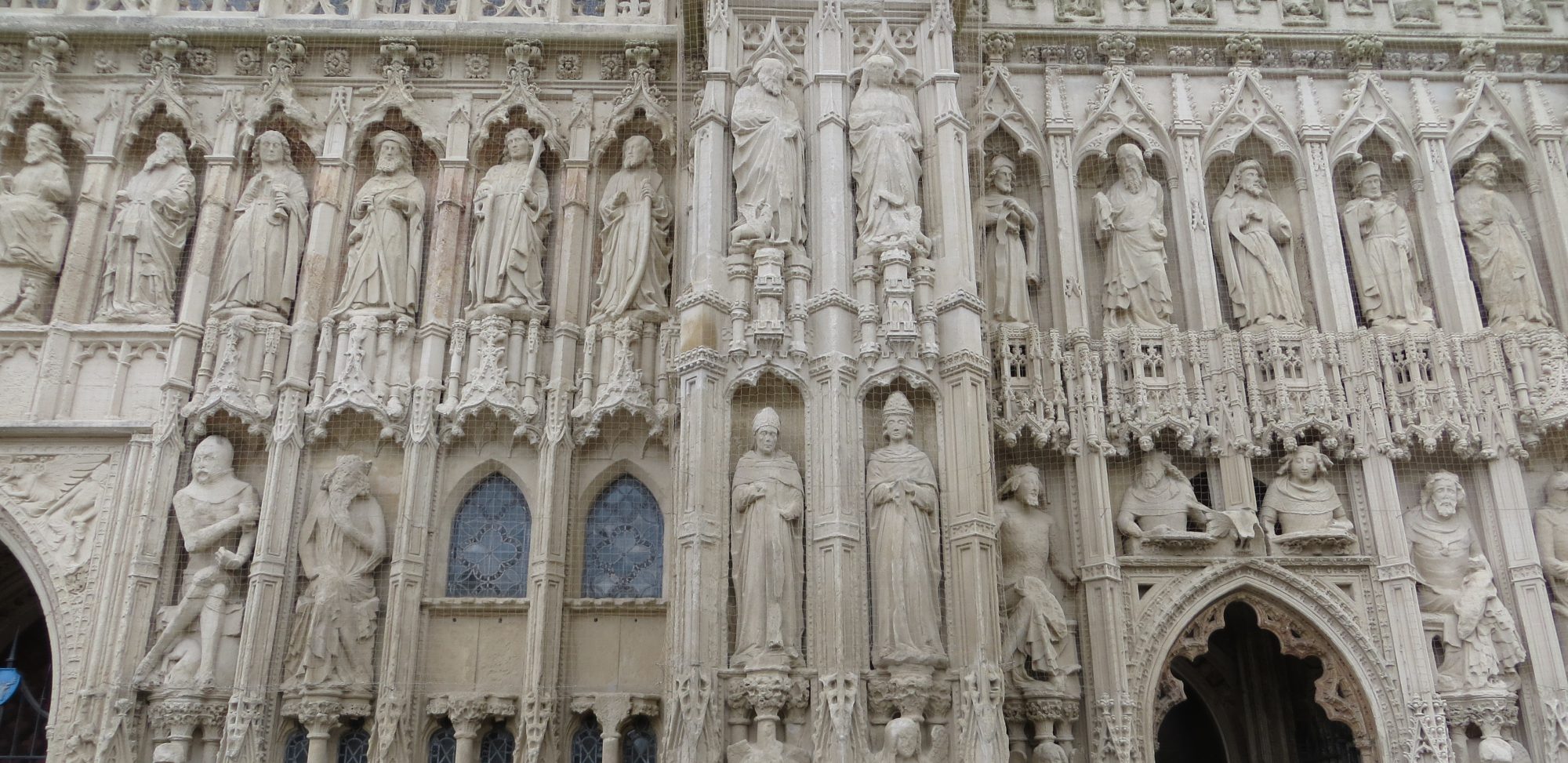
Anglicans, authority and charity

Theological commissions within provinces need to be made more conscious of, and conversant with, Communion-wide dimensions of theological discourse. In particular, we need to develop the habit, and thence the virtue, of that charity which listens intensely and with good will to widely different expressions of sincerely held Christian theology, at the levels both of method and of content. As a Communion, we need a common forum for debate, a common table to which we can bring our questions for a proper family discussion.

It is because we have not always fully articulated how authority works within Anglicanism, and because recent decisions have not taken into account, and/or worked through and explained, such authority as we all in theory acknowledge, that we have reached the point where urgent fresh thought and action have become necessary.

The Windsor Report paragraph 41

The Church is a participation in divine being

Here is another excerpt from ‘The Critics of ‘Being as Communion”, Alan Brown chapter’s in Personhod and the Church: The Theology of John Zizoulas, due to appear at the end of this year:

“Baptism is a new birth in which the human being is newly hypostasised in the mode of being of Jesus Christ. This ontological re-constitution and in-corporation is not, however, a re-constitution and in-corporation into a separated and individualized hypostasis, but rather one into the hypostasis of the one who is the only-begotten of the Father, existing in and only in an absolute perichoretic reciprocity with the Father and the Holy Spirit. As such, the communion of the Church is a participation (an already eschatological participation) in the mode of divine being itself, the mode of catholic, koinonetic love. Consequently, for Zizioulas, it is not possible to ‘project’ the mode of being of the Church onto the divine being, since the mode of being of the Church already is the mode of being of divine being;

For Zizioulas, there are not ‘two communions’, one divine and one human – rather there is one divine communion, in which humans participate, this participation being the ecclesial mode of being that is the Church.”

The long way to Anglican unity

The most articulate discussion of the struggle for discipleship in the Anglican Communion has been going on over at Titusonenine. Here are excerpts from comments by Ephraim Radner and IRNS –

“Windsor itself is not just about practical actions, taken within some vacuum of public affirmation and meaning. There is an entire theology about the church, however broad, that upholds its recommendations, and this theology includes the character of teaching, witnessed life, and the place of Scripture as informing and even directing thisâ?¦ there is every reason to believe that â??bare actionsâ?? are and will be considered inadequate if they are not tied to clear and clearly-interpreted commitments. The matter of trust for the Communionâ??s future life is at stake in this.

No one can underestimate the destructive degree to which ECUSA has thrown a poisoned apple into the everyoneâ??s midst. There is every sign that Rowan Williams knows this, and may well realize that the poison has already been ingested by everyone. There is little cause for optimism here, and every cause for pleading with the Almighty.”
Ephraim Radner

“In my own diocese, a reappraiser and I asked the bishop the same question on the same day and received answers to suit our own particular reappraiser/reasserter positionsâ??in other words opposite responses from the same mouth. That is not leadership and is precisely why we are in the mess we are in.”
SD

“By remaining neutral as regards Lambeth 1.10, TWR [The Windsor Report] implicitly OKâ??d the idea that one could remain neutral, or even opposed.
There is no question that Lambeth 1.10 is the present teaching of the Anglican Communionâ??thank God!â??but there is equally no question that TWR leaves the question of changing that teaching open. Until it is clear that changing that teaching is NOT openâ??that some doctrines are not open to â??developmentâ?? or â??evolutionâ?? from one species of doctrine to anotherâ??then we will remain in a never-ending doctrinal guerilla war, a war that TWR has failed to mediate.
Broadly speaking, TWR addresses two interrelated questions, â??developmentâ?? and authority in matters of doctrine within the Anglican Communion (or â??receptionâ??). I believe that it solves neither of them, and in fact at best confuses the issues. The main reason why parties can continue to either disagree or even simply talk past each other while claiming to adhere to the Windsor Report is not because one side or the other is disingenuous (although there is certainly plenty of that to go around), but because the Windsor Report failed so spectacularly.”
Iâ??d Rather Not Say

Read some more of this discussion at Titusonenine. For a longer statement on the decisions the Anglican Communion has to take, read Ephraim Radner’s If there is a future for ECUSA and the Anglican Communion…

Oswald Bayer

Oswald Bayer

Oswald Bayer’s Living by Faith: Justification and Sanctification is very short, 88 pages, but nonetheless quite remarkable. You can see the contents page here.

Oswald Bayer, until recently professor of theology at Tübingen, is as big as Eberhard Jüngel, and his interests are much broader than justification, and much bigger than Miroslav Volf, though in the same area of Church and discipleship. This is magisterial philosophically- and hermenutically-literate theology. You can get some idea of the scale of his thought from his titles – Gott als Auctor (God as Author), Schöpfung als Anrede (Creation as Address), Freiheit als Antwort (Freedom as Answer), Leibliches Wort (Embodied Word: Reformation and Modernity in Conflict). ‘Embodied Word’ – with the sophisticated ontology of Luther’s theology of the Word of God who speaks all things into existence. Bayer’s hermeneutics are theological to a degree not yet reached by the discussion in the UK and States.

It is a scandal that this book is the only piece of the work of this colossal theologian published in English, other than the (not very well translated) articles in Lutheran Quarterly. Read Bayer’s piece on Luther in Blackwell’s The Reformation Theologians (ed. Carter Lindberg) and you will be lifted by its sheer evangelical force and intelligence, its very brevity telling you more about the Reformation as evangelical movement – and merciful act of God – than all the rest of the book.

There are other other scandalously untranslated Germans, chiefly Ingolf Dalferth (Gedeutete Gegenwart: Zur Wahrnehmung Gottes in den Erfahrungen der Zeit – ‘Meaningful Present: The perception of God in the experience of time’) but I’ll tell you about them another day, and anyway, none are as important as Bayer.

Remind the Anglicans who they are

The Inter-Anglican Theological and Doctrinal Commission asks for your comments on the following issues:

1. Anglicanism has always given a high place to the reading of Scripture as the ground of its worship and teaching. How is it possible for Anglicans in different parts of the world to listen to the Bible together?

2. The Inter-Anglican Theological and Doctrinal Commission (ATDC) and the Windsor Report are both emphasising the notion of ‘covenant’ as a basis and expression of communion. If a covenant is more than a constitution, what implications does this have for decision-making by churches that are in a covenantal relationship with each other?

3. How do you think the genuine and meaningful expressions of communion that your church experiences with Anglican Christians in other parts of the world will be able to survive current disagreements in the Anglican Communion?

4. What sort of language (theological and otherwise) is appropriate for speaking about Christian people with whom you disagree?

We also welcome contributions from individuals, and especially lay people, so we will be pleased if you feel able to spread the contents of this letter as widely as possible.

Inter-Anglican Theological and Doctrinal Commission

These are very reasonable questions. Wouldn’t any list of Christian characteristics, such as ‘godliness, faith, love, endurance, gentleness…’ (1 Timothy 6.11) be the way to reply? The Anglicans are God-marked people, distinuished by all the spiritual gifts that make up Christian discipleship.

O'Donovan on judgment

The defining role of secular government is to exercise judgment. The court is the central paradigm of government – all government, in all its branches. In Ancient Israel, the simplest model, such as we find in the narratives of David and Solomon and in the Psalms, is that the monarch is a judge who sits in court. “Morning by morning I will destroy all the wicked in the land,” he declares according to the psalm, in what is probably a kind of oath of office; thus, daily assizes are the proof of a just king. Ancient Israel also knew, however, that the task of judgment required not only that the monarch sit in court but that he also found courts.
To provide a court in which a judge sits is no less an act of judgment than to sit in court himself. He considers the situation obtaining, in which those who are wronged lack access to public interest and vindication; he finds it wanting; he redresses it by inaugurating courts. He does not found the judiciary from outside, as it were, like a businessman founding a University chair without himself being a man of learning. The founding of the judiciary is precisely the founding judicial act. It gives judgment in favor of the oppressed.

Oliver O’Donovan Government as Judgment